My Mom passed away last October at the age of 97 during a difficult period of the pandemic. A dear friend gifted me a miniature rose plant that is a beautiful coral pink. My parents were from Ireland and they always grew roses in their garden. I adore the flowers but have never been a huge fan because of the many common diseases they get such as powdery mildew, rust and block spot. Also, it seems that every time I am near a bush, the thorns love to grab me and wreak havoc on my skin!
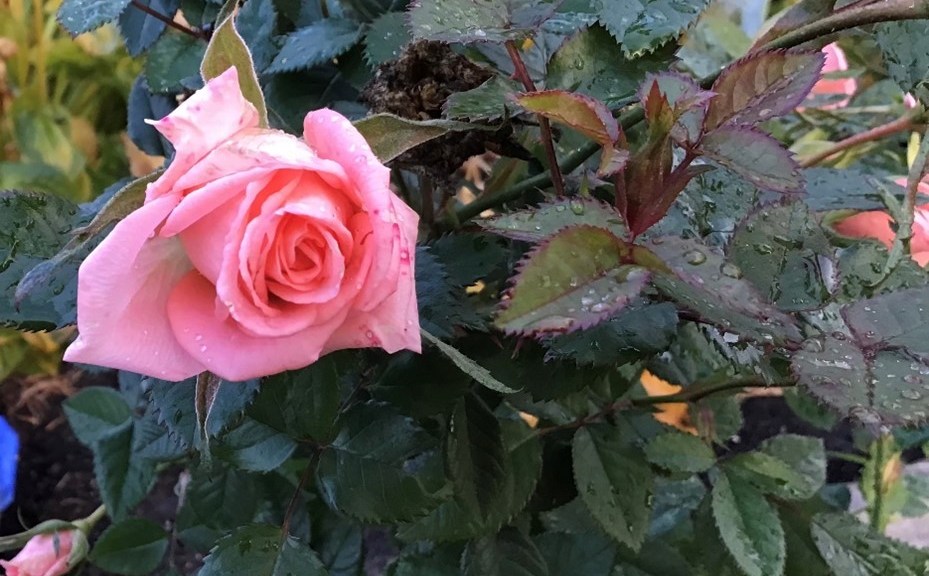
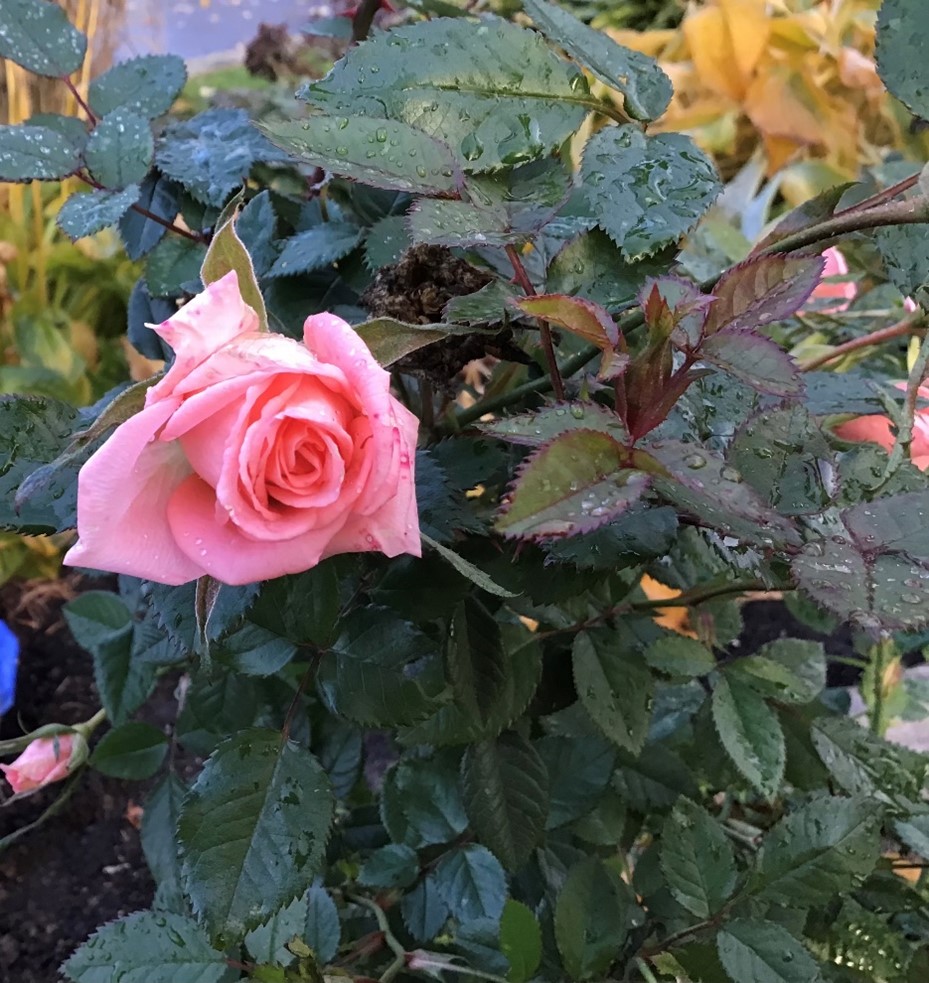
Close-up of the Coral Pink Rose! November 2021 in Author’s Garden
However, this rose was special and I managed to keep it alive during the winter months and after all signs of frost, I planted it in my front garden, tucked amongst other annuals such as the Impatiens walleriana ‘Variegata’, common name Variegated Impatiens. This plant belonged to Norma Evans, a well-known founding member of the Peterborough Master Gardeners as well as a member of both the Peterborough and Omemee Horticultural Societies. She passed away in 2017 at the age of 90. Through cuttings, this gorgeous plant that is a perennial in warmer climates, has been passed amongst many friends and family.
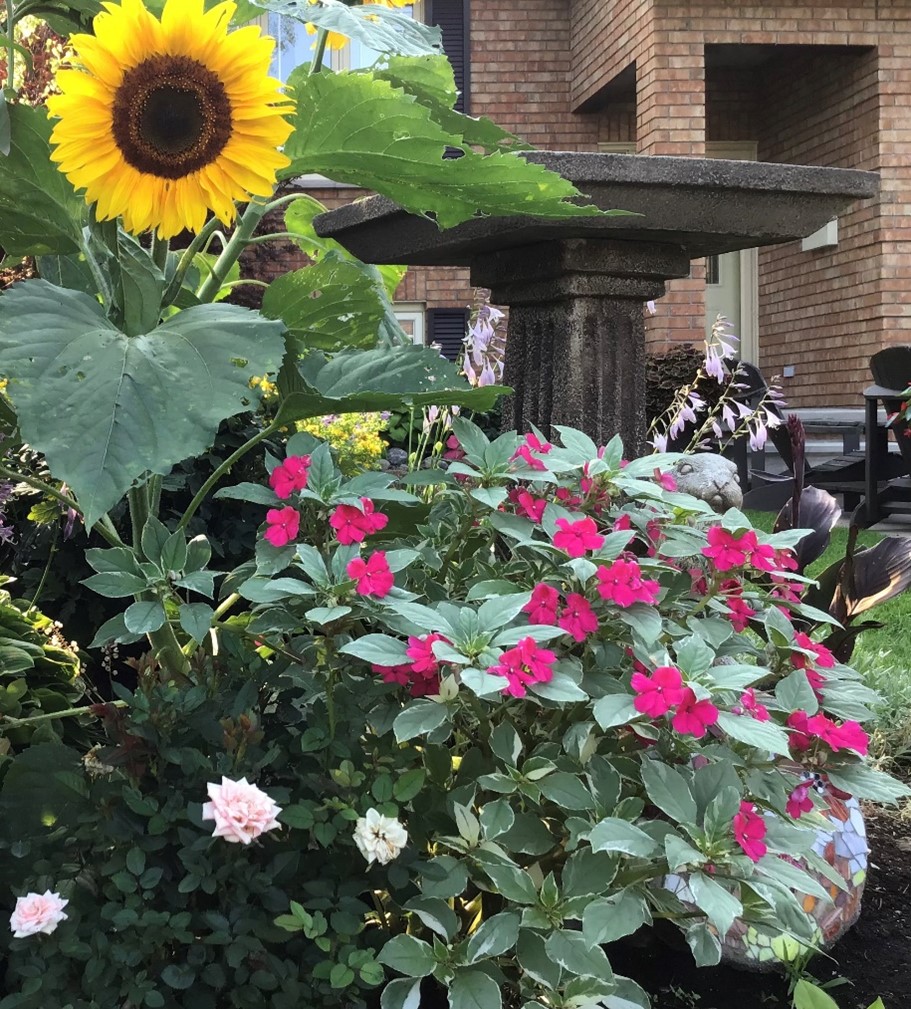
Rose beside the Impatiens, October 2021, Author’s Garden
I was gob smacked by how well that little rose and that one small cutting of the variegated impatiens performed in my garden this summer. The rose was blooming well into November. The impatiens succumbed to the frost on November 4th, however, it was as large as a small bush. It also had lovely deep pink flowers all summer long.
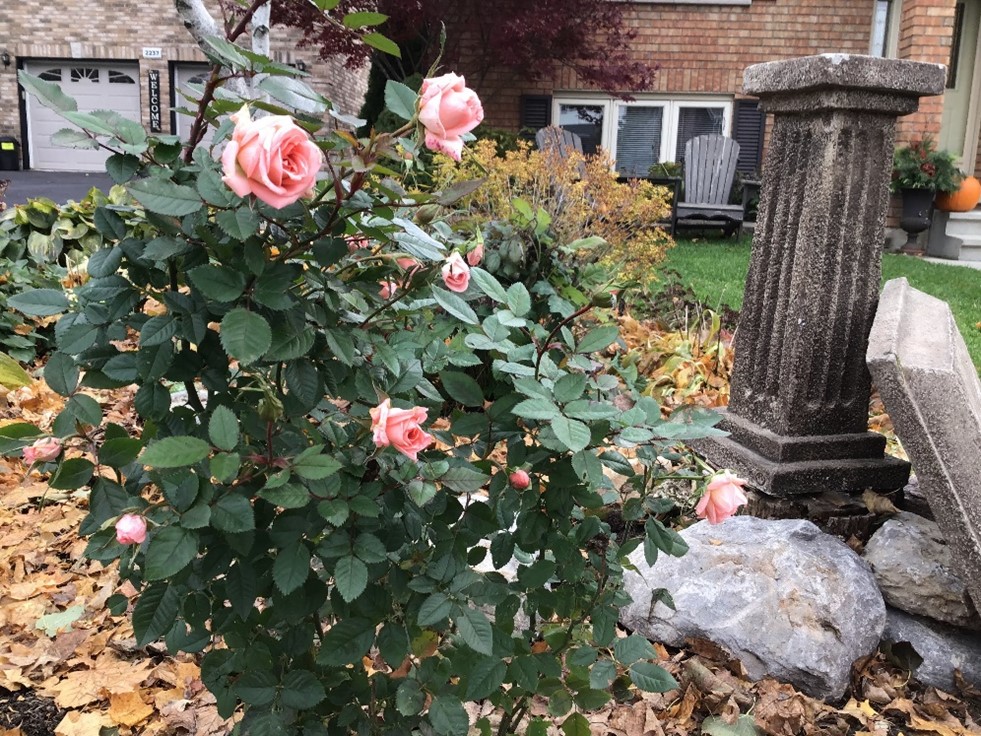
The Rose continues to bloom! Author’s Garden, November 2021
I have two cuttings of the impatiens growing in my kitchen window so that this plant can continue to be grown year after year. As for the rose, I have heaped it with lots of leaves and soil in the hopes that it survives our Peterborough winter.
My Mom and Norma would be smiling and I believe they both have had an invisible hand in the success of these plants. I know they have brought me peace and happiness. Memories are what we hold on to, and what better way to honour a person’s life than through the growth of a plant!
Happy holidays! I hope you have all been able to safely celebrate Christmas with a few loved ones. Wishing you all the best in 2022.
Common European holly (Ilex aquifolium) has a long history of use as a Christmas symbol. It appears on Christmas cards, in holiday arrangements, in Christmas carols, and my personal favourite: in stained glass ornaments. This shiny, spikey evergreen plant is easy to use for decorating, plus it has a long history of cultural significance.
Holly is a shrub-like tree that can grow up to 10-15 feet in height. Its leaves are thick and leathery, with serrated edges and spiky points. The female versions of the tree produce the red berries we’re so used to seeing everywhere at Christmastime. It is sold as a perennial in our region, but very few of the over 400 species are actually hardy in zone 5 (Peterborough). One such variety is American holly (Ilex opaca). The plant requires four or more hours of direct, unfiltered sunshine per day, and requires acidic, rich, and well-drained soil.
For centuries this magical shrub-tree has been been used in winter solstice decorating in central and northern Europe, specifically among the Celts who wore crowns of holly for good luck. They would hang holly sprigs from their windows and doorways to keep evil spirits away. Holly gradually became a symbol of hospitality and welcome.
In pre-Victorian times Christmas trees were not pines, but holly bushes. Christian culture adopted the holly – along with ivy – in Christmas celebrations; holly symbolized Christ’s crown of thorns; the crimson berries represented His blood and the evergreen a metaphor for life after death.
Holly is a real showstopper in winter when little else is green. The same features that make it so attractive today are what made holly a mythical plant to ancient cultures.
Holly’s red berries, toxic to humans and most household pets, are only produced on female plants. Hollies are dioecious, which means male and female flowers occur on separate plants (female flowers must be pollinated by male flowers to produce berries). So if you would like to see those bright red holly berries in winter, you’ll have to plant one male for every 5-10 female plants. The berries are a food source for some of our native birds in the winter.
While most of us no longer believe in the magic of plants, holly is indeed a beautiful adornment for our winter homes (“deck the halls with boughs of holly”), and has a long history of significance throughout the world.
From the Peterborough Master Gardeners to each of our amazing subscribers, we’d like to wish you all a blessed Christmas & holiday season!
Agastache foeniculum, also known as Anise hyssop, is an herb belonging to the mint family. It was originally purchased by me as a garden thriller. It has since become a workhorse for my garden. The mother plant of the ones I now have was planted in my garden in Havelock – the “Blue Fortune” cultivar.
The seeds of the ones I have now arrived in my new garden in Norwood in the compost I brought from my old place. This delightful aromatic native plant is tolerant of a wide range of soils, drought tolerant once established, deer resistant and will do well in sun to part shade.
Although it self seeds very readily, it is easily pulled when small. The plant will grow 2-3” tall with a branching habit. The flowers are produced on the tips of the branches starting in early July. Some are still flowering in mid September. As far as it’s attraction to pollinators is concerned; it is a bee magnet. It also doesn’t seem to attract insect pests or diseases.
Anise hyssop in my garden (photo taken September 13th 2021)
Since I had so many seedlings coming up all over my garden, I decided to let them develop and act as filler plants until I had something else coming along or decided to use them elsewhere. I have since used them as a border for some of my flower beds next to my neighbour’s property.
Others I use as specimen plant for some of my beds and some others next to my vegetables to attract pollinators. For me, this is one of the most enjoyable and versatile plants in my garden.
Once upon a time there was a gardener who wanted something that grew quickly to screen a neighbour’s unsightly yard and house addition. She noticed that the ‘ditch lilies’ that surrounded her front yard tree (already there when she moved in) seemed to be pretty vigorous, so she planted a row of them between the yards, along with some small bridal wreath spirea (Spirae aprunifolia).
What she didn’t realize was that she had unleashed a horrible monster into her garden, one that quickly engulfed any other plants, sucked all the moisture out of the soil, and eventually killed most of those spirea.
Yes that gardener was me, many years ago, before I knew better and before I became a master gardener. So this year I knew I had to finally tackle the monster, remove all these plants, and reclaim this garden area. I knew how much work it would be (it took me three weekends this spring), but I got it done. Here’s my story…
Even though you see it growing in ditches around the province, Hemerocallis fulva (aka ditch lily, tawny daylily, orange daylily, tiger lily) is native to China, Japan and Korea and was introduced to North America in the early 19th century. They spread via seed and a network of tuberous roots, and can reproduce and proliferate from a small fragment left behind during removal. In 2020 the Ontario Invasive Plant Council added this plant to their invasives list, and their Grow Me Instead Guides offer some native alternatives to consider.
Screen capture from the Grow Me Instead Guide on Hemerocallis fulvaGarden bed, spring 2021
So this was my garden bed in May this year – just waiting to burst out and take over, again. Every single one of these plants had to be dug and lifted, making critically sure to get every last bulb. These photos show how many bulblets can be on just one stem – it was quite overwhelming to think of the job ahead.
Hemerocallis fulva plants
All the plants that were dug out were put in black plastic garbage bags and left out in the hot sun beside our barn for a month. At last count I used 45 garbage bags, and they were a slog to carry as they were heavy!! Eventually they went to our rural dump, where the hot composting they do should ensure their demise.
Bit by bit, over three weekends, I got them all out. It was beneficial to have a dry spring, as it made digging them out a little easier. But still a workout!
Chipping away at the ditch lilies. Not for the faint of heart
Once everything was cleared out, I weeded the soil for anything else. All that remained were my tulips and a few hardy perennials that had been gasping for air for more than a decade.
Getting there.Ready for a fresh load of soil.
With a fresh load of soil on top and a final check for bulblets done (and knowing that I would have missed a few), I put in some new plants, aiming for 50 percent native plants (those marked with a *). The area has both sun and shade spots so I needed to be careful with my choices.
For sun, Echinacea*, Gray-headed coneflower* (Ratibida pinnata), summer phlox (Phlox paniculata), American Witch Hazel* (Hamamelis virginiana), New England asters (Symphyotrichum novae-angliae), Sedums, Switch grass* (Panicum virgatum), Lesser catmint (Calamintha nepeta ssp. nepeta), Black-eyed Susans* (Rudbeckia hirta), lupins, Giant fleeceflower (Persicaria polymorpha), Cyclindrical Blazing Star* (Liatris cylindracea)[once I can convince the bunnies to stop eating it – see green covers], and Virginia Mountain Mint (Pycnanthemum virginianum).
For part shade/shade, Mourning Widow Geranium (Geranium phaeum), Purple Flowering Raspberry* (Rubus odoratus), hostas, Sensitive Fern* (Onoclea sensibilis), Virginia Waterleaf* (Hydrophyllum virginianum), Columbine (Aquilegia), Starry False Solomon’s Seal* (Maianthemum stellatum), Buttonbush* (Cephalanthus occidentalis), Zig-zag goldenrod* (Solidago flexicaulis) and Berry Bladder fern* (Cystopteris bulbifera). Also the infamous Outhouse Plant (Rudbeckia laciniata ‘Hortensia’), to be replaced with something else next year. Any suggestions for fast growing native shrubs that can handle part share welcome!
The garden bed needs time to fill in, so we’ll see what it looks like next year. In August I went back into the bed and sure enough, there were new ditch lilies growing in a few places. Remember it only takes one bulblet for them to grow. But half an hour later they were all gone as well.
I suspect I will on alert for the odd ditch lily plant showing up for the next few years, but I’m really proud to have removed this nasty invasive plant from my garden and rejuvenated it with native plants. And my two lovely sugar maple trees are glad for some more breathing room.
NOTE: The orange, single flower, diploid Hemerocallis fulva is the only daylily currently listed as invasive. Most daylily cultivars are diploid or triploid and do not spread invasively like the ditch lily.
Plants are unable to hide or run away when faced with danger such as being eaten by a hungry rabbit. However some plants are toxic and can cause anything from mild discomfort to fatal consequences. Many of them are lovely to look at but it is wise to know which are poisonous especially if you have young children or pets.
Castor bean plant
Castor Bean Plant (Ricinus communis)
A friend phoned me and said that she had a fabulous plant with very unusual seed heads and would I like to take a look at it as she didn’t know what it was. Castor bean plants contain ricin, one of the most toxic substances known. The ricin is in the seeds which are covered with a prickly coating and are pretty shade of dark red. If the seed is swallowed whole without damaging the seed coat it will likely pass through the digestive system harmlessly. However, if it is chewed and swallowed the ricin will be absorbed within minutes and is usually fatal. One seed is enough for a deadly dose for a child and about four for an adult. My friend was very surprised and agreed to dig the plant put of her garden and dispose of it safely. These plants are often grown for their ornamental properties as they are tall and a lovely colour.
Yew
Yews (Taxus)
Again, another popular plant for hedges and often seen in gardens. The entire shrub is poisonous except for the red flesh of the berries. The oval, black seeds within the berries are highly toxic and can be fatal within a few hours of eating as few as 3 seeds. The toxin in yews is taxine which is a cardiac suppressant. I grew up on a farm and we all knew not to have yews in fields with livestock.
Rhododendron
Rhododendron
Not so hardy and a little harder to grow in this area but very common further south and in parts of England. All parts of the rhododendron are poisonous, even honey produced form the shrubs is poisonous.
Mountain laurel flower
Mountain Laurel (Kalmia latifolia)
This shrub is a close relative to Mountain Laurel and all the green parts, twigs, blooms and pollen are toxic. It’s blooms are gorgeous but beware!
Lily of the Valley
Lily of the Valley (Convalliaria majalis)
Lily of the Valley is valued for its lovely perfume and as a ground cover, although some people see it as a menace as it does spread quickly. The entire plant is poisonous and causes the heart’s contractions to intensify.
Monkshood
Monkshood (Aconitum)
This is a stunning, tall perennial which blooms late in the season with striking purple flowers. All parts of the plant especially the roots and seeds are extremely poisonous. Eating as little as 1 gram may cause death. Even the sap can cause fingers to become numb.
Delphinium
Delphinium
Another lovely and showy perennial, but all parts of the plant are poisonous, especially the seeds. Death can be caused in as little as 6 hours.
Foxglove
Foxglove (Digitalis purpurea)
Another commonly grown plant that produces the well known heart medication. However, the whole plant is poisonous and the toxin is deadly in high doses.
There are several other poisonous plants that you might want to think twice about before bringing them into your garden. Be aware of their deadly potential especially if you have young children or pets. By all means grow them if you love them, just be careful.
Like a lot of other gardeners during this time of COVID, I have taken advantage of the many, many gardening presentations, seminars, talks, and webinars that have all been available online–not to mention catching up on my reading. The two books that I am currently reading are both by Douglas Tallamy and have been recommended numerous times. They are ‘Bringing Nature Home’ and ‘Nature’s Best Hope’. Both are packed full of facts and figures; the first one providing a list of recommended native plants as well as basic information regarding the insects that are eaten by bird and wildlife. The second book, which is one of the main reasons why I like it so much actually has a plan (or approach as the book calls it) for turning our home gardens into wildlife habitats and extending that approach to create corridors preserving our native wildlife.
What I have noticed among the many presentations, seminars, etc. is the focus on native plants, native wildlife preservation, sustainable and organic gardening and environmental gardening. I am definitely all in favour of this shift; in fact I believe that this has been too long coming. We, as a whole, are definitely a little late to the table. Now this is just my personal opinion but I feel that as a nation, as a people, we do seem to be forever running behind a problem trying to come up with solutions only when the situation becomes critical!
I have to admit that I am as much at fault as the next person. My garden is only approximately 40% native plants, the rest being ornamental. Although if you count bulbs and annuals, that figure could drop down to about 30%.
But do not panic just yet, Douglas Tallamy does not recommend that we ‘adopt a slash and burn policy towards the aliens that are now in your garden’, thank goodness for that. What he does suggest is two-fold, if an alien plant dies replace it with a native plant that has the same characteristics, and two, create new beds with native plants if you have space and if not, dig up some of your lawn.
So here is my dilemma, and guilt. I have no more space to expand and only a very narrow patch of lawn in the back garden for my husband, dogs and future grandchildren. So I either have to wait for something to die, which is not happening fast enough to outweigh my guilt, or dig up a plant replacing it with a native. This is not quite as easy as you think. I have walked around my garden a number of times looking for plants to give away to plant sales or neighbours. The problem is the less plants you have the more each plant tends to have its own story, your mother or good friend gave it to you, you’ve inherited it from someone you care about, the plant reminds you of a certain time, the list and stories go on.
Photo of backyard in author’s garden showing on the left the narrow strip of lawn
One of my favourite native plants is culver’s root. It always and consistently has the most insect activity of any plant in the garden. I already have two. But would I want to dig up the rose bush that my mother bought me because coincidentally it has the same name as my grandmother and replace it with a third culver’s root?
What about ironweed? I love this tall, stately plant covered in late summer with purple flowers. Again I already have two, but would I want to dig up the delphinium that a neighbour gave me 15 years ago, that had apparently been growing in her yard for 30 years prior to that and replace with an ironweed?
Picture of Ironweed in author’s backyard
What about all the daylilies I have spent years collecting, each one unique and individual, or the peonies I bought from my last garden, one in each colour? Now, I understand that maybe not all of my ornamentals have the same level of memories, and that, yes, they would be going to good homes. But it is a difficult decision, I want to increase the natives in my garden, I want to do what is right and sustainable, and I want to increase the wildlife in my garden. I have even given talks myself encouraging gardeners to add at least one native plant to their garden each year. But do I really have time to wait; my guilt levels and motivation levels want me to act now, to take a stand, to encourage by action.
As Douglas Tallamy concludes: ‘Our success is up to each one of us individually. We can each make a measurable difference almost immediately by planting a native nearby. As gardeners and stewards of our land, we have never been so empowered – and the ecological stakes have never been so high.’
I can not claim to be a clematophile (Clematis expert) but I do like Clematis! Clematis are wonderful perennial flowering plants … many grow as vines, some are more like small shrubs, some are evergreen and some are herbaceous so die back to the ground each winter. Their flowers come as bell-like or more star-like shapes with sepals that are single or double; some are scented. And the colours! They range from white or yellow to pink or red to purple or blue … pale to deep and some are even striped. Some flowers grow as large as 25 cm (10in) across! The beautiful clematis blooms are followed by eye-catching fuzzy seed heads. There are lots of choices in the genus Clematis.
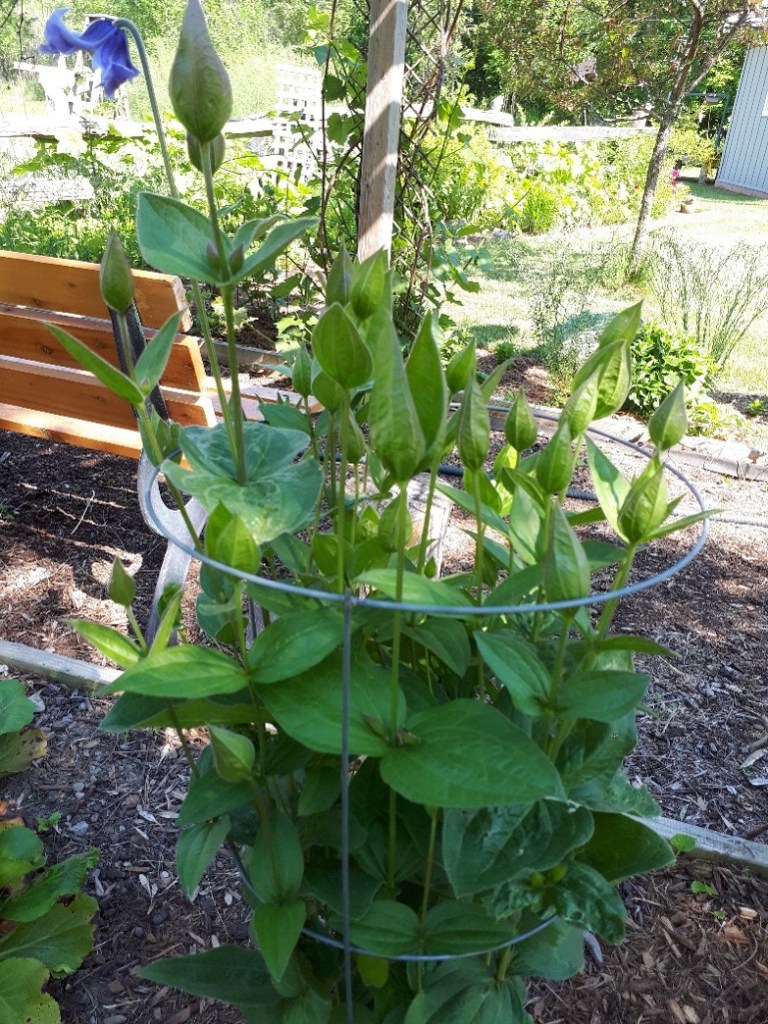
Clematis seed head
Clematis grow in zones ranging from 3-11. If you are not sure which zone you are in, check here. Choose a plant from a reputable dealer. Look for those that have strong stems and are at least 2 years old so that their root structure is well developed. Most Clematis prefer sun or part shade but like their roots kept cool so mulch or plant another perennial close by to shade the roots. Plant your Clematis in moist but well drained soil with lots of well-rotted, organic matter (eg. finished compost) added. Plant the ripened stem (brown, no longer green) about 16 cm (6 in) below the final soil level. Clematis prefer neutral to slightly alkaline soil. All new plants need to be watered regularly until they are established and during dry conditions. Fertilize with an all purpose organic fertilizer monthly but stop when flower buds are ready to bloom in order to prolong bloom time. You may start fertilizing again after flowering has ended but stop feeding in late summer early autumn.
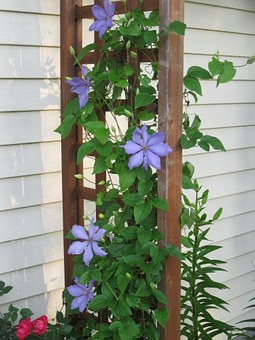
Clematis on trellis
Pruning your Clematis for the best blooms may seem complicated. The confusing part for me was that some references refer to groups 1,2,3 and others use group A, B, C while others will use the species names. What is important is knowing what you have and then you can determine how to prune. Read your plant label for pruning directions or if you do not know which Clematis you have:
When does your Clematis flower?
*flowers on old (previous year) wood in early to late spring, early summer. *does not need regular pruning – prune to remove damaged stems or to keep your plant tidy and growing within it’s allocated space. Prune after the flowering period has ended.
*flowers early on old (previous year) wood and again in late summer on new current year’s growth. *prune to remove damaged or weak stems and the early flower shoots (encourages the second period of flowering) immediately after the early flowering period.
* flowers on current year’s growth in mid to late summer. * prune back all of the previous year’s stems to the lowest pair of live buds in early spring.
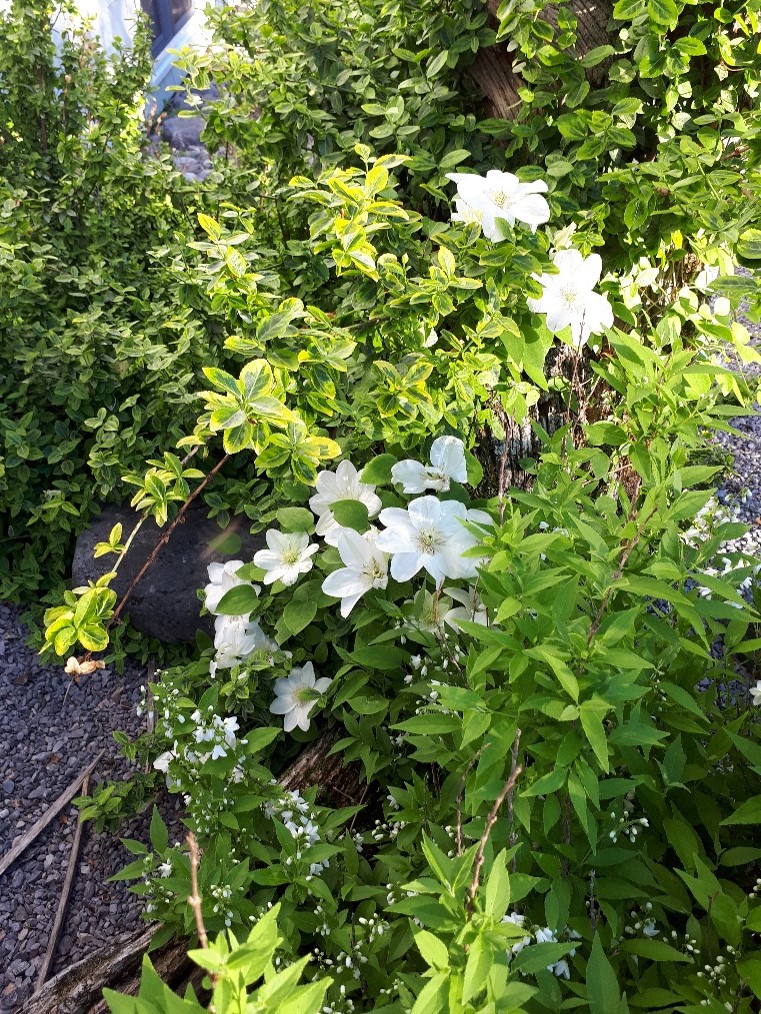
Clematis growing through shrub, author’s garden
Clematis may suffer from snails, slugs, aphids or mildew. Clematis wilt is a fungal disease that may result in the sudden collapse of a previously healthy plant. Cut back affected part of the plant, even right to the ground if necessary, if fungus wilt occurs. I have to say that I have only ever experienced the odd slug-chewed clematis leaf in my garden just east of Peterborough.
Clematis will grow on a trellis and in a container, through the branches of another shrub or even up into trees. It may be used as a ground cover and the shrub types look great in the perennial border. Clematis flowers are lovely and will attract pollinators and provide them with pollen and nectar.
Read plant labels, talk to garden nursery staff and other gardeners in your area and/or google to ensure that you purchase the clematis that is right for you. We may not all become clematophiles but we can still have some of these wonderful plants in our gardens!
I recently listened to a talk by Lorraine Johnson who is the former president of the North American Native Plant Society and is the author of numerous books on gardening and environmental issues. I was inspired by her talk and have started plans to turn part of my front lawn into a native garden.
I have struggled for years to grow grass near the bottom of our front yard. The soil is mostly clay with a lot of rock. We have no sidewalks and this part of the lawn sits at the curbside where it could be affected in the winter by salt and sand. It faces north/west and receives a very hot sun, especially in the afternoon.
I am not a regional native plant purist. I get excited about most plants and have a variety of perennials in my gardens. I am hoping to fill this garden bed with as many native plants as possible, but I do recognize that some of the plant varieties are not always considered native.
There are a number of lovely native plants for sun that have height, but I am cognizant of the fact that my neighbour requires a safe line of sight to the street when they come down their driveway. For this reason I would like to use mostly low growing groundcover with a few taller plants positioned in areas that will give a pleasing look to the garden bed, but also not impede on visibility.
I have begun to research native groundcovers and other low growing plants that would survive in the conditions I’ve described and here is what I have found so far. Some of these are new to me, but others are plants I already have in my backyard.
Have you considered replacing part of your lawn? I would love to hear about your ideas and your successes and failures.
Bearberry (Kinnikinnick) Arctostaphylos uva-ursi
This plant grows 6 to 8” tall and has a spread of approximately 3 feet and is similar to a low growing shrub. It has a white bloom with a tinge of pink in May. It’s drought tolerant once it’s established. Rounded berry-like fruits ripen in August to September. Birds love the fruit! I have a friend who has found that this plant will disappear over time and because it prefers a sandier soil, it may not be the perfect plant for my home. However, I may give it a try as I occasionally enjoy pushing the limits.
Creeping Juniper, Juniper horizontalis ‘Wiltonii’
This plant is known to be salt tolerant, likes sandy soil and full sun, grows to a height of 8” and spreads to approximately 7 ft. It is a non-flowering evergreen. It spreads by long trailing branches. Foliage is primarily scale-like (adult) with some awl/needle-like (juvenile) needles appearing usually in opposite pairs. Foliage is typically green to blue-green during the growing season, but often acquires purple tones in winter. It likes to grow over rocks; however, it is a slow grower and takes some time to get established.
Prairie Smoke, Geum triflorum
Prairie Smoke; Author’s garden
This is a tough plant, and grows to about 6 – 12 inches. It has a lovely reddish pink to purple bloom with interesting seed heads. It is drought tolerant. My one concern is the hot afternoon sun, as my research shows it may prefer a bit of shade later in the day. As the flower fades and the seeds begin to form, the styles elongate (to 2″ long) to form upright, feathery gray tails which collectively resemble a plume or feather duster. They are very unique. It spreads by rhizomes and can be naturalized to form an interesting groundcover.
Small Pussytoes, Antennaria howelli
It has spoon-shaped basal leaves, is known to be drought tolerant, and has flower heads that look like little shaving brushes. There are three to 15 flower heads in a flat to rounded cluster at the top of the stem. Stems are erect, green to reddish, covered in long, white, matted hairs and sometimes glandular hairs. Horizontal, above ground stems (stolons) emerge from basal leaf clumps, spreading in all directions, rooting at the nodes and forming colonies.
Pasque Flower, Anemone patens or sometimes Pulsatilla vulgaris
Pasque Flower; Author’s garden
Pasque flower grows up to 12 inches tall and forms a rounded clump, which increases yearly. It never gets out of hand, making it a desirable plant. It carries one flower with purple petals and yellow stamens, on top of each stem. The bloom is quite large, up to 2 inches in relation to the overall size of the plant. It is not fussy about soil conditions, but may go dormant during drought. It blooms in late spring into summer.
Nodding Wild Onion, Allium cernuum
My research shows this is a very pretty plant that grows to a height of 1 to 2 feet. It blooms in mid-summer. Its grass-like ribbony leaves are long and graceful; its flower cluster hangs down, covered with a fine onion-skin-like sheath before opening. The blooms in mid-summer are whitish rose coloured and bell-shaped. The seed heads are round. It does prefer good drainage. Looks best when planted in groups.
Butterfly Weed, Asclepias tuberosa
Butterfly Weed with Zinnias; Author’s garden
This is a butterfly magnet that has clusters of orange flowers borne at the top of 2-to-3-foot stems. It is probably a little larger than I would like, but thought I might give it a try in the front. This image is from my garden 3 years ago. I lost the plant the next year and believe it was because of overcrowding and not enough sun. The leaves are narrow and dark green. The plants get bushy if they have lots of room. The seed pods are large and very striking. They bloom in mid-summer and prefer a full sun exposure. Once established, they are drought tolerant. It emerges from the soil quite late in spring, so it is important to be careful not to disturb the roots.
Check out the following nurseries for native plants
I wrote the first part of this two-part blog on a beautiful fall day, with a temperature of around 20 degrees and blue skies. Today as I’m writing it is the type of winter day that I love, temperature hovering around zero, snow on the ground and I don’t need 4 or 5 layers of clothes on when I go out for a walk. The first part of my year in review blog that was published back in November described some of the many challenges and learning experiences I faced gardening in 2020, including growing Sicilian zucchinis, handling Creeping Charlie in my lawn, and becoming more selective when deadheading. In this second section I’ll continue on with the challenges, including staking perennials, trying to grow an English cucumber and battling with the wildlife over the grapes, blueberries and currants.
Now I have to admit before I start, that staking is not really my thing; it typically needs planning and thinking ahead. You can stake reactively as I tend to do, but by then it is often too late; the plants still look untidy, flop over adjacent plants and you can see the stakes, which for me personally is an issue. Last spring my iris, lupins and especially peonies grew so tall so quickly that they easily outgrew the old peony cages that surrounded them. My fall asters also fell over as they hadn’t been staked at all and were easily over six feet tall. So this spring I need to be more preventative and stake as early as I can. There are many different types of stakes that you can use such as grow-through supports as in peony cages or tomato cages. These work well if the plants are not too tall, although I do have some of the larger tomato cages in my garden. Grid-type supports also work well for plants that bloom heavily, and for irises I tend to use single stakes that I can just move around the garden as needed. You can also make your own supports using bamboo stakes or tree branches and twine or even chicken wire. Most gardening catalogues, such as Veseys or Lee Valley sell plant supports in many styles. For me however, I tend to find them quite expensive and tend to work with tomato cages or make my own. For more information please see the following article: https://www.bhg.com/gardening/flowers/perennials/staking-and-training-perennials/
English cucumbers, what can I say, I still tend to prefer these over other varieties that definitely grow much better here. English cucumbers tend to be longer, thinner, with an edible skin and in my opinion taste better. They do not however like cold temperatures, so if planting in the garden ensure that all danger of frost has long passed, and in fact, wait a further week or two after that. They also have shallow roots so need more frequent watering. I also find that for me they grow stronger and healthier if I provide some type of shade when it gets really hot. English cucumbers will also grow straighter and longer if the fruit can hang, so growing on a vertical support works really well. However, after saying all that, I still am unable to grow them as well as I would like and they are definitely very labour-intensive. So for this year, I am going to grow a different variety, although in saying that I have not tried growing cucumbers in containers, so that might be an option to try. Greta’s Organic Gardens have some interesting cucumber varieties for seed purchase, including Crystal Apple Cucumber that is shaped like an apple when mature, a Miniature White Cucumber which needs no peeling and is eaten when smaller than 3 inches. Lastly a Spacemaster Picking Cucumber that can be grown in either a container or a hanging basket. This company is one of many Organic seed companies based in Ontario. https://www.seeds-organic.com/pages/contact-us
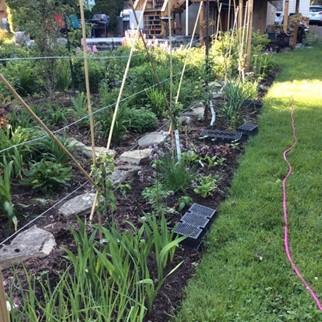
And last but not least, one of my favourite subjects last year in the garden was the wildlife, namely the dreaded squirrels and rabbits. We have a few different structures that we have built to keep out the animals, including:
And:
Not to mention:
This last picture shows simple plant trays with a mesh bottom lying upside down over new seedlings. I use these both to deter the animals and also to help keep the seedlings shady. However, none of these prevented the squirrels from taking bites out of most of my tomatoes, eating all my grapes, of which we had a bountiful crop, and the birds from eating my blueberries and white currants. The previous year I had put nets over the blueberries and currants which had helped, however since then I have read a few articles stating that the types of netting I was using could damage both birds and other wildlife so I was reluctant to put it on again. I have since done more research but not found anything yet suitable for my needs. However it is only January and will likely get a lot colder, which gives me plenty of time to do more investigation and come up with something suitable.
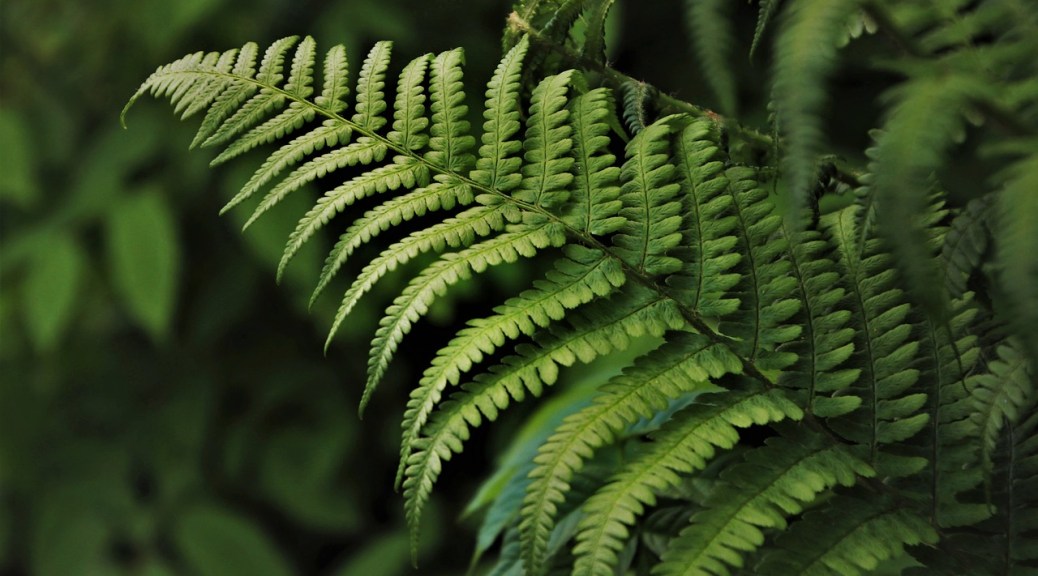
Ferns are fascinating plants! They evolved more than 350 million years ago. Ferns and their allies were the most common plants during prehistoric times. Today, there are over 12,000 fern species growing everywhere except at the poles.
Ferns are special in the gardening world. They are exotic and beautiful but not as flamboyant as many plants. We have developed a fern “dictionary” to describe them. For example, an entire fern leaf is actually called a frond and the stem is called a stipe. Ferns reproduce via spores which are not the same as seeds and ferns do not produce flowers. If you study ferns, you may be a pteridologist….oh my!
Fern propagation means collecting spores or bulblets. Fern propagation, using spores or bulblets, is explained here. There is only one native Ontario fern that produces bulblets. It is the bulblet fern or Cystopteris bulbifera. The easiest way to obtain a new fern is, of course, to buy one. A list of local vendors is below. Some ferns spread via rhizomes or underground runners, just split the root with a sharp shovel and separate out the fronds of the new plant. You may also split ferns with fibrous roots as you would many perennials, once they reach an adequate size, again using a sharp shovel. You may split then plant ferns in the spring or fall. Check out your friend’s gardens…you may find a fern, or two, growing that your friend may be willing to share. Please do not harvest from the wild. Some fern species no longer grow in the wild because of over harvesting.
Ferns may be used in your garden as an exclamation point or a secret quiet spot, mixed in with your other shade loving perennials or in a woodland garden. I have some ferns mixed in my gardens now but 2021 is the year that I plan to tackle the creation of a woodland garden. I have already put in an order for some ferns including the bulblet fern (Cystopteris bulbifera), ghost fern (Athyrium X Ghost) and the ostrich fern (Matteuccia struthiopteris). This grouping should work well together because they all prefer shade or part sun and moist soil with lots of organic matter. I plan to amend their location with compost and to mulch after planting to maintain moisture and reduce weeds. These plants are perennials so I will expect to see them again next year.
Ferns are beautiful plants whose graceful, arching fronds would make a great addition to your garden!
Please support your local nurseries. Many of them, including those listed above, carry the more unusual plants that you will not likely find at the big box stores.