By Marjorie Vendrig, Master Gardener
The Correspondent is a popular novel this year. Written by Virginia Evans, it inspired me to write more letters and connect with family and friends using pen and paper, envelopes and stamps. At Canada Post, I discovered a wonderful collection of stamps featuring flora and fauna and used the first set to send off letters to young grandchildren using the stamps to tell a story.
The first booklet presents five species of fungi and lichen found in Canada and explains that interest in mushrooms is part of our growing awareness and appreciation of Indigenous culture and traditions.
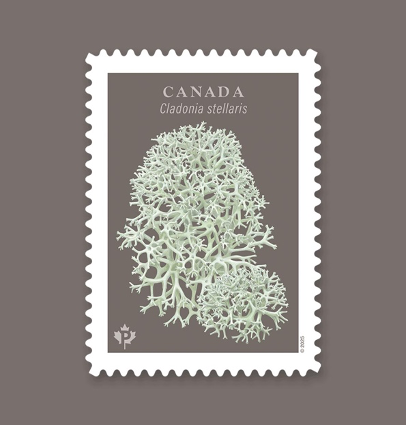
One of the stamps profiles the Star-tipped Reindeer Lichen (Cladonia stellaris). It is not a fungi but a lichen. Found in Canada’s north and familiar to many of us, it grows in large continuous mats on the ground, on trees and rocks in the boreal and arctic regions. It’s said to resemble cauliflower and is often used by model train builders to represent trees and forests. Reindeer and caribou use it as a food source in the winter. A lichen is neither a moss nor a plant, it is not a single organism but a combination of a fungus and algae or cyanobacteria. Each of the partners benefits from the association: fungi do not photosynthesize on their own and rely on the algae as a food source and the algae or bacteria rely on the fungi for structure and foundation. The relationship is stable and is symbiotic. Perhaps it is because of this symbiotic relationship that the Star-tipped Reindeer Lichen was voted by Canadians to be a national lichen species.
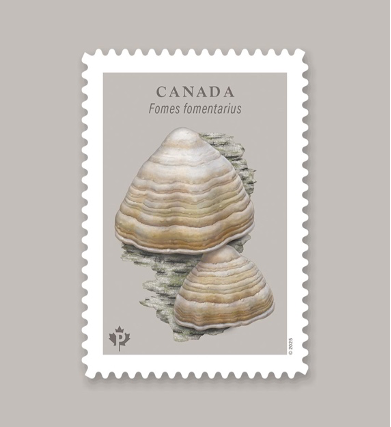
Fomes fomentarius has several common names: hoof fungus because it resembles a hoof and tinder fungus because of its role in starting slow-burning fires. It is not edible but the inner flesh can be used to make amadou, the material used as tinder. Amadou can also be stretched and pounded to make a felt-like product for clothing. Sometimes it is referred to as Iceman’s Fungus because several pieces of the fungus were found with the 5,000 year old Iceman mummy in the Alps. Hoof fungus is a familiar sight in eastern North America, most often on hardwoods, especially birch.
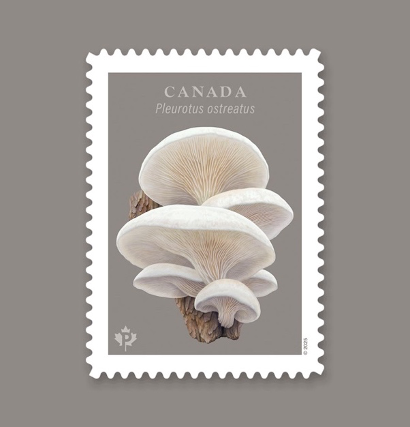
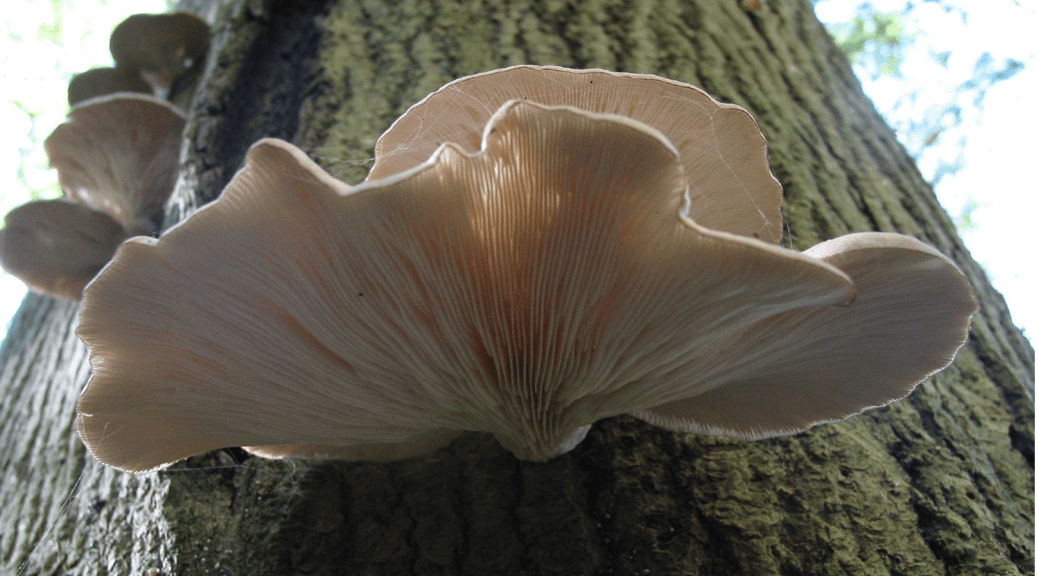
The oyster mushroom ((Pleurotus ostreatus) is commonly found in northern forests, usually on dead hardwood trees and can be found at all times of the year. The common name comes from the appearance of the mushroom, not the taste. Like the hoof fungus, the oyster mushroom is described as a shelf fungi because of its growth habit on the side of trees.
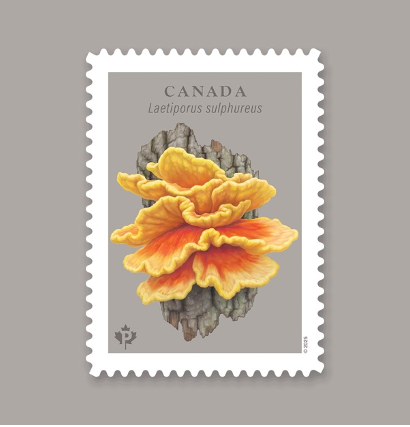
Chicken of the Woods is the common name for Laetiporus sulphureus. It’s an edible mushroom found in living or decaying trees, usually hardwood. It’s described as a bracket or shelf fungus (Sulphur shelf is another common name of this mushroom) because it grows on the vertical side of a tree. It can also be found at the base of a tree or on stumps or rotting logs. These fungi are yellow or bright orange and can be found as individuals or clusters. Small, single mushrooms measure only a few inches but a large cluster can be several feet and weigh up to 50 pounds. Chicken of the Woods is a polypore, it has pores rather than gills on the underside and appears in summer and fall with younger, smaller mushrooms being more tender. This type of mushroom is considered a favourite by most people. As with all mushrooms, care should be taken to have exact identification before eating.
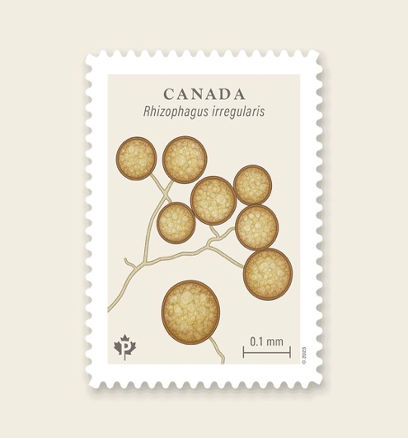
And finally, Rhizophagus irregularis, is a microbe – a mycorrhizal fungus that is used as a beneficial soil amendment, its importance to gardeners and particularly the agricultural community is significant. It is found in almost all soils and has undergone many name and classification changes recently.
References:
Science Writers & Communicators of Canada (SWCC)https://sciencewriters.ca/archivedblog/10530549
iNaturalist: https://www.inaturalist.org/taxa/125632-Cladonia-stellaris
Canada Post, booklet of fungi stamps: https://www.facebook.com/photo/?fbid=1233746638785510&set=a.235173518642832

