Category Archives: Planting

Gardening for Birds Through the Seasons

By Silvia Strobl, Master Gardener in Training

More than 1 in 4 birds have disappeared in North America since 1970, primarily due to habitat loss according to a recent study. As gardeners we can help to mitigate further declines by adding native plants to our gardens that meet seasonal bird habitat needs. If you would like to help, consider whether you can add one or more of the Ontario native plants noted below in your 2024 garden plans. All these are easy to grow, low maintenance, prefer full to part sun, and tolerate a wide range of soil conditions—ideal for almost any garden! Click on the plant names for Ontario specific growing information and photos.

In spring, food for early returning migrants is critical. The catkins of Pussy Willow (Salix discolor) and other willow species are an important early nectar and pollen source for native bees, but they also attract insects which feed returning Eastern Phoebes, Ruby-crowned Kinglets, Chickadees, and other insect eating birds.
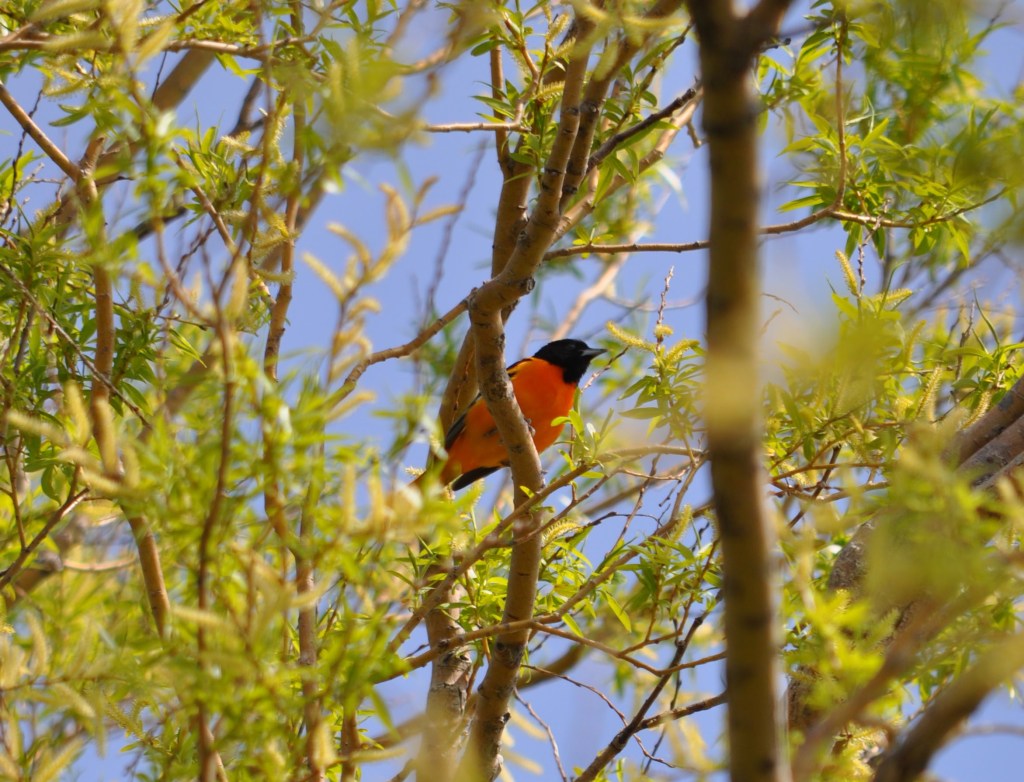
Northern Oriole among Willow catkins in early spring (photo credit: Beth McEwen)

For returning Ruby-throated Hummingbirds, growing a patch of Wild Columbine (Aquilegia canadensis) provides a critical source of early nectar. Providing a succession of nectar sources for hummingbird parents will entice them to nest and let you enjoy the flight chases of the juvenile birds in late summer. Include native plants with red, orange, or pink tubular flowers such as Scarlet Beebalm (Monarda didyma), Fly Honeysuckle (Lonicera canadensis), or Northern Bush Honeysuckle (Diervilla lonicera).

If you have room to plant only one tree in your yard, make it a Bur Oak (Quercus macrocarpa), Red Oak (Q. rubra), or Black Cherry (Prunus serotina). These trees support the greatest numbers of caterpillar species and hence provide important food high in protein for Chickadees and other birds raising nestlings in our short, temperate summers. To rear one clutch, Chickadees require up to 9000 caterpillars. Trees also provide structure and cover for nests.

Small, garden-size shrubs such as Serviceberries (Amelanchier spp.), Common Elderberry (Sambucus canadensis) and Chokecherry (Prunus virginiana) produce early season berries that provide food for Cedar Waxwings, Rose-breasted Grosbeaks, Catbirds, and Robins. These shrubs also provide cover for nesting birds.
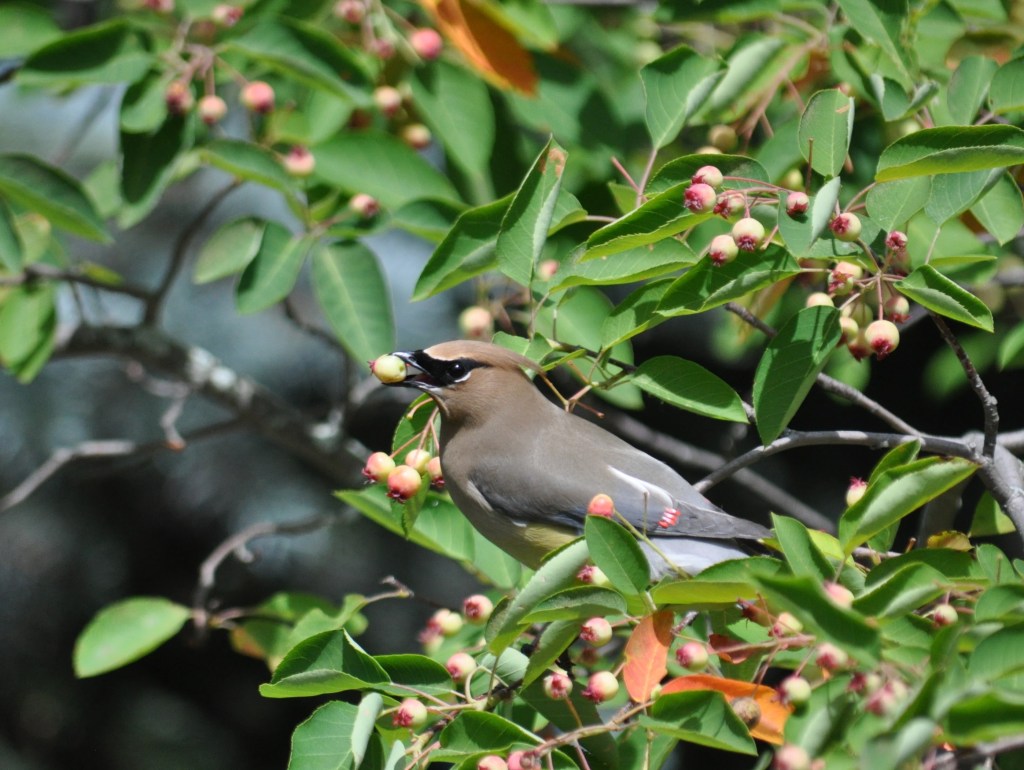
Cedar Waxwing eating a Smooth Serviceberry (Amelanchier laevis) berry in late June/early July in the author’s former Peterborough Garden (photo credit: Silvia Strobl)

For fall and winter bird habitat, grow a variety of plants that provide food, including:

  • Native Sunflowers, Purple Coneflower (Echinacea purpurea), Black-eyed Susan (Rudebekia hirta), and Asters (Symphyotrichum spp.) and stop deadheading at the end of August to promote production of seeds. Leave these plants standing overwinter to provide food for Goldfinches, Northern Cardinals, and Dark-eyed Juncos.
  • Shrubs such as Grey Dogwood (Cornus racemosa), American Plum (Prunus americana), Chokeberry (Aronia melanocarpa) and the vine, Virginia Creeper (Parthenocissus quinquefolia) produce late-season berries that are rich in fats. Many insect-eating birds switch to eating berries in fall to store fat under their chests and wings to support either long journeys south or survival in our chilly winters. Berries of native shrubs have higher percentages of fat (6.5% to 48.7%) than most non-native shrubs (less than 1%) according to this study.
  • Conifer trees and shrubs such as Eastern White Cedar (Thuja occidentalis) provide sheltering cover for year-round resident birds such as Chickadees, Nuthatches and Mourning Doves.
  • Decaying stumps and logs attract numerous beetles and ants. If you must remove a tree that has died or outgrown your garden, consider leaving the standing dead tree or stump to decay and provide insect food for Pileated and other Woodpeckers.
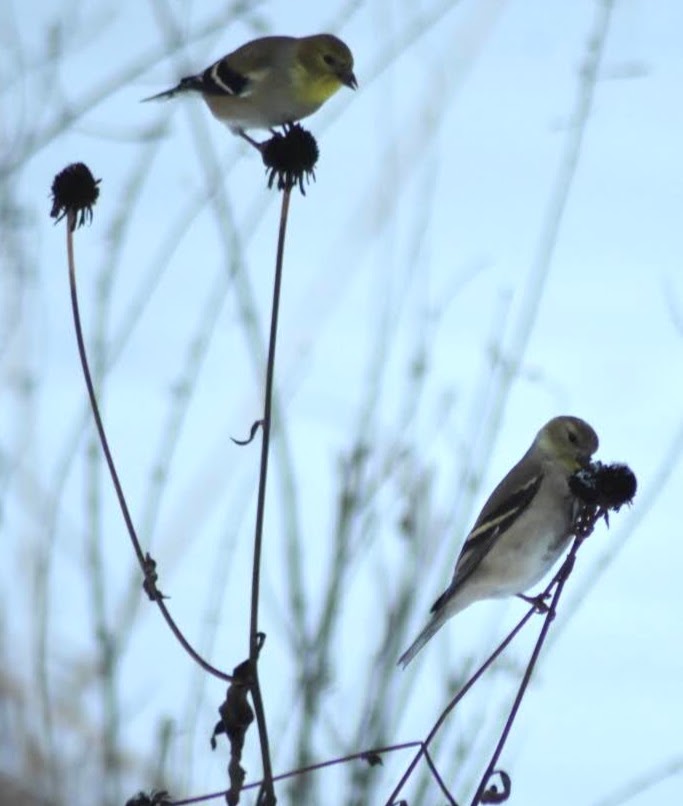
Goldfinches enjoying seeds of Purple Coneflower against a backdrop of winter snow in the author’s current garden (photo credit: Silvia Strobl)

You can have a spectacular garden by adding native plants. And, when you see birds using your garden, you will not only feel good about your contribution to bird conservation, but you will enjoy your garden even more!
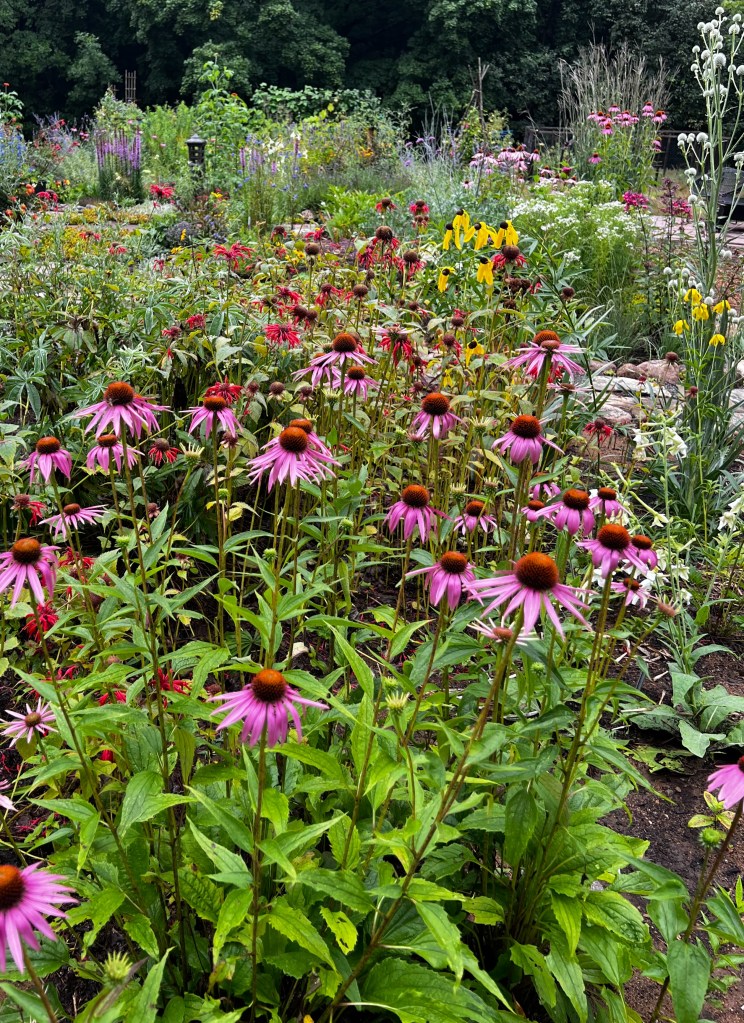
The author’s (mostly native plant) garden in early August (photo credit: Silvia Strobl)

Native Plant Sources

A key issue for those trying to grow native plants is finding them. To help you, the Halton Master Gardeners maintains a map of Ontario native plant nurseries that also provides websites and contact information. Always phone the nursery first to confirm they will be open.

Other Resources

In Our Nature. Nd. Native Plants for Hummingbirds. https://www.inournature.ca/plants-for-hummingbirds

In our Nature. N. 30 Native Shrubs for Ontario Gardens: Your go-to reference for the best shrubs for gardeners and wildlife. https://www.inournature.ca/best-native-shrubs

Tallamy, D.W. 2019, Nature’s Best Hope: a new approach to conservation that starts in your yard. Timber Press. 256 pp.

Related Over the Fence Blogs

EXPANDING YOUR NATIVE PLANT PALETTE

ATTRACTING BIRDS 1

ATTRACTING BIRDS, PART 2

ATTRACTING BIRDS PART 3

Divide to Multiply

by Marilyn Homewood, Master Gardener

Despite the lingering snow, the longer days and stronger sun tell us that spring is indeed here! With that we begin to think about all of the chores we wish to accomplish. Division of perennials is a common task. So why do we divide?

Division is a common means of vegetative propagation. It is an easy way to increase the number of plants you have available. Division is also required maintenance for some perennials in order to achieve maximum bloom year after year. Although a fairly simple process, there are a couple of considerations you must make.

Time of Year

Because successful division depends on the growth of new roots, the best times of the year to divide are spring and fall when the soil is warm, water is available and stressors are at a minimum.

Many perennials can also be divided during the summer months but high temperatures mean an increase in water loss. This leads to a stressed plant so extra care must be provided to ensure the plant remain well hydrated. Also, there are some ornamental grasses that only grow new roots in the spring. These plants should not be divided in the fall as they will not grow new roots that can take up water.

Method of Division

This will depend on the type of root and crown system the plant has. No matter the type of plant, keep in mind that each plant division must contain at least one bud or growing point and a few healthy roots. If you are unsure of the what you are dealing with, there is a link to a list from the University of Minnesota at the end of this blog.

Clumpers – These plants often have fibrous root systems sometimes with rhizomes but grow many smaller crowns at the base of the original each having its own root system. This often makes for easy separation with little tissue damage. Examples include ajuga, daylily and hosta.

Runners – These are plants that spread by covering the ground by shallow horizontal stems. They root along their nodes and send up new shoots making them easily dividable by separating the root ball. Examples include bee balm and goldenrod.

Tight, woody crowns – These plants are a little more challenging to divide as the buds are often tightly packed on a hardened crown. For best results the plant must be older when split to ensure that divisions with have growing points. Examples include baptisia and peony.

Thick rhizomes or tubers – Rhizomes are technically stems that grow underground. Divided sections must contain at least one growing eye. Examples in this group would be bearded iris and dahlia. These varieties should only be divided when dormant.

Tap rooted plants –These cannot rarely be divided unless multiple tap roots have developed and are better propagated by using root cuttings. Plants in this group includes oriental poppies.

Basic Steps for Division

  1. Dig out the plant. If not replanting immediately, protect from desiccation. Removing the plant from the ground can destroy tiny root hairs (responsible for water uptake). Protecting the plant means a faster recovery on the division is replanted. I often place the root ball in a plastic bag and place in a shaded area.
  2. Separate your plant into pieces using the most appropriate method. Make sure to take generous divisions of sufficient size to ensure growing points and healthy roots.
  3. Replant, digging hole wide enough. Roots like to grow out and down so give them enough space to spread out. Be sure that the soil has good contact with the root system by firming the soil then water the division in, slowly allowing the soil to further settle against the roots.

Resources

The Science Behind Plant Division

Divide and Conquer: How to Divide and Multiply Perennials

How and When to Divide Perennials

Table for Dividing Perennials

The Case for Coir

By Christine Freeburn, Master Gardener

For many years, we have been told of the depleted bogs where peat has been harvested and why we should not be buying it. Many gardeners wonder what they would use to replace this product that is a great soil amendment and seed starting medium.

Peat is an organic naturally forming product which can take hundreds of years to replace. We all know the history of peat bogs in the British Isles when peat was used to heat homes and then mined irresponsibly, destroying wetlands and ecosystems. The International Union for Conservation of Nature (IUCN) is a group which is responsible for setting up a Peatland Programme in the UK.

Peat harvesting

Did you know that Canada is the largest producer and exporter of horticultural peat, with about 1.3 million tonnes of peat being mined in 2010? Peat companies must, however, follow federal and provincial guidelines. Just recently, in Manitoba, this ruling occurred: On January 20th, 2023, Moswa Meadows and Fish Lake Fen were designated as provincially significant peatlands in the newly created Provincially Significant Peatlands Regulation in order to ensure the biodiversity of the two areas is preserved. Specified development activities, including mining, forestry, agriculture, and peat harvesting, are now prohibited across the nearly 28,000 hectares that make up Moswa Meadows and Fish Lake Fen and will ensure the areas can continue to provide long-term beneficial goods and services including carbon sequestration and storage, water filtration, and flood mitigation. For more about peat management in Canada, check out

Peat Mining in Manitoba

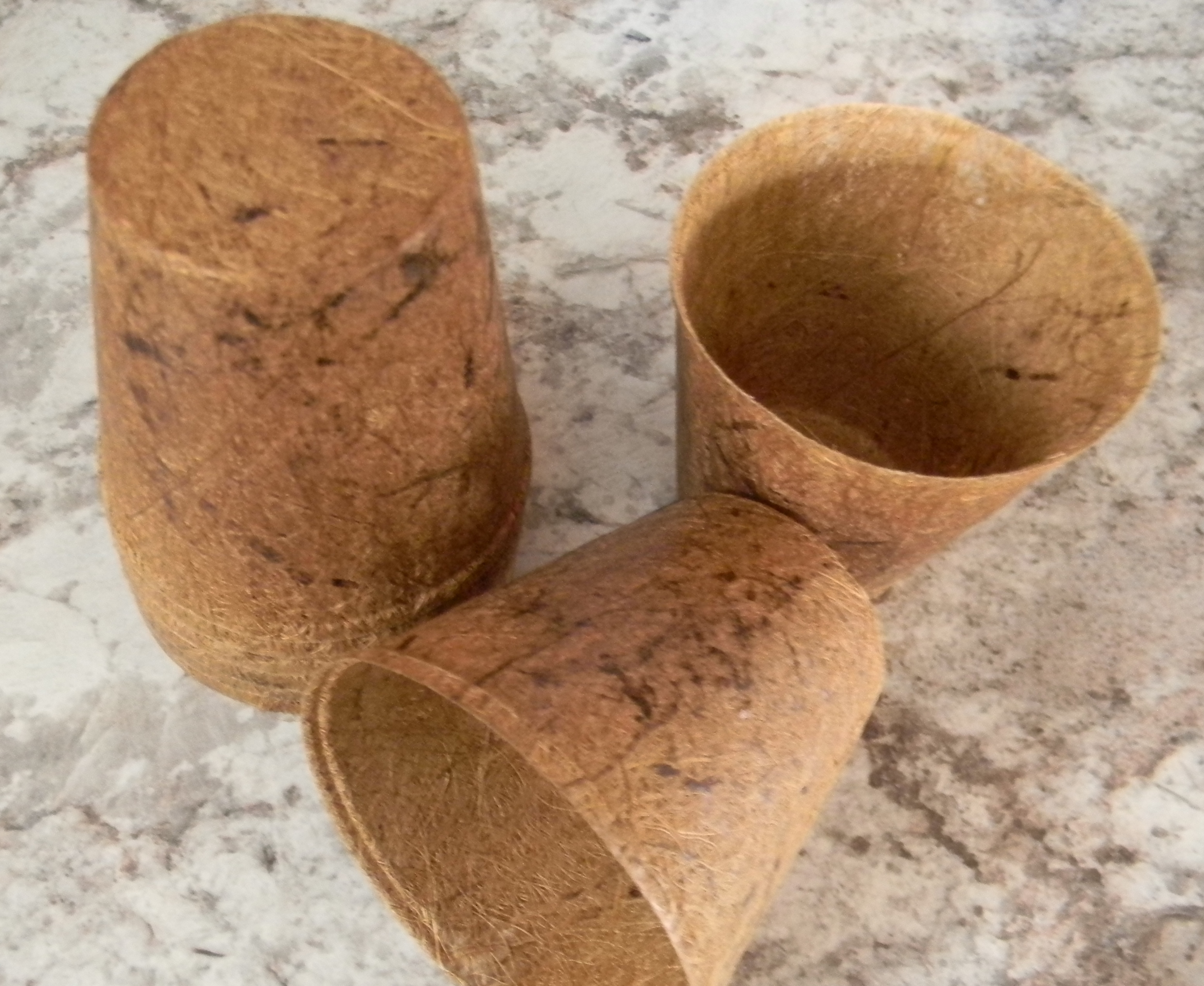
Coir  (pronounced COY-er) comes from the coconut plant.  It is the part between the meaty white flesh and the hard outer shell. Because coconuts are grown and harvested for food, coir is readily available. India is the largest exporter of coir. It can be used on its own as a growing medium for seed starting and root cuttings or as a soil amendment for holding moisture and is a great replacement for peat.

Sample package of coir

Coir has a pH of 5.7 to 6.5 which is perfect for plants to obtain nutrients. It can be used in containers to help hold moisture and lighten soil. The square foot garden formula is one third peat moss, vermiculite and compost, so coir would be an excellent peat replacement. Coir last longer than peat, being slower to breakdown. It has no odour. It gives sandy soil more structure. Excess salt may be a problem, however, rinsing with fresh water a few times should remove enough of the salt.

Coir is available in many different ways including bales, bricks, pots and discs. Compressed blocks need to have warm water added for it to absorb and expand, just like peat. Place the brick in a bucket, add water and watch it expand. The coir will absorb the water, and can expand by up to 15%. It will soften and have a fluffy texture which can then be placed in pots for planting slips or rooting plants. The small disks also need to have water for them to expand and act like the peat pods we are familiar with. And like the peat pods, these coir disks can be planted directly into the garden. Check out this article:  What is Coconut Coir?

Coir products are available online at many sites like Veseys Seeds. I have also found them in Peavey’s and Home Hardware in Peterborough. Let’s all be responsible by purchasing coir rather than peat.

The KISS Principle – Winter Sowing 101

By Emma Murphy, Master Gardener

“If it’s not easy, you’re doing it wrong” Trudi Davidoff

For the last few years I’ve been hearing people (especially those in the native plant field) raving about winter sowing. What’s that I asked? Simple, they said – a germination method where you put seeds in an enclosed container out in your garden in winter and let Mother Nature make you more plants.

Hmm, I thought, that sounds too easy. As someone who has struggled for year with starting plants from seeds (especially annuals, vegetables, or herbs) and lost many sad looking seedlings to damping off I was intrigued.

Now I know it really is straightforward (although it requires an Ontario twist – more later) – and I am all about using a KISS principle – Keep It Simple Stupid!  

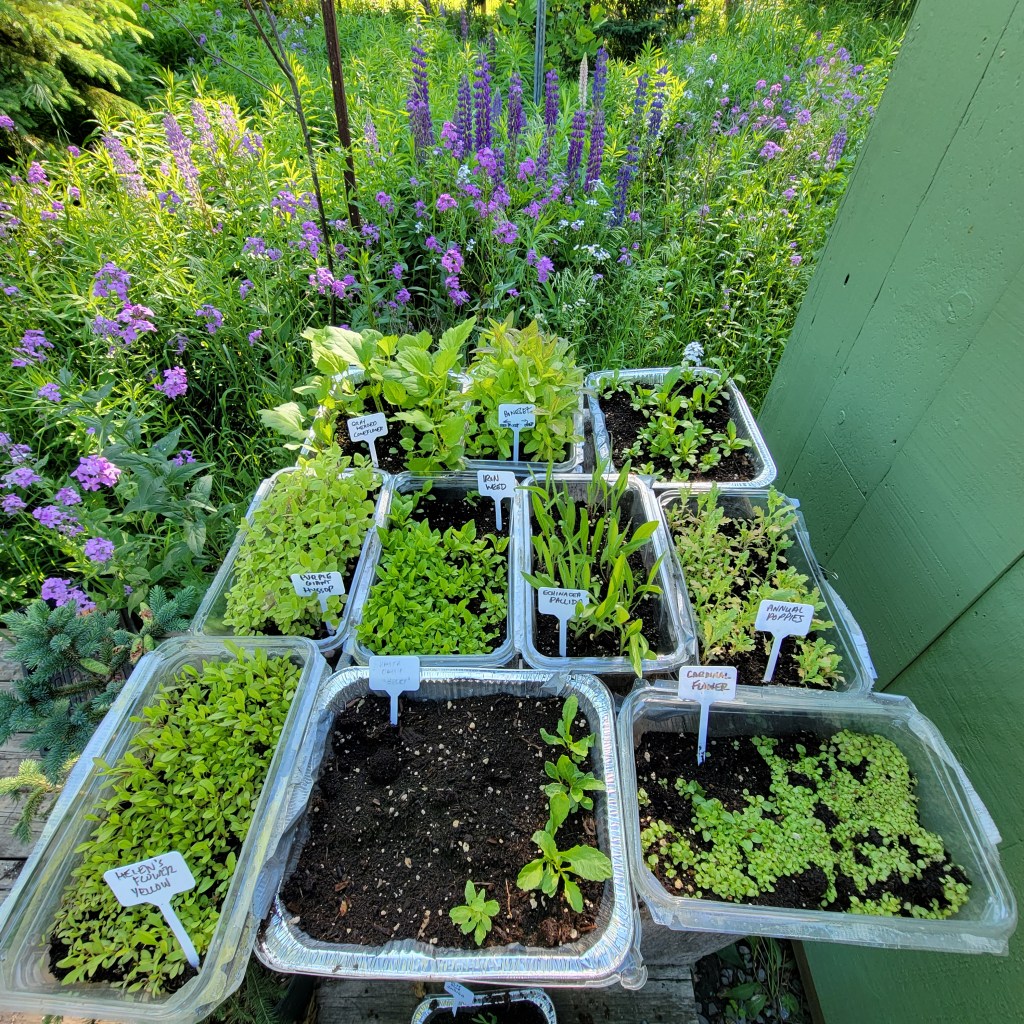
My plants – June 2022. As you can see not all successful. I love the Hunk O’ (or Chunk O’) transplanting method once they have grown (see FAQs)

Started in 2000 by Trudi Greissle Davidoff of New York in an essay, the Winter Sowing Method is a low cost (bonus!!!), temperate climate method of producing sturdy plants for your garden. There is no need to set up lights or have a space inside your house and best of all, no hardening off process. In 2006, the U.S. Department of Agriculture recognized the viability of the technique by adding the term to the National Agricultural Library Thesaurus.

The Basics

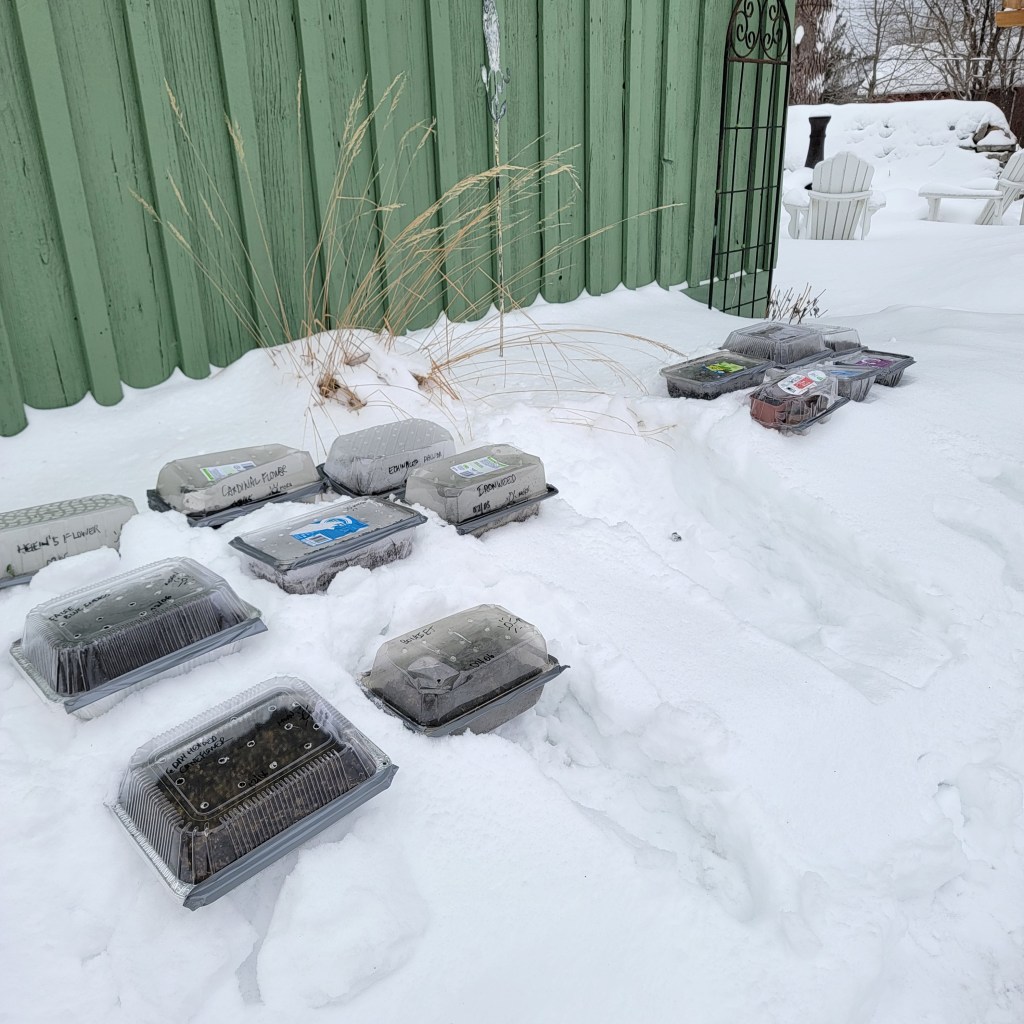
So how does it work? For winter sowing you use a recycled container (bonus!) to create a mini greenhouse that protects the seeds from animals, birds and other pests, as well as from our often variable spring weather, until they get big enough to transplant into your garden. This is one case when you actually want your seeds to be placed outdoors and exposed to the elements (including freezing temperatures, snow, and rain).

You can use any container that’s deep enough to hold sufficient potting mix and has a clear or translucent covering that is tall enough to allow the transplants to grow. It must have drainage holes in the bottom as well as ventilation holes in the top. You can use perennial or annual seeds – basically anything as long as it isn’t a tropical seed (for obvious reasons). Native seeds are particularly good because they need a period of cold stratification to germinate – why not take advantage of natural temperatures, rather than artificially refrigerating seeds that need this process?

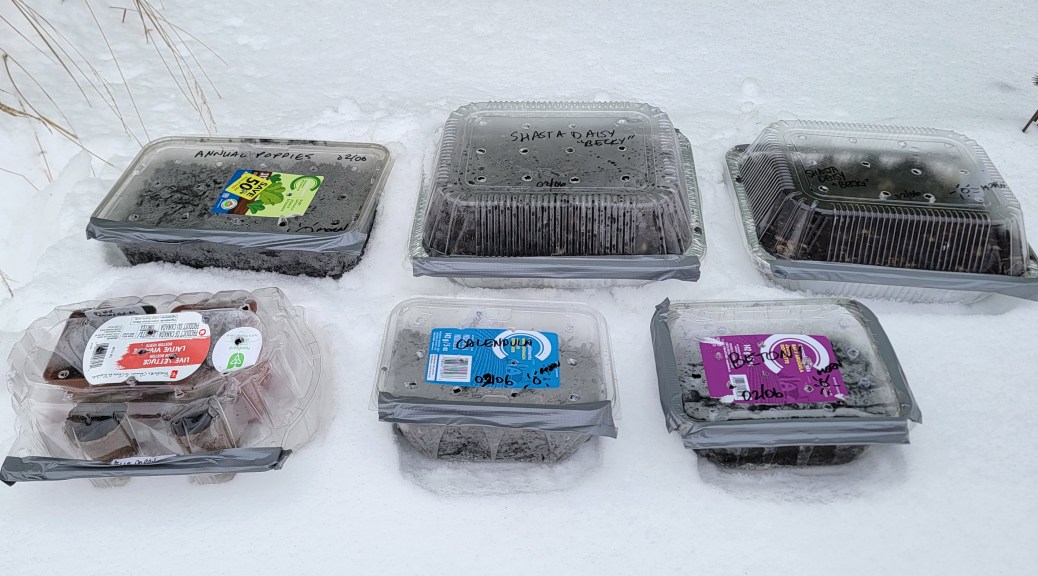
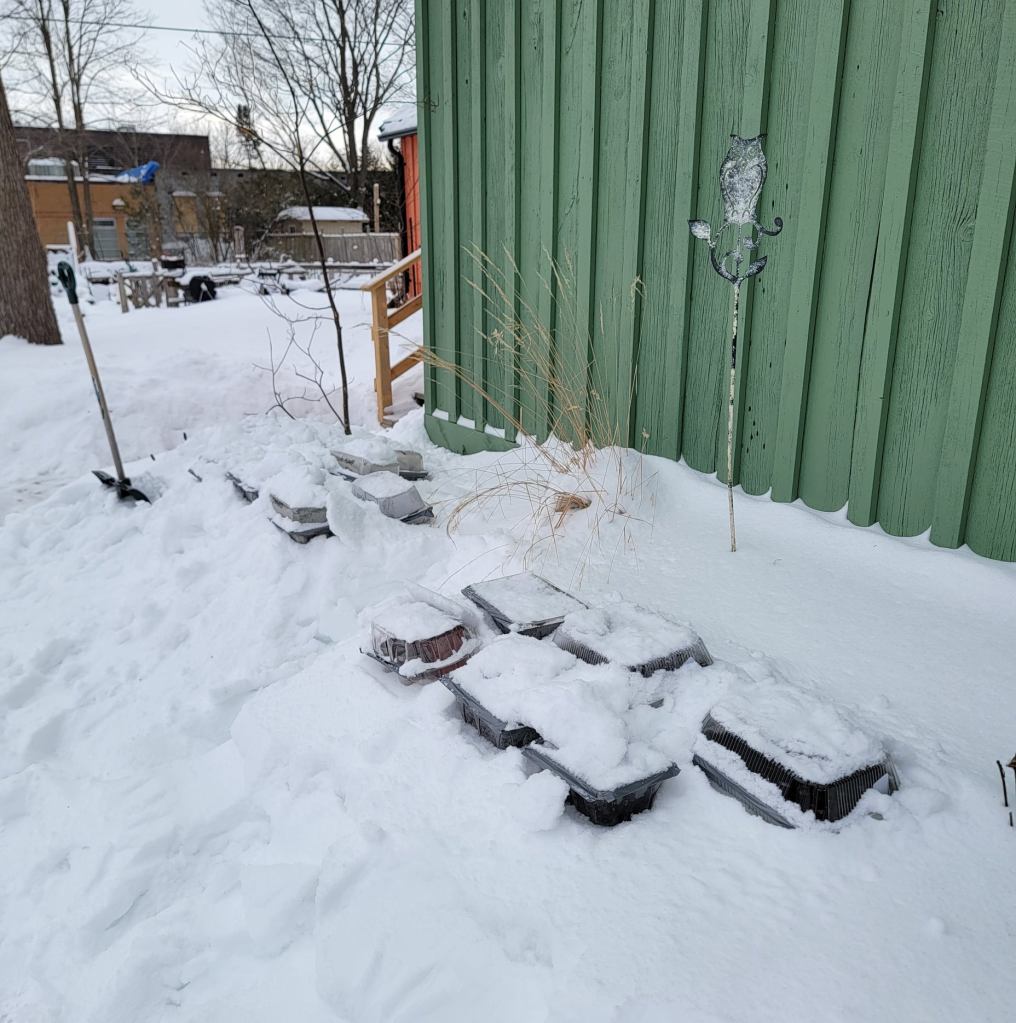
My winter sowing containers – January 2022

You fill the container with potting mix (at least 4-5 inches), sprinkle in your seeds, make sure the mix is moist, tape or secure the top of the container in some fashion, and put it outside. It’s good to check on the containers periodically so they don’t dry out or become waterlogged. Then you wait – it really is that simple.

Ok, I know there are questions – When do I start where I live? When do I plant x seeds? What soil do I use? Let me try and answer some of the basic ones and point you to other resources as well.

Trudi’s original website is no longer active but there is a very active Facebook page that follows her method – Winter Sowers – which I highly recommend for all the basic information and lively discussions amongst members. Trudi is an admin on the page.

Timing for Winter Sowing?

You can start winter sowing anytime after the Winter Solstice (December 21st). Perennials are generally done first, as they often require (or benefit from) cold stratification, then hardy annuals, then tender annuals. But the bottom line is that the seeds will germinate when the conditions are right for each kind of seed. That is the beauty of winter sowing! Many people winter sow their perennials in January but then wait until March to start their annuals. It really doesn’t matter – do what works for you!

They are ready to plant whenever the outside temperature has sufficiently warmed and they are the right size (2 to 3 inches or more importantly at least two sets of real leaves).

What Soil to use?

It’s recommended to use a sterile potting soil mix; avoid soil bags that say they are ‘weed free’ because they can contain chemicals mixed into soil to prevent any weed seeds in that bag from germinating. So they will also prevent the germination of seeds you sow in that same soil! If you live in an extremely dry environment, you might want to use soil that has moisture retentive crystals – otherwise this is not necessary (and can even be a problem in wet winter regions like the U.S. Pacific Northwest). Using fertilized soil for a sowing medium is a personal preference.

What Containers? The Ontario Twist

Most winter sowers tend to use milk jugs for their seeds, but these are not readily available in Ontario – we still love our milk bags! But the reality is that you can use any container for winter sowing as long as it can hold at least 3 inches (7.6 cm) of potting soil. I have seen various other things used –  juice bottles, clear pop bottles, blue and green bottles, aluminum pans, salad boxes, plastic containers, pretzel barrels, cheese curl containers, ice cream buckets, nut containers, and vinegar jugs. They must be translucent (some light passes through) or transparent (all light passes through). Opaque materials will not work. Personally I have used the large fresh spinach containers or aluminum roasting pans with clear lids.

You do need some sort of cover on your container, as it helps keep heavy rains under control (so they drip slowly into your containers), it keeps more moisture in so that you have a higher germination rate of your seeds, and it keeps weed seeds out of your containers.

How do I Label?

Labelling is really important unless you’re a genius at identifying new sprouts! I recommend putting in two labels – one on the underside of your tray and one on a popsicle stick in the container. Trudi recommends using duct tape and an industrial sharpie. Tip – place your labels before you fill the tray with soil and put them so they don’t impede the water drainage holes. There is lots of discussion on the best pens to use for labelling – everything from paint pens to garden markers, livestock markers, and china/grease markers.

This will be my second year winter sowing just north of Peterborough – I learned a lot in my first year, most importantly to transplant my seedlings before they get too big and dry out. I wrote a blog earlier this year about some of the cool native plants that I winter sowed last winter.

I hope this blog encourages you to consider winter sowing for your garden, particularly for native species to your area – seeds are so much cheaper than plants and then once they go to seed you are all set to grow even more plants, either for yourself or to share with friends!

Want More Information?

Some videos (and posts) you may want to check out – there are lots of winter sowing videos out there (sometimes with conflicting information) but these are two that are recommended by the online group

Dolly Foster – Hort4U Winter Sowing Presentation

All The Dirt on Winter Sowing

Planting Native Seeds (Facebook link)

WinterSowing 101 – Jug Prep (if you have milk jugs) (Facebook link)

Frequently Asked Questions (Facebook link)

Exploring Two Special English Gardens (and the Gardeners behind them)

by Emma Murphy, Master Gardener

This week I had the pleasure of doing my first in-person presentation in almost three years to the Peterborough Horticultural Society on some very special south England gardens that my husband and I were able to visit in May 2022.

National Garden Scheme

I also talked about the amazing UK National Garden Scheme (NGS), where gardeners open their private gardens on specific days during the year to raise funds for primarily health charities. Since many people had never heard of the NGS, I thought I’d share with a wider audience with my blog for this month.

Screen capture from NGS website

The NGS gives access to over 3,500 exceptional private gardens in England, Wales, Northern Ireland and the Channel Islands, which in turn raise impressive amounts of money for nursing and health charities through admissions, teas and cake. And it’s not just about seeing beautiful gardens – there is a strong focus on physical and mental health benefits of gardens too. They also support other charities doing amazing work in gardens, and provide health and grant bursaries to help community gardening projects. You can read more here.

How I wish we could start something similar here in Canada (or Ontario, or Peterborough)! Imagine all the good that could happen just from sharing our gardens with people. I’ll have to think more about this.

So we managed to see two very special private gardens (that both open for the NGS as well) and get to meet the gardeners behind the garden, which is always my favourite thing to do when I visit to a garden. I want to understand the inspiration, the goals and objectives, and the plans for the future…because we all know our gardens are ever evolving places.

Waterperry Gardens

Waterperry Gardens (east of Oxford in Oxfordshire) has a long legacy and an amazing history as one of the few horticultural schools for women (from 1943 to 1971) – run by two outstanding women – Beatrix Havergal and her partner Avice Sanders.

Photo courtesy of Waterperry Gardens

It’s an 80 acre estate with 8 acres of formal gardens, and is famous for the herbaceous border. This is what it looked like May 2022 when we visited, and how it looks now (fall 2022, photo courtesy of Head Gardener Pat Havers, who I was lucky enough to meet in person in probably the busiest time of the year!) I love this blog written about her in 2017.

You know you’re a hard core gardener when your Mum takes you to work in a wheelbarrow!

Photo courtesy of Pat Havers

Pat grew up in the gardens as her mother worked there, and has been working there herself for the past 20 years -10 years as Head Gardener.

“Living in the village it was every little girl’s dream to have this haven on their doorstep”, says Pat. “I would spend hours running through the beds and asking all the gardeners questions about their work. This soon caught Miss Havergal’s eye and I became the youngest student of hers at just the age of 4. My guess is perhaps she did this to keep me out of trouble.

Her passion for the gardens were evident in everything she said. I found out about her favourite quiet space (down by the River Thame), and the incredible legacy established by Havergal and Sanders, that continues to this day in terms of courses, plant identification tags, and garden design.

This garden is the Formal Garden/Silent Garden, where people are encouraged to turn off the phones and just enjoy the beautiful knot garden, sculptures, and seasonal changes.

St Timothee Garden

Just a bit further east near Maidenhead in Berkshire is St Timothee, a spectacular 2 acre private country garden planted for year-round interest with a variety of different colour-themed borders, each featuring a wide range of hardy perennials, shrubs and ornamental grasses.

The garden artist at work here is Sarah Pajwani, and I love her approach to gardening (similar to my own), and especially her focus on making her gardens appealing all year round, including those winter months. While England obviously doesn’t have the harsh winters we have here, her focus is on maintaining structure and colour in the garden.

photo courtesy of Sarah Pajwani

An overgrown field area when she moved in (2006), Sarah created a design rationale with the help of professional landscapers, but then set about filling her garden with plants of her choice, border by border. She definitely loves her purples and pinks, but also has a few ‘hot’ borders with lovely reds, oranges and yellows.

There are so many lovely aspects to her gardens, including a large pond, wild meadow, potting shed, and formal parterre garden. While we were there in May, her photos of her winter garden are amazing, designed to have year round interest that’s easy to manage.

Sarah’s garden received national recognition in 2021, being recognized by The English Garden magazine as the National Winner for favourite garden. A garden not to be missed if you are in the area!

This excellent garden blog shows the beauty of the St Timothee Garden in wintertime, when it’s one of the first to open for the NGS.

While we did enjoy seeing many of the ‘signature’ ‘must see’ gardens on our English trip – like Sissinghurst, Hidcote, Kiftsgate Court Gardens, and Great Dixter – it was these private gardens – where we had the opportunity to meet the gardeners – that were the highlight of our trip. So if you’re in the UK, be sure to check out the NGS website for what gardens are open while you are there – they have a great interface to help you – either by week or by arrangement.

(Special thanks to the magic of Twitter for connecting me to Ontario gardener Lynette, who connected me to master gardener Nicki in Sussex, who helped me find these very special gardens and gardeners. You will both be on my list of gardens to see next time I’m in your area.)

Native Plant Gardening for Birds, Bees & Butterflies

by MJ Parker, Master Gardener

I recently downloaded “Native Plant Gardening for Birds, Bees & Butterflies” from my local library. This book was a fabulous find for me because I am currently planning a buffer area by the water in our new place. Going through this book reminded me of when I was a kid with a new Sears or Eaton’s catalogue – always an exciting event – something only people of a certain age will remember.

Book cover

The book was written by an entomologist, Jaret C. Daniels, currently living in Florida but the area covered by the book is the upper Midwest which is roughly parallel to us here. I have ordered plants from Minnesota before with no problems and some of the plants I currently grow are in the book.About 1/4 of the book is devoted to why we should plant gardens for birds, bees and butterflies. He does a brief summary on a number of topics about the actual mechanics.

False Indigo (Baptisia australis)

Most of the book, however, was a precis of individual plants roughly divided into sun, shade, and bog. Each plant started with a picture, then a summary of what it would attract and ended with specific location and cultivar tips. And this plant section was the part that I found extremely interesting and helpful.

New Jersey Tea (Ceanothus americanus)

So what I did was I sat down with a pen and paper over a number of days and compiled a list of what would work for me and plants I wanted to get. I ended up with a comprehensive list of plants, some I had forgotten to bring from the old place and some completely new to me.

And to date I have already placed 2 seed orders for some of the things on my list.

The Golden Glow Has Got To Go

By Emma Murphy, Master Gardener

Last year around this time I wrote a blog about reclaiming a garden bed from the dreaded ditch lily (Hemerocallis fulva), now considered an invasive species by many organizations including Ontario Parks and the US Fish & Wildlife Service and the U. S. National Park Service. If you’ve ever struggled with this plant you know what I mean.

The other plant growing in our large Lakefield garden when we moved in (more than 20 years ago) is what I was told was called an ‘outhouse plant‘. I eventually learned that the Latin name for this plant (also called golden glow or tall coneflower) was Rudbeckia laciniata “Hortensia”.

Rudbeckia laciniata “Hortensia” or Outhouse Plant, circa 2005 in my garden

It’s a cultivar of our native Rudbeckia laciniata, also known as Cut Leaf Coneflower or Green Headed Coneflower, which has a lovely simple daisylike flower (whereas the Hortesia cultivar is a double ‘puffy’ flower).

Our lovely R. laciniata elsewhere in the garden. It will do better (and flop less) if it’s in a garden bed with other tall and native plants.

The outhouse plant was pleasant enough so I let them grow for years in what I call our ‘back 40’, meaning our naturalized garden area at the back of the property, behind the cedar rail fence. Yes they were tall and gangly, and fell over in thunderstorms. Yes they spread, but they gave the prolific Canada Goldenrod (Solidago canadensis) and New England Asters (Symphyotrichum novae-angliae) a run for their money in August/September. And hey, I had more than enough to deal with in the rest of my more organized garden!

However, as I started to learn more about both native (and invasive) plants over the years I realized that I might have a problem. The outhouse plant isn’t a huge problem per se, as it can be controlled through digging, Chelsea chop etc., but its double shape means that it offers minimal benefit as food for our pollinators. And I wanted plants that not only look beautiful but have an ecological benefit. So I sat in my hammock and pondered.

Sitting in my hammock contemplating the outhouse plant’s fate
(he’s watching on the right)

As a result of winter sowing (first time this past winter – highly recommend!) I have lots of new native plant seedlings, including some of the ones I featured in my May blog – A Few of My Favourite Native Plants – Culver’s Root (Veronicastrum Virginicum), Cardinal Flower (Lobelia cardinalis), and Green Headed Coneflower (Rudbeckia laciniata). I certainly have lots of the native Rudbeckia, as well as Boneset (Eupatorium perfoliatum), Giant Ironweed (Vernonia gigantea), and Purple Giant Hyssop (Agastache scrophulariifolia).

So the clearing of the outhouse plant began in earnest last week, and by the end of two afternoons I had an area to work with.

The initial chop of material
Then removal of the actual plants and roots

Definitely not light work, but not too difficult either compared to other plants. The area is now clear, and I’ll be putting in Green Headed Coneflower (the native), Boneset, Giant Ironweed, and Purple Giant Hyssop. They can all tolerate a little competition (a good thing for native plants, especially tall ones) and basic soils.

If I have space I might even mix in some shorter plants like native Bush honeysuckle (Diervilla lonicera) and Pearly Everlasting (Anaphalis margaritacea) in at the front as they can tolerate dry conditions. The area is mostly sunny all day. Unfortunately my beloved Cardinal Flower and Turtlehead are too dry for this location.

We’ll see how this experiment works and check back in with you all on another blog. If it works we’ll expand into another area of outhouse plant that I recently cut down, but haven’t removed yet…a work in progress. There are only so many hours in my (still working part time) day. And I still need to get that Canada Ggoldenrod under control…but that’s another story…

Planting Trees

By Sharleen Pratt, Master Gardener

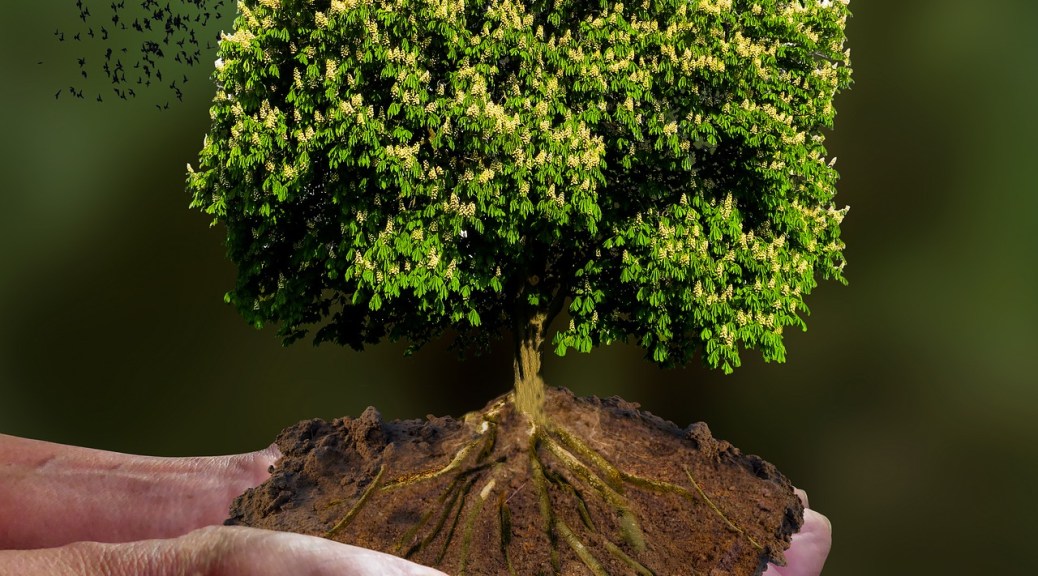
Image Courtesy of pixabay.com

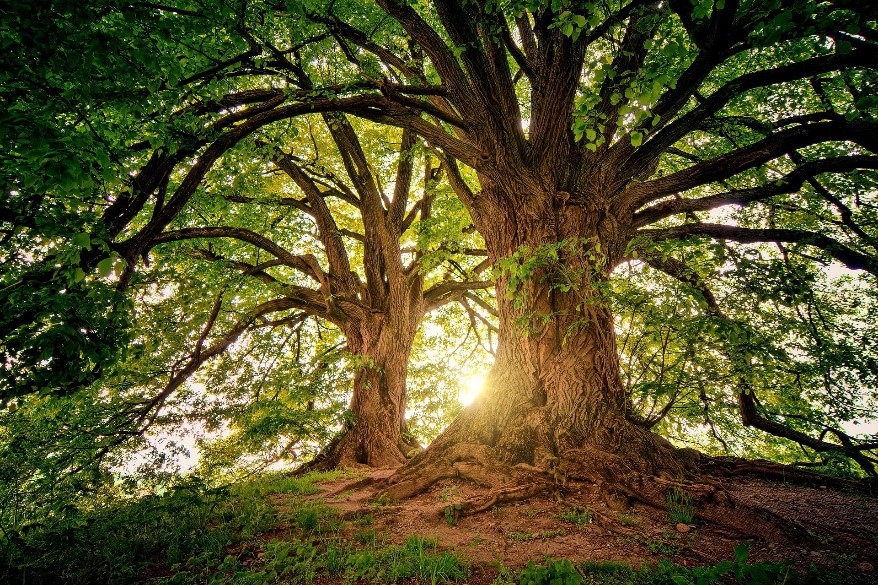
Peter Wohlleben in his well-know book, The Hidden Life of Trees, describes how trees are like families, continually communicating and supporting one another. Trees improve soil and water conservation, moderate climate, increase the wildlife habitat, reduce stress and improve health.

It is imperative we continue to increase the tree canopy in our ever-growing cities.  This became more important after the recent storm that whipped through Southern Ontario and took out so many beautiful trees.

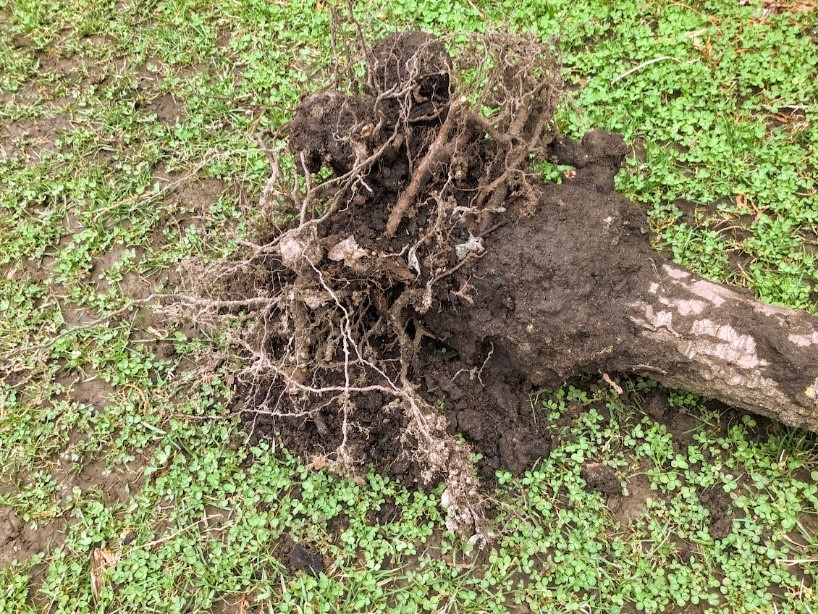
There are many factors to consider when planting a tree and it is easy to make mistakes.  I learned this the hard way this past month when I was able to literally pull a 9-year-old tree out of the ground.  Believe me, I am no incredible hulk!  I made many mistakes when planting that tree; the picture shows it was planted too deep, the roots girdled around the original root ball and by amending the dug hole with compost the tree likely resisted growing roots into the surrounding clay soil.

Image Courtesy of Author

Do your research and purchase a tree that is suitable for your yard conditions: 

  • How much sun and shade you receive each day?
  • What type of soil do you have?  
  • Would you prefer a large tree or one that is smaller and more suitable to an urban setting? 
  • What growing zone do you live in? (Check out this Zone Map if you are unsure)
  • Are you looking for a tree that will attract pollinators?   

I would suggest you consider planting a native tree. Trees that occur naturally in our surrounding area are better adapted to local climate and soil conditions and more resistant to disease. Oak trees are a powerhouse for feeding birds and attracting pollinators and insects, however, they are quite large.  A smaller tree to consider would be an Eastern Redbud or a Fall Witch Hazel.

Here is an article from Landscape Ontario with suggested native trees to consider.

HOLE DEPTH

In well-drained soils, the planting hole width should be two to three times the diameter of the root ball and only as deep as the root ball.  Widening the planting hole produces a hole with a greater volume of loose cultivated soil that allows rapid root growth.  This way roots gain access to a greater volume of loosened soil.  Do not plant the tree’s root flare below the ground.  The root flare should be within the top 5 cm of the soil surface.  Use a brush to find the top of the root flare which is where the structural roots begin.

SOIL AMENDMENT

Remove any grass roots, weeds, rocks or other debris from the planting hole. It used to be believed that you should fill the hole with an organic amendment such as compost, however, recent research has found that this doesn’t improve root development or tree growth and can sometimes be detrimental to tree performance and survival.  It is best to backfill in layers and lightly tamp and water to eliminate air pockets.  Additions of mulch and compost can be surface applied in future years to supplied much needed nutrients.

CREATING A BERM

It is wise to build a 10 cm high berm of soil extending 15 to 20 cm around the periphery of the root ball.  It should be firmed and is intended to keep water from flowing away.

MULCH

Apply mulch such as leaf litter or untreated wood chips evenly at the base of the tree.  It will help to reduce evaporation and suppress weeds.  Be sure to pull the mulch about 15 cm away from the base of the trunk.  The depth should be between 5 to 10 cm. I often see trees planted with mulch piled like a volcano.  This does not allow the water to penetrate to the roots and can also cause damage and disease to the trunk of the tree.

STABILIZATION

Only stake the tree if the roots will not support its height or if it is exposed to high winds. If a tree must be staked, place stakes no higher than 1/3 the height of the tree. Stake the tree loosely so it can move naturally in the wind. This movement will help to increase the tree’s stability.  The staking material should not constrict or rub against the bark of your plant. Remove stakes after roots have established, no longer than one growing season.

LASTLY

Remove all plant identification tags and any trunk protection or packaging material.

Supplemental watering is recommended the first 2-years after planting your tree. A sprinkle with the hose for a couple of minutes does more damage than good as this does not provide enough water to penetrate deep into the soil.  Newly planted trees must be watered regularly until frost.  Also, if water is pooling around the tree, cut back on the watering.

Do not be tempted to add additional fertilizer at this point.  Mineral imbalances can occur and cause more vegetative growth than root growth.

Do not prune the tree beyond removing any dead, diseased or damaged branches.

For further information, check out this Tree Planting Guide from Landscape Ontario.

A Few of My Favourite Native Plants

by Emma Murphy, Master Gardener

I’ve been gardening for more than 25 years and, like many of you, thrill at the opportunity to discover new plants for my gardens. Over the past few years these have been mostly native plants, as I learn about all the benefits that they bring – here’s just a few examples of why native wildflowers, grasses, shrubs and trees do so much more than just add beauty to the landscape:

  • They support birds, pollinators and wildlife – native gardens attract birds and butterflies and provide habitat and food for native pollinators
  • They increase biodiversity – native plants increase garden health and resilience, and help contribute to a broader effect to nurture and sustain living landscapes
  • They’re tough and low maintenance – because they’re adapted to grow in their native range, locally native plants tend to thrive with little to no care and conserve one of our most precious resources – water
  • They help you save money AND create a healthier environment for people – native plants don’t require expensive fertilizers and chemicals, or toxic pesticides and herbicides
  • They help with climate change – no lawn mower costs or exhaust! and long lived native trees help store carbon dioxide
  • They make gardening easier – if you select the right native plants for your garden, you don’t have to modify or amend your soil

I’m just going to share three favourite native plants in my garden, with hopes that you may consider them for yours.

Culver’s Root (Veronicastrum Virginicum)

Culver’s Root offers a strong upright, architectural accent to any perennial garden that attracts attention from both people and pollinators!! It can reach heights of 5 feet if it’s happy (although mine hasn’t achieved that yet) and the spikes of white flowers open from the bottom up in mid-summer. It has finely toothed leaves that are lanceolate and occur in a whorl of 3 to 8 leaflets. The inflorescence has several wand-like flowering spikes that resemble an elegant candelabra.

Culver’s Root grows in zones 3-8, in full sun to part shade but it does like moist, well-drained soil. The seeds are so tiny that they should be directly sown on the soil surface in fall or in the spring – I’ve tried winter sowing some this year so we’ll see how that goes.

The plant really has no other synonyms; apparently the name was derived from a Dr. Coulvert, a late 17th to early 18th century pioneer physician who found laxative properties in the plant. More information here.

Cardinal Flower (Lobelia cardinalis)

Who doesn’t love bright red flowers in the garden? For those who say native plants can’t be showy I give you this amazing example to disprove that theory. Named for its scarlet red flowers, its tubular flowers are a magnet and important nectar source for hummingbirds and swallowtail butterflies.

Like Culver’s Root the flowering spikes open from the bottom to top and bloom for several weeks. They grow best in moist, rich soils in full sun to partial shade.

I’ve only had my plants for two seasons but I understand that the parent plants will not persist after a few years, so it’s important to either let it go to seed (so it reseeds naturally) or collect seed – this is another plant where I am trying out winter sowing (native plants are a great choice for this propagation method). While many sites will tell you it needs a really moist site mine have done fine, although I do keep the plants well watered in drier times. More information here.

Green Headed Coneflower (Rudbeckia laciniata)

Also commonly called Cut Leaved (or Cut Leaf) Coneflower, this is the straight species, not to be confused with the double cultivar many of us have in our rural gardens (often called the Outhouse Plant – or Rudbeckia laciniata “Golden Glow”).

Not a small plant (it grows 4 to 5 feet tall in my garden), it clumps and spread by rhizomes so only one to consider if you have the space! Its bright yellow, daisy-like drooping flowers with green centre disks (which can be about 3 inches across) bloom later in the summer season. It prefers moist soil, but grows well in average, medium, well-drained soil in full sun to part shade. In nature it is often found in woods, meadows, streambanks, and roadside ditches.

The Cherokee natives call this plant Sochan and the spring basal leaves are a traditional Cherokee food. Butterflies are attracted to nectar from the blooms and songbirds, especially American Goldfinches, eat the seed in the fall. It is moderately deer resistant. More information here.

So I hope you’ll take the opportunity to seek out native plants to add to your garden, finding ones that are native to your region and appropriate to your conditions. Happy Gardening!!

Why Do We Garden?

by Emma Murphy, Master Gardener

“To plant a garden is to believe in tomorrow.” Audrey Hepburn

If you’re like me, you love to garden. Time in my garden provides me with joy on so many levels — emotional, physical, social, creative — and connects me with the outdoors and the environment. And while the COVID-19 pandemic has turned our lives upside down, one of the silver linings is that we’ve seen a renewed interest in gardening and its benefits, whether you’re working in a large garden or a few containers on your balcony. So I thought I would explore some of the top reasons I think we garden.

Physical and Emotional Health

Gardening is physical. As a low to medium impact exercise that requires both strength and stretching, you’ll see increased muscle strength and cardiovascular fitness over time, as well as improved sleep and diet (if you grow your own produce). On the emotional side, gardening reduces stress, anxiety, and depression and improves self esteem.

It’s good for the mind — gardening calms me down and helps me be more patient with myself and those I interact with on a daily basis. It gives me time to contemplate as I go about my tasks, up to my elbows in soil. Even weeding is cathartic, pulling out those little terrors by the root!

Just visiting gardens helps to calm the mind, bringing a sense of contentment and tranquility from looking at beautiful landscapes, flowers, or just colour and texture.

Building Relationships

While gardening can be a solo activity (some of my favourite moments are just by myself in my green oasis), it’s also a fabulous way to connect with people, whether they be family or strangers!

Teaching people how to nurture a living thing and to be responsible for a little bit of the environment is a lesson and gift we can share with others. Gardening knowledge is shared through generations — I love hearing about plants handed down from grandparents, or children working with their parents to grow seeds for the first time. It’s a great way to pass on critical life lessons — about patience as plants and vegetables grow, responsibility as they look after their care, and loss when flowers die at the end of a season.

Beyond family, gardening helps us connect with the broader community. Whether you plant too many tomatoes or zucchinis and end up giving them away to neighbours, or participate in a community garden plot, gardening can be a very social activity and a chance to learn from, and share your bounty, with others.

Learning Life Values

Gardening teaches you important life values like patience, determination, caring, and hard work. It also makes you very humble as you realize that there is always something new to learn. You need to observe the seasons and the weather, and this puts you in contact with the natural world. I love that I can get dirty and do this very physical activity, working with seeds and plants and seeing growth in all I do.

Growing Your Own Food

Gardening provides benefits for your wallet, your nutrition, and reduces your environmental footprint. By growing your own food (either from seeds or small plants), your food is automatically more sustainable simply because you are doing it onsite or in a community garden. If you control the ‘inputs’ and do it well, you can save a lot of money.

But ultimately there is nothing more rewarding than planting and maintaining your own vegetable garden and harvesting (and sharing) your results. And we all know how much better homegrown produce tastes versus conventional produce at the grocery store. If you have too much produce, then you can just share the love with others!

Connecting With Nature

I think this is one of the best reasons why people have a garden — the sunshine on your face, hands in the dirt, and feeling connected to nature. The garden is so much more than just plants and flowers — it’s the birds, the bugs, the bees, the spiders, the snakes and all the small mammals. I feel like I am establishing a little ecosystem in my own garden and that I am trying to give back for all the benefits that I receive.

Working in the garden also gives you that sense of wonder, accomplishment, and reward. To grow plants is to give life. It keeps you busy but reminds you to be one with the earth. To see the results of something growing from seed to six feet tall is just incredible.

Exploring Creativity

I find gardening to be an incredibly creative activity. Finding the right plant for the right spot, mixing colours, and making sure there is interest for every season — these are real challenges. I’ve spent much of the past few years learning about new plants to consider in my garden, especially natives.

Helping The Environment

Finally, gardening is so important for our planet. Even though we create our gardens (so they are human made) they do represent natural environments, with trees and shrubs and plants that are all taking in carbon and releasing oxygen. The plant roots stabilize the soil and filter water, and the plants themselves support our pollinators.

We live in a symbiotic relationship with our gardens. We give back by planting and maintaining them, but we receive so much more from them than we give.

Why do you garden?