Category Archives: Planting

Shady Gardens

by Sharleen Pratt, Master Gardener in Training

Now that the colder weather has arrived and the days are shorter, it’s time to dream about next year and possibly plan a new garden. Do you despair at the challenges surrounding a shade garden? We can enjoy the cooling effects of the shade and experience a garden that regales all of the senses. When choosing plants, consider interesting foliage and texture rather than solely depending on flower colour.

If you are planting under mature trees, especially non-native maples you must always remember that those vigorous, feeder roots quickly out-compete new transplants for water and nutrients. Every fall add several layers of shredded leaves as well as compost for additional nutrients. Remember to water often the first year.

There are many wonderful bulbs that would give you that burst of colour in the early spring before the trees get their leaves. The sun coming through the branches in early spring is perfect for encouraging Daffodil (Narcissus hybrids), Grape Hyacinth (Muscari botryoides) and Siberian Squill (Scilla Siberica) to flower before the tree canopy is in full leaf.

Hosta (Plantain Lily) are a must have in a shade garden and provides variations in leaf size, shape and colour. This perennial has hundreds of species and thousands of cultivars and they are tough, reliable plants. Along with the Hosta, you might consider Bleeding Heart (Lamprocapnos spectabilis). Their flowers hang down like dangling hearts and are a real source of delight. The dryer soil under a canopy of trees would quicken their disappearance shortly after flowering and would work well under the emerging large leaves of the Hostas. Another old-fashioned perennial is the Heartleaf Bergenia (Bergenia cordifolia) that has large waxy, heart shaped leaves. It also has some fall interest when the leaves take on a reddish winter hue.IMG_4094

Lungwort (Pulmonaria) are also shade tolerant and their delicately patterned foliage draws the eye throughout the summer. There are several species, some of which are variegated which can add texture and colour to the shade garden. Another perennial to consider is the Brunnera ‘Jack Frost’. This plant was named as the Plant of the Year for 2012. It bears panicles of light blue flowers held above silver leaves with green veins and edges. Once established, they can be fairly drought tolerant. An overlooked plant is the Foamflower (Tiarella cordifolia). It is a native groundcover and is happy in both full to light shade. It bears tall racemes of delicate white or pale pink flowers for six weeks in early summer. They grow best in moist, humus-rich woodland soil.

To give the shady garden some texture and shape, look at some of the broadleaf evergreen shrubs. The Oregon Grape Holly (Mahonia aquifolium) prefers moist, well-drained, acid soil. It produces very fragrant yellow racemes in mid-spring, followed by globose, dark blue fruit. Another broadleaf evergreen for shade is the Rainbow Leucothoe (Leucothoe fontanesiana ‘Rainbow’) a member of the Heath family with white urn-shaped flowers.

Take a close look at your growing conditions and plant accordingly. Put a bench under a tree and once established, the shade garden will be a wonderful oasis to roam and sit with a cup of tea and take in all the many senses surrounding you.

A good article that lists many perennials and groundcovers for a shade garden can be found at Landscape Ontario.

The Myth of Fragile Roots Planting Trees and Shrubs

By Emma Murphy, Master Gardener

(This blog entry builds on last week’s excellent post by Sue Flinders-Adams)

“When you transplant, try not to disturb the roots, just take the whole pot-shaped lump of soil/roots and pop it into its new home.” How many people have heard this story when purchasing a new tree or shrub from a nursery?

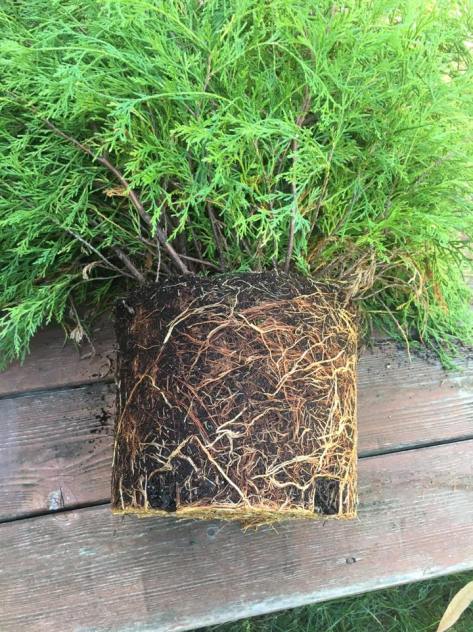
We take a shrub out of its container and see white fragile-looking roots and instinctively we don’t want to damage them or add to transplant shock. We know that healthy growth in a shrub is dependent on a good root system, so why would we mutilate or injure them?

nottoopotboundbutstill

Are Roots Really That Fragile?

Well, it turns out that those roots are not as fragile as we think. While you should take care with when transplanting seedlings, especially annual flowers and vegetables, woody perennials, shrubs, and trees all benefit from a more vigorous approach, according to Linda Chalker-Scott, Ph.D., Extension Horticulturist and Associate Professor at Washington State University and one of the ‘Garden Professors’ that I admire for their scientifically-based knowledge of horticulture.

Garden Professors on Facebook or Garden Professors Website

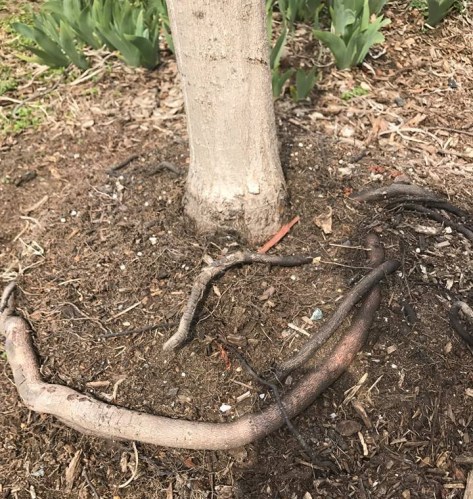
When we purchase gallon-sized pots in the nursery, the plants are often pot-bound, the often suffered from circled root systems, which if not corrected become even more problematic once the shrub is in the ground. Eventually they become girdling roots, which will lead to the early death of otherwise healthy trees and shrubs, as you see below.

timhamilton

(photo courtesy of Tim Hamilton)

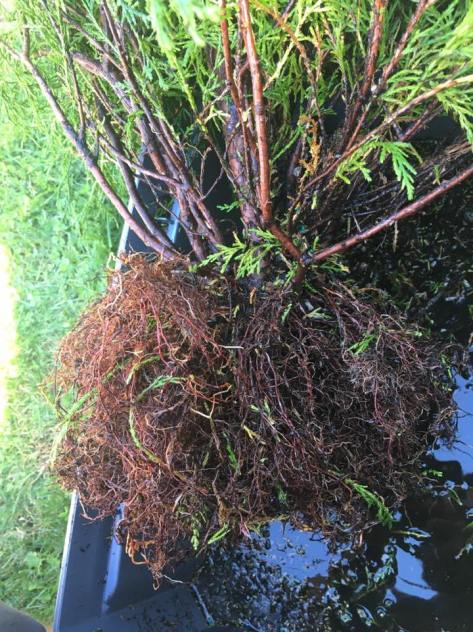
Think of it this way – roots respond to respond to pruning in much the same way as the crown—it stimulates new growth. If you prune the roots when you transplant, especially those that are excessively long or misshapen, the plant will respond by generating new, flexible roots that help them establish in the landscape. The best way to do this is by root-washing the shrub – taking it out of the pot, putting it in a wheelbarrow or other container, and washing off all the media so that you can see what the root system looks like.

cutcrossingandgirdlingroots

Two Critical Things to Do

  1. Prune the roots in a root-bound shrub or tree to avoid future problems
  2. Remove the media (soil) that shrub or tree came in

The second suggestion relates to the soil that comes with your tree or shrub. I always thought you just put it right in the ground, but evidence suggests that (generally) the container media is a soil-less mix with a large proportion of organic matter and pumice. It is best to remove this media as part of your root inspection, and use it as topdressing after planting, followed by mulch.

If you put the media in with your new plant, the material will inhibit root development outside the planting hole. It will also lose water more rapidly than the surrounding native soil (because of its porous nature), resulting in increased water stress to your new transplant.

Watering is Essential

As with all transplanting, regular and deep watering is needed to keep the new shrubs or trees happy while they establish their new root systems. The fall is a great time to plant trees and shrubs so happy planting!

Want To See How It’s Done?

Doug Gifford of Michigan recently posted to the Garden Professors Facebook page about his root washing, root-pruning, and planting of shrubs. You can check out the link here. Credit to Doug for most of the photos on this blog post.

shookoutandwet

A Special Note

If you plant a shrub or tree already in full leaf they will be more stressed than those that are dormant. Dormant planting is better as all resources go towards root establishment. You may see leaf damage or even death in the short run. But as long as the roots are kept cool and moist throughout the transplanting process, and as long as you keep the area mulched and watered, it should be fine in the long run.

Check out more detail on this issue in this blog post. It talks about the four things that result in landscape planting failures and how changes in the nursery industry have resulted in more problems with roots. Many of these issues also apply to balled and burlapped (B&B) trees – more information here.

This year, Dr. Chalker-Scott extended her experiment to perennials, as talked about in this blog entry  Three months later she revisited the site – here are the results.

For more information on other horticultural myths check out these pages. Even better? Spread the word to others 😊
Horticultural Myths – Dr. Linda Chalker-Scott
Garden Myths (Robert Pavlis’ site – he is based in Guelph, Ontario)

Planting to Encourage Proper Root Growth and Branching

By Sue Flinders-Adams, Master Gardener

Here are a few tips to ensure that the new shrub or tree you just brought home will thrive and grow to its full potential.

1. Before planting, soak the plant in the pot, in a pail of water for a few hours or even overnight to hydrate the roots.

2. Carefully remove plant from the pot. If it doesn’t come out easily gently press on the sides so that the roots will come away from the pot, and tap on the bottom.

3. There are usually roots circling the pot – gently coax these roots away from the root ball to encourage outward growth. If roots are left in the ‘circling’ position, they will continue to grow in this direction, circling the plant and even girdling the trunk of the tree in 10 or 15 years.flinders pic 1

4. The picture shows the roots that have been spread out in the very large hole. Partially cover the roots to hold them in place and water thoroughly with transplant fertilizer, according to the directions. Fill in the hole with the surrounding soil. Top dress with an inch or two of composted manure, and then 3 inches of mulch. Prune off any dead branches.flinders pic 2

5. Branches are often cramped and a little twisted from shipping. Gently pull them away to a better positon and secure with plant supports (pictured). In a couple of weeks you can take the supports away and the branches will continue to grow in that direction.

6. flinders pic 3Three weeks later, the Black Lace Elder is looking very happy. It is October which explains the lack of new growth.