Category Archives: Garden Cleanup

Five Great Garden Practices for the New Year

By Christine Freeburn, Master Gardener

With the new year days away, resolutions for 2025 might be on your mind. Here are a few easy garden practices you might want to include in those New Year’s Resolutions.

  1. Keep a record.

Have a file, record on your computer, write in a journal, put plant tags in a zip lock bag by year. Write on your tags the year & where you planted. It is important to know which hydrangea you planted, so if you need to research how to prune or how large it should get or if you want to purchase another, you will have that information. When you keep tags or record what annuals you plant, if it is something you want to repeat, you will have the exact variety when you go shopping the next spring. There are so many varieties of so many plants.

  • Keep things clean.

Disease is often spread through the tools we use. Have a pack of wet wipes in your tool box & clean tools after each use. Sharpen tools at the end of gardening season, so they are clean & ready to go in spring.  Although you should use leaves as compost, don’t leave diseased plants in your gardens. Place them in your green garbage. Keep houseplant soil free of fallen leaves as well.

  • Keep yourself healthy.

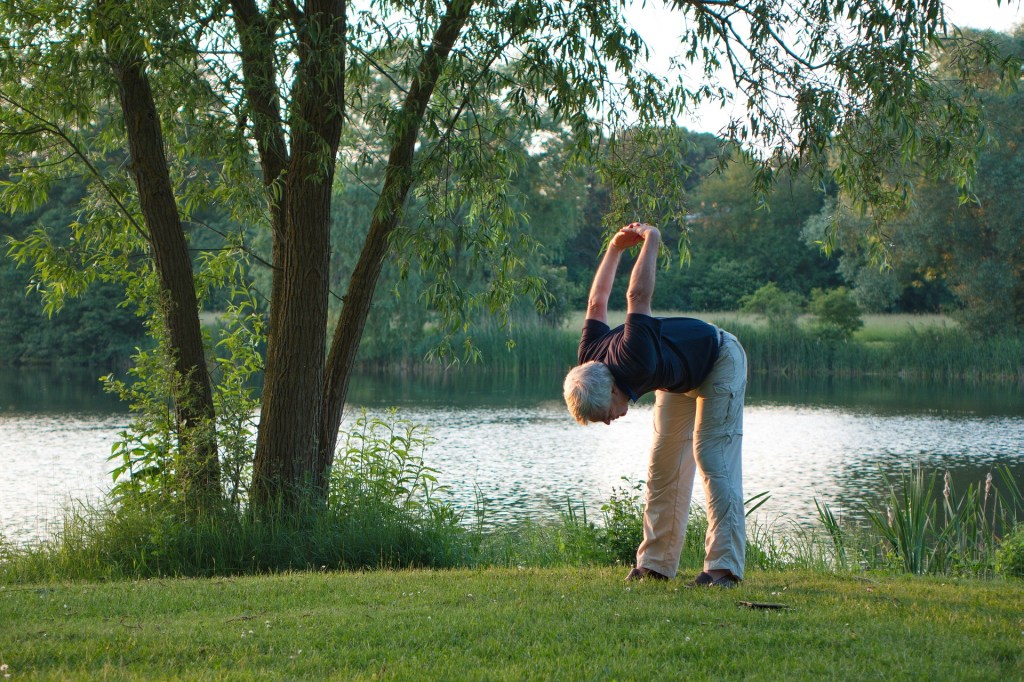
Stretch before going into the garden to do manual work. Limit yourself to an amount of time that is good for you and your body and stop when your time is up….your garden will be there when you come back. Take your water bottle with you. Wear gloves & hat to protect yourself. Don’t work in the blazing sun…. bad for you & your plants.

  • Do your research.

Right plant in the right spot will give you more chance of success. If you plant a water loving perennial in a dry sandy spot, the plant will suffer or fail. Planting a tall annual at the front of your bed will obscure the pretty ones behind it. Use the internet, but make sure you are using reputable sites where knowledgeable gardeners are sharing good information. Look for articles written by Master Gardeners or university professors or scientists. Look for websites that end with “edu.” You can also contact Peterborough Master Gardeners online (peterboroughmastergardeners.com) to ask questions or check out what events we will be at in 2025.

  • Enjoy your gardens.

Remember, you garden because you get enjoyment from your hard work. Wander through your garden, peaking at the new sprouts coming up or the gorgeous flowers opening. Breath deep. Enjoy the birds, insects and wildlife that visit. Research shows that gardening and being in nature help our minds, bodies & souls.

Happy New Year! From Peterborough Master Gardeners

November Reflections

by Lois Scott, Peterborough Master Gardener

Even though we are more than half way through November many gardeners are still finding things to do, enjoy or plan for in the garden.

This fall I planted a number of woody plants including three small trees and 2 shrubs which have required ongoing watering. With new woody plantings it is important to water them well, right up to the time that the ground freezes, paying attention to not drowning them but preventing the roots from drying out.

Tree roots are actively growing in the cool fall weather so they need the moisture. Here’s how to do it right.

As the season advances and the trees are bare it is an excellent time to see if there are any pruning needs. Wood that is diseased, damaged or dead/dying should be pruned sooner rather than later.

According to Lee Reich, author of ‘The Pruning Book’, pruning for structure is best left until late winter after the coldest part of the winter is past. Wounds in wood heal most quickly just as plant growth is getting underway rather than the fall when wounds heal poorly and many fungi are spreading their ‘disease producing spores’.

Of particular note is the caution to not prune any Oak species during the growing season due to Oak Wilt disease. If you do need to prune during the growing season apply wound paint to the cut area.

I am planning for some structural pruning on a Star Magnolia in late winter 2025 and I can now see the tree’s structure to plan for that which is a process I enjoy.

This November I am still enjoying the frost tolerant kale and arugula that were started in grow bags in late summer. They have stopped actively growing with the cold temperatures but are still very edible. At this time of year there is no concern about them bolting (going to seed)!

Walking our neighbourhood has also afforded me the opportunity to see and enjoy what nature and gardens have to offer in November. Oaks still bearing their beautiful fall foliage and my neighbour’s fabulous roses are just a few of the visual treats.

I hope your November garden reflections are enjoyable and satisfying!

Finding Freedom: Guerilla Dahlia Dividing

By Marilyn Homewood, Master Gardener

As the days shorten and the leaves fall, it is time to engage in the annual ritual that I call the dahlia conundrum.  Dahlia growers spend sleepless nights wondering whether to wash clumps or store with the dirt on; what to store in—peat, shavings, vermiculite or saran wrap; store as a clump or as individual tubers. They fill the Amazon coffers by ordering the newest recommended snips as though these snips will miraculously reveal the tiny hidden eyes in the crown of the tubers.  They pack every individual tuber away, ending up with far too many containers of dahlia tubers.  After all, how many tubers do you really need next year??

This year, I decided to make my own life easier and divide with the goal of having enough tubers for planting next year (with a backup in case of bad storage).  And discard the extra tubers no matter the volume.  First, I dug up my tubers, shook off the dirt and let them dry overnight.  Before dividing I check each plant for signs of disease or damage. Potentially diseased plants are discarded and damaged tubers removed.

Freshly dug dahlia tuber

When I come across a large clump, I split the stem (and hence the clump) with a chisel and mallet.  Effective and fast if not a little messy.  Next step, I look for a small grouping of tubers that can be stored as a unit.  This is what is more commonly done in Europe.  If small clumps are saved, then you no longer need to search for eyes.  There will be sufficient crown material to provide an eye or two.  Just be sure the tubers are firm, not damaged and that the necks are intact. 

Clumps labelled with flagging tape

I label each small clump with flagging tape which can be easily attached to the clump and tied in place.  I repeat this process only until I have the desired number of units of tubers.  The rest goes to the compost pile.  I was ruthless!  Before moving onto the next plant, I disinfected my tools. 

Dahlias are known to be infected by a large number of viruses which can be transmitted from plant to plant by pruning equipment.  Studies in the USA have shown that over 80% of dahlia stock is infected by a virus.  While good data is not available for Canada, it only seems likely that a significant portion of our tubers may be infected as many growers here import new varieties from the USA.  Insects also transmit these viruses between plants.  In the live plants, viruses are often discovered by observing changes in the coloration of the leaves.  Sometimes it is hard to be absolutely certain but with dahlia’s there is a saying “When in doubt, throw it out”.  It is not uncommon that when I discover a plant showing chlorotic changes in the leaves, that I simply pull the entire plant up tubers intact and discard it in the waste (never the compost!).  Left in the garden, these plants can infect all of your other dahlias.

Disinfectants known to be effective are 10% bleach solution using  a contact time of 10 minutes, Virkon S, a viricidal agent commonly used in veterinary cleaning applications; Virkon has the advantage of being non corrosive and has a contact time similar to bleach. Lysol All Purpose Cleanser has also shown viricidal activity provided that a contact time of 2 minutes is achieved.  70% rubbing alcohol is a common viricidal agent with a minimal contact time making it suitable for the wiping of snips between plants when harvesting blooms.  Remember to clean all dirt and sap from tools prior to using a disinfectant.
Once all the needed clumps have obtained, tubers can tucked away into the storage medium of your choice (vermiculite medium grade for me) and put into an area that is 50 degree F or less for the winter.  Check on tubers monthly to adjust moisture levels and wait for the next spring.

 Left: Vermiculite in bulb crate
Right: Tubers packed in bulb crates ready to store in basement

My efforts this year reduced my time dividing by 66% and cut the volume of dahlias stored in half!  More time for planting fall bulbs!

Resources

Clean and disinfect gardening tools and containers:
https://extension.umn.edu/planting-and-growing-guides/clean-and-disinfect-gardening-tools

American Dahlia Society: https://www.dahlia.org/docsinfo/understanding_virus_in_dahlia/virus-documentation-index

Dahlia Mosaic Virus: https://dahlia.org/wp-content/uploads/2018/01/ADS-DMV_Symptoms_Slides.pdf

Off with Their Heads

By Christine Freeburn, Master Gardener

Deadheading is an important garden maintenance chore for July and there are several reasons for deadheading (or not). When deadheading, it is important to not just take the blossom off, but to cut the stem right back to the first junction and cut above that. Often you can just break the stem by hand, but be sure not to rip it. Use good pruning shears to make a clean cut. This applies to almost all deadheading, whether it is hosta, daylily or annuals.

The reason a plant grows and flowers is so it will go to seed and reproduce. If you remove the seed head you are encouraging the plant to put its energy back into the roots and leaves, making it become a stronger plant. Doing this as soon as possible after the flower is spent, is important for the overall look of the plant and the energy redirected.

Perennials that rebloom such as salvia, dianthus, delphiniums and roses should be deadheaded to encourage new blooms. Many new hybrids have tags that say “reblooming”, so watch for this when purchasing. Annuals like dahlias, marigolds and zinnia all benefit from cutting spent blooms to encourage new flowers.

Another reason to deadhead is to control self seeding in the garden. Many perennials and biennials will multiply by dropping seed. Forget Me Nots, Oriental Poppies, Lupins and Native Coneflowers will all appear in your garden if you don’t deadhead or disturb the soil.

Deadheading also makes the garden a bit neater. I deadhead Iris right after they bloom; cutting the stem right back. I often leave Siberian Iris to form seed pods as I use them in dried arrangements.  I don’t particularly like the washed out purple flowers on Hosta, so I usually cut them back. There are some Hosta flowers that are fragrant and white, and I like to leave those on. The profusion of flowers on the daylilies this year are stunning. I like to snap off the spent blossoms, so they don’t distract from the fresh new flowers. Peony petals separate and settle through the flower bed, so I like to remove them before this happens. Other perennials that benefit from deadheading include yarrow, cranesbill, phlox, and astilbe.

Clematis form a lovely fluffy seed head which can be left on. I also leave my Monarda didyma for the birds and the pretty seed heads.

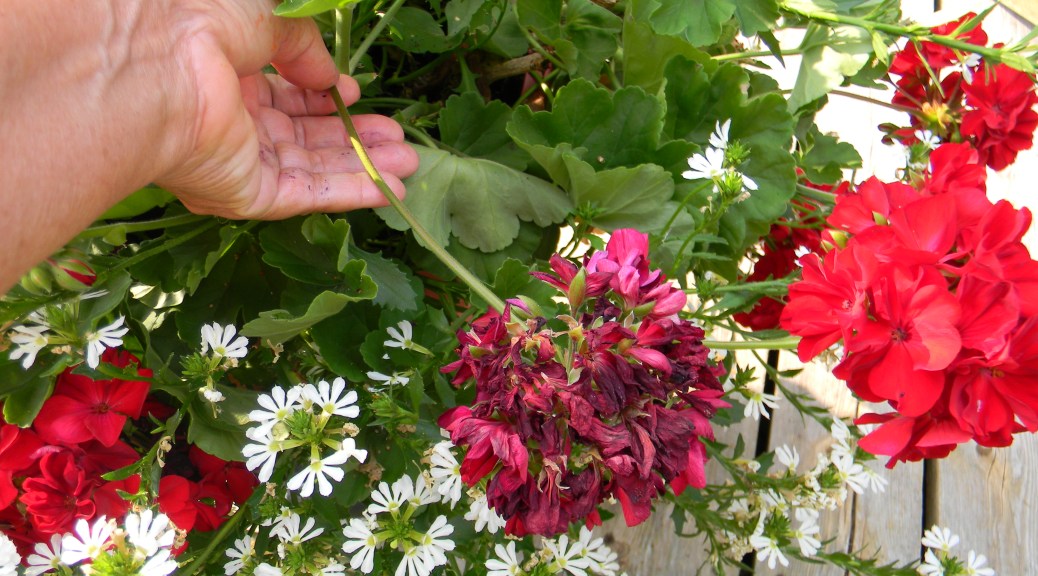
Your hanging annual pots and containers also may need a bit of TLC by now. Annuals like to be cut back. It encourages new fresh growth and flowers, makes them bushier because when you cut a stem it will branch out. Cutting back also brings the planting back under control so it doesn’t look overgrown.

Removing seed heads is removing food that birds may enjoy. If you are growing natives, you may want to leave them for the birds, butterflies and other pollinators, however you can deadhead and leave in an open compost pile.  Although I deadhead throughout the summer, by late August, I stop and let the seed heads form on perennials like coneflower and black eyed susan so the chickadees and finches can feast.

So, get in your garden, enjoy the beautiful blooms and “off with the heads” of those that need it!

https://extension.psu.edu/to-deadhead-or-not-your-final-answer-is

Ditch Lilies – a Cautionary Tale

By Emma Murphy, Master Gardener

Once upon a time there was a gardener who wanted something that grew quickly to screen a neighbour’s unsightly yard and house addition. She noticed that the ‘ditch lilies’ that surrounded her front yard tree (already there when she moved in) seemed to be pretty vigorous, so she planted a row of them between the yards, along with some small bridal wreath spirea (Spirae aprunifolia).

What she didn’t realize was that she had unleashed a horrible monster into her garden, one that quickly engulfed any other plants, sucked all the moisture out of the soil, and eventually killed most of those spirea.

Yes that gardener was me, many years ago, before I knew better and before I became a master gardener. So this year I knew I had to finally tackle the monster, remove all these plants, and reclaim this garden area. I knew how much work it would be (it took me three weekends this spring), but I got it done. Here’s my story…

Even though you see it growing in ditches around the province, Hemerocallis fulva (aka ditch lily, tawny daylily, orange daylily, tiger lily) is native to China, Japan and Korea and was introduced to North America in the early 19th century. They spread via seed and a network of tuberous roots, and can reproduce and proliferate from a small fragment left behind during removal. In 2020 the Ontario Invasive Plant Council added this plant to their invasives list, and their Grow Me Instead Guides offer some native alternatives to consider.

Screen capture from the Grow Me Instead Guide on Hemerocallis fulva

Garden bed, spring 2021

So this was my garden bed in May this year – just waiting to burst out and take over, again. Every single one of these plants had to be dug and lifted, making critically sure to get every last bulb. These photos show how many bulblets can be on just one stem – it was quite overwhelming to think of the job ahead.

All the plants that were dug out were put in black plastic garbage bags and left out in the hot sun beside our barn for a month. At last count I used 45 garbage bags, and they were a slog to carry as they were heavy!! Eventually they went to our rural dump, where the hot composting they do should ensure their demise.

Bit by bit, over three weekends, I got them all out. It was beneficial to have a dry spring, as it made digging them out a little easier. But still a workout!

Once everything was cleared out, I weeded the soil for anything else. All that remained were my tulips and a few hardy perennials that had been gasping for air for more than a decade.

Getting there.
Ready for a fresh load of soil.

With a fresh load of soil on top and a final check for bulblets done (and knowing that I would have missed a few), I put in some new plants, aiming for 50 percent native plants (those marked with a *). The area has both sun and shade spots so I needed to be careful with my choices.

For sun, Echinacea*, Gray-headed coneflower* (Ratibida pinnata), summer phlox (Phlox paniculata), American Witch Hazel* (Hamamelis virginiana), New England asters (Symphyotrichum novae-angliae), Sedums, Switch grass* (Panicum virgatum), Lesser catmint (Calamintha nepeta ssp. nepeta), Black-eyed Susans* (Rudbeckia hirta), lupins, Giant fleeceflower (Persicaria polymorpha), Cyclindrical Blazing Star* (Liatris cylindracea)[once I can convince the bunnies to stop eating it – see green covers], and Virginia Mountain Mint (Pycnanthemum virginianum).

For part shade/shade, Mourning Widow Geranium (Geranium phaeum), Purple Flowering Raspberry* (Rubus odoratus), hostas, Sensitive Fern* (Onoclea sensibilis), Virginia Waterleaf* (Hydrophyllum virginianum), Columbine (Aquilegia), Starry False Solomon’s Seal* (Maianthemum stellatum), Buttonbush* (Cephalanthus occidentalis), Zig-zag goldenrod* (Solidago flexicaulis) and Berry Bladder fern* (Cystopteris bulbifera). Also the infamous Outhouse Plant (Rudbeckia laciniata ‘Hortensia’), to be replaced with something else next year. Any suggestions for fast growing native shrubs that can handle part share welcome!

The garden bed needs time to fill in, so we’ll see what it looks like next year. In August I went back into the bed and sure enough, there were new ditch lilies growing in a few places. Remember it only takes one bulblet for them to grow. But half an hour later they were all gone as well.

I suspect I will on alert for the odd ditch lily plant showing up for the next few years, but I’m really proud to have removed this nasty invasive plant from my garden and rejuvenated it with native plants. And my two lovely sugar maple trees are glad for some more breathing room.

NOTE: The orange, single flower, diploid Hemerocallis fulva is the only daylily currently listed as invasive. Most daylily cultivars are diploid or triploid and do not spread invasively like the ditch lily.

Lending Insects a Helping Hand in our Gardens

By Laura Gardner, Master Gardener in Training

When some of us think of insects, it is common for them to be thought of in a negative light. Some of our earliest childhood memories include being stung, bitten, or just plain scared by the sight of them. I can remember running screaming from an outhouse at a provincial park when I was about five years old. What was so scary? It was the sight of a Yellow Garden Spider (Argiope aurantia) hanging in its web in the stall. Fortunately, the experience didn’t make me fear or dislike spiders and as a gardener I know how beneficial they are to have around. While some insects certainly do deserve our scorn— invasive species such as the LDD moth (Lymantria dispar dispar); Emerald Ash Borer (Agrilus planipennis); Japanese Beetle (Popillia japonica), etc.—by and large, the majority of insects are harmless and beneficial. Not long ago, I saw a couple—perhaps grandparents, out for a walk with their grandson. One of them was urging the young boy to stomp on an ant on the pavement, calling out “Get it! Get it!” It was disheartening to see. It is experiences like this that call for a shift in our thinking about insects.

Bumblebee (Bombus sp.) on False Sunflower (Heliopsis helianthoides)

I recently got a sneak preview of a book by British entomologist Dave Goulson called Silent Earth: Averting the Insect Apocalypse (Harper Collins). It is to be published this Fall (September 2021). The copy I reviewed was an e-book proof and so page numbers referred to here may change in the final published copy. Goulson’s work is primarily focused on bumblebees and as the founder of the Bumblebee Conservation Trust in the UK, he is dedicated to reversing the decline of them. He is also known for his work that was instrumental in influencing the European Union’s decision to ban neonicotinoids in 2013. Goulson wrote this book in an effort to bring more public attention to the recent and rapid decline of global insect populations—which are critical for our planet’s survival. He also explores the chief causes of insect declines such as habitat fragmentation, industrial farming practices, pesticides, climate change, and non-native insect diseases (p. 71) and provides suggestions for readers that can help support insects—especially gardeners.

Bumblebee (Bombus sp.) on Sweet Joe Pye Weed (Eutrochium purpureum)

Here are a few highlights from the book:

Goulson refers to a phenomenon called “Shifting Baseline Syndrome” where humans tend to only see their current world as “normal” and are unable to detect changes over time. Humans also tend to have something called “personal amnesia” in which they downplay the extent of change (p. 64-65). With these points in mind, it is no wonder that most people would not know that insect populations have recently declined by as much as 75% (p. 50) and that there have been parallel declines in populations of insectivorous birds (p. 58). One bird that I remember as a child that I haven’t seen since is the Eastern Meadowlark (Sturnella magna). This species is one of those that depends on insects in its diet.

One concern that the author has is the level of human awareness of the existence of the natural world. It is important to learn the names of plants and animals—otherwise they cease to exist. If they don’t exist, their importance can’t be recognized. Astonishingly, in 2007, some of the words eliminated from the Oxford Junior Dictionary included words such as acorn, fern, moss, clover, kingfisher, otter, among others (p. 225).

87% of all plant species require pollination in order to flower, produce fruit/seeds, and ensure perpetuation of the species. This includes 75% of all agricultural crops (p. 26). Most of this is performed by insects and a large part is performed by those other than bees—flies, ants, beetles, wasps, moths and butterflies. A world without insects means that we would need to subsist mainly on cereal crops as these can be wind-pollinated. I can’t imagine going without fruits such as strawberries, apples, cherries, raspberries, and even my morning coffee (p. 26).

Insects are not only important pollinators, but they assist in the development of healthy soils. Not only do they help to aerate soil, they are valuable decomposers of organic matter—participating in a process along with bacteria that help make nutrients more available to plants (p. 29, 31).  As biological control agents, predatory insects such as Lady Bugs (Coccinellidae spp.), Lacewings (Chrysopidae spp.), Ground Beetles (Carabidae spp.), Wasps (Vespidae spp.), etc., can help us reduce the need for pesticides.

Blue Mud Dauber (Chalybion californicum) on Swamp Milkweed (Syriaca incarnata)

What can we do to help?

Despite the current state, Goulson is optimistic that insect declines can be stabilized or reversed because they are generally good at reproducing—we just need to support them better (p. 216). Here are some ideas:

  1. Learn how to identify the difference between harmful and beneficial insects. The majority (95%) are the latter.
  2. Reduce or avoid the use of pesticides and give beneficial predatory insects a chance to take care of the problem first (p. 277). Even so-called organic treatments such as diatomaceous earth, BTK, horticultural oils, etc. need thoughtful consideration before use as they can harm harmful as well as beneficial insects.
  3. Learn how to differentiate between irreversible and cosmetic damage in your plants. Accept that plants are meant to be food sources for insects and some imperfections and damage is ok. Give up growing ornamental plants that are persistently defoliated by certain insects (e.g. Asiatic Lilies).
  4. Incorporate a wide range of native plants that flower throughout the season in your garden to attract beneficial insects. One of the best late flowering perennials is New England Aster (Symphyotrychum novae-angliae). It provides a valued food source for migrating Monarch butterflies. Some of the best food sources for insects are early flowering trees such as Serviceberry (Amelanchier spp.), Maple (Acer spp.), and Crabapple (Malus spp.).
  5. When using mulch in flower beds, leave some soil exposed so that ground nesting bees can have easy access. Some solitary wasps such as Mud Daubers (Sphecidae spp.) also need easy access to bare soil in order to glean material to build their nests.
  6. Reduce lawn and use the space for more plants. Reduce mowing of the lawn that exists. Allow a corner of your garden to “grow wild” and “get messy.”  (p. 277).
  7. Choose native plants over “nativars.” A nativar is a cultivated variation of a native plant. Some are supportive of pollinators but many are sterile or lack pollen and therefore are unable to provide food. The ones that are most likely to be the least supportive will have features such as double blooms, different leaf colours, etc. Reduce planting of ornamental annuals like Petunias, Begonias, Pansies, etc. because of their tendency to have no pollen or nectar (p. 233). That being said, some of these plants can still be enjoyed.
  8. Choose a range of plants that support the broadest number of insect species. While Milkweeds (Asclepias spp.) are in the limelight as being supportive of Monarch Butterflies (Danaus plexippus), compared to some other plants, they only support 12 Butterfly and Moth species (Tallamy, Bringing Nature Home). Goldenrods (Solidago spp) support 115 different species. Some, like Canada Goldenrod (Solidago canadensis) can be aggressive in small gardens but there are more restrained types such as Blue-Stemmed Goldenrod (Solidago caesia), and Zigzag Goldenrod (Solidago flexicaulis).
  9. Avoid aggressive fall and spring clean-up of leaves and hollow, dead stems. Doug Tallamy describes the practice of waiting 7-10 consecutive days of 10 degree C. temperatures for insects to emerge as myth as many insects emerge at different periods throughout the season. For example, Io (Automeris io) and Luna Moth (Actius luna) emerge around mid May (Tallamy, Leaf Litter: Love it and Leave it).
  10. Recognize that commercially produced “Bee Hotels” can become populated by non-native bees such as European Orchard Bee (Osmia cornuta), Horned-Face Bee (Osmia cornifrons), and Blue Mason Bee (Osmia coerulescens) as well as native bees (p. 135). If used, periodically clean them so as to reduce mites and fungi that can be harmful to the bees.
  11. Reconsider taking up beekeeping as a hobby. The European Honey Bee (Apis mellifera) threatens native bees because they take the lion’s share of available plant pollen (p. 139). It is also not a good strategy to rely on one species for pollination in case something happens to that species (p. 33).
  12. Raise awareness and share your knowledge with family and friends. You can convince others that insects need our help if they realize they themselves will be personally impacted by their decline (p. 216).

Selected Resources

Holm, Heather. Pollinators of Native Plants: Attract, Observe and Identify Pollinators and Beneficial Insects with Native Plants (Pollination Press, 2014).

Tallamy, Doug. Bringing Nature Home: How you can Sustain Wildlife with Native Plants (Timber Press, 2009).

Tallamy, Doug. Leaf Litter: Love it and Leave it. April 2021. Online: https://tinyurl.com/4jphhnbc

Walliser, Jessica. Attracting Beneficial Bugs to your Garden: a Natural Approach to Pest Control (Timber Press, 2013).

Xerces Society for Invertebrate Conservation. Visit https://xerces.org/publications to view and download a wide range of factsheets and other guidance documents concerning beneficial insects, native plant lists, pesticides, habitat construction, and more.

Monarch Butterfly Caterpillar (Danaus plexippus) on Swamp Milkweed (Syriaca incarnata)

The Importance of Edging

By Mary-Jane Pilgrim, Master Gardener

When it comes to maintaining a healthy garden, one of the most important elements that you need to consider is landscape edging. Options for edging range from a simple trench to high-end paving stones, and everything in between.

Edging creates clean, crisp lines between beds and other areas. It helps to keep grass from creeping into surrounding garden areas. At the same time, it prevents soil or mulch in garden beds from spilling onto the lawn whenever you water or it rains. It protects your expensive plants from the lawnmower, and your tree trunks from the string trimmer. Landscape edging also controls gravel or mulch pathways; it maintains clearly defined walking areas while keeping the path materials in place.

For me, edging has the critical job of making sure that the grass knows what its limits are, and for the garden to know the same. Once grass makes its way into a garden, it’s “game over, garden”. The grass wins, every single time.

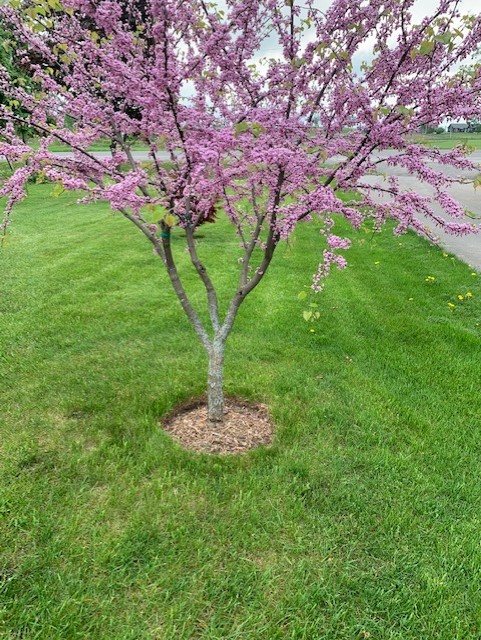
Trench edging around author’s blooming Eastern red bud tree (Cercis canadensis)

If you’re using permanent edging such as the items described below, it’s a one-time installation for years of service. If you’re using the temporary simple trench, it should be dug/redug several times per season in order to be effective: spring, summer and late fall. I personally use a very short, flat spade and a root knife (reverse curve blade) to do this task — cutting away minimal grass so as to ensure that the garden does not get incrementally bigger each year. Ensure that the mulch, when spread, comes up to the edge of the trench bottom but doesn’t fill it. You don’t want to have any materials at the edge that grasses can grow through because they will be persistent in trying to jump the barrier. For anyone with a Stihl string timmer, I also use a Stihl Bed Edge Redefiner each spring to loosen the soil and redefine the edge on my garden beds.

There are many attractive and more permanent edging choices, if digging is not your thing:

  • Stone materials including natural fieldstone can be used, and there are some great stone tile options on the market as well.
  • Repurposed bricks can create a classic look for your landscape.
  • Plastic is affordable and easy to install due to its flexibility. The least expensive edging does look inexpensive, so invest in the best you can afford. Use the longest spikes you can find to anchor this edging into the soil.
  • Metal: Similar to the plastic edging, you can purchase flexible aluminum edging strips. They look great but at present these are quite pricey.
  • Concrete: You can purchase preformed sections of concrete landscape edging that are ready to be set in place, or you can make a simple form and create a custom edge. The downside of using concrete is that it’s pretty permanent!
  • Wood: Usually more affordable than at present, this material is easy to work with in straight lines, and adds an informal, organic look. Count on wood edging to last about 10 years. Pressure treated wood barriers are not recommended for edging vegetable gardens, and old railway ties are not recommended at all due to the leakage of harmful creosote over time.
Trench edging around author’s front yard garden

Resources

Better Homes & Gardens: Using Landscape Edging

Stihl Bed Redefiner

Family Handyman: The Best Garden and Lawn Edging Ideas and Tips

Joys of Nature and Spring Garden Tasks

By Sharleen Pratt, Master Gardener

April 22nd was Earth Day.  It is a time for reflection on what we can do to help develop a new approach to conservation and it can all start in our own yard. As we experience what we all hope will be our last full shutdown, we need to remain optimistic in the growing interest in gardening with natives and the number of younger people who are learning to grow their own vegetables.  Douglas Tallamy, author of Nature’s Best Hope, writes that as homeowners, we need to “turn our yards into conservation corridors that provide wildlife habitats”.

Spring is a time of renewal.  To help us get through the stressful days of this lockdown, a walk outdoors will help you experience the joys of nature and all it has to offer! 

I have created two lists.  The first is ‘Joys of Nature’ that you will encounter this time of year.  The second is ‘Garden Tasks’ to tackle over the next few weeks.

JOYS OF NATURE

Hepatica image compliments of Joan Harding, Peterborough MG
  • My garden makes me smile this time of year with all the blooming Daffodils (Narcissus), Hyacinths, Hellebores and even Lungwort (Pulmonaria officinalis). 
  • Local ponds are alive with the sounds of the spring peepers and the chorus frogs.  If you take a walk and come across a wetland, you will be amazed at the sound.
  • Many of the migrating birds and waterfowl have returned.  My feeders are being well used by the yellow finches, grackles, house finches and mourning doves.  If you enjoy the hummingbirds, don’t forget to get your feeders out now.  They will soon be back!
  • A walk through the woods will reveal the beauty of the spring ephemerals.  Ephemerals are short-lived spring flowers that take advantage of the sunshine before the trees get their leaves.  I have seen bloodroot, hepatica, coltsfoot and the beginnings of the trilliums and the dog-toothed violets.
  • If you are out digging in your garden, don’t be surprised if a robin will follow you around in the hopes you might throw him a much sought-after worm.  Robins are already nesting so the female is likely to be at the nest site.
  • Watch for early butterflies such as the Mourning Cloaks, Eastern Comma and the Spring Azure.
  • In early May, you should begin to see the white blossoms of serviceberries and the beginnings of the lilacs and the cherry blossoms.

Get outdoors, take a deep breath and walk slowly through a local park or wooded area and enjoy many of the items mentioned above.  Do it now before the return of the blackflies and mosquitoes!!

If you are interested in a sample of simple nature events in the Kawarthas, Drew Monkman, a retired teacher and well known environmentalist and advocate for climate control, has written this monthly almanac: https://www.drewmonkman.com/sample-page/monthly-almanacs/

SPRING GARDEN TASKS

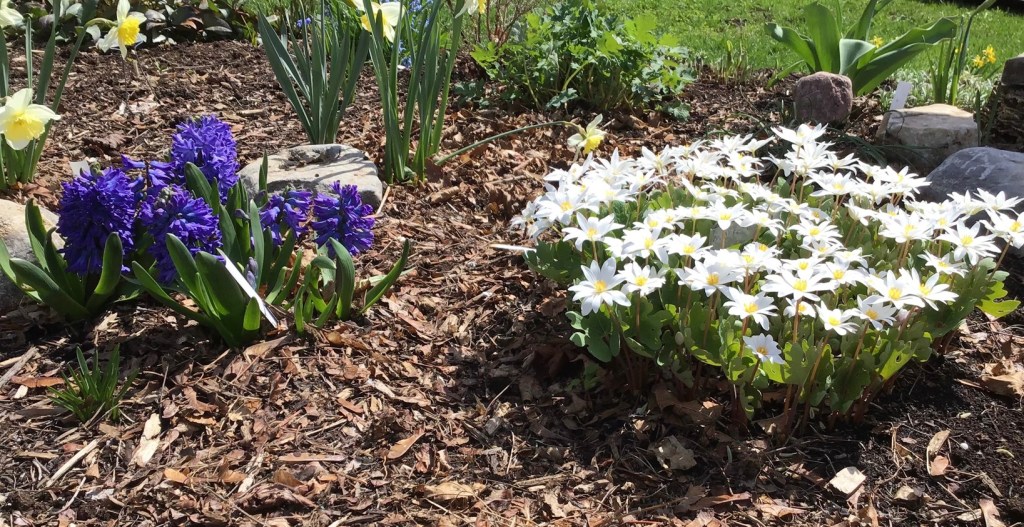
Author’s Spring Garden… Hyacinths, Bloodroot and Daffodils
  • Only rake your lawn if walking on it leaves NO footprint.  The time to overseed your lawn is generally when the lilacs are in bloom.
  • Now is the time to top dress a generous amount of compost and other organic material into your garden beds.  Let the earthworms do the work.  I do not suggest that you rototill your garden as this disturbs the beneficial life in the soil.  Bacteria, mycorrhiza and insects are damaged, sometimes beyond repair, with rototilling.
  • Prune overgrown vines and shrubs such as some hydrangea and some of the clematis; basically all the shrubs and vines that do not bloom in spring.  Do not prune lilacs as they bloom on last year’s growth.
  • Gradually remove protection on rose bushes and prune down to a swollen bud.  Remove dead, diseased and crossing branches.
  • If you haven’t already, now is the time to sow frost tolerant veggies such as peas, carrots, spinach, lettuce, beets, kale and radishes directly into the garden.
  • Divide and transplant perennials as growth resumes.
  • Now is a good time to think about planting shrubs and trees.  Maybe you would like to replace an old shrub with something native, such as Black chokeberry (Aronia melanocarpa), Eastern snowberry (Symphoricarpos albus) or Gray dogwood (Cornus racemosa)
  • Be sure to have your rain barrels set-up and ready to collect that wonderful spring rain.
  • Keep your bird baths filled and cleaned.
  • If you have been growing tomatoes, peppers, cucumbers and annual flowers indoors, early May is the time to begin to harden off those young seedlings.
  • The soil is still quite soft, so now is a good time to edge your garden beds as well as start to pull all those weeds that seem to survive no matter what the weather.

    Get out in your gardens, enjoy the warmer temperatures and don’t forget to get your knees dirty!

The Importance of Stretching While Gardening

Make sure you warm up and stretch like you would for other activities!

By Emma Murphy, Master Gardener

(Disclaimer – The information provided is for general educational purposes only and not intended as medical advice; please discuss your personal situation with a medical professional)

The last time I was at my physiotherapist she said that more than half the cases she sees in April and May are related to gardening and sports injuries. People rush into doing things too quickly and most injuries could have been avoided by simply stretching properly to warm the body up.

“The secret to a healthy garden is a healthy gardener.”

Canadian Physiotherapy Association

Gardening is wonderful for your physical, mental, and emotional health, but if you don’t take care to stretch your body before spending time crouching, bending, and pulling weeds, you’ll end up feeling stiff and sore or potentially injuring yourself. This is especially important at the beginning of the season when we’ve been less active over winter but are overly enthusiastic to get into our gardens and complete all our spring tasks.

A stretching routine before and after gardening helps to minimize muscle imbalances, prevent injury, and improve your ability to garden for longer periods.

A warm up and stretches are critical to avoiding injury, particularly as we get older.

First, take a walk around your garden (or around the block) for 5 to 10 minutes to warm up your large muscle groups. The best stretches prior to gardening are dynamic stretches because they prepare your muscles for the repetitive movements required with gardening. After you finish gardening static stretches are better to improve your overall flexibility. Read more here.

This warm up will raise your heart rate and body temperature, as well as giving you an opportunity to assess your gardening situation and think about your plan for tackling the tasks ahead.

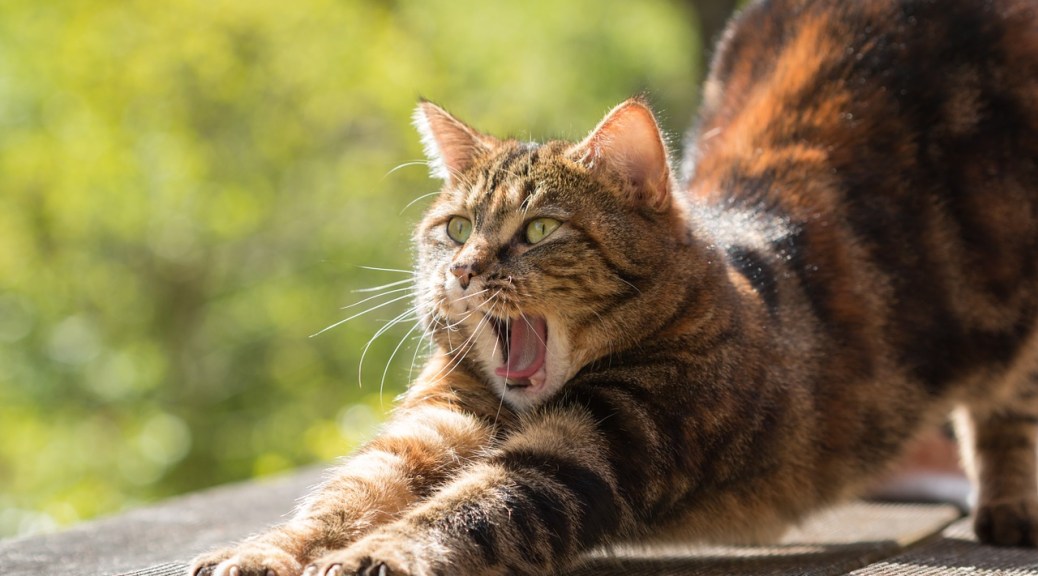
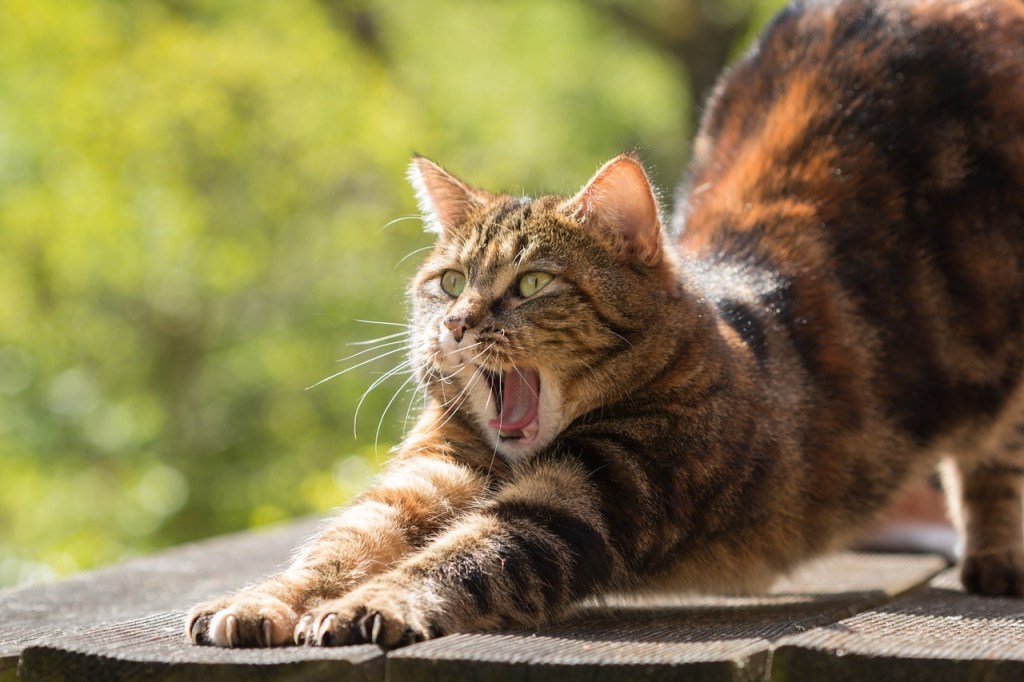
Yawning and stretching at the same time – cats are multitaskers!
(the cat stretch is great for your back as well) #gratuitouscatphoto

An excellent resource is this Michigan State University Rehabilitation Department.

Source: Michigan State University Rehabilitation (https://rehab.msu.edu/media/tips/Gardening_Brochure.pdf)

Here’s some of the key videos:

MSU Gardening Warmup – Upper Extremities

MSU Gardening Functional Five

MSU Gardening Cool Down

And one more from the Marshfield Clinic Health System

Cindy Haynes of the Iowa State University Department of Horticulture has some great advice on preparing your body for the gardening season ahead. Dr. Leonard Perry, Extension Professor at the University of Vermont’s Extension Department of Plant and Soil Science lists a number of stretches in this article.

If you suffer from arthritis, this publication by the U.S. National AgrAbility Project called Arthritis and Gardening contains information about arthritis, how it affects gardening activities, and things you can do to minimize its effects.

A few final words from my own experience:

  • Make sure you always have enough water with you and drink plenty of it, particularly in the summer months. Dehydration can impede your body function and lead to aches and pains.
  • While doing repetitive activities, limit any one to 20 minutes, then take a 5 minute break and stretch. Then your next activity should not involve the same muscle group. So weed for 20 minutes, stretch, then rake for 20 minutes.
  • After a busy day gardening and completing some static stretches, a warm bath with Epsom salts does the body a lot of good.

Gardening is a great activity for maintaining and improving your body’s range of motion, bone density and muscle strength, and joint flexibility, not to mention the benefits of reducing stress and anxiety, which we are all dealing with during this pandemic.

At Sergeant Phil Esterhaus used to say on the TV show Hill Street Blues “Let’s be careful out there”.

Don’t Spring into Spring Clean-Up just Yet

By Anica James, Master Gardener in Training

Spring is finally here, a time for new beginnings. The days are getting longer, birds are singing their hearts out and the snow has melted for the most part, but it’s still too soon to do any kind of clean up in your yard. It may be tempting to get out the rake or leaf blower just because it’s sunny and leaf bags are on sale at your local box store, but we need to hold off just yet for the sake of helping other creatures and pollinator species who are still asleep.

Although we are all anxiously waking up from our own personal winter hibernation–whether it be mental or physical–many creatures around us are still sound asleep in the leaf litter or below the mulch and we should not disturb them just yet. When you clean up your yard too soon, all for the sake of aesthetics or curb appeal, you are essentially removing all of the beneficial insects in your vicinity, like those responsible for making your flowers bloom or for your fruit and vegetable plants to produce food.

Some beneficial pollinators overwinter in the hollow stalks of perennials and under rocks. Examples of insects local to us that are still in diapause state are butterflies (like Mourning Cloaks or Question Marks), lacewings, ladybugs, mason bees and parasitic wasps, which all spend the winter either as pupae or adults hidden away in your yard. Even Luna moths and black swallowtails spend the winter months in cocoons or pupa that look just like a crumpled brown leaf, so be on the lookout for those.

It is best to wait until the temperature is consistently 10 degrees Celsius before you start raking leaves, turning soil, or using a leaf blower. Personally, I like to play it safe with the 10 For 10 rule: 10 degrees for 10 days. This allows nature to take its course and it allows me to have enough time to observe my property and familiarize myself with the various kinds of flora and fauna that emerge post-winter.

If you do decide you feel so inclined to “tidy up” this early, do it with purpose and be mindful of the sleeping and living creatures that are still hidden away. Take your time, look for any signs of beneficial insect stages and either take note and leave it for a later date, or carefully cut and set it aside in a natural area so solitary bees and others insects can still use the refuse for food or shelter. Refrain from adding more mulch because it can trap certain kinds of beneficial bees, beetles and flies that burrow in the ground (almost 70% of Canada’s bee species nest underground). For more information on how to properly “clean up” your yard read Nesting and Overwintering Habitat for Pollinators and Other Beneficial Insects PDF by the Xerces Society.

But again, the best thing to do is wait and to try to remove as little from your property as possible.

So in the meantime, what can you be doing instead of gardening?

  • Get outside, go for walks, enjoy the little things; notice the bulbs emerging naturally and gracefully from the cool earth, poking their way through the leaf litter- now is the time to enjoy the scilla, crocus, pushkinia, galanthus and helleborus
  • Continue to sow vegetable and annual seeds indoors and plan your garden; what are your goals for this year, however big or small?
  • Early spring is the best time of year to be on the lookout for invasive pests and plant species and begin to develop an Integrated Pest Management plan; gypsy moths, garlic mustard, european buckthorn, and goutweed are commonly found throughout the Peterborough area
  • Focus on spring cleaning your tools, your patio furniture, tidying your deck, potting bench or shed; put more focus into the inanimate things
  • Celebrate the beginning of spring by honouring the maple tree, it’s delicious sap and syrup, and the work that goes into providing us all with natural liquid sugar; maybe consider ordering a maple for your own yard
  • Repot indoor plants if needed
  • Read up on and think about ways you can increase pollinator habitat on your property or within your community, no matter the scale

There is so much that you can do while resisting the urge to rake or blow. Relax, enjoy the much needed sunshine that the vernal equinox has brought us after the long winter and try to go at the same pace nature is. Patience will pay off in the long run once you remember that gardening isn’t just about plants.

Great resources for more information about pollinators that spend the winters in our gardens and why we should hold off until mid-April to start yard work: