Category Archives: Advice

What We Want and What Trees Need–Or Which Tree do I Buy?

By Cheryl Harrison, Master Gardener

We plant trees for various reasons. Trees are one of the main contributors to a beautiful landscape. They provide shade and can provide a windbreak. Trees sequester carbon and help to clean the air … some can even help to clean toxins from the soil. They serve as homes, shelters, and food for many birds and other small and large creatures including humans. A stroll through a forest can cool, calm, and inspire us!

harrison3

There is a lot to consider in order to choose the right tree for you.

Make a List:

  • Do you want shade, shelter, privacy or just something to fill a spot?
  • Do you want a tree that produces fruit or flowers?
  • Do you prefer leaves (deciduous trees) or needles (coniferous trees)? · Do you want a native tree?  See Ontario Tree Atlas to see which trees are native to your area of Ontario.
  • Think about your budget. Some trees are more costly than others.

Location Considerations:

Stand in your chosen potential tree planting location and look around.

  • How close is your home and other buildings including the neighbour’s?
  • Are there any overhead wires that the tree’s branches will interfere with as it matures? Will the mature tree block window views?
  • Will mature tree roots eventually interfere with a building’s foundation or septic system? Will it’s branches scrape against walls, roofs or hang over the neighbour’s yard?
  • Will the tree drop fruit, seeds, twigs or large amounts of leaf debris on your sidewalk or deck?
  • How close are you to a road or parking area? Pavement impedes water and air from getting to the tree’s roots. Air pollution and road salt are very hard on many kinds of trees.

harrison2

Growing Conditions:

Next, lets look at what trees need. Different trees need different growing conditions.

Soil

  • Determine your soil’s texture. Sandy soil will not retain water or contain many nutrients. Clay soil has lots of nutrients but may not drain well. Silt soil may not drain at all. Most soils are a combination of sand, clay and silt and will benefit from the addition of organic matter. Seee Soil Types and Soil Texture for more information.
  • Test your soil’s pH, if very acid or very alkaline, it will affect a trees ability to access soil nutrients. There are home test kits available or you may send a soil sample to a soil testing laboratory in Ontario. See Soil Testing Laboratories List for more information.
  • Evaluate your subsoil especially if you live in a new subdivision. Newer subdivisions often have a thin layer of topsoil on compacted subsoil. You may need to replace some of the subsoil with topsoil or at least break the subsoil up so that the tree will not develop a shallow root system. A tree’s roots need to be able to spread out to access water and air.

See All About Soil for lots more information on soil.

Water

  • Water is necessary for the tree roots to absorb nutrients and for other life processes. Some trees prefer more water while others prefer a well drained site and there are lots of variations in between. How much moisture will be available to your tree?

Sun

  • Buildings, other structures and other trees can shade the soil. Many trees need full sun but many will tolerate partial shade. How much sunlight will your tree receive in a day?

Plant Hardiness Zone

  • The plant hardiness zone of your potential tree planting location will indicate the weather conditions that your tree needs. In Canada, the zones are based on maximum temperature, minimum temperature, rainfall, snowfall, frost free period and wind. See Plant Hardiness of Canada to figure out your plant hardiness zone.

“Which Tree do I Buy” Example:

You love trees that flower. You have decided to plant a tulip tree in the small courtyard of your condo in Peterborough, great, they grow in zones 3-4 … so far so good for the Peterborough area. However, tulip trees can grow over 35 m (115 ft) according to the University of Guelph, so a tulip tree is not a good choice for the tiny yard of a condo. The mature tree will be far too large!

In summary, make a list of what you want and your specific growing conditions. We have many locally owned plant nurseries nearby. The staff will use their expert knowledge to help you choose a tree appropriate for your needs and growing conditions.

harrison1

Additional Resources

Arboretum at the University of Guelph

Ontario Trees and Shrubs

Plant Resources, Landscape Ontario – scroll through has lots of info on various kinds of trees

Perennial Gardening with Less Effort

By Mary-Jane Pilgrim, Master Gardener

Are you spending more time working in your perennial garden this hot, dry summer than enjoying it?  You may want to consider some of these low maintenance tips for fall renovations and next year’s plans.

What does low maintenance mean? Low maintenance does not mean no maintenance and low maintenance is not for lazy gardeners. Low maintenance means making wise plant decisions and doing your homework up front, so you don’t end up with a flower garden that requires tons of work to look good.

Getting to the point of ‘lower maintenance’, however, will be tough.  Prepping a new garden is pure slogging, involving wheelbarrowing compost and mulch, digging & then digging some more.  If your current reality involves plants that were plentiful at your neighbour’s house or at a recent plant sale, it could involve even more digging to get rid of persistent roots.

thumbnail_IMG_1658
Well behaved full sun perennials in the author’s garden

However, you will love the end result of an easy to care for garden if you follow some of the following suggestions.

The first rule of thumb in creating a low maintenance flower garden is to keep it small. Don’t go crazy when you’re picking out plants; stick with 3 or 4 groupings of 3 of the same perennial, and then fill in with annuals if you wish.

The most important tip of all in creating a low maintenance flower bed is mulch. Mulch is a gardener’s best friend. After planting your flower garden and watering it well, always apply a 2 – 3 inch layer of a good, shredded mulch. If you can’t afford mulch right away, shredded leaves and untreated grass clippings will do the trick. Mulch is your #1 defense against weeds and it helps the soil retain moisture so that your plants don’t dry out. Skipping mulch in a low maintenance flower garden is not an option.

Another important step to keeping your flower garden low maintenance is to install an edging of some type. Allowing the grass to creep into the garden, or allowing the garden to creep into the grass are both problem situations that will require a lot of work to deal with.

Choose and plant flowers that:

  • aren’t vigorous, invasive or self-seeding spreaders (avoid “creeping” anything!
  • aren’t too picky about the soil
  • will survive a wee bit of neglect
  • are relatively drought tolerant
  • don’t require deadheading or minimal deadheading (removal of spent flowers)
  • don’t require staking
  • are not prone to pest problems or diseases.

A good nursery or garden centre with knowledgeable staff is a great place to start — and we are blessed with some great ones in the Peterborough area!

The best easy-care perennials for sun or part sun: Clumping ornamental grasses, Coneflower, Salvia, Daylilies, Black-eyed Susan, Shasta Daisies, Veronica, Lavender, Peony, Blanket Flower, Perennial Geranium (cranesbill), Russian Sage, Penstemon, Sedum Stonecrop (there are some new cultivars out that are amazing, like Firecracker or Lime Zinger), Autumn Joy Sedum, Hens & chicks (Sempervivum).

Low maintenance perennials for shade: Hosta, Ferns (not ostrich), Coral bells, Barrenwort (epimedium), Astilbe, Hellebore, Brunnera, Primula.

thumbnail_IMG_1659
Well behaved shade perennials in the author’s garden

The goal is to get to the point where you only need to set aside 15 or 20 minutes every couple of days to weed and deadhead your plants. Deadheading also reduces the number of “volunteer” plants that you will get as the seeds will also be removed. You can combine weeding with deadheading and get the chores done at the same time. This will keep your flower garden looking beautiful and will help the plants produce more blooms.

Alchemy in the Garden – Layering

by Marilyn Homewood, Master Gardener in Training

“A seemingly magic process of creation”

Layering is an asexual (vegetative) method of plant propagation that produces genetic replicas of the parent plant. In this technique, the newly developing offspring remains attached to the parent plant.  This keeps it supplied with water, carbohydrates and nutrients avoiding some of the pitfalls of traditional cuttings.

What makes this possible is totipotency. Every cell in any plant—except for egg and sperm —is capable of regenerating into a complete organism or differentiating into specific cell tissues. Under appropriate conditions, a cell can be induced to multiply into roots, shoots, leaves, or flowers.  One example of this is the formation of adventitious roots.  These are roots that form from “non root” tissues.  Growth of these roots are promoted in part by the plant’s own hormone auxin.

“Wounding” the shoot being layered by making a small sloping shallow cut on the underside of the stem/branch induces this process.  Wounding is known to produce adventitious roots by increasing levels of auxin at the wound site and by forming callus (dedifferentiated plant tissue capable of becoming roots).

Simple Layering

  • Select a young vigorous shoot that is low to ground
  • Wound stem, keeping wound slightly open using matchstick
  • Dust with rooting hormone
  • Dig shallow hole, set stem in contact with soil,
  • Secure stem in place (u-shaped pin or rock)
  • Fill hole and mulch to keep moist
  • Check for roots in fall, sever from parent and replant new shrub
  • Recommended for climbing roses, forsythia, honeysuckle and boxwoodSimple

Tip Layering

  • Works well on plants with long whippy stems like berry crops
  • Tip of shoot is pegged into soil, secured and buried at point of contact
    Tip

Serpentine Layering

  • Similar to simple except that multiple points are wounded and buried
  • Good for plants that produce long shoots such as clematis, grapes, wisteria, rambler roses, vining honeysuckle, willow and viburnum
    Serpentine

Stooling/Mounding

  • Process encourages masses of basal shoots which are allowed to layer naturally
  • Cut parent shrub back to near ground level in dormant season to encourages masses of basal shoots
  • In spring, when shoots are at 15cm, they are covered with dirt leaving tips exposed
  • Repeat process as shoot grow to 25 cm
  • Buds inside dirt will form roots
  • When plant reaches dormancy again, remove soil and newly rooted shoots and plant on
  • Recommended for this technique are smoke bush, dogwoods, spirea, daphne, magnolia, cotoneaster
    Stooling

Resources

Bryant, Geoff (1992) Propagation Handbook, Basic Techniques for Gardeners, Stackpole Books

Dunn, Bruce (Feb. 2017) Layering Propagation for the Home Gardener, Oklahoma State University Extension, http://extension.okstate.edu

Evans, Ervin, Blazich, Frank (Jan. 1999) Plant Propagation by Layering, North Carolina State Extension, http://content.ces.nscu.edu

Rich, Lee (2007) Making More Shrubs, http://finegardening.com

Stefman, Bianka, Rasmussen, Amanda (2016) Physiology of Adventitious Roots, Plant Physiology, Vol 170 pp 603-617.

Yadav, Deependra, Sing, S.H. (2018) Vegetative Methods of Plant Propagation: I- Cutting, layering, budding, Journal of Pharmacognosy and Phytochemistry, 7 (2) 3267-3273.


My Favourite Pruning Book

by Suzanne Seryck, Master Gardener

I have a lot of gardening books and whilst I do search on the internet if I have a quick question, there are a few books that I go to repeatedly and often. One of these is from the UK Royal Horticultural Society Pruning & Training. I am sure you could find a similar book in Canada but as this book was given to me a few years ago by my father-in-law as a present, it has special meaning for me.

I love growing fruit, apples, grapes, currants, blueberries, to name a few and as I have a smaller city garden, this comes with challenges. I have to make use of all available space and prune effectively to fit everything I want into my garden. Hence the reason why this book is so important to me and why I use it so often.

There are chapters on ornamental trees as well as ornamental shrubs and roses and a good introduction describing the parts of a plant as well as the principles of pruning and training. But it is the chapters on tree fruits, soft fruits and climbing plants that I refer to most often. I actually have PostIt® notes on the sections that describe the pruning shapes I have chosen for my apples, currants, gooseberries and grape so I can check I am doing it correctly. I must admit it took a few years to observe the effectiveness of pruning well, I was always hesitant to cut off too much of the plant, much as I still save every perennial seedling that comes up in my garden. In my last house we had a grape for approximately 6 years and whilst we did get some fruit on it, we could have doubled or tripled the harvest with better pruning, but I hated to cut so much off.

For my grape vine I originally had it growing over an arch, but it soon outgrew that support, so we had to build a new support system and then re-prune it into its new system. There are many different systems that can be used for grapes including the rod and spur system in which the grape is grown along 3-4 horizontal wires to the guyot system in which shoots from two horizontal stems are grown vertically.

The chapter on tree fruits starts by showing diagrams of all the different forms or shapes as well as describing basic and pruning techniques. There are lots of photos and diagrams in this book so that you can visually see everything being discussed, which I really like. There is also a section on renovating neglected tree fruits.

I chose to prune my apples trees as espaliers on a four tiered tree, this is my trees fourth year and first year that they have blossoms, so I am hoping to have my first apples. It is fairly time consuming, especially as I didn’t know what I was doing the first couple of years, but I followed the instructions religiously and am now beginning to approach the trees with pruners in hand confidently.

espalieredapple
Espaliered apple tree (Year 4)

My currant and gooseberry bushes were pruned as multiple cordons with three vertical arms. I have this grown both on the same support system that I have for the fruit trees but also on bamboo poles. I find that by growing them in this way as opposed to a bush, I can fit more currant bushes into the same space, I grow red, pink, white and black, and they are easier for me to pick. I still have a high yield of berries and am able to harvest almost all of them.

currentcloseup
Close up of currants
redcurrent
Redcurrent bushes

There are plenty of videos on the internet showing different pruning techniques, maybe even too many as it is often difficult to choose just one, and then you end up getting side tracked. As I was writing this article and looking up videos, I ended up watching three including one on heucheras. Here’s one you might like from the RHS on renovating fruit trees.


Garden Myths

by Emma Murphy, Master Gardener

Gardeners have been passing down tips, tricks, and knowledge for generations. Some of this advice is science-based and works, but much of it is a mix of folklore and superstition. While some of it is benign, some of it may actually harm your gardens or have you spending money when you don’t need to.

Here are five of my favourite garden myths – there are hundreds out there – just google ‘garden myths’ and you’ll see what I mean.Picture1

I think social media has intensified the problem – in the past information spread through word of mouth, often handed down through generations. Now anyone with a computer can claim to be an expert, and provide inaccurate information that others will share.

Part of my reason for becoming a Master Gardener was to expand my gardening knowledge and share my passion for growing with others using solid, science-based information. We offer our services to the public in many forms – through presentations, advice clinics, answering email queries, and publishing blogs like this one!

The Master Gardeners of Ontario (MGOI) website shows where all the Master Gardener groups are located – find yours and their website and take advantage of their knowledge and expertise. If they don’t have the answer they will go research it for you.

MGOI also has a great Facebook page where you can post questions to Master Gardeners. And I highly recommend The Garden Professors Facebook page for science-based gardening information.

Make sure to follow the Peterborough and Area Master Gardeners through our
Weekly Blog (by clicking on ‘Follow’ in the left column on the homepage)
Facebook Page
Twitter or reach us at contact@peterboroughmastergardeners.com

Myth: You Should Stake A Newly Planted Tree

Truth: Unless it’s top-heavy or in an especially windy site, your tree does not require staking. Some movement is actually good for young trees. I loved this description “Just as our muscles grow larger with exercise, tree trunks grow thicker and stronger when they’re allowed to move.”

The response of trees and plants to wind is called thigmomorphogenesis (yes that’s a word!). The buffeting from winds releases ethylene gas, a growth mediator that triggers the formation of wood-strengthening lignin.

While staked trees tend to grow taller, their trunks are skinny and weak, so if you decide you must stake, stake as loosely as possible and only for a short time (no longer than six months). Make sure to use something soft against the tree bark to keep from cutting into it. But best to practice tough love – your tree will appreciate it.

P1030592-e1555428966560
Photo used with permission of The Garden Professors  http://gardenprofessors.com/

Myth: Gravel in The Bottom of Containers Improves Drainage

Truth: This myth will not die. We’ve all been told to place stones or pieces of pot at the bottom of our containers “for drainage”. The reality is that added gravel or rocks to the bottom of your pot will actually accelerate the potential for root rot, rather than preventing it. Water is pulled down through the container by gravity and builds up near the drainage hole. A layer of gravel at the pot’s base serves as the drainage hole and collects water in the same way. So gravel actually moves the pool of water higher up the pot, where it damages your plant.

As long as there is a hole in the bottom of the container, water will find its way out without the need for stones.

Myth: Add Epsom Salts To The Soil Helps Tomatoes Grow

Truth: You would think it was a miracle cure for everything
“It helps seeds germinate”
“It makes plants grow bushier”
“It can prevent blossom end rot in tomatoes” (see bonus information at the bottom of this blog!)
“It can prevent transplant shock”
“It results in more flowers”
“It increases chlorophyll production”
“It deters pests, such as slugs and voles”
“It reduces the total amounts of fertilizers needed”

Magnesium sulfate, or Epsom salt, is a naturally occurring mineral consisting of magnesium and sulfur (MgSO4). Magnesium is a necessary element for plant growth but adding unnecessary salts to your soil will destroy your soil structure over time. You are better to simply add compost or worm castings to the soil. There are decades of research that has documented damage done to both plants and soil with overuse and misuse of magnesium sulfate. Want to read more about it? Check out this peer reviewed study by Washington State University’s Extension Center (click here for more of their excellent science-based studies). The best thing epsom salts can be used for is a nice hot bath after working hard in your garden all day.sphynx-1521190

Myth: You Can’t Grow Anything Near A Black Walnut Tree

Truth: This one is a personal favourite, since I have extensive flower and vegetable gardens in the vicinity of two almost 150-year-old black walnuts. While the roots of black walnut (Juglans nigra) do release an allelopathic chemical known as juglone that inhibits the growth of some plants, the idea that nothing grows under a walnut started gaining traction in the 1920s when a Virginia researcher saw his tomatoes were suffering and just assumed the nearby trees were at fault based on folklore he had heard. Washington State University put out an excellent peer reviewed paper in 2019 explaining the history of walnut allelopathy.

Enjoy your walnut trees! Not only are they robust landscape plants but they provide food and habitat for wildlife and birds. Here’s my lovely perennial garden under my walnut tree (and featured in Linda Chalker-Scott’s paper mentioned above) and my previous blog specifically on this topic.

BP4

(Bonus – information on Blossom End Rot)

Research has shown that calcium deficiency is not the cause of blossom end rot. Egg shells won’t correct it. Epsom salts (which are magnesium sulfate) won’t correct it. Nor will coffee grounds, Tums, calcium sprays, dairy products, or any of the other things that are usually recommended for it. It just corrects itself. It’s not caused by a fungus, bacteria, or virus. It’s not in the soil. It’s an internal condition of the plant. The cause appears to be simply environmental: low temperatures at night, fluctuating temperatures, watering too often, etc. Ammonia fertilizer is linked to it, so some forms of plant food can be a problem. But basically: just pick off the fruit that are affected, water more deeply and don’t allow the plant to get severely drought stressed (daily watering is probably not necessary unless you have unusually fast-draining soil or are growing in a container). The next fruit will probably be fine. It’s usually a problem with the first tomatoes, peppers. and squash that set in the season and the rest come along fine.

Repair or Replace? That is the Question

By Judy Bernard, Master Gardener

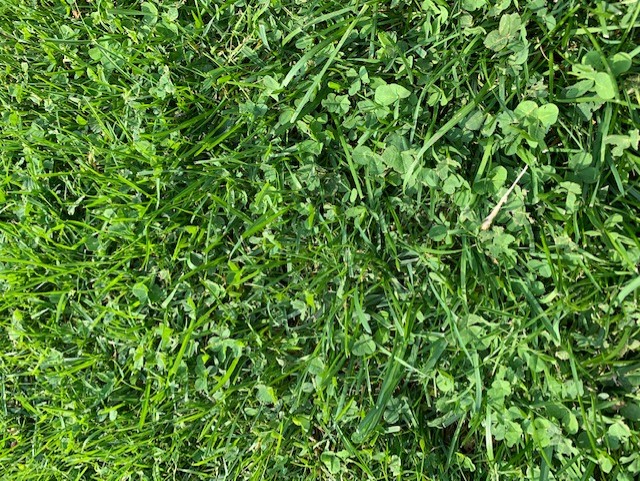
A question about sod that didn’t root came to our contact email account recently. The person asked what to do about an area the size of about a dozen rolls of sod that didn’t take or thrive. Replace it or seed over? Below is a photo of the area in question. Because this is the time of year that we see these problems, I thought the answer to this question would make a good blog.

grass blog

Since new sod won’t be available for a few weeks, I suggested to try seeding a small area. If the seed germinates and grows, then go for it! If not, remove the dead sod and replace. If you’re replacing, make sure the new sod is freshly harvested that day. Also, I would add some compost to the soil before laying the new sod. The compost will help the soil retain moisture and provide nutrients.

This time of year is perfect for seeding lawns as usually there is more rain and the weather is cooler, which grass prefers for germinating and growing. Top seeding is usually done on top of existing lawns, so I don’t see why it shouldn’t work on your recent sod.

Rather than topsoil, my suggestion is to use compost. Depending on where you get topsoil, it could be full of weed seeds. You can get compost from most garden/landscape supply places. The City of Peterborough also makes and sells compost which you can buy at Ecology Park or at the Bensfort Road transfer station. Take your own containers. The compost will also help the old sod decompose into the soil.

Before seeding on top of the sod that didn’t take, rake off as much of the loose grass as possible. Put a good layer of compost over that area, 1/2 inch at least. Before seeding, make sure the old sod and the ground are moist underneath. Two and a half centimetres (1”) of rain/water will soak approximately 15 cm (6”) deep.

Then, seed the area with the same variety of grass that is in the sod so that eventually you will have a uniform lawn. Gently cover the lawn seed with a thin layer of mulch by using the back of a garden rake to rake over the area. Water well.

To keep the existing sod healthy, put a thin layer of compost over that as well and rake it in. The compost will help the soil retain moisture and provide all the nutrients your lawn needs without expensive chemicals.

Resources

Green Up Ecology Park Garden Market
Choose Compost Carefully when Topdressing the Lawn
How to spread Compost on the Lawn

A Gardener’s Favourite Tools

by Emma Murphy, Master Gardener

Every gardener has their favourite ‘tools of the trade’. What those are often depends on the type of gardener you are (novice or experienced, annuals or perennials, plants or shrubs and trees etc.) but over time you figure out what works for you best. Here are my favourites – what are yours?


20190713_144228

A Giant Wheelbarrow 

A good wheelbarrow is worth its weight in gold to a gardener. An essential tool, I use it to transport tools, dirt, mulch, rocks, and garden cuttings from one place to another. For me the most important features are the volume and the wheels. While I have another ‘regular’ one wheel wheelbarrow, this yellow two-wheeled monster is my best friend. I love the stability of the two wheels in my ‘not-flat’ garden. I have had it for so long the bottom plastic has finally cracked from all the big boulders I have dumped into it, but the yellow barrow bottom is now covered with a sheet of metal so it’s still functional. I’ve replaced the original pneumatic (air filled) tires with airless tires. Now I just need to find a new barrow that doesn’t cost more than replacing the entire wheelbarrow! (Special mention to my second favourite wheeled vehicle – an old Radio Flyer red wagon. Acquired from a cousin, this metal workhorse is great for moving plants around, especially in tight spots)

20190713_144159


20190713_140635.jpg

My Felco #7 Secateurs and Leather Holder

Pruners or secateurs (from the British – a pair of pruning clippers for use with one hand) are indispensable to the serious gardener. There are many brands on the market, but there are two primary types, so it’s important to get the ones that match your needs. Anvil pruners have a blade that pushes the plant material onto a cutting board, whereas bypass pruners have two blades that pass by each other to create a cut. Anvil pruners tend to crush soft plant tissue but, used properly, bypass pruners minimize plant damage. You can read more in Robert Pavlis’ blog on the subject here.

I only use bypass pruners; my Felco #7s are comfortable, light, efficient, and ergonomic. Why Felco? Because they are excellent quality and last forever. There are many models; many friends like the Felco #2s, but there are some designed for left handed people (Felco #9), people with small hands, or people like me that want to minimize hand strain, which is the focus of Felco #7. It provides me with hand and wrist protection, and optimizes the force exerted by the revolving handle. I should probably buy shares in this company. 9a2684c4213171476e13732af3b26537


20190713_140910


A Drain Spade

There are lots of different spades out there, so take the time to find one that works for you. Your height, the weight of the tool, what you need to use it for, and ergonomic considerations should all be taken into account. I have both shovels and spades – shovels tend to have longer handles and a more curved blade than spades – but once I used my drain spade I realized it was going to be my favourite. It’s heavy but I love the long blade for getting deep into the earth, and the narrowness for getting into tight spots. I have actually managed to dig the full taproot of a mature lupin and transplant it (and have it survive) using this spade, and that is an accomplishment in itself.


covertwitter

Great Gloves

Gloves are a very personal item of clothing for gardeners, but since this is my blog I’ll let you know my favourites are the West County gloves I can get from Lee Valley (the orange ones above) and the Noble Outfitter gloves I just picked up at the TSC Store. Many people like the nitrile and latex gloves, especially for fine gardening work like pruning, but they are too hot for my hands. I am pretty tough on my gloves, so it’s normal for me to go through a few pairs each season.


20190713_140804

My Garden Bandits

What the heck is a Garden Bandit™? Nope, it’s not a robber, just a very handy tool for weeding and clearing areas with minimal hand strain. Its innovative shape, designed after a garden tool used by early settlers, allows you to remove weeds but cutting them off at their roots. It also lets you safely work soil close to existing plants without damaging foliage or tender feeder roots. I got mine from Brenda at the Avant Garden Shop in Peterborough. Made in Canada, the bandit is not sold in big box stores, so contact your local birding/gardening store or nursery to see if they stock them. Check them out here.
bndt_icon2


20190713_141013.jpg

Collapsible Garden Bags

A variation on traditional English ‘tip bags’ and often called kangaroo bags, these lightweight, collapsible bags are great for collecting weeds and waste (and leaves when that time comes). They can be collapsed and stored away easily when not being used, and who doesn’t like space-saving things! I have had several of these bags, but I am not sure where I got these particular ones. They do have them at Lee Valley (or give Google a try). I like them better than the plastic tubs because (well, plastic!), they are lightweight, and I can maneuver them into tight spaces.


20190713_140530

Hori Hori Knife

I was introduced to this tool by my fellow Master Gardeners, and now I understand why it’s a favourite (as you can see I have two of them!). Made in Japan, the hori hori knife is a cross between a knife and a trowel, and can serve multiple functions, including dividing perennials or planting. Traditionally used in Japan to collect specimens for bonsai (hori means “digging”), the knife has a rust-resistant steel blade with a serrated edge on one side and a sharpened edge on the other. About 12 inches overall, it has a hardwood handle and comes with a belt sheath. I have only ever seen these at Lee Valley.


20190713_140827

A Wide Brimmed Hat, Bandanna, Sunscreen, Bug Spray, and Towel

Last but not least the essentials for all gardeners – a nice wide brimmed hat and sunscreen to protect you from the sun’s rays, bug spray (I feel like I am wearing this 24/7 this year!), and a towel to wipe off all that sweat – gardening can be a great workout.

One final hint – you may notice that most of my tools are bright colours. If you – like me – tend to ‘lose’ tools in the garden, or the compost, or the leaf pile, or under a plant, you’ll want to look for tools in nice bright colours so that when your husband turns out the compost in the spring he can say ‘hey honey I found your garden bandit’. That reminds me – I need to put some paint on my hori hori knives!

Happy Gardening! 

Please note: I do not receive any compensation for mentioning where you can get these items


Scarlet Runner Beans

By Judy Bernard, Master Gardener

Have you ever wondered what that vine was growing up the side your grandmother’s porch? The one with the big leaves and the little red flowers? It gave lovely cool shade on the porch in the heat of the summer.

Scarlet runner beans, Phaseolus coccineus, are a native of the mountains of Central America. In their native habitat they are a perennial, but are planted annually when grown in our gardens. The vines are vigorous growers and can reach up to 6 meters in length. This makes them ideal for growing along chain link fences or up trellises or on strings beside your grandmother’s porch. They like full sun and a rich well draining soil.

prod000599

The beans produced are edible when the pods are small and the beans inside have just begun to develop. The skin of the pod is a bit furry but with cooking they are a tasty vegetable. When more mature, the seeds inside can be shelled and eaten like Lima beans. The seeds can be saved from the pods that have been left on the vines to ripen and dry. When ripe, the seeds will rattle inside the pods. This vine keeps producing right up until frost.

You can plant directly into the soil, 4-5cm deep and 6-8cm apart earlier than regular beans, but they won’t tolerate a frost if they have sprouted above ground. You can also start them indoors in pots and transplant outside when there is no more danger of frost. Make sure there is a trellis or fence or something for them to climb on. (Strings or mesh hung from the eaves of grandmother’s porch.)

The flowers are attractive to humming birds and bees. So, plant them where you will be able to enjoy the hummingbirds. They are also attractive to rabbits and slugs. I start my seeds in juice cartons with the tops cut off. Just before planting I cut the bottom off the carton and leave the sides up as a collar to protect the tender plants from slugs. Slugs don’t seem to bother the plants as they get large.

We’re still waiting and dreaming of our garden, but we will  be getting topsoil for our new property in time to start our gardens. Scarlet runners on teepees and mesh hung from the eaves will give some vertical interest to our bland landscape.

https://en.m.wikipedia.org/wiki/Phaseolus_coccineus

Invasive Species

By Sharleen Pratt, Master Gardener

According to the Ontario Invasive Plant Council, an Invasive Species is an alien species whose introduction or spread negatively impact native biodiversity, the economy and/or society, including human health.

Therefore, an invasive plant species is often a plant that has been brought into Ontario from another country, possibly for medicinal reasons or as an addition to one’s garden.  For various reasons, it becomes aggressive, spreads quickly and often displaces native plants.

Here is a detailed description of five invasive species that could show up in your garden.  They are all Category 1 Invasive as designated by the Credit Valley Conservation described as species that exclude all other species and dominate sites indefinitely. Plants in this category are a threat to natural areas wherever they occur because they tend to disperse widely (for example, through transport by birds or water). They are the top priority for control but control may be difficult.

Rhamnus cathartica
Common Name:  Common Buckthorn, European Buckthorn Common-Buckthorn

Height:  Up to 10m tall
Type of Plant:  Deciduous Shrub or small tree that is fast growing and short lived
Leaves:  Smooth, dark green leaves with slightly serrated leaf margins, somewhat elliptical and arranged in opposite to sub-opposite pairs along the stem.  A sharp thorn can be found on the end of most branches.
Flowers:  Flowers occur in the spring.  They are yellowish/green, with four petals in clusters of 2 to 6 near the base of the petioles.  They are small and inconspicuous.
Fruit:  Produces clusters of berry-like globose black fruit in late summer and fall; although it’s mildly poisonous, birds and other wildlife eat the fruit and disperse the seeds.
Culture:  Can thrive in a wide range of soil and light conditions.  It is shade tolerant.
Invasion Pathway:  Introduced from Eurasia to North America in the 1880s for ornamental landscaping.  It was widely planted for fencerows and windbreaks in agricultural fields.  The large number of seeds are spread by birds and animals.
Impacts:  Habitat destruction and because it leafs out early, it is a danger to native species.  It also alters the nitrogen levels in the soil. The soybean aphid, an insect that damages Ontario soybean crops, can use buckthorn as a host plant to survive the winter.
Control Measures:  Physical removal, herbicides, fire, girdling

Alliaria petiolata
Common Name:  Garlic Mustard
Garlic Mustard
Height:  30 – 100cm tall
Type of Plant:  Biennial Herb in Mustard Family
Leaves:  In First Year:  Leaves are dark green, cordate shaped with crenate margin edges. In Second Year:  Leaves are alternate on a larger stem with somewhat doubly serrated edges.  The lower leaves on the stem are broad, cordate shaped and up to 10cm across.  The upper leaves on the stem start to narrow.
Flowers:  In Second Year:  Four white petals appear, arranged in cross shape.
Fruit:  In Second Year:  The fruit is erect, slender, 4-sided pod, green, maturing pale grey-brown, two rows of small shiny black seeds.  Hundreds of seeds can be produced from a single plant.
CultureAlliaria can grow in a wide range of sunny and fully shaded habitats, including undisturbed forest, forest edges, riverbanks and roadsides.
Invasion Pathway:  Introduction for perceived medicinal value as a disinfectant, a diuretic and sometimes being used to treat gangrene and ulcers.  It was also planted as a form of erosion control. European settlers also used it as a garlic type flavouring.  Seeds can remain in the soil for several years and still be able to germinate.  Hundreds of seeds produced from one plant.
Impacts:   Alliaria forms dense stands, replacing native plants and has been implicated as partial cause for endangered status of our native wood poppy (Stylophorum diphyllum), American ginseng (Panax quinquefolius) and our provincial Trillium (Trillium cernuum).  It is toxic to larvae of certain butterfly species that lay eggs on the plant.
Control Measures:  Removal by hand, mowing or burning in early spring before flowering.  Should always be bagged and burned.

Cynanchum louiseae and C. rossicum
Common Name:  Dog Strangling VineDog Strangling Vine

Height:  2m high
Type of Plant:  Twining Vine
Leaves:  Oval with a pointed tip and grow opposite
Flowers:  Pink to dark purple star-shaped flowers have five petals
Fruit:  Produces bean-shaped seed pods that open to release feathery white seeds in late summer
Culture:  Prefers open sunny areas but can handle some shade. More dominant in meadows or woodland edges.
Invasion Pathway:  Introduced in the U.S. in the mid 1800s for use in gardens. Produces 28,000 seeds per square metre.  Seeds spread by wind and new plants also can grow from root fragments
Impacts:   Forms dense stands that overwhelm and crowd out native plants and young trees, preventing forest regeneration.  Invading ravines, hillsides, stream banks and utility corridors.  Leaves and roots may be toxic to livestock.
Control Measures:  Digging is most effective.  Hand pulling is not recommended as the plant will send up multiple shoots.

Vinca minor
Common Name:  PeriwinklePeriwinkle

Height:     Up to 15 cm tall
Type of Plant:  Evergreen herb that exhibits a trailing mat with a medium growth rate.
Leaves:  Lance shaped, shiny, evergreen with a subtle white mid vein.  They are opposite along stem.
Flowers:   Showy blue/purple with 5 fused pin-wheel like petals and a short tubular throat that bloom in late spring.
Culture:  Various soil types.  Found in forests and along streams, roads and wetlands.  Typically associated with residential gardens.
Invasion Pathway:  Introduced as a garden ornamental and medicinal herb.  It spreads by means of arching stolons, which root at the tips.  Grows most vigorously in moist soil with only partial sun, but it can grow in the deepest shade and even in poor soil.
Impacts:  Still sold as a groundcover which is a major concern.  It spreads quickly and is a threat to native biodiversity.
Control Measures:  It can be pulled, raked, or dug up, though re-sprouting will likely occur.  It can also be cut or mowed in spring during its rapid growth stage.

Aegopodium podagraria
Common Name:  GoutweedGoutweed

Height:  2m tall
Type of Plant: Herb
Leaves:  Compound leaf with serrated edges, can be non-variegated or variegated green and white, alternate
Flowers:  Flat topped ‘umbrella like’ flower head with many small white flowers in late spring held above the foliage on leafy stems (which look similar to Queen Anne’s Lace).
Culture:  Various habitat.  Full sun to part shade.  An escapee from residential gardens into forested areas.
Invasion Pathway:  Goutweed seeds require recently disturbed soil and a sunny location to survive after germination. For this reason, Goutweed does not have much success reproducing by seed in forest ecosystems. However, even one established plant can create a large colony by spreading through its aggressive rhizomes.
Impacts:  Forms dense patches that displace native plants.
Control Measures: Because it has limited reproductive success by seed, small patches of Goutweed can be easily controlled by digging up the plant (with careful attention given to removing the entire rhizome) or covering with a tarp or weed barrier for at least one growing season.

A reliable resource for invasive species is the Ontario Invasive Plant Council

Spring Ephemerals

By Cheryl Harrison, Master Gardener

Definitions of “spring” and “ephemeral”, curtesy of Merriam-Webster online dictionary, are “to come into being” and “lasting a very short time”.  Two wonderful words, when used together, mean those lovely but short-lived flowers that we may see on our walks through woodland gardens or deciduous forests at this time of year!

My list of favourite spring ephemerals includes:

Trillium (Trillium grandiflorum) – Of course, this native plant comes to mind first.  It is Ontario’s official flower but not Ontario’s only trillium … there are four other native species. Trillium grandiflorum produces one large, white, three-petaled flower above three, simple, broad leaves.  The flower fades to pale pink as it ages.  Red seeds are produced which are mainly dispersed by……ants!  Seeds germinate slowly and take 4-5 years to become a mature flowering plant.  Plants grow to reach 30-45 cm (12-18 in.) high, prefer moist rich soil and dappled shade.

trillium
Trillium grandiflorum

Dog-toothed violet (Erythronium americanum) –  These pretty little native flowers grow from a corm.  They are small, just 15 cm (6 in.) high but their bright, yellow flowers stand out  and along with their spotted leaves (hence their other common name “Trout Lily”), are one of the earliest spring ephemerals to appear.  They prefer rich, moist but well-drained soil and part to full shade.

dogtooth
Erythronium americanum

Bloodroot (Sanguinaria canadensis) – If you remember your high school latin, you will recognize where Sanguinaria originates when you learn that all  parts of this native contains an orange/red juice.  The Latin sanguinarius means “bloody”.  S. canadensis is the only species in this genus.  It produces a white flower, that may be tinged in pink, and has deeply lobed, flat leaves.  It prefers part to full shade and well drained, moist, rich soil but seems to survive in varying soil conditions.  This plant will grow under your black walnut tree!  S. canadensis grows 15-30 cm (6-12 in.) high and spreads through rhizomes.

bloodroot
Sanguinaria canadensis

Mayapple (Polophyllum peltatum) – Mayapple makes a great groundcover.  It grows up to 45 cm (1.5 ft.) tall and produces one white flower which appears under it’s umbrella-like, multi-lobed, two leaf foliage in late spring…..a single leaf means no flower and no fruit.  The leaves and root are poisonous as is the immature green fruit.  Only the mature yellow fruit is edible.  This plant spreads through rhizomes, prefers light shade and moist, rich soil.

mayapple
Polophyllum peltatum

Jack-in-the-pulpit (Arisaema tryphyllum) – Where do I start; this plant has a very interesting flower …. the spathe is the most conspicuous part.  It is a hooded, tube-like structure and houses the spadex which is a spike and is where the actual flowers are located.  Clusters of bright, red berries form in the fall.    It grows 30-90 cm (1-3 ft.) tall and prefers moist, rich, slightly acidic soil and part to full shade.  Jack-in-the-pulpit grow from corms.

jack
Arisaema tryphyllum

Next time you go for your woodland walk look for the spring ephemerals.  Their appearance signals that warmer weather is coming very soon!  Let the gardening season begin!

Many nurseries now carry native plants and some specialize in natives.  Just be sure to ask about the origin of the plants that you are buying, you are looking for plants that have been nursery propagated not harvested from the wild.

Suggested Nurseries

Resources

Books

  • The Ontario Naturalized Garden, by Lorraine Johnston ISBN1-55110-305-2

Websites