Category Archives: Pruning

Getting Pumped About Pruning

By Carol Anderson, Master Gardener

What else is there to do in February, other than shovel … so why not begin planning your spring gardening clean-up? In my last blog, I shared with you my invasive ground cover plight and promised to update you in the early summer with my progress on eradicating and controlling the many species on my property. But I didn’t share with you the whole story – that in my excitement over my new home, I failed to look at the overall state on my gardens … more specifically my shrubs. It would appear that the previous homeowner planted somewhere between 20-30 shrubs about 17 years ago … and then forgot about them! So in addition to my “ground cover grievances”, I also have some “bothersome bushes”! Let me share with you my plan-of-attack to address overgrown flowering shrubs in my garden using a few examples that you will recognize.

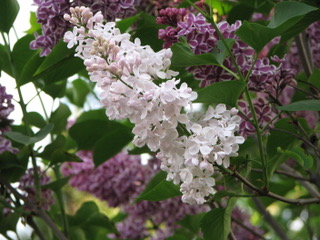
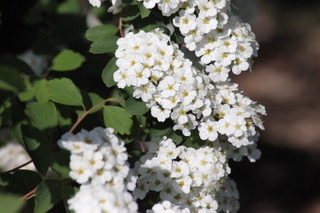
Although pruning supports the growth of healthy and robust plants, it is one of the most inconsistent and often poorly executed garden techniques. Pruning is not only essential to maintaining plant health, but also an essential practice used to improve the quality of the plant (e.g. flowers or yield), “train” plants (shape and structure), and control their size. Perhaps the reason that pruning is avoided by many gardeners is because proper pruning takes careful planning and execution; knowing your plants growth patterns and life cycle will determine pruning time and technique to be used. The general rule of thumb, as you likely know, is that if the shrub blooms in the spring (e.g. common lilac, bridal wreath spirea, some ninebark), then most likely the flowers bloom from buds formed on last years’ growth. Therefore, pruning after flowering enables new growth to become established in preparation for flowering the following year. In contrast, most summer blooming shrubs (e.g. hydrangea, hibiscus) will flower on “new growth”, therefore they require a late winter/early spring prune to stimulate new growth for flowering in the same year. 

In general, your garden pruning is undertaken as follows

Step 1.

Create a pruning plan based on each shrub’s needs and growth habits.  Include timing and any specific needs of the shrub and any notes you made from last year’s observations.

Step 2,

Sanitation pruning (removing dead, dying and broken branches) should be carried out on all shrubs in the spring and fall and as needed throughout the growing season, regardless of the flowering time.

Step 3.

Pruning approach. The approach will depend upon the objective. Thinning (removing older branches to their point of origin) is used to improve vigour by stimulating growth throughout the plant, as well as air and light penetration. This is most often done when the shrub is overcrowded. Heading back (pruning back to a lateral branch or node with an outward facing bud lower on the stem) is used to improve overall vigour and bushiness (by diverting energy to the new growth) and to enhance flowering.

However, given that most of my flowering shrubs are overgrown and will likely not produce as they should, I need to utilize additional (more drastic) pruning techniques as follows:

Group 1. Very overgrown, dense mat of old growth, minimal flowering and damaged branches/potential for disease.

e.g. Common ninebark (Physocarpus opulifolius), Bridal wreath spirea (Spirea prunifoloia), and Common Lilac (Syringa vulgaris)

Reserved for only the most neglected and problematic shrubs … Extensive Rejuvenation (or Renewal) Pruning!  This technique requires pruning the entire shrub down to 6-10” from the ground in the Spring and then pruning out ½ of the new growth mid-summer and heading back the other ½ of the new growth to encourage bushiness. Not all flowering Shrubs can tolerate this. If these shrubs show signs of disease, they will be removed.

Group 2. Flowers evident, branches spindly/lack vigour/bushiness.

e.g. Panicle hydrangea (Hydrangea paniculata)

Gradual Rejuvenation (renewal) Pruning. This method is intended to truly rejuvenate a plant, while maintaining its’ overall appearance, making it more attractive during the renewal process. The technique requires 3 years, removing 1/3 of the oldest growth each year.

Group 3. Shrub has foliage but limited flowering and stunted growth.

e.g. Rose of Sharon (Hibiscus syriacus)

Although a Rose of Sharon does not usually need regular pruning (unless to manage shape or size), it would appear that heading back would be beneficial to stimulate vigour, new growth and budding. It is likely that this shrub may also need some specific fertilizer in Spring to stimulate growth and bud formation or soil amendments to acidify the soil.

As always, stay tuned and in my next blog I will update everyone on my invasive groundcover and overgrown shrub approaches (what worked, what didn’t and what next)!!!

November Reflections

by Lois Scott, Peterborough Master Gardener

Even though we are more than half way through November many gardeners are still finding things to do, enjoy or plan for in the garden.

This fall I planted a number of woody plants including three small trees and 2 shrubs which have required ongoing watering. With new woody plantings it is important to water them well, right up to the time that the ground freezes, paying attention to not drowning them but preventing the roots from drying out.

Tree roots are actively growing in the cool fall weather so they need the moisture. Here’s how to do it right.

As the season advances and the trees are bare it is an excellent time to see if there are any pruning needs. Wood that is diseased, damaged or dead/dying should be pruned sooner rather than later.

According to Lee Reich, author of ‘The Pruning Book, pruning for structure is best left until late winter after the coldest part of the winter is past. Wounds in wood heal most quickly just as plant growth is getting underway rather than the fall when wounds heal poorly and many fungi are spreading their ‘disease producing spores’.

Of particular note is the caution to not prune any Oak species during the growing season due to Oak Wilt disease. If you do need to prune during the growing season apply wound paint to the cut area.

I am planning for some structural pruning on a Star Magnolia in late winter 2025 and I can now see the tree’s structure to plan for that which is a process I enjoy.

This November I am still enjoying the frost tolerant kale and arugula that were started in grow bags in late summer. They have stopped actively growing with the cold temperatures but are still very edible. At this time of year there is no concern about them bolting (going to seed)!

Walking our neighbourhood has also afforded me the opportunity to see and enjoy what nature and gardens have to offer in November. Oaks still bearing their beautiful fall foliage and my neighbour’s fabulous roses are just a few of the visual treats.

I hope your November garden reflections are enjoyable and satisfying!

Rejuvenating Shrubs through the act of Coppicing

By Christine Freeburn, Master Gardener

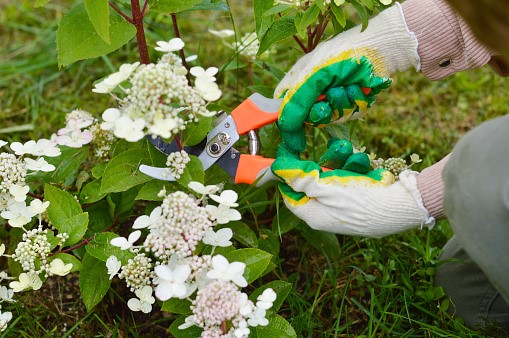
Flowering shrubs are the great “bones” of your garden. They give structure, are generally long lived, offer winter interest and protection for creatures. But most do need to be pruned as they age.  When you prune depends on when in the season the shrub blooms. Early bloomers like forsythia, deutzia, flowering almond, purple sandcherry or bridal wreath spireas should be pruned after flowering. Summer flowering shrubs such as hydrangea, dogwood, potentilla, summer flowering spireas, butterfly bush or rose of sharon can be pruned in late winter or early spring. Taking just the spent flowers would be a light prune which can be done when the shrub is young, looking healthy and keeping its natural shape. The practice of cutting out a third of the bush which includes the oldest discoloured branches, branches that cross each other, or dead branches will keep your shrub looking good and producing good bloom. Cutting stems on an angle facing out and just above a bud is a best practice. 

An older, established shrub can become wonky looking, have many dead branches, grow too large or stop producing flowers. This is when you can do a drastic prune called coppicing.

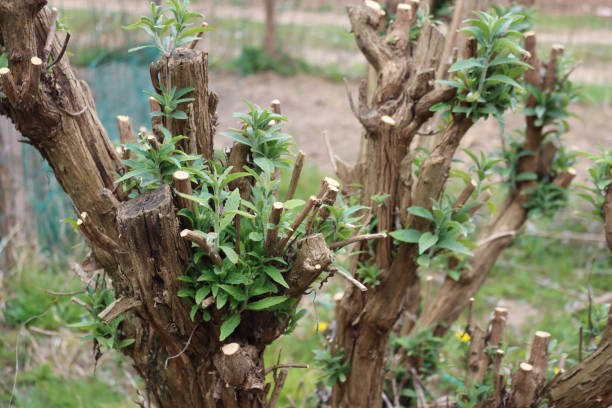
Coppicing is a procedure that has been popular in England and Europe for ages. It involves cutting back the shrub to the ground or just above the ground. This stimulates the roots and the plant will send up fresh new shoots which will develop into a renewed shrub.

Many gardeners will coppice their Annabelle hydrangea each year, so it comes up from the ground to become the beautiful late summer flowering shrub.

Coppicing is usually done in late winter or early spring, when the plant is still dormant. Coppiced shrubs should be mulched with a good compost or fertilizer.

Unfortunately, flowering will not happen in the year this pruning is done.

Shrubs that can benefit from this aggressive pruning include:

  • Deutzia
  • Forsythia
  • Elderberry (sambucus)
  • Red Osier Dogwood (cornus sericea)
  • Smokebush (cotinus)
  • Beauty bush (kolkwitzia)
  • Ninebark (physocarpus)
  • Weigela
  • Mock Orange (philadephus)
  • Rose of Sharon (hibiscus syriacus)
  • Willow (french pussywillow, salix)

Sean James does not recommend coppicing lilac which tend to just send up suckers, or potentilla which are slow to respond when coppiced. Here is a link to show you Sean James coppicing a deutzia

Rejuvenating Shrubs the VERY old fashioned way!

And here is a Toronto Master Gardener you-tube video to show you how this gardener coppiced a sad looking weigela and the great results.

Coppicing an Old Weigela

Pruning of any kind can seem intimidating to the beginner. Like any task, the more you do it, the more comfortable you will be. A tip that I use is to stand back and look at your shrub as you prune, to see the overall effect. And remember to research if you are not sure when to prune to avoid pruning off the flower buds that may be setting.

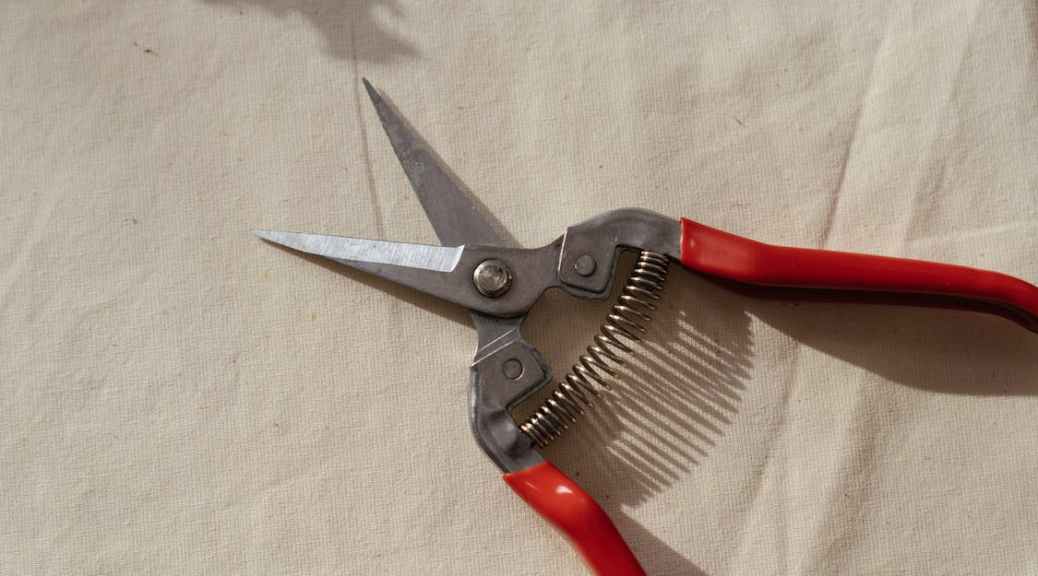
Now get your pruners sharpened and out you go!

But don’t look at the solar eclipse today without proper eye protection!

https://www.rhs.org.uk/plants/types/trees/coppicing

Pruning Herbaceous Perennials “The Chelsea Chop”

By Marilyn Homewood, Master Gardener

As the spring bulbs fade and we move past our “last frost” date (or so we hope!), the perennials are starting to grow by leaps and bounds. This can lead us to consider ways to manage their size or bloom time. The Chelsea Chop is a method of pruning that limits the size of a plant, controls the flower season (which can assist in creating peak season bloom combinations) and often decreases the floppiness of a number of herbaceous perennials.

In England, the time for this type of pruning is carried out now which is around the same time as the Chelsea Flower Show is held, hence the name.  In our neck of the woods, timing would be most appropriate in late spring or very early summer when the plant has a fairly substantial amount of vegetative growth.  When I am going to do this, I like to have it done before the onset of our hotter, drier weather so that it does not stress the plant overly (on average by mid June).

Phlox chopped in front to extend blooming season

Plants that have received the Chelsea Chop are not as tall or leggy, so that they may not need supporting.  Flowers are smaller but are more numerous (removal of top shoots encourages branching of laterals).

It should be noted that you can not chop all summer blooming plants.  Woody sub-shrubs do not respond well.  If the spring has been dry, drastic pruning could shock your plants so a light hand is recommended in those years.

Many summer and autumn flowering perennials are good candidates for the chop.  These plants include:

  • Garden phox (Phlox paniculata)      
  • Yarrow (Achillea spp.)
  • Bellflower (Campanula spp)
  • Aster (Symphyotichum spp)
  • Coneflower (Echinacea spp)
  • Black-eyed Susan (Rudbeckia spp)
  • Upright Sedum Hylotelephium spp)
  • Penstemon (Penstemon spp)
  • Goldenrod (Solidago spp.)
  • Shasta daisy (Leucanthemum superbum)

This list is not complete.  Try experimenting with some of the vigorous plants in your garden.  I have a cultivar of catmint (Nepeta “Six Hills Giant”) that is large and spreading.  In one area of my garden, I prefer it to stand a little more to show the blooms to effect so I chop it back by about one third in the last week of May.

Nepeta more upright and floriferous due to chopping

The chop is done in two ways depending on the effect one desires.  In the first method, clumps of perennials are cut back by one third to one half.  This will delay flowering and keep plants shorter and more compact.  The second method involves cutting back only half of the stems on a plant, this has the effect of extending the flowering season over a longer period.  I commonly used the second method on my Garden Phlox keeping the plants in bloom for a longer time. Pruning can be done with sharp shears or with secateurs.  Garden shears are often faster when there is a large volume of pruning to be done.  Try out the chop and see if you can alter the form or flower of some of your favourites!

Resources

https://www.gardenersworld.com/plants/11-plants-to-chelsea-chop/

https://www.bethchatto.co.uk/discover/our-blog/guides/the-chelsea-chop-how-to-do-it.htm

To Prune or Not to Prune your Deciduous Shrubs … that is the Question!!

By Carol Anderson, Master Gardener in Training

Spring is upon us and most of us are venturing out into the garden to undertake some much needed clean up, anticipating the beautiful days and growing season ahead. However, do you find yourself looking at your shrubs and wondering whether to prune or not, and if so, when, and how? If this describes you, then this blog might be helpful as you consider your spring work ahead. Although we know that pruning supports the growth of healthy and robust shrubs, it is one of the most inconsistent and often poorly executed garden techniques. Pruning is not only essential to maintaining plant health, but also an essential part of woody plant maintenance used to:


ü  improve the quality of your plant/shrub (e.g. flowers or yield),


ü  “train” plants (shape and structure),


ü  remove dead of broken branches,


ü  control their size and shape, and


ü  create an esthetically appealing specimen in your garden. 

Perhaps the reason that pruning is avoided by many gardeners is because proper pruning takes careful planning and execution; knowing your plants growth habit (mounding, cane or tree-like) and life cycle will determine pruning time and technique to be used. The following tips will hopefully turn this daunting task into something more enjoyable.

  1. Develop a pruning plan for your garden – a plan that outlines each plant’s pruning requirements (including timing). Create a table that identifies, at a minimum, what species of shrub you have, its location in the garden and when to prune. In addition, you may wish to add details and notes about any observations you have made and when it was last pruned. Keep this plan as a reference tool going forward.
2. Determine your objective for pruning – are you cleaning up broken or diseased branches? Is the shrub too big? Is the shrub dying in the middle and too dense? Or is the shrub very old and has lost much of its’ vigour?

3. Determine how much to prune – rule of thumb: don’t remove more than 1/3 of a shrub in any one season (Exception: if you are undertaking gradual or extensive rejuvenation pruning – see below)

4. Understand the proper tools and technique to use – general rule of thumb is that secateurs can be used for branches up to ¾” and lopping shears up to 2” branches – anything beyond that may require a specialized saw. Cuts should be clean and taken back to the next lateral branch, node or close to the ground (described below), but never randomly in the middle of a branch.

5. Determine when to prune – the following table provides an overview of pruning objectives, techniques, and timing.

Special Note: most evergreen shrubs do not need pruning, except sanitation pruning as required. The proper selection of the shrub and then allowing them to grow to their natural form is always recommended, unless you are training them to a specific form. Evergreen shrubs require special consideration as they cannot withstand the pruning described here for deciduous shrubs.  

Pruning Objective

Purpose

Technique

Timing

Sanitation Pruning

Used to remove dead, dying or diseased branches. Note: broken stems can lead to disease and insect infestations

Cut below area of damage (into healthy wood) just above an outward facing branch node

Throughout the growing season (inspection of your shrubs should be done regularly)

Thinning

Used to improve air flow and light penetration and prevent branches in the middle or bottom of the shrub from dying; thinning stimulates growth throughout the shrub

Remove branches to their point of origin (next lateral branch). Note: for shrubs with cane type growth, remove the oldest growth cane close to the ground

*Regardless of the objective and method, it is important to know whether the shrub blooms on “new” growth (this year’s branches) or “old growth” (branches formed the previous year). For example, a Common Lilac blooms on last year’s growth – pruning right after blooms dies off will ensure sufficient time for new growth to become established  prior to dormancy and exposure to harsh cold temperatures.

Reducing Size

Used to reduce the overall size of the shrub. Note: it is recommended that when choosing a garden shrub, the mature size should be considered given the space

“Head-back” to the next lateral branch that is at least 1/3 the size of the one being removed

Stimulating Growth

Used to improve overall yield of flowers or enhanced foliage growth (bushiness)

Head back to an outward facing bud (new growth will be stimulated at the bud closest to the cut and in the direction the bud is facing)

Rejuvenation Pruning

Older shrubs have large portions of unproductive wood; these are removed to stimulate new growth

Gradual: requires ~ 3 years of gradual removal of old and new shoots

Extensive: removal to 6-10” from ground with gradual removal of some of the new growth

*In general, spring blooming shrubs most often bloom from buds formed on last years’ “old growth”, such as the Common Lilac. In contrast, most summer blooming shrubs will flower on “new growth” requiring a late winter/early spring prune to stimulate new growth for flowering in the same year, such as most Hydrangeas. Pruning your shrubs (and trees…although not covered in this blog), should become an essential technique to managing your home garden – and it will pay off in spades (😊).

Be clear on your objective before starting and take notes that will guide you in subsequent years. Do not be fearful of doing some rejuvenation for those shrubs that are just not what they used to be; but it is recommended that you do some homework on this technique before embarking on anything extensive. So get out those secateurs, clean them thoroughly and start pruning – your shrubs will thank you for it!

Winter Browning of Conifers

By Laura Gardner, Master Gardener in Training

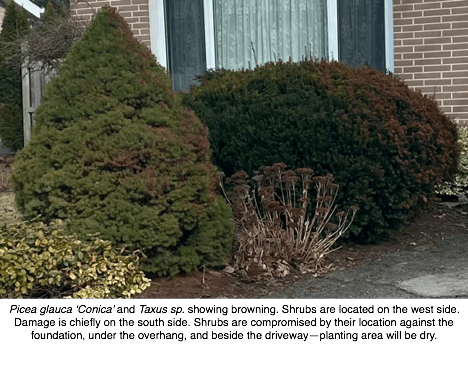
This spring as I walk around my neighbourhood, I have noticed quite a few evergreen conifers with brown needles. The species that are commonly affected are mainly the dwarf and ornamental varieties such as Picea glauca ‘Conica’ (Dwarf Alberta Spruce), Thuja occidentalis ‘Smargd’ (Emerald Cedar), and Taxus spp. (Yew). Some of the more robust and resistant conifers are the parent species such as Thuja occidentalis (Eastern White Cedar).

Some Causes[i]

  1. Inadequate moisture
  2. Inadequate protection from sun and wind
  3. Rapid freezing/thawing
  4. Salt spray damage
  5. Root damage at transplant
  6. Late season pruning and fertilization
  7. Late fall transplant
  8. Genetic maladaptation

Cultural Practices for Recovery and Future Maintenance

Depending on the extent of the damage, these shrubs may recover and produce new growth. This process can be encouraged by additional watering and the addition of mulch. Shrubs should be well-hydrated up until freezing in the fall to prepare them for moisture loss in the following winter. Mulching helps protect shallow roots from drying out, can help limit frost-heaving, and moderates the temperature of the soil.

Prior to winter, consider adding some protection such as a burlap screen with stakes for plantings on the south and/or west side where it is sunny or windy or near driveways and walkways that are salted. Burlap can be wrapped around shrubs but should be kept loose so that moisture is not trapped. The advantage to a screen is that the area remains open to air and light. Salt, sun, and wind can draw out moisture from the needles and because the ground is frozen, the roots are unable to draw in replacement moisture. Planting these types of shrubs on the north and east sides, in less open areas, and away from driveways can minimize damage.

Shrubs that have been dug from the nursery field and then have been repotted for sale may be subject to some root damage/loss. This can be more problematic when transplanting late in the fall as there is limited time for root re-development. In addition, the ability of the roots to draw in moisture before freeze-up can be compromised. Refrain from pruning and fertilizing late in the summer as this can encourage a flush of late new growth—tender growth that is more susceptible to winter damage.

Conifers that are exhibiting winter browning:

Is Supportive Care Enough?

Perhaps—it is required in the first few years after transplant and probably they will continue to require extra support. However, some dwarf and ornamental conifer cultivars are simply not genetically adapted to thrive in this region. This is because they have originated from areas of more moderate climate and hardiness zones. When considering trees and shrubs, while some species are more adaptable than others, it is preferable that stock be grown locally and be from local cuttings and seed. Forest Gene Conservation Association notes that “bringing material in from dissimilar areas often results in low survival from heat stress or winterkill, frost damage, reduced growth rates, and increased insect and disease problems.”[ii] While climate change is indeed allowing us to push the envelope a little and plant some species from the next hardiness zone, and there are assisted migration[iii] programs for species, there can be a risk in transplanting certain plants from further afield. Plants are genetically adapted to follow a particular timed growth cycle. For example, a study of Quercus rubra (Red Oak) found that a specimen grown in Algonquin Park that was transplanted in the Niagara region stopped growing before the end of the growing season. It was genetically adapted to a growing season of 185 days but the growing season in Niagara is around 230 days. Another specimen grown in Niagara that was transplanted in Algonquin Park was genetically adapted to continue growing past the end of the growing season there and as a result suffered frost damage and browning. It would be weakened and be more prone to damage from disease and insects.[iv]

Another study of Picea glauca (White Spruce) in Alberta found that cold hardiness was determined to be the trait with the strongest genetic variation. Seed from plants originating from Ontario had high growth but a poor survival rate. Because they were accustomed to longer growth periods, there were more vulnerable to early damaging frosts. The plants with the highest survival and growth rates were grown from local stock.[v]

Before purchasing, determine your garden’s site conditions: soil, moisture, drainage, sunlight, wind, climate, and whether the trees or shrubs you are considering can adapt readily to the conditions. Climate change also needs to be considered as we experience increased drought and higher temperatures. Determine their origin. Ask the vendor where they were grown. If they originated from an area with very different conditions, consider giving them a pass. Realize that “if a tree is not genetically adapted to your site conditions, no amount of care will help it grow as vigorously as one from the appropriate source.”[vi]

Keep in mind the gardening adage, “the right plant for the right space.”


[i] Winter Burn. University of Wisconsin Garden Fact Sheets. Online: https://hort.extension.wisc.edu/files/2015/01/Winter-Burn.pdf

[ii] Seed Source Matters. Forest Gene Conservation Association. Online: https://fgca.net/2016/12/seed-source-matters/

[iii] Assisted Migration. Forest Gene Conservation Association. Online: https://fgca.net/climate-change/assisted-migration/

[iv] How Far Should the Seed Fall from the Tree? It’s a Question of Respecting Diversity: Genetic and Environmental. Online: https://ontariosnaturalselections.org

[v] Sebastian-Azcona, Jaime, et al. Adaptations of White Spruce to Climate: Strong Intraspecific Differences in Cold Hardiness Linked to Survival. Ecology and Evolution, vol. 8, no. 3, 2018. Online: http://dx.doi.org/10.1002/ece3.3796.

[vi] When Planting Trees. Forest Gene Conservation Association. Online: https://fgca.net/forest-gene-convservation/when-planting-trees/

Pruning Tips for Spring Flowering Shrubs

By Lois Scott, Master Gardener

Spring finally arrived and is now quickly passing, as are the blossoms on spring blooming shrubs such as Forsythia, Lilac and Bridlewreath Spiraea.  Once these shrubs are finished blooming, we can ensure that next year’s blossoms will be abundant by pruning them effectively.

These shrubs flower best on the wood that grew the previous summer and they benefit from some yearly pruning done right after blooming and before new growth begins. The general idea is to prune out some of the oldest wood each year so that your shrub is renewed over time and does not become overgrown and underperforming.  Along with the following tips you should always prune any material that is dead, diseased or dying when you find it.

Lee Reich, the author of “The Pruning Book” recommends the following pruning process.

  • Cut to within 1 ft (or less) of the ground some of the oldest stems.
  • To keep your clump to a desired size, selectively cut some of the oldest stems from around the edge of your clump.
  • If desired shorten some of the remaining older stems.  This will keep your shrub short enough that blossoms will be more accessible.
  • If you have just planted a new shrub this spring, the recommendation is not to do any pruning while plants are young.  Just mulch, water and weed your shrub, pruning only material that is dead, diseased or damaged.  Pruning stimulates growth and for a young shrub it is important for the energy to go towards root growth.
  • Use loppers and hand pruners rather than hedge trimmers.

I agree with Lee when he says “it’s best to use your pruning tools to coax a bush along in the direction of its natural inclinations” rather than trying to contain naturally arching shrubs into ‘balls’.  Planting shrubs in locations where they have room to grow into their natural shape is preferable to me, however pruning can be a creative pursuit so each to their own!

Resources

It is Time to Prune Lilac, Forsythia and Other Early Spring Flowering Shrubs

Penn State Extension: A Prime Time to Prune!

Ode to the Clematophile!

By Cheryl Harrison, Master Gardener

I can not claim to be a clematophile (Clematis expert) but I do like Clematis!   Clematis are wonderful perennial flowering plants … many grow as vines, some are more like small shrubs, some are evergreen and some are herbaceous so die back to the ground each winter.  Their flowers come as bell-like or more star-like shapes with sepals that are single or double; some are scented.  And the colours!  They range from white or yellow to pink or red to purple or blue … pale to deep and some are even striped.  Some flowers grow as large as 25 cm (10in) across!  The beautiful clematis blooms are followed by eye-catching fuzzy seed heads.  There are lots of choices in the genus Clematis.

Clematis seed head

Clematis grow in zones ranging from 3-11.  If you are not sure which zone you are in, check here.   Choose a plant from a reputable dealer.  Look for those that have strong stems and are at least 2 years old so that their root structure is well developed.  Most Clematis prefer sun or part shade but like their roots kept cool so mulch or plant another perennial close by to shade the roots.  Plant your Clematis in moist but well drained soil with lots of well-rotted, organic matter (eg. finished compost) added.  Plant the ripened stem (brown, no longer green) about 16 cm (6 in) below the final soil level.  Clematis prefer neutral to slightly alkaline soil.  All new plants need to be watered regularly until they are established and during dry conditions.  Fertilize with an all purpose organic fertilizer monthly but stop when flower buds are ready to bloom in order to prolong bloom time.  You may start fertilizing again after flowering has ended but stop feeding in late summer early autumn.

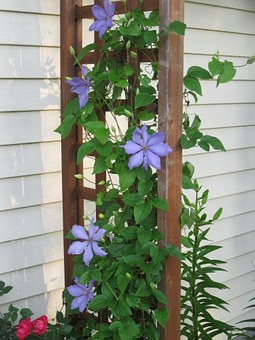
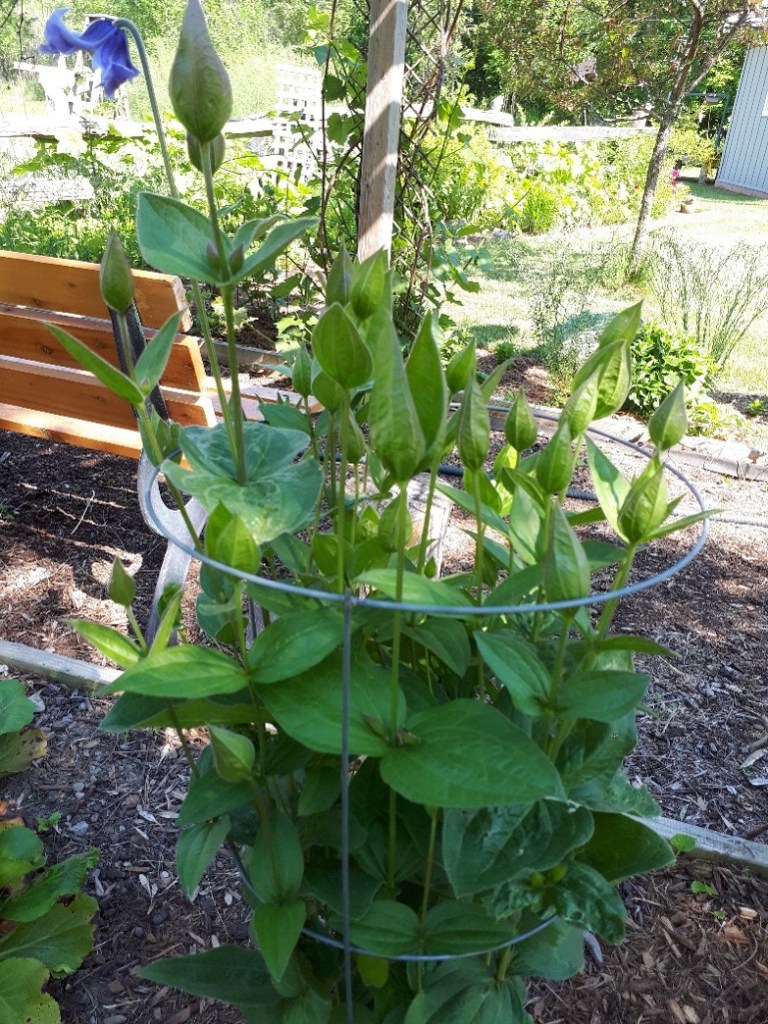
Clematis on trellis

Pruning your Clematis for the best blooms may seem complicated.  The confusing part for me was that some references refer to groups 1,2,3 and others use group A, B, C  while others will use the species names.  What is important is knowing what you have and then you can determine how to prune.  Read your plant label for pruning directions or if you do not know which Clematis you have:

When does your Clematis flower?

  1. *flowers on old (previous year) wood in early to late spring, early summer.
    *does not need regular pruning – prune to remove damaged stems or to keep your plant tidy and growing within it’s allocated space.  Prune after the flowering period has ended.
  2. *flowers  early on old (previous year) wood and again in late summer on new current year’s growth. 
    *prune to remove damaged or weak stems and the early flower shoots (encourages the second period of flowering) immediately after the early flowering period.
  3. * flowers on current year’s growth in mid to late summer. 
    * prune back all of the previous year’s stems to the lowest pair of live buds in  early spring.
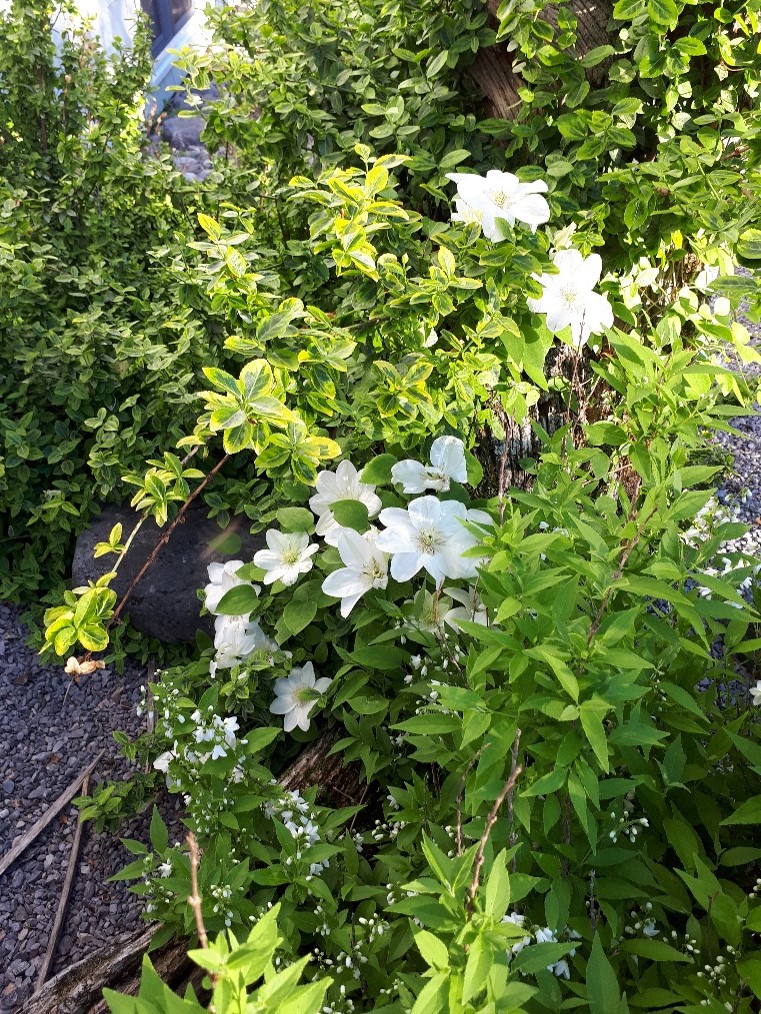
Clematis growing through shrub, author’s garden

Clematis may suffer from snails, slugs, aphids or mildew.  Clematis wilt is a fungal disease that may result in the sudden collapse of a previously healthy plant.  Cut back affected part of the plant, even right to the ground if necessary, if fungus wilt occurs.  I have to say that I have only ever experienced the odd slug-chewed clematis leaf in my garden just east of Peterborough.

Clematis will grow on a trellis and in a container, through the branches of another shrub or even up into trees.  It may be used as a ground cover and the shrub types look great in the perennial border.  Clematis flowers are lovely and will attract pollinators and provide them with pollen and nectar.

Read plant labels, talk to garden nursery staff  and other gardeners in your area and/or google to ensure that you purchase the clematis that is right for you.  We may not all become clematophiles but we can still have some of these wonderful plants in our gardens!

For more information check out:

Clearview Horticultural Products – Clematis and Vine Guide

International Clematis Society

Timber Press Pocket Guide to Clematis by Mary Toomey with Everett Leeds and Charles Chesshire, ISBN-13:978-0-88192-814-3

Clematis ‘Stand by Me’, bush type, author’s garden

Winter, when a gardener’s thoughts turn to Spring

By Emma Murphy, Master Gardener

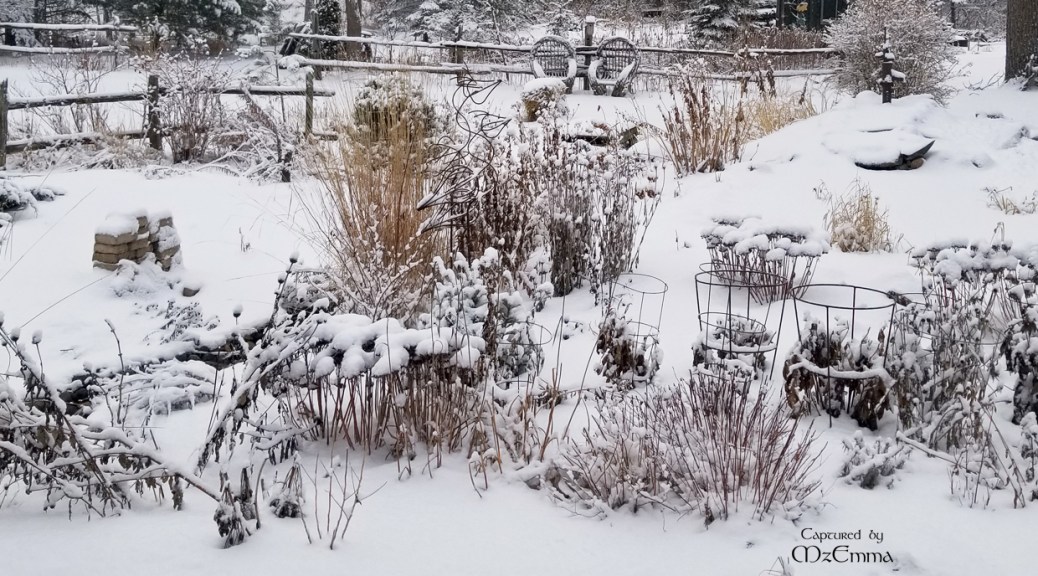
So now it’s wintertime. Our plants are sleeping quietly beneath a bed of wonderful white snow, and although we hibernate and rest to a degree, a gardener’s thoughts turn to springtime. I’m exploring some new ideas for my gardens for next spring, and thought I would share them with you.

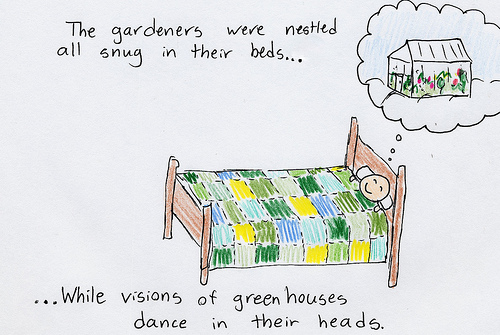
Credit: Joseph Tychonievich; cartoon from https://www.facebook.com/FineGardeningMagazine/photos

No I didn’t get a greenhouse for Christmas…yet.

RAISED BEDS FOR GARDENING

But I do have a wonderful husband who knows how to make his wife – the Master Gardener – a happy person. His Christmas 2020 gift to me was to create some raised beds so we will be doing that this spring. I have been wanting to do raised beds for a few years since seeing Tara Nolan do a presentation at the Peterborough Garden Show, and I guess dropping those significant hints finally worked 😉

So we did a little research. Have you been thinking of creating raised beds for either vegetable or other gardening? They are great to extend the gardening season, be able to control soil quality, provide accessibility for older gardeners or those with disabilities, create a garden for special purposes (youngsters or horticultural therapy), increase yields, reduce weeds, and keep critters at bay. They also work well for condos and rooftops in our urban centres. Here’s some great sites I found for those interested in the idea.

One of my favourite gardeners with a similar climate to mine in Central Ontario – Erin Schanen in Southeastern Wisconsin (zone 5) – The Impatient Gardener. She has several good articles on growing in raised beds, from layout through to construction.

Tara Nolan’s book Raised Bed Revolution emerged at a time when this idea was gaining a lot of traction, and it’s an excellent source of information on size requirements for constructing raised beds, height suggestions, types of materials you can use, and creative tips for fitting the maximum garden capacity into small spaces—including vertical gardening. The Toronto Botanical Garden also wrote a great review. We also have a copy of Mel Bartholomew’s Square Foot Gardening, which focuses on growing more fresh produce in less space, and is very complementary to the raised bed philosophy.

For some general information on raised beds try here and here.

ORDERING YOUR SEEDS

Maybe it was just the crazy rush (and delay on delivery) for seeds this past spring, but we just ordered our vegetable and flower seeds for the 2021 season. There are lots of seed companies to choose from, but please try to shop from Canadian companies and especially those local to you. Although COVID-19 meant the cancellation of Peterborough’s wonderful Seedy Sunday, the organizers did post a list of all the vendors who would have been there, and it’s a great resource, as is the Seeds of Diversity site.

ESPALIERED FRUIT TREES

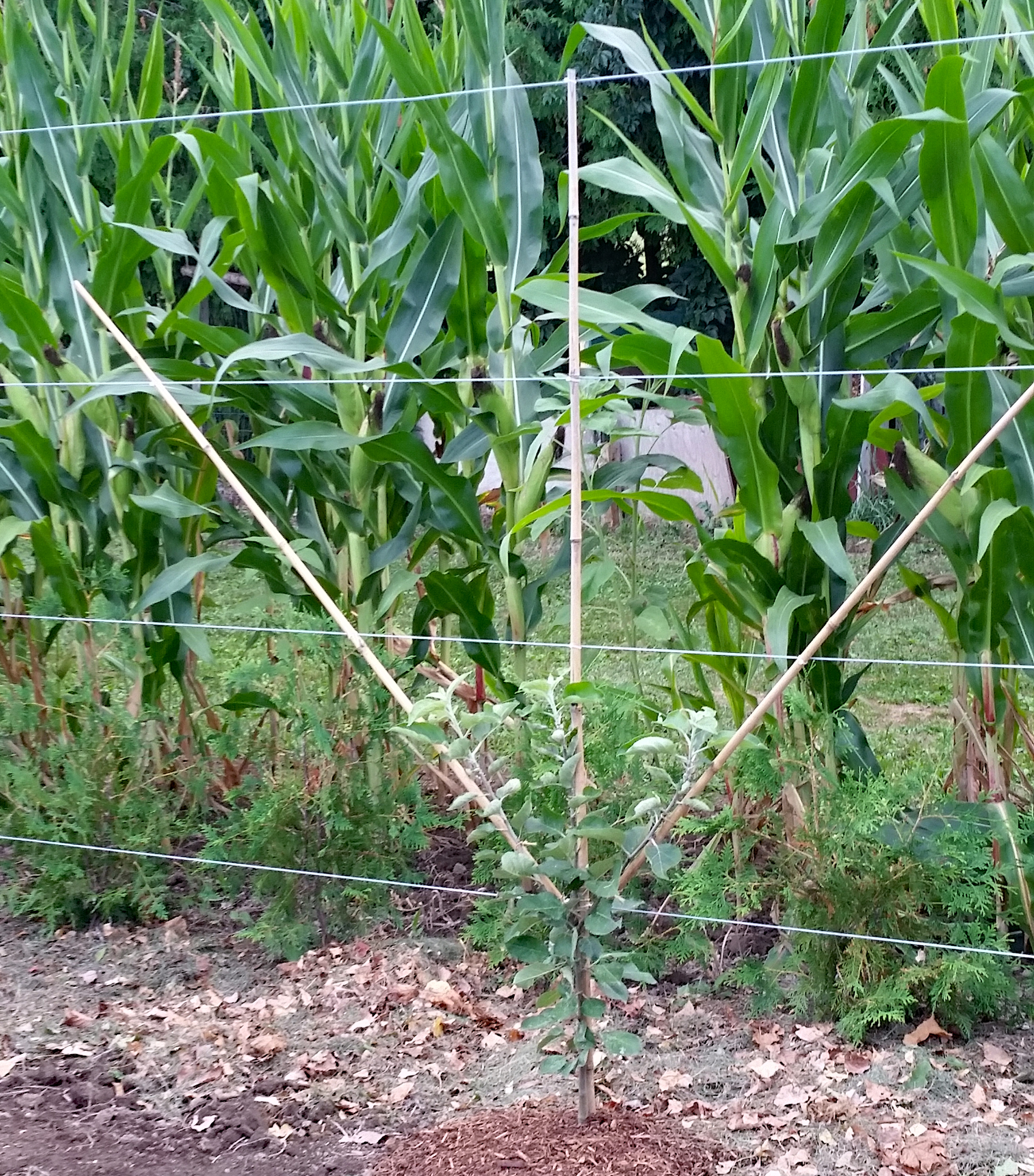
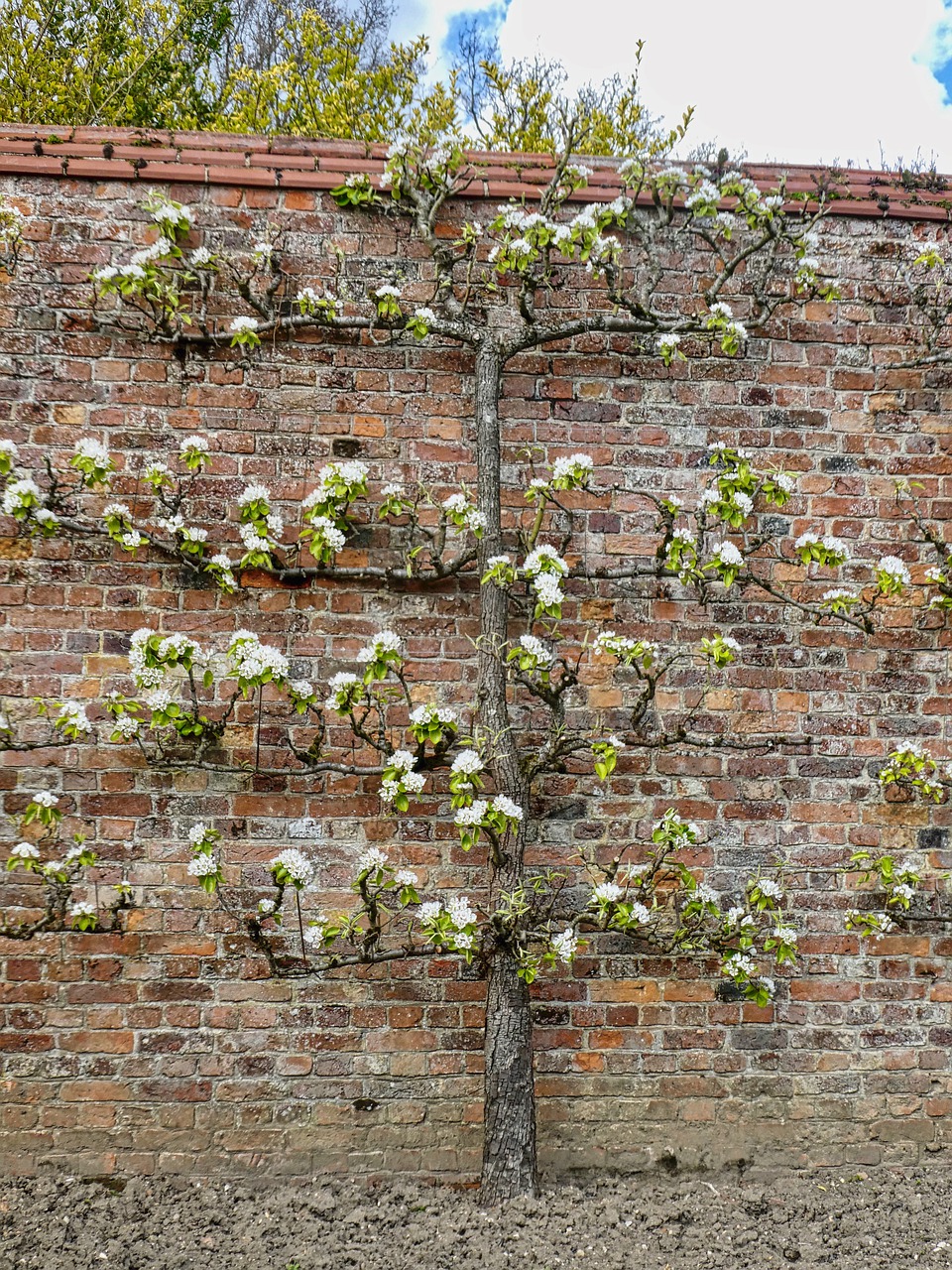
Espaliered fruit trees (espalier – to train a tree or shrub to grow flat against a support or wall) have been on my garden wish list for several years, and I missed an opportunity to pick up a mixed apple espalier tree several years ago which I have been kicking myself for ever since. I saw amazing espaliered fruit (English style) in the Victorian Kitchen Garden at Meadow View Gardens (just north of Cobourg) on a Master Gardener tour several years ago, and was entranced (well I’m entranced by owners Julie and Garry Edwards’ entire English-inspired gardens, but that’s another story).  

Although they can be any kind of fruit they are most often apples, and the key to doing it well is understanding how to prune the trees. Garden Therapy has an excellent article on how to grow these edible gardens, in ways that can accommodate both small spaces but be decorative. There are many different shapes that can be done – cordon (branches straight out to the sides), fan (branches fanning up and to the side), candelabra (like a cordon but the branches turn at a right angle to form the shape of a candelabra), lattice (multiple trees with crossing branches), and “Y” shapes. Maybe this is something you can try in your garden as well? The Ontario Ministry of Agriculture, Food and Rural Affairs (OMAFRA) has a list of nut and fruit tree nurseries. I know one company I have dealt with is Silver Creek Nurseries in Wellesley, who specialize in fruit trees, and they offer the following advice on their website:

“Spur bearing varieties are recommended (rather than tip bearing), such as Cox’s Orange Pippin, Winesap, Fuji, Belle de Boskoop, Calville Blanc, Sweet 16 and many more. Apple and pears are generally the easiest fruits to train, but other species may be espaliered with varying degrees of difficulty.”

Grow a Little Fruit Tree: Simple Pruning Techniques for Small-Space, Easy-Harvest Fruit Trees is also recommended as a resource (although I haven’t read it).

I’ll be in touch with them once spring rolls around, which should be in 82 days or so (but who’s counting?). Enjoy your winter garden dreaming, and spring will be here soon enough.

My Favourite Pruning Book

by Suzanne Seryck, Master Gardener

I have a lot of gardening books and whilst I do search on the internet if I have a quick question, there are a few books that I go to repeatedly and often. One of these is from the UK Royal Horticultural Society Pruning & Training. I am sure you could find a similar book in Canada but as this book was given to me a few years ago by my father-in-law as a present, it has special meaning for me.

I love growing fruit, apples, grapes, currants, blueberries, to name a few and as I have a smaller city garden, this comes with challenges. I have to make use of all available space and prune effectively to fit everything I want into my garden. Hence the reason why this book is so important to me and why I use it so often.

There are chapters on ornamental trees as well as ornamental shrubs and roses and a good introduction describing the parts of a plant as well as the principles of pruning and training. But it is the chapters on tree fruits, soft fruits and climbing plants that I refer to most often. I actually have PostIt® notes on the sections that describe the pruning shapes I have chosen for my apples, currants, gooseberries and grape so I can check I am doing it correctly. I must admit it took a few years to observe the effectiveness of pruning well, I was always hesitant to cut off too much of the plant, much as I still save every perennial seedling that comes up in my garden. In my last house we had a grape for approximately 6 years and whilst we did get some fruit on it, we could have doubled or tripled the harvest with better pruning, but I hated to cut so much off.

For my grape vine I originally had it growing over an arch, but it soon outgrew that support, so we had to build a new support system and then re-prune it into its new system. There are many different systems that can be used for grapes including the rod and spur system in which the grape is grown along 3-4 horizontal wires to the guyot system in which shoots from two horizontal stems are grown vertically.

The chapter on tree fruits starts by showing diagrams of all the different forms or shapes as well as describing basic and pruning techniques. There are lots of photos and diagrams in this book so that you can visually see everything being discussed, which I really like. There is also a section on renovating neglected tree fruits.

I chose to prune my apples trees as espaliers on a four tiered tree, this is my trees fourth year and first year that they have blossoms, so I am hoping to have my first apples. It is fairly time consuming, especially as I didn’t know what I was doing the first couple of years, but I followed the instructions religiously and am now beginning to approach the trees with pruners in hand confidently.

espalieredapple
Espaliered apple tree (Year 4)

My currant and gooseberry bushes were pruned as multiple cordons with three vertical arms. I have this grown both on the same support system that I have for the fruit trees but also on bamboo poles. I find that by growing them in this way as opposed to a bush, I can fit more currant bushes into the same space, I grow red, pink, white and black, and they are easier for me to pick. I still have a high yield of berries and am able to harvest almost all of them.

currentcloseup
Close up of currants

redcurrent
Redcurrent bushes

There are plenty of videos on the internet showing different pruning techniques, maybe even too many as it is often difficult to choose just one, and then you end up getting side tracked. As I was writing this article and looking up videos, I ended up watching three including one on heucheras. Here’s one you might like from the RHS on renovating fruit trees.