Category Archives: Native Plants

Invite These Super-Pollinators & Pest Managers to Your Garden

By Silvia Strobl, Master Gardener

You may know that native bees are the most important of our native pollinators, but which insects are the second most important pollinators of food crops and native wildflowers?

Perhaps you’ve never heard of flower flies? Visiting flowers more often and moving more pollen than pollinators such as butterflies, flower flies range in size from less than 1/4 inch long to more than 3/4 inch long, but pollinate at least 72% of global food crops and about 70% of wildflowers (Pollinator Partnership, 2024).

Maybe you have mistaken their strongly contrasting black and yellow bands on the abdomen for a bee or a wasp? Their colouring mimics that of these stinging insects—an evolutionary development known as Batesian mimicry. The English naturalist, Henry Walter Bates, came up with this term for harmless species that take on the physical traits of dangerous or bad-tasting species. So although hover flies lack a stinger, their colouring imitates the warning colours of bees and wasps that do have stingers, thereby offering protection by deceiving predators.

The larvae of flower flies are stellar pest managers, consuming aphids, leafhoppers, mealy bugs and thrips. In fact, one larva can eat up to 400 aphids over its two to three week development!

Females lay hundreds of eggs, depositing each tiny white egg singly on leaves or shoots near colonies of aphids. The larvae hatch in two to three days and resemble small legless maggots,  ranging in colour from creamy-white to green or brown (Mahr 2025).

Four common flower flies that I have observed and photographed in my garden, and whose identity has been verified by experts on iNaturalist, are shown and described in the following. Lists of flowers visited are from Skevington et al 2019).

Caption: This Orange-legged Drone Fly (Eristalis flavipes) is found in a many habitats. It visits a wide range of flowers, including this Zinnia in my garden, but also Spreading Dogbane (Apocynum androsaemifolium), Button Bush (Cephalanthus occidentalis), Thistles (Cirsium spp.) Joe-Pye Weeds (Eupatorium spp), Apple (Malus spp.), Ninebark (Physocarpus opulifolius), Primroses (Primula spp.), Sedum (Sedum spp.), Goldenrods (Solidago spp.), Meadowsweet (Spirea spp.), Asters (Symphyotrichum spp.), and Viburnum (Viburnum spp.).
Caption: This adult Eastern Calligrapher‘s (Toxomerus geminatus) beautiful black and white pattern is well disguised on the disc flower of the native Lance-leaved Coreopsis (Coreopsis lanceolata). The adults consume both pollen and nectar, and have been recorded visiting: Joe Pye Weeds, Ninebark, Goldenrods, brambles (Rubus spp.), feverfew and tansy (Tanacetum spp.) and blueberries (Vaccinium spp.). The larvae pierce aphids and mites with their hooked mouthparts before feeding on them.
Caption: The Narrow-headed Marsh Fly (Helophilus fasciatus) is one of the earliest and latest flower flies, shown here pollinating late blooming Smooth Aster (Symphyotrichum laeve) in my garden. Some flowers visited include Button Bush, Joe-Pye Weeds, Grass leaved Goldenrod (Euthamia graminifolia), Ninebark and Golden Alexanders (Zizia spp.). The adults lay eggs on vegetation overhanging ponds and when the larvae hatch they fall into the water where they complete their development.
Caption: Transverse Banded Flower Fly (Eristalis transversa) on flower of the native Tall Coreopsis (Coreopsis tripteris).The adults consume pollen and nectar from:
Native shrubs such as Buttonbush, Ninebark, and Viburnums
Native coneflowers (Rudebekia spp.), Goldenrods, and Asters
Non-native winter cress or yellow rocket (Barbarea spp.), sedums, feverfew and tansy

There are 416 known flower fly species in eastern North America (Skevington et al. 2019). So I hope to observe and photograph at least a few more species on flowers in my garden this season! Nearly all flower flies can readily be identified by their:

  • Large heads with large forward-facing eyes that often fuse together. Bees have kidney-shaped eyes on the side of their heads.
  • Stubby, short antennae as opposed to the long antennae that bees have
  • Only 2 wings compared to 4 wings for bees and wasps (Erikson 2020)
  • A “false” vein in their wing venation i.e., a vein that is not joined to any others

From: https://ipm.ucanr.edu/PMG/S/I-DP-SYRP-KC.003.html#gsc.tab=0

How do you attract these super pollinators and pest managers to your garden?

  1. Flower flies prefer white and yellow flowers that are open and have easily accessible pollen and nectar, for example the disc flowers in the daisy (or Asteraceae family), but they also use orange, pink, purple, and blue daisy-like flowers. According to a recently published book about the flower flies of northeastern North America, native plants are essential to supporting a diversity of flower flies (Skevington et al. 2019). Non-native plants that attract flower flies include: Queen Anne’s lace, wild mustard, sweet alyssum, coriander, dill, broccoli, kale, lettuce, mustards, dandelion, plums and cherries (Mahr, 2025, Pollinator Partnership 2024).
  2. Don’t use pesticides since they can kill both the larvae and the adult flower flies.
  3. To give the larvae something to eat, tolerate some level of aphids and other pests in your garden.

Don’t be surprised if by doing these things you suddenly start seeing flower flies in your garden. Also known as hover flies, you may even observe their darting back and forth flying behaviour i.e., when males hover in the open hoping to attract a female, or when males of some species defend a territory.

Flower flies are some of the most beneficial insects you can have in the garden so invite them in by planting the annual non-native and native flowers they prefer.

Literature Cited

Erikson, B. 2020. Flower flies: insects with a “PR problem”. Wild Pollinator Partners.

Mahr, S. 2025. Hover, Flower or Syrphid Flies (Syrphidae). Wisconsin Horticulture, Division of Extension.

Pollinator Partnership. 2024. Flower flies—masters of disguise. 2-pages.

Skevington J.H., M.M. Locke, A.D. Young, K. Moran, W.J. Crins and S.A. Marshall. 2019. Flower Guide to the Flower Flies of Northeastern North America. Princeton University Press. 512 pp. (Note: all 6 authors are Canadians from Ontario).

The Mysterious Magic of Maple Syrup

By Rachel Foebel, Master Gardener in Training

Recently, I have grown to love maple syrup for more than just its delicious taste. The harvesting and boiling of the sap brings me outside in the fresh air during a time of year when I need it most. But I’ve wondered what makes this harvest season so short, so specific and so unique.

First, the Sap

A cross section of a hardwood tree

During the growing season, sugars needed for tree growth are created via photosynthesis and stored in the tree as starches in the sapwood. When the weather cools, starches are converted back to sugars and passed into water flowing through the xylem of the tree, creating sap.

How Water Moves Through the Tree

Typically, water moves up the tree from the roots through cell channels called xylem. Since the xylem is made up of dead elongated cells, these cells don’t contribute to the movement of the water, they rely on pressure gradients. In maples, a unique pressure is present in the springtime, but only when it freezes at night and thaws during daytime.

A diagram of a plant cell

Maple Magic in Spring Time

Just outside of the xylem vessels are dead wood fibre cells with air inside. When the temperature drops in the evening, the smaller branches at the top of the tree freeze first, and sap frost collects in the air-filled wood fibre cells surrounding the sap-filled xylem. This creates suction, pulling sap up the tree. When the temperature rises in the morning, the frost melts and falls down the tree through the xylem by both gravity and pressure created by the warming air in the wood fibre cells. This is when you get to collect!

What about Fall?

But wait! We don’t just get freezing at night and above freezing daytimes in the spring. That happens in the fall too. Can you tap maple trees and make syrup in the fall too? The answer is yes, but researchers have found you won’t get as much as springtime, and the sap won’t be as sweet. Additionally, it will reduce the sweeter springtime sap yields as well. Worth it? Probably not.   

The Pros Know What They’re Doing

Tapping only once a year also helps to reduce injury and therefore risks to the tree caused by severing its protective layers and exposing it to external factors. Hobbyists and large-scale producers alike want to foster a healthy tree that provides delicious syrup for years to come.

References

Giesting, K. (2020). Maple Syrup. Climate Change Resource Centre. www.fs.usda.gov/ccrc/topics/maple-syrup

Merhaut, D. J. (Feb, 1999). How do large trees, such as redwoods, get water from their roots to the leaves? Scientific American. https://www.scientificamerican.com/article/how-do-large-trees-such-a/

Tyree, M. (Jan, 1984). Maple Syrup Exudation: How it Happens. Maple Syrup Journal. 4(1). 10-11.https://www.uvm.edu/~uvmaple/maplesapexudation.pdf

A Garden Visit – The Abkhazi Garden

By Marjorie Vendrig, Master Gardener in Training

Gardening is an incredibly versatile hobby, a hobby that can move around with you when you move house or travel near or afar. I’ve always made a point of visiting gardens whenever or wherever I travel. Out-of-town sporting events, family holidays, weddings, and even business travel have always included visits to public gardens, arboretums, or even garden centres. These visits are always aesthetically pleasing and relaxing. At the same time, they provide a chance to learn about the plant material along with some local history and culture.

On a recent trip to Vancouver Island I visited the Abkhazi Garden in Victoria.  It was early October, well past the glory days of summer and far too late to enjoy the rhododendrons – the highlight of the garden – at their prime.  That didn’t matter at all, the vistas were astounding, the property a real treasure where gardens wind their way over and around dramatic glaciated rock mounds. This is a site where the gardeners took full advantage of the topography and natural environment rather than change it or cover it up. It’s a one acre spot surrounded by urban Victoria yet each view from anywhere in the garden carries the eye to pleasing combinations of shape, colour, texture, and form. The main house and summer house were built in the late 1940’s reflecting the post-war Modernist sprit, resulting in a superb integration of house and garden.  The house and garden are carefully integrated, the blend of the natural and designed is seamless and sublime.

The story behind the garden is interesting as well. The property was originally purchased by Peggy Pemberton-Carter who, in 1946, had recently arrived in Victoria after having spent the war in prisoner-of-war camps in China. She soon married Nicolas Abkhazi, an exiled Georgian prince who had also been interned. The combination of their personal privilege and hardship found a creative outlet in their garden. In the beginning they acquired plant material from the finest nurseries, they were mentored by distinguished horticulturalists and over the next 40 years they experimented and refined their project.

The walk through the garden begins in the rhododendron woodland where the native Garry oaks provide the canopy for species and hybrid rhododendrons. Growing closer to the ground are the ferns and hostas with winter aconite, fawn lilies, camas and hardy cyclamen blooming in season. There’s also tigridia, primula, and galtonia, along with spring flowering bulbs.

A Spanish fir tree holds place of honour at the beginning of a meandering green path with an immense rock outcropping on one side and a profusion of heather and other mounding, textural interest on the other. The path was inspired by the Yangtze River and Peggy’s image of it near her childhood home. Side paths lead onto several naturally created rock ponds providing reflections of sky and other nearby plantings. At each turn or change in elevation the composition is unique and spellbinding.

Recent additions to the garden include a swathe of native camas and a collection of plants indigenous to the Caucasus region, these the result of a donation from the Georgian Ambassador.

The Land Conservancy of British Columbia (TLC) purchased the property in 2000 to save it from becoming a townhouse development. Part of the main room in the house has been refurbished as a Tea House. Community support is a large factor in the continued success and improvement of the garden: the entry fee is by donation and a large group of enthusiastic volunteers do much of the work around the garden.

References:

https://www.abkhaziteahouse.com/

Cedar Trees: A Winter Food Source for Wildlife

By Mary-Jane Pilgrim, Master Gardener

In February of 2023, I wrote an article about cedar trees; their botanical family, the medicinal history and their use by the early pioneers of our region.

Although the article alluded to its use as a food source for critters, that wasn’t the main purpose of the article. In this blog, I’d like to expand on that initial description to provide more information on the importance of the tree to our mostly four-legged friends and planet co-habitants.

The eastern white cedar (Thuja occidentalis), common in forests and along shorelines, provides a reliable food source for many animals when other options are scarce during our harsh winters. I have a row of cedars at the back of my lot mostly for wind control but it provides other functions for local wildlife.

Deer are among the most frequent consumers of cedar during winter. When snow covers ground vegetation, deer browse on cedar foliage, which is rich in nutrients. This evergreen tree helps sustain deer populations, especially in areas with limited winter food. However, over-browsing can damage young cedar trees and affect forest regeneration.

Other animals also rely on cedar. Snowshoe hares feed on cedar bark and twigs when their preferred food sources, like shrubs, are unavailable. Porcupines chew on cedar bark for nourishment. Even small birds, such as chickadees and finches, eat the seeds found in cedar cones.

Cedar trees provide shelter. Their dense, evergreen foliage offers protection from wind and snow, creating warm habitats for birds and small mammals. This shelter can be as important as food for survival in winter.

If you own land with cedar trees, consider their value to wildlife. Protect young trees from over-browsing by using barriers or planting more cedars in areas where they are heavily used. Maintaining healthy cedar stands can support local ecosystems and provide crucial resources for animals during winter.

In addition to cedar, deer and other wild animals rely on a variety of other trees, shrubs, and woody plants for food. These sources are critical when grasses, green plants, and other ground vegetation are buried under snow. Below are some examples:

Trees Consumed by Deer

  1. Aspen and Poplar (Populus species): Deer often browse the twigs and bark of these trees, especially younger specimens.
  2. Maple (Acer species): Deer will eat twigs and buds from sugar maple and red maple trees.
  3. Birch (Betula species): Twigs and bark of birch trees can be a winter food source.
  4. Hemlock (Tsuga canadensis): Eastern hemlock is a favorite winter food, with deer browsing its soft, green needles.
  5. Willow (Salix species): Willows near wetlands provide twigs and bark for deer and other animals.
  6. Oak (Quercus species): Acorns, if not consumed in the fall, remain an important energy source for deer and squirrels during winter.

Other Trees and Shrubs for Wildlife

  1. Alder (Alnus species): Twigs and catkins are eaten by small mammals and birds.
  2. Pine (Pinus species): Seeds from pine cones are consumed by squirrels and birds, while deer sometimes nibble on needles.
  3. Dogwood (Cornus species): Red osier dogwood is a common browse species for deer and rabbits.
  4. Sumac (Rhus species): Deer eat sumac twigs and fruit clusters during the winter.
  5. Apple and Crabapple (Malus species): Wild or abandoned apple trees provide fruit, twigs, and bark for wildlife.

Conservation Tips

To support wildlife during winter, maintaining diverse tree species in forests and natural areas is crucial. Planting native shrubs and trees that produce berries or nuts can also help sustain wildlife through the cold months.

Resources

How do Deer Survive Harsh Winter Weather?

Do Cedar Trees Make Good Deer Habitat?

Northern White Cedar – An important winter food source for White-tailed Deer

5 native plants that benefit wildlife in winter

Light in the Garden

By Marjorie Vendrig, Master Gardener in Training

It’s the darkest time of the year, daylight is at its lowest, and most gardening has ended for the season. That doesn’t mean, however, that there is nothing in the garden to be enjoyed. Garden design and planting choices should take into account the many months when the garden is still and inactive. It’s during this time when, despite the lack of light and active growth, the garden is revealed. It is stripped bare of colour and the exuberance of growth is set aside. With the leaves gone and many small plants succumbing to frost, the garden reveals itself openly and honestly.  It’s odd, but in the dark days of winter there is more light in the garden. Unencumbered by layers of leaves, loud colours, or scrambling growth, the garden becomes airy and lets us see its bones and form. There is a lot to consider and enjoy when the garden, no matter how big or how small, is revealed.

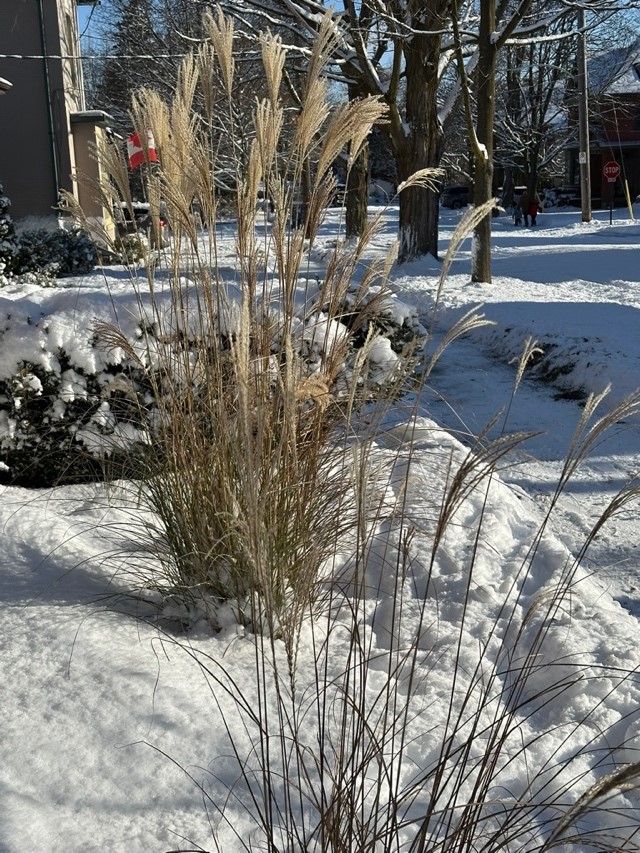
The low slanting light of late autumn and winter is an important piece of the beauty of the garden. Glancing out my bedroom window first thing every morning, I’m drawn to the morning light shining behind the swollen, grey buds of the magnolia tree next to the driveway. The buds are soft and fluffy, vulnerable yet so full of promise. In a nearby garden, there are a few large clumps of Karl Foerster grass (Calamagrostis x acutiflora) that sway and drift with the slightest breeze. Their slender stalks are a soft gentle brown, somehow able to withstand strong winds and pelting rain. Fall blooming grasses are a particular treat in fall and early winter, the slanting light is illuminated through the fluffy plumes making a beautiful statement. Hameln (Pennisetum Alopecuroides ‘Hameln’) is a favourite but there are many to choose from including some special native ones such as Side -oats Grama (Bouteloua curtipendula)  and Prairie Dropseed (Sporobolus heterolepis).

Another subtle feature of winter light is the shadow effect. The gentle lengthened shadows created by tree structure, moving grasses, seed heads, or conifer form merit consideration when choosing plants and placement. They are certainly worth more than a glance on a spectacular bright winter day.

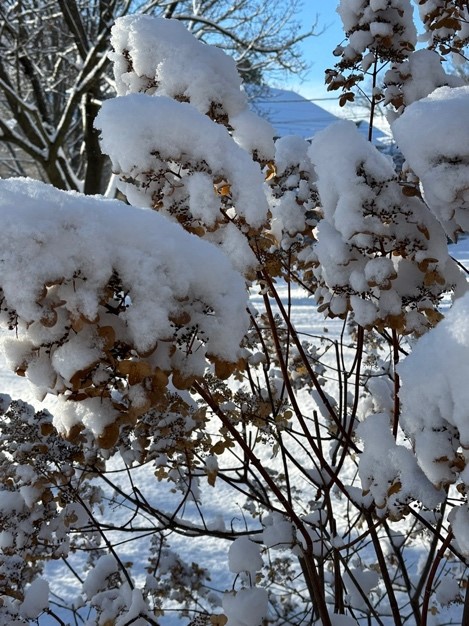
The dried flower heads of ever popular hydrangeas are a common winter garden treat especially when topped with a light dusting of early snow. Summersweet (Clethra alnifolia), a small summer flowering shrub, also retains dried flower heads through fall and winter. Other shrubs offer interest because of bark colour and texture (red twig dogwood, cornus sericea) or growth habit. Staghorn Sumac doesn’t take centre stage in the summer, but offers spectacular colour in fall.  In winter, its red fruits, antler-like branches, and graceful form make it a show-stopper.  Another shrub favourite in my fall and winter garden is Seven-Son Flower (Heptacodium miconiodes). It is an all-around wonderful, unique shrub with added appeal for its beautiful peeling bark in winter.  Other shrubs that hold particular appeal in the winter are Witch Hazel (Hamamelis virginiana)  and Corkscrew Willow (Salix babylonida).

Limelight hydrangea in the snow
Summersweet in the snow

Of course, conifers are the bones of any garden in winter. With different needle textures and lengths, and different shapes and forms, they provide obvious interest to every garden. When everything else is grey and brown, the rich textured green of a conifer stands out and when the snow comes along their interest increases. It’s important to have a variety of shapes and forms: cylindrical, mounding, conical, and weeping. In a small urban garden such as mine, I’ve found dwarf varieties and columnar species. One of my favourites is a weeping white pine (Pinus strobus ‘Pendula’), which is supported and pruned to fit a small spot.  It’s a lovely unique specimen tree with gentle movement, at certain times of the day its pleasure is doubled when the sun throws it shadow on the nearby shed. 

References

https://kawarthanow.com/2022/01/13/tips-from-peterborough-greenup-on-how-to-design-your-own-winter-garden/

Winter Gardens: Reinventing the Season by Cedric Pollet
This book features beautiful winter gardens across France and the UK

Native Grasses Provide Winter Interest and Feed the Birds

By Silvia Strobl, Master Gardener

This week I’ve been enjoying watching a flock of American Tree Sparrows that have migrated south from their summer tundra breeding grounds to my garden north of Peterborough for the winter. While I have both sunflower and nyger feeders, they are feeding exclusively on the Big Bluestem and Savannah Grass seeds in my garden. Sadly, these native grasses seem to have a bad rap among gardeners which is too bad as they have many benefits for both you and local wildlife.

I have the following four commonly occurring warm season perennial native grasses in my full sun garden:

Big Bluestem (Andropogon gerardii) is a very tall (5 – 8 ft) grass with clumps that form a dense sod but does not creep by rhizomes. It competes aggressively with shallow-rooted flowers, so it is best planted with species that form deep tap roots or spring bloomers that go dormant in the summer. In my garden it is a fall season focal point at the back of a border behind Culver’s Root (Veronicastrum virginicum) which has a central taproot as well as underground rhizomes.

In early May, Big Bluestem still hasn’t emerged, but allium foliage and some blooming tulips fill the space (left). By late June, alliums appear to float above the Big Bluestem grass (highlighted in orange) that is now 2 ft. tall (middle) and hiding the bulb foliage. By late July, Big Bluestem grass provides a green backdrop for the white flower spikes of Culver’s Root (right).

Little Bluestem (Schizachyrium scoparium) is an excellent grass for gardens due to its shorter height (2 – 4 ft), clumping form, very showy silver-white seed heads, and bright red stems in fall.It prefers dry sandy soils.

Savannah Grass (Sorghastrum nutans)is another tall grass (5 -7 ft) for the back of the border. It tends to self-sow so the young seedlings require a little annual weeding.

Native grasses add movement and colour to the garden. Little Bluestem’s red stems are illuminated by early October morning sun (left) while the late afternoon August sun highlights the tiny golden flowers and flower stalks of Savannah Grass (right).

Sideoats Grama (Bouteloua curtipendula) is a hardy, short bunchgrass that spreads very slowly by means of short, stout rhizomes and doesn’t compete with other plants. Its deep fibrous roots make it useful on slopes to prevent erosion (or on the edges of slightly sloped garden beds as in my garden). Do not plant it in clay soils.

Sideoats Grama has delicate hanging flowers (left), and later seeds (right) that are held in spikes that fall gracefully to one side of the stem.

Benefits for you

As well as being stunning fall and winter focal points, the tall native grasses, Big Bluestem and Savannah Grass, make excellent privacy borders. Their very deep roots (5-6 feet or more) make them useful for erosion control on slopes. Each of these native grasses is drought tolerant. And, each creates excellent winter interest as they tend to maintain their upright form. Another bonus is that they all have low palatability to deer.

Big Bluestem (left) and Savannah Grass (right) stand tall in the author’s garden despite 12 inches of winter snow.

Benefits for wildlife

Many butterfly skipper and moth larvae feed on these native grasses and they provide critically important seeds and habitat for native birds in fall and winter.

An adult Delaware Skipper rests on a blade of Big Bluestem in the author’s garden (left). Big Bluestem is a host plant for this butterfly’s larvae. Both Little Bluestem and Sideoats Grama are host plants for Leonard’s Skipper caterpillars. The adult butterfly is seen here nectaring on marigold in the author’s garden (right)

American Tree Sparrows feeding on a buffet of Big Bluestem (left) and Savannah Grass (right) seeds in the author’s garden. It is fun to watch them “ride” the Savannah grass stems to the ground so they can more easily peck at the seeds some of which spill onto the fresh snow.

Native Grass Establishment and Maintenance

Most native plant nurseries stock these grasses and all of them are easily propagated from seed. Plant seedlings densely at 1 ft to 1.5 ft spacing to discourage weeds. Water during the first year while roots are getting established. Fertilization is not necessary. All can be easily divided, but Sideoats Grama should be teased apart, not cut with a spade.

Remnant pockets of native grasses like this one of Big Bluestem growing on the shoreline of Little Jack Lake (left) are good places to collect seeds to propagate your own plants (right). Never collect more than 10% of seeds.

Depending on how much seed the birds eat in winter, you might get a few volunteer seedlings. If you don’t want more plants, they are easily kept in check by weeding when they are small.

If weedy cool season grasses have seeded into native warm season clumps, use a propane torch in early spring to burn emerged leaf blades while warm season native grasses are still dormant. Be sure to first cut off last year’s dry stalks and have a hose nearby. Don’t do this on a windy day!

Big Bluestem, Savannah and Little Bluestem are 3 of the 4 dominant grasses found in remnant tall grass prairies and oak savannahs, of which less than 1% of their pre-European settlement extent remains in Ontario. (The other is Switchgrass (Panicum virgatum) which can self sow quite a bit so might not be suitable for small gardens.) These grasses are also found on dunes, sandy shorelines, rock barrens, roadsides, and hydro corridors. Including these grasses in your garden can help support some of the wildlife that rely on this endangered ecosystem.

REFERENCES & ADDITIONAL RESOURCES

Diboll, N and H. Cox. 2023. The Gardener’s Guide to Prairie Plants. Pages 302-303, 306-307, 326-329.

Ehrlich, P. R. D.S. Dobkin and D. Wehte. 1988. The Birder’s Handbook A Field Guide to the Natural History of North American Birds, The Essential Companion to your Identification Guide. Page 584.

Johnson, L. and S. Colla. 2022. A Garden for the Rusty-Patched Bumblebee—Creating Habitat for Native Pollinators. Pages 149, 150, and 159.

Map of Native Plant Nurseries in Ontario maintained by Halton & Area Master  Gardeners

North American Native Plant Society. 2017. Seed collecting and saving.

RELATED

GARDENING FOR BIRDS THROUGH THE SEASONS

A FEW OF MY FAVOURITE NATIVE PLANTS

EXPANDING YOUR NATIVE PLANT PALETTE

WINTER FAVOURITES

Dynamic Accumulators: Useful plants for both lazy and nerdy gardeners

By Rachel Foebel, Master Gardener in Training

What are dynamic accumulators?

These are plants known to collect large amounts of soil nutrients, usually from deeper in the soil via long tap roots (sometimes fibrous roots as well) and store them within the plant. These plants are used to then release their nutrients to the upper layers of the soil as the above ground parts of the plant break down, either by harvesting, winter, or completion of a life cycle. The most known and used plants tend to be Common Comfrey (Symphytum officinale) or Russian Comfrey (Symphytum x uplandicum) and sometimes plants from the nettle family such as stinging nettle (Urtica dioica). Additionally, cover crops such as legumes are used widely to serve this same purpose. Dandelions and rhubarb are also known to be dynamic accumulators.

Left: Comfrey picture (caption: Common comfrey (Symphytum officinale)
Right: Comfrey flower (caption: Comfrey flower)

Is there any science to back this up?

While this method of soil improvement has been discussed and used for a while (since the 1980’s), research to prove this concept has only begun to occur very recently.

In 2020, Northeast SARE (Sustainable Agriculture Research and Education) provided a research grant to Unadilla Community Farm, in coordination with Cornell University, “to help expand our collective understanding of what exactly dynamic accumulators are, how they work, and what are some practical applications for these plants,” (Zarro, 2020). For the purposes of their work, a dynamic accumulator was defined as a plant containing roughly 200% of the set average of any of the 20 beneficial nutrients they had data for (Tyler, 2022). They were able to identify over 340 plant species that qualify based on these terms and created a dynamic accumulator online database.

Here is where you can find this database: https://docs.google.com/spreadsheets/d/19S3wsjXU6VPzmbklZLVxKt6DCyZIPjCYw6zRrVg7M4Y/edit?pli=1&gid=1519867200#gid=1519867200

Add picture:

A clip of the database to show how it displays its information about each nutrient

And here is where you can find more information on the methods they used to compile the database: https://smallfarms.cornell.edu/2022/04/new-findings-further-the-study-of-dynamic-accumulators/

The work done since the database was formed has given more insight still. It has been found that these plants cannot perform to the level they are expected on the database unless these nutrients exist somewhere in the soil to begin with. While this seems obvious, it means that you can’t expect these plants to fully restore poor soil on their own. They can only be one part of the plan or be used to maintain soil that already has some nutrients to share.

Are there dynamic accumulators that are native to Ontario?

Yes. Some examples are paw paws, blue cohosh, wild strawberries, self heal. To find more you can cross reference the above-linked dynamic accumulator database with a native plant database like this:

https://networkofnature.org/species/

Or this:

Wild Strawberry (Fragaria vesca)), Self heal (Prunella vulgaris))

How do I fit this into my garden practices?

Some of these will arise on their own, like clover, lamb’s quarters, dandelions, etc. If they have not gone to seed, simply pull them like you would any weed and let them decompose on top of your garden soil. Alternatively, you can bring them to your compost bin to release their nutrients there. If they are a desired species, you can plant them right where you need them most. You can plan them into your vegetable crop rotations if they are annuals. The commonly used perennial comfrey re-grows quickly, so the foliage can be removed and used as mulch nearby. Planted under a fruit tree, you can let the process occur on its own each year as the foliage on top dies in winter and feeds the soil that way. This is a common permaculture practice that now finally has some research to back it up!

A permaculture-style vegetable garden

References

Tyler, Ben. (April 3, 2022). New Findings Further the Studies of Dynamic Accumulators. Cornell College of Agriculture and Life Sciences. https://smallfarms.cornell.edu/2022/04/new-findings-further-the-study-of-dynamic-accumulators/

Zarro, Greta. (July 20, 2020). Breaking Ground with Dynamic Accumulators. Cornell College of Agriculture and Life Sciences. https://smallfarms.cornell.edu/2020/07/breaking-ground-with-dynamic-accumulators/

Tyler, Ben & Zarro, Greta (Dec 2021). A dynamic accumulator database and field trials for six promising species. Northeast Sustainable Agriculture & Research Education.  https://projects.sare.org/wp-content/uploads/A-dynamic-accumulator-database-and-field-trials-for-six-promising-species.pdf

Some other interesting articles on Dynamic Accumulators:

Kitsteiner, John. (April 15, 2015). The Facts about Dynamic Accumulators. Permaculture Research Institute. https://www.permaculturenews.org/2015/04/10/the-facts-about-dynamic-accumulators/

James, Sean. (2011). Permaculture, the art of edible gardening. Landscape Ontario.com https://landscapeontario.com/permaculture-the-art-of-edible-gardening

Battersby, Sarah (2009). Love Your Dandelions, They’re Dynamic! Toronto Gardens Blog. https://www.torontogardens.com/2009/04/love-your-dandelions-theyre-dynamic.html/

Fall is the New Spring…It’s Time to Plant

by Emma Murphy, Master Gardener

I confess to LOVING this time of year. The heat and humidity of the summer is gone, and our gardens are still looking lovely. Although my established gardens are beginning the slow process of fading and getting settled in for their winter sleep, fall is a wonderful time to plant for so many reasons.

They may not look perfect but they’ll be going to sleep soon and will wake up next spring in their new homes.

You Have Time

Unlike your annuals or tender perennials, most perennials (and native plants in particular) can be planted in September and well into October (depending on where you live in Ontario).

Smaller trees and shrubs in particular are fine to plant once they have gone dormant and leaves have dropped, as long as they are well watered until freeze up.

I love the fall as it seems less frenzied than the spring gardening season, with time to reflect on the summer that has passed. Unlike spring and summer, temperatures moderate during fall, not only for the plants but also for us! It’s terrific working weather – you start with your sweatshirt on in the morning, but by the afternoon the temperatures have warmed up considerably and you might be in a t-shirt. During July and August I can only work in my gardens in the early morning or late evening due to the heat. Your plants don’t like to be planted in the heat of summer either. So fall is my happy time.

Assessing and Dividing

Fall is the perfect time to look around your garden – do you have holes, bad-looking spots, poorly performing plants? Are there places that need something new or something moved?

I need to revamp this garden and think about moving some perennials around.

Fall is a great time to divide overgrown perennials, especially those that bloom in the spring. I just dug up all of my fragrant hostas the other day and moved them to a new location so that I can expand my shade native plant garden. Next up – planting a hedgerow.

Warmer Soil Temperatures

During fall, soil temperatures remain warm from the summer sun, so conditions are ideal for root growth.

Cooler Air Temperatures

Gone is the humidity and heat of the summer and the unpredictability of spring weather (and worries about frost). Daytime high temperatures are nice and there is less water evaporation from leaves.

More Rain, Less Work

With fall also comes more frequent rainfall and less need to water new plantings. There aren’t crazy swings in moisture levels – fall rains are warm and welcome and moisture levels are perfectly balanced, encouraging root growth.

When you plant in spring and early summer, the weather can be very variable, especially with regard to temperatures and rainfall. The soil is still cool, and plants take a while to get established.

Fall rains rejuvenate our gardens

Some Challenges

It can be challenging to plant new perennials in the fall – stock and selections at nurseries may be less (however the prices may be better!) and some plants have been sitting in plastic pots for months and look less than perfect. Be sure to purchase new plants at a nursery that takes good care of their plants over the gardening season (that generally does not include big box stores – shop local where you can) and pull the plant out and check for a healthy root mass in the pot.

Ideally, give your plants at least 6 weeks of optimal growing weather of fall before the colder winds start blowing in.

One Last Note

It’s a really good idea to add mulch to your fall gardening – it helps insulate the ground and maintains warm soil temperatures even during early winters. So, you are providing a nice warm area for young plants to establish their root systems before the frost.

A Special Note on Native Plants

They might look a little sad in the nursery, with not much top growth and it may be browning. However, under that soil are roots, lots of roots, and that is what you are buying when you purchase a native plant.

So when you see a small three inch plant with roots coming out the bottom, recognize that it’s the perfect size to plant, and don’t worry about its ability to survive the winter.

Sleep, Creep, Leap

You may have heard the phrase “sleep, creep, leap” with respect to many plants, and especially native plants. Unlike most perennials, native plants just want to get their roots established during the first year (which is why they appear to ‘sleep’).

So if you plant in the fall, the roots are growing furiously, pushing south to grab moisture and nutrients to sustain them through the heat of summer next year. In the second year native plants creep, with more top growth and maybe even flowering. Watch out in the third year! They leap to their full size and blooming capacity.

So, if you can plant in the fall, the sooner your native plants can put down their roots in their new home, and be ready to grow in the spring season.

Bottom line? Fall weather is optimal for growth.

The perfect combo of warm soil temperatures near the root and cooler air temperatures on the top offer the ideal growing conditions for any new plantings or dividing existing perennials.

So get out in your gardens! (It’s also time to think about planting your spring flowering bulbs. Check out Master Gardener Cheryl Harrison’s excellent blog on how to do this.

Garden Jeopardy: The Small Native Tree Edition

By Lois Scott, Master Gardener

Welcome to the second edition of Garden Jeopardy featuring a number of smaller native trees. 

I do love trees and in my suburban garden the opportunity to grow multiple smaller varieties is appealing.  The choices are many and discovering an interesting characteristic or benefit about a particular species inspires my choices.  Hopefully this edition will be inspiring for gardeners looking to add more trees to their gardens this fall.  You can confirm your responses at the end.

  1.  A shade-tolerant tree with smooth, blue-tinged bark and a fluted trunk sometimes known as ‘musclewood’.
  2. A tree that bears white, showy clusters of flowers in June or July that develop into orange or red fruits that are persistant throughout the winter and much loved by birds.
  3. A small evergreen tree that is resistant to insects and rot, rarely requires pruning and produces dark blue, berry-like cones that are a food source for Cedar Waxwings.
  4. A species at risk tree for part to full shade that is a host tree for the Giant Swallowtail butterfly, the largest butterfly found in Canada.
  5. An understory tree with branches in distinct layers that produces clusters of white flowers in spring, red leaves in the fall and is an important butterfly larval host.
  6. A tough, adaptable and urban friendly tree with a distinct upright trunk, wide-spreading crown and the densest Canadian wood.
  7. A tree bearing pea-flower shaped intense pink flowers in spring prior to leafing out, that is not native to Peterborough but will thrive here in a protected area.
  8. An excellent Peterborough source for the aforementioned trees.
A bedraggled Giant Swallowtail in my garden.

  1. What is the Blue Beech; Carpinus caroliniana?
  2. What is the American Mountain Ash; Sorbus americana?
  3. What is the Eastern Redcedar; Juniperus virginiana?
  4. What is the Common Hoptree; Ptelea trifoliata?
  5. What is the Alternate-Leaf Dogwood; Cornus alternifolia?
  6. What is the Ironwood, Hop-hornbeam; Ostrya virginiana?
  7. What is the Redbud; Cercis canadensis?
  8. What is Ecology Park Native Plant Nursery?  https://greenup.on.ca/ecology-park/
Pagoda Dogwood in fall.

Thank you for participating in this edition of Garden Jeopardy!  For information on tree planting please check out MG Cheryl Harrison’s blog on planting trees which includes a link on how to properly plant a tree. https://peterboroughmastergardeners.com/2024/04/22/earth-day-2024-plant-a-tree/

Underfoot & Under-Valued? The Common Liverwort

By Mary-Jane Pilgrim, Master Gardener

Umbrella liverwort (Marchantia polymorpha) is a fascinating plant that often catches the eye with its unique, umbrella-like structures. These small, flat, and green plants have been around for millions of years, making them one of the oldest plant species on Earth. They do not have a vascular system, and like ferns, they produce spores instead of seeds. While they do not flower, the female reproductive structures mature to look like tiny palm trees or umbrellas. For this reason, the common variety is called umbrella liverwort.

In our area, umbrella liverwort is commonly found in moist, shaded areas like garden beds, greenhouses, and along stream banks. This plant is native to many parts of the world, including Ontario, and has a long history of thriving in damp environments.

While liverwort is native, it can sometimes behave like an invasive plant, especially in gardens and greenhouses. It thrives in conditions where moisture is abundant, and air circulation is poor. If left unchecked, it can spread rapidly, covering the soil surface and competing with other plants for light and nutrients. However, its unique appearance and ancient history make it a cool plant to observe in your garden.

If you want to manage umbrella liverwort, focus on improving drainage, reducing moisture levels, and allowing more sunlight into the affected areas. But for those who appreciate its prehistoric charm, umbrella liverwort can be a delightful addition to a garden, provided it’s kept in check. An added benefit is that you don’t have to plant them — they just show up!