By Cheryl Harrison, Master Gardener
African violets are the plants that immediately come to mind when anyone asks me about houseplants. This plant is an old favourite for good reason. I have two. As the name implies, African violets are native to the cloud forests in the mountains of east Africa. Many of the native plants are threatened or endangered due to habitat loss. African violets are not violets (family Violaceae, genus Viola) but are included in the family Gesneriaceae, genus Saintpaulia.
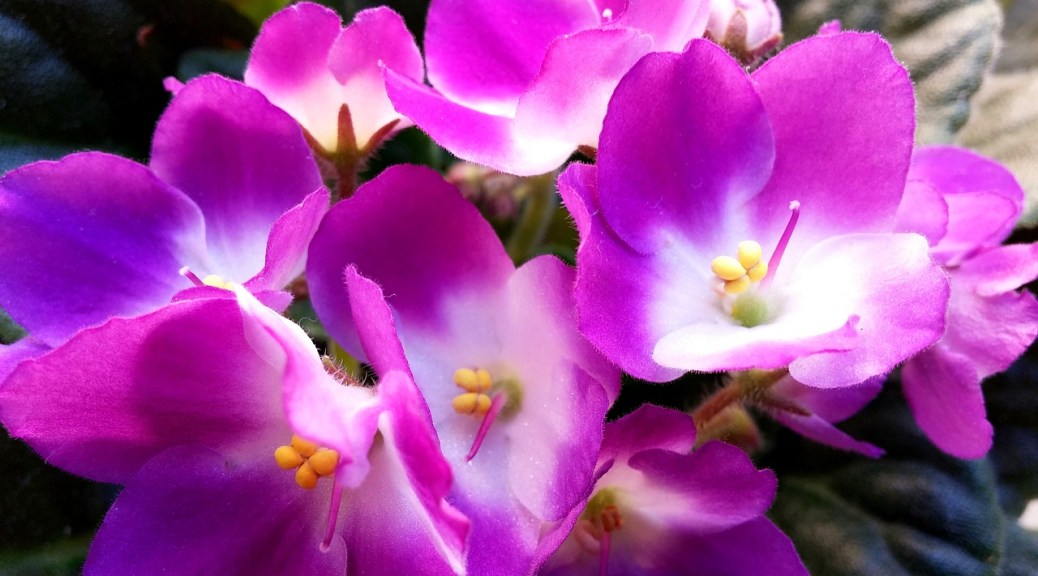
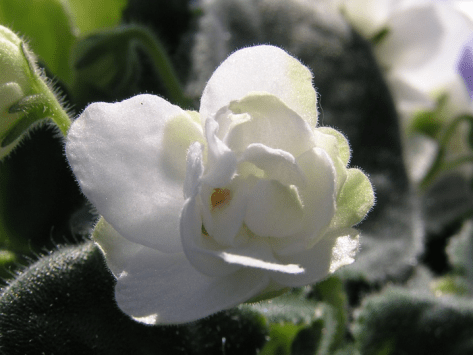
African violets are classified by size from the “Mini” which are less than 7.6 cm (3 inches) in above-ground diameter to the “Giant” which ranges from 30.5 cm – 40.6 cm(12-16 inches). They are pretty plants even when not in flower which they will do almost continuously under good growing conditions. Their flowers may be single, semi-double or even double. This refers to the rows of petals on the flowers. Flower colours include blue/violet, pink, fuchsia, white and bi-coloured. Their dark, green leaves appear velvety because they have a fleshy texture and are covered with fine hairs. The plants maintain a compact form but do come in a trailing form. Lots of choices!
African violets prefer soil that has excellent drainage because the plant may rot if water lays on top or the soil stays water logged. You may purchase specific African violet soil to help ensure a porous growing medium that allows water to percolate through.
Water your plant so that the soil stays moist all of the time but pour off the standing water from the saucer under the plant to prevent the soil from becoming water logged. Do not get water on the leaves of this plant because disfiguring rings will appear where the leaf has been damaged. You may also use a system that allows you to water your African violet from the bottom. This can be as simple as filling the saucer under your plant with water then allowing the plant to absorb water from the saucer. Discard any water left in the sauce after about 45 minutes. Remember to check the surface of the soil to make sure that it is moist … if not, then repeat this process. There are also self-watering pots available. Over-watering or under-watering will damage and may eventually kill your plant.
 African violets like bright indirect light. A sunny, warm window is okay in winter but in summer, place your plant in a north or east window or just sit it back from a south or west window so that it does not receive direct sunlight. African violets prefer cooler temperatures at night around18C (60F) and up to 27-29C (80-85F) in the day. Too cool temperatures will stunt their growth.
Like any houseplant, African violets can suffer from some diseases and insect pests including botrytis blight, powdery mildew, mites, mealybug, aphids or thrips. Be sure to purchase your African violet and all of your house plants from a reputable seller to avoid these problems.
With all of the new African violet cultivars and their colourful blooms, why not try one? If you enjoy house plants then the African violet may be the one for you!
Resources
African Violet Society of Canada, (note that this site is under construction)
African Violet Society of America




 gardener has a long list of things they wish they had because many of these items will make their gardening hobby just a little bit easier. Also, most of them will rarely treat themselves.
 A Garden Show! Treat someone to a trip to Canada Blooms or the awesome


 I started my seeds inside under lights. When I planted the seedlings outside, one went into the ground in my garden and the other went into a 5 gallon bucket with holes drilled in the bottom. The bucket plant went into my little greenhouse.


 little TLC. During the gardening season, these groups magically transform to become a forum for a little bragging for those inclined to share pictures of the results of their hard work, and also a forum for those needing a little help. I’ve posted a plant picture to one of them, and had a definitive answer to an identification question in literally less than ONE MINUTE (Thanks, Jeff Mason!).



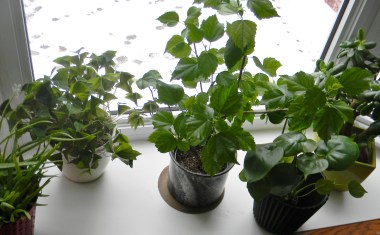
 Most homes in winter are too dry for most houseplants and this is why we see them suffer by dropping leaves. To increase humidity, you can mist the plant, give it a shower (at room temperature – this also will dust for you!), or set in a saucer with rocks (elevate so the pot and roots are not constantly wet). Placing plants in kitchens or bathrooms where there tends to be more humidity is another idea. Plants that like it humid include ferns, palms, dieffenbachia and dracaena.
 The Peterborough & Area Master Gardeners