By Cheryl Harrison, Master Gardener
Are you concerned about the natural world? Do you want to know what you, one person, one gardener, can do?
Douglas W. Tallamy is Professor and Chair of the Department of Entomology and Wildlife Ecology at the University of Delaware in Newark, Delaware, USA. In 2007, Mr. Tallamy’s book, “Bringing Nature Home”, was published. It has been updated and expanded several times since then but his message has remained the same:
“Plants are not optional on this planet. With few exceptions, neither we, nor anything else, can live without them.”
Plants, through photosynthesis, take energy from the sun and turn it into food. Only plants can do this, we can’t and we, like all other creatures, depend on plants for our energy in order to survive. Mr. Tallamy explains the reliance that exists between the diversity of animal species and the diversity of plants. He explains the damage we are causing with our large lawns and our ornamental trees, shrubs and garden plants. Mr. Tallamy explains what one person, one gardener, can do and why we must. “Bringing Nature Home” is a beautiful book. Its language is compelling, its photos inspiring, and by the end, you will want to tear out your ornamental garden and plant all native plants! Or, at least look at your garden and re-evaluate and elevate what you are trying to achieve…..a pretty garden just won’t cut it anymore.
“The Living Landscape”, published in 2014, and written by Rick Darke and Doug Tallamy, again explains why, then how, to develop home gardens that are ecologically sound but beautiful and that meet our other land use needs (eg. vegetable garden, kids and dogs play area). They help us to also understand that, by using native plants, we will make a “layered landscape” that supports diverse wildlife and a healthy ecosystem. They provide beautiful photos to show us what can be achieved followed by detailed information to tell us exactly how to achieve it.
In 2019, “Nature’s Best Hope” by Douglas W. Tallamy was released. In this book, Mr. Tallamy tries again to not only inspire us but to also unite us in his vision of “a homegrown national park.” At first, I was disappointed with this book….ho hum, more of the same with fewer, and less dynamic, photos. Mr. Tallamy does explain again why we must start living on the earth in a way that is sustainable. However, with this book, he proves to us that we can do this because we want to and not because we feel we are forced to. We can create biological systems in our own yards that connect to others in your neighbour’s yard…..”a homegrown national park.” We can do this with native plants which will attract native insect species including pollinators, native birds and so on, to spread out across the food web to humans. “Nature’s Best Hope” was a harder read maybe because Mr. Tallamy states just the facts. In Chapter 11, titled “What Each of Us Can Do”, he succinctly lists exactly that. Mr. Tallamy believes that humans have “the intelligence, knowledge and ability” and “wisdom” to successfully restore natural habitat and ecosystems. I do too.
I recommend that you read all three of the books listed.
Resources
Darke, Rick & Tallamy, Doug.( 2014). The Living Landscape. Timber Press, Portland, Oregon, USA.
Tallamy, Douglas W. (2016 – 10th printing). Bringing Nature Home. Timber Press, Portland, Oregon, USA.
Tallamy, Douglas W. (2019). Nature’s Best Hope. Timber Press, Portland, Oregon, USA.


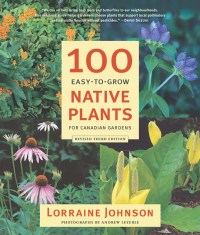 This book is, without a doubt, one of my favourite go-to gardening books! The new revised third edition of Lorraine Johnson’s book, 100 Easy-to-Grow Native Plants for Canadian Gardens, is a testament to Lorraine’s expertise. She writes in the forward that “one of the greatest satisfactions of growing native plants is that you are supporting a complex web of ecological relationships that are the basis of a healthy, resilient ecosystem.” Lorraine Johnson is the former president of the North American Native Plant Society and the author of numerous other books. She lives in Toronto.
 The photos by Andrew Layerle, along with detailed descriptions of the plants, make this book most helpful when trying to decide what native plants you would like to incorporate into your garden. I think many of us can relate to her point that “gardeners tend to be voyeuristic creatures and plant lists are our chaste form of porn”! We all crave the perfect plant and often browse through books over the winter months with dreams of starting a new garden and we wait patiently for the spring weather that allows us to once again get our hands dirty.
 The plants are divided into a number of different categories and Lorraine does a good job at listing the common name (although she warns there are sometimes many), the botanical name, the height, blooming period, exposure, moisture, habitat and range. She gives a good description, the maintenance and requirements, along with suggestions on propagation and good companions. I love that she also mentions the wildlife benefits of each plant.
 Lorraine has also included Quick-Reference Charts at the back of the book that separate the plants by region as well as specific conditions, such as acidic soil, water requirements, etc. She has lists of plants suitable to prairie habitat, drought-tolerant plants, plants for moist areas, and plants that attract butterflies and other pollinators.




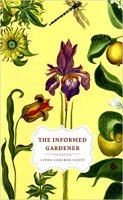 Debunking many anecdotal garden myths, this book is backed by scientific research. Boring, it isn’t. It is charming and witty with a no-nonsense approach. Ms. Chalker-Scott is a passionate professor whose life work is devoted to raising consciousness about marketing misconceptions so we can garden with intention and confidence in an environmental and sustainable way. (paperback – $20.00)
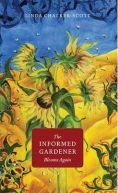 I learned so much from her first book, I bought this one and was not disappointed. She surprises, teaches and makes sense. (pp. $20.00)
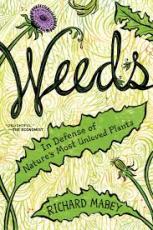 3. Weeds: in Defence of Nature’s Most Unloved Plant – Richard Mabey