All posts by peterboroughmastergardeners

Five Great Garden Practices for the New Year

By Christine Freeburn, Master Gardener

With the new year days away, resolutions for 2025 might be on your mind. Here are a few easy garden practices you might want to include in those New Year’s Resolutions.

  1. Keep a record.

Have a file, record on your computer, write in a journal, put plant tags in a zip lock bag by year. Write on your tags the year & where you planted. It is important to know which hydrangea you planted, so if you need to research how to prune or how large it should get or if you want to purchase another, you will have that information. When you keep tags or record what annuals you plant, if it is something you want to repeat, you will have the exact variety when you go shopping the next spring. There are so many varieties of so many plants.

  • Keep things clean.

Disease is often spread through the tools we use. Have a pack of wet wipes in your tool box & clean tools after each use. Sharpen tools at the end of gardening season, so they are clean & ready to go in spring.  Although you should use leaves as compost, don’t leave diseased plants in your gardens. Place them in your green garbage. Keep houseplant soil free of fallen leaves as well.

  • Keep yourself healthy.

Stretch before going into the garden to do manual work. Limit yourself to an amount of time that is good for you and your body and stop when your time is up….your garden will be there when you come back. Take your water bottle with you. Wear gloves & hat to protect yourself. Don’t work in the blazing sun…. bad for you & your plants.

  • Do your research.

Right plant in the right spot will give you more chance of success. If you plant a water loving perennial in a dry sandy spot, the plant will suffer or fail. Planting a tall annual at the front of your bed will obscure the pretty ones behind it. Use the internet, but make sure you are using reputable sites where knowledgeable gardeners are sharing good information. Look for articles written by Master Gardeners or university professors or scientists. Look for websites that end with “edu.” You can also contact Peterborough Master Gardeners online (peterboroughmastergardeners.com) to ask questions or check out what events we will be at in 2025.

  • Enjoy your gardens.

Remember, you garden because you get enjoyment from your hard work. Wander through your garden, peaking at the new sprouts coming up or the gorgeous flowers opening. Breath deep. Enjoy the birds, insects and wildlife that visit. Research shows that gardening and being in nature help our minds, bodies & souls.

Happy New Year! From Peterborough Master Gardeners

How do Insects Survive the Winter?

By Mary-Jane Pilgrim, Master Gardener

Last April, I wrote an article entitled “How do my outdoor plants survive the winter?” Although not as popular a subject topic, a quick dip into the world of all things creepy crawly when the temperatures plummet may be of similar interest.

When winter hits our region, we head indoors, but what about insects? These creatures have incredible ways of making it through the cold winter months. So much for my favourite October joke: “What’s the best thing about October? The mosquitoes are dead.” True, but also not for long.

Some insects, like ladybugs and cluster flies, find shelter and enter a hibernation-like state called diapause. They slow their bodies down to a near standstill, using very little energy while tucked away in cracks, under leaves, or even in homes. Those sneaky lady beetles seem to be able to find a way into houses too!

Other insects, like woolly bear caterpillars, use natural antifreeze. Their bodies produce special chemicals called cryoprotectants, which prevent their cells from freezing. This allows them to survive temperatures well below zero.

Some insects, like mosquitoes, leave behind their eggs, which are tough enough to endure the cold. Come spring, these eggs hatch, and a new generation begins. Sigh. Similarly, some butterflies, like the Mourning Cloak, overwinter as adults in tree bark or woodpiles, waking up early in the spring.

For honeybees, survival is a team effort. They cluster together in their hives, shivering their bodies to create heat and keep the colony warm.

And then there are insects like crickets, which die off in the fall, leaving behind their eggs to carry on their legacy.

Winter may seem quiet, but beneath the snow, insects are surviving in remarkable ways. Whether through hibernation, antifreeze, or teamwork, our local insects prove how tough and adaptable nature can be—even in the coldest months. For some, like pollinators, that’s great news. For others, like the red lily beetle, the Japanese beetle, and aphids, we simply have to grin and bear it.

Light in the Garden

By Marjorie Vendrig, Master Gardener in Training

It’s the darkest time of the year, daylight is at its lowest, and most gardening has ended for the season. That doesn’t mean, however, that there is nothing in the garden to be enjoyed. Garden design and planting choices should take into account the many months when the garden is still and inactive. It’s during this time when, despite the lack of light and active growth, the garden is revealed. It is stripped bare of colour and the exuberance of growth is set aside. With the leaves gone and many small plants succumbing to frost, the garden reveals itself openly and honestly.  It’s odd, but in the dark days of winter there is more light in the garden. Unencumbered by layers of leaves, loud colours, or scrambling growth, the garden becomes airy and lets us see its bones and form. There is a lot to consider and enjoy when the garden, no matter how big or how small, is revealed.

The low slanting light of late autumn and winter is an important piece of the beauty of the garden. Glancing out my bedroom window first thing every morning, I’m drawn to the morning light shining behind the swollen, grey buds of the magnolia tree next to the driveway. The buds are soft and fluffy, vulnerable yet so full of promise. In a nearby garden, there are a few large clumps of Karl Foerster grass (Calamagrostis x acutiflora) that sway and drift with the slightest breeze. Their slender stalks are a soft gentle brown, somehow able to withstand strong winds and pelting rain. Fall blooming grasses are a particular treat in fall and early winter, the slanting light is illuminated through the fluffy plumes making a beautiful statement. Hameln (Pennisetum Alopecuroides ‘Hameln’) is a favourite but there are many to choose from including some special native ones such as Side -oats Grama (Bouteloua curtipendula)  and Prairie Dropseed (Sporobolus heterolepis).

Another subtle feature of winter light is the shadow effect. The gentle lengthened shadows created by tree structure, moving grasses, seed heads, or conifer form merit consideration when choosing plants and placement. They are certainly worth more than a glance on a spectacular bright winter day.

The dried flower heads of ever popular hydrangeas are a common winter garden treat especially when topped with a light dusting of early snow. Summersweet (Clethra alnifolia), a small summer flowering shrub, also retains dried flower heads through fall and winter. Other shrubs offer interest because of bark colour and texture (red twig dogwood, cornus sericea) or growth habit. Staghorn Sumac doesn’t take centre stage in the summer, but offers spectacular colour in fall.  In winter, its red fruits, antler-like branches, and graceful form make it a show-stopper.  Another shrub favourite in my fall and winter garden is Seven-Son Flower (Heptacodium miconiodes). It is an all-around wonderful, unique shrub with added appeal for its beautiful peeling bark in winter.  Other shrubs that hold particular appeal in the winter are Witch Hazel (Hamamelis virginiana)  and Corkscrew Willow (Salix babylonida).

Limelight hydrangea in the snow
Summersweet in the snow

Of course, conifers are the bones of any garden in winter. With different needle textures and lengths, and different shapes and forms, they provide obvious interest to every garden. When everything else is grey and brown, the rich textured green of a conifer stands out and when the snow comes along their interest increases. It’s important to have a variety of shapes and forms: cylindrical, mounding, conical, and weeping. In a small urban garden such as mine, I’ve found dwarf varieties and columnar species. One of my favourites is a weeping white pine (Pinus strobus ‘Pendula’), which is supported and pruned to fit a small spot.  It’s a lovely unique specimen tree with gentle movement, at certain times of the day its pleasure is doubled when the sun throws it shadow on the nearby shed. 

References

https://kawarthanow.com/2022/01/13/tips-from-peterborough-greenup-on-how-to-design-your-own-winter-garden/

Winter Gardens: Reinventing the Season by Cedric Pollet
This book features beautiful winter gardens across France and the UK

Native Grasses Provide Winter Interest and Feed the Birds

By Silvia Strobl, Master Gardener

This week I’ve been enjoying watching a flock of American Tree Sparrows that have migrated south from their summer tundra breeding grounds to my garden north of Peterborough for the winter. While I have both sunflower and nyger feeders, they are feeding exclusively on the Big Bluestem and Savannah Grass seeds in my garden. Sadly, these native grasses seem to have a bad rap among gardeners which is too bad as they have many benefits for both you and local wildlife.

I have the following four commonly occurring warm season perennial native grasses in my full sun garden:

Big Bluestem (Andropogon gerardii) is a very tall (5 – 8 ft) grass with clumps that form a dense sod but does not creep by rhizomes. It competes aggressively with shallow-rooted flowers, so it is best planted with species that form deep tap roots or spring bloomers that go dormant in the summer. In my garden it is a fall season focal point at the back of a border behind Culver’s Root (Veronicastrum virginicum) which has a central taproot as well as underground rhizomes.

In early May, Big Bluestem still hasn’t emerged, but allium foliage and some blooming tulips fill the space (left). By late June, alliums appear to float above the Big Bluestem grass (highlighted in orange) that is now 2 ft. tall (middle) and hiding the bulb foliage. By late July, Big Bluestem grass provides a green backdrop for the white flower spikes of Culver’s Root (right).

Little Bluestem (Schizachyrium scoparium) is an excellent grass for gardens due to its shorter height (2 – 4 ft), clumping form, very showy silver-white seed heads, and bright red stems in fall.It prefers dry sandy soils.

Savannah Grass (Sorghastrum nutans)is another tall grass (5 -7 ft) for the back of the border. It tends to self-sow so the young seedlings require a little annual weeding.

Native grasses add movement and colour to the garden. Little Bluestem’s red stems are illuminated by early October morning sun (left) while the late afternoon August sun highlights the tiny golden flowers and flower stalks of Savannah Grass (right).

Sideoats Grama (Bouteloua curtipendula) is a hardy, short bunchgrass that spreads very slowly by means of short, stout rhizomes and doesn’t compete with other plants. Its deep fibrous roots make it useful on slopes to prevent erosion (or on the edges of slightly sloped garden beds as in my garden). Do not plant it in clay soils.

Sideoats Grama has delicate hanging flowers (left), and later seeds (right) that are held in spikes that fall gracefully to one side of the stem.

Benefits for you

As well as being stunning fall and winter focal points, the tall native grasses, Big Bluestem and Savannah Grass, make excellent privacy borders. Their very deep roots (5-6 feet or more) make them useful for erosion control on slopes. Each of these native grasses is drought tolerant. And, each creates excellent winter interest as they tend to maintain their upright form. Another bonus is that they all have low palatability to deer.

Big Bluestem (left) and Savannah Grass (right) stand tall in the author’s garden despite 12 inches of winter snow.

Benefits for wildlife

Many butterfly skipper and moth larvae feed on these native grasses and they provide critically important seeds and habitat for native birds in fall and winter.

An adult Delaware Skipper rests on a blade of Big Bluestem in the author’s garden (left). Big Bluestem is a host plant for this butterfly’s larvae. Both Little Bluestem and Sideoats Grama are host plants for Leonard’s Skipper caterpillars. The adult butterfly is seen here nectaring on marigold in the author’s garden (right)

American Tree Sparrows feeding on a buffet of Big Bluestem (left) and Savannah Grass (right) seeds in the author’s garden. It is fun to watch them “ride” the Savannah grass stems to the ground so they can more easily peck at the seeds some of which spill onto the fresh snow.

Native Grass Establishment and Maintenance

Most native plant nurseries stock these grasses and all of them are easily propagated from seed. Plant seedlings densely at 1 ft to 1.5 ft spacing to discourage weeds. Water during the first year while roots are getting established. Fertilization is not necessary. All can be easily divided, but Sideoats Grama should be teased apart, not cut with a spade.

Remnant pockets of native grasses like this one of Big Bluestem growing on the shoreline of Little Jack Lake (left) are good places to collect seeds to propagate your own plants (right). Never collect more than 10% of seeds.

Depending on how much seed the birds eat in winter, you might get a few volunteer seedlings. If you don’t want more plants, they are easily kept in check by weeding when they are small.

If weedy cool season grasses have seeded into native warm season clumps, use a propane torch in early spring to burn emerged leaf blades while warm season native grasses are still dormant. Be sure to first cut off last year’s dry stalks and have a hose nearby. Don’t do this on a windy day!

Big Bluestem, Savannah and Little Bluestem are 3 of the 4 dominant grasses found in remnant tall grass prairies and oak savannahs, of which less than 1% of their pre-European settlement extent remains in Ontario. (The other is Switchgrass (Panicum virgatum) which can self sow quite a bit so might not be suitable for small gardens.) These grasses are also found on dunes, sandy shorelines, rock barrens, roadsides, and hydro corridors. Including these grasses in your garden can help support some of the wildlife that rely on this endangered ecosystem.

REFERENCES & ADDITIONAL RESOURCES

Diboll, N and H. Cox. 2023. The Gardener’s Guide to Prairie Plants. Pages 302-303, 306-307, 326-329.

Ehrlich, P. R. D.S. Dobkin and D. Wehte. 1988. The Birder’s Handbook A Field Guide to the Natural History of North American Birds, The Essential Companion to your Identification Guide. Page 584.

Johnson, L. and S. Colla. 2022. A Garden for the Rusty-Patched Bumblebee—Creating Habitat for Native Pollinators. Pages 149, 150, and 159.

Map of Native Plant Nurseries in Ontario maintained by Halton & Area Master  Gardeners

North American Native Plant Society. 2017. Seed collecting and saving.

RELATED

GARDENING FOR BIRDS THROUGH THE SEASONS

A FEW OF MY FAVOURITE NATIVE PLANTS

EXPANDING YOUR NATIVE PLANT PALETTE

WINTER FAVOURITES

When Ground Cover Plants Take Over

By Carol Anderson, Master Gardener

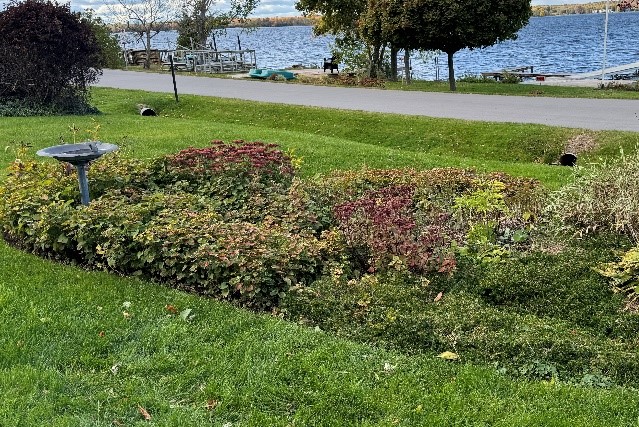
When I recently purchased a new home, I was too preoccupied with the beautiful lake view to truly notice some of the gardening challenges that lay ahead for me. Once I began the process of itemizing what garden treasures I had, I became acutely aware of the gardening style of my predecessor … a style that included utilizing ground cover plants to “fill in” raised beds … and apparently the faster they spread, the better!!! The challenge I have ahead of me is the removal or containment of numerous ground covers that have invaded every inch of the property. In this segment I will briefly touch on the management and/or extraction of 4 different commonly used ground covers that range from just “annoying” to outright invasive.

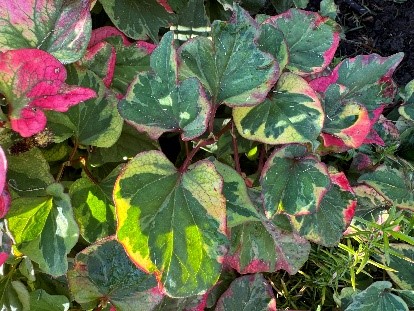
Chameleon Plant,  Bugleweed, Yellow Archangel, Periwinkle

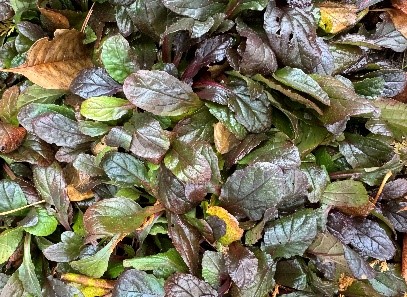
Bugleweed (Ajuga reptans):

Although not considered invasive, Bugleweed can become problematic if left on its own without management, as it has a tendency to spread into adjacent lawn areas. I personally like the dark burgundy-red foliage, however, on my property it has spread across an entire garden and into the lawn. Bugleweed spreads through “shallow” underground runners with new baby plants popping up at the end of the runners. As a result, it is not impossible to remove nor contain. In the spring, I will be digging up the new plants all around the edge of the garden border and installing edging below the garden surface to stop the spread into the lawn. Periodic thinning (by digging up and removing some of the parent plants in the clump) will help to keep it manageable as well.

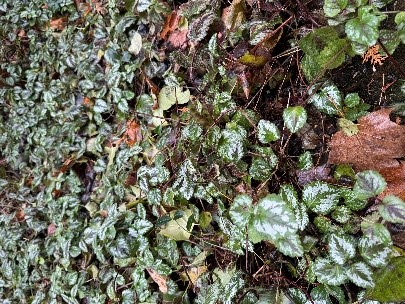
Yellow Archangel or Golder Deadnettle (Lamium galeobdolon):

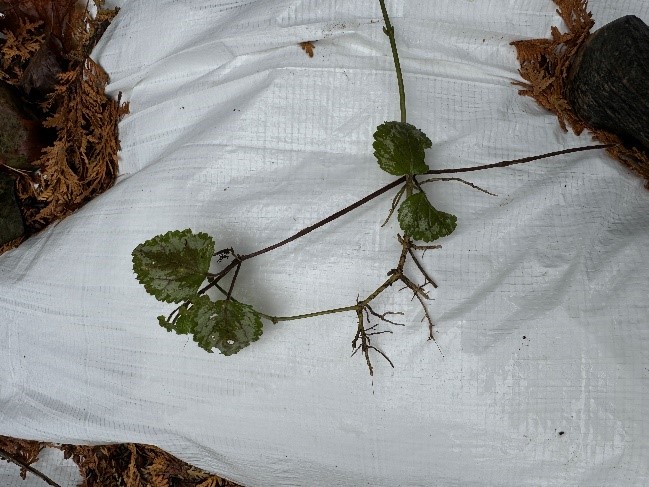
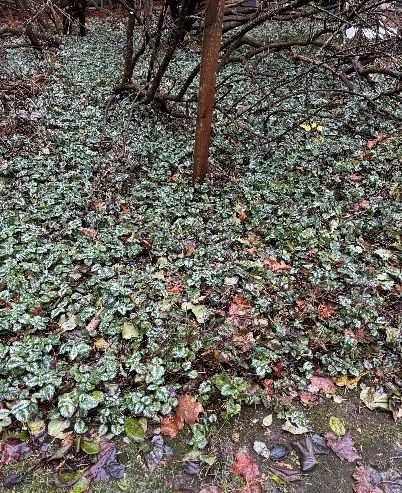
Although Lamium is a common ground cover used in many garden applications, it is invasive in Ontario. It has infested natural areas and will out-compete native groundcovers in the wild. Lamium  spreads by plant fragments, rooting along the surface on the stems (see photo below). However, it also can spread by seed which can then be carried into natural environments by birds.  For this reason, I will be completely removing it from several of the large shade gardens on the property and replacing with native species. Luckily it spreads along the surface and can be removed by mechanical means. This will be another spring project in the garden and once fully extracted, I will begin investigating other options such as anemone, wild ginger, bunchberry dogwood and ostrich fern for the heavily shaded areas of the garden.

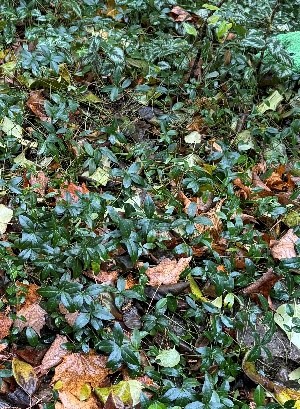
Periwinkle (Vinca minor):

Periwinkle is a very common shade groundcover used by gardeners. It is considered to be invasive as it spreads quickly given the right climatic conditions. It poses a threat to natural biodiversity as it can out-compete other forest understory plants. However, because it spreads by rooting along the stems on the surface of the ground (stolons), it can be contained through proper management of the plant. I plan to dig up the roots and plants and cut back the excessive amount of Periwinkle in the garden, interspersing it with other shade loving plants. This will require ongoing observation and management on my part. 

Chameleon Plant (Houttuynia cordata):

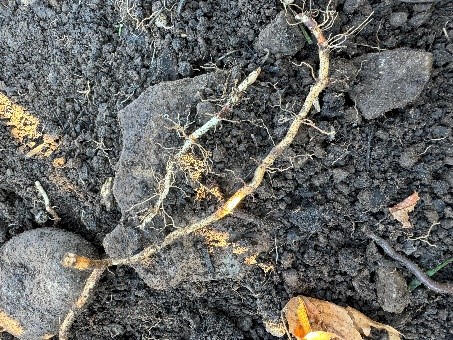
Avoid, avoid, avoid. Although an attractive groundcover, chameleon plant will invade your garden and lawn very quickly and became completely unmanageable. It is a non-native that spreads by a highly dense deep underground network of roots (rhizomes)(see pics below). Even a small segment of root left behind will live and spread for years to come making eradication very difficult. This fall, I began digging around the perimeter of the patch well outside of where the plant is visible on the surface. I dug down 12 inches and was still running into dense mats of roots!!!  I then sifted through the soil to remove all plant segments and put the soil back. At this point I have just begun the process of eradication (Step 1) and will keep you posted on my progress in my blog next spring. If I need to resort to solarization (using the sun’s heat to kill the plants under plastic), then this might be the next step for me. Stay tuned!!!

If you are a fan of using plants as groundcover in your gardens and raised beds, proceed with caution. If it spreads quickly, filling in bare areas, then it is likely invasive at worst and hard to manage at best. Proceed with caution and be prepared to observe and manage the groundcover to avoid the situation where the plant literally takes over the garden, eliminating all other species. In addition, there are many native Ontario alternatives to the traditional groundcovers…try them out and enjoy (https://www.inournature.ca/native-groundcovers).

Sharing the Love of Gardening

by Emma Murphy, Master Gardener

I’ve always loved nature and the environment, but my all consuming love for everything gardening didn’t hit until we owned our first home in West Rouge, Ontario. Finally, we had a place where we could put our own “stamp” on the landscape, and we loved trying new plants in our gardens.

We made a lot of mistakes in those beginning years, but over the past 30 years both I (and my husband) have learned so much. Most of that learning came through joining local horticultural societies and eventually (for me) becoming a Master Gardener (MG) in 2012 after taking the requisite courses and becoming part of my local MG group in Peterborough.

Reaching out to the Younger Generation

While we don’t have kids, we are grateful for all the youngsters in our Lakefield neighbourhood and this summer, our neighbour’s son, who is 3.5 years old, has shown an interest in gardening.

He first saw our lovely summer phlox in all shades of pink, purple and white in August and decided he would like it in ‘his garden’. So we proceeded with some hands on learning, digging up some plants (with his supervision), and replanting them in their front garden (after consulting with mom, who asked to have both pink and white in the garden).

Summer phlox moving across the road from our house to L’s house
Learning about watering their new plants

This past week, little L saw me out in the garden planting bulbs, and his curiosity was peaked. His mom had picked up some Grape Hyacinth (Armeniacum) and I happened to have a few extra Daystemon Species Tulips, which we are naturalizing in our garden.

Species/botanical tulips originated in the Asia and Turkey back in the 1800s and are the basis of all our modern tulips. They are short, naturalize, and the Daystemon variety have white tipped star shaped yellow flowers. Bonus? They are deer and critter resistant.

Daystemon Tarda Species Tulips

So, rake and small spade in hand, this past weekend L, his mom and I cleared off the leaves in their front garden bed and proceeded to learn about how to plant bulbs.

Putting our special bulbs in the ground.

L learned all about ‘pointy end up, furry end bottom’ and all the bulbs got planted in their spots, along with a bit of dried chicken manure (just to try and put off the squirrels). He was very excited to hear that these little bulbs would be pretty purple and yellow flowers in the spring.

After raking the leaves back in place (again to dissuade the squirrels from being too inquisitive), we will have to wait until the spring to see the results.

It’s not all about the youngsters

Gardening is for everyone, and I’m also so impressed with some of the work that our Peterborough Master Gardeners do in our community, particularly with seniors.

For many years, several of my colleagues have been volunteering at a local retirement home, assisting elderly residents with raised garden beds, and sensory therapy. Their work really touches me deeply as moving into a senior’s residence and leaving your home (and garden) doesn’t mean that your love of gardening is any less (or that you can’t take up a new hobby if you haven’t gardened before).

Studies have proven that horticultural therapy significantly improves senior’s mental and physical well-being by reducing depression and anxiety, enhancing cognitive function, boosting self-esteem, promoting social interaction, providing gentle physical activity, and offering a sense of purpose through gardening activities.

Photo credit: Grand Strand Comfort Care

So, no matter what your age, if you love to garden, try and find a way to share that with both the younger and older generations. Gardening is for everyone.

November Reflections

by Lois Scott, Peterborough Master Gardener

Even though we are more than half way through November many gardeners are still finding things to do, enjoy or plan for in the garden.

This fall I planted a number of woody plants including three small trees and 2 shrubs which have required ongoing watering. With new woody plantings it is important to water them well, right up to the time that the ground freezes, paying attention to not drowning them but preventing the roots from drying out.

Tree roots are actively growing in the cool fall weather so they need the moisture. Here’s how to do it right.

As the season advances and the trees are bare it is an excellent time to see if there are any pruning needs. Wood that is diseased, damaged or dead/dying should be pruned sooner rather than later.

According to Lee Reich, author of ‘The Pruning Book, pruning for structure is best left until late winter after the coldest part of the winter is past. Wounds in wood heal most quickly just as plant growth is getting underway rather than the fall when wounds heal poorly and many fungi are spreading their ‘disease producing spores’.

Of particular note is the caution to not prune any Oak species during the growing season due to Oak Wilt disease. If you do need to prune during the growing season apply wound paint to the cut area.

I am planning for some structural pruning on a Star Magnolia in late winter 2025 and I can now see the tree’s structure to plan for that which is a process I enjoy.

This November I am still enjoying the frost tolerant kale and arugula that were started in grow bags in late summer. They have stopped actively growing with the cold temperatures but are still very edible. At this time of year there is no concern about them bolting (going to seed)!

Walking our neighbourhood has also afforded me the opportunity to see and enjoy what nature and gardens have to offer in November. Oaks still bearing their beautiful fall foliage and my neighbour’s fabulous roses are just a few of the visual treats.

I hope your November garden reflections are enjoyable and satisfying!

Finding Freedom: Guerilla Dahlia Dividing

By Marilyn Homewood, Master Gardener

As the days shorten and the leaves fall, it is time to engage in the annual ritual that I call the dahlia conundrum.  Dahlia growers spend sleepless nights wondering whether to wash clumps or store with the dirt on; what to store in—peat, shavings, vermiculite or saran wrap; store as a clump or as individual tubers. They fill the Amazon coffers by ordering the newest recommended snips as though these snips will miraculously reveal the tiny hidden eyes in the crown of the tubers.  They pack every individual tuber away, ending up with far too many containers of dahlia tubers.  After all, how many tubers do you really need next year??

This year, I decided to make my own life easier and divide with the goal of having enough tubers for planting next year (with a backup in case of bad storage).  And discard the extra tubers no matter the volume.  First, I dug up my tubers, shook off the dirt and let them dry overnight.  Before dividing I check each plant for signs of disease or damage. Potentially diseased plants are discarded and damaged tubers removed.

Freshly dug dahlia tuber

When I come across a large clump, I split the stem (and hence the clump) with a chisel and mallet.  Effective and fast if not a little messy.  Next step, I look for a small grouping of tubers that can be stored as a unit.  This is what is more commonly done in Europe.  If small clumps are saved, then you no longer need to search for eyes.  There will be sufficient crown material to provide an eye or two.  Just be sure the tubers are firm, not damaged and that the necks are intact. 

Clumps labelled with flagging tape

I label each small clump with flagging tape which can be easily attached to the clump and tied in place.  I repeat this process only until I have the desired number of units of tubers.  The rest goes to the compost pile.  I was ruthless!  Before moving onto the next plant, I disinfected my tools. 

Dahlias are known to be infected by a large number of viruses which can be transmitted from plant to plant by pruning equipment.  Studies in the USA have shown that over 80% of dahlia stock is infected by a virus.  While good data is not available for Canada, it only seems likely that a significant portion of our tubers may be infected as many growers here import new varieties from the USA.  Insects also transmit these viruses between plants.  In the live plants, viruses are often discovered by observing changes in the coloration of the leaves.  Sometimes it is hard to be absolutely certain but with dahlia’s there is a saying “When in doubt, throw it out”.  It is not uncommon that when I discover a plant showing chlorotic changes in the leaves, that I simply pull the entire plant up tubers intact and discard it in the waste (never the compost!).  Left in the garden, these plants can infect all of your other dahlias.

Disinfectants known to be effective are 10% bleach solution using  a contact time of 10 minutes, Virkon S, a viricidal agent commonly used in veterinary cleaning applications; Virkon has the advantage of being non corrosive and has a contact time similar to bleach. Lysol All Purpose Cleanser has also shown viricidal activity provided that a contact time of 2 minutes is achieved.  70% rubbing alcohol is a common viricidal agent with a minimal contact time making it suitable for the wiping of snips between plants when harvesting blooms.  Remember to clean all dirt and sap from tools prior to using a disinfectant.

Once all the needed clumps have obtained, tubers can tucked away into the storage medium of your choice (vermiculite medium grade for me) and put into an area that is 50 degree F or less for the winter.  Check on tubers monthly to adjust moisture levels and wait for the next spring.

 Left: Vermiculite in bulb crate
Right: Tubers packed in bulb crates ready to store in basement

My efforts this year reduced my time dividing by 66% and cut the volume of dahlias stored in half!  More time for planting fall bulbs!

Resources

Clean and disinfect gardening tools and containers:
https://extension.umn.edu/planting-and-growing-guides/clean-and-disinfect-gardening-tools

American Dahlia Society: https://www.dahlia.org/docsinfo/understanding_virus_in_dahlia/virus-documentation-index

Dahlia Mosaic Virus: https://dahlia.org/wp-content/uploads/2018/01/ADS-DMV_Symptoms_Slides.pdf

Dynamic Accumulators: Useful plants for both lazy and nerdy gardeners

By Rachel Foebel, Master Gardener in Training

What are dynamic accumulators?

These are plants known to collect large amounts of soil nutrients, usually from deeper in the soil via long tap roots (sometimes fibrous roots as well) and store them within the plant. These plants are used to then release their nutrients to the upper layers of the soil as the above ground parts of the plant break down, either by harvesting, winter, or completion of a life cycle. The most known and used plants tend to be Common Comfrey (Symphytum officinale) or Russian Comfrey (Symphytum x uplandicum) and sometimes plants from the nettle family such as stinging nettle (Urtica dioica). Additionally, cover crops such as legumes are used widely to serve this same purpose. Dandelions and rhubarb are also known to be dynamic accumulators.

Left: Comfrey picture (caption: Common comfrey (Symphytum officinale)
Right: Comfrey flower (caption: Comfrey flower)

Is there any science to back this up?

While this method of soil improvement has been discussed and used for a while (since the 1980’s), research to prove this concept has only begun to occur very recently.

In 2020, Northeast SARE (Sustainable Agriculture Research and Education) provided a research grant to Unadilla Community Farm, in coordination with Cornell University, “to help expand our collective understanding of what exactly dynamic accumulators are, how they work, and what are some practical applications for these plants,” (Zarro, 2020). For the purposes of their work, a dynamic accumulator was defined as a plant containing roughly 200% of the set average of any of the 20 beneficial nutrients they had data for (Tyler, 2022). They were able to identify over 340 plant species that qualify based on these terms and created a dynamic accumulator online database.

Here is where you can find this database: https://docs.google.com/spreadsheets/d/19S3wsjXU6VPzmbklZLVxKt6DCyZIPjCYw6zRrVg7M4Y/edit?pli=1&gid=1519867200#gid=1519867200

Add picture:

A clip of the database to show how it displays its information about each nutrient

And here is where you can find more information on the methods they used to compile the database: https://smallfarms.cornell.edu/2022/04/new-findings-further-the-study-of-dynamic-accumulators/

The work done since the database was formed has given more insight still. It has been found that these plants cannot perform to the level they are expected on the database unless these nutrients exist somewhere in the soil to begin with. While this seems obvious, it means that you can’t expect these plants to fully restore poor soil on their own. They can only be one part of the plan or be used to maintain soil that already has some nutrients to share.

Are there dynamic accumulators that are native to Ontario?

Yes. Some examples are paw paws, blue cohosh, wild strawberries, self heal. To find more you can cross reference the above-linked dynamic accumulator database with a native plant database like this:

https://networkofnature.org/species/

Or this:

Wild Strawberry (Fragaria vesca)), Self heal (Prunella vulgaris))

How do I fit this into my garden practices?

Some of these will arise on their own, like clover, lamb’s quarters, dandelions, etc. If they have not gone to seed, simply pull them like you would any weed and let them decompose on top of your garden soil. Alternatively, you can bring them to your compost bin to release their nutrients there. If they are a desired species, you can plant them right where you need them most. You can plan them into your vegetable crop rotations if they are annuals. The commonly used perennial comfrey re-grows quickly, so the foliage can be removed and used as mulch nearby. Planted under a fruit tree, you can let the process occur on its own each year as the foliage on top dies in winter and feeds the soil that way. This is a common permaculture practice that now finally has some research to back it up!

A permaculture-style vegetable garden

References

Tyler, Ben. (April 3, 2022). New Findings Further the Studies of Dynamic Accumulators. Cornell College of Agriculture and Life Sciences. https://smallfarms.cornell.edu/2022/04/new-findings-further-the-study-of-dynamic-accumulators/

Zarro, Greta. (July 20, 2020). Breaking Ground with Dynamic Accumulators. Cornell College of Agriculture and Life Sciences. https://smallfarms.cornell.edu/2020/07/breaking-ground-with-dynamic-accumulators/

Tyler, Ben & Zarro, Greta (Dec 2021). A dynamic accumulator database and field trials for six promising species. Northeast Sustainable Agriculture & Research Education.  https://projects.sare.org/wp-content/uploads/A-dynamic-accumulator-database-and-field-trials-for-six-promising-species.pdf

Some other interesting articles on Dynamic Accumulators:

Kitsteiner, John. (April 15, 2015). The Facts about Dynamic Accumulators. Permaculture Research Institute. https://www.permaculturenews.org/2015/04/10/the-facts-about-dynamic-accumulators/

James, Sean. (2011). Permaculture, the art of edible gardening. Landscape Ontario.com https://landscapeontario.com/permaculture-the-art-of-edible-gardening

Battersby, Sarah (2009). Love Your Dandelions, They’re Dynamic! Toronto Gardens Blog. https://www.torontogardens.com/2009/04/love-your-dandelions-theyre-dynamic.html/

Fall Colour in Your Garden

by Cheryl Harrison, Master Gardener

Fall is a wonderful time of year!  The leaves are changing, often it is still warm, and gardening is winding down.  However, there can still be some beautiful colour and texture in your garden.

Fall tree and shrub leaf colour is caused by less sunlight and longer nights.  Chlorophyll production, which gives leaves their green colour, slows down and then stops. Eventually all the chlorophyll is destroyed. The carotenoids and anthocyanin that are present in the leaf then show their true colours….ranging from yellow to orange to red. 

Many garden plants are known for their fall colour.  We are all familiar with maple trees especially the sugar maple (Acer saccharum).  However, sugar maple trees grow to be large trees so what might be some other options?

Evergreens

Evergreens, as their name indicates, stay green year-round.  They can add rich colour in the fall and some winter interest in the garden.  Birds love evergreens because they provide shelter from predators and from bad weather as well as nesting sites and, in some cases, food.

Some evergreen examples, in my garden, include false cypress (Chamaecyparis).  This shrub grows slowly and needs little to no pruning.  Others to consider would be the various species of dwarf spruce (Picea) shrubs.  Perhaps a dwarf blue spruce for its small stature, slow growth and beautiful blue colour or a dwarf green spruce would work.  The dwarf shrubs take up less space than a full sized shrub so are great in a small, or any size, garden.

Dwarf Blue Spruce

Flowers for Fall

We still had annual zinnias blooming in mid-October.  This may be an old-fashioned flower but there are so many sizes, shapes and colours that it is well worthwhile.  A couple of perennials might include peonies…..not for their flowers (long gone, of course) but for their foliage.  Many develop a reddish colour in the fall.  One perennial that blooms late summer or in the fall, is monkshood (Aconitum).  Mine bloomed in October this year but note that monkshood is a poisonous plant (all parts) so this one may not be for you if you have small children or pets who visit your garden.  The perennial stonecrop (Sedum) or houseleek (Sempervivum species) and annual straw flowers (Xerochrysum bracteatum) never disappoint in fall.  Certainly, the native asters (Symphyotrichum species) and goldenrod (Solidago species), especially when grown side by side, are beautiful as they bloom in the fall garden.

Grasses

I love the grasses, particularly in the fall. Their gold, bronze, copper, red or blue foliage and seed heads, are beautiful as they sway in the breeze.  Blue fescue grass (Festuca glauca) remains a pretty blue year-round which is welcome as the gardening season winds down.  This grass may be short lived but reseeds well.

Blue switch grass ‘Heavy Metal’ (Panicum virgatum) is a taller grass which is good for the back of the border or as a focal point.  It has metallic blue leaves that turn bright yellow in the fall and is accompanied by delicate pink panicles (loose, branching cluster of flowers).

Blue fescue grass

Fall is a good time of year to walk through your garden.  Look at what catches your eye.  If you decide that more colour is needed, perhaps consider some of the choices suggested above for spring planting then texture and colour next fall.   For more information on fall colour in the garden, check here.