November can be a odd and awkward time for gardeners. The blooms of summer are long gone, and even the hardiest plants are starting to fade. As we temporarily pack up our tools for winter, many of us go through something like the five stages of grief—only with more dirt under our fingernails than we usually have when grieving.
1. Denial It starts with pretending the frost and snow aren’t really that bad. You convince yourself that a touch of frost won’t actually kill your tomatoes and that they’ll bounce back by noon when they get a bit warmer. Spoiler: They won’t.
2. Anger Then comes the frustration. Why did you forget to cover the basil? Why didn’t the weather app warn you about that early freeze? You glare at the sky, muttering about how unfair it all is, and plan to move south at the earliest opportunity.
3. Bargaining You start making deals with nature: “If I bring the pots inside, maybe they’ll survive.” You shuffle plants indoors, rearranging windowsills in a desperate act of hope with space in the south window at a serious premium. You conveniently forget that most plants won’t actually survive inside of our dry as a desert homes—but you’ve gotta try, right?
4. Mulching Reality sets in, and you finally take action. You clean up the garden beds (leaving flower stalks for our nesting insects, of course), spread mulch, finally finish planting those tulip bulbs, and then tuck everything in for winter. The tools have been oiled and the mushy hosta leaves are in the composter, just in time for the fluffy stuff to start falling. It’s a quiet, grounding ritual—part farewell, part promise to return but mostly it’s acceptance of our fate as Canadians in a four season climate.
5. Hibernation At last, peace. You sip tea by the window, dream over seed catalogs, and plan next year’s garden. November reminds us that rest is part of the growing cycle too—and even gardeners need a little dormancy.
While I like to think of myself as a decent outdoor gardener, the same cannot be said of my indoor houseplant expertise.
However, I have worked hard at it over the years and we’ve had some lovely Clivia, various cactus, some Pothos, a Norfolk Island pine, and a goldfish plant (Columnea gloriosa) in my office at various times.
My pre-2018 houseplants (my Mum’s cat Cleo showed no interest at all)
This was pre-2018, when my indoor kitties had no interest in my houseplants, and no nibbles were had.
That all changed when these two arrived in October 2018 – meet Lulu and Roxy.
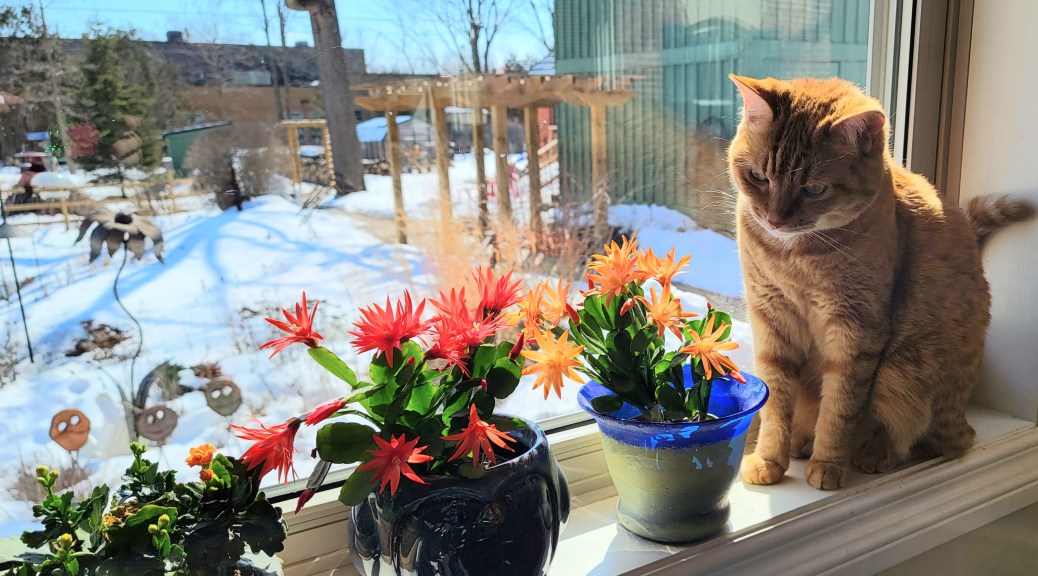
Meet Lulu and Roxy – our tuxedo and ginger and white female cats (respectively).
While I love both of them, Lulu’s favourite activities are digging in the dirt and chewing on plants. Roxy just likes to rub up against them, knock them over and then maybe have a nibble.
While indoor plants can add beauty and life to your home, it’s essential to be aware of their potential toxicity to our furry friends. Certain plants can be harmful or even fatal to pets, especially cats and dogs. Understanding which plants are safe and which to avoid is crucial for ensuring a pet-friendly environment.
Many common indoor plants are toxic to pets, such as Pothos (Devil’s Ivy), which causes vomiting and oral irritation in cats and dogs, lilies (which are particularly dangerous for cats) and sago palms, which are extremely toxic, especially to dogs, causing severe liver damage. The Ontario SPCA has a list of the 17 most poisonous plants, but it’s not an exhaustive list.
If you suspect your pet has ingested a toxic plant, it’s best to consult a veterinarian immediately. Look for signs such as difficulty breathing, vomiting, diarrhea, or lethargy. It’s always better to be safe than sorry.
Reliable Resources on Plant Toxicity for Pet Owners
Here are some reputable websites offering advice on pet safety and plant toxicity:
If you’re looking to enhance your home with pet-friendly plants, here are a few options for you to consider. Personally, I find the palms, ferns and spider plants still tough to have in our house because I think our cats will gravitate to anything that is grass-like.
Unfortunately if your cat or dog is a habitual nibbler, you might be better off without houseplants altogether. We love our kitties more than we love our houseplants. For now I’ll just stick to my Phalaenopsis orchids and my various seasonal cactus and focus my gardening efforts on the outside of our house.
Unlike daffodils, which should be in the ground by Thanksgiving, tulip bulbs can be planted anytime from September until when the ground freezes in December. When you plant later in the season, squirrels are not as active, so may not discover and dig up your bulbs.
Planting in circles or groups rather than in a straight line is more pleasing to the eye. Plant tulips in well drained soil at least 6-8 inches deep and 2-3 inches apart.
Hen manure is a good fertilizer and it will also deter squirrels. For 5 or 6 bulbs, dig your hole (digging that 8” deep will also deter squirrels), put in a couple tablespoons of fertilizer in the hole, place bulbs (one in middle with the rest around), cover with soil, pat firmly, sprinkle more fertilizer, cover bare earth with leaves or mulch (to disguise it from squirrels) and water thoroughly.
You can also use heavy wire to cover the area to keep squirrels from digging or place a board or rock over the area, removing it when the ground has frozen.
After your flowers fade in spring, you can cut back the flower stem but let the leaves die back naturally. This allows photosynthesis to continue, giving food back into the bulb so it will produce again the next year. Plant perennials close by so they emerge and hide the tulip leaves as they decline.
There are thousands of different tulip varieties in many colours, shapes and sizes. Below is a list of some of the main tulip varieties with their characteristics.
NOTE:Don’t forget our first ever Peterborough Master Gardener Spring Blooming Bulb sale still has tulips (and other beautiful spring bulbs) available. Click here for more information and to order!Pickup is in Peterborough.
It has been a warm start to the fall season, but despite a little more frequent rain in September, the summer drought has continued here north of Peterborough in my 4b Plant Hardiness Zone garden. My soil is also sandy and dry. So what could still be blooming and feeding our most effective pollinators, the native bumble bees?
Although bumble bees are more active in spring and summer, they still need nectar and pollen in fall because the gynes, unmated females that will become next year’s new queen bees if fertilized, are mating and then must build up fat reserves and find a place to overwinter (The Xerces Society 2025). At this time of year you may see bumble bees sleeping on flowers in the morning, especially after a cold night or overnight rainfall. These are mostly the solitary male bumble bees that sleep outdoors. They are searching for a mate, and then they will die. Bad weather may also force female bumble bees to sleep outdoors, but their preference is to return to the hive at night (St. John 2023).
Here are a few drought-hardy native species that were still blooming and supporting pollinators in my garden on October 10th. All are resistant to deer. Sun, soil and moisture requirements, height, bloom colour and bloom time are noted for each.
Smooth Aster (Symphyotrichum laeve)
Full sun – light shade; Sand, loam, clay; Dry to Medium; 4 feet tall; Lavender to light blue; September – October
Smooth Aster has very frost-hardy flowers that often bloom into early November. The lavender to light blue flowers provide a lavish display. It has an upright form, is salt tolerant, and has the ability to survive drought.
Given that it blooms into early November, Smooth Aster is an important food source for late season bumble bees. The backdrop of Sugar Maple in full fall colour contrasts nicely with its lavender blooms.
New England Aster (Symphyotrichum novae-angliae)
Full sun – Part sun; Sand, loam, clay; Moist-average soil; Tolerates dry soil but may look scraggly; 2-5 feet tall; Purple, pink; August – October
New England Aster is another late bloomer, often lasting until it is hit by a few hard frosts (Booth nd). It is a clumping perennial that can be divided every 3-5 years and also “politely” seeds into garden gaps. To keep it from flopping over in fertile soils, it can be “Chelsea-chopped” in mid-June to restrict its height. It is an important nectar plant for migrating Monarch butterflies, as well as a larval host for 5 butterflies and more than 40 moth species (Booth and Gray 2024).
A male Common Eastern Bumble Bee (Bombus impatiens) sleeping on New England Aster blooms.
Zig Zag Goldenrod (Solidago flexicaulis)
Part shade to Full Shade; Prefers, fertile loam but tolerates heavy clay; Well-drained soils; 1-3 feet tall; Yellow; August – October
Zig Zag Goldenrod is a non-aggressive goldenrod that is a great addition to the shade garden. It provides pollen and nectar for both short- and long-tongued bees, wasps, flies and butterflies and it is the larval host plant for over 45 species of moths (Booth and Gray 2024).
The leaves of Zig Zag Goldenrod can also change colour in fall, adding to the plant’s aesthetic value.
Blue-stemmed Goldenrod (Solidago caesia)
Part shade to Full Sun; Most well-drained soils, tolerates poor soil; 1.5 – 3 feet tall; Yellow; August – October
Blue-stemmed goldenrod has yellow clusters of flowers that bloom all along the purplish-blue stem in early autumn, creating streaks of gold if planted in large patches. Unlike other goldenrods, it does not spread aggressively. Its leaves host larvae of 45 moth species (Gray and Booth 2024).
Common Eastern Bumble Bee on Blue-stem Goldenrod.
Button Blazing Star (Liatris aspera)
Full Sun; Dry-Medium; Sand, loam; 2 – 5 feet tall; Yellow; August – October; Purple-Pink
Button Blazing Star is one of the most drought tolerant blazing stars. Unlike Dense Blazing Star (Liatris spicata) its flowers are held on individual stems rather than in spikes and the corms cannot be divided. Birds especially prefer its seeds (Diboll and Cox 2023).
Button Blazing Star provides nectar to migrating Monarchs in my garden on Sept. 2. It was still blooming on October 10th.
The evening of October 9th we had a second hard frost (-6oC with wind chill) but the next day all of these native perennials were still blooming. If you are looking at your garden this Thanksgiving and not seeing any plants still flowering and supporting pollinators, maybe make plans to add one or two of these next spring?
Springtime gardening comes with a burst of energy, an unavoidable tendency to order too many seeds, buy too many plants and generally underestimate our own energy and garden space. Fall gardening, on the other hand, allows us to work with past season successes and failures fresh in our memories. It’s much more measured — the best season for gardening, in many respects.
Fall is the perfect time to divide perennials. There are several reasons to divide perennials: Mature perennials often begin to die out from the centre, they might be in the wrong spot, or they have gotten too big where they are. For many perennials, division is a straightforward way to create more plants with minimal effort and cost. Many perennials, such as Hostas and Daylilies are good candidates for fall division. Division should take place early enough in the season to allow the roots to establish before it gets too cold. Late-blooming perennials such as Asters and Chrysanthemums are best divided in spring. And some plants, such as Poppies, don’t divide well at all.
Through this year’s growing season, I identified three plants in my garden ready for division: a hosta, a goat’s beard, and a spikenard.
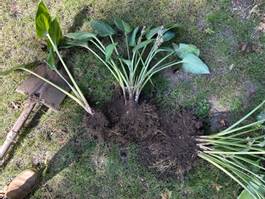
Hosta is a tough plant, it requires some muscle to get out of the ground and split but is also tough enough to withstand the move. Despite the heat and drought this year, my hosta was in fine shape so I decided to dig up the plant without removing the leaves. (If it were later in the season, or if the plant were suffering, I would cut away many of the leaves above the crown and dig up the root without leaves.) The plant was well established, enough that I had to push the spade around the plant a few times, pushing it deeper each time and with some tearing and snapping of roots. In the end, the whole clump came out fairly easily. Sometimes there is an obvious small or ‘baby’ clump that can be broken or cut off easily. In other cases, the roots can be plied apart with a garden fork and, when it’s really tough, a sharp spade or knife cut into the middle of the clump is easiest. Broken or damaged leaves are removed and the new plants are planted at the same level they had been growing. Care should be taken to ensure all roots are under soil and the plant is watered generously for the next weeks.
The Goat’s Beard (Aruncus dioicus) is simply too big for its current location, overdue for division. Because of its size – it would be very difficult to dig and divide the plant without breaking the stems – I cut back all the stems to about 6 – 8” above the soil level. With a bit of digging, the clump came out fairly easily. I shook off a lot of the soil making it easier to divide into two substantial clumps, each with good roots. If the centre of an old perennial has died out, the living clumps around the edges can be dug out and replanted, the old clump in the centre discarded. Each clump gets replanted at the same depth and watered well. Smaller perennials, such as perennial Geranium (Geranium), Coral Bells (Heuchera), Lamb’s Ears (Stachys byzantina) can be dug up gently and teased apart to produce new small plants, each to be planted and watered carefully.
Sun King Golden Japanese Spikenard (Aralia cordata) is a real showstopper in my garden. It loves where it’s growing but it is far too big. As with the Goat’s Beard, I cut off all the stems, then tackled the root clump. It is a beast of a plant, requiring lots of digging and hefting to get it out of the ground. Once out, I washed away the soil with high pressure water from the garden hose, then plunged the spade into the almost woody root. It took a lot of force and pushing to split. I only want a small clump so I worked with the spade to pull apart several sections, planting one and giving the rest to friends.
The red circles indicate ‘eyes’, this is where there will be new growth in the spring, each root clump should have several eyes.
Every autumn, leaves throw one final party as they drop to the ground. It looks like they’ve just given up, disconnected from their branches and collapsed. But trust me—fallen leaves are not lying around doing nothing. They’re busy living their best afterlife.
First, an important definition:
Abscission: the natural detachment of parts of a plant, typically dead leaves and ripe fruit.
When leaves detach from their tree, they fall to the ground and form crunchy carpets, daring you to walk through and make as much noise as possible. (Kids and dogs in parks are especially good at this.) But once the fun is over, the real magic begins. Beneath those piles, leaves quietly turn into a delicious buffet for worms, beetles, fungi, and all sorts of tiny critters. It’s basically an all-you-can-eat salad bar for the soil.
As they break down, leaves release nutrients back into the earth, feeding your trees, flowers, and veggie patch — nature’s own recycling program. They also act like outdoor blankets, keeping plant roots warm through winter. Your daffodils may never say thank you, but they’re grateful. Just remember to peel back the blanket a bit in the spring when the daffodils want to make their grand entrance.
So next time you’re tempted to bag every last leaf in the fall, remember—they’re not just garden litter. They’re quiet agents of soil health, undercover mulch, and active decomposers. Fallen leaves aren’t dead weight. They’re just busy working on their next big role: turning into next spring’s garden gold.
So maybe this fall you can give your rake a rest and let the leaves do their thing. After all, they’ve been running this underground operation for millions of years. They know what they’re doing. Do take the time to rake them off of your grass, though, as grass doesn’t tolerate the leaf party as well as the garden does!
These are plants that are seeded and grown in a specific area for the purpose of covering the soil with plant matter and then allowing that green material (and its roots) to return to the soil by decomposing, thereby feeding the soil and its constituents. Specific crops are used for this purpose as you can choose the cover crop to fit the needs of your soil or the period of time that your garden space is not being used for other crops.
Benefits of Cover Crops
Covers the soil – preventing soil run off, evaporation of moisture, and suppresses weeds
Feeds microbial life in the soil
Creates organic matter for the soil to feed itself with
Convert atmospheric nitrogen into a form that is usable for plants
Their roots can loosen compacted soil and allow for aeration as they decompose
Where to use them?
You can use them in any garden space that is not otherwise in use, is about to come out of production or to prepare a garden space for future use. Cover crops are often used by farmers and market gardeners, but can be used in your backyard veggie garden, annual beds, or a garden space you hope to use next year.
Freshly mowed cover crop
Winter-Kill Cover Crops
These are the types that you plant in early fall. They grow to a nearly mature size before winter and then are killed by the frost. They then form a nice mulch over the winter to protect the soil. Choose these varieties in spaces that you want to be able to plant early in the spring.
Oats – Good for suppressing weeds, improving soil health, protecting from erosion. Sow 6-10 weeks before first frost.
Field Peas – Grow well in cool weather, great for nitrogen fixation. Plant about 6-8 weeks before first frost for maximum benefit.
Field Peas in Bloom
Daikon Radish (Tillage Radish) – Most known for its bio-tillage capabilities. The long tap root grows deep into the soil and then breaks down over winter and early spring, aerating the soil, providing organic material for the microbes and can be useful in loosening compacted soil.
Radish Sprouts – I planted these around Sept 3. This photo was taken Sept 12.
Sorghum Sudan Grass – Great for weed suppression and moisture retention in the soil. Be sure to plant when soil is still warm. It will die after frost but if planted too early will go to seed so be sure to mow before it sets seed if it hasn’t been killed by frost yet.
Mature Sorghum (when used as a cover crop you would terminate before this stage)
Cold-Hardy Cover Crops
These are types that you plant in mid to late fall. They begin to grow in fall, become dormant in the winter and re-emerge in the early spring. You then wait for them to develop appropriate bio-mass and terminate before they go to seed. These are usually more difficult to terminate and may require tillage, crimping or tarping. Choose these varieties for a space in the garden that won’t be needed until very late spring.
Rye – Can thrive in low-fertility soil. Very cold hardy. It is recommended to till it into the soil in the spring when it reaches 12-18 in high.
Mature Rye (Should be terminated by crimping or tilling before this stage)
Hairy vetch – Not as great for weed control at first as it is slow growing, but an excellent nitrogen fixator as it is a legume. Plant in early fall and then till or mow it down in the spring and it can remain in place as a nitrogen-rich mulch.
Vetch Flowers
Crimson Clover & Red Clover – If allowed to grow to mid-May in the spring, will provide lots of nitrogen for the soil and provide a spring flower source for pollinators. Has a strong root system that helps reduce compaction.
As we draw closer to the Autumn Equinox, my thoughts dwell more frequently on the topic of fall planted bulbs. For me, they evoke a powerful sense of anticipation similar to what I felt as a child when the Eaton’s and Simpson’s Christmas catalogues arrived. The suspense and delayed gratification that both provide is beyond words. A seemingly lifeless bulb has the potential to create a stunning spring display of bloom after the harshness of the Canadian winter!
Participating in this ritual is easy with not too many things to looks for. When purchasing in person, look for the largest bulb for the type you can find (good quality tulips are typically 12+ cm in circumference, daffodils may be larger or smaller depending on variety). The larger the bulb, the more blooms that you will have in the spring. Bulb size is probably most important in tulips as not all varieties size up well once planted. Major bulbs known to perennialize (narcissus, allium for example) will size up. I once bought some Leucojum (summer snowflake) bulbs late in the year locally knowing nothing about them, planted them and had to wait 2 years for bloom. They were worth the wait. Last year, I dug some of them up and the bulbs were at least three times the size of what I planted. Bulbs should also be plump and firm with no mold or black spots.
Local nurseries are a good source of bulbs as are some of the larger outlets with nurseries.
More frequently, bulbs are purchased online. Online suppliers will usually be able to provide bulb size and the bulbs they ship should be healthy. Ask for a recommendation from someone in your horticultural society (there is always at least one bulb nut in every club). Vesey’s and Brecks are long time reputable suppliers of bulbs. Also, have a look at the local flower farmer’s webpage. It is quite common for them to retail some of the varieties they have ordered for themselves. In this area Dahlia May Flower Farm and Antonio Valente Flowers both have attractive offerings each fall. With online orders of course, there is the additional cost of the shipping.
A British Columbia company, “Wildwood Express” offers packaged bulbs for sale that are sourced from a reputable importer in BC. They often have last minute sales that are hard to resist and of course end of year sales late in the season. Bulbs can be planted very late into the season (if the ground can still be worked, and YOU are hardy enough).
Of course, there are often good local sales. Not for profit organizations often sell bulbs as a fundraiser. Consider these sales, both to buy some magic and to support a good cause. In our area the Port Hope Garden Club and the Peterborough Master Gardeners have bulbs for sale. Consult the PMG website for details on their sale and for Port Hope, drop me an email through this website.
Some of us have succumbed to temptation long ago. For this year, I ordered around 1700 bulbs last spring (less than last year!), have bought some from the club sale in Port Hope and still broke down and ordered a few fancy new narcissus from a flower farmer.
On a warm spring morning in Ontario, a familiar hum drifts through the air. Low, steady, and purposeful, it comes from a black-and-yellow visitor weaving between garden blossoms—the Eastern Bumblebee (Bombus impatiens). To most of us, it’s a sign of summer’s return, but beneath that fuzzy exterior lies a fascinating story of evolution, resilience, and quiet importance.
Bumblebees belong to the genus Bombus, a group that diverged from honeybee ancestors around 25 to 40 million years ago (Hines, 2008). Unlike honeybees, which thrive in massive colonies, bumblebees are social but live in smaller, more seasonal groups. The Eastern Bumblebee has evolved as a master of cool and temperate climates, thanks to its thick fuzz and the ability to generate heat by vibrating its flight muscles—a survival skill that lets it fly on chilly mornings when other pollinators remain grounded (Heinrich, 2004).
Every spring, the story begins anew with a solitary queen who has survived winter hibernation beneath leaf litter (leave the leaves!) or soil. Emerging hungry, she forages for nectar and pollen while searching for a suitable nest site—often an abandoned rodent burrow or a hollow beneath grasses. There, she lays her first clutch of eggs, which hatch into female workers. These workers soon take over foraging, allowing the queen to remain in the nest and focus on laying eggs (Colla et al., 2011). As the colony grows through summer, new males and future queens are produced. Mating occurs in late summer and early fall, after which the old colony dies, leaving only the fertilized young queens to overwinter and begin the cycle again the following year.
Eastern Bumblebees are generalist foragers, meaning they visit a wide range of flowers. They sip nectar for energy and collect pollen to feed their larvae. Unlike honeybees, which rely heavily on certain crops, Eastern Bumblebees are flexible, visiting everything from clovers and goldenrods to tomatoes and blueberries (Goulson, 2010). Their unique ability to perform “buzz pollination”—vibrating flowers to release hidden pollen—makes them essential for crops like tomatoes, peppers, and cranberries, which depend on this technique.
In the grand web of life, Eastern Bumblebees are lynchpins. By transferring pollen as they forage, they ensure the reproduction of wildflowers and food crops alike. This not only feeds people but also supports wildlife, since countless birds and mammals depend on the seeds and fruits that bumblebees help create. In forests, meadows, and city gardens, their work sustains plant communities that form the backbone of biodiversity.
Despite their adaptability, Eastern Bumblebees face mounting challenges. Habitat loss from urbanization and intensive agriculture has reduced nesting and foraging opportunities. Pesticides—especially neonicotinoids—pose lethal and sublethal risks, impairing navigation and reproduction (Woodcock et al., 2017). Climate change adds another layer of stress, disrupting flowering times and exposing bees to extreme weather (Kerr et al., 2015).
The Eastern Bumblebee may be small, but its impact is enormous. With every hum in your backyard or park, it carries the story of millions of years of evolution, a seasonal cycle of resilience, and a vital role in keeping our ecosystems alive. Protecting them means protecting the beauty and abundance of the natural world.
References
Colla, S. R., Richardson, L., & Williams, P. H. (2011). Guide to the Bumble Bees of North America. Princeton University Press.
Goulson, D. (2010). Bumblebees: Behaviour, Ecology, and Conservation. Oxford University Press.
Heinrich, B. (2004). Bumblebee Economics. Harvard University Press.
Hines, H. M. (2008). Historical biogeography, divergence times, and diversification patterns of bumblebees (Bombus). Systematic Biology, 57(1), 58–75. https://doi.org/10.1080/10635150801898912
Kerr, J. T., Pindar, A., Galpern, P., et al. (2015). Climate change impacts on bumblebees converge across continents. Science, 349(6244), 177–180. https://doi.org/10.1126/science.aaa7031
Woodcock, B. A., Bullock, J. M., Shore, R. F., et al. (2017). Country-specific effects of neonicotinoid pesticides on honey bees and wild bees. Science, 356(6345), 1393–1395. https://doi.org/10.1126/science.aaa1190
I’m sipping my coffee on the deck, overlooking my vegetable garden. Everything shows signs of fall. The onions and garlic have been harvested. The green beans are finished for the season and are ready for the compost pile. The zucchini and summer squash are suffering from powdery mildew, and the tomatoes are carrying the last few fruits of the season. Although summer is ending, the fall gardening season is just beginning – and I have a secret weapon: a cold frame.
Why Cold Frames Work
Several leafy green vegetables can survive and even thrive in cooler temperatures. Kale, lettuce, Swiss chard, and spinach produce sugars that lower the freezing point of water in their cells, protecting them from damaging ice crystals. These crops tend to bolt in the heat of summer but thrive in the crisp days of fall. Still, even hardy plants will eventually succumb to our harsh Canadian winters.
That’s where a cold frame comes in – you can significantly extend your growing season with one. Imagine brushing snow off your cold frame in November to harvest fresh kale for a salad!
A cold frame is a low, bottomless structure with a transparent lid that protects plants from wind and cold. The lid lets sunlight in, while the insulated base traps heat and creates a microclimate that can run several degrees warmer than the surrounding air. Ventilation is key – open the lid on sunny days to prevent overheating and ensure proper airflow.
Cold frames come in various styles depending on budget, materials, and space.
Types of Cold Frames
Traditional Cold Frame Built from wood with an angled, hinged top – this could use glass, polycarbonate, or heavy plastic. They can be permanent or portable and built with reclaimed or new materials. An old window makes a perfect lid.
Straw Bale Cold Frame Stack straw bales to form a frame and cover with windows or plastic sheeting. Straw provides insulation and can be reused or composted in spring.
Hot Bed A sunken bed filled with compostable material such as horse manure, straw, or poultry bedding, covered with soil and topped with a cold frame. As the material decomposes, it generates heat, warming the soil below.
Timing is everything: Sow spinach, kale, or lettuce in late August or early September to harvest well into late fall – or even December, depending on snow cover.
Ventilation matters: Even on sunny October days, closed frames can overheat. Keep lids open when needed.
Spring bonus: In March or April, use your cold frame to start early crops like lettuce or radishes, or to harden off seedlings before planting.
The Quiet Magic of Cold Frames
No matter which style you choose, a cold frame is a valuable addition to any garden. It helps you garden later into the season and gives you a head start in spring.
With one simple structure, you don’t have to say goodbye to your garden when frost arrives. Picture a crisp November morning—brushing snow from the lid and harvesting fresh spinach for breakfast. That’s the quiet magic a cold frame brings to your backyard.







 The Peterborough & Area Master Gardeners