During the gardening season you may find yourself wondering about how plants work. This quick garden jeopardy game is just the thing to answer some of those burning questions you may have.
This plant pigment acts as a sunscreen for plants, is a powerful antioxidant protecting plants from various environmental stressors and due to its mobility in water it can transport important substances to parts of the plant that need them. This pigment is responsible for a temporary condition called juvenile reddening. It acts as a sunscreen for tender young leaves. It may also help young leaves hang onto their water during expansion. What are Anthocyanins?
Photo: Lois Scott Juvenile Reddening of Witch-hazel leaves
This plant hormone controls rooting, stem elongation and directional growth. It is why shoots grow towards the light and roots grow down. If a sun-loving plant is suffering in too little light it will have sparse leaves that are larger and paler than normal, leggy (etiolated) stems and will lean towards the sun with most of the leaves on the sunny side. What is Auxin?
This plant movement (tropism) causes some plants like sunflowers to track the sun. A pigment (cryptochrome) absorbs blue light from the sun and uses it as a means to tell time. Cryptochrome sends a signal to the base of the leaf or flower where a pulvinus (a specialized, swollen structure) moves the leaf or flower to the right angle. What is Heliotropism?
This plant movement (tropism) causes the turning and bending of plants including the winding of vines and tendrils. Physical contact is the stimulus for this action. In vines, auxins are lowest where the tendril touches the support and highest on the opposite side. The high levels of auxin cause the cells on that side to grow longer, curving the tendril around the structure. What is Thigmotropism?
Photo: Lois Scott Twining Tendrils of Clematis
Thank you for playing the game! The material used is from the book ‘How Plants Work’ by Dr. Linda Chalker Scott, Timber Press, 2015. This excellent resource has answered many questions for me and one I return to when I need to refresh my memory or when I wish to marvel at just ‘How Plants Work’. Any misinterpretations are my own!
Back in the 1890s, the mouth of the Don River in Toronto was filled in to make way for industry—known as the Port Lands. This changed the landscape and the plants that used to grow there “disappeared.” In 2021 while the site was being ecologically restored as part of the Port Lands Flood Protection Project, workers discovered some unusual plants that had sprouted shortly after seven metres of soil had been excavated. They were thought to be different than the usual species seen at the site.[i] Researchers at the University of Toronto began working to identify the species of plants and seeds found.[ii] Some of the plants included Schoenoplectus (Bulrush), Typha (Cattail), Salix exigua (Coyote Willow), Equisetum (Horsetail), as well as mosses and liverworts. Research is still ongoing as they seek to verify whether these plants came from an ancient seed bank. Through carbon dating, the research team was able to determine that some of the seeds from soil samples were between 150-400 years old! So far, most of the seeds that have been identified were from the Cyperaceae (Sedge) family with the majority in the Carex (True Sedges) genus followed by Schoenoplectus (Bulrushes), Sparganium (Bur-Reed) and Typha (Cattail).[iii] This is all very exciting because it shows that while some urban environments may be drastically altered, they are not necessarily permanently altered, and we may be able to successfully restore such landscapes to their pre-industrialized states.
Seed Dispersal and Physical Dormancy
Most seeds are known to be “physiologically dormant.” This means that they have an internal inhibiting mechanism (“endogenous”) that requires exposure to certain conditions to break dormancy (e.g. light, temperature, etc.).[iv] “Physically dormant” seeds have an external inhibiting mechanism (“exogenous”)—a hard coating that inhibits germination unless it becomes permeable–allowing water to enter, and then germination is initiated.[v] Some years ago, I planted a Zebrina Hollyhock Mallow (Malva sylvestris) in my garden. It is considered a biennial or a short-lived perennial. It bloomed but didn’t come back the following year and no new plants emerged from any possible dispersed seeds. It was not until about five years later that two plants emerged—about four metres away from the original plant site. These seeds are quite hard and require some form of natural scarification to break their seed coats. Scarification can occur through fluctuations in temperature, damage by gardening tools, damage by microorganisms, fungi, or animals; or transit through animals’ digestive tracts.”[vi] Myrmecochory could possibly explain the transfer of the seed from one location to another as seeds in the Malva family are frequently targeted by ants.[vii] In myrmecochory, ants transport the seeds and then remove and eat a nutritious coating from the seeds called the elaiosome. Sometimes when the elaiosome is removed, the seed coat becomes thinner, and this enables water to enter. However, Baskin and Baskin suggest that removal of the elaiosome by ants on seeds like this may not influence the seed’s ability to imbibe moisture.[viii]
When I think about some of the plants I grew from seed last year, I recall one species that did not have good germination—Geranium maculatum (Wild Geranium). There are different causes for poor germination, but one possibility is that the seed was not fresh enough or that their moisture content was not sufficiently retained. I learned that this species is somewhat recalcitrant or hydrophilic. These types of seeds are sensitive to drying and as time progresses, the percentage of seed death increases. William Cullina, in Wildflowers: A Guide to Growing and Propagating Native Flowers of North America, recommends sowing Geranium maculatum immediately upon harvest of the seeds in the summer. However, germination may be successful with seeds stored in plastic for 4-6 months—perhaps indicating this species inclination towards being partially recalcitrant.[xi] According to Dr. Norman Deno in Seed Germination Theory and Practice, Geranium maculatum is best sown in the summer from fresh seed and then is exposed to winter temperatures before germinating in the spring. Seeds are mostly dead when kept in dry storage for more than 6 months.[xii] One of the lessons learned here is to research the germination requirements thoroughly as well as inquire about the storage conditions/age of the seed before obtaining seed of a recalcitrant species from a supplier.
Heteromorphic or Dimorphic Seeds
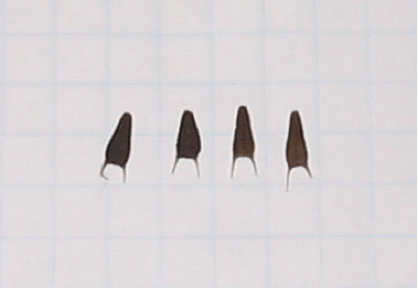
Although considered a composite species, Bidens frondosa (Devil’s Beggarticks), usually lacks ray flowers and only has disk flowers. As a result, they are less attractive to pollinators than the other Bidens species.[xiii] It also has a weedier reputation. Being an annual, each plant can produce around 1,200 seeds that are viable for 3-5 years. The seed is a two-barbed achene that can stick to clothing and pet fur. Interestingly, the achenes are known to be heteromorphic or dimorphic in nature—there are two different kinds. Those produced on the periphery are black, thicker, and are less dormant than the ones produced in the middle. Those in the middle are brown, elongated, and are more dormant than the others. This is an example of how a plant has a particular way of increasing its rate of reproductive survival—the less dormant achenes fall close to the mother plant and germinate the following year while the ones that are more dormant are carried by animals (“epizoochory’) or by wind (“anemochory’) to germinate at different times in new environments.[xiv] These seed features help explain the resiliency and ability of this species to proliferate.
[iii] Riskin, Shelby. Email communication (December 2023).
[iv] Willis, C.G., Baskin, C.C., Baskin, J.M., Auld, J.R., Venable, D.L., Cavender-Bares, J., Donohue, K., Rubio de Casas, R. and (2014), The evolution of seed dormancy: environmental cues, evolutionary hubs, and diversification of the seed plants. New Phytol, 203. p. 301. https://doi.org/10.1111/nph.12782
[v] Baskin, Carol C. and Jerry M. Baskin. Seeds: Ecology, Biogreography, and Evolution of Dormancy and Germination. 2nd Edition. 2014. p. 72.
July is the month that I tend to really enjoy the garden….most of the work is done! The planting of seeds, and plants into pots and garden beds, dividing and thinning and garden creating is behind me for now. However, there are still a few garden tasks.
I try to keep up with weeding because weeds can quickly overrun your garden as they begin to set seed. Weeds take nutrients from the soil which your plants need and can smother out young plants. And I am one of those gardeners who enjoys weeding. I feel a great sense of accomplishment when I finish weeding a garden bed and when I pull out a weed and get the root….well that is simply thrilling.
Early July is a good time to trim back your annuals in order to encourage bushier growth and to trim off the spent blooms of your perennials to prevent seed production and allow the plant to put its energy into its roots. You may want to start fertilizing your potted plants because any fertilizer that was contained in the potting soil has probably been used up by now. There are lots of choices when it comes to fertilizers so talk to the staff of your favorite local nursery. They will be able to advise you and will likely carry the best products.
July is also the month when that garlic that you planted last fall is ready to harvest. We grow hard neck garlic that a kind neighbor started us on a few years ago. I removed the curled scapes last week and froze them for future use. I will keep an eye on the leaves on the garlic because when a few leaves have started to turn brown then the garlic is ready to harvest.
The rest of your vegetable garden may be starting to produce now as well. We have harvested some tomatoes already which is a bit earlier than usual for us. It is a good idea to check your vegetable garden daily so that you harvest and enjoy the results at their peak and to respond quickly to any issues that may arise.
I evaluate the appearance of my ornamental gardens in July. It is interesting to see if the garden looks the way that I had planned. I do not mean, “is it perfect” but how close is it this year to the feeling that I would like to achieve when someone walks through the gardens for the first time. I look at how the colours and textures work together. I ask myself if there are any bare spots or areas that I will need to renovate soon (eg. crowded and/or overgrown plants).
I am starting to plan my fall and next spring projects now. This year, two smaller gardens were joined and planted with mainly annuals for quick impact. I know that I plan to fill this garden with perennials and native woodland plants. This means keeping this garden in mind when I am shopping at the local nurseries.
Spring, and early summer, gardening can be a very busy time. July is the month to really enjoy your gardens and dream about what you might like to do next!
Here we are in the dark days of winter; the holidays are over, the new year has been rung in, and the days are getting longer as we see the snow falling and the temperatures plunging.
Although we can’t go out and play in the garden, there are still lots of things we can do to satisfy our green thumbs.
Clean and sharpen garden tools Buying good quality tools and keeping them clean and sharpened just makes good sense. Diseases can be passed through your tools, so always wipe with soap & water or even better with disinfectant wipes. Check out this site for tips on keeping tools in great condition.
Check out seed catalogues online Growing plants from seed gives you a wider variety to choose from and also the satisfaction of growing your own. If you are a vegetable grower, try something new this coming season. If you are like me, you will want to order a paper copy catalogue from your favourite seed companies.
Start a garden journal Set something up on your computer with charts and photos, or start a written record in a blank book or special garden journal. Record new plant purchases and who you bought them from and where they were planted in your garden. Include successes, ways to improve and dreams for next season.
Review last year’s garden successes If you have kept a journal, you can check your notes. How can you improve for this coming season? Did you plant the right plant in the best location? Were soil, light and water conditions the best they could be? Remember that weather can determine success or failure as well. Some plants thrive with wet cooler springs while others enjoy hot and humid weather.
Check your houseplants for signs of pests or diseases Gnats and aphids seem to come alive during the next couple of months. Have Safers soap ready to combat those nasty pests. Remove diseased leaves and isolate plants that are sick. Many houseplants are in resting stages and are not actively growing, so do not fertilize. Houseplants may not be drinking as much either so water sparingly. Have a bright indirect spot in your home? Maybe it’s time for a new specimen. Remember to isolate your new plant to ensure it is not infested or diseased before introducing to the rest of your collection.
Brighten your home with some fresh cut flowers There is nothing like fresh cut flowers to brighten up a gloomy winter day. Check out this post on our website for caring for cut flowers.
Read a gardening book When the weather outside is frightful, be sure to have a list of books to read, whether physically or electronically. Lorraine Johnson’s A Garden for the Rusty-Patched Bumble Bee is on my list.
Outside garden maintenance When you are outside shovelling snow, throw some clean snow on and around any of your more tender perennials. Things like rhododendrons and hibiscus overwinter better if they have a nice layer of snow to cover and insulate them. If the weather has gotten mild and the snow has melted, cut and use your old Christmas tree branches to cover and protect from the coming frigid temperatures and bright burning sunlight.
Sign up for some online learning There are many local garden organizations that have newsletters, blogs, YouTube videos and live zoom events available. Be sure you are learning from a reputable and local site if you want to add to your knowledge for your own garden. You can, of course, enjoy the foliage of some exotic locations, but know we can’t grow most of it in our zone 5 environment.
Try these sites for local learning. Some sites offer free webinars while others will charge.
Layering is an asexual (vegetative) method of plant propagation that produces genetic replicas of the parent plant. In this technique, the newly developing offspring remains attached to the parent plant. This keeps it supplied with water, carbohydrates and nutrients avoiding some of the pitfalls of traditional cuttings.
What makes this possible is totipotency. Every cell in any plant—except for egg and sperm —is capable of regenerating into a complete organism or differentiating into specific cell tissues. Under appropriate conditions, a cell can be induced to multiply into roots, shoots, leaves, or flowers. One example of this is the formation of adventitious roots. These are roots that form from “non root” tissues. Growth of these roots are promoted in part by the plant’s own hormone auxin.
“Wounding” the shoot being layered by making a small sloping shallow cut on the underside of the stem/branch induces this process. Wounding is known to produce adventitious roots by increasing levels of auxin at the wound site and by forming callus (dedifferentiated plant tissue capable of becoming roots).
Simple Layering
Select a young vigorous shoot that is low to ground
Wound stem, keeping wound slightly open using matchstick
Dust with rooting hormone
Dig shallow hole, set stem in contact with soil,
Secure stem in place (u-shaped pin or rock)
Fill hole and mulch to keep moist
Check for roots in fall, sever from parent and replant new shrub
Recommended for climbing roses, forsythia, honeysuckle and boxwood
Tip Layering
Works well on plants with long whippy stems like berry crops
Tip of shoot is pegged into soil, secured and buried at point of contact
Serpentine Layering
Similar to simple except that multiple points are wounded and buried
Good for plants that produce long shoots such as clematis, grapes, wisteria, rambler roses, vining honeysuckle, willow and viburnum
Stooling/Mounding
Process encourages masses of basal shoots which are allowed to layer naturally
Cut parent shrub back to near ground level in dormant season to encourages masses of basal shoots
In spring, when shoots are at 15cm, they are covered with dirt leaving tips exposed
Repeat process as shoot grow to 25 cm
Buds inside dirt will form roots
When plant reaches dormancy again, remove soil and newly rooted shoots and plant on
Recommended for this technique are smoke bush, dogwoods, spirea, daphne, magnolia, cotoneaster
Just 3 short weeks ago I shared my thoughts on the impacts of the coronavirus (COVID-19) on our gardening activities, shortly after the World Health Organization declared it to be a pandemic.
So many events have been cancelled – garden shows, seminars, Seedy Saturdays (and Sundays) – that even the cutest cat photos are not making us feel any better. (yes these are my two cuties – Lulu and Roxy).
Although garden centres and nurseries that grow their own stock are permitted under the conditions of the Emergency Management and Civil Protection Act (as an agricultural activity), many of our favourite nurseries have closed their doors to in-person shopping and resorted to online sales with no-contact pickups at their entrances in order to protect staff and the public.
Fellow gardeners are panicking. After all, this is the time of year when we finally get outside again, clean up our gardens, start seeds, decide on our plans, and look forward to purchasing our favourite plants at the stores.
However, gardening is not cancelled. This year will definitely be different, and we will have to adjust.
In these chaotic times, let gardening be therapy, providing a place for you to find calm and peace.
Working in the soil, with the sun on your face, can take away your worries, at least temporarily. You are using your hands, digging in the dirt, taking in the fresh air, watching the birds flutter around the yard and – best of all – all the news and social media is in the house! Your garden is an escape!
For families with kids at home, gardening offers the opportunity to get the kids outside and busy, while building their self-esteem and bringing variety to what has suddenly become a lot of time spent together. For those on their own you are never truly alone in a garden – there are always birds, bugs, plants or other living things to observe all around you.
COVID-19 is forcing us to re-examine how we live, and how we consume goods and services. This has translated into an increased interest in people wanting to grow their own food, taking us back to World War II, when millions of people cultivated Victory Gardens to protect against potential food shortages while boosting patriotism and morale.
We still don’t know whether we will be able to get starter plants, so many people are ordering seeds. As a result, seed companies are experiencing a deluge of orders, with many stopping new orders until they can catch up. Your local Master Gardener groups and horticultural societies can help you out if you need some advice on how to grow plants from seeds.
Start some seeds.Just seeing something grow out of the soil is a very positive experience. Hopefully you have some seed starter mix around (or can get some) and you can use anything to grow seeds in – from old roasted chicken containers to yogurt cups to folded up newspapers.
Check out social media gardening groups– there are groups out there for every topic under the sun, from seed starting to plant identification to perennials. Since the pandemic began, I have noticed far more people joining these groups, which is wonderful because gardeners just love to share their experiences.
Plan your vegetable garden – figure out which ones you can grow easily from seeds. Learn from others and search Google for ideas.
Stuck inside on a rainy day? Find some online gardening classes or check out YouTube for some good instruction videos on any number of gardening topics.
Get outside for a walk in nature – while maintaining physical distancing, enjoy getting some exercise and seeing all the plants emerging from their winter slumber.
Repot your houseplants. You might just find they reward you with some lovely blooms once we start getting more sunshine.
Hopefully soon we’ll be able to look forward to getting plants at our favourite nurseries (you can be sure they are working very hard to find safe ways to do this). When we do, make sure you support your local nurseries and #buylocal as much as possible.
Until then, find your inner gardening zen, whatever that may be, and enjoy all that spring has to offer. I know I will be sitting by my garden pond, thinking about brighter days ahead.*For best information on the COVID-19 situation contact your local health unit or the Government of Ontario website. Peterborough Public Health, led by Medical Officer of Health Rosana Salvaterra, also has great resources.
Just when Ontario gardeners thought spring was peeking through the piles of snow – with warmer weather and the change to daylight savings time – we’ve been derailed, and not by Mother Nature.
It’s been a tough few weeks with the increasing spread of the coronavirus disease (COVID-19) to North America. People are becoming increasingly alarmed, and in the past few days we have seen measures by our local health authorities and governments to ‘flatten the curve’ of the pandemic by imposing restrictions on travel, movement, and large events. For best information on the COVID-19 situation contact your local health unit or the Government of Ontario website. Peterborough Public Health, led by Medical Officer of Health Rosana Salvaterra, also has great resources.
Flattening the curve – Proactively instituting protective measures to protect our healthcare system’s capacity to respond.
For Ontario gardeners, the past week has seen the cancellation of two major garden shows, numerous Seedy Sundays (and Saturdays), various Ontario Horticultural Association District meetings, and local meetings (in venues that have closed their doors to external groups). The biggest shock was the last minute cancellation of Canada Blooms just before its opening (March 13-22) as so much hard work and preparation goes into this event (6 days of building, but also plant-forcing, planning, designing etc.). But all is not lost! Thanks to Paul Gellatly (new Director of Horticulture at the Toronto Botanical Gardens), Sean James (Master Gardener and gardening consultant), and Helen Battersby (Toronto-based writer and garden speaker), we have photos and video of Canada Blooms before it was dismantled so that everyone can appreciate the results, even if we don’t have “smell-o-rama” and can’t see it in person.
Photos of Canada Blooms (thanks Paul Gellatly) Here and here
(note that all the TBG’s plants from Canada Blooms will be on sale at the TBG at 777 Lawrence Ave East on March 14th and 15th from 10 a.m. to 4 p.m.)
Video Tour of Canada Blooms (thanks Sean James) Here
More Photos of Canada Blooms (thanksHelen Battersby) Here
The Peterborough Garden Show is also a huge draw for Ontario Gardeners. This year was to be the 20th Anniversary show – completely community run by volunteers from the Peterborough Horticultural Society, with all profits being reinvested in the community in Peterborough.
In addition, our beloved PeterboroughSeedy Sunday this March 15th has been cancelled (along with many others across the province). Organizer Jillian Bishop (of Nourish and Urban Tomato) is encouraging people to visit the website and click on links for the various vendors to support them by buying seeds online.
What are Gardeners to Do?
Don’t give up hope.
Bring spring inside!Check out my recent blog on bringing dormant spring flowering branches inside and forcing them for early colour and bloom.
Plant some seeds!You may not be able to go to Seedy Saturdays/Sundays but you can order seeds from local companies or find them at your local nurseries. A great activity for March Break with kids.
Do some virtual garden tours!Google Arts and Culture has some, or there’s a virtual tour of Prince Charles’ Highgrove Gardens that I just found. I’m sure a quick Google search for “virtual tour” and “gardens” would bring up many more.
Plan your 2020 garden.Whether it’s reworking your perennial beds, planning a new garden, or deciding on your vegetables and herbs for this year, best to get your design ideas laid out now before spring arrives. Maybe think about a rain garden or pollinator garden for this year?
Clean your tools. Get in your garage or garden shed and take inventory of what tools need repair or replacing, and what new tools may be helpful this season. Clean your tools now so you are ready for the season.
Get outside. Yes we might still have snow (well some of us do) but that doesn’t stop you wandering around your garden and dreaming does it?
Go wander in nature. Many of the COVID-19 restrictions are stopping our regular activities in our communities. But that is no reason not to enjoy our wonderful environment. Take this opportunity to get out for a hike, see the plants emerging from their winter hibernation, listen to the spring birds singing, and relax in nature. (more on this in our MG Sharleen’s blog on Monday)
These are challenging times, but our gardens and love of gardening will help get us through. If you have other ideas please tweet them out to us or share them on our Facebook page.
As this decade comes to a close, I like to think that I over the past ten years that have learned some things about gardening. And with that in mind, I’ve set a few New Year’s resolutions to guide me through this next year (and decade).
1. Be Better at Cleaning My Tools
I have some great tools – my Felco #12 secateurs/pruners (several pairs), my delightful drain spade, and my Japanese hori hori knife. But I am neglectful and do not clean these well during the season and especially at the end of the gardening year. My resolutionto improve my tool maintenance for next year. Some guidance here and here.
2. Make a Plan
I was basically back to square one in my garden a few years ago after a major house renovation. Since then we have installed some hardscaping and I have tried to replan my gardens. I’m 15 years older than when I first did my gardens, so my plan needs to take into account my aging and energy level, so I have eliminated those fussy perennials and focused more on a garden built on flowering shrubs that are lower maintenance. But I don’t have a plan, and my engineer husband keeps saying “where’s the plan?”. So my resolution is to spend this January laying out a plan for spring, rather than just going with my gut.
3. Don’t Order Too Many Seeds
This will be a tough one. After all who hasn’t looked out their window in January at the snowy landscape while reviewing seed catalogues and dreaming of a perfect garden? The diversity available via seed companies is just astonishing these days, and it’s nice to grow something that your friends don’t have and that you can keep seed for the next year! But we all tend to indulge and over purchase, so my resolution is to have a specific place for any seeds that I order (see previous note for a plan), and to test all the existing seeds I have for viability like this.
4. Share my Knowledge and Start a Blog
While I write a blog for the Peterborough Master Gardeners on a regular basis, I’d like to start a garden blog of my own. The challenge? Just finding the time when I work full time and write for a living. Myresolution is to spend January getting a basic blog set up, and then to try and write once a week starting in February. I’ll share a link once it’s up and running, and you can all hold me to task for getting it off the ground. The great part is there is lots of good advice on how to start a blog out there.
Create a Holistic Garden
I am passionate that my garden should be more than just beautiful flowers – it should be a wonderful habitat for birds and bugs and critters and pollinators, and everything in between. I want to know that I am making a difference that contributes to supporting our local ecology and habitat. My resolution is to continue focusing on this as I re-establish my garden, and share my knowledge with others so that we can all make a difference.
Wishing everyone a Happy New Year and a wonderful 2020 gardening season, wherever you may be.
This past growing season was my first foray ever into growing marijuana. I tried this because I want to attempt to make a salve that I have been purchasing locally for arthritis (which, by the way, seems to work for me!)
I started my seeds inside under lights. When I planted the seedlings outside, one went into the ground in my garden and the other went into a 5 gallon bucket with holes drilled in the bottom. The bucket plant went into my little greenhouse.
I did not fertilize either plant regularly – maybe 3 times the whole summer – but I did water the potted plant pretty well daily. I gather from other growers that I should have fertilized a lot more and then held back on the fertilizing later in season to clear chemicals out of the plants.
I thought this would be a good way to test growing techniques – greenhouse as opposed to outdoors but in the end it was not. I had planted 2 varieties that had very different characteristics. One had a beautiful bluish, reddish tinge to it and the other was twice as bushy.
Both plants ended up being well over 5 feet tall with lots of flowers. I cut them down before first frost and hung them in the greenhouse with shade cloth draped overhead.
So now, I am not sure if all the work was worth the effort and I haven’t even made the salve yet. I don’t know how the hippies from the 60’s and 70’s did it. I was told to trim off all the leaves before I hung the plants. That took an incredibly long time. And apparently I will have to trim the dried flowers off in the very near future. The marijuana plants themselves are kind of interesting architecturally but they stink. Birds for the most part avoided them and I don’t think I saw even one bee on them and I have lots of bees here. At any rate, I will make the salve and reserve judgement until then. We have to try new things, right?
Gardening resources on the internet are plentiful but can quickly become overwhelming for both novice and experienced gardeners. Over the past year I have noticed certain websites that continually show up at the top of my search results; these sites are “gardening content farms”, a term I learned from fellow Master Gardener Cathy Kavassalis (@CathyKavassalis). A content farm (or content mill) is a website that provides limited pay to large numbers of writers to generate a wide range of (user-generated) content which is often specifically designed to maximize page views in order to generate advertising revenue.
Examples include gardeningknowhow.com, gardendesign.com, thespruce.com, theflowerexpert.com. Many have names that entice you into their site (like a fly to a spider’s web). The websites may contain lots of information about gardening, but it appears to be mostly collected from other sites or produced by writers with minimal gardening knowledge. As Cathy puts it “The quality is variable but the sites are created to ensure they show up early in Internet searches to generate ad revenue.”
For a while I actually didn’t notice the content farm sites because I have an adblocker program (so I didn’t get the ads). Once Cathy mentioned the sites in response to a question on our Master Gardeners of Ontario Facebook site, I consciously looked and was shocked by the number of ads that had been blocked when I clicked on the links – 6, 9, even 15 or more.
So I purposefully put “types of peonies” in the subject line in a Google search, keeping the topic very general. First link up is from gardendesign.com. Some good information there, but 8 ads blocked. And of course first of all I get a pop-up wanting me to sign up for their newsletter (to sell me more stuff).This is where you have to be an engaged researcher. Often the author may own a business (for example, one that sells expensive peonies); this doesn’t mean the information isn’t good, but their primary motivation in writing the article is to drive you to their website, or for you to share their article with others to increase their profile. Other sites engage writing generalists to search the internet for information on a topic and repost it on the site, which could mislead you into thinking they wrote the article (usually there is an attribution to the source at the bottom of the page in small lettering).
The content provided on these sites are not a bad place to begin your searches, but the quality varies significantly, as these are not generally writers with gardening knowledge. Also if they are reworking other (maybe erroneous) information, they are simply continuing to spread misinformation.
I offer three suggestions to help you find gardening information on the web:
If you are doing a Google search focus your search with as many key terms as you can so you get what you need, often bypassing the gardening content farms. For example, typing in “ontario gladiolus bulbs overwintering” brings up good local answers from sites such as TorontoGardens (with Helen and Sara Battersby), Landscape Ontario, an Agriculture Canada publication on gladiolus, and Toronto Master Gardeners. Then the aggregate (garden farm) sites follow, as they have more general information.
Rather than Googling for information, use some of the great resources available on Facebook and Twitter. Master Gardeners of Ontario, Ontario Horticultural Association (OHA) (through GardenOntario), and many regional Master Gardener and OHA groups are on Facebook and Twitter – it really is a terrific way to learn (and make new gardening friends). Also there are many good gardening websites to be found (really another entire post) – look for information with that provided by a government agency (e.g. OMAFRA, USDA, etc.), respected horticulturalists, a botanic garden and/or arboretum, a university, a Cooperative Extension services associated with a university (USA), or a wildflower or native gardening society.
Subscribe (or follow) excellent gardening blogs – find those that match your interests and where the writers are passionate gardeners who want to share their knowledge. You are on one now so sign up to get notifications of new posts (every week). Other blogs I like are The Impatient Gardener, Savvy Gardening, and Three Dogs in a Garden. Ask friends for recommendations. You can also reach out to me on Twitter.
Filtering through all the information is challenging, but hopefully this blog gives you some tools to separate the wheat from the chaff. Happy Gardening!












 *For best information on the COVID-19 situation contact your local health unit or the Government of Ontario


 I started my seeds inside under lights. When I planted the seedlings outside, one went into the ground in my garden and the other went into a 5 gallon bucket with holes drilled in the bottom. The bucket plant went into my little greenhouse.

 This is where you have to be an engaged researcher. Often the author may own a business (for example, one that sells expensive peonies); this doesn’t mean the information isn’t good, but their primary motivation in writing the article is to drive you to their website, or for you to share their article with others to increase their profile. Other sites engage writing generalists to search the internet for information on a topic and repost it on the site, which could mislead you into thinking they wrote the article (usually there is an attribution to the source at the bottom of the page in small lettering).
 so sign up to get notifications of new posts (every week). Other blogs I like are
 The Peterborough & Area Master Gardeners
