Category Archives: Perennials

Lupins

By Suzanne Seryck, Master Gardener

I have just finished cutting back my lupins for a possible second bloom, scattering their seeds and transplanting baby lupins that have popped up in all the wrong places.

Lupinus, or more commonly known as Lupins, are one of my favourite plants especially in the late spring when they are first in bloom. I tend to lean towards plants that need little to no care, that will attract insects, will self seed but are not invasive, and that give me joy when they are in bloom. Lupins fit that category for me perfectly.

suzanne1
Lupins in the author’s garden

Lupin is a genus of flowering plants in the legume family Fabaceae, along with peas and beans. They have been grown since the days of the ancient Egyptians and were eaten by the Romans. Lupins like well drained soil, preferring sandy soil, but in my garden they grow well in clay. They grow in either sun or partial shade conditions. I will often let some of the flowers on my plants go to seed, self-seeding throughout the garden. But depending on where they decide to grow, I tend to transplant them and move them around. When digging up a lupin, take care to dig up the large tap root. I prefer to dig them up when they are very small, so I don’t damage the root any more than necessary. I also find it easier on both me and the plant to transplant them into a pot, rather than directly in the ground. This enables me to keep the plant in the shade for a few days, water more often and just baby them along more.

suzanne2
Photo showing the large taproot on lupin seedlings

For me, lupins in my garden tend to be short-lived perennials, lasting anywhere from 3-5 years. They do not grow true from seed so to ensure that you have a true seedling you should take basal cuttings. A basal cutting is best done before the plant has flowered; you cut a shoot close to the root, take off all the leaves, nip out the top of the cutting and then transplant into a pot filled with compost and soil. When you see roots coming from the bottom of the pot, you can then transplant the lupin into your garden.

Because lupins are members of the legume family they are nitrogen fixer plants. Using a specific bacteria, ‘rhizobia bacteria’, that allows them to draw nitrogen from the air, convert and then store the nitrogen in nodules that grow on their roots. The nitrogen can become available to other plants in a number of ways. If a nodule breaks off and decomposes, the nitrogen becomes available in the soil and when the plant dies or if the plant is tilled back into the ground, the nitrogen also becomes available. In addition, lupins have a large tap root that is great for breaking up compact soils.

Most of the lupins you buy in garden centres are not native to Canada, as there is a native lupin–the wild lupin or Lupinus perennis which is considered native in Ontario. It is normally blue or purple and prefers a dry, sandy soil, but will grow in any well-drained soil. Wild lupins are often used in restoration projects because the large tap root helps to control erosion. It is also essential to the endangered Karner Blue butterfly which feeds exclusively on it and is a host to other butterflies. If you want to add this plant to your garden, you are best to buy the seed from wildflower farms and ensure you follow the instructions carefully as the seeds need specific conditions to germinate.

An example of a wildflower nursery selling the seed is given below:

https://www.wildflowerfarm.com/index.php?route=product/product&path=18&product_id=112

Perennial Gardening with Less Effort

By Mary-Jane Pilgrim, Master Gardener

Are you spending more time working in your perennial garden this hot, dry summer than enjoying it?  You may want to consider some of these low maintenance tips for fall renovations and next year’s plans.

What does low maintenance mean? Low maintenance does not mean no maintenance and low maintenance is not for lazy gardeners. Low maintenance means making wise plant decisions and doing your homework up front, so you don’t end up with a flower garden that requires tons of work to look good.

Getting to the point of ‘lower maintenance’, however, will be tough.  Prepping a new garden is pure slogging, involving wheelbarrowing compost and mulch, digging & then digging some more.  If your current reality involves plants that were plentiful at your neighbour’s house or at a recent plant sale, it could involve even more digging to get rid of persistent roots.

thumbnail_IMG_1658
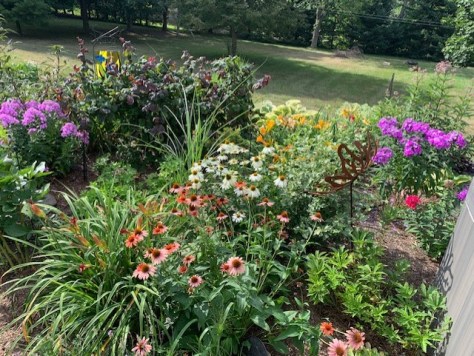
Well behaved full sun perennials in the author’s garden

However, you will love the end result of an easy to care for garden if you follow some of the following suggestions.

The first rule of thumb in creating a low maintenance flower garden is to keep it small. Don’t go crazy when you’re picking out plants; stick with 3 or 4 groupings of 3 of the same perennial, and then fill in with annuals if you wish.

The most important tip of all in creating a low maintenance flower bed is mulch. Mulch is a gardener’s best friend. After planting your flower garden and watering it well, always apply a 2 – 3 inch layer of a good, shredded mulch. If you can’t afford mulch right away, shredded leaves and untreated grass clippings will do the trick. Mulch is your #1 defense against weeds and it helps the soil retain moisture so that your plants don’t dry out. Skipping mulch in a low maintenance flower garden is not an option.

Another important step to keeping your flower garden low maintenance is to install an edging of some type. Allowing the grass to creep into the garden, or allowing the garden to creep into the grass are both problem situations that will require a lot of work to deal with.

Choose and plant flowers that:

  • aren’t vigorous, invasive or self-seeding spreaders (avoid “creeping” anything!
  • aren’t too picky about the soil
  • will survive a wee bit of neglect
  • are relatively drought tolerant
  • don’t require deadheading or minimal deadheading (removal of spent flowers)
  • don’t require staking
  • are not prone to pest problems or diseases.

A good nursery or garden centre with knowledgeable staff is a great place to start — and we are blessed with some great ones in the Peterborough area!

The best easy-care perennials for sun or part sun: Clumping ornamental grasses, Coneflower, Salvia, Daylilies, Black-eyed Susan, Shasta Daisies, Veronica, Lavender, Peony, Blanket Flower, Perennial Geranium (cranesbill), Russian Sage, Penstemon, Sedum Stonecrop (there are some new cultivars out that are amazing, like Firecracker or Lime Zinger), Autumn Joy Sedum, Hens & chicks (Sempervivum).

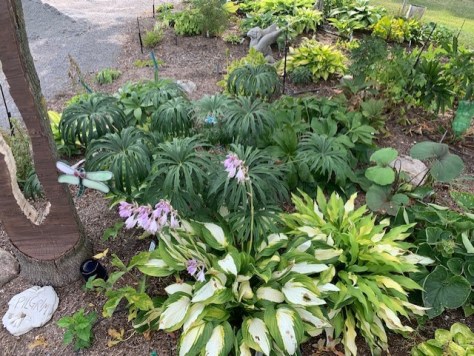
Low maintenance perennials for shade: Hosta, Ferns (not ostrich), Coral bells, Barrenwort (epimedium), Astilbe, Hellebore, Brunnera, Primula.

thumbnail_IMG_1659
Well behaved shade perennials in the author’s garden

The goal is to get to the point where you only need to set aside 15 or 20 minutes every couple of days to weed and deadhead your plants. Deadheading also reduces the number of “volunteer” plants that you will get as the seeds will also be removed. You can combine weeding with deadheading and get the chores done at the same time. This will keep your flower garden looking beautiful and will help the plants produce more blooms.

Alchemy in the Garden – Layering

by Marilyn Homewood, Master Gardener in Training

“A seemingly magic process of creation”

Layering is an asexual (vegetative) method of plant propagation that produces genetic replicas of the parent plant. In this technique, the newly developing offspring remains attached to the parent plant.  This keeps it supplied with water, carbohydrates and nutrients avoiding some of the pitfalls of traditional cuttings.

What makes this possible is totipotency. Every cell in any plant—except for egg and sperm —is capable of regenerating into a complete organism or differentiating into specific cell tissues. Under appropriate conditions, a cell can be induced to multiply into roots, shoots, leaves, or flowers.  One example of this is the formation of adventitious roots.  These are roots that form from “non root” tissues.  Growth of these roots are promoted in part by the plant’s own hormone auxin.

“Wounding” the shoot being layered by making a small sloping shallow cut on the underside of the stem/branch induces this process.  Wounding is known to produce adventitious roots by increasing levels of auxin at the wound site and by forming callus (dedifferentiated plant tissue capable of becoming roots).

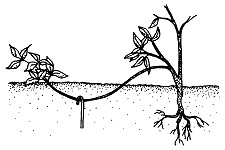
Simple Layering

  • Select a young vigorous shoot that is low to ground
  • Wound stem, keeping wound slightly open using matchstick
  • Dust with rooting hormone
  • Dig shallow hole, set stem in contact with soil,
  • Secure stem in place (u-shaped pin or rock)
  • Fill hole and mulch to keep moist
  • Check for roots in fall, sever from parent and replant new shrub
  • Recommended for climbing roses, forsythia, honeysuckle and boxwoodSimple

Tip Layering

  • Works well on plants with long whippy stems like berry crops
  • Tip of shoot is pegged into soil, secured and buried at point of contact
    Tip

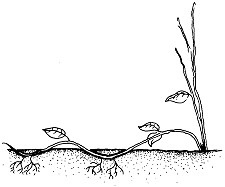
Serpentine Layering

  • Similar to simple except that multiple points are wounded and buried
  • Good for plants that produce long shoots such as clematis, grapes, wisteria, rambler roses, vining honeysuckle, willow and viburnum
    Serpentine

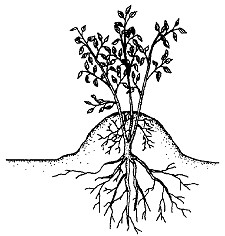
Stooling/Mounding

  • Process encourages masses of basal shoots which are allowed to layer naturally
  • Cut parent shrub back to near ground level in dormant season to encourages masses of basal shoots
  • In spring, when shoots are at 15cm, they are covered with dirt leaving tips exposed
  • Repeat process as shoot grow to 25 cm
  • Buds inside dirt will form roots
  • When plant reaches dormancy again, remove soil and newly rooted shoots and plant on
  • Recommended for this technique are smoke bush, dogwoods, spirea, daphne, magnolia, cotoneaster
    Stooling

Resources

Bryant, Geoff (1992) Propagation Handbook, Basic Techniques for Gardeners, Stackpole Books

Dunn, Bruce (Feb. 2017) Layering Propagation for the Home Gardener, Oklahoma State University Extension, http://extension.okstate.edu

Evans, Ervin, Blazich, Frank (Jan. 1999) Plant Propagation by Layering, North Carolina State Extension, http://content.ces.nscu.edu

Rich, Lee (2007) Making More Shrubs, http://finegardening.com

Stefman, Bianka, Rasmussen, Amanda (2016) Physiology of Adventitious Roots, Plant Physiology, Vol 170 pp 603-617.

Yadav, Deependra, Sing, S.H. (2018) Vegetative Methods of Plant Propagation: I- Cutting, layering, budding, Journal of Pharmacognosy and Phytochemistry, 7 (2) 3267-3273.


Forbidden Love!

By Cheryl Harrison, Master Gardener

Ok, I know that peonies may not be the trending plant but I love them! Like many grandmothers, my maternal grandmother grew peonies around her farmhouse… Their fragrance filled the air and they sprawled magnificently after a rain. I found them captivating!

Peonies were first described as medicinal herbs in China around 200 B.C. Traditional Chinese medicine still uses peony extracts to treat various ailments. Peonies were introduced to Europe, and England, in the late 1700’s. English, and French, nursery sales began in the early 1800’s as did hybridization. The public was delighted!

There are many reasons to use peonies in your garden. They are beautiful in bloom and many are wonderfully fragrant. Peonies are excellent when used as a focal point, an accent plant, to hide spent tulip blooms, to shade clematis roots or even as a hedge whose flowers can be used for cutting.

Peony flowers come in various colours including red, rose, lavender, yellow and lots of lovely shades of pink and white. The flowers can be many petaled or have as few as five petals. Peonies are not invasive and are long-lived. Once established, peonies are drought-resistant, easy-care perennials. They are also deer and rabbit resistant probably because the flowers and leaves have a bitter taste.

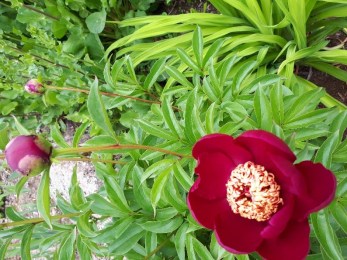
cheryl1
Very early herbaceous peony – author’s garden

Herbaceous peonies are the most common of the three common types. Herbaceous peonies grow in zones 2-8. They die back to the ground in the fall and are dormant all winter. They bloom in May to June depending on the cultivar. Woody peonies, often called tree peonies, are small shrubs that lose their leaves in the fall but keep their strong, woody stems all winter. Woody peonies like it a bit warmer growing in zones 4-8. They do not like to be moved once established. Finally, itoh, or intersectional, peonies are fairly new. They are a cross between the woody peony and the herbaceous peony. They too prefer zones 4-8 and die back to the ground in the fall followed by winter dormancy. Itoh peonies have strong stems, often a longer flowering period and large blooms.

In the fall, plant peonies in well drained, rich soil in full sun or full sun/part shade in areas with very hot afternoon sun. Do not plant the peony crown any deeper than a couple of inches. Lightly fertilize your plants annually with composted manure but do not allow the manure to come in direct contact with the plant’s crown. Mulch to help retain moisture. Water if soil is dry in the spring for good bloom production and as needed usually just the first summer after planting. Maintain space around your peonies to encourage good air circulation otherwise, peonies can be prone to fungal diseases. In late fall, remove all peony debris to help prevent disease and pests.

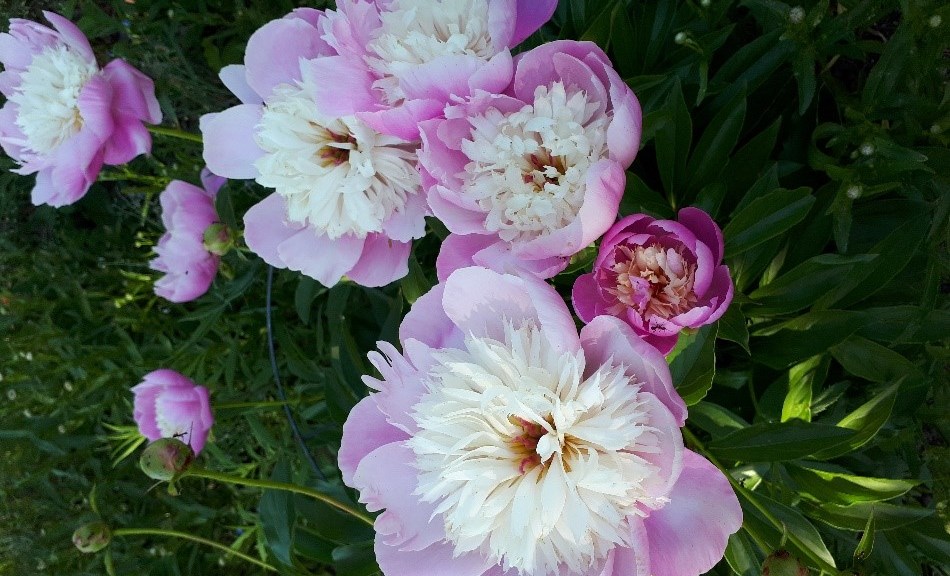
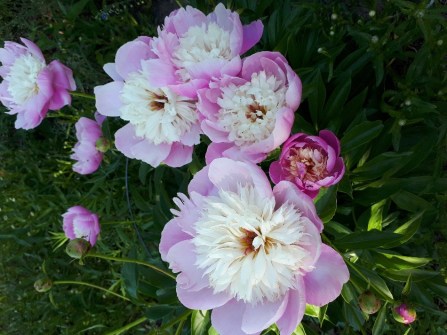
cheryl4
Herbaceous peony – author’s garden

My peony is not blooming…..why?

Reasons include planted too deep, not enough sun, weather extremes (eg. hard spring freeze may damage flower buds), disease or pests, newly planted (can take up to three years for a young plant to bloom), too old (takes several decades, divide the plant to rejuvenate), too much fertilizer will encourage foliage growth not blooms but not enough can result in undernourished roots that are unable to support blooming. Just a caution, do not remove peony leaves in July or August, their removal can weaken the roots so that they are unable to support blooms.

I love peonies! Their blooms are glorious and their foliage stays lovely and green after the flowers are gone. They are easy care perennials that can add colour, texture, drama and a sumptuous fragrance to your garden. If you grow peonies now, you know already, if not, try them… You will be captivated too!

More Information:

The American Peony Society

Peonies by Allan Rogers, Timber Press Inc., ISBN 0-88192-662-0

The Canadian Peony Society

Spring Ephemerals

By Cheryl Harrison, Master Gardener

Definitions of “spring” and “ephemeral”, curtesy of Merriam-Webster online dictionary, are “to come into being” and “lasting a very short time”.  Two wonderful words, when used together, mean those lovely but short-lived flowers that we may see on our walks through woodland gardens or deciduous forests at this time of year!

My list of favourite spring ephemerals includes:

Trillium (Trillium grandiflorum) – Of course, this native plant comes to mind first.  It is Ontario’s official flower but not Ontario’s only trillium … there are four other native species. Trillium grandiflorum produces one large, white, three-petaled flower above three, simple, broad leaves.  The flower fades to pale pink as it ages.  Red seeds are produced which are mainly dispersed by……ants!  Seeds germinate slowly and take 4-5 years to become a mature flowering plant.  Plants grow to reach 30-45 cm (12-18 in.) high, prefer moist rich soil and dappled shade.

trillium
Trillium grandiflorum

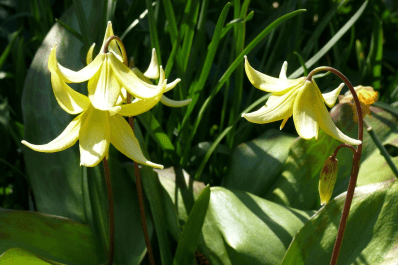
Dog-toothed violet (Erythronium americanum) –  These pretty little native flowers grow from a corm.  They are small, just 15 cm (6 in.) high but their bright, yellow flowers stand out  and along with their spotted leaves (hence their other common name “Trout Lily”), are one of the earliest spring ephemerals to appear.  They prefer rich, moist but well-drained soil and part to full shade.

dogtooth
Erythronium americanum

Bloodroot (Sanguinaria canadensis) – If you remember your high school latin, you will recognize where Sanguinaria originates when you learn that all  parts of this native contains an orange/red juice.  The Latin sanguinarius means “bloody”.  S. canadensis is the only species in this genus.  It produces a white flower, that may be tinged in pink, and has deeply lobed, flat leaves.  It prefers part to full shade and well drained, moist, rich soil but seems to survive in varying soil conditions.  This plant will grow under your black walnut tree!  S. canadensis grows 15-30 cm (6-12 in.) high and spreads through rhizomes.

bloodroot
Sanguinaria canadensis

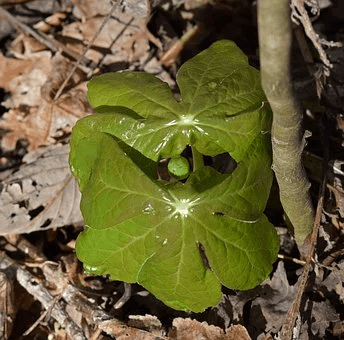
Mayapple (Polophyllum peltatum) – Mayapple makes a great groundcover.  It grows up to 45 cm (1.5 ft.) tall and produces one white flower which appears under it’s umbrella-like, multi-lobed, two leaf foliage in late spring…..a single leaf means no flower and no fruit.  The leaves and root are poisonous as is the immature green fruit.  Only the mature yellow fruit is edible.  This plant spreads through rhizomes, prefers light shade and moist, rich soil.

mayapple
Polophyllum peltatum

Jack-in-the-pulpit (Arisaema tryphyllum) – Where do I start; this plant has a very interesting flower …. the spathe is the most conspicuous part.  It is a hooded, tube-like structure and houses the spadex which is a spike and is where the actual flowers are located.  Clusters of bright, red berries form in the fall.    It grows 30-90 cm (1-3 ft.) tall and prefers moist, rich, slightly acidic soil and part to full shade.  Jack-in-the-pulpit grow from corms.

jack
Arisaema tryphyllum

Next time you go for your woodland walk look for the spring ephemerals.  Their appearance signals that warmer weather is coming very soon!  Let the gardening season begin!

Many nurseries now carry native plants and some specialize in natives.  Just be sure to ask about the origin of the plants that you are buying, you are looking for plants that have been nursery propagated not harvested from the wild.

Suggested Nurseries

Resources

Books

  • The Ontario Naturalized Garden, by Lorraine Johnston ISBN1-55110-305-2

Websites


Book Reviews: “Bringing Nature Home”, “Nature’s Best Hope” and “The Living Landscape”

By Cheryl Harrison, Master Gardener

Are you concerned about the natural world? Do you want to know what you, one person, one gardener, can do?

Douglas W. Tallamy is Professor and Chair of the Department of Entomology and Wildlife Ecology at the University of Delaware in Newark, Delaware, USA. In 2007, Mr. Tallamy’s book, “Bringing Nature Home”, was published. It has been updated and expanded several times since then but his message has remained the same:

Plants are not optional on this planet. With few exceptions, neither we, nor anything else, can live without them.”

Plants, through photosynthesis, take energy from the sun and turn it into food. Only plants can do this, we can’t and we, like all other creatures, depend on plants for our energy in order to survive. Mr. Tallamy explains the reliance that exists between the diversity of animal species and the diversity of plants. He explains the damage we are causing with our large lawns and our ornamental trees, shrubs and garden plants. Mr. Tallamy explains what one person, one gardener, can do and why we must. “Bringing Nature Home” is a beautiful book. Its language is compelling, its photos inspiring, and by the end, you will want to tear out your ornamental garden and plant all native plants! Or, at least look at your garden and re-evaluate and elevate what you are trying to achieve…..a pretty garden just won’t cut it anymore.

“The Living Landscape”, published in 2014, and written by Rick Darke and Doug Tallamy, again explains why, then how, to develop home gardens that are ecologically sound but beautiful and that meet our other land use needs (eg. vegetable garden, kids and dogs play area). They help us to also understand that, by using native plants, we will make a “layered landscape” that supports diverse wildlife and a healthy ecosystem. They provide beautiful photos to show us what can be achieved followed by detailed information to tell us exactly how to achieve it.

In 2019, “Nature’s Best Hope” by Douglas W. Tallamy was released. In this book, Mr. Tallamy tries again to not only inspire us but to also unite us in his vision of “a homegrown national park.” At first, I was disappointed with this book….ho hum, more of the same with fewer, and less dynamic, photos. Mr. Tallamy does explain again why we must start living on the earth in a way that is sustainable. However, with this book, he proves to us that we can do this because we want to and not because we feel we are forced to. We can create biological systems in our own yards that connect to others in your neighbour’s yard…..”a homegrown national park.” We can do this with native plants which will attract native insect species including pollinators, native birds and so on, to spread out across the food web to humans. “Nature’s Best Hope” was a harder read maybe because Mr. Tallamy states just the facts. In Chapter 11, titled “What Each of Us Can Do”, he succinctly lists exactly that. Mr. Tallamy believes that humans have “the intelligence, knowledge and ability” and “wisdom” to successfully restore natural habitat and ecosystems. I do too.

I recommend that you read all three of the books listed.

Resources

Darke, Rick & Tallamy, Doug.( 2014). The Living Landscape. Timber Press, Portland, Oregon, USA.

Tallamy, Douglas W. (2016 – 10th printing). Bringing Nature Home. Timber Press, Portland, Oregon, USA.

Tallamy, Douglas W. (2019). Nature’s Best Hope. Timber Press, Portland, Oregon, USA.

butterfly-17057_640

Planning and Dreaming

by Judy Bernard, Master Gardener

Winter is a time for planning and dreaming about our gardens.

Since we decided to move and downsize, I’ve been planning on how I want to create my new garden. Right now, under the snow, is mostly compacted construction zone. Debris from bricks, rocks, and stones ( I’ve collected some of the larger stones for garden beds) and weeds have been partly covered by sand fill. I’m hoping that we will have topsoil and sod fairly early in the spring. In the meantime, I’ve been dreaming and planning.

watercolour-2045917_1920

Our house is oriented east-west. There are two story houses to the north and south of us. Before planning on what shrubs and plants to put in those areas, I want to see how much shade they provide and for how long during the daytime. I’m keeping a record of where the sun is in the sky relative to those areas. The front and back are wide open, like a blank canvas.

summer-4282857_1280

At the same time, I’m making plans for what trees and shrubs I want to put in those areas. My choices are for mostly native shrubs, trees and and fruit producing plants. Other than the usual garden centres, I’ve been looking for places to purchase native plants and have found some close by Peterborough that grow shrubs and trees. Richardson’s Pineneedle Farms in Pontypool is one. They are a major commercial grower and have a lot of native shrubs and trees for sale. You can buy in bulk there. Another one Eastern Evergreen Inc. grows white cedar for hedges and is located in Warkworth.

With an office in downtown Peterborough, Cedar Ontario has a long track record of providing healthy natural eastern white cedar trees and installing hedges throughout Peterborough and the Kawarthas.

2019-Smith-8' 3rd season-2
Photo courtesy of Cedar Ontario

When it opens, Ecology Park in Peterborough is another good place to purchase native plants. Their big annual plant sale is Saturday May 16th at 10 am. Remember to bring your own containers for leaf compost and cedar mulch. The bulk sales are self loading , with a 20 bucket limit per person, per visit. Knowledgeable staff and are there to help you (and often Master Gardeners are there too).

plantsalecourtesyofGreenUpFBpage

In the meantime, I’m researching trees and shrubs, drawing plans, and dreaming.


I Remember When…

by Mary Jane Parker, Master Gardener

EmmaHayfield

One of my first gardening loves was daylilies. This probably started with Master Gardener Beryl Harris taking me to an open house for “We’re in the Hayfield Now” daylily gardens in Orono, Ontario. And every time I see Henry Lorrain today at my favorite breakfast haunt, I think of how much fun those open houses were. They were like the social event of my gardening season and I know many others who felt the same way.

Henry and his then partner, Doug Lycett (who has since died), knew all of the renowned hybridizers of the time – mostly people from the eastern U.S. right down to Florida. Henry and Doug were probably the premier hybridizers in Canada, if not the only ones when I first discovered daylilies. Those were heady times. Hybridizers were aiming for ruffles and frills, picotees and edges, rebloomers and the colour blue, among other things. There are 390 cultivars registered to Lycett, Lorrain/Lycett and Lorrain.

20200103_205956

Collectively these peoples’ daylilies created the genetics for generations of daylilies and encapsulated the best of the best. still have early plants from Henry and other key hybridizers.

Kudos Henry. We owe you!

HenryLorain


Thank goodness the seed catalogues have arrived…

By Mary-Jane Pilgrim, Master Gardener

“Thank goodness the seed catalogues have arrived… I was about to start cleaning my house!”

It starts with the dream.

There’s no better time than now to  dive into a good seed catalogue and start planning for the upcoming growing season. Seed catalogues can be a great resource for bulbs and unique seeds, and offer a far bigger selection than what you can find in your local garden centre. You’ll find inspiration and will likely discover new plants that you must have in your 2020 garden.

You’ll be the most successful if you pick the seed companies that are closest to where you live, or in the same growing region as you. However, you can still have success ordering from a company farther away, but you’ll have to be careful not to order a plant that isn’t in your growing zone.

Below are some popular seed companies from across Canada, with some that are also in close proximity to the Peterborough, ON, area.

Florabunda Seeds

Whether you are an avid gardener or just beginning to get your hands dirty, Florabunda Seeds in Keene, ON, has a wide variety of heirloom and unusual flower, vegetable and herb seeds. They pride themselves in their untreated, non-GMO, and non-Hybrid offerings. They package generously by measurement and not by seed count.  Download catalogueRequest a catalogue.

OSC Seeds

OSC Seeds from Kitchener, ON, features a selection of high-quality seed packets, perfectly suited for the Canadian climate and ready for planting in your garden. Their full line of products includes 30 herbs, 250 vegetables, 240 annuals and 100 perennials & biennials. Request a free catalogue

William Dam Seeds

William Dam Seeds is a family-run company located just outside of Dundas, Ontario, supplying small farmers and gardeners in Canada with seed for food, flowers and soil building. They are proud to offer a varied catalogue of many different seed varieties that are not chemically treated, and some of the seeds are certified organic as well. You can download their online catalogue, or request a mailed copy via their contact page.

Natural Seed Bank

Natural Seed Bank is an online retailer of garden seeds. They sell various organic and untreated garden seeds. Located in Port Hope, Ontario, Natural Seed Bank is 100 percent Canadian owned and operated. All of their seeds are non-GMO and untreated, and many selections are organic. They’re committed to never selling GMO products.

Richters

Richters is your go-to for everything herbal. Located in Goodwood, Ontario, Richters has been growing and selling herbs since 1969. Check out their online catalogue or request a copy to be mailed out.  Online catalogueRequest a catalogue.

Veseys

Veseys is one of the premier seed, bulb and garden supply sites in North America. Located on Prince Edward Island, Veseys has 75 years of history providing products, services, and advice to gardeners.  Be sure to head over and subscribe for your free catalogue. They put on many fantastic specials, have quality products and outstanding customer service. Request a catalogue.

Resources

80668913_593105334822382_5245713304025825280_n

Gardening Resolutions for A New Year

by Emma Murphy, Master Gardener

As this decade comes to a close, I like to think that I over the past ten years that have learned some things about gardening. And with that in mind, I’ve set a few New Year’s resolutions to guide me through this next year (and decade).

1. Be Better at Cleaning My Tools

I have some great tools – my Felco #12 secateurs/pruners (several pairs), my delightful drain spade, and my Japanese hori hori knife. But I am neglectful and do not clean these well during the season and especially at the end of the gardening year. My resolution to improve my tool maintenance for next year. Some guidance here and here.

20190713_140635

2. Make a Plan

I was basically back to square one in my garden a few years ago after a major house renovation. Since then we have installed some hardscaping and I have tried to replan my gardens. I’m 15 years older than when I first did my gardens, so my plan needs to take into account my aging and energy level, so I have eliminated those fussy perennials and focused more on a garden built on flowering shrubs that are lower maintenance. But I don’t have a plan, and my engineer husband keeps saying “where’s the plan?”. So my resolution is to spend this January laying out a plan for spring, rather than just going with my gut.

gardenplan

3. Don’t Order Too Many Seeds

This will be a tough one. After all who hasn’t looked out their window in January at the snowy landscape while reviewing seed catalogues and dreaming of a perfect garden? The diversity available via seed companies is just astonishing these days, and it’s nice to grow something that your friends don’t have and that you can keep seed for the next year! But we all tend to indulge and over purchase, so my resolution is to have a specific place for any seeds that I order (see previous note for a plan), and to test all the existing seeds I have for viability like this.

rucola-salad-plant-leaf2

4. Share my Knowledge and Start a Blog

While I write a blog for the Peterborough Master Gardeners on a regular basis, I’d like to start a garden blog of my own. The challenge? Just finding the time when I work full time and write for a living. My resolution is to spend January getting a basic blog set up, and then to try and write once a week starting in February. I’ll share a link once it’s up and running, and you can all hold me to task for getting it off the ground. The great part is there is lots of good advice on how to start a blog out there.

wordpress-265132_1280

Create a Holistic Garden

I am passionate that my garden should be more than just beautiful flowers – it should be a wonderful habitat for birds and bugs and critters and pollinators, and everything in between. I want to know that I am making a difference that contributes to supporting our local ecology and habitat. My resolution is to continue focusing on this as I re-establish my garden, and share my knowledge with others so that we can all make a difference.

Wishing everyone a Happy New Year and a wonderful 2020 gardening season, wherever you may be.

GDD