By Cheryl Harrison, Master Gardener
Definitions of “spring” and “ephemeral”, curtesy of Merriam-Webster online dictionary, are “to come into being” and “lasting a very short time”. Two wonderful words, when used together, mean those lovely but short-lived flowers that we may see on our walks through woodland gardens or deciduous forests at this time of year!
My list of favourite spring ephemerals includes:
Trillium (Trillium grandiflorum) – Of course, this native plant comes to mind first. It is Ontario’s official flower but not Ontario’s only trillium … there are four other native species. Trillium grandiflorum produces one large, white, three-petaled flower above three, simple, broad leaves. The flower fades to pale pink as it ages. Red seeds are produced which are mainly dispersed by……ants! Seeds germinate slowly and take 4-5 years to become a mature flowering plant. Plants grow to reach 30-45 cm (12-18 in.) high, prefer moist rich soil and dappled shade.

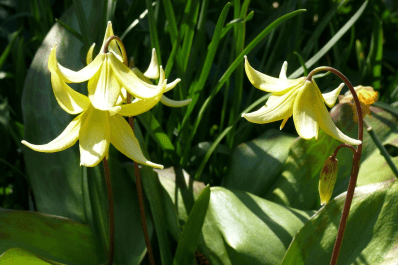
Dog-toothed violet (Erythronium americanum) – These pretty little native flowers grow from a corm. They are small, just 15 cm (6 in.) high but their bright, yellow flowers stand out and along with their spotted leaves (hence their other common name “Trout Lily”), are one of the earliest spring ephemerals to appear. They prefer rich, moist but well-drained soil and part to full shade.
Bloodroot (Sanguinaria canadensis) – If you remember your high school latin, you will recognize where Sanguinaria originates when you learn that all parts of this native contains an orange/red juice. The Latin sanguinarius means “bloody”. S. canadensis is the only species in this genus. It produces a white flower, that may be tinged in pink, and has deeply lobed, flat leaves. It prefers part to full shade and well drained, moist, rich soil but seems to survive in varying soil conditions. This plant will grow under your black walnut tree! S. canadensis grows 15-30 cm (6-12 in.) high and spreads through rhizomes.

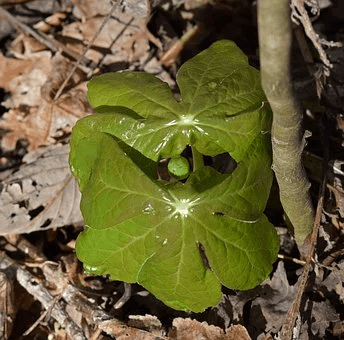
Mayapple (Polophyllum peltatum) – Mayapple makes a great groundcover. It grows up to 45 cm (1.5 ft.) tall and produces one white flower which appears under it’s umbrella-like, multi-lobed, two leaf foliage in late spring…..a single leaf means no flower and no fruit. The leaves and root are poisonous as is the immature green fruit. Only the mature yellow fruit is edible. This plant spreads through rhizomes, prefers light shade and moist, rich soil.
Jack-in-the-pulpit (Arisaema tryphyllum) – Where do I start; this plant has a very interesting flower …. the spathe is the most conspicuous part. It is a hooded, tube-like structure and houses the spadex which is a spike and is where the actual flowers are located. Clusters of bright, red berries form in the fall. It grows 30-90 cm (1-3 ft.) tall and prefers moist, rich, slightly acidic soil and part to full shade. Jack-in-the-pulpit grow from corms.

Next time you go for your woodland walk look for the spring ephemerals. Their appearance signals that warmer weather is coming very soon! Let the gardening season begin!
Many nurseries now carry native plants and some specialize in natives. Just be sure to ask about the origin of the plants that you are buying, you are looking for plants that have been nursery propagated not harvested from the wild.
Suggested Nurseries
Resources
Books
- The Ontario Naturalized Garden, by Lorraine Johnston ISBN1-55110-305-2
Websites
- Edible Wild Food
- Jack-in-the-Pulpit
- Mayapple and maidenhair fern flourish in woodland garden
- Ontario’s Trilliums
- Ontario Wildflowers
- Sanguinaria canadensis


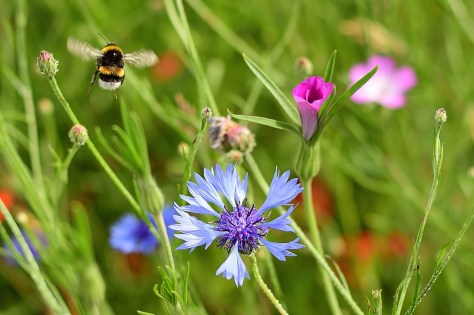






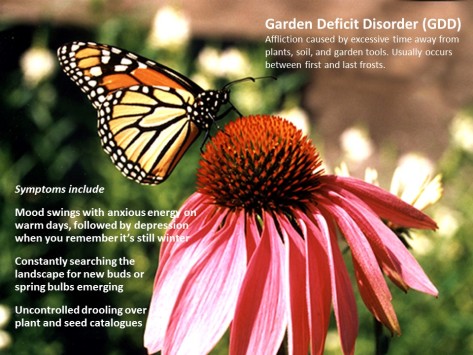


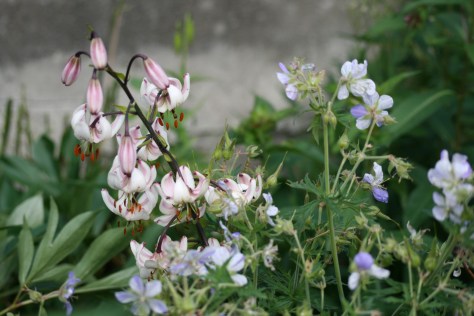

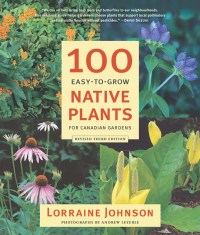 This book is, without a doubt, one of my favourite go-to gardening books! The new revised third edition of Lorraine Johnson’s book, 100 Easy-to-Grow Native Plants for Canadian Gardens, is a testament to Lorraine’s expertise. She writes in the forward that “one of the greatest satisfactions of growing native plants is that you are supporting a complex web of ecological relationships that are the basis of a healthy, resilient ecosystem.” Lorraine Johnson is the former president of the North American Native Plant Society and the author of numerous other books. She lives in Toronto.
 The photos by Andrew Layerle, along with detailed descriptions of the plants, make this book most helpful when trying to decide what native plants you would like to incorporate into your garden. I think many of us can relate to her point that “gardeners tend to be voyeuristic creatures and plant lists are our chaste form of porn”! We all crave the perfect plant and often browse through books over the winter months with dreams of starting a new garden and we wait patiently for the spring weather that allows us to once again get our hands dirty.
 The plants are divided into a number of different categories and Lorraine does a good job at listing the common name (although she warns there are sometimes many), the botanical name, the height, blooming period, exposure, moisture, habitat and range. She gives a good description, the maintenance and requirements, along with suggestions on propagation and good companions. I love that she also mentions the wildlife benefits of each plant.
 Lorraine has also included Quick-Reference Charts at the back of the book that separate the plants by region as well as specific conditions, such as acidic soil, water requirements, etc. She has lists of plants suitable to prairie habitat, drought-tolerant plants, plants for moist areas, and plants that attract butterflies and other pollinators.