Category Archives: Links

Got the Gardening Winter Blues?

by Emma Murphy, Master Gardener

Last night I dreamed of green, lush tropical gardens. It was yet another sign I am suffering from the February winter blues or as I call it “Garden Deficit Disorder”.

Yes, the days are getting a little longer with every sunrise, and we have had a fair bit of sun over the past month (which helps a lot) but I have more than half a metre of snow blanketing my gardens while my English cousins are sending photos of snowdrop drifts after their ‘long winter’.

I do like the winter season, if for no other reason than my aging body needs a rest from the garden. But it’s also the only downtime I have to plan for next year’s garden, order seeds and attend garden workshops, because I know once spring arrives I will not have a minute to spare.

So I’ll offer up a few gardening related activities for the wintertime that may help you through the blues…

Browse those Seed Catalogues

Whether you get paper copies or just look at them online, seed catalogues will bring a smile to your face, even if you don’t buy anything. The wonderful folks at Seeds of Diversity have put together an great map of Canadian seed companies. Some of my favourites are Northern Wildflowers (Sudbury), William Dam Seeds (near Dundas), Floribunda Seeds (near Peterborough) and Hawthorn Seeds (Mount Forest).

cartoon showing someone in bed with seed catalogs
Credit: Joseph Tychonievich

Catch Up on Your Reading

Winter is the only time (and my favourite time) to cuddle up with my newest garden book, while enjoying beautiful photos and deciding which new plants will be my garden next year.

If you’re interested in native plants I highly recommend The Gardener’s Guide to Native Plants of the Southern Great Lakes Region (I did a book review here) and A Northern Gardener’s Guide to Native Plants and Pollinators: Creating Habitat in the Northeast, Great Lakes and Upper Midwest by Lorraine Johnson.

Another favourite I’ll be drooling over (it’s visually stunning) is Planting – A New Perspective by Piet Oudolf and Nigel Kingsbury.

Or even a fictional book involving gardening makes me happy – highly recommend The Last Garden in England by Julia Kelly.

Buy a New Houseplant (or 2, or 10)

While I love seeing colourful houseplants over the winter, our harsh interior conditions (furnace heat and low humidity) are not ideal for them. I will confess – I am a much better gardener outside than inside, plus I have the additional challenge of two cats that like to nibble. But do a little research and find the right plant for your space, or if you’re not ready for that investment, just pick up some fresh cut flowers to brighten your day.

Review your Garden Photos

On dull winter days I try to review and organize the zillions (ok maybe a slight exaggeration) of garden photos on my phone (I even have a gardening folder). I download the photos to my computer and organize them, all the while just enjoying the memories and seeing the colour! It’s wonderful that digital cameras and our smart phones now make it so much easier these days to capture our gardens in all their glory.

Here’s one of my chipmunks munching on some Green-headed/cutleaf coneflower (Rudbeckia laciniata) buds this summer.

Attend a Seedy Saturday or Sunday

If you’d like some more social interaction with likeminded gardeners or even just some advice, finding a local Seedy Saturday or Sunday is perfect. They occur across Canada, mostly in February and March. Seeds of Diversity have a comprehensive list – use the menu on the right of the page to filter by province. Peterborough’s Seedy Sunday is March 9th.

Find Gardening Seminars (online or in person)

If I can think of anything positive about the pandemic, it’s that we all transitioned to more online learning, and platforms like Zoom made it easy for garden experts to reach large audiences. While it’s always wonderful to see speakers in person, online presentations mean I can watch gardening experts that I might otherwise never have the chance to see in person.

Our Grey County Master Gardeners offer a great series, as does Mississauga-based Blooming Boulevards, and I’ve also been attending the Home Gardening seminars offered by the Iowa State MG Program and some by the Wild Ones organization in the US.

An upcoming in-person gardening event in Peterborough is the very popular A Day for Gardeners – save the date!

Gardening Blogs and Websites

Personally I tend to follow those who have similar growing conditions to me (Zone 4b, harsh winters, Central Ontario) but I do have several (including a few in the UK) which I like to just view and enjoy.

You should of course sign up to receive the weekly Peterborough Master Gardener blog, delivered straight into your email on Monday mornings. Our members cover various topics and issues which will be of interest to gardeners, and you can also search older blogs for specific information using the search function.

Here are a few of my favourite blogs/newsletters. Many of these folks also have YouTube channels and extensive information on their websites.

The Empress of Dirt (Ontario)

The Impatient Gardener (Wisconsin)

The Laidback Gardener (Quebec)

The folks at Savvy Gardening (Pittsburgh, Halifax, Dundas)

I hope these ideas help get you through these cold winter days and nights. Let’s all dream about spring and a new gardening season!

photo of butterfly on echinacea with text on garden deficit disorder

The Wilting of ‘Mrs. Robert Brydon’

By Lois Scott, Master Gardener

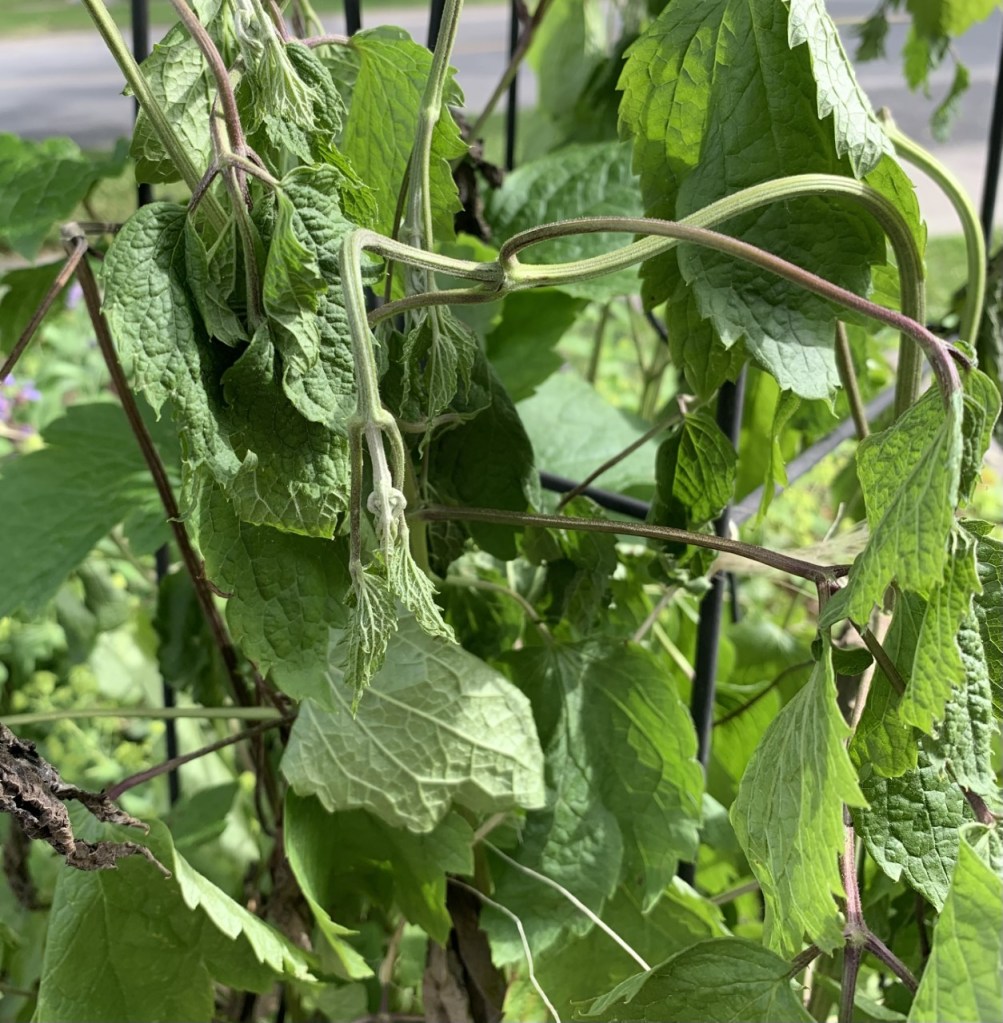
Garden gazing out the window a couple of weeks ago I noticed, with a sickening jolt, that my Clematis x jouiniana ‘Mrs. Robert Brydon’ was wilting.  (It’s only a plant, Lois, only a plant).  She has been in my garden for 4 years and had been growing very well up to this point but it appeared she must have clematis wilt.  Clematis wilt and clematis slime flux are the two diseases that this particular cultivar may be susceptible to.  Not noticing any slimy, smelly matter oozing from the stems, I ruled out slime flux. 

‘Mrs. Roberty Brydon’ showing leaf wilt

According to Missouri Botanical Garden,  clematis wilt is a serious disease of clematis caused by the fungus Ascochyta clematidina.  This fungus can survive in the soil surrounding infected plants and may overwinter in infected plant debris.  The fungus appears to be activated by ‘high humidity and favourable growing conditions found early in summer’.  Any to all stems may be affected and the whole plant killed down to just below soil level.  The good news is that the plant may recover after a year or two. 

There are ways to manage and avoid having your clematis plants affected by this disease and indeed other diseases of clematis.    Strategies (cultural practices) include a favourable planting site with 6 or more hours of sun.  Soil should be fertile and well-drained with good air circulation around the plant.  The area around your clematis should be free of plant debris and avoid any injury to stem and roots.  Do not cultivate the soil around your clematis plants and mulch it well.  Water carefully, keeping water off the leaves.  If your plant becomes infected, cut the diseased stems just below ground level and destroy them.

‘Mrs. Robert Brydon’ in flower

I removed and destroyed all the diseased growth on my clematis (which was all the growth) and there is now new growth coming up from the root.  I will be paying attention to keeping leaf debris cleaned up, improving air circulation around the vine and watering as needed, with care.

Hopefully ‘Mrs. Robert Brydon’ will survive this setback.  Her profuse, pale blue flowers are unusual and appealing to me.  The gardener, Robert Brydon, who ‘found’ this clematis in a Cleveland, Ohio garden in 1935, clearly thought enough of it to name it after his wife! Sigh.

virtual garden tours

Exploring gardens around the world makes the winter pass so much faster

By Emma Murphy, Master Gardener

I have the February blahs. Although I am absorbing each minute of our ever increasing daylight (when it’s not cloudy!), I’m craving lush greenery and blooms anywhere I can find them. I spent part of yesterday looking through some trip photos to Florida from 3 years ago where I visited just about every botanical garden and specialty garden I could find – it was heaven!

And while my seed orders have arrived from William Dam Seeds and Richters and I can look forward to some sort of virtual Peterborough Seedy Sunday, the traveller is me is still feeling unfulfilled.

So..the solution..virtual garden tours! So many wonderful botanical and famous gardens have adapted to not being able to have guests by launching virtual tours or live broadcasts from their locations since the pandemic. Here’s a few of my favourites.

Time to travel around the world from your living room. (additional links at the end).

Keukenhof, The Netherlands

Built in 1641, the Keukenhof Castle (west of Amsterdam in the Netherlands) and estate is more than 200 hectares. In 1949 a group of 20 leading flower bulb growers and exporters decided to use the estate to exhibit spring-flowering bulbs. 2021 will be the 72th edition of Keukenhof, with A World Of Colours as its theme. Check out their virtual tours and the initial invitation by Managing Director Bart Siemerink in March 2020.

The Keukenhof Gardens in full colour.

Claude Monet’s Garden, Giverny, France

Over 500,000 people visit painter Claude Monet’s famous gardens each year (so glad to be one of them in 2018!). There are two parts to the garden – the Clos Normand flower garden in front of the house and a Japanese inspired water garden on the other side of the road (where he completed his Water Lilies painting series). Enjoy a commentary alongside a video tour of the famous garden, including the wonderful lily pond. More info here.

Monet’s Water Garden

National Trust’s Hidcote Manor Gardens, England

The National Trust site allows you to take a 360-degree tour around the old garden, plant house and spectacular red borders of these Arts and Crafts-inspired gardens in the rolling Cotswold hills in Gloucestershire.

Hidcote Gardens

Scotland’s Garden Scheme

One of my favourites. Established in 1931, it helps garden owners across the country open their private gardens to the public to raise money for charity. The properties range from cottage gardens to stately homes; allotments to therapeutic and physic gardens; and formal gardens to wildlife sanctuaries. There are more than 100 tours to look at here.

A Scottish country garden.

Australia’s Blue Mountains, New South Wales

Further afield in Australia’s Blue Mountains just outside Sydney, artist Trisk Oktober’s steep, cool temperate gardens in Katoomba are transformed into a living artwork. I visited the nearby Mount Tomah Botanic Gardens in 2010 and it was magical. It’s also the only botanic garden within a United Nations World Heritage Area.

The view from Mount Tomah Botanic Gardens of the Blue Mountains

Hawaii Tropical Botanical Garden, Hawaii

Located on Hawaii’s Big Island, the Hawaii Tropical Botanical Garden includes not only a garden but a nature preserve. If you need to zen out and feel like you are on a tropical island, this is the tour for you. And this one.

Plumeria flower

Longwood Gardens, Pennsylvania, USA

Closer to home across the border is Longwood Gardens, consisting of 1,077 acres of gardens, woodlands, and meadows. It is the living legacy of American entrepreneur and businessman Pierre du Pont, inspiring people through excellence in garden design, horticulture, education, and the arts. The Our Gardens, Your Home initiative is their way of keeping gardeners connected.

Longwood Gardens

There are so many more virtual garden tours going on around the world.

Lewis Ginter Botanical Garden, Richmond, Virginia, USA

This botanical garden was one of the first to go virtual when the pandemic started. They have great virtual tours and visits and a terrific Facebook page.

Gardens Illustrated‘s Virtual Garden Tour series

Gardens Illustrated has assembled a collection of some of the most amazing tours – everything from Chatsworth House (a 105-acre garden with 500 years of careful cultivation) to a Virtual Chelsea Flower Show.

Kew Gardens, London, England

On my bucket list when we can travel again, this video gives you some of the highlights to see. The Royal Botanic Gardens at Kew has 37 acres of woodland, 14,000 trees and 50,000 different plant species.

Wisley Gardens, Surrey, England

The Royal Horticultural Society’s garden at Wisley in Surrey (south of London), is one of five gardens run by the Society, and top of my list of gardens to see. Check out their website, and also they have a great collection of videos on YouTube.

If you’ve found a great virtual garden tour please share it with all of us in the comments! Spring will be here soon!

Favourites from My Bookshelf

By Lois Scott, Master Gardener

The Internet conveniently provides seemingly endless avenues when searching for information on best practices for gardening but there are times I prefer to turn to my bookshelf for a favourite and trusted author.  Here is a collection of books that I find useful in a practical sense or just to reread to refresh my mind on certain topics. 

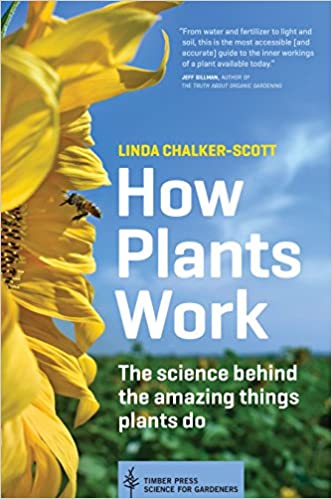
How Plants Work by Linda Chalker-Scott, a well-known “associate professor and extension urban horticulturist at Washington State University” is an excellent resource for me.   Quoting the back cover “this book arms you with the information that will change the way you garden.  You’ll learn how to fertilize and prune more effectively, how to weed less and how to determine which garden products are worth your time and money”.  She discusses the science of how plants work but most importantly for me, translates that into practical science-based practices for my garden.  As a bonus it does include attractive, instructive photographs.  Dr. Chalker-Scott is a very engaging author.  I also recommend her other books The Informed Gardener and The Informed Gardener Blooms Again which are both collections of her Garden Myths.

What A Plant Knows:  A Field Guide to the Senses by Daniel Chamovitz is another fascinating book about how plants work.  In this book Dr. Chamovitz discusses the science around what a plant sees, smells, feels, hears (or doesn’t hear), how it knows where it is and what it remembers.  This book is beautifully written, very engaging and the science quite accessible.

The Pruning Book by Lee Reich is very useful, practical and well written. .  Dr. Reich takes the reader through the basics of pruning, the tools and the plants, including ornamental trees and bushes, evergreens, vines, fruit and nut trees/bushes, houseplants and herbaceous plants.  For the adventurous he also describes specialized techniques such as topiary and espalier.  There are many useful photographs and diagrams along the way that are both instructive and attractive.

I am looking forward to adding to the bookshelf in the near future.  I do have two of Doug Tallamy’s books on order from The Hunter Street Book Store in Peterborough where the above books can also be ordered.   The Peterborough Public Library has a hard copy of The Informed Gardener, and electronic copies of How Plants Work and What a Plant Knows.  Also available at the library are electronic copies of two of Lee Reich’s other books Weedless Gardening and The Ever Curious Gardener.  I am also always interested in other gardener’s favourite books to potentially add to my collection. 

Bromeliads

By Sharleen Pratt, Master Gardener

Continuing on a similar theme to last week’s blog on Orchids by Master Gardener Cheryl Harrison, I thought I would touch on another family of plants that are tropical and exotic; the Bromeliaceae family.  Known as Bromeliads, it is a large family which includes more than 50 genera and at least 2,500 known species which are native mainly from an area stretching from the southern U.S. to Central and South America.

Before COVID, we would do an annual visit to the Sarasota area in Florida.  One of my favourite places to visit is the Marie Selby Botanical Gardens.  Selby Garden botanists have made hundreds of expeditions into the tropics and subtropics and have contributed to the most diverse living and preserved collection of epiphytes in the world.  They have a greenhouse that is beautiful to walk through with very knowledgeable volunteers to answer questions.

Many bromeliads are stiff-leaved, rosette-forming plants with brightly coloured leaves, bracts and flowers.  The majority of them are epiphytic, meaning that they grow on the branches of trees without taking nutrients from the tree.  They can also be lithophytic which means they reside on rocks, and the remaining are generally terrestrial, meaning that they grow in soil.  Bromeliad flowers can last several months, but they generally only bloom once.  The mother plant will produce new plantlets, also called ‘pups’.  They are incredibly resilient but do not like to be overwatered.  Their roots are usually used for balance and not for transferring nutrients.  Instead, the leaves take in all of the water and nutrients the plant needs.  They never breath out carbon dioxide almost as if they hold their breath in order not to lose moisture.  It is a very special photosynthesis.

A picture of a Bromeliad Tree taken at the Edison & Ford Winter Estates in Fort Myers

Many bromeliads have leaves that form a reservoir to hold water at their bases (known as tank bromeliads), with the largest holding up to two gallons of water.  Types that don’t hold water are called xerophytic or atmospheric bromeliads.

One of the most well-known Bromeliads is in the Ananas genera.  This is the pineapple, Ananas comosus.  Europeans first found out about bromeliads when Columbus went on his second trip to the New World in 1493.  The pineapple was being cultivated by the Carib tribe in the West Indies.  After colonization, it was rapidly transported to all areas of the tropics and became a very important fruit.

Another genus is Tillandsia.  It is the largest group in the family and this genus is also known as “air plants”.  Most do not form tanks and have grey-green leaves and are densely covered with fuzzy scales that give the plants their characteristic colour.  Tillandsia require more humidity than other bromeliads and tend to dehydrate in the dry air of most homes, but can still be grown successfully with more frequent watering.

Spanish Moss falls under this genus, Tillandsia usneoides.  It is very prevalent in Florida and is neither Spanish nor a moss.  Unlike other epiphytes that have roots to anchor themselves to their host tree, Spanish moss has tiny scales on its leaves and its curved structure to cling to its host tree.  It is important for diversity as its large mats that drip from trees harbor a great variety of insects, birds and bats.  In Florida, you usually see Spanish Moss clinging to Live Oaks.

Author standing under a Live Oak tree covered in Spanish Moss


Bromeliads will survive for months or even years under less than ideal conditions.  They need satisfactory light, temperature and humidity.  It is best to use water that is not softened.  You should use a potting mix that holds moisture yet drains quickly.  Orchid bark mixed with course perlite and humus is good for most bromeliads.  The small air plants only need to be misted with a spray bottle or put in a bowl of water for an hour.  If you would like to learn more about these amazing plants, visit University of Wisconsin-Madison.

It’s not too late …

By Mary-Jane Pilgrim, Master Gardener

As I type this, we in central Ontario are in the midst of a burst of spring-like weather, and it’s supposed to continue for a few days yet. It gives us all a second chance to finish fall chores not completed when the snowfall and killing frosts hit in the last few weeks.

Author’s recently received Breck’s bulb order, still in the box!

If, like me, you failed to get all of your tulips and daffodils planted, do not worry. As long as you can get a shovel in the ground it’s OK to plant spring flowering bulbs. Some pros suggest they actually do better if planted when the ground harbors a bit of frost, so take advantage of those late season sales and plant away. Also, by planting later, you may experience fewer issues with squirrels stealing your bulbs. The arrival of snow doesn’t mean you’ve missed your chance, either. If the ground hasn’t completely frozen yet, you’re in luck, even if you have to break through the frozen crust first.

If you regularly find that squirrels munch on your buffet of bulbs, you may wish to purchase some “chicken wire” at your local co-op store. Cut a small round circle about the same size as the hole you’re going to dig. Plant the bulbs at the recommended depth, and then cover with some soil up to about 2″ from the surface. At that height, plant the chicken wire, and cover over with a bit more soil and mulch. The added benefit of the chicken wire is that should you forget where you planted tulips next summer after their foliage has died back, the chicken wire will be a good reminder when you hit it with your shovel. The bulbs will happily grow through the 1″ holes in the wire next spring.

An amazing purchase of mine a few weeks ago is a small cordless drill auger attachment. It works wonders to create just the right size of hole for my bulbs, with very little effort. Mine is only about 6″ tall and makes about a 2″ hole. I move it around a bit to make the hole just big enough for 5-6 bulbs. Worth the $10 investment, for sure.

Remember: Bulbs are not seeds. They are alive and need to be planted in the fall. They will not last in storage — or that sack on a shelf in the garage. They require somewhere between 13-14 weeks of sub-zero temperatures before they’ll bloom next spring.

So what do you do if you find a bag of bulbs in January? There is a method of bulb planting that can work even during the coldest winter. It’s called the “no-dig” method. Simply move the snow away from your chosen location and place your bulbs on the frozen ground. Cover them with a bag or two of garden soil to a depth of three times the height of the bulb, and that’s it! The bonus of this method is that the soil above the bulbs will likely freeze quickly, and squirrels won’t harvest half of your crop. This method also works in areas where there are so many roots that digging a hole for bulbs is challenging. Try it!

Resources:

HGTV: When is it Too Late to Plant Bulbs?

Country Living: It’s Not Too Late to Plant your Spring Bulbs

Planting garlic (Allium sativum)

By Sharleen Pratt, Master Gardener

Happy Thanksgiving! While we navigate through this pandemic, we hope that you will be able to enjoy some happy moments in a safe and healthy environment. The colours have been beautiful this year and I have marveled at the many different shades of red, orange, yellow and green that still exist in my small urban backyard.

Photo credit: Sharleen Pratt

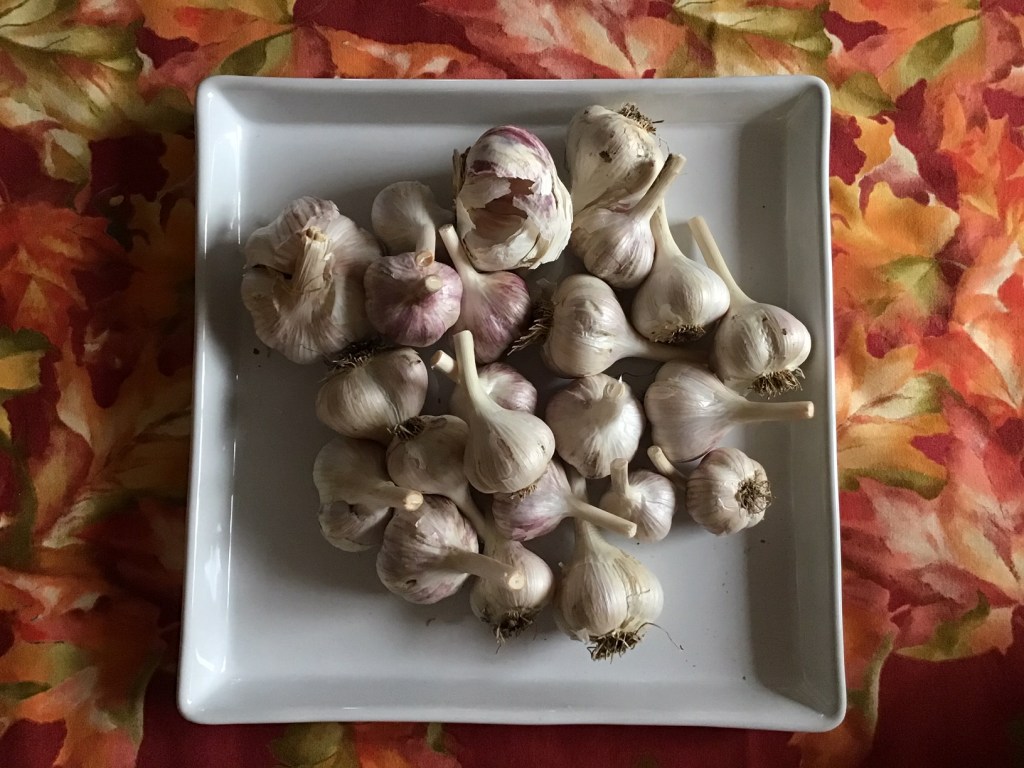
Thanksgiving reminds me that it is time to plant garlic for next years’ harvest. Here is a ‘Fact Sheet’ that I have put together for those who might be interested in planting this very easy to grow root vegetable.

PLANT DESCRIPTION:

Garlic is part of the Onion Family (Alliaceae) and although there are hundreds of varieties, they all fall under two main categories; Hardneck and Softneck.

Hardneck have a long flowering stem called a scape which eventually develops tiny bulbils at its top end. They usually have a single row of cloves and tend to do best in colder climates. They peel easier than softneck but do not store as long. They last approximately 4 to 6 months.

Softnecks are best for warmer climates, will last 9 to 12 months and have more than one row of cloves in each head. They do not develop a flowering stalk or scape. Softneck garlic are the type that are used to make garlic braids.

Elephant Garlic (Allium ampeloprasum) is a type of leek that is grown like garlic, but is 6 to 7 times bigger and has a milder flavour.

PLANTING NEEDS:

Full sun and well-drained soil with infrequent watering.

WHEN TO PLANT:

In the Peterborough area, October is the best month to plant your garlic. It can be done in early spring but you will produce a larger harvest if done in the previous Fall. Do not use garlic from your local grocery store as it may not be the best variety for your region and it’s often treated with an anti-sprouting chemical to inhibit growth. I purchase my garlic from my local nursery or Farmer’s Market and I also use my own garlic that was harvested in early August.

Photo credit: Sharleen Pratt

HOW TO PLANT:

Separate the inner cloves but do not remove the papery covering. Plant the largest cloves with the pointy end up. Space cloves five to six inches apart and two to three inches deep. You can mulch with straw, but I always mulch the garlic bed with shredded leaves which will be plentiful in the next couple of weeks.

CHALLENGES:

I have never had any garlic concerns; however, my daughter did deal with the leek moth this year. Adult moths lay their eggs and the hatched larvae tunnel into the leaves. She was able to keep it under control by going out each morning and removing the leaves that were encasing the larvae. If you have the space, it is always best to rotate your garlic each year.

HARVESTING SCAPES:

Garlic produces a garlic scape which appear on hardneck varieties, usually in June. They look a little like green onions that spiral and have a small bulbil at the end (which looks like a small hat). They should be cut once you see the spiral or they will become tougher the longer you leave them. Cut it at the base where it comes out of the stalk. Chop them up and fry with a little olive oil or they can be made into garlic scape pesto. It is wise to remove the scapes even if you don’t plan on eating them. This allows the energy to go back into growing the underground bulb.

HARVESTING GARLIC:

You will know your plant is ready to harvest when two to three sets of the bottom leaves have died or turned yellow. Do not leave them too long as the bulb will begin to split. Gently pull out the bulbs with a garden fork.

CURING GARLIC:

Garlic needs to be dried. Gently remove the dirt and trim the dangling white roots to approximately 1 cm. I tie my garlic together in bunches and hang it in my shed to dry for two weeks. Keep it out of direct sunlight and ensure it doesn’t get wet.

STORAGE:

Once dried, clean gently. Trim the long stalk off and store in a cool dry area. Garlic does not like to be refrigerated. You could also store them in empty egg cartons.

If you would like to learn more about growing garlic, read this extensive article from the Ontario Ministry.

A new kind of lawn?

By Mary-Jane Pilgrim, Master Gardener

If you scroll through some of the gardening groups on Facebook these days, you’ll often see people asking “How do I get rid of the clover in my lawn?” Shortly thereafter, you’ll see a lot of people respond with “Love my clover”, “Leave it”, “Food for pollinators”, etc., all of which is true. This post follows fellow MG Emma Murphy’s post from last week quite well, I think!

As a contract gardener/landscaper, if I had a loonie for every person who asked me what to do about their weed-ridden lawns post-herbicides, I’d be a rich person.

Clover may be just the ticket, as it requires less water, fertilizer and weeding than lawns without clover. It stays green all summer. It requires little or no mowing as it only grows 10-20cm (4 -8″) high. It out-competes other weeds, as it has a dense root structure. It grows well in poor soil. It feels great on bare feet. The seed is inexpensive (see below for a tip on where to buy it!)

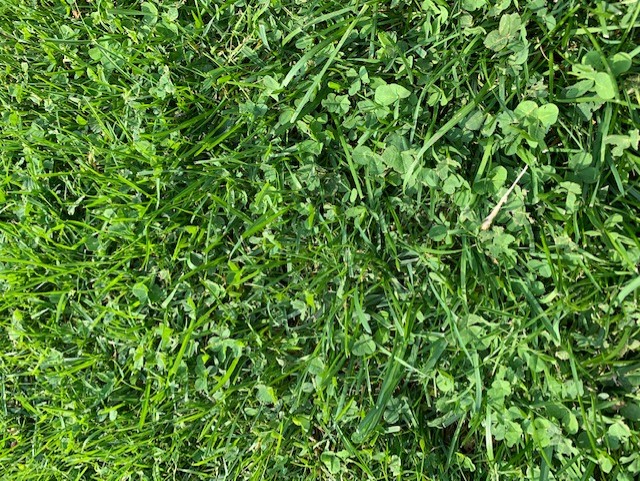
White clover (Trifolium repens) or Dutch white clover can be established in an existing lawn by overseeding whatever is currently there or by planting a mixture of clover and basic grass seed in a new lawn. From my reading, I’ve found that people have had disappointing results when trying to establish a pure clover lawn. You really need both clover AND grass as they are complementary to each other and one supports the other. Clover does best in full sun, but can do OK in partial shade. It doesn’t grow well in full shade. When mixed with grass, it does well in high traffic areas as well.

Author’s back lawn showing already successfully combined grass and white clover

For us, it started with the white grubs. Whole sections of grass in the front yard are gone. Just gone. Turns out that grubs also do not like clover. Bonus.

Be sure to use Dutch white clover and not the larger red clover. The best time to plant clover is in the early spring before the grass starts growing quickly because the other broadleaf plants are not in competition with it. Early seed sown will germinate when the soil starts to warm up in late April. Clover seed can be purchased at your neighbourhood garden centre or hardware store, but I’ve found it to be much cheaper (less than half price) at my local co-op as it is also a farm product. Clover seed to cover my large front lawn (150ft x 150ft) cost about $10 at the Co-op. About 2 ounces of clover is needed for every 1,000 sq ft of lawn, so my front yard required about 3 pounds or 1.4kg of clover, mixed with about $30 worth of grass seed.

Late summer/early fall is an alternative time to plant. The grass should be cut short and raked first to remove any existing thatch. Clover seed can be spread onto the soil along with grass seed on a 10:1 or 15:1 grass/clover ratio. I’d suggest top-dressing with some triple mix for best results so that the seeds are covered well. Most seed will germinate in less than a week if the temperature is above 15C and if it’s well watered.

It may be necessary to overseed with clover every 2-3 years for the first few years until the mixture gets established.

One caution: If you or any of your loved ones are allergic to bee stings, clover may not be right for you. The clover will flower, and bees will be attracted to the flowers! You can, however, minimize this risk by mowing regularly from June through August during flowering time.

Author’s front lawn showing recent overseeded and top-dressed grass/clover mix.

Resources:

How to Overseed Clover Into a Lawn
Establishing White Clover in Lawns:
Advantages and Disadvantages of Clover Lawns

Lupins

By Suzanne Seryck, Master Gardener

I have just finished cutting back my lupins for a possible second bloom, scattering their seeds and transplanting baby lupins that have popped up in all the wrong places.

Lupinus, or more commonly known as Lupins, are one of my favourite plants especially in the late spring when they are first in bloom. I tend to lean towards plants that need little to no care, that will attract insects, will self seed but are not invasive, and that give me joy when they are in bloom. Lupins fit that category for me perfectly.

suzanne1
Lupins in the author’s garden

Lupin is a genus of flowering plants in the legume family Fabaceae, along with peas and beans. They have been grown since the days of the ancient Egyptians and were eaten by the Romans. Lupins like well drained soil, preferring sandy soil, but in my garden they grow well in clay. They grow in either sun or partial shade conditions. I will often let some of the flowers on my plants go to seed, self-seeding throughout the garden. But depending on where they decide to grow, I tend to transplant them and move them around. When digging up a lupin, take care to dig up the large tap root. I prefer to dig them up when they are very small, so I don’t damage the root any more than necessary. I also find it easier on both me and the plant to transplant them into a pot, rather than directly in the ground. This enables me to keep the plant in the shade for a few days, water more often and just baby them along more.

suzanne2
Photo showing the large taproot on lupin seedlings

For me, lupins in my garden tend to be short-lived perennials, lasting anywhere from 3-5 years. They do not grow true from seed so to ensure that you have a true seedling you should take basal cuttings. A basal cutting is best done before the plant has flowered; you cut a shoot close to the root, take off all the leaves, nip out the top of the cutting and then transplant into a pot filled with compost and soil. When you see roots coming from the bottom of the pot, you can then transplant the lupin into your garden.

Because lupins are members of the legume family they are nitrogen fixer plants. Using a specific bacteria, ‘rhizobia bacteria’, that allows them to draw nitrogen from the air, convert and then store the nitrogen in nodules that grow on their roots. The nitrogen can become available to other plants in a number of ways. If a nodule breaks off and decomposes, the nitrogen becomes available in the soil and when the plant dies or if the plant is tilled back into the ground, the nitrogen also becomes available. In addition, lupins have a large tap root that is great for breaking up compact soils.

Most of the lupins you buy in garden centres are not native to Canada, as there is a native lupin–the wild lupin or Lupinus perennis which is considered native in Ontario. It is normally blue or purple and prefers a dry, sandy soil, but will grow in any well-drained soil. Wild lupins are often used in restoration projects because the large tap root helps to control erosion. It is also essential to the endangered Karner Blue butterfly which feeds exclusively on it and is a host to other butterflies. If you want to add this plant to your garden, you are best to buy the seed from wildflower farms and ensure you follow the instructions carefully as the seeds need specific conditions to germinate.

An example of a wildflower nursery selling the seed is given below:

https://www.wildflowerfarm.com/index.php?route=product/product&path=18&product_id=112

Container Gardening

By Sharleen Pratt, Master Gardener

Container gardening has grown in popularity for many reasons. As property sizes have decreased, it has allowed those with small yards or even those living in condos to enjoy the colour and blooms that abound in containers. They allow you to bring the garden to the deck, patio, steps, driveway or the front entranceway. You can grow tropicals, keep invasive plants under control, ensure easy gardening for those with aging bodies and they can be placed wherever you need them. A container of herbs right near the kitchen door will ensure the cook in the home has easy access. A well designed container can add colour and texture to any area in your home or apartment and it can be a wonderful introduction to gardening for children as well as adults.

GriffinsGreenhouses
Container gardens at Griffin’s Greenhouses, Lakefield, ON.  Used with permission.

When choosing your container, ensure you choose one that is large enough to allow adequate root growth as well as appropriate drainage holes. Remember that a large terra-cotta pot will be heavy, so you may find it is preferable to use one of the newer styles made from synthetics such as fiberglass, although these can be fairly expensive. Remember that extra work will be needed to keep smaller containers watered.

When choosing your plants, use ones that have similar cultural requirements, such as sun or shade, moisture loving or drought loving, and vigorous growing or slow growing. Colour is a personal preference, however, it is pleasing to the eye to use complimentary harmonies such as purple and green or analogous harmonies such as pink and blue. The container will be more interesting if you have contrasting leaf shapes. You need not limit yourself just to annuals, although they will provide more long-lasting colour. A popular formula to follow is ‘thriller, filler, spiller’. Thrillers provide the drama and are typically the tallest part of the container. Common thrillers are canna lilies and ornamental grasses. The filler gives the container body and substance and often surrounds the thriller. Examples of fillers would be coleus, geraniums or even coral bells. The spiller can create a flow by pouring over the edge of the container, such as wave petunias, lobelia or sweet potato vine.

Container soil lacks natural nutrients found in regular garden soil, therefore, fertilizing is necessary every couple of weeks. Using regular garden soil is not advisable as you will get poor drainage. It is best to use a good soilless mix. In the heat of the summer, containers will need daily watering. Fertilizing every two weeks is a good rule of thumb, but in hot weather you may need to feed more often as water use increases.

At the end of the season, the tender annuals will be discarded. I often use Coleus in one of my pots and in the fall I take cuttings and root them in water and then repot them indoors for the winter months, to be used again the following spring. I usually cut the annuals to the soil level and use the existing soil in the container to insert some winter greenery. The soil will eventually freeze and hold the greenery in place.

When we last travelled to England, we stayed across from a small thatched roof home where an older couple grew almost everything in pots. They had very little property but still managed to have a very interesting garden. I enjoyed watching them with their morning tea wandering through their front yard inspecting and watering their many containers.

Container2019
Picture from author’s garden.


This is one of my pots from last year. As you can see the fillers (dragon wing begonias) and spillers (sweet potato vine) did so well that the thriller (Kimberly Queen fern) did not have an opportunity to shine. I find that my pots respond differently every year. It depends very much on the weather conditions, remembering to fertilize on a regular basis and the type of plants used. It is fun to experiment and try new and different colour schemes. Have fun with it!

The University of Georgia has published the following on Gardening in Containers. It contains some good information on soil mixtures and fertilizers as well as some suggested plants