Category Archives: Information

The Joy of Sharing our Gardens

Reflections after a Garden Tour

by Emma Murphy, Master Gardener

It’s been a tough few years for all of us because of COVID-19, but I had time to reflect this weekend on why it’s been hard for me as a gardener. While it’s been wonderful to have our gardens as an oasis and source of comfort during the pandemic, I realized that other than a few close friends, no one had seen all the work (and the results) that my husband Grant and I had achieved over that time.

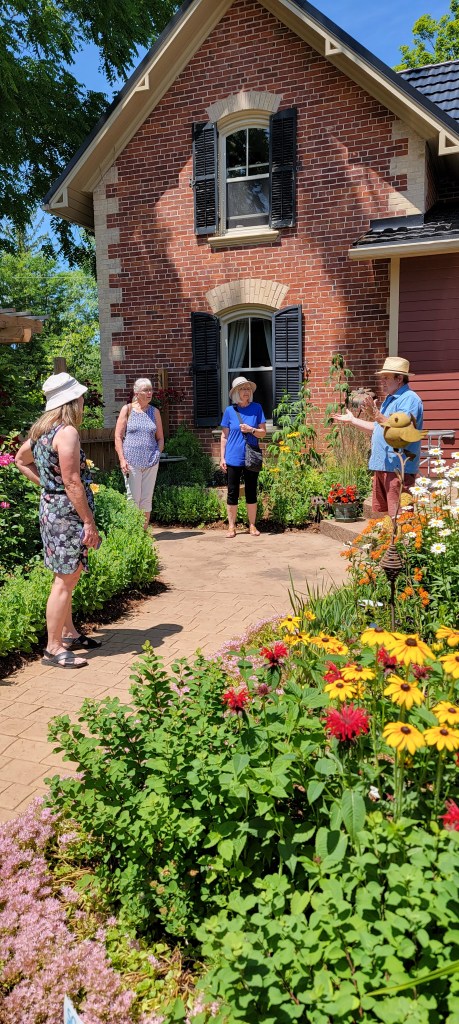
So it was with great anticipation that we looked forward to our Lakefield garden being featured on a garden tour organized as a fundraiser to celebrate 60 years of the Lakefield Horticultural Society.

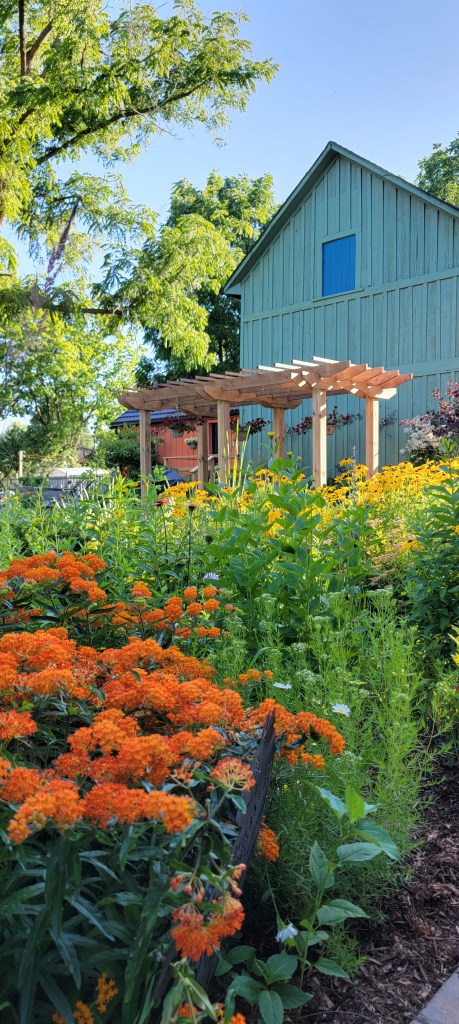
While we spent a few very crazy days trying to put the final touches on our garden (my husband decided he would build a beautiful pergola [awesome] a week before the event [not so awesome] so plants had to be moved into pots and then back into the beds just a few days before) — sorry I digress — everything was perfect on the day — the weather was spectacular, we placed the last bits of mulch to cover a few empty patches and we looked forward to welcoming our guests.

The new pergola.

As the first people arrived (I think our first visitor was a man on a bicycle!) I began to realize how much I had missed the joy of sharing our gardens with others. And as the day progressed, it was wonderful to hear other people’s perceptions — for some it was inspiring, for some a bit overwhelming (we have a 3/4 acre property in a small village), for some they loved that we had plants they had never seen before (not your typical garden). Everyone seemed to leave with a smile on their face, which made our day.

Grant created numerous raised beds over the past few years — at my request — and we’ve had great success with them. We also purchased a “COVID present” for ourselves — a long wished-for greenhouse to extend our gardening season, and it’s been put to good use.

We’ve spent time over the past few years planting more native plants as I learn more about the benefits of creating habitat as well as having an aesthetically pleasing garden. Hey, it’s not all about me!! Doug Tallamy’s book is a great start to understanding the benefits we can provide in our humble gardens to the greater ecosystem.

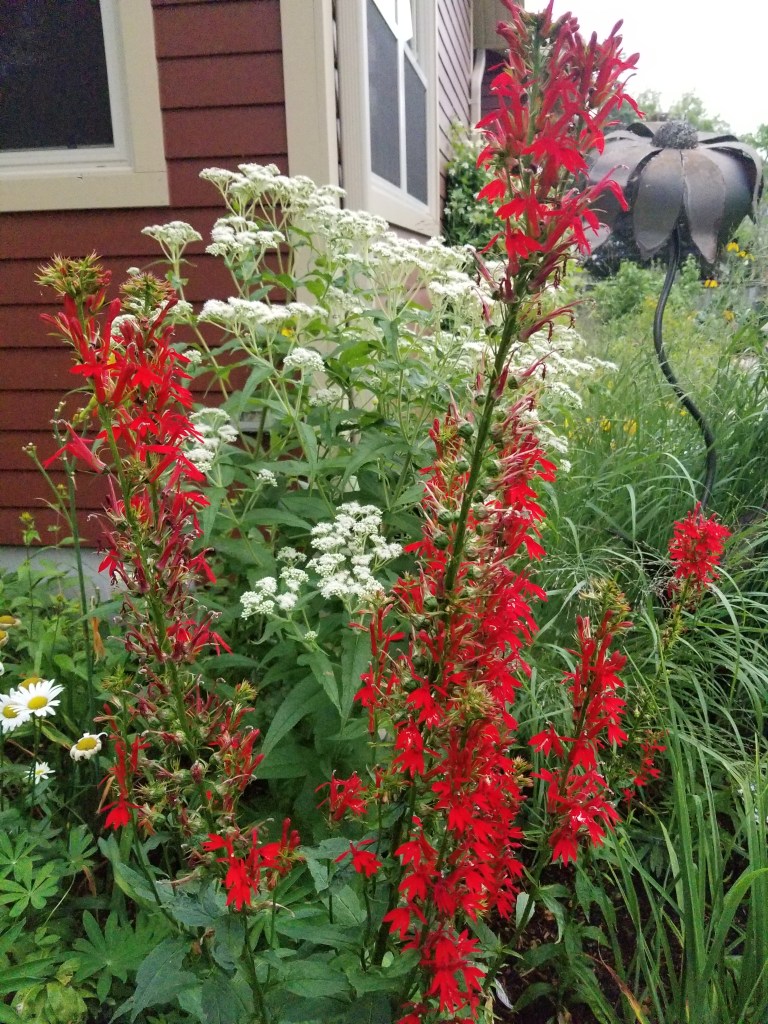
There is definitely a balance — we’re aiming for a 50/50 balance of native/non-native — because I love my daylilies and peonies and don’t want to give them up (they give me pleasure), but I also love the hundreds of pollinators (bees, butterflies, wasps etc.) that flock to my Common Boneset (Eupatorium perfoliatum), Pearly Everlasting (Anaphalis margaritacea), Cup Plant (Silphium perfoliatum), and Cardinal Flower (Lobelia cardinalis) because I am choosing to plant native plants.

Boneset (white) and Cardinal Flower (red)

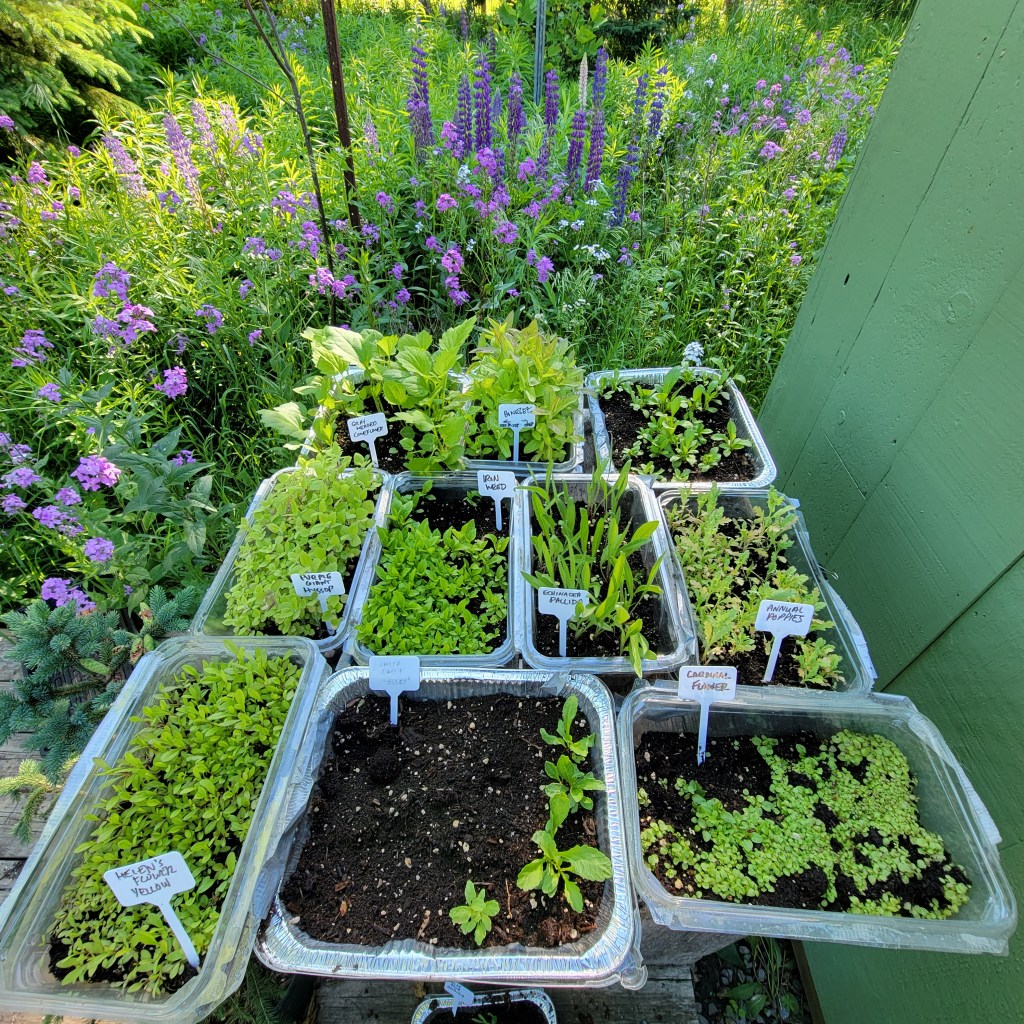
Last winter I grew some native (and non-native) plants using the Winter Sowing technique (because most native plant seed requires winter/cold stratification) and it was a great success (with some lessons learned – but that’s another blog).

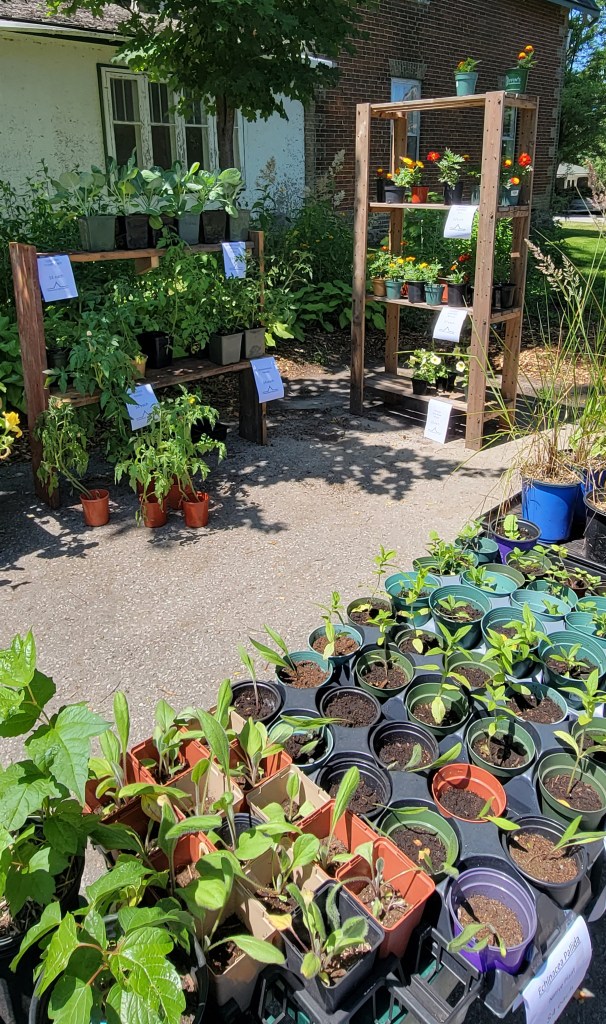
Grant set up a Plant Sale area for the garden tour and people were able to buy plants that they saw in the garden (although alas, I did not take any cuttings on my amazing orange Butterfly Weed – a type of milkweed – which really caught everyone’s attention).

The Plant Sale area

Over the day I saw many gardening friends I hadn’t seen in several years, and made all sorts of new friends. It felt like my community was coming together — like we were reconnecting after a long time apart in a beautiful place. And I realized that gardening is both a solitary and a very social activity. We even got featured in the local newspaper.

We raised funds to support our local horticultural society, we got back to feeling ‘a bit normal’, and most importantly we got to reconnect with people over a common passion — the love of gardening.

I hope that all of you will find opportunities to reconnect with people this summer and share your gardens and plants and trade stories about attracting pollinators etc. with others. It’s a feeling like no other. #happygardening

Our lovely rudbeckia and greenhouse in the background.

The Wilting of ‘Mrs. Robert Brydon’

By Lois Scott, Master Gardener

Garden gazing out the window a couple of weeks ago I noticed, with a sickening jolt, that my Clematis x jouiniana ‘Mrs. Robert Brydon’ was wilting.  (It’s only a plant, Lois, only a plant).  She has been in my garden for 4 years and had been growing very well up to this point but it appeared she must have clematis wilt.  Clematis wilt and clematis slime flux are the two diseases that this particular cultivar may be susceptible to.  Not noticing any slimy, smelly matter oozing from the stems, I ruled out slime flux. 

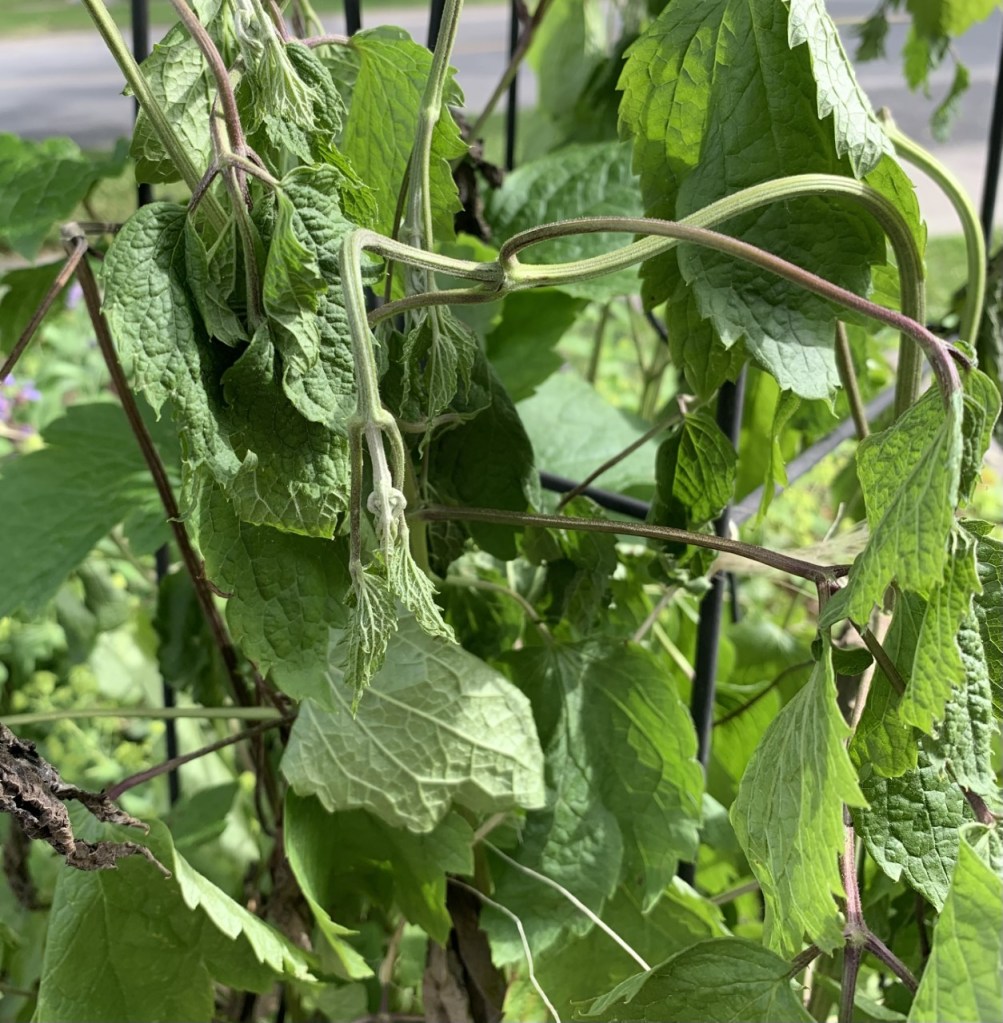
‘Mrs. Roberty Brydon’ showing leaf wilt

According to Missouri Botanical Garden,  clematis wilt is a serious disease of clematis caused by the fungus Ascochyta clematidina.  This fungus can survive in the soil surrounding infected plants and may overwinter in infected plant debris.  The fungus appears to be activated by ‘high humidity and favourable growing conditions found early in summer’.  Any to all stems may be affected and the whole plant killed down to just below soil level.  The good news is that the plant may recover after a year or two. 

There are ways to manage and avoid having your clematis plants affected by this disease and indeed other diseases of clematis.    Strategies (cultural practices) include a favourable planting site with 6 or more hours of sun.  Soil should be fertile and well-drained with good air circulation around the plant.  The area around your clematis should be free of plant debris and avoid any injury to stem and roots.  Do not cultivate the soil around your clematis plants and mulch it well.  Water carefully, keeping water off the leaves.  If your plant becomes infected, cut the diseased stems just below ground level and destroy them.

‘Mrs. Robert Brydon’ in flower

I removed and destroyed all the diseased growth on my clematis (which was all the growth) and there is now new growth coming up from the root.  I will be paying attention to keeping leaf debris cleaned up, improving air circulation around the vine and watering as needed, with care.

Hopefully ‘Mrs. Robert Brydon’ will survive this setback.  Her profuse, pale blue flowers are unusual and appealing to me.  The gardener, Robert Brydon, who ‘found’ this clematis in a Cleveland, Ohio garden in 1935, clearly thought enough of it to name it after his wife! Sigh.

Another Garden Beauty

By Marilyn Homewood, Master Gardener

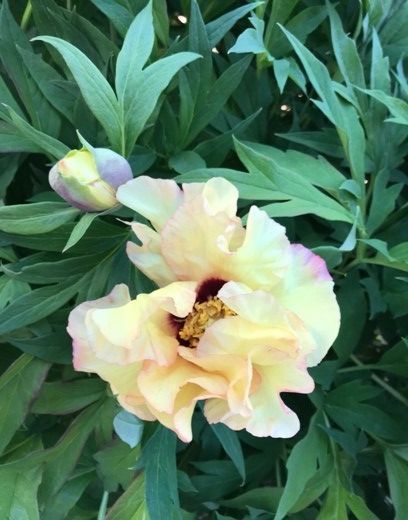
Summer solstice has just passed and with it the waning of some iconic garden varieties.  Late spring/early summer brings us not only the iris and rose but the peony as well.  Peonies are large, long-lived perennials that may stay in one place without division for up to 100 years. Peonies bloom in a wide range of forms, from simple, elegant singles to massive doubles with more than 300 petals in colours of white, pink, yellow and red tones.  They form a rounded shrub that may be up to 3 feet in height and width with glossy deep green foliage that remains attractive after the bloom is over.

Itoh peony ‘Bartzella’ in landscape

There are three types of peonies: Herbaceous, Tree and Itoh.  Herbaceous peonies bloom in late spring/early summer and have stems that die back to the ground in the fall.  Tree peonies have a permanent woody stem, more like a shrub. Woody stalks remain standing through winter and go on to flower again the next season. The blooms on trees peonies are larger and more fleeting than those on their herbaceous counterparts.  In our area, tree peonies appreciate a sheltered spot to grow as a hard winter may result in a lot of die back. The third type of peonies are the Itoh peonies.  These plants are a result of crossing herbaceous peonies with tree peonies.  The stems of Itoh peonies die back to the ground each fall and yet the bloom is large like that of a tree peony.  These plants do not require any additional support unlike some of the herbaceous peonies.

Tree peony

Peonies perform best when planted in a location with a minimum of 6 hours of sun per day and must have fertile, well drained soil.  Once planted in a suitable location, they are relatively care free, requiring only a good clean up in the fall to cut the stems down and remove all leaves (reducing the potential for fungal growth). In the case of tree peonies, the stems are not cut but all leaves should be removed and discarded in the landfill.

Peonies are sold as bare roots from growers as well as from some of the larger companies. These can be planted in either spring or fall however from experience fall is the preferred time to get them into the ground.  As well, many nurseries sell peonies in containers that can be added to the garden at any time provided they are kept watered.

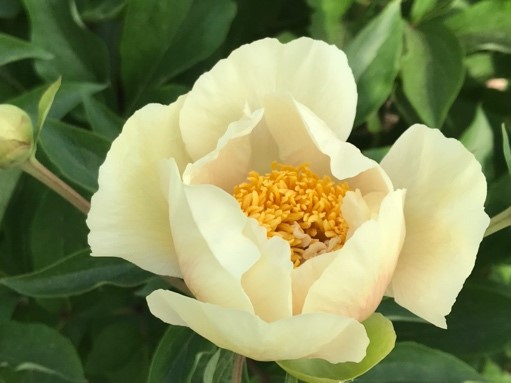
Early single peony “Claire de Lune”

Recognizing the value of a peony variety that performs well in the landscape, the American Peony Society developed an Award of Landscape Merit for cultivars that do not require support and are vigorous garden varieties.  When choosing a peony for your garden, consider one of these.

Japanese peony “Sword Dance”

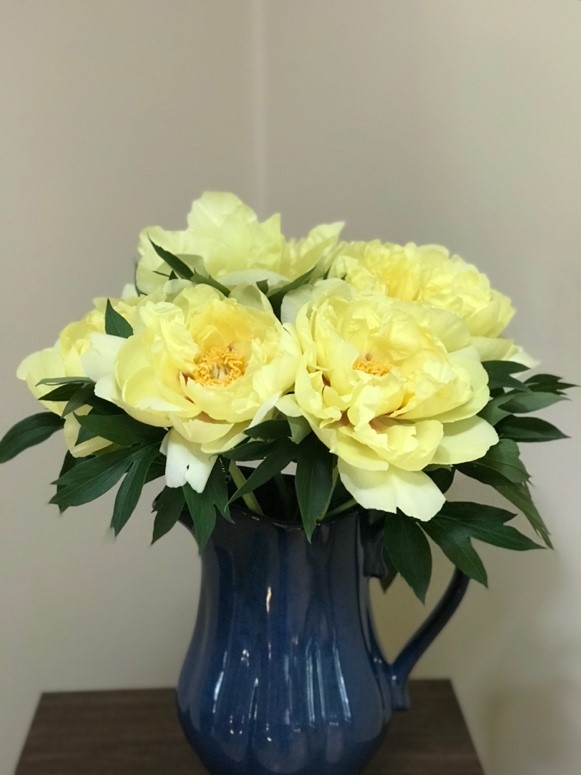
Peonies are not just for the garden. They make wonderful cut flowers as well.  For maximum vase life, harvest them when the bud is coloured, rounded and soft to the touch, keep the vase out of direct sunlight and change the water frequently (peonies like cold water and I have started to add some ice cubes to the water in the morning).  This should give you 6-7 days of vase life.  The blooms are so large that it only takes a few to fill up your vase.

Treat yourself and purchase a peony for your garden.  One can never have enough peonies!

Peonies as cut flowers

“Flowers are the music of the ground. From earth’s lips spoken without sound.” – Edwin Curran

Resources

http://ccenassau.org/resources/peonies

Home

https://www.treepeony.com

It’s Iris Time in the Garden!

By Chris Freeburn, Master Gardener

June brings a great show of Bearded Iris into the garden. Iris germanica flower in spring and although the bloom time seems short, the big colourful blooms are breath taking. Iris come in different heights, have big showy flowers in lots of fabulous colours and their elongated fan-like leaves give a different shape in the mixed border. There are 3 parts of the flower – “standards” which are the 3 upright petals, “falls” which are the lower petals usually hanging down and the “beard” which is the fuzzy hairs and is often yellow in colour. There are many varieties available, with colours ranging from shades of blue, purple, pink, peach, orange and combinations of colours where standards are one colour and falls another. Stunning!

Orange Harvest

Iris want a sunny location facing south or west, in well drained soil. They do not want to sit in water and will rot if they are too wet. Iris have rhizomes which produce roots to hold the plant in place and draw up water and nutrients. Rhizomes want their tops to be near the surface of the soil or slightly exposed, especially in heavy soil. A heavily mulched bed will not work for iris unless you leave a large area bare. Fertilize in early spring.

Raspberry Parfait

Dead-head flowers by cutting spent blossom stems right down, which encourages more bloom on rebloomers. Leaf fans should be cut back to 3” to 6” in the fall with sharp scissors.

Plants need to be divided every 3 to 4 years to reduce crowding and encourage blooming. Dividing should be done when plants are dormant in August or September. When dividing, check rhizomes for signs of disease and cut out any soft, wrinkled or marred parts. Let rhizomes dry overnight before replanting to allow cut areas to seal over to protect

Watch for Iris borer which will eat through the rhizomes. If you do get borers, dig up and cut off the damaged rhizomes.

Siberian Iris

Iris are often sold bare root from seed companies and there are several online iris companies in southern Ontario. They tend to ship for fall planting when plants are dormant. You can purchase plants in containers in garden centres in spring or summer.

Royal Botanical Gardens in Burlington have a wonderful display garden if you are up for a trip. Check out their website https://www.rbg.ca/gardens

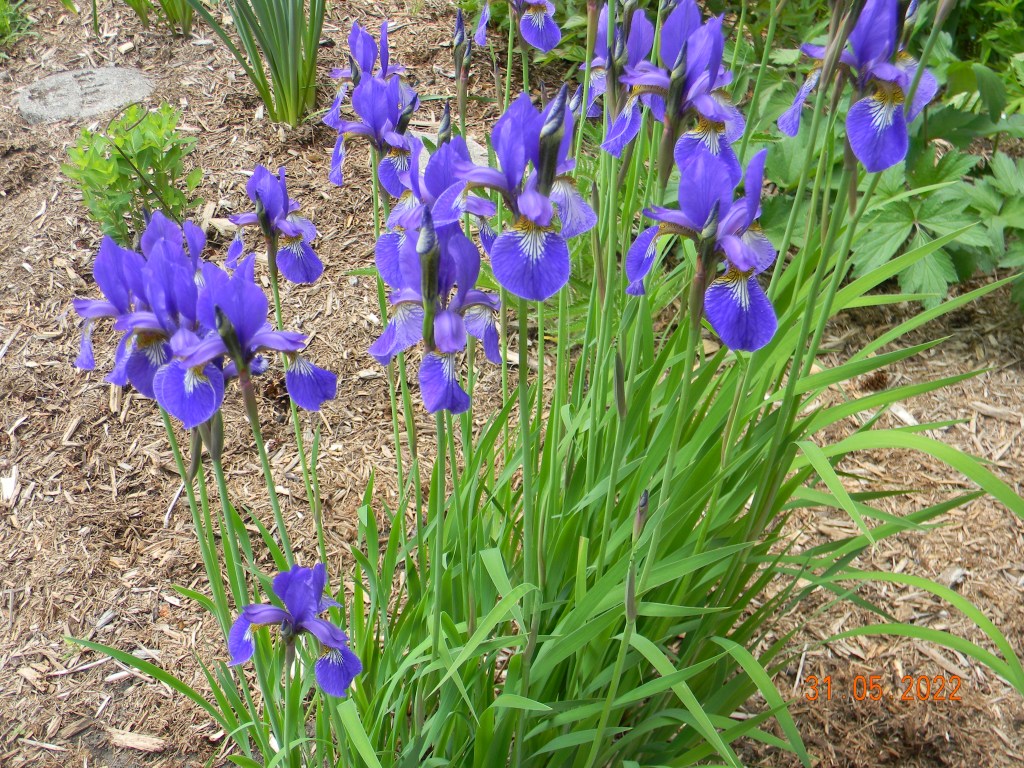
Iris siberica is another showy plant in the early summer garden. Siberian Iris grow 15” to 36” tall with lots of smaller flowers having standards and falls. Their leaves are narrower and almost grass-like. Siberian Iris can be planted into the soil rather than on top although they still have rhizomes. They can take full sun or part sun and do like a moist area. Dividing needs only to be done every 10 years or if the centre dies out.

Siberian Iris: Such amazing detail!

One of the earliest iris is Iris reticulata which is actually a bulb that you would plant in the fall. They are short and usually purple.

In Ontario we have native iris that are classed as wildflowers and known as Flags. They include Iris versicolor which you will find in shades of blue and Iris lacustris which is a smaller wildflower and very rare. These are often used in pond settings as they prefer to be wet. Iris pseudacorus is the non native yellow flag iris which is listed  on the Ontario Invasive list.

Iris are poisonous for cats, dogs and humans if eaten.

For more information check out these websites:
https://www.cdn-iris.ca/growing-bearded-irises/
https://www.chapmaniris.com/
http://ontariowildflowers.com

In praise of the Trillium, our provincial flower

By Mary-Jane Pilgrim, Master Gardener

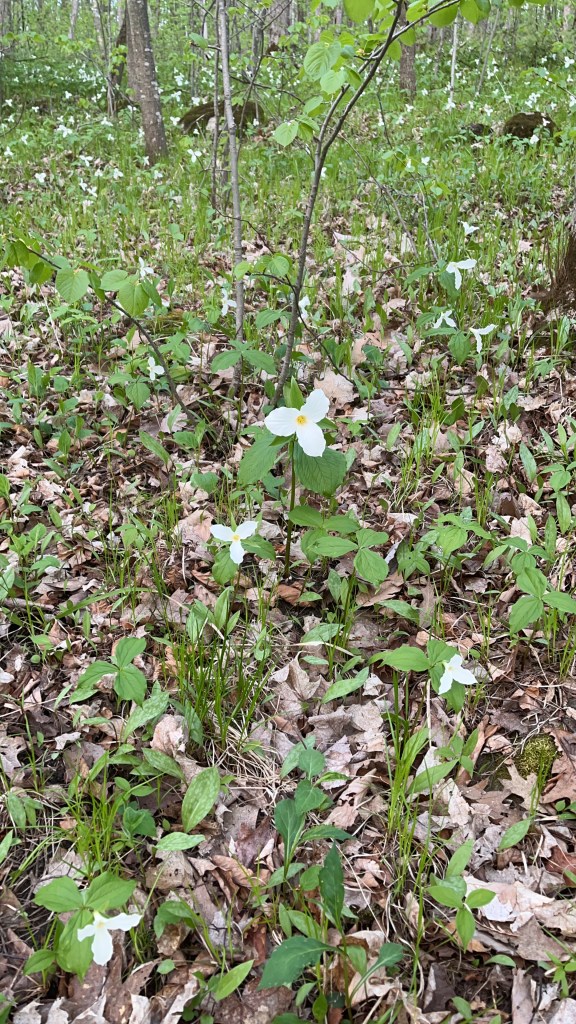
Most people know of the White Trillium (Trillium grandiflorum) as Ontario’s provincial flower. This is the flower featured on many of our provincial documents, from health cards to driver’s licenses. It was on March 25, 1937 that the Province of Ontario gave the trillium this honour.

Trilliums have three broad leaves, three small green sepals, three petals, and a three-sectioned seedpod. The “tri” in the Latin word trillium refers to these collections of three.

Trilliums are very slow-growing plants; their seeds take at least two years to fully germinate. The plant itself takes seven to 10 years to reach flowering size. After first flowering, it will bloom annually in early spring, with the blooms lasting for around three weeks. Trilliums can live for up to 25 years.

Did you know that the plants are phototropic? This means that the blooms will bend toward the sun and follow it across the sky.

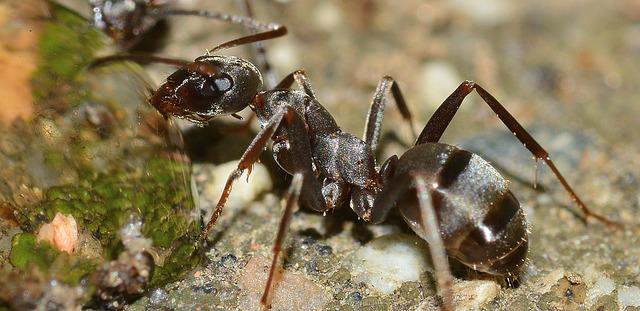
You may not know that ants are involved in the dispersion efforts of the trillium. Ants are attracted to the protein-rich seed sac on the seeds which they eat after carrying the entire seed back to their nests. The actual seeds are not harmed during this process, and are later discarded to grow a new plant in a new location.

As a spring ephemeral, trilliums have a few short weeks in the spring to collect as much sunlight and nutrients as possible to be able to survive for the rest of the year. If trilliums are picked in the height of their flowering glory, they may not be able to collect enough resources to survive.

There’s a pervasive myth that it’s against the law in Ontario to pick or relocate these native plants. In 2009, former Peterborough-Kawartha MPP Jeff Leal introduced a private members’ bill called the Ontario Trillium Protection Act. Although the bill passed first reading, it never became law. If you do relocate these spring beauties or buy them from a garden centre, mulch with leaf litter for best results. Filtered light is best as they cannot tolerate much direct sun. The soil needs to be rich in organic matter, well-drained, and moist.

There are several varieties of trilliums in Ontario, with the most common being the White Trillium. The next common variety in our region is the Red Trillium which is also called “Stinking Benjamin” (Trillium erecta). Why? Go out this spring and find one and take a sniff. You may discover it smells a bit like rotting meat. Yikes! The aroma’s purpose is to attract pollinators, and in this case, the pollinators are green flesh-flies who are out in search of rotting meat on which to lay their eggs. Instead of finding the perfect nursery, however, they end up assisting the plant in its procreative efforts.

Plants are rarely boring, once you get to know them!

Winter Browning of Conifers

By Laura Gardner, Master Gardener in Training

This spring as I walk around my neighbourhood, I have noticed quite a few evergreen conifers with brown needles. The species that are commonly affected are mainly the dwarf and ornamental varieties such as Picea glauca ‘Conica’ (Dwarf Alberta Spruce), Thuja occidentalis ‘Smargd’ (Emerald Cedar), and Taxus spp. (Yew). Some of the more robust and resistant conifers are the parent species such as Thuja occidentalis (Eastern White Cedar).

Some Causes[i]

  1. Inadequate moisture
  2. Inadequate protection from sun and wind
  3. Rapid freezing/thawing
  4. Salt spray damage
  5. Root damage at transplant
  6. Late season pruning and fertilization
  7. Late fall transplant
  8. Genetic maladaptation

Cultural Practices for Recovery and Future Maintenance

Depending on the extent of the damage, these shrubs may recover and produce new growth. This process can be encouraged by additional watering and the addition of mulch. Shrubs should be well-hydrated up until freezing in the fall to prepare them for moisture loss in the following winter. Mulching helps protect shallow roots from drying out, can help limit frost-heaving, and moderates the temperature of the soil.

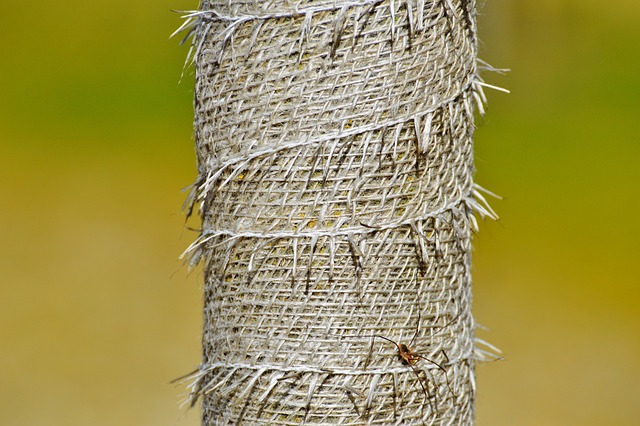
Prior to winter, consider adding some protection such as a burlap screen with stakes for plantings on the south and/or west side where it is sunny or windy or near driveways and walkways that are salted. Burlap can be wrapped around shrubs but should be kept loose so that moisture is not trapped. The advantage to a screen is that the area remains open to air and light. Salt, sun, and wind can draw out moisture from the needles and because the ground is frozen, the roots are unable to draw in replacement moisture. Planting these types of shrubs on the north and east sides, in less open areas, and away from driveways can minimize damage.

Shrubs that have been dug from the nursery field and then have been repotted for sale may be subject to some root damage/loss. This can be more problematic when transplanting late in the fall as there is limited time for root re-development. In addition, the ability of the roots to draw in moisture before freeze-up can be compromised. Refrain from pruning and fertilizing late in the summer as this can encourage a flush of late new growth—tender growth that is more susceptible to winter damage.

Conifers that are exhibiting winter browning:

Is Supportive Care Enough?

Perhaps—it is required in the first few years after transplant and probably they will continue to require extra support. However, some dwarf and ornamental conifer cultivars are simply not genetically adapted to thrive in this region. This is because they have originated from areas of more moderate climate and hardiness zones. When considering trees and shrubs, while some species are more adaptable than others, it is preferable that stock be grown locally and be from local cuttings and seed. Forest Gene Conservation Association notes that “bringing material in from dissimilar areas often results in low survival from heat stress or winterkill, frost damage, reduced growth rates, and increased insect and disease problems.”[ii] While climate change is indeed allowing us to push the envelope a little and plant some species from the next hardiness zone, and there are assisted migration[iii] programs for species, there can be a risk in transplanting certain plants from further afield. Plants are genetically adapted to follow a particular timed growth cycle. For example, a study of Quercus rubra (Red Oak) found that a specimen grown in Algonquin Park that was transplanted in the Niagara region stopped growing before the end of the growing season. It was genetically adapted to a growing season of 185 days but the growing season in Niagara is around 230 days. Another specimen grown in Niagara that was transplanted in Algonquin Park was genetically adapted to continue growing past the end of the growing season there and as a result suffered frost damage and browning. It would be weakened and be more prone to damage from disease and insects.[iv]

Another study of Picea glauca (White Spruce) in Alberta found that cold hardiness was determined to be the trait with the strongest genetic variation. Seed from plants originating from Ontario had high growth but a poor survival rate. Because they were accustomed to longer growth periods, there were more vulnerable to early damaging frosts. The plants with the highest survival and growth rates were grown from local stock.[v]

Before purchasing, determine your garden’s site conditions: soil, moisture, drainage, sunlight, wind, climate, and whether the trees or shrubs you are considering can adapt readily to the conditions. Climate change also needs to be considered as we experience increased drought and higher temperatures. Determine their origin. Ask the vendor where they were grown. If they originated from an area with very different conditions, consider giving them a pass. Realize that “if a tree is not genetically adapted to your site conditions, no amount of care will help it grow as vigorously as one from the appropriate source.”[vi]

Keep in mind the gardening adage, “the right plant for the right space.”


[i] Winter Burn. University of Wisconsin Garden Fact Sheets. Online: https://hort.extension.wisc.edu/files/2015/01/Winter-Burn.pdf

[ii] Seed Source Matters. Forest Gene Conservation Association. Online: https://fgca.net/2016/12/seed-source-matters/

[iii] Assisted Migration. Forest Gene Conservation Association. Online: https://fgca.net/climate-change/assisted-migration/
[iv] How Far Should the Seed Fall from the Tree? It’s a Question of Respecting Diversity: Genetic and Environmental. Online: https://ontariosnaturalselections.org

[v] Sebastian-Azcona, Jaime, et al. Adaptations of White Spruce to Climate: Strong Intraspecific Differences in Cold Hardiness Linked to Survival. Ecology and Evolution, vol. 8, no. 3, 2018. Online: http://dx.doi.org/10.1002/ece3.3796.

[vi] When Planting Trees. Forest Gene Conservation Association. Online: https://fgca.net/forest-gene-convservation/when-planting-trees/
Deck the Halls with Boughs of Holly

By Mary-Jane Pilgrim, Master Gardener

Common European holly (Ilex aquifolium) has a long history of use as a Christmas symbol. It appears on Christmas cards, in holiday arrangements, in Christmas carols, and my personal favourite: in stained glass ornaments. This shiny, spikey evergreen plant is easy to use for decorating, plus it has a long history of cultural significance.

Holly is a shrub-like tree that can grow up to 10-15 feet in height. Its leaves are thick and leathery, with serrated edges and spiky points. The female versions of the tree produce the red berries we’re so used to seeing everywhere at Christmastime. It is sold as a perennial in our region, but very few of the over 400 species are actually hardy in zone 5 (Peterborough). One such variety is American holly (Ilex opaca). The plant requires four or more hours of direct, unfiltered sunshine per day, and requires acidic, rich, and well-drained soil.

For centuries this magical shrub-tree has been been used in winter solstice decorating in central and northern Europe, specifically among the Celts who wore crowns of holly for good luck. They would hang holly sprigs from their windows and doorways to keep evil spirits away. Holly gradually became a symbol of hospitality and welcome.

In pre-Victorian times Christmas trees were not pines, but holly bushes. Christian culture adopted the holly – along with ivy – in Christmas celebrations; holly symbolized Christ’s crown of thorns; the crimson berries represented His blood and the evergreen a metaphor for life after death.

Holly is a real showstopper in winter when little else is green. The same features that make it so attractive today are what made holly a mythical plant to ancient cultures.

Holly’s red berries, toxic to humans and most household pets, are only produced on female plants. Hollies are dioecious, which means male and female flowers occur on separate plants (female flowers must be pollinated by male flowers to produce berries). So if you would like to see those bright red holly berries in winter, you’ll have to plant one male for every 5-10 female plants. The berries are a food source for some of our native birds in the winter.

While most of us no longer believe in the magic of plants, holly is indeed a beautiful adornment for our winter homes (“deck the halls with boughs of holly”), and has a long history of significance throughout the world.

From the Peterborough Master Gardeners to each of our amazing subscribers, we’d like to wish you all a blessed Christmas & holiday season!

Resources

The Plastic Dilemma

By Marilyn Homewood, Master Gardener

The recent severe weather experienced by the west coast drives home the reality of our changing climate. Gardeners pride themselves on being good stewards of the land and are always trying new techniques to improve. However, there is a fly in the sustainability ointment.

The horticultural industry uses a lot of plastic. Pots, weed barrier, netting, propagation equipment; it’s overwhelming.  On a global basis, about 4 percent of world oil production is used as a feedstock for all plastic and another 4 percent is consumed as energy in the manufacturing process. Emissions are just the beginning of the problem.  The Earthways Center at the Missouri Botanical Garden estimates that about 350,000 lbs. of horticultural plastic enters the waste stream each year in America. Plastic is ubiquitous, does not degrade rather it disintegrates and some types (PVC and polystyrene) leech toxins into the soil and groundwater.  As it disintegrates, it becomes microplastic fragments that can be found both in marine settings and in the soil.  We are all aware of the impact on marine life but it has now been discovered that these fragments are in the soil and have a significant negative impact on arthropods and roundworms (all important in the breakdown of organic matter). 

Freedom from plastic is the goal but will take time. There are things gardeners can do right now to reduce their plastic consumption.

  • Extend the life of plastic you already own by careful handling and reuse
  • Forgo plastic when workable alternatives exist. Use biodegradable pots made of coir or fibre and try soil blocking for starting seedlings. Use wooden plant markers.
  • Buy bare root plants and or start plants from seeds to cut down on plastic pots
  • Use planters made of terra cotta, metal or ceramics.
  • Only use tools made from metal and wood
  • Skip the use of bagged products and purchase these products at a bulk outlet using preowned containers.
  • Use weed barriers that biodegrade such as cardboard or biofilm (made from corn)
Metal tools that last a lifetime

There may still be items for which no good alternative exists in your situation.  In these cases, purchase higher quality versions that are more durable and last a long time.  Companies such as Bootstrapped Farmer are now specializing in this type of product.

Many years ago (1996) I purchased 2 large plant trays from Lee Valley Tools and am still using them.  The trays are still in the catalogue and I am going to purchase more.  I have a metal watering can which I have had since I started to garden.  These things can be passed along to younger gardeners.  As the urgency of this issue becomes apparent, additional products come to market assisting in the transition to freedom from plastic.

“We have forgotten how to be good guests, how to walk lightly on the earth as its other creatures do.” ~ Barbara Ward


Resources

https://www.gardenorganic.org.uk/say-no-plastic-garden

https://www.npr.org/2019/07/09/735848489/plastic-has-a-big-carbon-footprint-but-that-isnt-the-whole-story

https://www.bootstrapfarmer.com/

Mushrooms in the Wild

By Mary-Jane Pilgrim, Master Gardener

Go for a hike in the woods in November, and you’ll see plants you’ve probably never seen before. With the wetness of fall comes an entire forest of miniature fungus elements of many different shapes, sizes and colours. Some can be eaten, others don’t taste very good, some will make you sick and a small number of them will kill you. In general, the types of trees in the forest will determine what fungus and hence what mushrooms will grow there.

Mushrooms are the fleshy, spore-bearing fruit of various fungi. They are generally short-lived. They can emerge from the ground, expand, produce spores, and die back in a matter of a few days. Some are as big as dinner plates and some as small as pinheads.

This fall, myself and two active friends have been going hiking in different parks, conservation areas and public wild spaces in our area. Whenever we see a new mushroom, we generally stop and take a closer look and we’re often amazed at what we find. In additional to the white, brown and sometimes orange mushrooms, we also find different mosses and lichens. We often taunt each other to try to eat the different mushrooms, but just in jest — recognizing the danger of improper identification.

Mushrooms play an important role in our ecosystem. They are capable of decomposing pretty much any material (plant or animal) in the woods and breaking it down into the primary components of forest soil; providing nutrients that feed the plants growing in it. Many animals rely on mushrooms for food, especially squirrels and other rodents. Slugs also dine on mushrooms, and certain types of flies spend their whole lives on, and in, mushrooms.

Mushrooms develop from a mycelium; a mass of threadlike structures that make up the main part of the fungus. It is usually embedded in soil or wood. These mycelia often form connections, called mycorrhizae, with the roots of coniferous trees and other plants. Unlike plants, mushrooms cannot synthesize their own food from the sun’s energy. They lack chlorophyll – the substance which permits plants to use sunlight to form food. Mycorrhizae assist the plants around mushrooms in absorbing water and nutrients, and in turn, the fungi receives some of the carbohydrates the plant produces through photosynthesis — it’s a symbiotic relationship.

Most interesting to me are the mushrooms that grow in rings. Recently, while hiking the “UpTown” trail in HaroldTown Conservation Area east of Peterborough, we spotted several large rings of mushrooms and wondered how and why they were growing like that. Turns out that when a mushroom spore lands in a suitable location, the underground roots grow out evenly in all directions. As the fungus grows and ages, the oldest parts in the center of the pile die, creating a circle. When the fungus roots produce its mushrooms, they appear above-ground in a ring. The ring continues to grow outwardly, eating up all of the nutrients in its path, and leaving behind nutrient-rich soil.

There are edible mushrooms in our forests like chanterelles, morels, and porcini mushrooms. Also to be found from the fungi family are edible puff balls. Foraging is prohibited in Ontario’s provincial parks without proper authorization and also in conservation reserves, unless the forager is harvesting for personal consumption. In Toronto, foraging for any purpose is illegal in city parks and natural spaces. The Ontario Poison Centre views foraging as an “extremely dangerous” hobby because the difference between safe and toxic mushrooms can be microscopic.

Warning: Never consume a wild mushroom unless you are certain of its identity and edibility. Do not attempt to identify a mushroom from comparing photographs alone. Check out all the characteristics and if in any doubt, do not eat them.

Foraging aside, my suggestion after my experiences this fall is to get out and hike in the forest before the snow falls because there are still thousands of mushroom creatures along the forest floor in different shapes, sizes and colors. It’s a whole new garden in the fall once most of the green has disappeared. Take a camera along with you!

Resources:

https://www.tvo.org/article/where-the-wild-things-are-foraging-in-ontario

https://www.thecanadianencyclopedia.ca/en/article/wild-mushrooms-in-canada

Verbena bonariensis

By Sharleen Pratt, Master Gardener

Verbena bonariensis Courtesy of pixabay.com

I was very intrigued by the plant known as Verbena bonariensis.  This particular Verbena is often shown growing in gardens on the British show Gardener’s World.

I managed to find seeds this spring from William Dam Seeds Ltd.  The package instructed me to start seeds 8 to 10 weeks before the last frost, however, due to a huge demand for seeds the past few years, my package arrived quite late and I was unable to start the seeds until well into April.  At the best of times, Verbena can be an erratic germinator and I was only successful getting one seed to germinate.  However, this one plant was a huge success and I will definitely be trying again next year, although I may be lucky to find some seedlings in my garden.

This plant is one of about 250 species in the genus Verbena. Most are not in cultivation.  It is native to Brazil and Argentina.  Bonariensis means ‘from Buenos Aires, Argentina’.  ‘Buenos’ means ‘good’ and ‘aires’ means ‘air’. It is a perennial in zones 7 to 11, therefore, is grown as an annual in the Peterborough region.  In some milder climates such as California, it can be considered a weed. Verbena bonariensis, also known as Tall Verbena or Brazilian Verbena has stiff upright branching stems.  It reaches a height of 3 to 6 feet and spreads 1 to 3 feet and is unlikely to fall over.  The stiff square and rough stems hold clusters of lilac-purple flowers from early summer right through to late fall.  The deep green, lance-shaped serrated leaves form a mounded rosette at the base of the plant.  The flowers are borne in rounded clusters 2 to 3 inches across.  The cut flowers last a long time in flower arrangements.  England’s Royal Horticultural Society Floral Committee awarded V. bonariensis an Award of Garden Merit (the Society’s symbol of excellence given to plants of outstanding garden value) “because of its attractive flowers and uncluttered habit.” They can make an unforgettable display and although they are tall plants, they have an open and airy appearance which lends them to being tucked in between other plants or even creating a dramatic appearance at the front of a border.  They sway in the breeze and are very attractive to butterflies, bees and other insects.  They prefer full sun to part shade in well-drained soil.

Our very hot summer did not affect its performance and knowing that they are drought tolerant once established is another plus for this plant. There are little known pests or diseases, although powdery mildew can sometimes be a problem.  White spots on the leaves do not seem to have much impact on blooming.

If you leave the flowers to develop seed heads for the birds, the plant may self-seed the following year.  As this was my first season with this plant, I will have to wait until the spring to see if my conditions are good for self-seeding.  I understand that they may not appear until late spring.

It is also possible to cultivate through cuttings and you can find out how to do this in this short video by the very well-known British gardener Monty Don.