June brings a great show of Bearded Iris into the garden. Iris germanica flower in spring and although the bloom time seems short, the big colourful blooms are breath taking. Iris come in different heights, have big showy flowers in lots of fabulous colours and their elongated fan-like leaves give a different shape in the mixed border. There are 3 parts of the flower – “standards” which are the 3 upright petals, “falls” which are the lower petals usually hanging down and the “beard” which is the fuzzy hairs and is often yellow in colour. There are many varieties available, with colours ranging from shades of blue, purple, pink, peach, orange and combinations of colours where standards are one colour and falls another. Stunning!
Orange Harvest
Iris want a sunny location facing south or west, in well drained soil. They do not want to sit in water and will rot if they are too wet. Iris have rhizomes which produce roots to hold the plant in place and draw up water and nutrients. Rhizomes want their tops to be near the surface of the soil or slightly exposed, especially in heavy soil. A heavily mulched bed will not work for iris unless you leave a large area bare. Fertilize in early spring.
Raspberry Parfait
Dead-head flowers by cutting spent blossom stems right down, which encourages more bloom on rebloomers. Leaf fans should be cut back to 3” to 6” in the fall with sharp scissors.
Plants need to be divided every 3 to 4 years to reduce crowding and encourage blooming. Dividing should be done when plants are dormant in August or September. When dividing, check rhizomes for signs of disease and cut out any soft, wrinkled or marred parts. Let rhizomes dry overnight before replanting to allow cut areas to seal over to protect
Watch for Iris borer which will eat through the rhizomes. If you do get borers, dig up and cut off the damaged rhizomes.
Siberian Iris
Iris are often sold bare root from seed companies and there are several online iris companies in southern Ontario. They tend to ship for fall planting when plants are dormant. You can purchase plants in containers in garden centres in spring or summer.
Royal Botanical Gardens in Burlington have a wonderful display garden if you are up for a trip. Check out their website https://www.rbg.ca/gardens
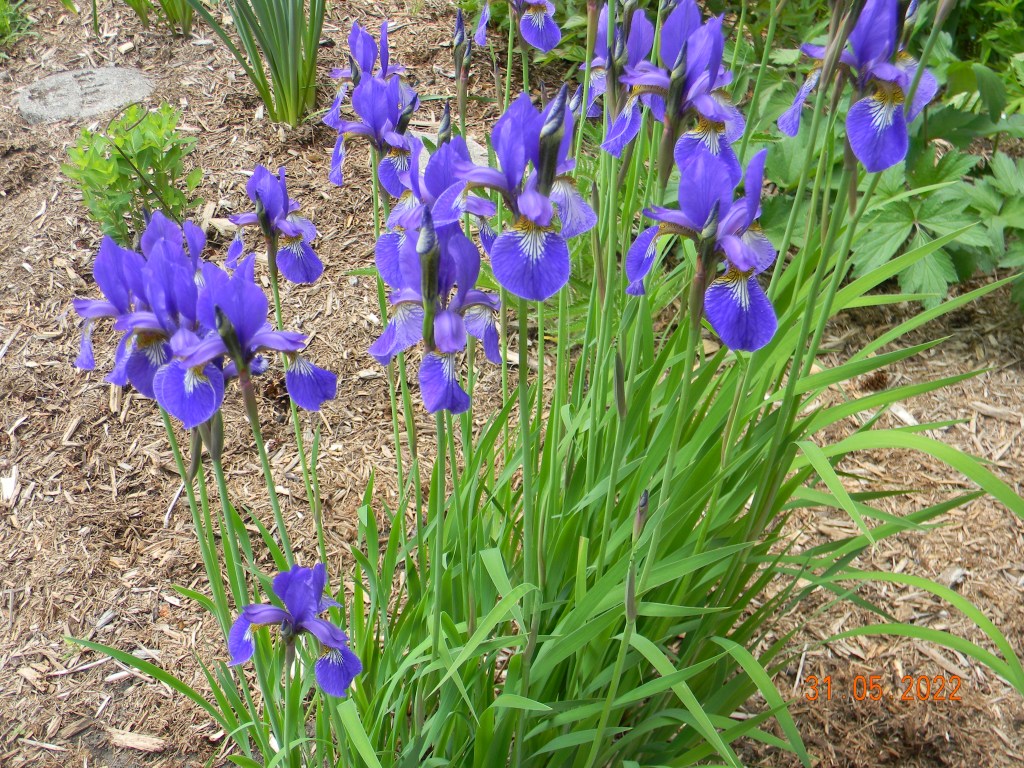
Iris siberica is another showy plant in the early summer garden. Siberian Iris grow 15” to 36” tall with lots of smaller flowers having standards and falls. Their leaves are narrower and almost grass-like. Siberian Iris can be planted into the soil rather than on top although they still have rhizomes. They can take full sun or part sun and do like a moist area. Dividing needs only to be done every 10 years or if the centre dies out.
Siberian Iris: Such amazing detail!
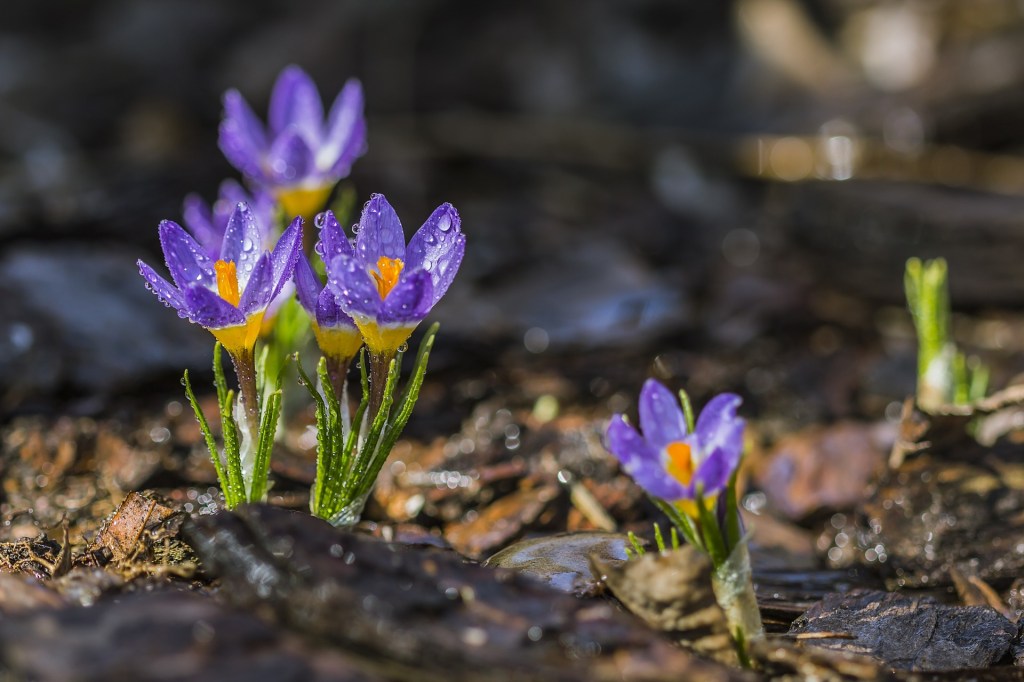
One of the earliest iris is Iris reticulata which is actually a bulb that you would plant in the fall. They are short and usually purple.
In Ontario we have native iris that are classed as wildflowers and known as Flags. They include Iris versicolor which you will find in shades of blue and Iris lacustris which is a smaller wildflower and very rare. These are often used in pond settings as they prefer to be wet. Iris pseudacorus is the non native yellow flag iris which is listed on the Ontario Invasive list.
Iris are poisonous for cats, dogs and humans if eaten.
Canadians love to garden! 2022 is the Canadian ornamental sector’s centennial and has been declared by the Canadian Garden Council as the Year of the Garden. For more information, check Year of the Garden.
Our gardens became even more important to us over the last couple of years while we were sheltering at home due to the covid pandemic. 2022 is a year for us to share our gardening passion and knowledge. It is the mission of the Peterborough and Area Master Gardeners to inform, educate and inspire the residents of Peterborough and area to create healthy and vibrant gardens, landscapes and communities through the use of safe, effective, proven and sustainable horticultural practices. Peterborough has even declared itself as a garden-friendly city as part of the Year of the Garden festivities!
So, think how you can “live the garden life” … maybe consider gardening indoors with house plants, or in containers on your balcony or create a new garden in your yard. You could join your local Horticultural Society to learn more about plants and then perhaps become more involved in the community. Your next step might be to become a Master Gardener!
The Peterborough and Area Master Gardeners will celebrate the Year of the Garden by partnering with the Peterborough Public Library to renovate the gardens around their Aylmer Street building. The gardens had originally been planted with invasive plants. We will remove the invasives and replace them with native plants from Grow Wild, Native Plant Nursery. The Peterborough Kawartha Association of Realtors (PKAR) are providing some much needed sponsorship funding for the project. We are planning to involve the younger crowd in some of the planting along with our great group of adult volunteers. We hope that, with some growing time, the gardens will become a haven with native plants and local pollinators and a beautiful spot for human visitors to rest.
June 18/2022 has been designated as the Year of the Garden day in Peterborough. The opening of the newly planted gardens at the Peterborough Public Library will be on that date from 10 until 2 pm. There will also be a story walk for children, a Master Gardener advice table and more. Another great event happening that day is the Peterborough Horticultural Society’s garden tour. Tickets will be on sale soon for the tour. Follow the Peterborough Master Gardeners and the Peterborough Horticultural Association on social media for more information.
“To plant a garden is to believe in tomorrow.” Audrey Hepburn
If you’re like me, you love to garden. Time in my garden provides me with joy on so many levels — emotional, physical, social, creative — and connects me with the outdoors and the environment. And while the COVID-19 pandemic has turned our lives upside down, one of the silver linings is that we’ve seen a renewed interest in gardening and its benefits, whether you’re working in a large garden or a few containers on your balcony. So I thought I would explore some of the top reasons I think we garden.
Physical and Emotional Health
Gardening is physical. As a low to medium impact exercise that requires both strength and stretching, you’ll see increased muscle strength and cardiovascular fitness over time, as well as improved sleep and diet (if you grow your own produce). On the emotional side, gardening reduces stress, anxiety, and depression and improves self esteem.
It’s good for the mind — gardening calms me down and helps me be more patient with myself and those I interact with on a daily basis. It gives me time to contemplate as I go about my tasks, up to my elbows in soil. Even weeding is cathartic, pulling out those little terrors by the root!
Just visiting gardens helps to calm the mind, bringing a sense of contentment and tranquility from looking at beautiful landscapes, flowers, or just colour and texture.
Building Relationships
While gardening can be a solo activity (some of my favourite moments are just by myself in my green oasis), it’s also a fabulous way to connect with people, whether they be family or strangers!
Teaching people how to nurture a living thing and to be responsible for a little bit of the environment is a lesson and gift we can share with others. Gardening knowledge is shared through generations — I love hearing about plants handed down from grandparents, or children working with their parents to grow seeds for the first time. It’s a great way to pass on critical life lessons — about patience as plants and vegetables grow, responsibility as they look after their care, and loss when flowers die at the end of a season.
Beyond family, gardening helps us connect with the broader community. Whether you plant too many tomatoes or zucchinis and end up giving them away to neighbours, or participate in a community garden plot, gardening can be a very social activity and a chance to learn from, and share your bounty, with others.
Learning Life Values
Gardening teaches you important life values like patience, determination, caring, and hard work. It also makes you very humble as you realize that there is always something new to learn. You need to observe the seasons and the weather, and this puts you in contact with the natural world. I love that I can get dirty and do this very physical activity, working with seeds and plants and seeing growth in all I do.
Growing Your Own Food
Gardening provides benefits for your wallet, your nutrition, and reduces your environmental footprint. By growing your own food (either from seeds or small plants), your food is automatically more sustainable simply because you are doing it onsite or in a community garden. If you control the ‘inputs’ and do it well, you can save a lot of money.
But ultimately there is nothing more rewarding than planting and maintaining your own vegetable garden and harvesting (and sharing) your results. And we all know how much better homegrown produce tastes versus conventional produce at the grocery store. If you have too much produce, then you can just share the love with others!
Connecting With Nature
I think this is one of the best reasons why people have a garden — the sunshine on your face, hands in the dirt, and feeling connected to nature. The garden is so much more than just plants and flowers — it’s the birds, the bugs, the bees, the spiders, the snakes and all the small mammals. I feel like I am establishing a little ecosystem in my own garden and that I am trying to give back for all the benefits that I receive.
Working in the garden also gives you that sense of wonder, accomplishment, and reward. To grow plants is to give life. It keeps you busy but reminds you to be one with the earth. To see the results of something growing from seed to six feet tall is just incredible.
Exploring Creativity
I find gardening to be an incredibly creative activity. Finding the right plant for the right spot, mixing colours, and making sure there is interest for every season — these are real challenges. I’ve spent much of the past few years learning about new plants to consider in my garden, especially natives.
Helping The Environment
Finally, gardening is so important for our planet. Even though we create our gardens (so they are human made) they do represent natural environments, with trees and shrubs and plants that are all taking in carbon and releasing oxygen. The plant roots stabilize the soil and filter water, and the plants themselves support our pollinators.
We live in a symbiotic relationship with our gardens. We give back by planting and maintaining them, but we receive so much more from them than we give.
It’s really cold out. I mean REALLY cold. -25 degrees Celsius cold. With lots of snow. And wind. And ice. So it’s got me dreaming of springtime and things that are green and not white.
So indulge me while I research and share with you some of my favourite English gardens in southern England that we plan to visit later this spring. Hoping things improve to celebrate my aunt’s 95th birthday and fulfill a long held dream to visit England in late springtime. While I’m planting many more natives in my messy “English-style” garden, I’m still fascinated with the diversity, structure, and composition of more formal English gardens.
Here’s my top 5 ‘not to be missed South England gardens” – there are (of course) more on our list but these are the key ones. Some of these may be familiar to you, and some not…
Hoping that these profiles help ease the January blues. Since I’ve haven’t been there yet these are photos taken by others. If you have been lucky enough to visit these gardens please share your photos in the comments.
Great Dixter is an historic house, a garden, a centre of education, and a place of pilgrimage for horticulturists from across the world. Certainly it’s the one garden that has the highest reputation with overseas visitors.
Surprisingly, it’s maintained this reputation for many decades, even through a change of hands. Initially famous through its owner Christopher Lloyd (1921-2006) – who lived in the half-timbered fifteenth-century house all his life – Lloyd (or “Christo” as he was known) was not only a gifted and artistic gardener but a prolific and knowledgeable writer whose articles and books inspired a generation of gardeners.
Today, the gardens are managed by the Great Dixter Charitable Trust and Fergus Garrett, who became head gardener in 1992. I was lucky enough to hear him speak at a Toronto Master Gardeners’ Technical Update a few years ago.
The two gardeners had a creative working relationship, both loving plants and their combinations, and even though Lloyd is gone more than 50,000 visitors a year find Great Dixter as vibrant a garden as ever, and full of things to learn from.
This is an ‘arts and crafts’ style garden, with topiary, a long border, an orchard and a wild flower meadow. The planting is profuse, yet structured, and has featured many bold experiments of form, colour and combination.
On the grounds are three 18th-century oast houses, under a common roof, and a 15th-century barn. Find out more here.
Located in beautiful Kent, Sissinghurst Castle Garden was created by poet and writer Vita Sackville-West and her husband Harold Nicolson, author and diplomat in 1930 and developed over 30 years with some notable head gardeners.
Designated Grade I on Historic England’s register of historic parks and gardens, it’s among the most famous gardens in England. They transformed a farmstead of “squalor and slovenly disorder” into one of the world’s most influential gardens.
Following her death in 1962, the estate was donated to the National Trust for Places of Historic Interest or Natural Beauty. It is one of the Trust’s most popular properties, with more than 200,000 visitors each year (and I hope to be one of them!).
There are a number of specialty gardens, including the Rose Garden, the (famous) White Garden, the South Cottage Garden, the Herb Garden, the Nuttery, the Lime Walk (Spring Garden), the Delos Garden (Mediterranean garden), Moat Walk, the Orchard, and the Purple Border. Learn more here.
Hidcote is a world-famous garden located in the north Cotswolds (not far from [the original] Stratford-upon-Avon). Created by the talented horticulturist Major Lawrence Johnston (and inspired by the work of designers Alfred Parsons and Gertrude Jekyll), yew, holly and beech hedges define a series of outdoor garden rooms – the Circle, the Fuchsia garden , the Bathing Pool Garden, the Red Borders and the steps up to the two gazebos. The outbreak of the Great War (1914 – 1918) in which Lawrence fought, suspended progress.
You might recognize the narrow-leaved lavender, Lavandula angustifolia ‘Hidcote’, and Penstemon ‘Hidcote Pink’, as developed by Johnston. Many of the plants found growing in the garden were collected from Johnston’s many plant-hunting trips to faraway places so it will be the perfect source for gardening inspiration. More history here.
Created in 1885 at the former home of William Robinson, who championed naturalistic planting, the site today is a prestigious hotel, but visitors can still enjoy the gardens which are curated and cared for by Tom Coward (who trained with Fergus Garrett at Great Dixter).
An oasis of calm with over 35 acres of beautiful grounds, Robinson created a landscape that celebrates nature rather than controls it. He also introduced the idea of the modern mixed border and popularized common place items such as secateurs and hose pipes. In many ways Robinson created modern gardening as we know it.
Some of his most influential books include The Wild Garden and The English Flower Garden, which remains the bestselling gardening book ever printed. He also ran several gardening journals such as The Garden and Garden Illustrated.
Robinson made Gravetye “the paradigm in which house, garden, fields, and forest are united in a pastoral work of art as quintessentially English as a painting by Constable,” wrote landscape designer Elizabeth Barlow Rogers. Some ideas on how to create the Gravetye look here.
Royal Horticultural Society (RHS) Garden Wisley is operated by the RHS and is a beautiful garden with romantic half-timbered Tudor-style buildings. Unlike many English gardens, the soil is mainly acid sand which is poor in nutrients and fast draining.
There is a canal designed by Sir Geoffrey Jellicoe, a rock garden, formal and walled gardens by Lanning Roper, a country garden by Penelope Hobhouse and long borders by Piet Oudolf.
Then there are long herbaceous borders, the alpine gardens, the model gardens, soft fruit garden, rose-garden, summer garden, winter garden and woodland garden, a fruit field, glasshouses and an arboretum.
This garden is home to some of the largest plant collections anywhere in the world, with constantly evolving planting schemes to inspire visitors. In June 2021, Hilltop – The Home of Gardening Science opened at Wisley so I’m looking forward to exploring this impressive exhibition space and three beautiful new gardens.
Well that’s it for this blog – I hope you feel inspired to explore gardens wherever you live or travel – they are so many incredible gardens here in Canada and the U.S. alone. Even if we can’t travel much at the moment, many gardens have developed virtual visits, presentations, and videos so you can explore that way until we can move more freely. One of my favourites is the Lewis Ginter Botanical Garden in Richmond, Virginia, which I hope to visit in person in the future. Check it out here.
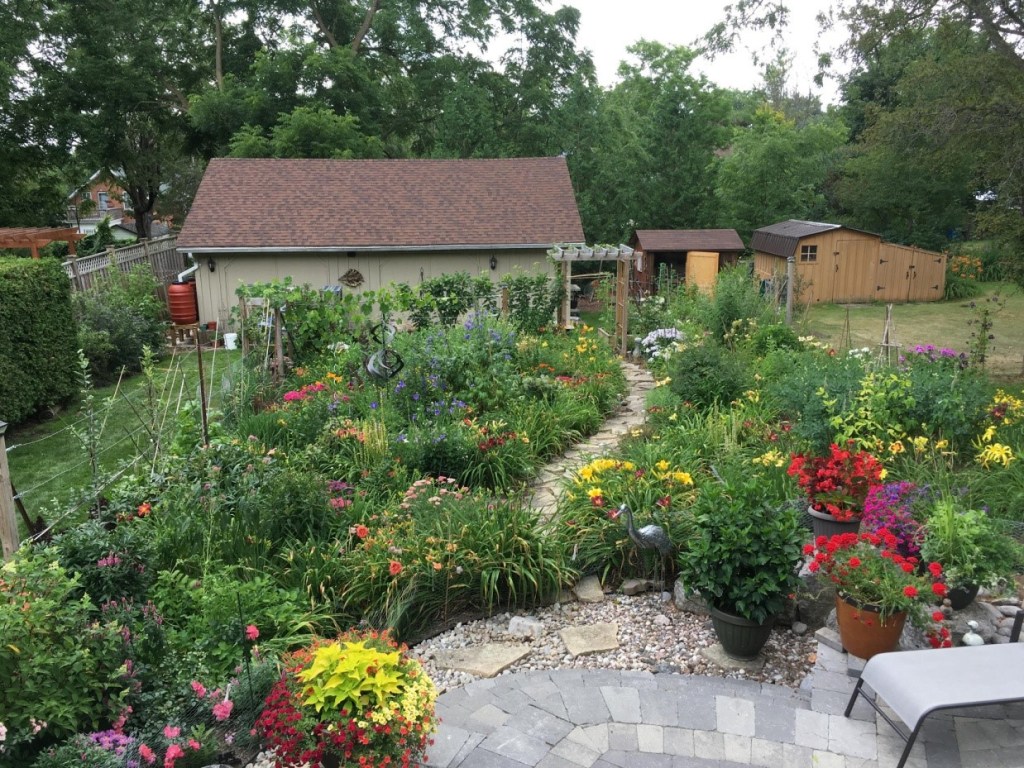
I leave you with a photo of my messy Lakefield “English garden” from last summer, my hardworking husband and our 2021 new greenhouse and dreams of springtime.
Gardeners are used to seeing the “zone” as part of the information provided on the label of most perennial plants, trees and shrubs purchased from a nursery. Some labels will list a zone with the corresponding temperature in brackets afterwards. This seems like an easy way to determine if your chosen plant will successfully grow in your garden–you will need to know the average lowest winter temperature, in your region, then figure out your zone. You then just buy the plant labelled with your zone for success! Easy, right? Yes and no!
In Canada, the original 1960’s plant hardiness zones were based on information gathered at 640 weather stations across the country along with the survival results of selected trees and shrubs. In 2012, revised maps were released using elevation, more locations and more environmental details resulting in a hardiness index which corresponds to a zone . At present, there are 13 zones ranging from 1-13. You may also see an “a” or “b” beside the number. This indicates a slight variation within that region. See Plant Hardiness Zone by Municipality to find your zone.
Zone 5, author’s garden.
In the USA, the system is different. Again, there are 13 zones ranging from 1-13 and “a” or “b” indicates variation within the region. See US Plant Hardiness Zones. However, the US system is only based on minimum temperature and no other factors. You may read about a plant grown in the US and designated US zone 5. A US zone 5 labelled plant may require warmer winter conditions than it’s corresponding zone 5 labelled Canadian plant. Bottom line, US zones may not be the same as Canada’s.
Canadian data is based on previously collected information but we know that the weather does not always follow past patterns — it can, and will, fluctuate (e.g. freeze/thaw cycles). There may be microclimates (see Microclimate in Wikipedia) in your own gardening space. Good gardening practices (e.g. soil preparation) will contribute to the successful growth of your plant. Plant survival and growth depends on your gardening expertise and knowledge. The zone is just one indicator of whether, or not, the plant that you are contemplating will grow well in your garden. Oh, and Peterborough is a Canadian plant hardiness zone 5 b.
Tips:
#1 The plant hardiness zone site now can be used to explore where the specific plant that you are thinking about purchasing will grow through the “Species-Specific Models and Maps”. It does this by creating a “climate profile” of the plant and then mapping where it will grow in Canada. These are preliminary maps but click here to try it out.
#2 Grow native plants! Native plants are specifically well suited to an area especially if you can purchase locally grown plants or find locally sourced seeds.
#3 Consult local nursery staff and your knowledgeable fellow gardeners. They will know what will successfully grow in your area.
#4 Experiment! If there is a plant that you really must have, but the zone is off a little…..try it. You will need to choose a protected location for planting and probably baby it along but sometimes it may be worth it. Talking to other knowledgeable local gardeners may be especially helpful….someone may have successfully grown that special plant in their garden and may share their growing tips with you!
Your once showy, spectacular plants have finished blooming and their foliage may have withered. Do not despair, the late summer/fall garden can still be something to behold as well as feeding the pollinators and other wildlife!
Annuals
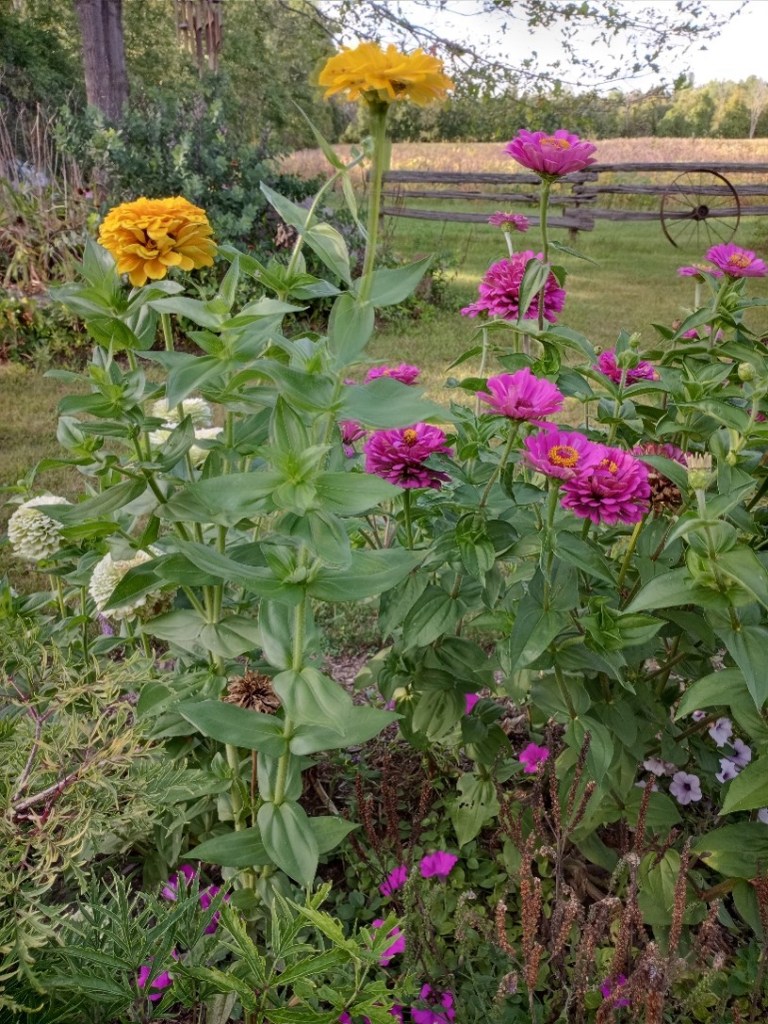
Plants that grow, bloom, go to seed then die all in one season are annuals. Annuals may be used to add some much needed colour at the end of our summer season. Zinnia, Petunia, annual sunflower (Helianthus annuus) and Cosmos are easy to source and grow. The ornamental kales and cabbages are dramatic plants that will look good in your pots or your garden.
Zinnia various — author’s garden
Shrubs
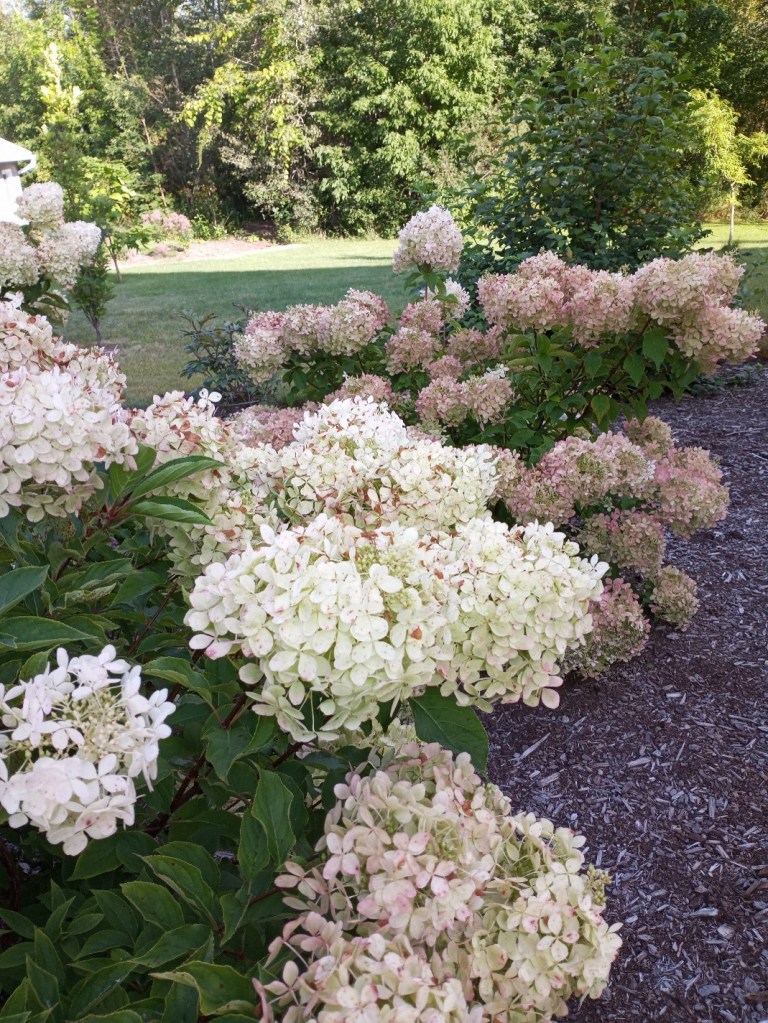
Hydrangea – I am referring to the panicle (H. paniculata) and smooth hydrangeas (H. arborescens) that bloom on new wood and may be pruned in late winter or very early spring. This is a plant that steals the show in late summer, fall and even into winter. They produce large, pink, white or pink/white poufy blooms. The blooms may be dried for inside décor or left on the plant outside for winter interest.
Witch hazel – Hamamelis virginiana is a native that blooms with interesting, spidery petaled, yellow flowers in the fall. This plant will attract birds to your garden.
Perennials
Plants that grow, bloom and produce seed but do not die after just one season … some are short lived but some live for many years. There are lots of perennials that bloom in late summer and fall. Many, like the native Aster species and golden rod (Solidago species) provide food for wildlife including the pollinators.
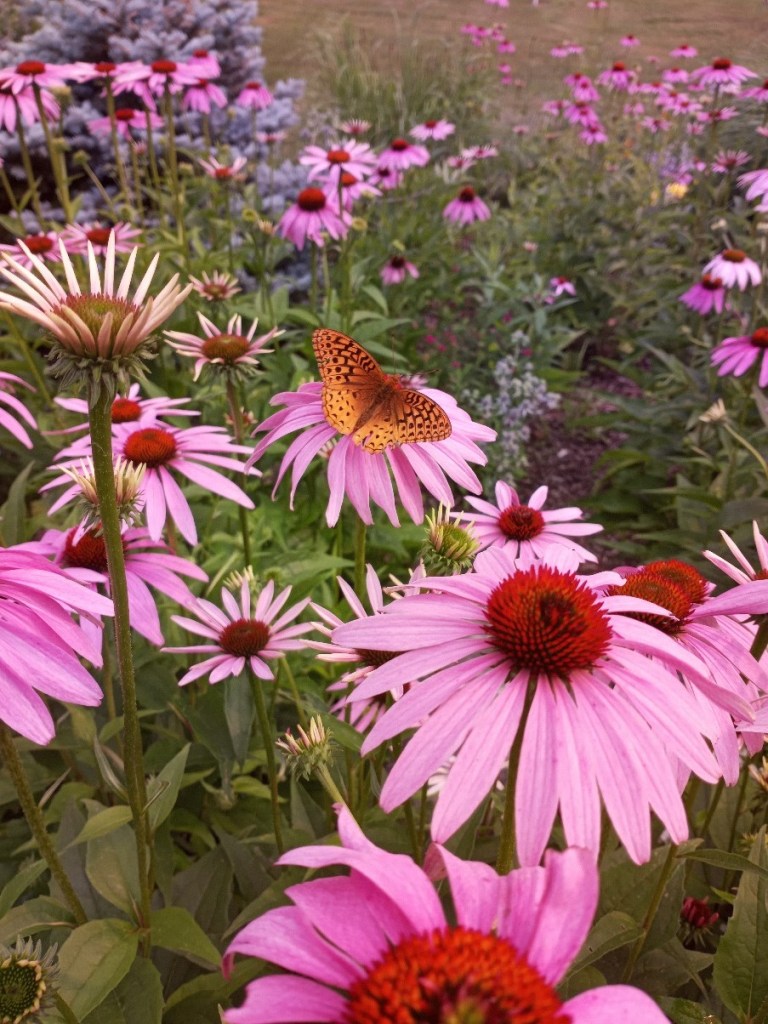
Echinacea purpurea — author’s garden
Some others in my garden include:
Phlox– There are lots of P. paniculata cultivars that bloom in the fall. This plant comes in a myriad of colours. Do not confuse this plant with the mid-summer/August blooming dame’s rocket (Hesperis matronalis) which can be quite invasive. Phlox flowers have five petals and dame’s rocket have four.
Black eyed susan – Bright, happy native plants and cultivars (Rudbeckia species) that may be annual, biennial (germinate in spring of first growing season but do not flower and go to seed until the next growing season) or perennial. The wild ones that we see on the Ontario road side are most often biennials.
Bugbane – Another pretty native (Actaea species formerly Cimicifuga) that blooms in the fall. I spent lots of time trying to get a good photo of a bumblebee on this plant’s bloom but it was too fast for me!
Anise hyssop – The bees love Agastache foeniculum. I have mine planted along a path. It is tall and quite dramatic when in bloom.
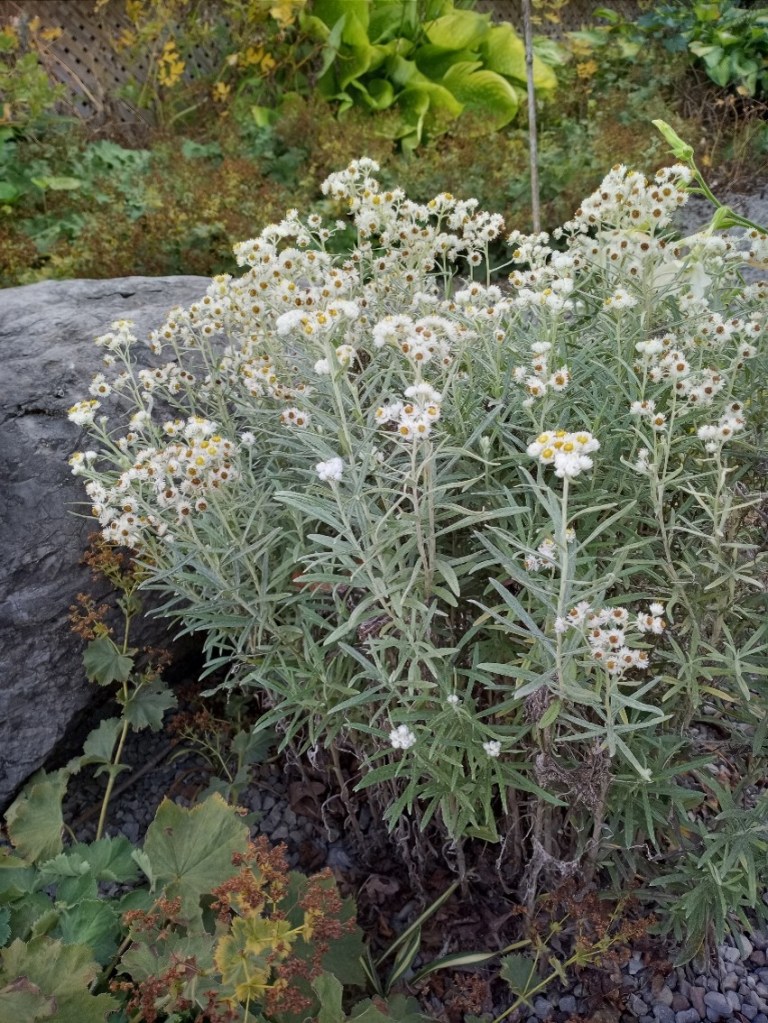
Antennaria — author’s garden
Plume poppy – This is the plant that everyone will ask “what is that”. Macleaya cordata growsvery tall and has an interesting seed head and large leaves. Beware though because it can spread through rhizomes (underground roots) and it exudes an orangey sap when pulled. It is easy to control just by pulling the plants when small but wear gloves to avoid touching the sap…it is poisonous.
Coneflower – Echinacea purpurea is a native plant but there are lots of colourful cultivars. Birds eat the seeds held in the spent blooms in winter.
Hydrangea — author’s garden
Pussy toes – The bees love this native (Atennaria species) too. Just like it’s common name, this plant has cute little flowers that resemble the toes of a soft, white kitten.
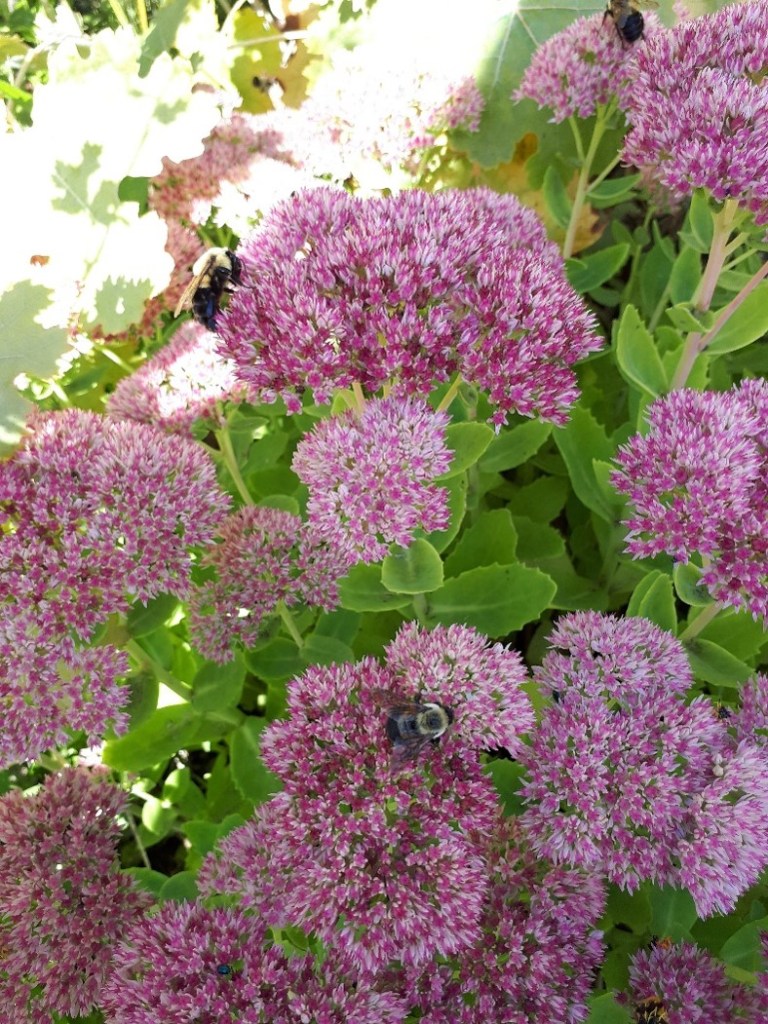
Sedum/stonecrops – These plants are some of the toughest, hardworking plants in your garden. They can take lots of heat and dry conditions. There are many, many to choose from … some bloom in spring and some bloom into the fall. The sometimes colorful foliage can add interest and the blooms will attract pollinators.
Sedum — author’s garden
So observe your garden, does it need some help this time of year? Try shopping the fall sales at your local nursery. If you can fit in some of these plants, you will have a beautiful garden full of late season blooms.
I am not a vegetable gardener but I love eating fresh vegetables so … I am a vegetable gardener. I learned how not to grow vegetables from my wonderful Dad. He liked to grow veggies in rows and hand weed those rows. This meant that my sister and I were tasked with hand weeding those never ending rows. Despite Dad’s best efforts, this was not “fun”.
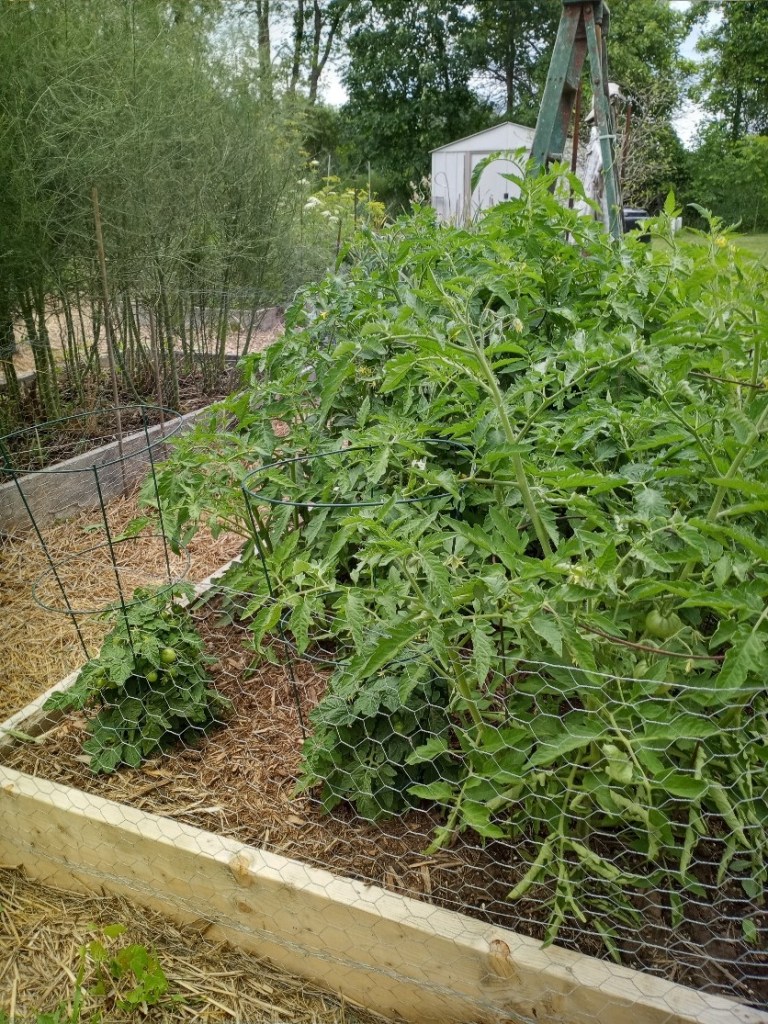
I first learned about growing vegetables in raised beds from a fellow Master Gardener. Gardens that have few weeds, are up off the ground to help save my back and look neat and orderly and even kind of pretty … what more can you ask for? And the best part, the plants are edible! Since then we have installed several raised beds close to our house for easy access to watering and harvesting. They are made of 2” X 8’ untreated spruce lumber. Some of my beds are 5 years old and the lumber is still going strong. We staple chicken wire around the beds to keep out the rabbits. The beds were filled with a combination of perlite, to minimize soil compaction, peat moss, to help retain water, and soil. Note that peat moss is a non-renewable resource so I would rethink it’s use for the next time. My composters are in the middle of the garden to make it easy to annually add the finished compost to the beds. Soil needs to have organic matter replenished regularly in order to feed your plants.
We use straw in between the beds to keep the weeds down and to create clean walkways. Hay tends to be full of weed seeds. Shredded bark mulch is used to mulch the vegetables although straw would work for this as well.
Grow what you eat but try something new each year too!
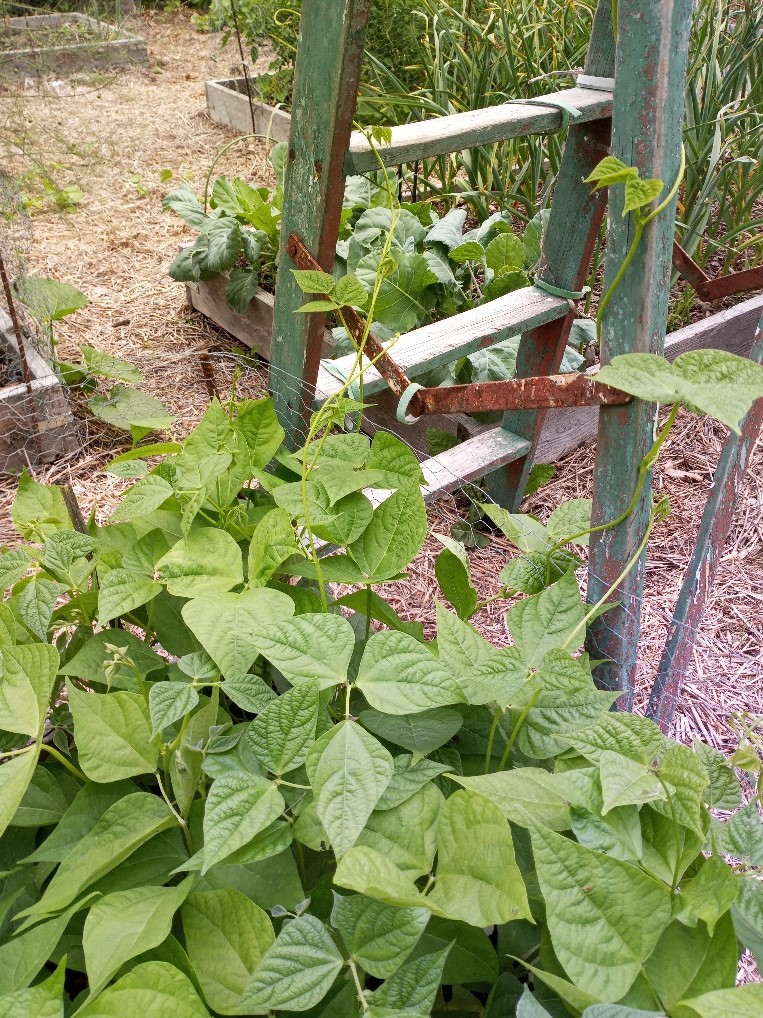
Beans – using an old ladder as a trellis. Author’s garden.
Some Basics
Most vegetables prefer full sun – 6-8 hours/day, regular water – 1” of moisture per week and heat. The necessary nutrients are pulled in through water absorbed by the plant’s roots from the soil.
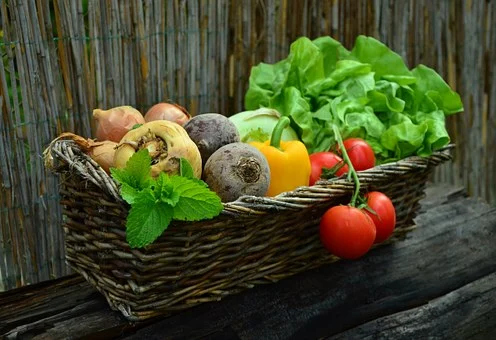
Most years, we grow cucumbers, squash, kale, beets, spinach, lettuce, garlic, parsnips, brussels sprouts and onions. We are usually successful but not always. New to us, this year, is turnips. Sometimes nature throws out a challenge like an unexpected late frost or an insect pest which can quickly destroy or damage your crop. Try to visit your garden each day to stay on top of problems and to harvest those ripe veggies.
For more info on growing veggies in Ontario check here. Also check the Peterborough & Area Master Gardeners resources page here for fact sheets on growing lots of different kinds of vegetables.
I am not a vegetable gardener but I have learned how to grow vegetables because I love to eat them. Have fun and enjoy your vegetables!
Tomatoes – cages in raised bed with shredded bark mulch. Straw used in walkways. Author’s garden.
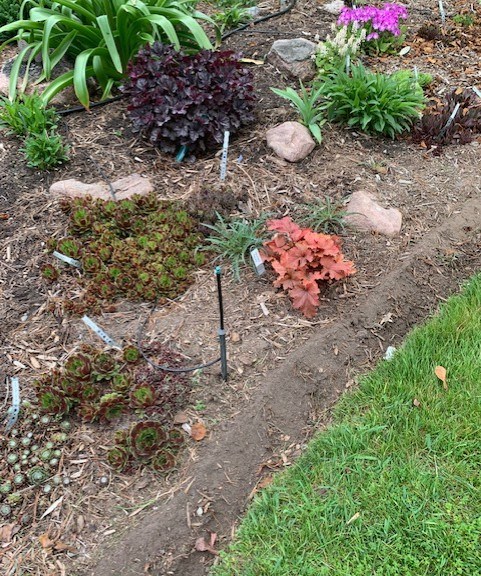
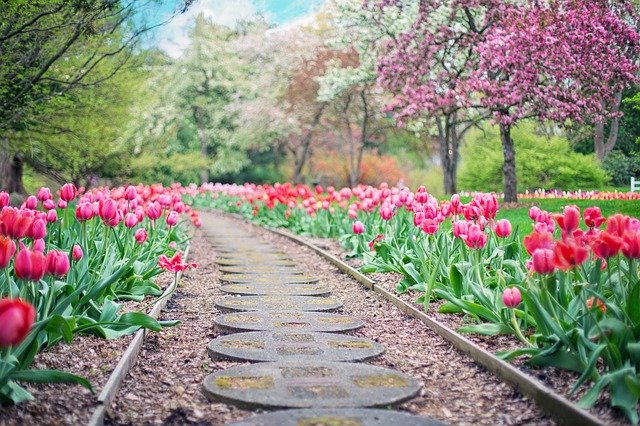
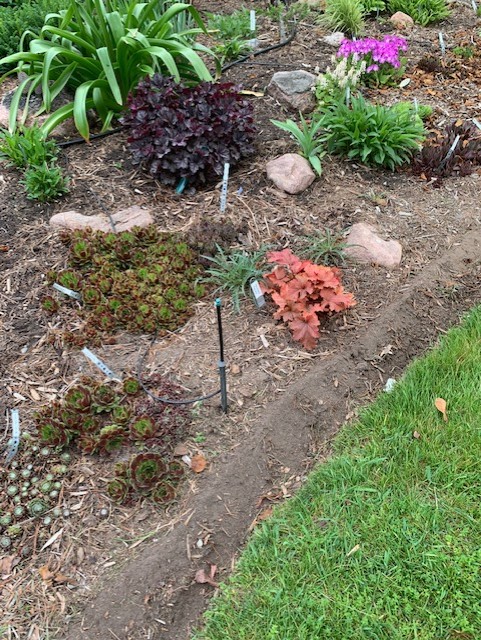
When it comes to maintaining a healthy garden, one of the most important elements that you need to consider is landscape edging. Options for edging range from a simple trench to high-end paving stones, and everything in between.
Edging creates clean, crisp lines between beds and other areas. It helps to keep grass from creeping into surrounding garden areas. At the same time, it prevents soil or mulch in garden beds from spilling onto the lawn whenever you water or it rains. It protects your expensive plants from the lawnmower, and your tree trunks from the string trimmer. Landscape edging also controls gravel or mulch pathways; it maintains clearly defined walking areas while keeping the path materials in place.
For me, edging has the critical job of making sure that the grass knows what its limits are, and for the garden to know the same. Once grass makes its way into a garden, it’s “game over, garden”. The grass wins, every single time.
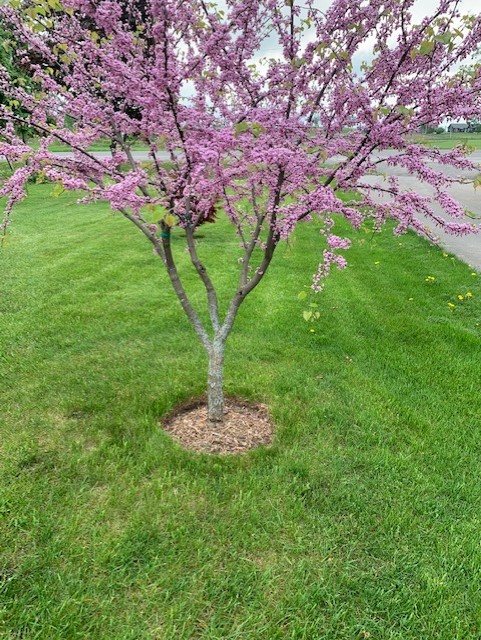
Trench edging around author’s blooming Eastern red bud tree (Cercis canadensis)
If you’re using permanent edging such as the items described below, it’s a one-time installation for years of service. If you’re using the temporary simple trench, it should be dug/redug several times per season in order to be effective: spring, summer and late fall. I personally use a very short, flat spade and a root knife (reverse curve blade) to do this task — cutting away minimal grass so as to ensure that the garden does not get incrementally bigger each year. Ensure that the mulch, when spread, comes up to the edge of the trench bottom but doesn’t fill it. You don’t want to have any materials at the edge that grasses can grow through because they will be persistent in trying to jump the barrier. For anyone with a Stihl string timmer, I also use a Stihl Bed Edge Redefiner each spring to loosen the soil and redefine the edge on my garden beds.
There are many attractive and more permanent edging choices, if digging is not your thing:
Stone materials including natural fieldstone can be used, and there are some great stone tile options on the market as well.
Repurposed bricks can create a classic look for your landscape.
Plastic is affordable and easy to install due to its flexibility. The least expensive edging does look inexpensive, so invest in the best you can afford. Use the longest spikes you can find to anchor this edging into the soil.
Metal: Similar to the plastic edging, you can purchase flexible aluminum edging strips. They look great but at present these are quite pricey.
Concrete: You can purchase preformed sections of concrete landscape edging that are ready to be set in place, or you can make a simple form and create a custom edge. The downside of using concrete is that it’s pretty permanent!
Wood: Usually more affordable than at present, this material is easy to work with in straight lines, and adds an informal, organic look. Count on wood edging to last about 10 years. Pressure treated wood barriers are not recommended for edging vegetable gardens, and old railway ties are not recommended at all due to the leakage of harmful creosote over time.
Like a lot of other gardeners during this time of COVID, I have taken advantage of the many, many gardening presentations, seminars, talks, and webinars that have all been available online–not to mention catching up on my reading. The two books that I am currently reading are both by Douglas Tallamy and have been recommended numerous times. They are ‘Bringing Nature Home’ and ‘Nature’s Best Hope’. Both are packed full of facts and figures; the first one providing a list of recommended native plants as well as basic information regarding the insects that are eaten by bird and wildlife. The second book, which is one of the main reasons why I like it so much actually has a plan (or approach as the book calls it) for turning our home gardens into wildlife habitats and extending that approach to create corridors preserving our native wildlife.
What I have noticed among the many presentations, seminars, etc. is the focus on native plants, native wildlife preservation, sustainable and organic gardening and environmental gardening. I am definitely all in favour of this shift; in fact I believe that this has been too long coming. We, as a whole, are definitely a little late to the table. Now this is just my personal opinion but I feel that as a nation, as a people, we do seem to be forever running behind a problem trying to come up with solutions only when the situation becomes critical!
I have to admit that I am as much at fault as the next person. My garden is only approximately 40% native plants, the rest being ornamental. Although if you count bulbs and annuals, that figure could drop down to about 30%.
But do not panic just yet, Douglas Tallamy does not recommend that we ‘adopt a slash and burn policy towards the aliens that are now in your garden’, thank goodness for that. What he does suggest is two-fold, if an alien plant dies replace it with a native plant that has the same characteristics, and two, create new beds with native plants if you have space and if not, dig up some of your lawn.
So here is my dilemma, and guilt. I have no more space to expand and only a very narrow patch of lawn in the back garden for my husband, dogs and future grandchildren. So I either have to wait for something to die, which is not happening fast enough to outweigh my guilt, or dig up a plant replacing it with a native. This is not quite as easy as you think. I have walked around my garden a number of times looking for plants to give away to plant sales or neighbours. The problem is the less plants you have the more each plant tends to have its own story, your mother or good friend gave it to you, you’ve inherited it from someone you care about, the plant reminds you of a certain time, the list and stories go on.
Photo of backyard in author’s garden showing on the left the narrow strip of lawn
One of my favourite native plants is culver’s root. It always and consistently has the most insect activity of any plant in the garden. I already have two. But would I want to dig up the rose bush that my mother bought me because coincidentally it has the same name as my grandmother and replace it with a third culver’s root?
What about ironweed? I love this tall, stately plant covered in late summer with purple flowers. Again I already have two, but would I want to dig up the delphinium that a neighbour gave me 15 years ago, that had apparently been growing in her yard for 30 years prior to that and replace with an ironweed?
Picture of Ironweed in author’s backyard
What about all the daylilies I have spent years collecting, each one unique and individual, or the peonies I bought from my last garden, one in each colour? Now, I understand that maybe not all of my ornamentals have the same level of memories, and that, yes, they would be going to good homes. But it is a difficult decision, I want to increase the natives in my garden, I want to do what is right and sustainable, and I want to increase the wildlife in my garden. I have even given talks myself encouraging gardeners to add at least one native plant to their garden each year. But do I really have time to wait; my guilt levels and motivation levels want me to act now, to take a stand, to encourage by action.
As Douglas Tallamy concludes: ‘Our success is up to each one of us individually. We can each make a measurable difference almost immediately by planting a native nearby. As gardeners and stewards of our land, we have never been so empowered – and the ecological stakes have never been so high.’
Gardeners learn as much from their setbacks as from their successes. By now, I should have a prepared cutting garden partially planted with frost hardy annuals. These are plants that prefer cooler growing conditions and can withstand a light frost allowing them to be planted early in the season. The group includes snapdragons, bachelor buttons, foxglove, scabiosa and sweet peas. However, instead of plants on their way to producing beautiful blooms, I have a 40 foot trench in my lawn.
The only cut flowers from this gardener so far
This garden was an end-of-year decision which meant a spring bed preparation, something I rarely do as the weather is not reliable and soil can be too wet to work. Working wet soil destroys the soil structure and porosity as well as wreaking havoc on soil microbial populations.
Progress so far
Not to be deterred, I had the sod removed both to see what I had to deal with (this part of the yard had not been turned since 1964, if then!) and to allow the area to dry more readily when the sun returns. When the soil does become workable, I intend to use a modified version of the “no till” method popularized by Charles Dowding to create the bed. A fork (or broadfork) will be inserted into the bed at close intervals and gently pried up. This will permit some aeration, rock removal and opportunities for soil amendment (compost). The amendments will be folded into the topsoil and the bed topped off with approximately 4 inches of compost. The portion of the bed slated for the hardy annuals may be planted while the remainder can continue to warm until it is time to plant the warm season varieties such as zinnia and dahlia. Lastly, a thin layer (1”) of shredded cedar mulch will protect the bed from incoming weed seed as well as help to keep the soil cool and retain moisture in the heat of the summer.
Hardening off in the morning sun
Ever hopeful, I have started to harden off plants. This is a gradual process over about a week that exposes tender plants to the outdoors and results in a thickening of the cuticle on the leaves. A thicker cuticle allows plants to retain moisture when exposed to the elements and helps to prevent transplant shock. As my seedlings are grown “cold and slow” indoors (at 55 degrees), they seem to hardened off more readily.
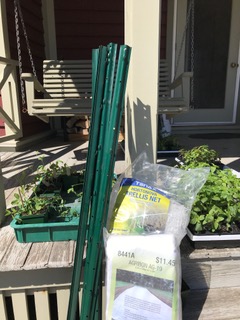
T posts will be placed every 8 feet along both sides of the garden and will be used to suspend the flower netting horizontally. The netting is a 6 inch square grid in plastic that will be positioned tautly about 18 inches above the ground keeping long stemmed flowers erect and preventing them from being blown over by wind and rain. Heavy, tall, floriferous plants will require a second layer of netting about 12 inches above the first.
The ranunculus will be planted using 6 inch spacings and Chantilly snapdragons will have 9 inch spacings. The delay in planting will mean limited or no bloom as these plants go dormant with the summer heat. However, the ranunculus corms can be dried and saved for next year and there are 2 other varieties of snapdragons started that tolerate the heat of summer.
The supplies are waiting
Once in the ground, plants will be hooped with temporary PVC hoops so that frost cloth can be used at night in case of frost or wind and to protect the young plants from deer and rabbits.
A wise gardener remembers that Mother Nature always bats last.
“it’s never too late to start anything, except maybe being a ballerina” Wendy Liebman
References
Cool Flowers, Lisa Mason Ziegler, St. Lyons Press, 2014












 The Peterborough & Area Master Gardeners