Category Archives: Butterflies and Moths

Want to help Monarchs? Plant Swamp Milkweed!

By Silvia Strobl, Master Gardener in Training

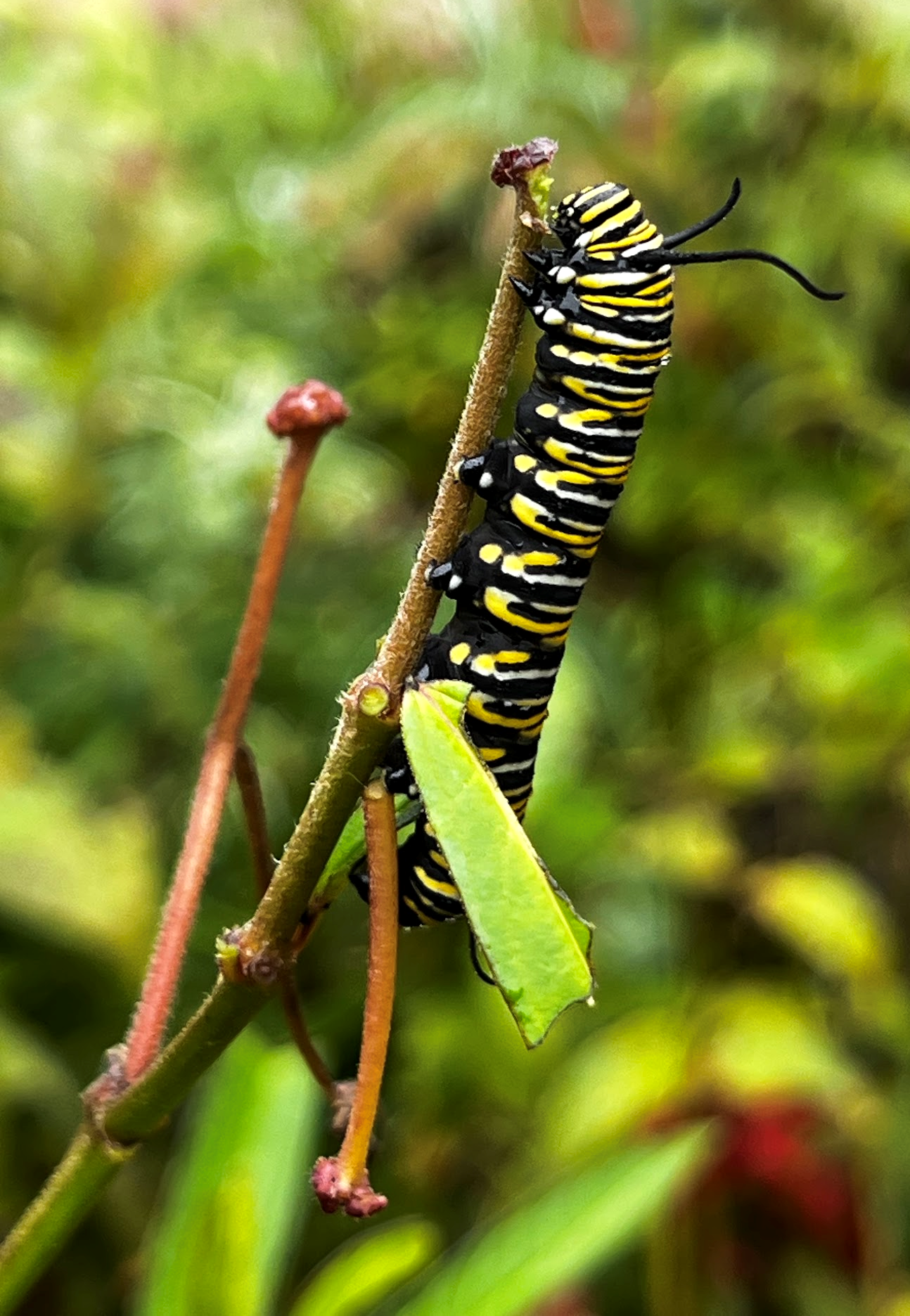
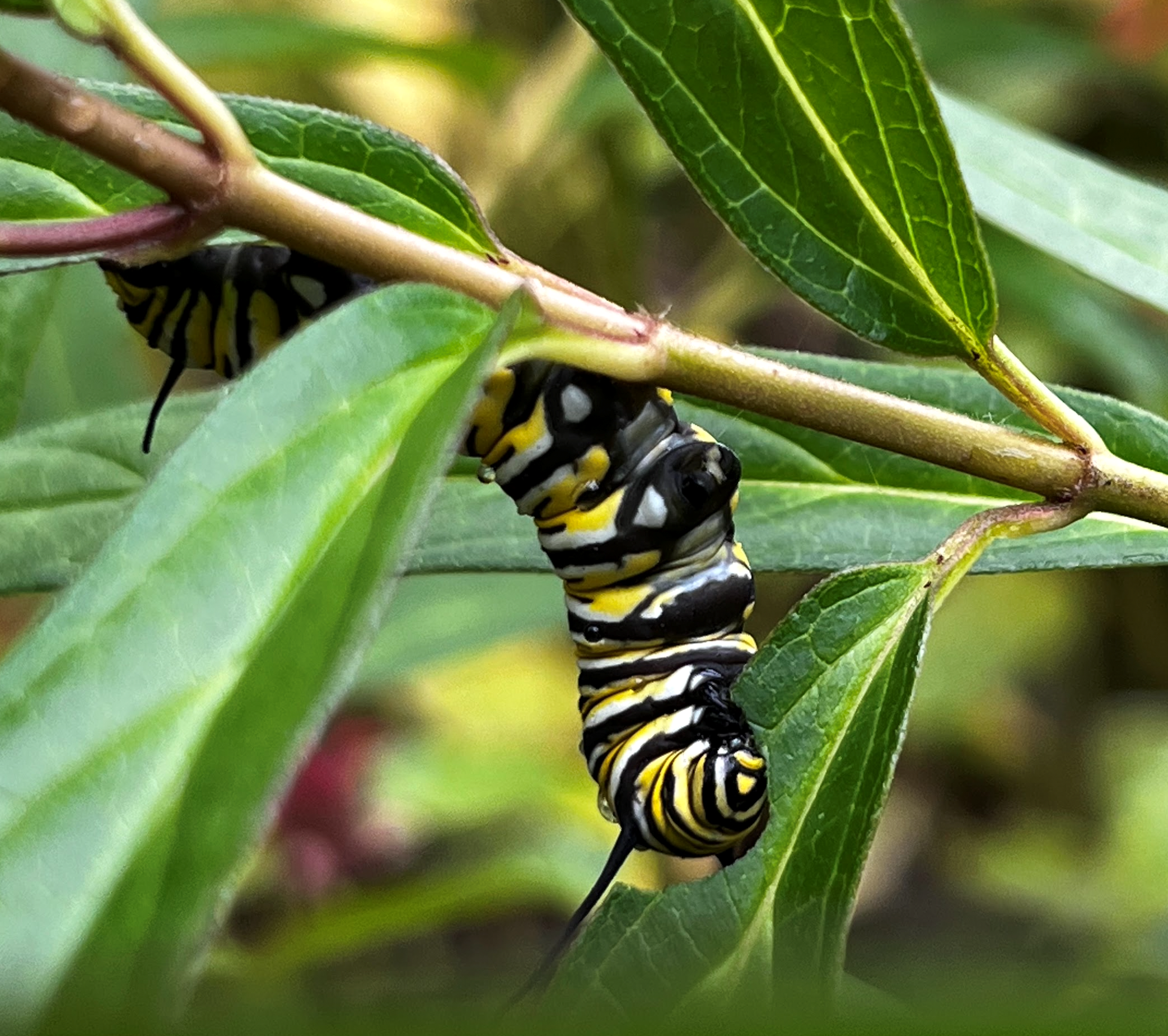
My 2023 garden gave me a front row seat for observing the monarch butterfly (Danaus plexippus) lifecycle. Two monarch caterpillars fed on my garden’s swamp milkweed (Asclepias incarnata) lower leaves for about 10-12 days.  I was very concerned when one started a long journey across the 10-foot-long patio and then climbed 10 feet up the house wall to make its chrysalis just under the eaves! I was relieved to read that monarch caterpillars typically do leave their host plant to make their chrysalis elsewhere just in case there are younger caterpillar instars feeding on the same plant. It would be tragic if their chrysalis came crashing down as another caterpillar feeds on the leaf from which it is suspended!

One of the two caterpillars in my garden last year feasting on swamp milkweed on August 8. By August 13, many more swamp milkweed leaves at been eaten (right)

I expectantly watched the “eaves” chrysalis daily and was rewarded on September 5th when the green and gold flecked chrysalis became more translucent with visible orange and black inside. An adult male, identified by the two dots on its hindwings (pheromone patches), emerged later that day.

One monarch caterpillar travelled across the patio and climbed up the house wall to make its chrysalis just under the eaves on August 17 (left). On September 5, the chrysalis became translucent, and the butterfly emerged. It dried its wings for a few hours (centre). Once it opened its wings, I could identify it as a male by the two pheromone patches on its hindwings (right).

I never saw the second caterpillar leave the swamp milkweed host plant but discovered its chrysalis suspended from the leaves of savannah grass (Sorghastrum nutans) one day.

Swamp milkweed is a common species in Ontario, usually found in wetlands, wet roadsides, floodplains and wet meadows, but looks beautiful in the garden with its upright stature and slender leaves. Its flowers also bloom for a long time and are floral and vanilla scented. It grows quite tall and maintains its structure well into the winter months to provide winter garden interest.

Swamp milkweed is a better choice for the garden than common milkweed (A. syriaca) which is not recommended for small gardens due to its rhizomatous aggressive spreading nature. Although butterfly milkweed (A. tuberosa) is a great nectar plant it is also a less desirable monarch caterpillar food due to its hairier leaves and lower protein content (UNC Charlotte Institute 2022). Both swamp and common milkweed averaged the highest number of eggs laid by female adult monarch butterflies in a study that evaluated the attractiveness of nine milkweed species common to Iowa (Pocius et al. 2018).

Typical habitat for swamp milkweed in the wild, but “it is fairly drought tolerant and will thrive in drier areas once established” (Gray and Booth 2024) (left). A 2-year-old swamp milkweed plant in my dry, sandy garden (right).

Well-intentioned people hope to increase the monarch population by home-rearing monarchs. However, an analysis of over 135,000 monarch observations at 403 annual butterfly count locations across the species’ large summer range[1] compared population numbers in 1993 to those from 2018 and found that although some areas had population decreases, overall summer monarch population numbers in North America are relatively stable i.e., reproduction in summer is compensating for losses at wintering grounds in Mexico (Crossley 2022).

A naturally occurring parasite (Ophryocystis electroscirrha) adversely affects how well monarchs fly as well as their migration survival. It has increased in the last 15 years, raising concerns that parasite transmission is decreasing winter colony populations (Majewska et al., 2021). The Xerces Society has published a joint statement against the release of purchased or mass-reared monarchs by backyard and commercial breeders. If you are raising small numbers of wild-collected monarch eggs and larvae for personal enjoyment, education, or as part of citizen science project they encourage you to follow protocols for safe rearing and collect data on your reared monarchs for programs such as the Monarch Larva Monitoring Project and Monarch Health.

Although the research is not definitive, I recommend letting nature take its course and simply providing for the monarch caterpillar’s habitat needs by planting host plants, particularly swamp milkweed, in your garden.  This spring I planted two more patches of swamp milkweed plants in my garden. I can’t wait to observe the monarch caterpillar drama that unfolds this summer!


[1] The NA monarch breeding range spans nearly the entire United States and southern Canada. Butterfly counts by citizen scientists are held between July 1 and August 31.  Only data with at least 5 years of Monarch observations over a 10-year period were used in the Crossley (2022) analysis. An average of 25 butterfly counts are held annually in southern Ontario. Each count covers a 24-kilometer diameter circle. Last year I participated in my first count in Haliburton, Ontario.

Tips for growing swamp milkweed in your garden

  • If space allows, plant a group of 3 to 5 plants so pollinators can more easily find the flowers. It can grow in sand, loam or clay and prefers full sun.
  • You can grow your own seedlings by winter sowing or purchase seedlings from Ontario native plant nurseries.
  • Water consistently during the first year so swamp milkweed can build roots to support flowering in year 2.
  • Remove seed heads before seed pods open if you want to control the number of volunteer seedlings.
  • Swamp milkweed is not palatable to deer.

References

Crossley, M.S., T.D. Meehan, M.D. Moran, J. Glassberg, W.E. Snyder, A.K. Davis. 2022. Opposing global change drivers counterbalance trends in breeding North American monarch butterflies. Global Change Biology https://onlinelibrary.wiley.com/doi/full/10.1111/gcb.16282

Gray, R. and S. Booth. 2024. The Gardener’s Guide to Native Plants of the Southern Great Lakes Region. Firefly Books. 352 pp.

Marinelli, J. 2024. Rethinking Monarchs: Does the Beloved Butterfly Need Our Help? Yale Environment 360, Yale School of the Environment. https://e360.yale.edu/features/monarch-butterflies-milkweed-home-breeders

Majewska, A. A., Davis, A. K., Altizer, S., & Roode, J. C. (2021). Parasite dynamics in North American monarchs predicted by host density and seasonal migratory culling. Journal of Animal Ecology, 2022, 1–14. https://doi.org/10.1111/1365-2656.13678

Pocius, V.M., J.M. Pleasants, D.M. Debinski, K.G. Bidne, R.L. Hellmich, S.P. Bradbury, and S.L. Blodgett. 2018. Monarch Butterflies Show Differential Utilization of Nine Midwestern Milkweed Species. Front. Ecol. Evol., 24 October 2018 https://www.frontiersin.org/journals/ecology-and-evolution/articles/10.3389/fevo.2018.00169/full

UNC Charlotte Institute. 2022. Milkweeds for Monarchs? The Answer isn’t so simple. https://ui.charlotte.edu/story/milkweed-monarchs-answer-isne28099t-so-simple/

Related

The Kiss Principle—Winter Sowing 101 https://peterboroughmastergardeners.com/2022/12/26/the-kiss-principle-winter-sowing-101/
 

Annuals in a Pollinator Garden?

by Laura Gardner, Master Gardener

If you’re thinking of creating a pollinator garden with native perennial plants, there will be a period where your space will be rather underwhelming or undeveloped.

There is a saying, “first year they sleep, second year they creep, and third year they leap.” In the first year of their growth, many native plants focus channeling their energy into root development instead of flowering. It is important to consider other ways to increase floral resources for pollinators while you wait for these plants to grow.

Consider adding a few native species that are short-lived annuals or biennials—either potted plants or directly sown seed. If started early in the spring, Black-Eyed Susan (Rudbeckia hirta), for example, will bloom in the first year. It usually produces enough seed to ensure future generations.

Spotted Horsemint (Monarda punctata) and Lanceleaf Coreopsis (Coreopsis lanceolata) are a couple of others that will also bloom the first year when started early. Near-native annual sunflowers (Helianthus annuus) are another great choice for new pollinator gardens. An important consideration for choosing annual sunflowers is to make sure that they are not pollenless types.

That said, there really are not a whole lot of native annual species that you can add. To help fill in the gap, it is possible to consider some non-native annuals. An aspect of this that is concerning is whether these plants provide adequate nectar and/or pollen to pollinators.

Many annuals have been bred for size, colour, vigour, and length of bloom period and not so much for their nectar and pollen production. When I visit a garden centre, I pay attention to see if there are any insects visiting the plants. I usually don’t see a whole lot of activity. Of course, this is anecdotal, so what does the research say?

From my cursory reading, the research is a bit uneven. A UK study in 2017 found that most ornamental flowering plants found in garden centres were unattractive to pollinators.[i]

Another US study that looked at a select group of annuals found that while native plants were superior overall, there were some non-native annuals that could be important forage for pollinators. It was found that in comparison with Zinnia, Marigold (Tagetes), Lantana, and Starcluster (Pentas), Sweet Alyssum (Lobularia maritima) was the top performer. In particular, the cultivars “Frosty Knight” and “Snow Princess” showed the greatest diversity and abundance of pollinators compared to the other Lobularia types as well as the other species.[ii]

This year I planted some Lobularia near my vegetable garden in the hopes of attracting beneficial parasitic wasps. The adult wasps will seek out the nectar from the flowers and look for caterpillars on my Brassicas for their young.

Image source: “”Sweet Alyssum” by Mustang Joe is marked with CC0 1.0. To view the terms, visit https://creativecommons.org/publicdomain/zero/1.0/?ref=openverse.

Another more recent study from June of this year also found that while the native plants in the study were visited more by pollinators than the non-native plants, there were still some desirable non-native annuals. Specifically, Begonia and Impatiens were visited more frequently by pollinators than Pansy, Petunia, New Guinea Impatiens, and Geranium.

Similar to the previously mentioned study, these researchers found that there was variability between cultivars of a species. Of the cultivars, the four most visited were Begonia ‘Cocktail Brandy’, Begonia ‘Ambassador Rose Blush’, Impatiens ‘Accent Coral’, and Impatiens ‘Super Elfin XP White.’[iii]

Now, an important question that comes out of this is whether these plants provide quality floral resources for pollinators. Pollinator visits to flowers does not necessarily mean that they are benefiting from the resource. More research is needed in this area. Until then, we can make a few reasonable annual plant choices to help in the interim while the other plants in our new pollinator gardens mature.


[i] Garbuzov, Mihail & Alton, Karin & Ratnieks, Francis. (2017). Most ornamental plants on sale in garden centres are unattractive to flower-visiting insects. PeerJ. 5. e3066. 10.7717/peerj.3066.

[ii] E Erickson, S Adam, L Russo, V Wojcik, H M Patch, C M Grozinger, More Than Meets the Eye? The Role of Annual Ornamental Flowers in Supporting Pollinators, Environmental Entomology, Volume 49, Issue 1, February 2020, Pages 178–188, https://doi.org/10.1093/ee/nvz133

[iii] David Smitley, Colin Oneil, Erica Hotchkiss, Erik Runkle, Jared Studyvin, Evaluation of the most popular annual flowers sold in the United States and Europe indicates low visitation rates by pollinators and large variation among cultivars, Journal of Economic Entomology, Volume 117, Issue 3, June 2024, Pages 1057–1070, https://doi.org/10.1093/jee/toae084

Book Review – The Gardener’s Guide to Native Plants of the Southern Great Lakes Region

by Emma Murphy, Master Gardener

Wow. What a pleasure to finally see this book in print. Written by two very knowledgeable Ontario gardeners — Rick Gray and Shaun Booth — this is the native plant gardening resource I wish I had more than 5 years ago when I started incorporating native plants in my garden.

Focused specifically on the Southern Great Lakes Region, it’s an all-in-one, easy to use resource for those interested in plants that not only look wonderful but fulfill a critical role in our gardens in supporting wildlife,  birds, and pollinators like butterflies, moths, bees, and insects.

It reminds me of an encyclopedia, with a full page spread on each native plant (and there’s over 150!). It’s not surprising to me that’s it’s already #4 on the Globe & Mail’s bestseller list.

The book is visually designed to make it easy to see key information at a glance, using quick guide key icons and two colour-coded bars providing exposure/light and moisture requirements. We’ve been blessed with several excellent native plant books in the past few years, but I appreciated several unique elements I hadn’t seen before – numerous appendices (matching soil types, seed collection and preparation, propagation, and butterflies and their host plants), as well as each plant’s Ontario’s Species at Risk status.

You’ll understand what each plant needs to thrive, how big they will get, and how to make more plants to share with your friends!

Sample spread page

As a Peterborough Master Gardener I have long been engaged in two Facebook groups – the Ontario Native Plant Gardening group (started by Shaun) and the Master Gardeners of Ontario group (where I am an admin and moderator). I remember clearly in May 2023 Rick trying to gauge interest from members on their proposed native plant book, and the incredibly positive response that they received. So full disclosure – I knew I was going to love this book before it was ever published.

The authors explain why the plants are organized by botanical/Latin name, which is important because common names can vary by region. However, if you only know the common name you can always search using the alphabetical index at the back of the book.

Essentially, each entry is a ‘checklist in a page’ on what you need to grow the plant. There are lots of photos (whole plant, leaves, flowers, fruiting bodies), a detailed description, easy to see symbols (the Quick Guide), information on the USDA Hardiness Zone, lifespan, propagation, and wildlife/pollinator value.  

Skill levels are also mentioned but don’t be alarmed – most are listed as beginner, but there are certainly a few native plants that are a bit more challenging to grow and propagate.

Table of Contents plus shameless plug for my wonderful local, independent bookstore where I ordered the book.

I appreciate that in the introductory chapters the authors clearly explain things such as:

  • What is a native plant?
  • Aggressive vs invasive
  • Origin of the term weed
  • Nativar vs cultivar
  • Value of native plants

The authors clearly have a good sense of humour – there are pages titled “How to use this book”, “A coneflower by any other name”, “Fifty shades of…shade” and my favourite “2b or not 2b” (on the rationale for using USDA Hardiness zones). I loved the section on propagation and codes as I’m actively trying to grow more native plant material in my area.

I have to say that as a seasoned gardener I was surprised to see Echinacea pallida (pale purple coneflower) is not in the book (not native to most of this region but often sold as a native apparently) and Agastache foeniculum (Anise hyssop) is one that is included specifically because it is non-native to Ontario (it’s a western prairie plant). Oops! I have both in my garden north of Peterborough.

Was anything missing? Technically no, as the authors were clear that this was not a garden design book. Perhaps after putting out Vol. 2 (the other 150+ plants I know they wanted to include), they’ll consider something on understanding planting density and creating root competition, which I am learning is different to conventional perennials, and good plant pairings (which native plants support others).

One quick comment I will add is that native plants are wonderful once they are established, so you may need to do a bit of watering that first year, but after that they need no watering or fertilizing.

If you’re interested in hearing about how this book came to be check out Rick’s Native Plant Gardener website.

This book is perfect for reading at home (my husband gave me a quick quiz contest this afternoon on the Latin names) or taking with you to your local nursery as you search for native plants to add to your garden. Having trouble finding these plants? The Halton Region Master Gardeners maintain a dynamic map listing native plant nurseries around the province. Check it out!

The bottom line – a wonderful addition to my garden library, and to anyone interested in incorporating more native plants in their Ontario gardens.

__________________________________________________________________________

The Gardener’s Guide to Native Plants of the Southern Great Lakes Region

By Rick Gray and Shaun Booth
Publisher: ‎Firefly Books, 2024
Paperback‏:‎ 352 pages ISBN-10: 0-2281-0460-2
Price: C$45.00; available through local booksellers and larger book companies

About the Authors

Rick Gray (The Native Plant Gardener) has more than 300 species of native plants in his garden in southwestern Ontario and provides native plant garden design services.

Shaun Booth runs In Our Nature, an ecological garden design business, and launched the Ontario Native Plant Gardening group on Facebook.

Want More Information?

Many wonderful books on native plant gardening and naturalization have been published in the past few years – anything by Lorraine Johnson is a great complement to this book, and I love Piet Oudolf’s work (although he doesn’t always use native plants).

Dr Linda Chalker-Scott (and the Garden Professors blog on Facebook) is a great source of good, solid scientific information on gardeners keen to avoid the misinformation often seen on social media.

And if you’re on Facebook, please follow both the Master Gardeners of Ontario and Ontario Native Plant Gardening groups.

Other Native Plant Blog Posts By Me

A Few of My Favourite Native Plants

Native Ontario Goldenrods for Your Garden

Why Do We Garden?

Ditch Lilies – A Cautionary Tale

The KISS Principle – Winter Sowing 101

5 Simple New Year’s Resolutions for Gardeners

by Emma Murphy, Master Gardener

As this year ends, I’m offering a few New Year’s resolutions for gardeners for 2024. If you want more of a challenge, the Chicago Botanic Garden offers 50.

Add Native Plants To Your Garden

  • We’re all seeing the effects of climate change on our gardens.
  • Native plants adapt more readily to stressful and changing weather patterns, such as prolonged droughts or winter cold snaps, than hybrids and non-natives often seen in our nurseries.
  • Native plants help sustain beneficial insects and bird populations because they attract native pollinators and birds that might not be drawn to non-natives.
  • Create less work for you, as native plants tend to be lower maintenance than non-native ones.
  • The Native Conservancy of Canada offers some suggestions to get you started, or consult with your local Master Gardener group or Horticultural Society.
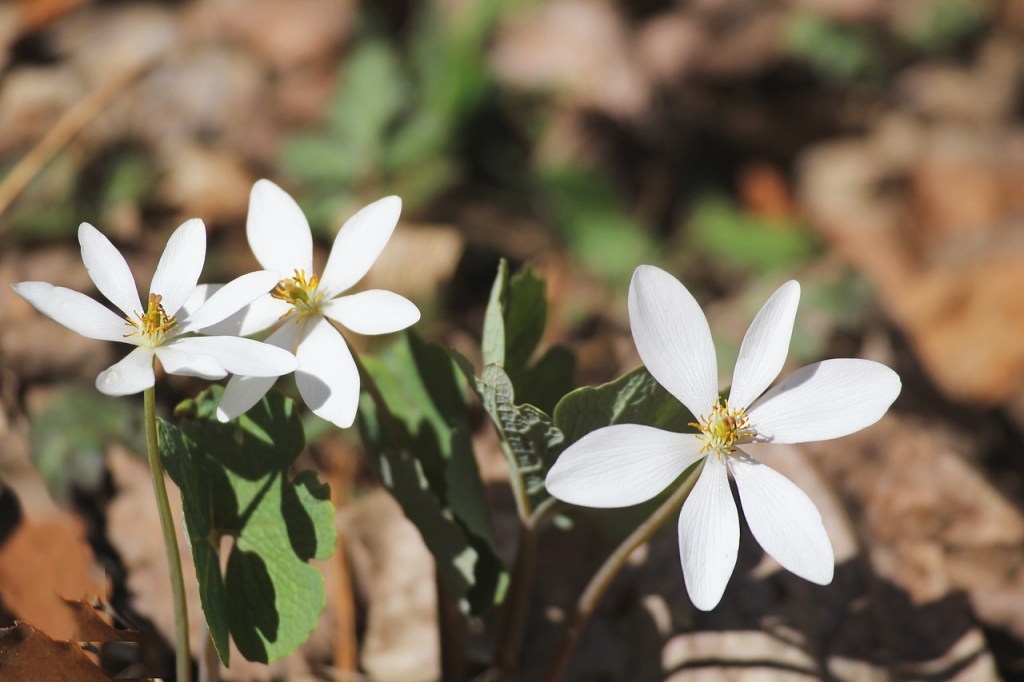
Bloodroot, Sanguinaria canadensis

Start A Compost Bin

  • Composting helps keep waste out of landfill by collecting and processing organics into material that can be used to create nutrient-rich compost used to feed and nourish soil.
  • Canadian Living offers a simple outline, as shared by Ed Begley  Jr.
  • Or more here from the Thames Region Ecological Association, including troubleshooting issues.
Compost bin

Grow More Of Your Own Food

  • The pandemic has highlighted how our agricultural systems are vulnerable to global shocks. Issues with supply chains, migrant workers, transport, trade and border closures have resulted in some foods being in short supply or prices going up (while quality goes down).
  • Insects do all the hard work, and all pollinators benefit.
  • Gardening provides benefits for your wallet, your nutrition, and reduces your environmental footprint. By growing your own food (either from seeds or small plants), your food is automatically more sustainable simply because you are doing it onsite or in a community garden. If you control the ‘inputs’ and do it well, you can save a lot of money.
  • Ultimately there is nothing more rewarding than planting and maintaining your own vegetable garden and harvesting (and sharing) your results. And we all know how much better homegrown produce tastes versus conventional produce at the grocery store. If you have too much produce, then you can just share the love with others!
  • Royal City Nursery in Guelph offers 8 Reasons to Start Growing Your Own Food from Seed
Creating a vegetable garden

Continuous Learning

  • Do what you love but keep on top of what’s trending in garden design to see if anything sparks your interest.
  • Keep track of what’s working and what’s not by documenting your garden happenings in a journal.
  • Expand your garden library and treat yourself to a new gardening book.
  • There are so many amazing (and free) garden webinars available now – learn from the experts.
  • Some of my favourite bloggers – The Impatient Gardener (in Wisconsin, similar climate to us), The Empress of Dirt (Ontario), Niki Jabbour (Halifax), The Laidback Gardener (Montreal), and Garden Myths (Robert Pavlis in Guelph, Ontario).
Online learning is a great opportunity

Reduce Your Use Of Plastic

  • Plastic is a major component in the garden, from plastic plant pots and seed trays to watering cans, and compost bins. Most plastic gardening equipment will end up in landfills, where plastic pots alone can take up to 500 years to decompose.
  • There are a few easy swaps you can make in going plastic-free: Many of us want to use less plastic in the garden, from plant labels to watering cans, tools, plant pots and the sheeting used to suppress weeds. Buying (and therefore using) less plastic will not only reduce your plastic footprint but also sends a message to manufacturers that gardeners want alternatives to plastic (especially single-use plastic).
  • Try to find biodegradable pots that made from natural materials such as coir, bamboo, wood chips, or seaweed (or commit to using your plastic pots year after year).
  • If you use plastic string, make the swap for a natural jute or hemp, and protect your fruits and vegetables with metal mesh instead of plastic netting – it lasts for years.
Find alternatives to plastic pots, or commit to using (and reusing them) for many years

Happy gardening dreams until we can get out into our gardens again….

Native Ontario Goldenrods for Your Garden

by Emma Murphy, Master Gardener

The burst of bright yellow in our late summer gardens and surrounding countryside heralds the blooming of our iconic native goldenrods. Although there are more than 25 goldenrods native to Ontario, most people are familiar with Canada Goldenrod (Solidago canadensis), which is likely the tall one you see as you are out driving.

I have lots of Canada Goldenrod in the naturalized back of my garden, but I also call it my garden thug, because it’s very happy there and trying to take over the world (or at least my backyard). First it outcompeted my New England Asters, and then started crowding out my newer planted trees.

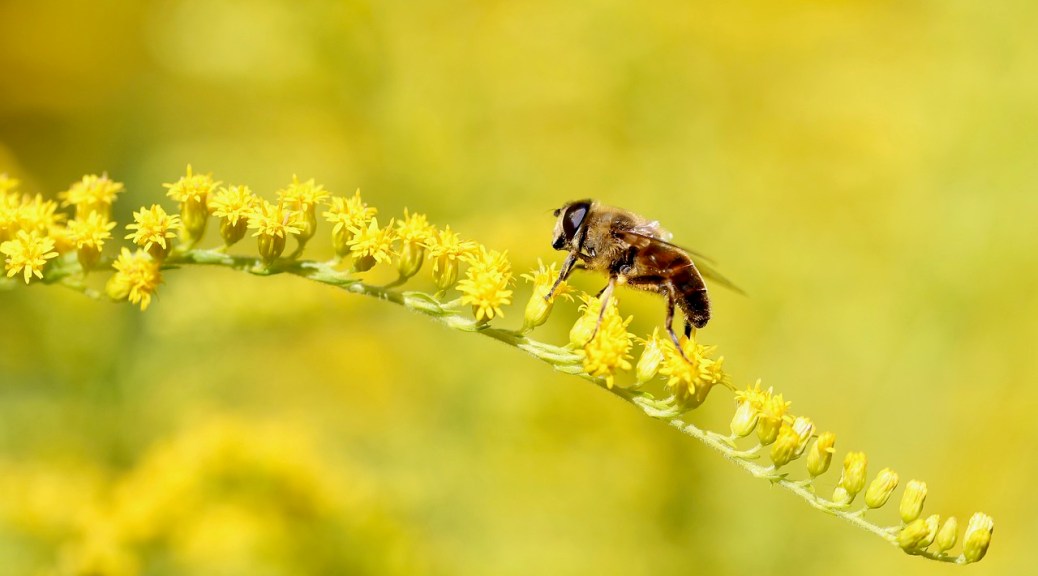
So I started exploring other, more well-behaved goldenrods to add to my garden that still bring all the benefits of this lovely plant, including acting as important nectar and pollen sources for many specialist pollinators and host plants for many moth and butterfly caterpillars. Goldenrods are important late season fuel for migrating butterflies (like monarchs) and our bumblebees.

Here are 3 goldenrods that you should be able to find at native plant nurseries (and maybe eventually in our regular nurseries) that I am experimenting with in my garden.

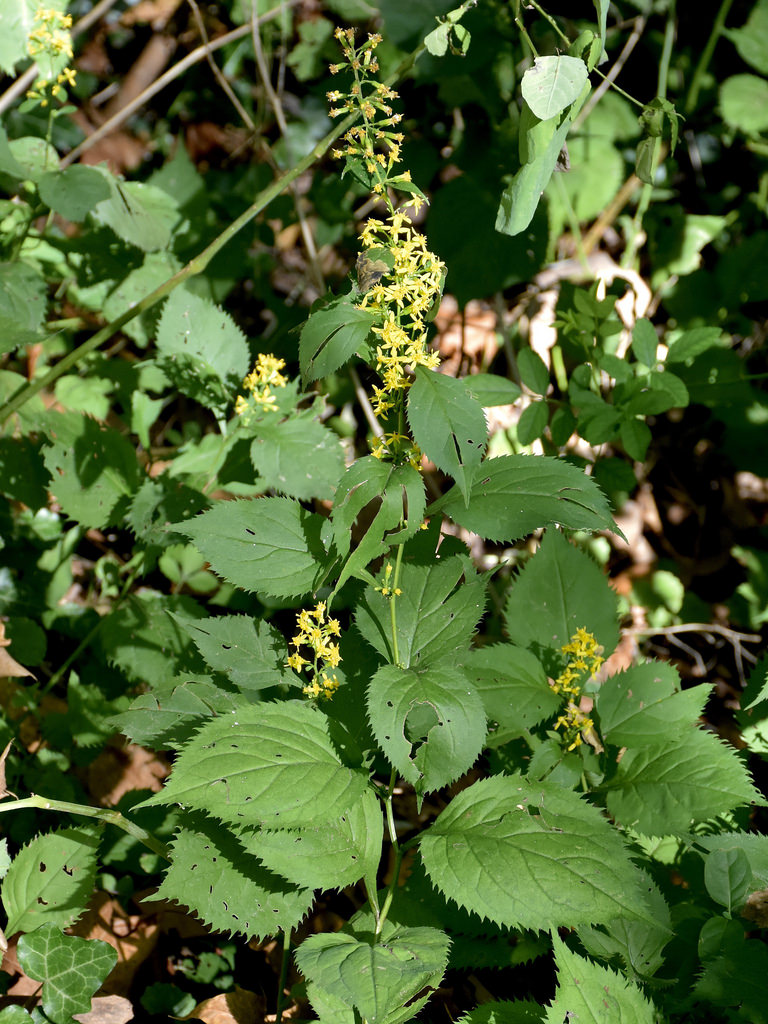
Zigzag Goldenrod (Solidago flexicaulis)

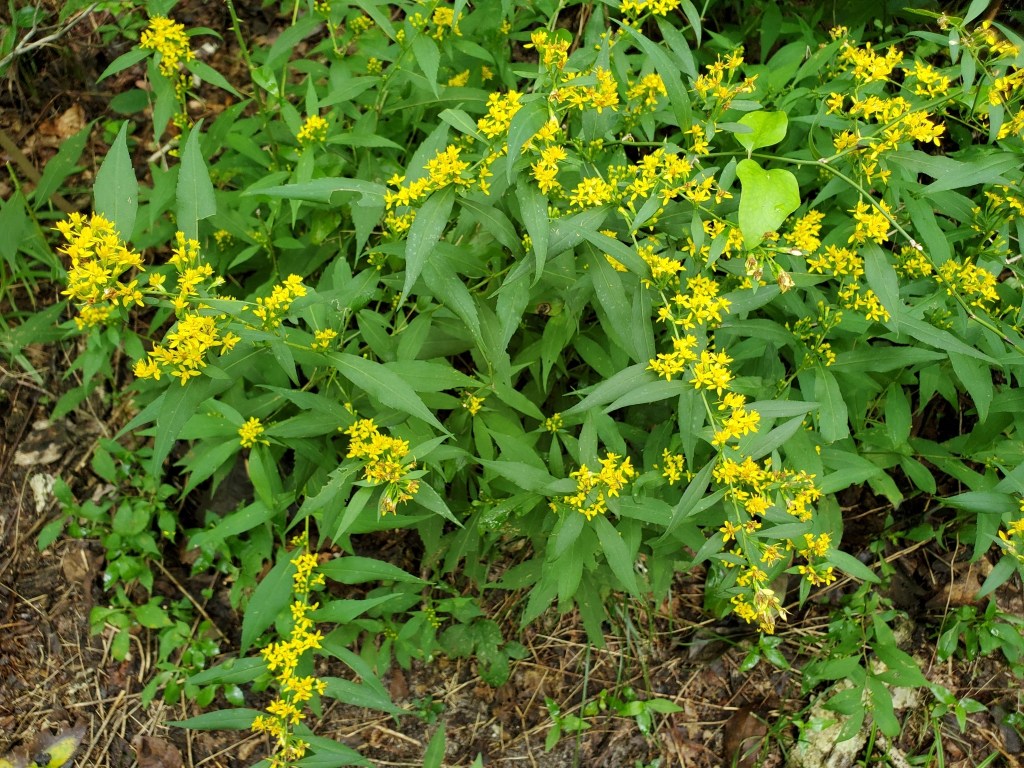
I first saw this goldenrod in a local provincial park and fell in love with it because it thrives in shade/part shade! It can take fairly dry conditions and will grow up to 3 feet high. I’m told if it’s happy it will spread nicely by rhizomes and seed. The name refers to the “zigzaggy” form of the stems. Added bonus? It’s fragrant.

Photo credit: Kirsten Johnson

Bluestem Goldenrod (Solidago caesia)

Another winner in my book (before it’s even flowered) because it also brightens up shade gardens, although this one prefers moister soils. Bluestem Goldenrod has graceful, arching stems and bright yellow flowers and can reach 3 feet tall – the name comes from the purplish stems. It will colonize over time by self seeding. Also known as Wreath Goldenrod.

Photo credit: Tom Feild

Stiff Goldenrod (Solidago rigida)

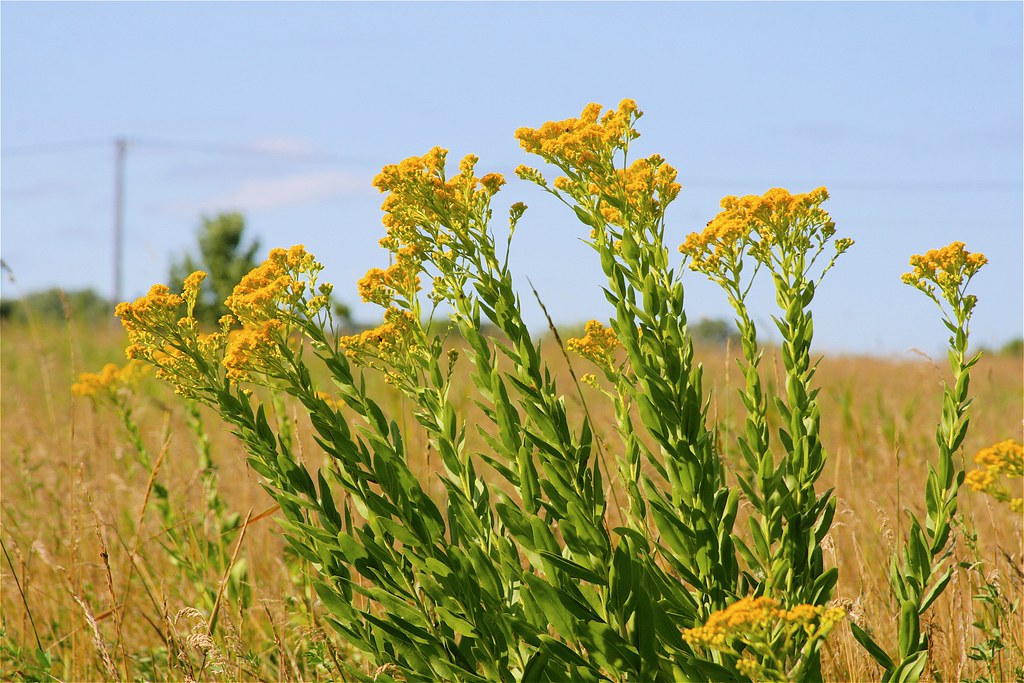
This one’s a sun lover and can reach 5 feet; I’m trying it in my front garden bed with my New England Asters (Symphyotrichum novae-angliae), cup plant (Silphium perfoliatum) and false sunflowers (Heliopsis helianthoides) because it needs similar height plants to avoid floppiness. Unlike the bluestem goldenrod, this one is upright and has large oval leaves and a cluster of yellow flowers at the top of the stems.

Photo credit: Dan Mullen

The City of Toronto’s LiveGreen initiative has some excellent additional information on various other goldenrods here. There is one to meet whatever garden conditions (sun/shade; dry/wet etc) you might have. You can also grow some in containers!

For those interested in more information on identifying and learning about goldenrods here are a few resources:

Ontario Wildflowers – Goldenrods Group

Ontario Wildflowers – Learn the Goldenrods

Goldenrods

Native Goldenrods for Ontario Gardens

So what new goldenrods will you try in YOUR garden?

Do Goldenrods Cause Hay Fever?

And finally (because we’re always asked this question as soon as fall hay fever starts) no, goldenrods do not cause hay fever. Their pollen is far too heavy to be blown around in the wind – the real culprit is Common Ragweed (Ambrosia artemisiifolia) which is easily blown around by the wind and while native, will never find a place in our garden (my husband gets hay fever). NOTE: yes I acknowledge that some people are allergic to goldenrod but they have to literally stand beside them to get the pollen on them). I love what Horticulture Magazine has to say

So why do we blame goldenrod instead of ragweed? Probably because goldenrod flowers are so showy. Ragweed’s green flowers are inconspicuous. It makes sense that people suffering from allergies suspect the plant that they can see is in full, abundant bloom.

Horticulture Magazine

Like Moths to a Flame – Rethinking Outdoor Lighting in Your Garden

by Emma Murphy, Master Gardener

A few weeks ago, the incomparable Lorraine Johnson spoke at my local horticultural society. She summarized four key actions gardeners could do to help our pollinators, and the last one stuck out for me — reduce/reconsider outdoor lighting (see her full list of actions at the bottom of the blog).

I thought, what does outdoor lighting around my house or garden have to do with pollinators? I know that the presence of lighting (or even more importantly, light frequency) is disruptive for migrating birds and nesting sea turtles, but for pollinators in my garden?

However, what I’ve learned in my research is that artificial lighting at night (aka ALAN) poses a hazard to nocturnal pollinators and prevents proper navigation, reproduction, and their ability to find food.

This really cool graphic (from Kenilworth Park and Aquatic Gardens in Washington DC) shows some examples of day and night pollinators.

Why is it a problem?

Use of ALAN has rapidly spread around the globe over the past few decades. This 2021 Nature Communications journal article states increasing evidence that ALAN adversely affects the behaviour, physiology, and survival of animals and plants, ultimately leading to a significant decline in their abundance and diversity.

This 2020 Biological Conservation journal article says that although habitat loss, pesticide use, invasive species, climate change all play a role in insect decline, ALAN is another important—but often overlooked—bringer of the “insect apocalypse”.

A Nature journal article back in 2017 also sounded the alarm, showing that in ALAN plant–pollinator communities, nocturnal visits to plants were reduced by 62% compared to dark areas.

This UK Royal Horticultural Society article lists some of the effects of ALAN, not just on pollinators but all wildlife:

  • Nocturnal insects (including many moths) who navigate using natural light sources (like the moon) are disoriented by ALAN (although research is now indicating that ALAN disrupts circadian rhythms in both nocturnal and diurnal animals).
  • Security lights appear to temporarily blind some animals and may even attract them (for example, frogs – I have seen this in my backyard near my pond).
  • Birds are disturbed from sleep by sudden lighting and can begin singing before dawn (robins especially seem sensitive to light). Birds that start migration flights at night can become disoriented.
  • In ALAN areas, shorter periods of nighttime darkness means less time for foraging/hunting for crepuscular (dawn/dusk) or nocturnal species.
  • ALAN is thought to be partly to blame for the decline of fireflies/glow worms; the females emit low, greenish light to attract mates and even low level ‘skyglow’ from distant light sources such as floodlit playing fields or towns will lessen their breeding success.

The type (frequency) of light seems to affect species differently. For example, research indicates that LEDs seem to attract more moths and flies, but fewer beetles than sodium lamps. And LEDs with cool white light (blue end of the spectrum) attract more insects than warm white ones. As a general rule insects are more sensitive or attracted to short-wavelength (UV, blue and green) than long-wavelength (orange, red and infra-red) light.

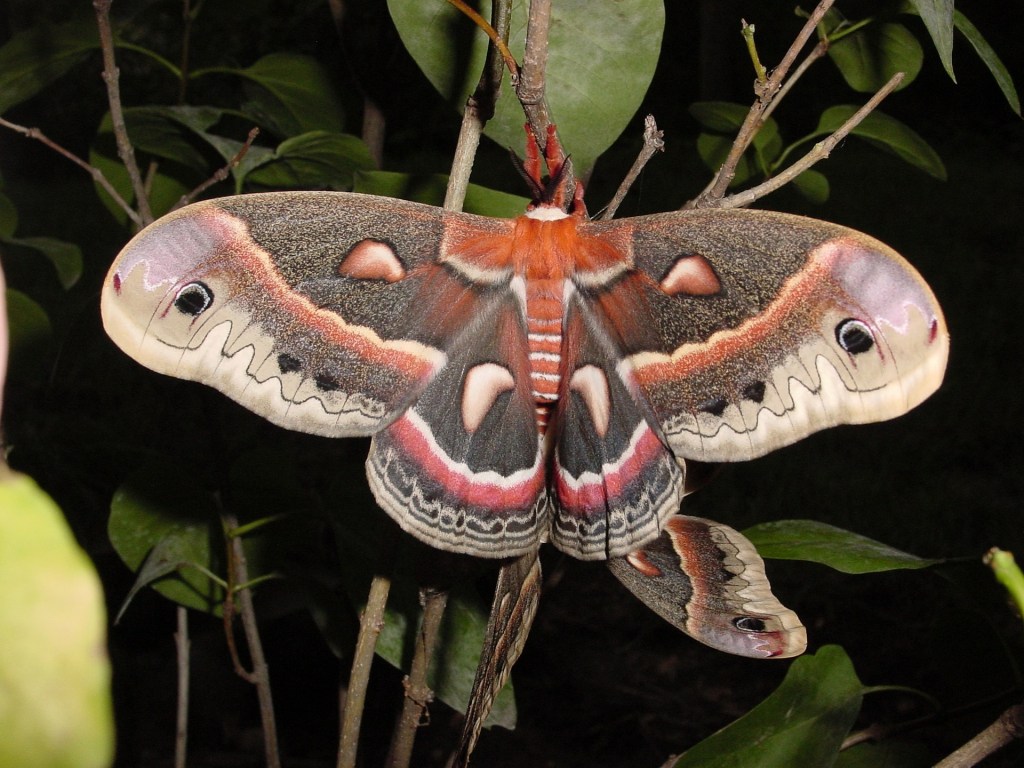
Cecropia moth (Hyalophora cecropia)

So what can gardeners do?

While ALAN has become a trendy part of our outdoor living spaces, consider whether you really need it, or modify it to minimize its impact. In my back garden I definitely need some path lighting for visiting guests, but I make sure it’s shielded lighting that is on a motion sensor so it’s only on for a short time. The International Dark-Sky Association has some great information on keeping our skies dark, including using shielded light fixtures that minimize glare, light trespass, and skyglow.

Besides, a garden can be just as magical a place enjoyed in moonlight or simply with the aid of a flashlight! And if you minimize ALAN you might just see more fireflies/glow worms in your garden, like I do (hint: having a pond or water feature also attracts them).

Want More Information?

Moths do the pollinator night shift – and they work harder than daytime insects

Fatal attraction: how street lights prevent moths from pollinating

The Darkness Manifesto: On Light Pollution, Night Ecology, and the Ancient Rhythms that Sustain Life by Johan Eklöf (on my to read list)

Google Lens (free!) for all of your identification needs

By Mary-Jane Pilgrim, Master Gardener

If you’re outside enjoying the fresh air, and happen across a flower or bird or insect and you’re not sure what you’re looking at, a new feature from Google can help you out.

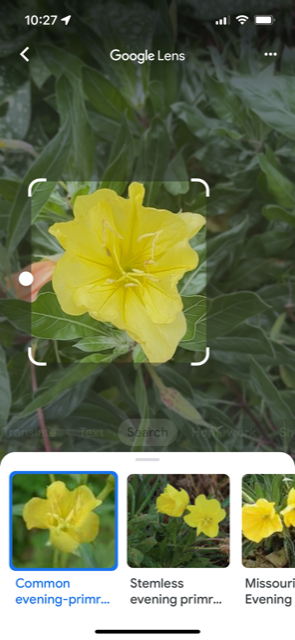
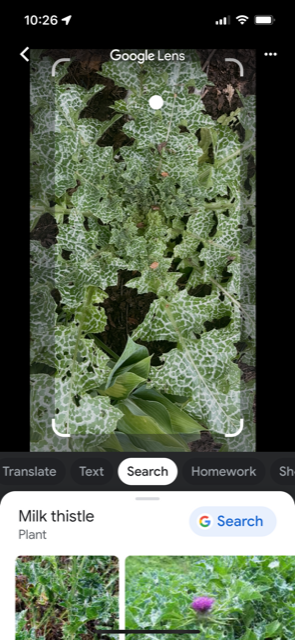
Google Lens lets you search what you see. Using a photo, your camera or almost any image, Lens helps you discover visually similar images and related content, gathering results from all over the internet.

All you need to do is: On your phone, open the Google app and in the search bar, tap Google Lens. Point your camera at the flower to identify the plant. Swipe up to learn about the discovery.

On Android, Google Lens is likely already built right in — open the Google App or Google Photos app. Tap Discover or tap the Google Lens icon.

On Apple, Google Lens is part of the Google app — a separate app from using Google on Chrome, Firefox or Safari. Go to the App Store and download/install Google as a unique app if you haven’t already done so.

When you open the Google App, you’ll see a screen like this with the Lens icon. It’s your window to discovery!

Last week, I went for a long walk and checked out a lot of the volunteer trees and plants along the rural roadway. Sometimes I wanted to verify an item I thought I already knew, but more often I wanted to determine the name of a common but name-unknown item. Google Lens scored on both fronts. Now if only I could remember all of those names!

If you have a bug infestation, use Google Lens to identify the bug if you can get it to sit still long enough!

There’s plenty more you can do with Google Lens, too, including pulling the contact information from business cards, identifying unusual foods and almost anything else. It can also translate words on the screen into other languages, and read them back to you.

The ability of the app to actually CORRECTLY identify plants and bugs is pretty decent, and will get better over time. It helps to allow Google to use location services, so that it’s not searching through the entire rain forest to determine the name of the plant in your neighbourhood. You can also allow Lens access to your photos, so that you can identify items you’ve already taken pictures of.

Best of all, it’s free and will always be free. Try it!

Holes in Leaves

By Christine Freeburn, Master Gardener

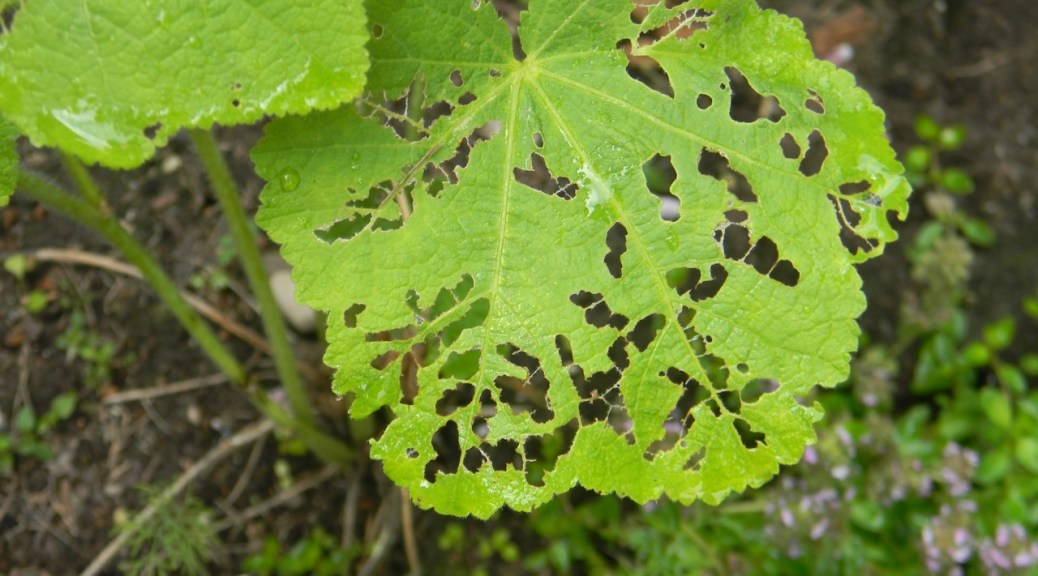
Several years ago I heard a wonderful talk by Martin Galloway on “Holes in Leaves.” His philosophy was that you can never totally eradicate pests from your gardens, so you should enjoy the beautiful lacing they do to your leaves. At the time, I was skeptical about how I could love holes in leaves and the pests that put them there. However as a Master Gardener, I now understand his perspective and I do try for a balance using safe methods to control pests. Integrated Pest Management (IPM) is a practice where pests are controlled using environmentally safe and economically sound values. Biological controls like BTK or parasitic nematodes can be used. Barriers such as diatomaceous earth, wood ashes or sticky boards are mechanical control methods as well as hand picking. Cultural methods include plant nutrition, sanitation, planting pest resistant varieties and plant rotation (in the case of vegetables).

Although we don’t want bad bugs in our garden, we do want the beneficial bugs that are predators and parasites. These include dragonflies and damselflies, lady bugs, lacewings, spiders, wasps and some types of flies.

Aphids or plant lice are one of the most common pests to attack your plants. They are tiny soft bodied creatures that can be black, red or green in colour. They suck the sap from your leaves, and leave a sticky substance behind. You will often see them in a long line on your stems. Red aphids are common on garden phlox. You can use an insecticidal soap for aphids. Or use a blast of hose water to knock them off your plants.

Beetles are hard bodied insects that are generally easy to find on your plants. There are many types and they are often named after their plant of choice, like scarlet lily beetle. The most effective method for controlling beetles is hand picking. Look for the striped cucumber beetle inside the blossoms. When handpicking, place a hand under where the beetle is to catch it as they tend to jump when you touch them.

Caterpillars are another garden pest that are easily spotted. In spring you may find your Hydrangea arborescens has closed, puckered leaves which are holding the common leaftier. You can gently open the leaf and remove and destroy the caterpillar inside or pluck of the entire leaf and squish.

Slugs and snails are sometimes difficult to find as they like dark damp places and feed at night. But you will know you have them when they are munching on your hosta leaves. Check out Gardens Plus for Dawn’s formula for slugs.

As we enter the dog days of summer, we are all battling voracious bugs eating our beautiful flowers and vegetables. The healthier your plants are, the less they will suffer from a deluge of bad bugs. That is why it is important that you give your plants the water and nutrients they need to be their best. Good soil health and good fertilizing methods will give you healthier plants.

Remember that anything you apply to your plants to kill those pests can also hurt pollinators and will be on the vegetables and fruit that you ingest.

To make your garden less inviting to pests

  1. plant the right plant in the right spot to keep it happy and not stressed
  2. do not overcrowd plants which encourages dampness and pests
  3. diversity in your garden will help with pest control – if there are a variety of plants, specific pests will not take over
  4. keep nitrogen levels moderate as many pests like aphids thrive on plants with high levels of N.
  5. Remove garden litter; if pests are present as they can overwinter there.

My favourite method of hand picking beetles and slugs and hosing down aphids is no cost and gets you out into your gardens….where you can enjoy your own “Holes in Leaves.”

For more information on garden pests go to https://www.missouribotanicalgarden.org/gardens-gardening/your-garden/help-for-the-home-gardener/advice-tips-resources/pests-and-problems.aspx

or try https://cdn.dal.ca/content/dam/dalhousie/pdf/agriculture/ExtendedLearning/gardenbox/Managing%20Vegetable%20Pests_Garden%20Box_Online.pdf

The Joy of Sharing our Gardens

Reflections after a Garden Tour

by Emma Murphy, Master Gardener

It’s been a tough few years for all of us because of COVID-19, but I had time to reflect this weekend on why it’s been hard for me as a gardener. While it’s been wonderful to have our gardens as an oasis and source of comfort during the pandemic, I realized that other than a few close friends, no one had seen all the work (and the results) that my husband Grant and I had achieved over that time.

So it was with great anticipation that we looked forward to our Lakefield garden being featured on a garden tour organized as a fundraiser to celebrate 60 years of the Lakefield Horticultural Society.

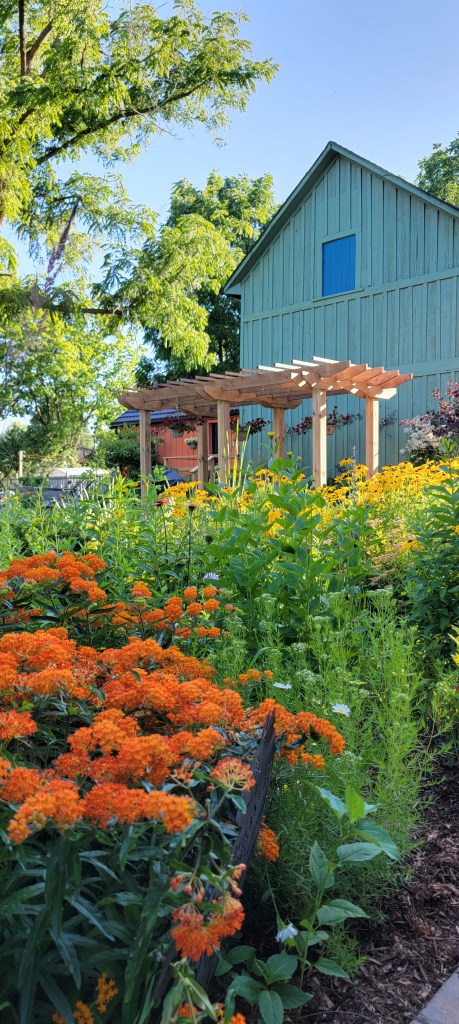
While we spent a few very crazy days trying to put the final touches on our garden (my husband decided he would build a beautiful pergola [awesome] a week before the event [not so awesome] so plants had to be moved into pots and then back into the beds just a few days before) — sorry I digress — everything was perfect on the day — the weather was spectacular, we placed the last bits of mulch to cover a few empty patches and we looked forward to welcoming our guests.

The new pergola.

As the first people arrived (I think our first visitor was a man on a bicycle!) I began to realize how much I had missed the joy of sharing our gardens with others. And as the day progressed, it was wonderful to hear other people’s perceptions — for some it was inspiring, for some a bit overwhelming (we have a 3/4 acre property in a small village), for some they loved that we had plants they had never seen before (not your typical garden). Everyone seemed to leave with a smile on their face, which made our day.

Grant created numerous raised beds over the past few years — at my request — and we’ve had great success with them. We also purchased a “COVID present” for ourselves — a long wished-for greenhouse to extend our gardening season, and it’s been put to good use.

We’ve spent time over the past few years planting more native plants as I learn more about the benefits of creating habitat as well as having an aesthetically pleasing garden. Hey, it’s not all about me!! Doug Tallamy’s book is a great start to understanding the benefits we can provide in our humble gardens to the greater ecosystem.

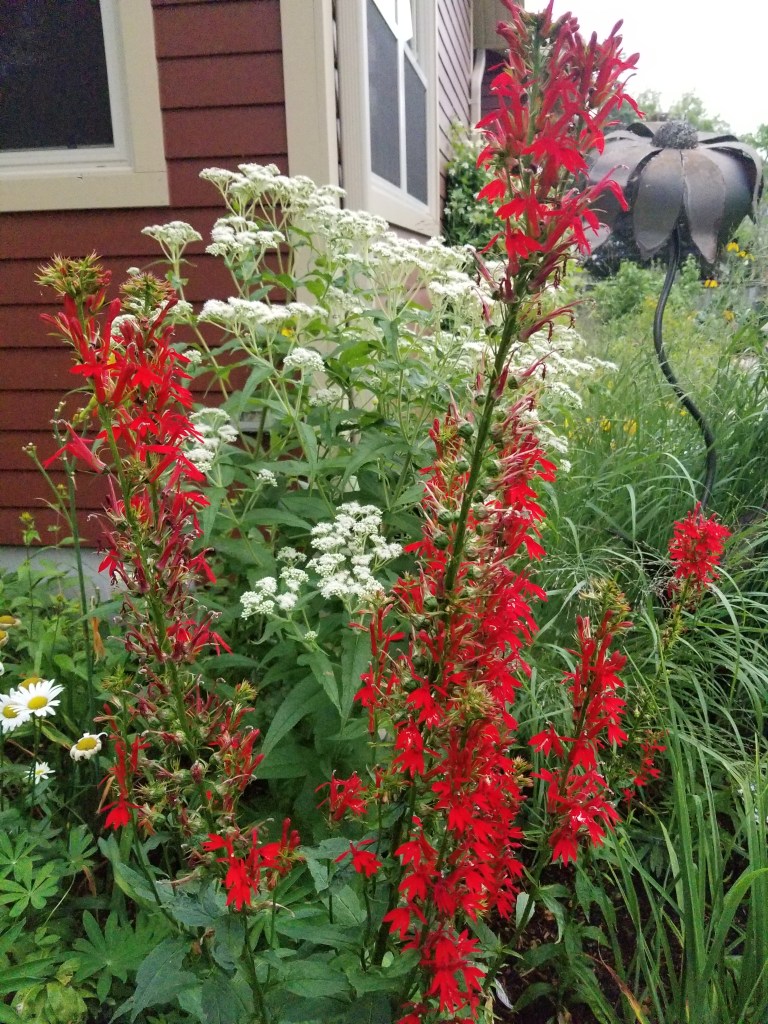
There is definitely a balance — we’re aiming for a 50/50 balance of native/non-native — because I love my daylilies and peonies and don’t want to give them up (they give me pleasure), but I also love the hundreds of pollinators (bees, butterflies, wasps etc.) that flock to my Common Boneset (Eupatorium perfoliatum), Pearly Everlasting (Anaphalis margaritacea), Cup Plant (Silphium perfoliatum), and Cardinal Flower (Lobelia cardinalis) because I am choosing to plant native plants.

Boneset (white) and Cardinal Flower (red)

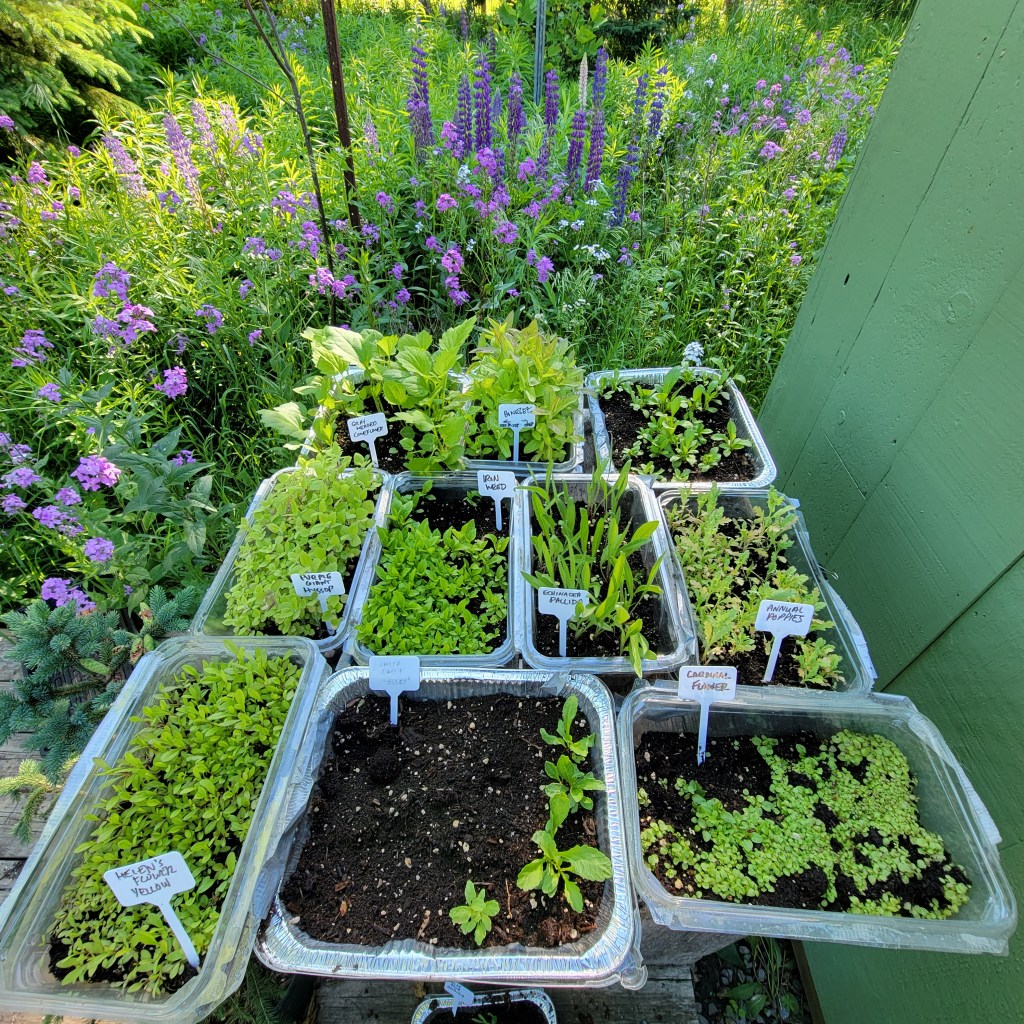
Last winter I grew some native (and non-native) plants using the Winter Sowing technique (because most native plant seed requires winter/cold stratification) and it was a great success (with some lessons learned – but that’s another blog).

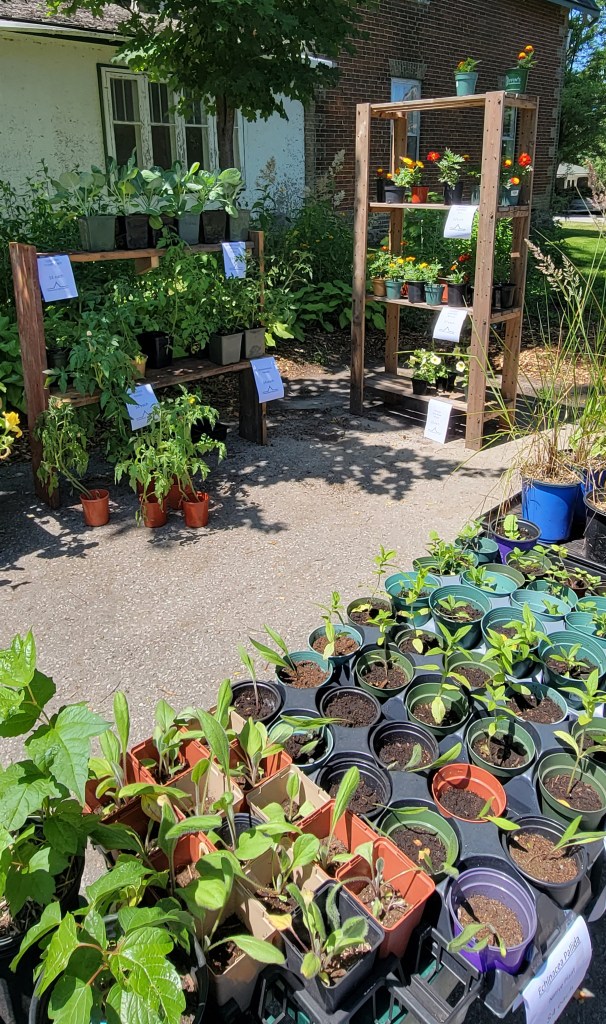
Grant set up a Plant Sale area for the garden tour and people were able to buy plants that they saw in the garden (although alas, I did not take any cuttings on my amazing orange Butterfly Weed – a type of milkweed – which really caught everyone’s attention).

The Plant Sale area

Over the day I saw many gardening friends I hadn’t seen in several years, and made all sorts of new friends. It felt like my community was coming together — like we were reconnecting after a long time apart in a beautiful place. And I realized that gardening is both a solitary and a very social activity. We even got featured in the local newspaper.

We raised funds to support our local horticultural society, we got back to feeling ‘a bit normal’, and most importantly we got to reconnect with people over a common passion — the love of gardening.

I hope that all of you will find opportunities to reconnect with people this summer and share your gardens and plants and trade stories about attracting pollinators etc. with others. It’s a feeling like no other. #happygardening

Our lovely rudbeckia and greenhouse in the background.

A Few of My Favourite Native Plants

by Emma Murphy, Master Gardener

I’ve been gardening for more than 25 years and, like many of you, thrill at the opportunity to discover new plants for my gardens. Over the past few years these have been mostly native plants, as I learn about all the benefits that they bring – here’s just a few examples of why native wildflowers, grasses, shrubs and trees do so much more than just add beauty to the landscape:

  • They support birds, pollinators and wildlife – native gardens attract birds and butterflies and provide habitat and food for native pollinators
  • They increase biodiversity – native plants increase garden health and resilience, and help contribute to a broader effect to nurture and sustain living landscapes
  • They’re tough and low maintenance – because they’re adapted to grow in their native range, locally native plants tend to thrive with little to no care and conserve one of our most precious resources – water
  • They help you save money AND create a healthier environment for people – native plants don’t require expensive fertilizers and chemicals, or toxic pesticides and herbicides
  • They help with climate change – no lawn mower costs or exhaust! and long lived native trees help store carbon dioxide
  • They make gardening easier – if you select the right native plants for your garden, you don’t have to modify or amend your soil

I’m just going to share three favourite native plants in my garden, with hopes that you may consider them for yours.

Culver’s Root (Veronicastrum Virginicum)

Culver’s Root offers a strong upright, architectural accent to any perennial garden that attracts attention from both people and pollinators!! It can reach heights of 5 feet if it’s happy (although mine hasn’t achieved that yet) and the spikes of white flowers open from the bottom up in mid-summer. It has finely toothed leaves that are lanceolate and occur in a whorl of 3 to 8 leaflets. The inflorescence has several wand-like flowering spikes that resemble an elegant candelabra.

Culver’s Root grows in zones 3-8, in full sun to part shade but it does like moist, well-drained soil. The seeds are so tiny that they should be directly sown on the soil surface in fall or in the spring – I’ve tried winter sowing some this year so we’ll see how that goes.

The plant really has no other synonyms; apparently the name was derived from a Dr. Coulvert, a late 17th to early 18th century pioneer physician who found laxative properties in the plant. More information here.

Cardinal Flower (Lobelia cardinalis)

Who doesn’t love bright red flowers in the garden? For those who say native plants can’t be showy I give you this amazing example to disprove that theory. Named for its scarlet red flowers, its tubular flowers are a magnet and important nectar source for hummingbirds and swallowtail butterflies.

Like Culver’s Root the flowering spikes open from the bottom to top and bloom for several weeks. They grow best in moist, rich soils in full sun to partial shade.

I’ve only had my plants for two seasons but I understand that the parent plants will not persist after a few years, so it’s important to either let it go to seed (so it reseeds naturally) or collect seed – this is another plant where I am trying out winter sowing (native plants are a great choice for this propagation method). While many sites will tell you it needs a really moist site mine have done fine, although I do keep the plants well watered in drier times. More information here.

Green Headed Coneflower (Rudbeckia laciniata)

Also commonly called Cut Leaved (or Cut Leaf) Coneflower, this is the straight species, not to be confused with the double cultivar many of us have in our rural gardens (often called the Outhouse Plant – or Rudbeckia laciniata “Golden Glow”).

Not a small plant (it grows 4 to 5 feet tall in my garden), it clumps and spread by rhizomes so only one to consider if you have the space! Its bright yellow, daisy-like drooping flowers with green centre disks (which can be about 3 inches across) bloom later in the summer season. It prefers moist soil, but grows well in average, medium, well-drained soil in full sun to part shade. In nature it is often found in woods, meadows, streambanks, and roadside ditches.

The Cherokee natives call this plant Sochan and the spring basal leaves are a traditional Cherokee food. Butterflies are attracted to nectar from the blooms and songbirds, especially American Goldfinches, eat the seed in the fall. It is moderately deer resistant. More information here.

So I hope you’ll take the opportunity to seek out native plants to add to your garden, finding ones that are native to your region and appropriate to your conditions. Happy Gardening!!