It was my sister that put the notion in my head that I would like a snag in my garden and the recent ice storm provided the opportunity. A standard Serviceberry cultivar was too broken to save but it left a reasonable and safe trunk for my smallish garden. It also left some small logs to tuck under shrubs.
Dead wood provides positive impacts to biodiversity as many beneficial species are on the search for dead wood. ‘Some of these species include cavity nesting birds and mammals, beetles, fungi and other plants and beneficial insects. Decaying wood positively impacts soil keeping your garden sustainable for years to come’. https://ecologicaldesignlab.ca/site/uploads/2024/12/04_good-garden-practices.pdf
Ecologically speaking a snag refers to a standing dead or dying tree, often missing a top or most of the smaller branches. A snag is also known as a den, cavity or wildlife tree. The following link (Ottawa Field Naturalists’ Club) provides an excellent description of the importance of wildlife trees to wildlife. They provide food, safe cavity nesting sites and platforms, roosting and denning sites, hunting perches, display stations and foraging sites for a wide variety of species. https://ofnc.ca/conservation-how-to/the-importance-of-snags-and-downed-logs-to-wildlife.
Safety first so have a certified arborist advise you on the appropriateness of a potential tree.
Photo: Top of the snag in author’s garden
Dead wood that is lying in your garden is an excellent addition. It will be quickly colonized by natural decay fungi known as saprophytic fungi, my new word of the day! These fungi help recycle the carbon and nutrients stored in woody tissue back into the garden soil which benefits your plants. A small pile of logs can support many different insects and provide shelter for small mammals, reptiles and amphibians and shelter for over-wintering and hibernating wildlife. https://www.rhs.org.uk/wildlife/dead-wood-compost-heap-habitats This may not make everybody’s heart sing but I like the idea.
Photo: A favourite chunk of wood in author’s garden
The small snag I now have may be more ecologically beneficial as a log on the ground but I have some ideas for it. I plan on providing some support on it for a vine, maybe a Apios americana (American Groundnut). There will probably be a small birdhouse attached. The new logs have joined other decaying wood that I use as garden edging and garden decoration.
This week I’ve been enjoying watching a flock of American Tree Sparrows that have migrated south from their summer tundra breeding grounds to my garden north of Peterborough for the winter. While I have both sunflower and nyger feeders, they are feeding exclusively on the Big Bluestem and Savannah Grass seeds in my garden. Sadly, these native grasses seem to have a bad rap among gardeners which is too bad as they have many benefits for both you and local wildlife.
I have the following four commonly occurring warm season perennial native grasses in my full sun garden:
Big Bluestem (Andropogon gerardii) is a very tall (5 – 8 ft) grass with clumps that form a dense sod but does not creep by rhizomes. It competes aggressively with shallow-rooted flowers, so it is best planted with species that form deep tap roots or spring bloomers that go dormant in the summer. In my garden it is a fall season focal point at the back of a border behind Culver’s Root (Veronicastrum virginicum) which has a central taproot as well as underground rhizomes.
In early May, Big Bluestem still hasn’t emerged, but allium foliage and some blooming tulips fill the space (left). By late June, alliums appear to float above the Big Bluestem grass (highlighted in orange) that is now 2 ft. tall (middle) and hiding the bulb foliage. By late July, Big Bluestem grass provides a green backdrop for the white flower spikes of Culver’s Root (right).
Little Bluestem (Schizachyrium scoparium) is an excellent grass for gardens due to its shorter height (2 – 4 ft), clumping form, very showy silver-white seed heads, and bright red stems in fall.It prefers dry sandy soils.
Savannah Grass (Sorghastrum nutans)is another tall grass (5 -7 ft) for the back of the border. It tends to self-sow so the young seedlings require a little annual weeding.
Native grasses add movement and colour to the garden. Little Bluestem’s red stems are illuminated by early October morning sun (left) while the late afternoon August sun highlights the tiny golden flowers and flower stalks of Savannah Grass (right).
Sideoats Grama (Bouteloua curtipendula) is a hardy, short bunchgrass that spreads very slowly by means of short, stout rhizomes and doesn’t compete with other plants. Its deep fibrous roots make it useful on slopes to prevent erosion (or on the edges of slightly sloped garden beds as in my garden). Do not plant it in clay soils.
Sideoats Grama has delicate hanging flowers (left), and later seeds (right) that are held in spikes that fall gracefully to one side of the stem.
Benefits for you
As well as being stunning fall and winter focal points, the tall native grasses, Big Bluestem and Savannah Grass, make excellent privacy borders. Their very deep roots (5-6 feet or more) make them useful for erosion control on slopes. Each of these native grasses is drought tolerant. And, each creates excellent winter interest as they tend to maintain their upright form. Another bonus is that they all have low palatability to deer.
Big Bluestem (left) and Savannah Grass (right) stand tall in the author’s garden despite 12 inches of winter snow.
Benefits for wildlife
Many butterfly skipper and moth larvae feed on these native grasses and they provide critically important seeds and habitat for native birds in fall and winter.
An adult Delaware Skipper rests on a blade of Big Bluestem in the author’s garden (left). Big Bluestem is a host plant for this butterfly’s larvae. Both Little Bluestem and Sideoats Grama are host plants for Leonard’s Skipper caterpillars. The adult butterfly is seen here nectaring on marigold in the author’s garden (right)
American Tree Sparrows feeding on a buffet of Big Bluestem (left) and Savannah Grass (right) seeds in the author’s garden. It is fun to watch them “ride” the Savannah grass stems to the ground so they can more easily peck at the seeds some of which spill onto the fresh snow.
Native Grass Establishment and Maintenance
Most native plant nurseries stock these grasses and all of them are easily propagated from seed. Plant seedlings densely at 1 ft to 1.5 ft spacing to discourage weeds. Water during the first year while roots are getting established. Fertilization is not necessary. All can be easily divided, but Sideoats Grama should be teased apart, not cut with a spade.
Remnant pockets of native grasses like this one of Big Bluestem growing on the shoreline of Little Jack Lake (left) are good places to collect seeds to propagate your own plants (right). Never collect more than 10% of seeds.
Depending on how much seed the birds eat in winter, you might get a few volunteer seedlings. If you don’t want more plants, they are easily kept in check by weeding when they are small.
If weedy cool season grasses have seeded into native warm season clumps, use a propane torch in early spring to burn emerged leaf blades while warm season native grasses are still dormant. Be sure to first cut off last year’s dry stalks and have a hose nearby. Don’t do this on a windy day!
Big Bluestem, Savannah and Little Bluestem are 3 of the 4 dominant grasses found in remnant tall grass prairies and oak savannahs, of which less than 1% of their pre-European settlement extent remains in Ontario. (The other is Switchgrass (Panicum virgatum) which can self sow quite a bit so might not be suitable for small gardens.) These grasses are also found on dunes, sandy shorelines, rock barrens, roadsides, and hydro corridors. Including these grasses in your garden can help support some of the wildlife that rely on this endangered ecosystem.
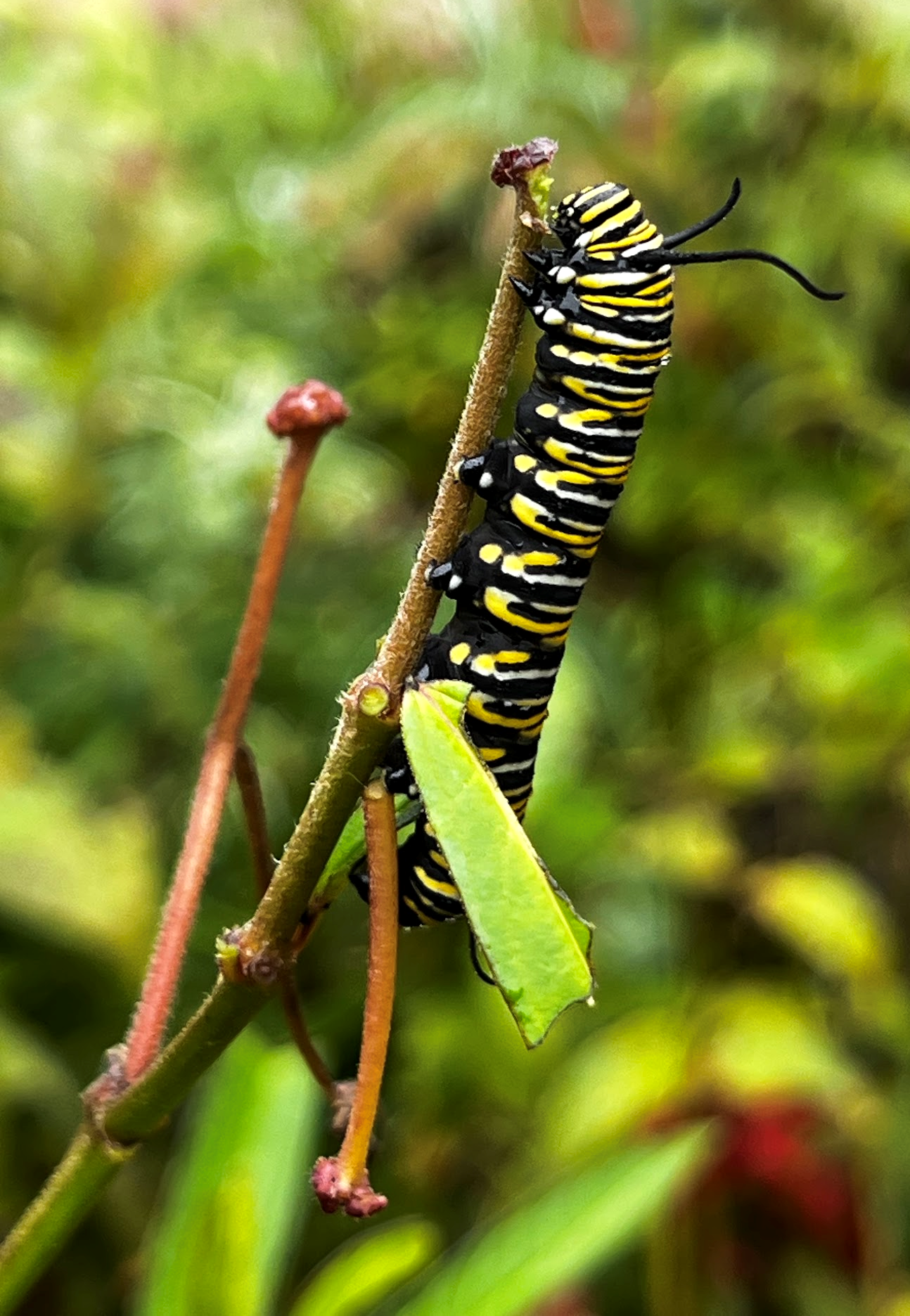
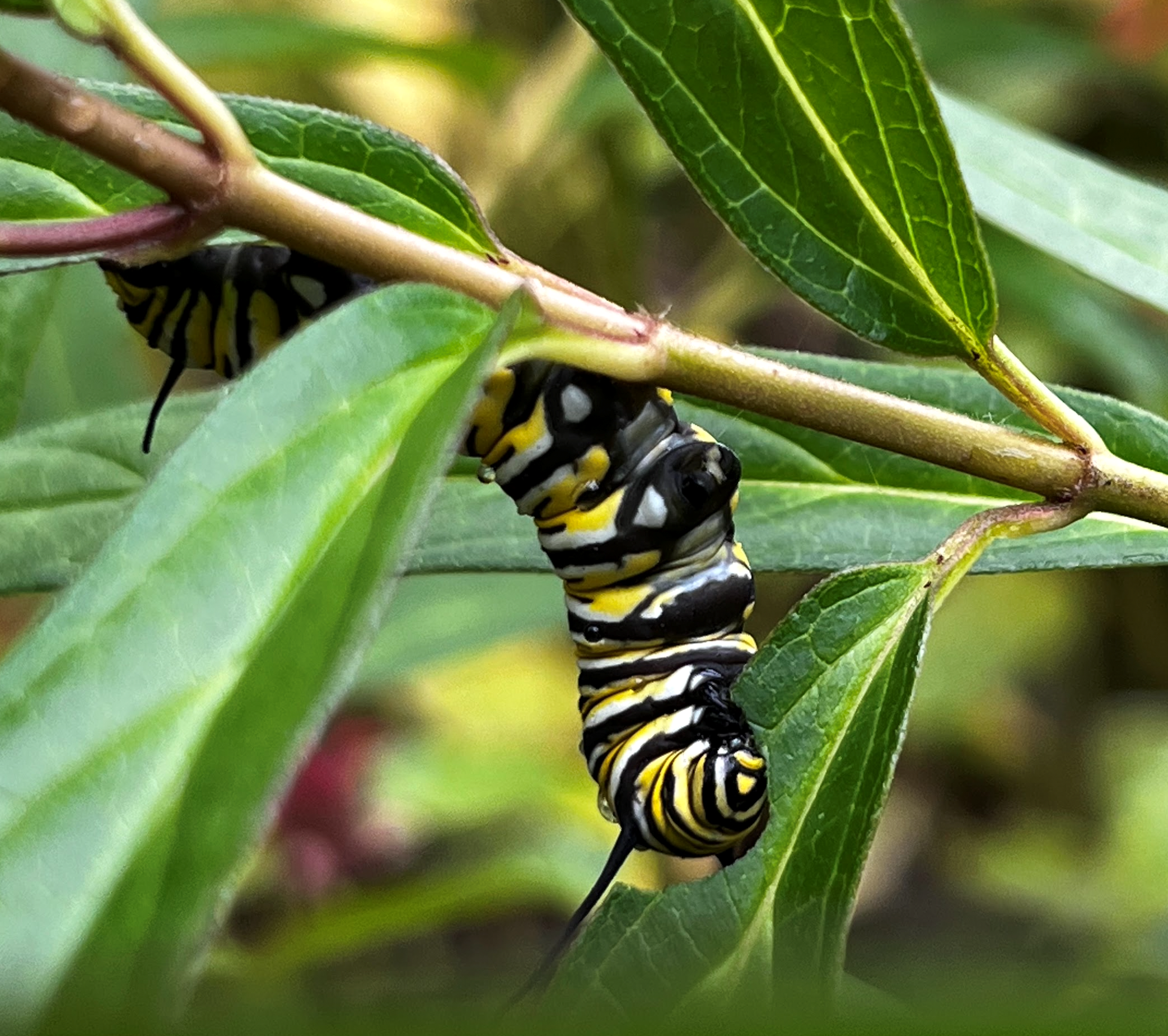
My 2023 garden gave me a front row seat for observing the monarch butterfly (Danaus plexippus) lifecycle. Two monarch caterpillars fed on my garden’s swamp milkweed (Asclepias incarnata) lower leaves for about 10-12 days. I was very concerned when one started a long journey across the 10-foot-long patio and then climbed 10 feet up the house wall to make its chrysalis just under the eaves! I was relieved to read that monarch caterpillars typically do leave their host plant to make their chrysalis elsewhere just in case there are younger caterpillar instars feeding on the same plant. It would be tragic if their chrysalis came crashing down as another caterpillar feeds on the leaf from which it is suspended!
One of the two caterpillars in my garden last year feasting on swamp milkweed on August 8. By August 13, many more swamp milkweed leaves at been eaten (right)
I expectantly watched the “eaves” chrysalis daily and was rewarded on September 5th when the green and gold flecked chrysalis became more translucent with visible orange and black inside. An adult male, identified by the two dots on its hindwings (pheromone patches), emerged later that day.
One monarch caterpillar travelled across the patio and climbed up the house wall to make its chrysalis just under the eaves on August 17 (left). On September 5, the chrysalis became translucent, and the butterfly emerged. It dried its wings for a few hours (centre). Once it opened its wings, I could identify it as a male by the two pheromone patches on its hindwings (right).
I never saw the second caterpillar leave the swamp milkweed host plant but discovered its chrysalis suspended from the leaves of savannah grass (Sorghastrum nutans) one day.
Swamp milkweed is a common species in Ontario, usually found in wetlands, wet roadsides, floodplains and wet meadows, but looks beautiful in the garden with its upright stature and slender leaves. Its flowers also bloom for a long time and are floral and vanilla scented. It grows quite tall and maintains its structure well into the winter months to provide winter garden interest.
Swamp milkweed is a better choice for the garden than common milkweed (A. syriaca) which is not recommended for small gardens due to its rhizomatous aggressive spreading nature. Although butterfly milkweed (A. tuberosa) is a great nectar plant it is also a less desirable monarch caterpillar food due to its hairier leaves and lower protein content (UNC Charlotte Institute 2022). Both swamp and common milkweed averaged the highest number of eggs laid by female adult monarch butterflies in a study that evaluated the attractiveness of nine milkweed species common to Iowa (Pocius et al. 2018).
Typical habitat for swamp milkweed in the wild, but “it is fairly drought tolerant and will thrive in drier areas once established” (Gray and Booth 2024) (left). A 2-year-old swamp milkweed plant in my dry, sandy garden (right).
Well-intentioned people hope to increase the monarch population by home-rearing monarchs. However, an analysis of over 135,000 monarch observations at 403 annual butterfly count locations across the species’ large summer range[1] compared population numbers in 1993 to those from 2018 and found that although some areas had population decreases, overall summer monarch population numbers in North America are relatively stable i.e., reproduction in summer is compensating for losses at wintering grounds in Mexico (Crossley 2022).
A naturally occurring parasite (Ophryocystis electroscirrha) adversely affects how well monarchs fly as well as their migration survival. It has increased in the last 15 years, raising concerns that parasite transmission is decreasing winter colony populations (Majewska et al., 2021). The Xerces Society has published a joint statement against the release of purchased or mass-reared monarchs by backyard and commercial breeders. If you are raising small numbers of wild-collected monarch eggs and larvae for personal enjoyment, education, or as part of citizen science project they encourage you to follow protocols for safe rearing and collect data on your reared monarchs for programs such as the Monarch Larva Monitoring Project and Monarch Health.
Although the research is not definitive, I recommend letting nature take its course and simply providing for the monarch caterpillar’s habitat needs by planting host plants, particularly swamp milkweed, in your garden. This spring I planted two more patches of swamp milkweed plants in my garden. I can’t wait to observe the monarch caterpillar drama that unfolds this summer!
[1] The NA monarch breeding range spans nearly the entire United States and southern Canada. Butterfly counts by citizen scientists are held between July 1 and August 31. Only data with at least 5 years of Monarch observations over a 10-year period were used in the Crossley (2022) analysis. An average of 25 butterfly counts are held annually in southern Ontario. Each count covers a 24-kilometer diameter circle. Last year I participated in my first count in Haliburton, Ontario.
Tips for growing swamp milkweed in your garden
If space allows, plant a group of 3 to 5 plants so pollinators can more easily find the flowers. It can grow in sand, loam or clay and prefers full sun.
Water consistently during the first year so swamp milkweed can build roots to support flowering in year 2.
Remove seed heads before seed pods open if you want to control the number of volunteer seedlings.
Swamp milkweed is not palatable to deer.
References
Crossley, M.S., T.D. Meehan, M.D. Moran, J. Glassberg, W.E. Snyder, A.K. Davis. 2022. Opposing global change drivers counterbalance trends in breeding North American monarch butterflies. Global Change Biology https://onlinelibrary.wiley.com/doi/full/10.1111/gcb.16282
Gray, R. and S. Booth. 2024. The Gardener’s Guide to Native Plants of the Southern Great Lakes Region. Firefly Books. 352 pp.
Majewska, A. A., Davis, A. K., Altizer, S., & Roode, J. C. (2021). Parasite dynamics in North American monarchs predicted by host density and seasonal migratory culling. Journal of Animal Ecology, 2022, 1–14. https://doi.org/10.1111/1365-2656.13678
Baptisia species are part of the pea, or legume, family (Fabaceae) of plants. The folks who develop new plants have been working on Baptisia for a few years. The old reliable B. australis, with its pretty blue flowers, is still very available but the new hybrids feature various different flower colours.
As expected with all members of the pea family, Baptisia host rhizobia bacteria on root nodules. These bacteria are able to take nitrogen from the air and convert it to a form that is usable by the plant. This is called nitrogen fixation. Nitrogen is a necessary nutrient for most plants.
Baptisia prefers full sun but will grow in part shade and may reach .5-1.5 Metres (2-4 ft.) high and will die back to the ground in fall after a hard frost. They prefer moist, well-drained soil and are drought tolerant. All my Baptisia grow well in our zone 4-5 garden. Baptisia spread by seeds which are pea/bean-like and form in pods. The dry seeds rattle in the pods in the fall winds and if you brush against the plant….this makes an unusual sound in the garden. You can prune the plant after flowering to help maintain a more rounded form but you will lose those interesting seed pods! My plants do not flop but you may wish to add some support if needed. The numerous, and gorgeous, flower blooms are lined up along the tall stems in late spring to early summer. Once the flowers are done, this shrub-like herbaceous perennial will still look good in your garden with its lush green foliage and attractive seed pods. For more information, check out this “Baptisia Plant Guide”.
Bonus….this plant is deer and rabbit resistant. We have at least one resident rabbit and the odd deer passing through, but I have never seen any foraging damage on my Baptisia plants. However, they are attractive to bees and butterflies.
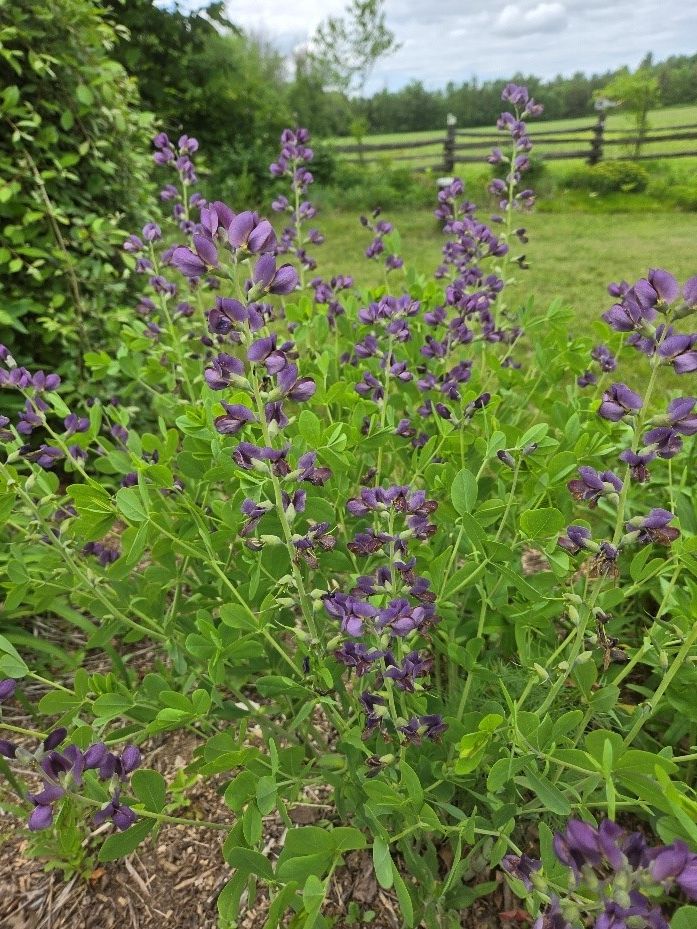
Baptisia australis, wild/blue false indigo, are native to the eastern half of the U.S. although it has become naturalized in Ontario. The old common name wild/blue false indigo refers to the plant’s use in the southern states as a substitute for the dye indigo during the 18th century. As mentioned, this plant has blue flowers.
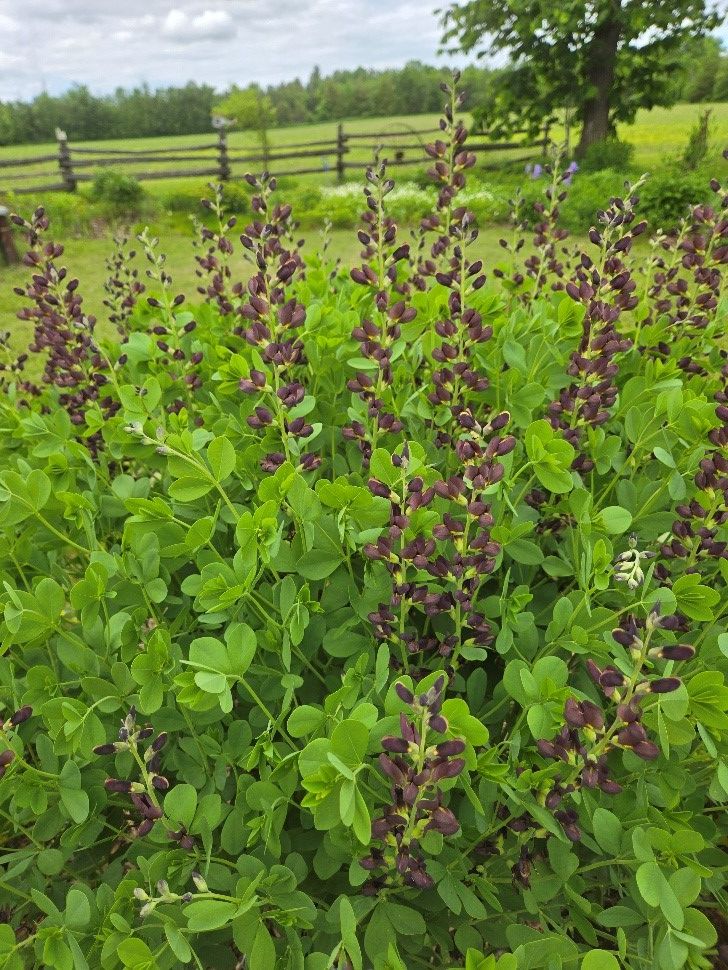
Baptisia hybrid ‘Dark Chocolate’ is one that I have in my garden. It has all of the usual Baptisia characteristics with the addition of dark brown flower blooms. That may sound odd but they really are quite attractive. Mine is growing beside a garden path so that a garden visitor can have a close look when strolling by.
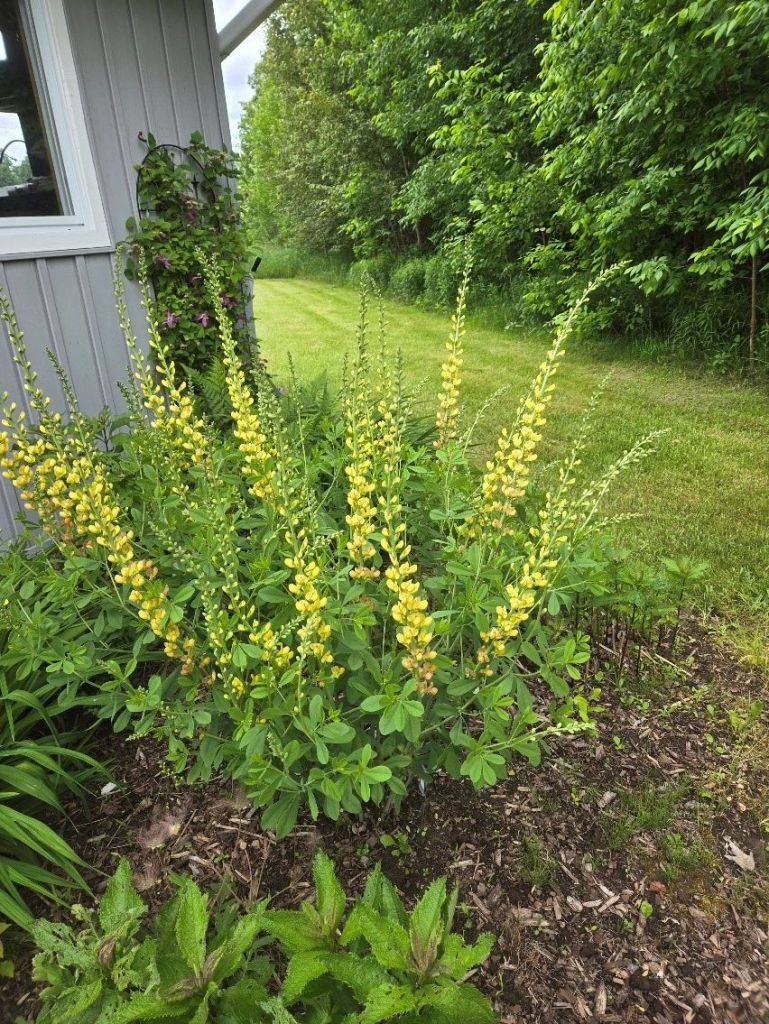
Another Baptisia hybrid is ‘Lemon Meringue’. This one, as you likely can guess, has yellow flowers. It too has the typical Baptisia look.
Baptisia flowers also come in white, lavender and purple…..I hope to collect them all. With its eye-catching presence, a Baptisia would make a great specimen plant in anyone’s garden!
If you’re thinking of creating a pollinator garden with native perennial plants, there will be a period where your space will be rather underwhelming or undeveloped.
There is a saying, “first year they sleep, second year they creep, and third year they leap.” In the first year of their growth, many native plants focus channeling their energy into root development instead of flowering. It is important to consider other ways to increase floral resources for pollinators while you wait for these plants to grow.
Consider adding a few native species that are short-lived annuals or biennials—either potted plants or directly sown seed. If started early in the spring, Black-Eyed Susan (Rudbeckia hirta), for example, will bloom in the first year. It usually produces enough seed to ensure future generations.
Spotted Horsemint (Monarda punctata) and Lanceleaf Coreopsis (Coreopsis lanceolata) are a couple of others that will also bloom the first year when started early. Near-native annual sunflowers (Helianthus annuus) are another great choice for new pollinator gardens. An important consideration for choosing annual sunflowers is to make sure that they are not pollenless types.
That said, there really are not a whole lot of native annual species that you can add. To help fill in the gap, it is possible to consider some non-native annuals. An aspect of this that is concerning is whether these plants provide adequate nectar and/or pollen to pollinators.
Many annuals have been bred for size, colour, vigour, and length of bloom period and not so much for their nectar and pollen production. When I visit a garden centre, I pay attention to see if there are any insects visiting the plants. I usually don’t see a whole lot of activity. Of course, this is anecdotal, so what does the research say?
From my cursory reading, the research is a bit uneven. A UK study in 2017 found that most ornamental flowering plants found in garden centres were unattractive to pollinators.[i]
Another US study that looked at a select group of annuals found that while native plants were superior overall, there were some non-native annuals that could be important forage for pollinators. It was found that in comparison with Zinnia, Marigold (Tagetes), Lantana, and Starcluster (Pentas), Sweet Alyssum (Lobularia maritima) was the top performer. In particular, the cultivars “Frosty Knight” and “Snow Princess” showed the greatest diversity and abundance of pollinators compared to the other Lobularia types as well as the other species.[ii]
This year I planted some Lobularia near my vegetable garden in the hopes of attracting beneficial parasitic wasps. The adult wasps will seek out the nectar from the flowers and look for caterpillars on my Brassicas for their young.
Another more recent study from June of this year also found that while the native plants in the study were visited more by pollinators than the non-native plants, there were still some desirable non-native annuals. Specifically, Begonia and Impatiens were visited more frequently by pollinators than Pansy, Petunia, New Guinea Impatiens, and Geranium.
Similar to the previously mentioned study, these researchers found that there was variability between cultivars of a species. Of the cultivars, the four most visited were Begonia ‘Cocktail Brandy’, Begonia ‘Ambassador Rose Blush’, Impatiens ‘Accent Coral’, and Impatiens ‘Super Elfin XP White.’[iii]
Now, an important question that comes out of this is whether these plants provide quality floral resources for pollinators. Pollinator visits to flowers does not necessarily mean that they are benefiting from the resource. More research is needed in this area. Until then, we can make a few reasonable annual plant choices to help in the interim while the other plants in our new pollinator gardens mature.
[i] Garbuzov, Mihail & Alton, Karin & Ratnieks, Francis. (2017). Most ornamental plants on sale in garden centres are unattractive to flower-visiting insects. PeerJ. 5. e3066. 10.7717/peerj.3066.
[ii] E Erickson, S Adam, L Russo, V Wojcik, H M Patch, C M Grozinger, More Than Meets the Eye? The Role of Annual Ornamental Flowers in Supporting Pollinators, Environmental Entomology, Volume 49, Issue 1, February 2020, Pages 178–188, https://doi.org/10.1093/ee/nvz133
[iii] David Smitley, Colin Oneil, Erica Hotchkiss, Erik Runkle, Jared Studyvin, Evaluation of the most popular annual flowers sold in the United States and Europe indicates low visitation rates by pollinators and large variation among cultivars, Journal of Economic Entomology, Volume 117, Issue 3, June 2024, Pages 1057–1070, https://doi.org/10.1093/jee/toae084
Wow. What a pleasure to finally see this book in print. Written by two very knowledgeable Ontario gardeners — Rick Gray and Shaun Booth — this is the native plant gardening resource I wish I had more than 5 years ago when I started incorporating native plants in my garden.
Focused specifically on the Southern Great Lakes Region, it’s an all-in-one, easy to use resource for those interested in plants that not only look wonderful but fulfill a critical role in our gardens in supporting wildlife, birds, and pollinators like butterflies, moths, bees, and insects.
It reminds me of an encyclopedia, with a full page spread on each native plant (and there’s over 150!). It’s not surprising to me that’s it’s already #4 on the Globe & Mail’s bestseller list.
The book is visually designed to make it easy to see key information at a glance, using quick guide key icons and two colour-coded bars providing exposure/light and moisture requirements. We’ve been blessed with several excellent native plant books in the past few years, but I appreciated several unique elements I hadn’t seen before – numerous appendices (matching soil types, seed collection and preparation, propagation, and butterflies and their host plants), as well as each plant’s Ontario’s Species at Risk status.
You’ll understand what each plant needs to thrive, how big they will get, and how to make more plants to share with your friends!
Sample spread page
As a Peterborough Master Gardener I have long been engaged in two Facebook groups – theOntario Native Plant Gardeninggroup (started by Shaun) and the Master Gardeners of Ontario group (where I am an admin and moderator). I remember clearly in May 2023 Rick trying to gauge interest from members on their proposed native plant book, and the incredibly positive response that they received. So full disclosure – I knew I was going to love this book before it was ever published.
The authors explain why the plants are organized by botanical/Latin name, which is important because common names can vary by region. However, if you only know the common name you can always search using the alphabetical index at the back of the book.
Essentially, each entry is a ‘checklist in a page’ on what you need to grow the plant. There are lots of photos (whole plant, leaves, flowers, fruiting bodies), a detailed description, easy to see symbols (the Quick Guide), information on the USDA Hardiness Zone, lifespan, propagation, and wildlife/pollinator value.
Skill levels are also mentioned but don’t be alarmed – most are listed as beginner, but there are certainly a few native plants that are a bit more challenging to grow and propagate.
Table of Contents plus shameless plug for my wonderful local, independent bookstore where I ordered the book.
I appreciate that in the introductory chapters the authors clearly explain things such as:
What is a native plant?
Aggressive vs invasive
Origin of the term weed
Nativar vs cultivar
Value of native plants
The authors clearly have a good sense of humour – there are pages titled “How to use this book”, “A coneflower by any other name”, “Fifty shades of…shade” and my favourite “2b or not 2b” (on the rationale for using USDA Hardiness zones). I loved the section on propagation and codes as I’m actively trying to grow more native plant material in my area.
I have to say that as a seasoned gardener I was surprised to see Echinacea pallida (pale purple coneflower) is not in the book (not native to most of this region but often sold as a native apparently) and Agastache foeniculum (Anise hyssop) is one that is included specifically because it is non-native to Ontario (it’s a western prairie plant). Oops! I have both in my garden north of Peterborough.
Was anything missing? Technically no, as the authors were clear that this was not a garden design book. Perhaps after putting out Vol. 2 (the other 150+ plants I know they wanted to include), they’ll consider something on understanding planting density and creating root competition, which I am learning is different to conventional perennials, and good plant pairings (which native plants support others).
One quick comment I will add is that native plants are wonderful once they are established, so you may need to do a bit of watering that first year, but after that they need no watering or fertilizing.
This book is perfect for reading at home (my husband gave me a quick quiz contest this afternoon on the Latin names) or taking with you to your local nursery as you search for native plants to add to your garden. Having trouble finding these plants? The Halton Region Master Gardeners maintain a dynamic map listing native plant nurseries around the province. Check it out!
The bottom line – a wonderful addition to my garden library, and to anyone interested in incorporating more native plants in their Ontario gardens.
The Gardener’s Guide to Native Plants of the Southern Great Lakes Region
By Rick Gray and Shaun Booth Publisher: Firefly Books, 2024 Paperback: 352 pages ISBN-10: 0-2281-0460-2 Price: C$45.00; available through local booksellers and larger book companies
About the Authors
Rick Gray (The Native Plant Gardener) has more than 300 species of native plants in his garden in southwestern Ontario and provides native plant garden design services.
Shaun Booth runs In Our Nature, an ecological garden design business, and launched the Ontario Native Plant Gardening group on Facebook.
Want More Information?
Many wonderful books on native plant gardening and naturalization have been published in the past few years – anything byLorraine Johnsonis a great complement to this book, and I love Piet Oudolf’s work (although he doesn’t always use native plants).
Dr Linda Chalker-Scott (and the Garden Professors blogon Facebook) is a great source of good, solid scientific information on gardeners keen to avoid the misinformation often seen on social media.
This is an important question! People garden for various reasons and the answer to that question is a wonderful guide for helping to create your garden. If you do not know why you garden, then you may put a lot of effort, and money, into something that does not make you happy or meet your needs. So, figure out why you garden, what inspires you and keeps you coming back for more!
I recently asked this question of the Peterborough Master Gardeners. Some find gardening a creative, and passionate, process that gives them joy and peace and a feeling of gratitude. They spoke of being in nature and being part of the relationship between the soil, bees, birds, butterflies and plants. For some, it is the nurturing of the land and being able to feed their families, and share with neighbours, through the vegetables that they grow. Others spoke about the enjoyment they get from the physical process of gardening. Gardening is good exercise, especially if your job includes sitting at a desk all day. One of our fairly new Master Gardeners talked about starting to garden because it was a lower-cost opportunity to take care of living things and the desire for her property to be pretty and attractive to pollinators. Gardening has evolved for her to provide her with a sense of peace and accomplishment. A final comment about the “why garden” question…..gardening can be a solitary activity or a very social activity where you talk to fellow gardeners or give advice to curious non-gardeners.
Thinking about why one gardens leads to asking yourself what type of garden you are most drawn to. One Master Gardener shared that she prefers a more formal garden although she can appreciate a cottage style or meadow garden too. The rest of us are a bit more on the wild side. We prefer colourful cottage gardens that are informal but not out of control. This type of garden might include bee balm (Monarda species), coneflowers (Echinacea species) and brown/black eyed susans (Rudbeckia species). The importance of growing for diversity with native plants and not growing invasives was mentioned as was a garden that appealed to pollinators. Formal gardens can be more difficult to maintain because it may require more time and effort to keep a very specific style eg. pruning shrubs to a unique shape. Cottage gardens tend to have a looser structure and may require less maintenance. They may also include vegetables!
However, gardening is not all just pretty flowers and shiny vegetables. Some Master Gardeners mentioned the frustration when garden pests or disease attack. The best defense is to inspect your garden often to catch problems early. Plants are also less susceptible when they are healthy. For good health, plants need the appropriate moisture, light, temperature and soil for that plant. Other Master Gardeners were challenged by out-of-control invasive plants (eg. goutweed, Aegopodium podagraria), weeds or limitations that occur as we age….for some, gardening from dawn until dusk is just a memory!
So, grab your pen and paper and answer the question, “why do I garden?” You may feel that you are on the right track, or you may decide to make some changes. Now is the time to dream and plan what you would like to do this year, to have a garden that feeds your soul and maybe your family and neighbours too!
Thank you to the Master Gardeners who responded to my questions. I loved reading your answers and thinking about how we are drawn to gardening in slightly different, but similar, ways.
Although I’ve lived in Canada for almost 50 years, I grew up in Bristol, England for some of my formative years, and always loved the traditional hedgerows that existed along rural roads and properties. Every time we return to the UK on a trip, I marvel at the diversity and intricacy of these functional garden/farm structures.
On our three quarter of an acre property in a small village north of Peterborough (Zone 4b/5a) I have a neighbour on one side who has a chain link fence and loves their golf green lawn. On the other side there is no fence at all, but I’ve been growing a few elderberries (Sambucus canadensis) and cup plants (Silphium perfoliatum) to hide a poorly maintained house – the first shrub suckers well and the second plant grows fast and tall.
So I’d love to have a traditional English-style hedgerow on both edges that would provide visual screening as well as animal and bird habitat…so I went looking to see how to adapt the traditional English hedgerow to Ontario.
Hedgerows can provide amazing bird habitat
The origins of hedgerows
It’s thought that hedgerows (or hedges) were first used by humans as ‘dead hedges’ to enclose livestock using thorny plants. Once agriculture began, clearing woodlands created fields with tree and shrub boundaries that were managed to create livestock-proof ‘living fences’.
Hedgerows have been planted since the time of the Romans and reached their peak in Britain during the Enclosure Acts of the 1700s when an estimated 200,000 miles of mostly hawthorn (Crataegus spp) hedgerows were planted.
Credit: People’s Trust for Endangered Species, UK
Hedgerows have many purposes, as you can see from this graphic from the People’s Trust for Endangered Species. They have an excellent video on how to manage a hedgerow here, but it’s not quite the same in Ontario, as we don’t have the same hedgerow species or coppicing techniques.
In their best form I think hedgerows can be a mini-ecosystem with key ingredients that animals and birds need to survive — food, shelter, nesting and denning sites. Hedgerows also function as corridors, connecting one habitat to another and offering a safe passage for wildlife. They help muffle sound, create privacy, and act as windbreaks.
Planted with a variety of berry- and seed-bearing shrubs for food
Interspersed with cedar for added cover
Thick, bushy, largely unpruned and entangled with vines
The Ontario Rural Skills Network suggests that hedgerows can be single species but are best if they comprise a diversity of plants. Planting should be very dense, with a double line spaced 40cm (16in) apart with plants in a staggered pattern at 30cm (12in), giving 5 plants per metre.
Because they’re comprised of living shrubs, hedgerows grow and require management. It’s all about creating a balance between growth and avoiding them becoming gapped and unmanageable. A hedgerow may take seven to 10 years to establish, depending on the species composition.
I’m just at the beginning of my plan for hedgerows on our property, but winter is a great time to do research. Both sites are sunny and have well drained soil, and I want to focus on using Ontario native plants as much as possible. I’m looking at a combination of seed- or nut-bearing shrubs (like speckled alder and hazel) and berry producers (serviceberry, chokecherry, red osier dogwood). Thorny shrubs (native roses, wild raspberry, hawthorns) will give added wildlife protection. The design will probably be different for each one, but that’s the fun of it.
The OFNC has excellent lists of plants you can consider for an Ontario hedgerow. I’m thinking about using
Speckled alder (Alnus incana)
Beaked hazel (Corylus cornuta)
Hawthorns (Crataegus spp.)
Common elderberry (Sambucus canadensis)
Flowering raspberry (Rubus odoratus)
Willow spp. (Salix spp.) – native if I can find them – there is an amazing group in
Choke cherry (Prunus virginiana)
Red osier dogwood (Cornus stolonifera or C. sericea)
Eastern white cedar (Thuja occidentalis)
Wild (riverbank) grape (Vitis riparia)
Next steps
I’m just at the beginning of my journey. In my next blog post on March 25th, I’ll give you an update on my research and my plans for my spring hedgerow projects. Until then, here’s some interesting sites to look at if you are thinking about something similar. And, by all means, if you have created a hedgerow in your Ontario garden, I would love to hear about it.
As this year ends, I’m offering a few New Year’s resolutions for gardeners for 2024. If you want more of a challenge, the Chicago Botanic Garden offers 50.
Add Native Plants To Your Garden
We’re all seeing the effects of climate change on our gardens.
Native plants adapt more readily to stressful and changing weather patterns, such as prolonged droughts or winter cold snaps, than hybrids and non-natives often seen in our nurseries.
Native plants help sustain beneficial insects and bird populations because they attract native pollinators and birds that might not be drawn to non-natives.
Create less work for you, as native plants tend to be lower maintenance than non-native ones.
The Native Conservancy of Canada offers some suggestions to get you started, or consult with your local Master Gardener group or Horticultural Society.
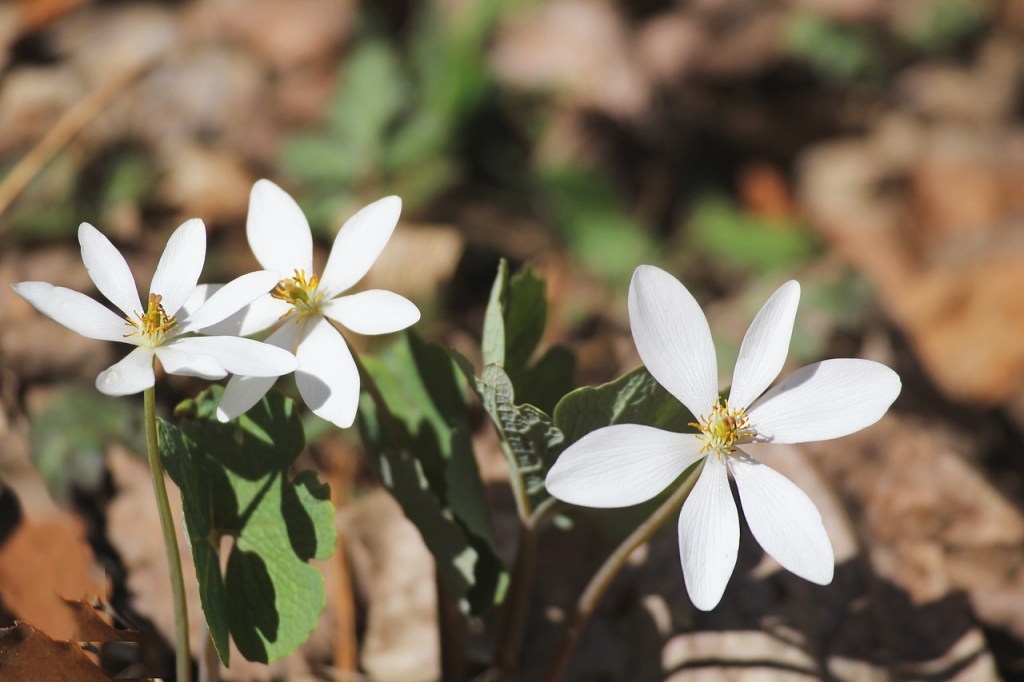
Bloodroot, Sanguinaria canadensis
Start A Compost Bin
Composting helps keep waste out of landfill by collecting and processing organics into material that can be used to create nutrient-rich compost used to feed and nourish soil.
Canadian Living offers a simple outline, as shared by Ed Begley Jr.
Or more here from the Thames Region Ecological Association, including troubleshooting issues.
Compost bin
Grow More Of Your Own Food
The pandemic has highlighted how our agricultural systems are vulnerable to global shocks. Issues with supply chains, migrant workers, transport, trade and border closures have resulted in some foods being in short supply or prices going up (while quality goes down).
Insects do all the hard work, and all pollinators benefit.
Gardening provides benefits for your wallet, your nutrition, and reduces your environmental footprint. By growing your own food (either from seeds or small plants), your food is automatically more sustainable simply because you are doing it onsite or in a community garden. If you control the ‘inputs’ and do it well, you can save a lot of money.
Ultimately there is nothing more rewarding than planting and maintaining your own vegetable garden and harvesting (and sharing) your results. And we all know how much better homegrown produce tastes versus conventional produce at the grocery store. If you have too much produce, then you can just share the love with others!
Plastic is a major component in the garden, from plastic plant pots and seed trays to watering cans, and compost bins. Most plastic gardening equipment will end up in landfills, where plastic pots alone can take up to 500 years to decompose.
There are a few easy swaps you can make in going plastic-free: Many of us want to use less plastic in the garden, from plant labels to watering cans, tools, plant pots and the sheeting used to suppress weeds. Buying (and therefore using) less plastic will not only reduce your plastic footprint but also sends a message to manufacturers that gardeners want alternatives to plastic (especially single-use plastic).
Try to find biodegradable pots that made from natural materials such as coir, bamboo, wood chips, or seaweed (or commit to using your plastic pots year after year).
If you use plastic string, make the swap for a natural jute or hemp, and protect your fruits and vegetables with metal mesh instead of plastic netting – it lasts for years.
Find alternatives to plastic pots, or commit to using (and reusing them) for many years
Happy gardening dreams until we can get out into our gardens again….
What says fall or October more than the iconic pumpkin? But how much do you really know about them?
Here’s 10 things about pumpkins that might surprise you.
They’re technically a fruit, not a vegetable. Pumpkins are a winter squash in the family Cucurbitaceae (which includes cucumbers, melons, and gourds.) Pumpkins, along with cucumbers, tomatoes, and avocados, grow from the flowers of their plants. So yes, all squashes are technically fruits as well. It is the official State Fruit of New Hampshire.
They’re native to the Americas. Scientists believe that pumpkins originated in the Americas about 9000 years ago. The oldest pumpkin seeds were found in Mexico and date to somewhere between 7000-5550 B.C.. Originally small and bitter, they were selectively bred by native peoples to be bigger, sweeter, and have more flesh.
They weren’t originally called pumpkins. The word “pumpkin” originates from “pepon” – which means “large melon” in Greek. Then it evolved to “pompon” (in French) and “pumpion” (in Britain). The evolution in North America was to “pumpkin,” what we use today.
Every single part of a pumpkin is edible. That means the skin, leaves, flowers, pulp, seeds, and stems. And they’re 92 percent water. Pumpkin and other squash blossoms can be eaten raw or I’m told they are tasty when lightly battered and fried. Pumpkin pie is a traditional part of Thanksgiving meals in Canada and the United States.
Bumble bees and squash bees are the primary pollinators of the cucurbit family of plants. They help transfer pollen from the male flower to the female flower by visiting each flower to drink the nectar located in the flower. As the bee drinks nectar it vibrates and moves its body around and in doing so, collects grains of pollen on the fine hairs of its body and in pollen baskets located in some species on their legs.
Pumpkins (along with other squash) were a historically important food staple among Native Americans. Using the “Three Sisters Method,” three crops (squash, maize, beans) were grown together – usually near riverbanks – so they could sustain each other. Corn is the trellis upon which the beans climb; beans keep the corn stalks stable on windy days, while also nourishing their soil; and pumpkins/squash shelter the corn’s shallow roots and prevent weeds from forming.
They’re a great source of beta carotene (which is what gives it the orange colour). It turns into vitamin A after you eat it, so it’s excellent for your eye and skin health.
They can get REALLY big. The heaviest pumpkin ever recorded was a staggering 1,226 kg (2,702 lb 13.9 oz), grown by Stefano Cutrupi (Italy) in Tuscany, Italy in 2021.
How long do they last? After a pumpkin is cut, it will usually last about seven to 10 days. Find out how to pick the perfect pumpkin.
Each pumpkin contains about 500 seeds. Once they sprout, pumpkins take between 90 and 120 days to reach maturity, which is why it’s recommended to plant them between May and July.
A LAST NOTE: Just a reminder that you’ll see lots of social media posts after Halloween about giving your pumpkins a second life by putting them out for wildlife. In your own garden, break the pumpkin into small pieces and monitor and remove the pieces when they rot, mold, or aren’t eaten.
Check and see whether local zoos or wildlife rehabilitation centres are interested in donations for animal enrichment. NOTE: they must still be fresh – carved pumpkins break down quickly and whole pumpkins that have been sitting in the sun for weeks can quickly become contaminated and shouldn’t be given to animals to eat. Some municipalities also offer a drop-off program.
Please don’t put them on the side of the road or in natural areas, as this creates problems because if they are near ditches or roadsides, animals will be drawn in close to traffic where they may get hit.
Last but not least, if a pumpkin is starting to decompose, turn it into compost! Chop it up to speed up the process.