Recently, I have grown to love maple syrup for more than just its delicious taste. The harvesting and boiling of the sap brings me outside in the fresh air during a time of year when I need it most. But I’ve wondered what makes this harvest season so short, so specific and so unique.
First, the Sap
A cross section of a hardwood tree
During the growing season, sugars needed for tree growth are created via photosynthesis and stored in the tree as starches in the sapwood. When the weather cools, starches are converted back to sugars and passed into water flowing through the xylem of the tree, creating sap.
How Water Moves Through the Tree
Typically, water moves up the tree from the roots through cell channels called xylem. Since the xylem is made up of dead elongated cells, these cells don’t contribute to the movement of the water, they rely on pressure gradients. In maples, a unique pressure is present in the springtime, but only when it freezes at night and thaws during daytime.
A diagram of a plant cell
Maple Magic in Spring Time
Just outside of the xylem vessels are dead wood fibre cells with air inside. When the temperature drops in the evening, the smaller branches at the top of the tree freeze first, and sap frost collects in the air-filled wood fibre cells surrounding the sap-filled xylem. This creates suction, pulling sap up the tree. When the temperature rises in the morning, the frost melts and falls down the tree through the xylem by both gravity and pressure created by the warming air in the wood fibre cells. This is when you get to collect!
What about Fall?
But wait! We don’t just get freezing at night and above freezing daytimes in the spring. That happens in the fall too. Can you tap maple trees and make syrup in the fall too? The answer is yes, but researchers have found you won’t get as much as springtime, and the sap won’t be as sweet. Additionally, it will reduce the sweeter springtime sap yields as well. Worth it? Probably not.
The Pros Know What They’re Doing
Tapping only once a year also helps to reduce injury and therefore risks to the tree caused by severing its protective layers and exposing it to external factors. Hobbyists and large-scale producers alike want to foster a healthy tree that provides delicious syrup for years to come.
Invasive terrestrial (grows on land) plants are non-native trees, shrubs, and herbaceous plants that are spread by global trade, humans and animals, and gardening. These plants have the ability to out-compete our native plants for space, nutrients and moisture. This means that they can damage the environment, human health and can have an economic impact.
Some also contaminate the soil so that it is difficult for other plants to grow even after the invasive has been removed (e.g. garlic mustard [Alliaria petiolate] – a herb).
Invasive plants may seem perfectly at home and under control in your garden. However, seeds can be relocated by an animal or other means. Other plant parts (e.g. rhizomes) can grow into new plants when you do a clean-up and dump your garden refuse in another perhaps wild area. This sets the invasive plant free!
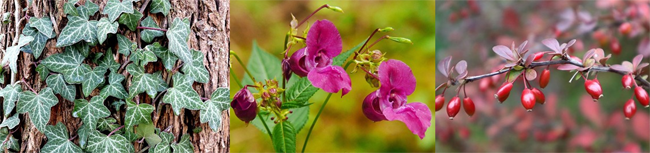
Japanese Barberry
Japanese Barberry (Berberis thunbergii) is an invasive shrub which has green to dark reddish purple leaves. It has many small, densely growing twigs and branches that have spines. Its small flowers develop into red fruit which may be eaten then distributed by birds. It can grow 1-2 m (3-6 ft) tall in full sun to part shade and well drained soil.
I brought home two Japanese Barberry a few years ago. We had finished building our house and had started landscaping. At that time, I did not know that Japanese Barberry was a poor choice. They are not only invasive but also attract ticks.
Japanese Barberry (Berberis thunbergii)
Himalayan Balsam
Himalayan balsam (Impatiens glandulifera) is a striking, but invasive, plant that grows 1-3 m (3-10 ft) tall. It has a reddish stem and produces pink, white or purple flowers. Seed pods are produced which explode when mature. This helps to scatter the seeds. This plant not only out-competes other plants through its prolific seed production and its size, it also produces large amounts of nectar which attracts pollinators. The same pollinators which would normally be pollinating native plants.
This plant prefers a moister soil and grows well in sun or part shade. I have seen a massive area where this plant was growing near a residential location in a moist spot. A gardener showed it to me. She had been discarding her garden refuse in this spot for years. She had not realized that the Himalayan balsam, growing in her garden, was an invasive species until……
Himalayan balsam (Impatiens glandulifera)
English Ivy
English ivy (Hedera helix) is an invasive evergreen (leaves are present and stay green all year round) vine. It can form a thick ground cover and a dense canopy in trees. It prevents other plants from growing and can, eventually, even kill a tree.
English ivy is also a reservoir for bacterial leaf scorch (Xylella fastidiosa). This bacterium infects a plant (e.g. many species of trees) and eventually blocks the xylem cells. Xylem cells are responsible for moving water and nutrients from the roots upwards into the plant. This disease will eventually kill the affected plant.
English ivy needs little light once established. I have seen this plant where it had overgrown an area. It was an ugly and truly disheartening spectacle.
English ivy (Hedera helix)
You may come across any of these plants for sale in a garden centre, in a friend’s garden who wants to share, or one may have hitch-hiked with another plant into your own garden. They are some of the plant world’s thugs and can do a lot of damage.
Please be aware of all of Ontario’s invasive terrestrial plants…..yes there are more. Eradicate them and inform your garden centre if you see them for sale.
Tucked away in the cool corners of gardens, beneath leafy cover and damp soil, lives an unassuming champion of ecological balance: the American toad (Anaxyrus americanus). With their warty skin, endearing hops, and golden eyes, these amphibians may not boast the charisma of butterflies or hummingbirds, but their contributions to gardens are unparalleled. Often overlooked, the American toad quietly goes about its work, consuming pests, enriching the soil, and maintaining harmony in ecosystems. It’s time we shine a light on these remarkable creatures and embrace their presence in our outdoor spaces.
American Toad showcasing why warty skin is so great at camouflage
The American toad, native to eastern North America, thrives in a range of environments, from woodlands to suburban backyards (Elliott et al., 2009). Unlike frogs, toads are covered in warty, textured skin, an adaptation that provides effective camouflage against predators. This camouflage, combined with their nocturnal habits, allows them to move unnoticed as they perform their crucial ecological roles. Chief among these roles is pest control. Each evening, American toads emerge from their shelters to feast on insects, slugs, and other invertebrates. By consuming thousands of pests in a single season, they provide natural, chemical-free pest management, an essential service for gardeners and farmers alike (Mitchell & Lannoo, 2020).
In gardens, toads reduce populations of harmful insects like beetles, cutworms, and mosquitoes, preventing these pests from damaging plants or spreading disease. Unlike chemical pesticides, which often harm beneficial insects and pollute the environment, toads work in harmony with nature, maintaining ecological balance without collateral damage (Relyea, 2005). Furthermore, their waste contributes organic nutrients to the soil, promoting plant health and improving soil quality—a testament to the interconnectedness of life in the garden.
Well-fed American Toad guarding Thom Luloff’s plants from pests
The life of an American toad is a remarkable journey of survival, reproduction, and adaptation. During the day, toads shelter under rocks, logs, or thick vegetation to escape predators and prevent dehydration. At night, they hunt using their long, sticky tongues to capture prey with incredible precision. In spring, their lives become even more captivating as males gather at ponds, streams, or garden water features to call for mates. Their trills, a hallmark of the breeding season, are a welcome sign of spring. After mating, females lay long strings of eggs, often numbering thousands, which hatch into algae-grazing tadpoles within days (Elliott et al., 2009). These tadpoles play a vital role in keeping aquatic ecosystems healthy by controlling algae growth.
Toads are also experts at enduring winter, surviving through a process called hibernation. As temperatures drop, toads burrow deep into the soil, often using loose dirt, leaf litter, or even garden waste as insulation. These layers protect them from freezing temperatures and provide shelter from predators (Mitchell & Lannoo, 2020). For this reason, leaving leaf piles and garden debris untouched during fall and winter is critical. These natural materials serve as vital hibernation sites, not just for toads but also for other beneficial creatures like pollinators and soil invertebrates. Clearing the garden too early in the spring can disrupt or destroy these overwintering habitats, inadvertently harming the wildlife that supports your garden’s health. Waiting until temperatures consistently rise ensures that these creatures can safely emerge and resume their roles in the ecosystem.
Despite their adaptations, American toads face numerous predators, including snakes, birds, and mammals. However, their warty skin serves as more than camouflage—it secretes a mild toxin that deters many would-be predators (Mitchell & Lannoo, 2020). Some toads even use dramatic behaviors, such as flipping onto their backs and feigning death, to discourage attacks.
Beyond their ecological contributions, American toads are fascinating creatures with unique traits. They can live over a decade in the wild, a testament to their resilience and adaptability (Elliott et al., 2009). They can also change their skin color slightly to blend with their surroundings, shifting between lighter and darker tones based on temperature and humidity. These subtle abilities add to the toad’s allure for those who take the time to observe them closely.
Creating a toad-friendly garden is simple and deeply rewarding. To attract toads, provide shelter using overturned flowerpots, rocks, or logs, and allow areas of dense vegetation or mulch for shade. A shallow water feature is a magnet for toads, especially during breeding season, but ensure the water source has sloped edges to allow easy entry and exit. Perhaps most critically, avoid using pesticides and herbicides, which can harm toads directly or contaminate their food sources (Rowe et al., 2001). Leaving leaf litter and reducing outdoor lighting can also make your garden more inviting to these nocturnal helpers.
A garden with toads is a garden alive with balance, biodiversity, and beauty. These humble amphibians are more than just pest controllers—they are symbols of a healthy ecosystem, reminding us of nature’s intricacy and resilience. By encouraging toads to share our outdoor spaces, we not only protect these vital creatures but also create gardens that are richer, more sustainable, and teeming with life.
________________________________
References
Elliott, L., Gerhardt, H. C., & Davidson, C. (2009). The Frogs and Toads of North America: A Comprehensive Guide to Their Identification, Behavior, and Calls. Houghton Mifflin Harcourt.
Mitchell, J. C., & Lannoo, M. J. (2020). Amphibian Declines: The Conservation Status of United States Species. University of California Press.
Having just come back from places where tropicals are growing wildly and flowers are blooming, I wanted to discuss growing zones and the importance of knowing your zone for overwintering plant success of perennials, trees and shrubs.
Plant hardiness zones can be a confusing subject. In Canada, we generally use the USDA (United States Department of Agriculture) system because it is the one we often see on labels of the potted plants we purchase at greenhouses and big box stores.
The USDA system was designed in 1960, updated in 2012 and again in 2023. These hardiness zones are determined as “geographic areas that have an average annual minimum temperature of a certain degree.” No other factors are taken into consideration. There are 13 zones with zone 1 being the coldest and zone 13, the warmest.
Natural Resources Canada has their own system which uses factors that include the number of frost free days, amount of rainfall, snowfall, and wind as well as mean temperatures in the coldest and warmest month. There are 9 zones. Interestingly, Ontario has 7 of these zones.
To complicate things further, there are also ‘a’ and ‘b’ zones. Zone 3a is colder than Zone 3b.
When you look at the government of Canada site, you will see zone dates from 1961-1990 and then an update of 1981-2010. In most cases, zones have moved by at least half a zone. In 2024, Natural Resources Canada was to release an updated version. At press time, I did not find an update.
Plants are described as being hardy to a zone #. If a plant is listed as zone 6, it will survive in Zone 6 or higher. If you live in Zone 4, and try to grow and overwinter a Zone 6 perennial, you will probably not be successful. You are better off to look at lower numbered zones from what your area suggests, to be sure a plant is going to survive and be robust.
Reading plant labels and buying plants that are zone appropriate will help you to have more overwintering success. You will notice on most labels the zone is the USDA system. The label may say “perennial” but look at the zone. A plant can be a perennial…..but only in Florida (Zone 8 or higher).
Other factors for overwintering success include snow cover, wind, and humidity. Snow cover is a great insulator, wind can cause windburn, humidity will help plants stay hydrated.
With climate change happening, our Peterborough area has changed from 5a to 5b which means our average annual minimal temperature has moved from -26.1C to -23.3C.
Below are some towns and cities and their current zones:
Bancroft – Zone 4a ( interesting to note, this zone did not change in the update)
Haliburton – Zone 4b
Port Hope – Zone 6a
Pickering – Zone 6a
Hamilton – Zone 6b
Thunder Bay – Zone 3b
Lakefield, Lindsay, Norwood, and Ennismore are all the same as Peterborough’s – Zone 5b
Things to Remember
Canadian and American systems are not the same. For instance, Zone 5 under the USDA system should be considered Zone 6 in Canada
You can stretch the zones, if you have a micro climate or spot protected from wind, good snow cover and a milder winter
So depending on your gardening confidence, you can stick to Zone 3 or 4 perennials for zonal success or be adventurous and try that beautiful Zone 6 perennial. Just remember to read your labels and check your zones.
March is the start of gardening season! Let the seed starting begin. My husband is the “seed starter” at our house. I am the “seed buyer”, the occasional “assistant transplanter” and a very helpful critic.
Husband has the seed packets organized by type of plant (e.g. perennials, vegetables – tomatoes, Brussel sprouts etc., and annuals – zinnias, marigolds etc.) and by the date that the seeds need to be started. The dates are calculated by looking at the back of the seed packets to find the length of time from seed planting to when the plant may be moved outdoors (i,e. the last expected date for frost), which is early to mid-May in the Peterborough area. For us, this means that the perennials are started first then the vegetables and the annuals.
Some supplies.
In fact, the back of the seed packet will also tell you:
How deep to plant the seed and how far apart to space the seeds when planting in a tray or for direct sowing in the garden. Planting in individual pots may be the way to go for some plants (e.g. tomatoes).
The number of days from planting to when the seed sprouts (germination) and to when you may expect to harvest.
The growing conditions required for the plant. This includes light, moisture and temperature. Seeds are often started in a special seed starting mixture which is sterile.
Husband and I check the seeds every day to ensure that moisture levels are adequate. The surface may be dry or barely moist but there should always be moisture below the surface. There is a fan set up to circulate air back and forth over the seeded areas. This helps prevent damping off. Damping off is a serious disease of seedlings that are grown in cool and wet conditions.
Repotting tomato seedlings.
A heated home is usually warm enough to start seeds – i.e. 21-27 degrees C (70-80 degrees F). Seedlings need 14-16 hours of light a day. Sadly, we do not have that many hours of sunlight in a day until near the end of April. We use indoor grow lights which do work very well. Plants that do not have enough light will stretch and become weak and spindly as they stretch towards the available light. This makes them more susceptible to disease and they may not do well when they are moved outside.
The seedlings are transplanted from their tiny starter pots, or tray, into larger pots after they have 2-6 new leaves. These new leaves are in addition to the 2 small leaves (cotyledons) that are the first to emerge from the seed starter after germination. The soil in the larger pots is potting soil not seed starter.
Seedling with only cotyledons.
We are grateful to have a homemade greenhouse where the plants, in their larger pots, are moved to continue growing until they are ready to be planted in a garden. Prior to the greenhouse, plants were kept inside under the indoor grow lights until the weather co-operated enough to plant them outside.
Tips
If you are new to starting seeds, I suggest starting small. Seed starting, while fun, can be labour intensive with planting. There is also the cost of startup supplies.
Remember to label your seeds with plant type and variety (e.g. tomato – Beefsteak). Nothing is more frustrating than when you plant seeds but do not know if you planted a tomato or a Brussel sprout.
Ensure that you are not using old seeds. Old seeds may not germinate. Purchased seed packets will be printed with an expiry date.
Moisten soil and seed starter before use.
Seed starting is great for children. They get to plant seeds, then care for and watch their plants grow.
Gardening is an incredibly versatile hobby, a hobby that can move around with you when you move house or travel near or afar. I’ve always made a point of visiting gardens whenever or wherever I travel. Out-of-town sporting events, family holidays, weddings, and even business travel have always included visits to public gardens, arboretums, or even garden centres. These visits are always aesthetically pleasing and relaxing. At the same time, they provide a chance to learn about the plant material along with some local history and culture.
On a recent trip to Vancouver Island I visited the Abkhazi Garden in Victoria. It was early October, well past the glory days of summer and far too late to enjoy the rhododendrons – the highlight of the garden – at their prime. That didn’t matter at all, the vistas were astounding, the property a real treasure where gardens wind their way over and around dramatic glaciated rock mounds. This is a site where the gardeners took full advantage of the topography and natural environment rather than change it or cover it up. It’s a one acre spot surrounded by urban Victoria yet each view from anywhere in the garden carries the eye to pleasing combinations of shape, colour, texture, and form. The main house and summer house were built in the late 1940’s reflecting the post-war Modernist sprit, resulting in a superb integration of house and garden. The house and garden are carefully integrated, the blend of the natural and designed is seamless and sublime.
The story behind the garden is interesting as well. The property was originally purchased by Peggy Pemberton-Carter who, in 1946, had recently arrived in Victoria after having spent the war in prisoner-of-war camps in China. She soon married Nicolas Abkhazi, an exiled Georgian prince who had also been interned. The combination of their personal privilege and hardship found a creative outlet in their garden. In the beginning they acquired plant material from the finest nurseries, they were mentored by distinguished horticulturalists and over the next 40 years they experimented and refined their project.
The walk through the garden begins in the rhododendron woodland where the native Garry oaks provide the canopy for species and hybrid rhododendrons. Growing closer to the ground are the ferns and hostas with winter aconite, fawn lilies, camas and hardy cyclamen blooming in season. There’s also tigridia, primula, and galtonia, along with spring flowering bulbs.
A Spanish fir tree holds place of honour at the beginning of a meandering green path with an immense rock outcropping on one side and a profusion of heather and other mounding, textural interest on the other. The path was inspired by the Yangtze River and Peggy’s image of it near her childhood home. Side paths lead onto several naturally created rock ponds providing reflections of sky and other nearby plantings. At each turn or change in elevation the composition is unique and spellbinding.
Recent additions to the garden include a swathe of native camas and a collection of plants indigenous to the Caucasus region, these the result of a donation from the Georgian Ambassador.
The Land Conservancy of British Columbia (TLC) purchased the property in 2000 to save it from becoming a townhouse development. Part of the main room in the house has been refurbished as a Tea House. Community support is a large factor in the continued success and improvement of the garden: the entry fee is by donation and a large group of enthusiastic volunteers do much of the work around the garden.
Flowers planted in a vegetable garden aren’t just beautiful, nor just an edible addition to your salads, and not even just a pollinator attractant for your zucchini crop. Did you know that specific flowers that attract beneficial insects by providing pollen and nectar resources, known as insectary plants, are one part of the botanical triad preventative pest management approach used by organic farmers that you can apply in your own garden? The other two parts of the triad are the desired crop (vegetable or fruit) and a trap crop that is more attractive to insect pests than the desired crop, hence luring pest populations away. The trap crop once infested with pests is sacrificed.
Field trials have demonstrated that planting both insectary plants and trap crops is more effective at reducing pest populations than using either method alone (i). Researchers are developing guidelines for the most effective triad plant combinations for a localities’ pest and beneficial insects. Additionally, they are testing optimal planting arrangements, for example, planting insectary plants along field edges and inter-planting trap crops with the desired crop.
In Quebec, researchers evaluated 10 different flowering plants for how well they attracted both (i) beneficial natural insects and (ii) typical insect pests. Weekly surveys found that beneficial ladybeetle (Coccinellidae family) captures were twice as high in Marigold (Targetes patula), Nasturium (Tropaeolum majus), Cosmos (Cosmos bipinnatus) and Common Yarrow (Achillea millefollium) as compared to the other six plants in the study. Meanwhile, captures of Tarnished Plant Bugs (Lygus lineolaris) pests were highest in Bee (or Lady) Phacelia (Phacelia tanacetifolia) while flea beetle pests (Chrysomelidae: Alticinae) were highest in Sweet Alyssum, White Charlock (Sinapis alba), and Marigold (ii).
Trap crops can be in the same family as the desired crop, but have to be more attractive to the pest. For example, in one study 10% percent of the Broccoli crop area was interplanted with the Brassica, Pac Choi to effectively lure away flea beetles (iii). Similarly, Blue Hubbard Squash, susceptible to Squash Vine Borer (Melittia cucurbitae), Squash Bug (Anasa tristis), and spotted and striped cucumber beetles (Diabrotica undecimpunctata, Acalymma vittatum), is used by commercial farmers as a trap crop when growing other squash, cucumbers and melons (iv).
Home gardeners can apply the botanical triad by interplanting trap crops and insectary plants in their vegetable gardens.
The Pac Choi trap crop is more attractive to flea beetles than Broccoli. Once flea beetles feed on Pac Choi they can easily be controlled by other means, for example, tilling the infected Pac Choi into the ground (Photo used with permission from Dr. Joyce E. Parker, The University of Sydney).
Trap Crops
Planting a diversity of trap crops is more effective than planting only one trap crop species. The trap crop should cover at least 10% of the desired crop’s planting area to be effective, and must be destroyed to kill the pest before it moves to the desired crop (iii). A few trap crops that have been found to reduce insect pests on common vegetable crops follow.
A few studies have found that basil and marigolds effectively reduced thrip and tomato hornworm populations in tomatoes (v). The author planted a few basil (in all 4 corners of the raised bed) and marigold plants into this tomato bed.
Insectary Plants
Flowering annuals like Marigold, Nasturtium, Cosmos, Bee Phacelia and Sweet Alyssum can be started indoors before transplanting the seedlings into vegetable gardens after the frost-free date. These will flower within a month and be able to feed beneficial insects, when pest populations peak and right into late fall. Planting a succession of native flowering plants near the vegetable garden can also provide habitat for beneficial insects as well as support pollinators.
These annuals can be purchased in garden centres, but are often only available as varieties with double flowers that either produce less nectar (because energy is put into petal production) or block pollinator access to nectar and pollen (vii). Choose single or heirloom varieties to maximize pollen and nectar for beneficial insects. It is also more economical to start your own plants, because you can be certain they haven’t been treated with synthetic pesticides. After all you want to attract beneficial insects that will in turn prey on or parasitize insect pests on your vegetables!
As you plan your 2025 vegetable garden, consider whether the botanical triad could help prevent or minimize any pest problems you may have experienced in the past.
Some flowers like Marigolds both attract beneficial insects and trap pests, here helping to protect the Armenian Cucumber in the author’s garden. The Sweet Alyssum in the bottom left corner (and elsewhere in the garden) has also been found to be both an insectary plant and a trap crop (ii).
References
i. Shesthra, B., D.L. Finke, and J.C. Piñero. 2019. The ‘Botanical Triad’: The Presence of Insectary Plants Enhances Natural Enemy Abundance on Trap Crop Plants in an Organic Cabbage Agro-Ecosystem. Insects: June10(6):181 https://www.mdpi.com/2075-4450/10/6/181
iv. University of Missouri. 2017. Trap cropping: A simple, effective, and affordable Integrated Pest Management strategy to control squash bugs and squash vine borers. https://ipm.missouri.edu/MEG/2017/3/Trap_cropping/
v. Parker, J.E., W.E. Snyder, G. C. Hamilton and C. Rodriguez‐Saona. 2013. Companion Planting and Insect Pest Control. Chapter 1 in Weed and Pest Control – Conventional and New Challenges, Pages 1-30. http://dx.doi.org/10.5772/55044
What else is there to do in February, other than shovel … so why not begin planning your spring gardening clean-up? In my last blog, I shared with you my invasive ground cover plight and promised to update you in the early summer with my progress on eradicating and controlling the many species on my property. But I didn’t share with you the whole story – that in my excitement over my new home, I failed to look at the overall state on my gardens … more specifically my shrubs. It would appear that the previous homeowner planted somewhere between 20-30 shrubs about 17 years ago … and then forgot about them! So in addition to my “ground cover grievances”, I also have some “bothersome bushes”! Let me share with you my plan-of-attack to address overgrown flowering shrubs in my garden using a few examples that you will recognize.
Although pruning supports the growth of healthy and robust plants, it is one of the most inconsistent and often poorly executed garden techniques. Pruning is not only essential to maintaining plant health, but also an essential practice used to improve the quality of the plant (e.g. flowers or yield), “train” plants (shape and structure), and control their size. Perhaps the reason that pruning is avoided by many gardeners is because proper pruning takes careful planning and execution; knowing your plants growth patterns and life cycle will determine pruning time and technique to be used. The general rule of thumb, as you likely know, is that if the shrub blooms in the spring (e.g. common lilac, bridal wreath spirea, some ninebark), then most likely the flowers bloom from buds formed on last years’ growth. Therefore, pruning after flowering enables new growth to become established in preparation for flowering the following year. In contrast, most summer blooming shrubs (e.g. hydrangea, hibiscus) will flower on “new growth”, therefore they require a late winter/early spring prune to stimulate new growth for flowering in the same year.
In general, your garden pruning is undertaken as follows
Step 1.
Create a pruning plan based on each shrub’s needs and growth habits. Include timing and any specific needs of the shrub and any notes you made from last year’s observations.
Step 2,
Sanitation pruning (removing dead, dying and broken branches) should be carried out on all shrubs in the spring and fall and as needed throughout the growing season, regardless of the flowering time.
Step 3.
Pruning approach. The approach will depend upon the objective. Thinning (removing older branches to their point of origin) is used to improve vigour by stimulating growth throughout the plant, as well as air and light penetration. This is most often done when the shrub is overcrowded. Heading back (pruning back to a lateral branch or node with an outward facing bud lower on the stem) is used to improve overall vigour and bushiness (by diverting energy to the new growth) and to enhance flowering.
However, given that most of my flowering shrubs are overgrown and will likely not produce as they should, I need to utilize additional (more drastic) pruning techniques as follows:
Group 1. Very overgrown, dense mat of old growth, minimal flowering and damaged branches/potential for disease.
e.g. Common ninebark (Physocarpus opulifolius), Bridal wreath spirea (Spirea prunifoloia), and Common Lilac (Syringa vulgaris)
Reserved for only the most neglected and problematic shrubs … Extensive Rejuvenation (or Renewal) Pruning! This technique requires pruning the entire shrub down to 6-10” from the ground in the Spring and then pruning out ½ of the new growth mid-summer and heading back the other ½ of the new growth to encourage bushiness. Not all flowering Shrubs can tolerate this. If these shrubs show signs of disease, they will be removed.
Group 2. Flowers evident, branches spindly/lack vigour/bushiness.
e.g. Panicle hydrangea (Hydrangea paniculata)
Gradual Rejuvenation (renewal) Pruning. This method is intended to truly rejuvenate a plant, while maintaining its’ overall appearance, making it more attractive during the renewal process. The technique requires 3 years, removing 1/3 of the oldest growth each year.
Group 3. Shrub has foliage but limited flowering and stunted growth.
e.g. Rose of Sharon (Hibiscus syriacus)
Although a Rose of Sharon does not usually need regular pruning (unless to manage shape or size), it would appear that heading back would be beneficial to stimulate vigour, new growth and budding. It is likely that this shrub may also need some specific fertilizer in Spring to stimulate growth and bud formation or soil amendments to acidify the soil.
As always, stay tuned and in my next blog I will update everyone on my invasive groundcover and overgrown shrub approaches (what worked, what didn’t and what next)!!!
Last night I dreamed of green, lush tropical gardens. It was yet another sign I am suffering from the February winter blues or as I call it “Garden Deficit Disorder”.
Yes, the days are getting a little longer with every sunrise, and we have had a fair bit of sun over the past month (which helps a lot) but I have more than half a metre of snow blanketing my gardens while my English cousins are sending photos of snowdrop drifts after their ‘long winter’.
I do like the winter season, if for no other reason than my aging body needs a rest from the garden. But it’s also the only downtime I have to plan for next year’s garden, order seeds and attend garden workshops, because I know once spring arrives I will not have a minute to spare.
So I’ll offer up a few gardening related activities for the wintertime that may help you through the blues…
Browse those Seed Catalogues
Whether you get paper copies or just look at them online, seed catalogues will bring a smile to your face, even if you don’t buy anything. The wonderful folks at Seeds of Diversity have put together an great map of Canadian seed companies. Some of my favourites are Northern Wildflowers (Sudbury), William Dam Seeds (near Dundas), Floribunda Seeds(near Peterborough) and Hawthorn Seeds (Mount Forest).
Credit: Joseph Tychonievich
Catch Up on Your Reading
Winter is the only time (and my favourite time) to cuddle up with my newest garden book, while enjoying beautiful photos and deciding which new plants will be my garden next year.
If you’re interested in native plants I highly recommend The Gardener’s Guide to Native Plants of the Southern Great Lakes Region (I did a book review here) and A Northern Gardener’s Guide to Native Plants and Pollinators: Creating Habitat in the Northeast, Great Lakes and Upper Midwest by Lorraine Johnson.
Another favourite I’ll be drooling over (it’s visually stunning) is Planting – A New Perspective by Piet Oudolf and Nigel Kingsbury.
Or even a fictional book involving gardening makes me happy – highly recommend The Last Garden in England by Julia Kelly.
Buy a New Houseplant (or 2, or 10)
While I love seeing colourful houseplants over the winter, our harsh interior conditions (furnace heat and low humidity) are not ideal for them. I will confess – I am a much better gardener outside than inside, plus I have the additional challenge of two cats that like to nibble. But do a little research and find the right plant for your space, or if you’re not ready for that investment, just pick up some fresh cut flowers to brighten your day.
Review your Garden Photos
On dull winter days I try to review and organize the zillions (ok maybe a slight exaggeration) of garden photos on my phone (I even have a gardening folder). I download the photos to my computer and organize them, all the while just enjoying the memories and seeing the colour! It’s wonderful that digital cameras and our smart phones now make it so much easier these days to capture our gardens in all their glory.
Here’s one of my chipmunks munching on some Green-headed/cutleaf coneflower (Rudbeckia laciniata) buds this summer.
Attend a Seedy Saturday or Sunday
If you’d like some more social interaction with likeminded gardeners or even just some advice, finding a local Seedy Saturday or Sunday is perfect. They occur across Canada, mostly in February and March. Seeds of Diversity have a comprehensive list– use the menu on the right of the page to filter by province. Peterborough’s Seedy Sunday is March 9th.
Find Gardening Seminars (online or in person)
If I can think of anything positive about the pandemic, it’s that we all transitioned to more online learning, and platforms like Zoom made it easy for garden experts to reach large audiences. While it’s always wonderful to see speakers in person, online presentations mean I can watch gardening experts that I might otherwise never have the chance to see in person.
Our Grey County Master Gardeners offer a great series, as does Mississauga-based Blooming Boulevards, and I’ve also been attending the Home Gardening seminars offered by the Iowa State MG Programand some by the Wild Ones organization in the US.
An upcoming in-person gardening event in Peterborough is the very popular A Day for Gardeners – save the date!
Gardening Blogs and Websites
Personally I tend to follow those who have similar growing conditions to me (Zone 4b, harsh winters, Central Ontario) but I do have several (including a few in the UK) which I like to just view and enjoy.
You should of course sign up to receive the weekly Peterborough Master Gardener blog, delivered straight into your email on Monday mornings. Our members cover various topics and issues which will be of interest to gardeners, and you can also search older blogs for specific information using the search function.
Here are a few of my favourite blogs/newsletters. Many of these folks also have YouTube channels and extensive information on their websites.
Many years ago, I was encouraged by an expert gardener to learn the botanical names of plants. The observation was made that gardeners already know many botanical names such as Delphinium, Dahlia, Phlox and Hosta so not to be intimidated by the process. I began to learn the botanical names of the plants in my own garden and find that using them regularly helps me remember them. There is still a lot to learn!
There are benefits to knowing what the botanical names are versus calling them by a common name. Botanical plant names are the same world-wide and are written in italics. Common names can be problematic. Take for example ‘Snow on the Mountain’. If you do a web search for that plant name you will find at least two different plants including Ageopodium podograria and Euphorbia marginata. Both these plants have multiple common names including Snow on the Mountain. Both these plants have very different habits. The first is an invasive ground cover also known as Goutweed. The second is a self-seeding annual. You may not want either!
The botanical name is in italics. The cultivar name is in apostrophes and is not italicized. The common name is not italicized.
Years ago, before the internet I was gifted two books to help with understanding and pronouncing botanical names. They have been very useful to me. I still like to look at them but truly the internet is where I turn to first. If you haven’t already discovered it the Missouri Botanical Garden Plant Finder site is helpful.
It will not only give you valuable plant information but it offers a recorded pronunciation. For me, my first attempt at pronouncing Schizachyrium scoparium (Little Bluestem) was fraught with anxiety. Hearing it pronounced is very helpful!
Two favourite resources from the past!
If you are still with me, thank you! I am not proposing that one needs to be able to understand or know all the botanical names but it is useful to know that if someone offers you some lilies you know whether you are getting Lilium longiflorum, commonly known as an Easter Lily or Hemerocallis fulva, which we know as daylilies. For me, getting to know the botanical names for my plants is another useful gardening tool.




 The Peterborough & Area Master Gardeners