Photosynthesis is the process by which plants use sunlight, water, and carbon dioxide to create oxygen and energy in the form of sugar. Plant leaves are most often green because that colour is the part of sunlight reflected by a pigment in the leaves called chlorophyll. However, not all plants are completely green!
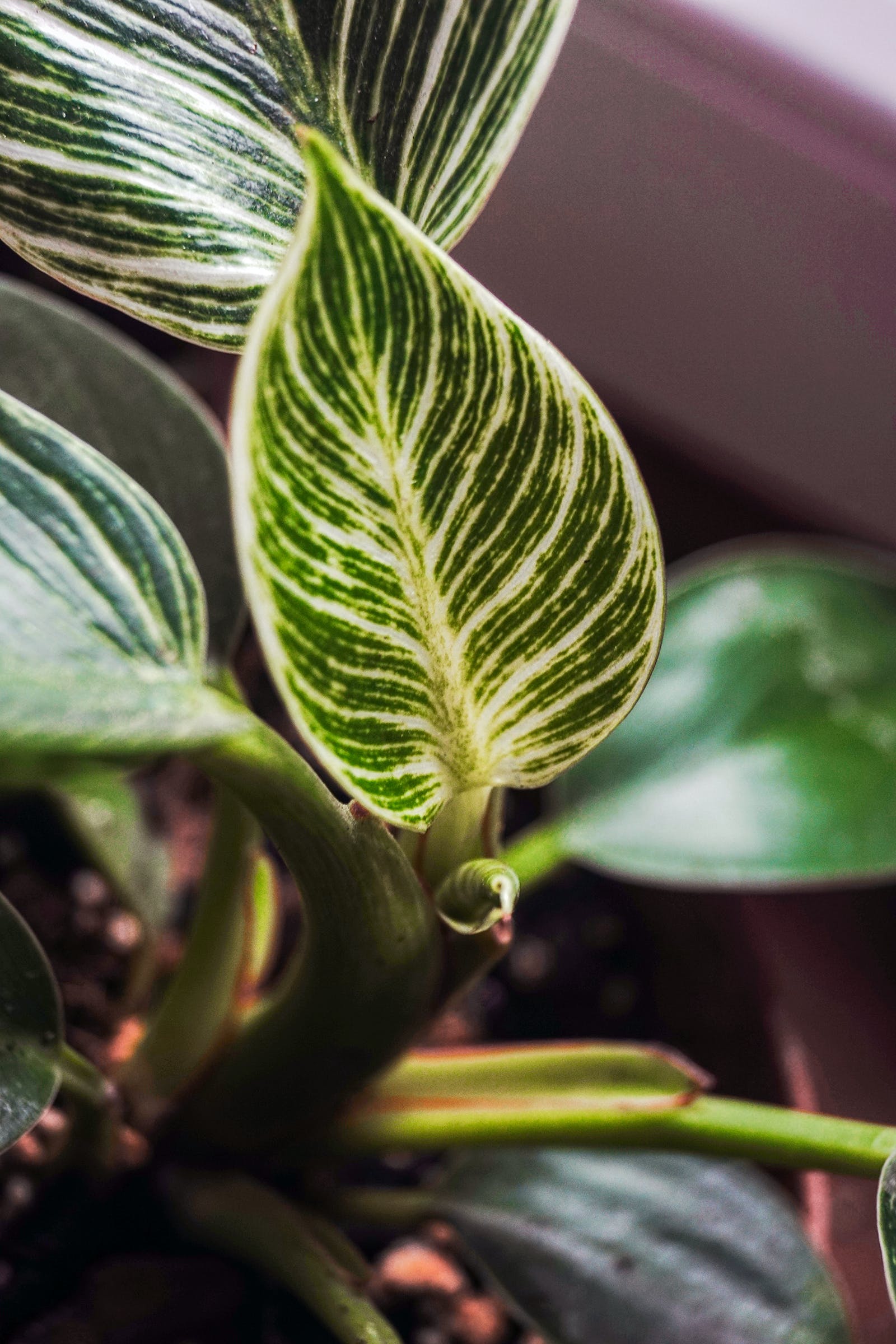
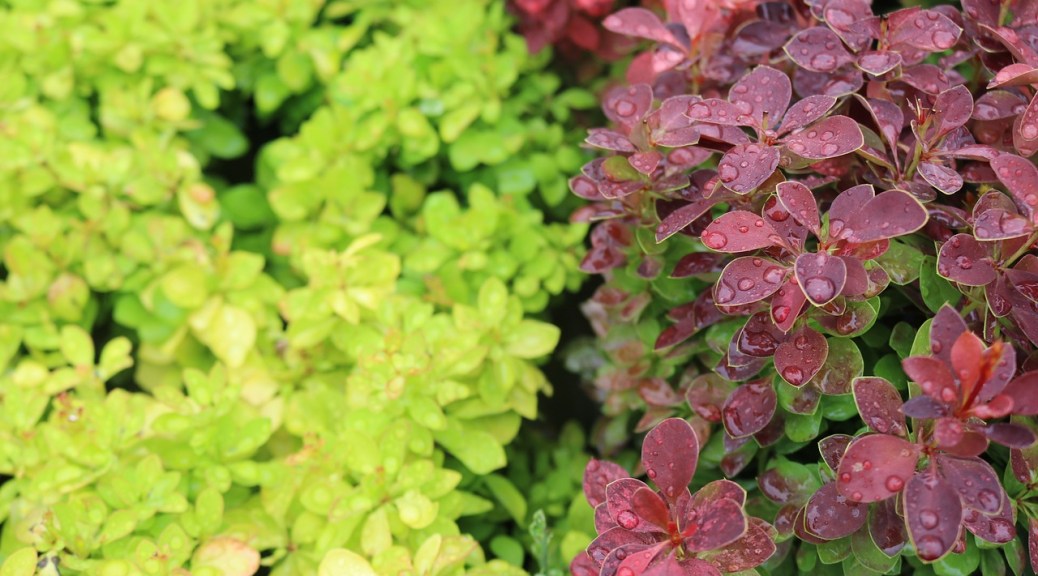
Variegated plants can be a beautiful and unique-looking addition to your plant collection. Variegation simply means that the plant’s leaves have both green and non-green parts. Some have shades of cream, or yellow, light green, pink, purple, or red – to name a few. Some plants have a stark white variegation that makes these plants really stand out. Many times, these plants are used to brighten up shady, dim areas or as used as focal points in landscapes or as striking indoor plants. Variegated plants can be the result of engineered breeding or a grower taking advantage of some type of random genetic flaw (chimera).
Leaves of variegated plants occasionally lose their colorful markings and return to plain green. This twist of nature can be frustrating when extra money is spent for the unique foliage markings. Variegated plants often have smaller leaves and are less vigorous than green specimens because the lack of the green pigment means less chlorophyll for generating energy.
Variegated plants can revert or turn green beginning on a stem, branch, or another area. Reverting back to solid green leaves could be a protective way that the plant returns itself back to a healthier form. When this happens, the best thing to do is prune out the affected leaves because if you don’t, the plain green can actually take over the plant because of the increased chlorophyll and vigour as compared to the variegated foliage. If the reversion continues, try to provide your plant with some extra light by moving it to a sunnier location if possible.
The hosta in this picture shows great variegation in all leaves except one. That leaf should be removed to preserve the variegation.
It’s been a tough few years for all of us because of COVID-19, but I had time to reflect this weekend on why it’s been hard for me as a gardener. While it’s been wonderful to have our gardens as an oasis and source of comfort during the pandemic, I realized that other than a few close friends, no one had seen all the work (and the results) that my husband Grant and I had achieved over that time.
So it was with great anticipation that we looked forward to our Lakefield garden being featured on a garden tour organized as a fundraiser to celebrate 60 years of theLakefield Horticultural Society.
While we spent a few very crazy days trying to put the final touches on our garden (my husband decided he would build a beautiful pergola [awesome] a week before the event [not so awesome] so plants had to be moved into pots and then back into the beds just a few days before) — sorry I digress — everything was perfect on the day — the weather was spectacular, we placed the last bits of mulch to cover a few empty patches and we looked forward to welcoming our guests.
The new pergola.
As the first people arrived (I think our first visitor was a man on a bicycle!) I began to realize how much I had missed the joy of sharing our gardens with others. And as the day progressed, it was wonderful to hear other people’s perceptions — for some it was inspiring, for some a bit overwhelming (we have a 3/4 acre property in a small village), for some they loved that we had plants they had never seen before (not your typical garden). Everyone seemed to leave with a smile on their face, which made our day.
Grant created numerous raised beds over the past few years — at my request — and we’ve had great success with them. We also purchased a “COVID present” for ourselves — a long wished-for greenhouse to extend our gardening season, and it’s been put to good use.
We’ve spent time over the past few years planting more native plants as I learn more about the benefits of creating habitat as well as having an aesthetically pleasing garden. Hey, it’s not all about me!! Doug Tallamy’s book is a great start to understanding the benefits we can provide in our humble gardens to the greater ecosystem.
There is definitely a balance — we’re aiming for a 50/50 balance of native/non-native — because I love my daylilies and peonies and don’t want to give them up (they give me pleasure), but I also love the hundreds of pollinators (bees, butterflies, wasps etc.) that flock to my Common Boneset (Eupatorium perfoliatum), Pearly Everlasting (Anaphalis margaritacea), Cup Plant (Silphium perfoliatum), and Cardinal Flower (Lobelia cardinalis) because I am choosing to plant native plants.
Boneset (white) and Cardinal Flower (red)
Last winter I grew some native (and non-native) plants using the Winter Sowing technique (because most native plant seed requires winter/cold stratification) and it was a great success (with some lessons learned – but that’s another blog).
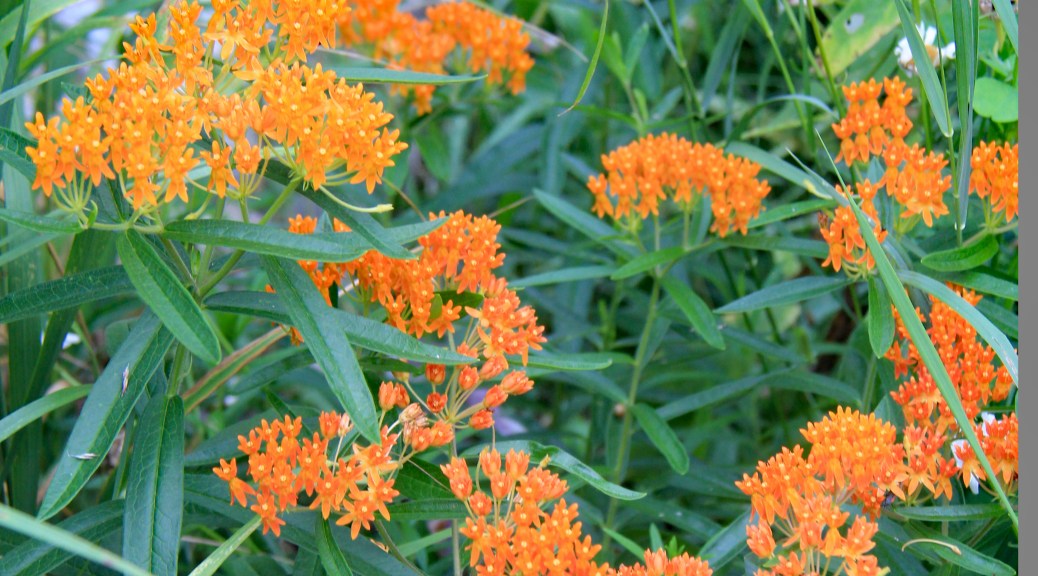
Grant set up a Plant Sale area for the garden tour and people were able to buy plants that they saw in the garden (although alas, I did not take any cuttings on my amazing orangeButterfly Weed – a type of milkweed – which really caught everyone’s attention).
The Plant Sale area
Over the day I saw many gardening friends I hadn’t seen in several years, and made all sorts of new friends. It felt like my community was coming together — like we were reconnecting after a long time apart in a beautiful place. And I realized that gardening is both a solitary and a very social activity. We even got featured in the local newspaper.
We raised funds to support our local horticultural society, we got back to feeling ‘a bit normal’, and most importantly we got to reconnect with people over a common passion — the love of gardening.
I hope that all of you will find opportunities to reconnect with people this summer and share your gardens and plants and trade stories about attracting pollinators etc. with others. It’s a feeling like no other. #happygardening
Our lovely rudbeckia and greenhouse in the background.
Garden gazing out the window a couple of weeks ago I noticed, with a sickening jolt, that my Clematis x jouiniana ‘Mrs. Robert Brydon’ was wilting. (It’s only a plant, Lois, only a plant). She has been in my garden for 4 years and had been growing very well up to this point but it appeared she must have clematis wilt. Clematis wilt and clematis slime flux are the two diseases that this particular cultivar may be susceptible to. Not noticing any slimy, smelly matter oozing from the stems, I ruled out slime flux.
‘Mrs. Roberty Brydon’ showing leaf wilt
According to Missouri Botanical Garden, clematis wilt is a serious disease of clematis caused by the fungus Ascochyta clematidina. This fungus can survive in the soil surrounding infected plants and may overwinter in infected plant debris. The fungus appears to be activated by ‘high humidity and favourable growing conditions found early in summer’. Any to all stems may be affected and the whole plant killed down to just below soil level. The good news is that the plant may recover after a year or two.
There are ways to manage and avoid having your clematis plants affected by this disease and indeed other diseases of clematis. Strategies (cultural practices) include a favourable planting site with 6 or more hours of sun. Soil should be fertile and well-drained with good air circulation around the plant. The area around your clematis should be free of plant debris and avoid any injury to stem and roots. Do not cultivate the soil around your clematis plants and mulch it well. Water carefully, keeping water off the leaves. If your plant becomes infected, cut the diseased stems just below ground level and destroy them.
‘Mrs. Robert Brydon’ in flower
I removed and destroyed all the diseased growth on my clematis (which was all the growth) and there is now new growth coming up from the root. I will be paying attention to keeping leaf debris cleaned up, improving air circulation around the vine and watering as needed, with care.
Hopefully ‘Mrs. Robert Brydon’ will survive this setback. Her profuse, pale blue flowers are unusual and appealing to me. The gardener, Robert Brydon, who ‘found’ this clematis in a Cleveland, Ohio garden in 1935, clearly thought enough of it to name it after his wife! Sigh.
Summer solstice has just passed and with it the waning of some iconic garden varieties. Late spring/early summer brings us not only the iris and rose but the peony as well. Peonies are large, long-lived perennials that may stay in one place without division for up to 100 years. Peonies bloom in a wide range of forms, from simple, elegant singles to massive doubles with more than 300 petals in colours of white, pink, yellow and red tones. They form a rounded shrub that may be up to 3 feet in height and width with glossy deep green foliage that remains attractive after the bloom is over.
Itoh peony ‘Bartzella’ in landscape
There are three types of peonies: Herbaceous, Tree and Itoh. Herbaceous peonies bloom in late spring/early summer and have stems that die back to the ground in the fall. Tree peonies have a permanent woody stem, more like a shrub. Woody stalks remain standing through winter and go on to flower again the next season. The blooms on trees peonies are larger and more fleeting than those on their herbaceous counterparts. In our area, tree peonies appreciate a sheltered spot to grow as a hard winter may result in a lot of die back. The third type of peonies are the Itoh peonies. These plants are a result of crossing herbaceous peonies with tree peonies. The stems of Itoh peonies die back to the ground each fall and yet the bloom is large like that of a tree peony. These plants do not require any additional support unlike some of the herbaceous peonies.
Tree peony
Peonies perform best when planted in a location with a minimum of 6 hours of sun per day and must have fertile, well drained soil. Once planted in a suitable location, they are relatively care free, requiring only a good clean up in the fall to cut the stems down and remove all leaves (reducing the potential for fungal growth). In the case of tree peonies, the stems are not cut but all leaves should be removed and discarded in the landfill.
Peonies are sold as bare roots from growers as well as from some of the larger companies. These can be planted in either spring or fall however from experience fall is the preferred time to get them into the ground. As well, many nurseries sell peonies in containers that can be added to the garden at any time provided they are kept watered.
Early single peony “Claire de Lune”
Recognizing the value of a peony variety that performs well in the landscape, the American Peony Society developed an Award of Landscape Merit for cultivars that do not require support and are vigorous garden varieties. When choosing a peony for your garden, consider one of these.
Japanese peony “Sword Dance”
Peonies are not just for the garden. They make wonderful cut flowers as well. For maximum vase life, harvest them when the bud is coloured, rounded and soft to the touch, keep the vase out of direct sunlight and change the water frequently (peonies like cold water and I have started to add some ice cubes to the water in the morning). This should give you 6-7 days of vase life. The blooms are so large that it only takes a few to fill up your vase.
Treat yourself and purchase a peony for your garden. One can never have enough peonies!
Peonies as cut flowers
“Flowers are the music of the ground. From earth’s lips spoken without sound.” – Edwin Curran
In the spirit of adding more native plants to my garden in order to help support diversity, native pollinators and birds, I recently purchased a New Jersey Tea shrub. Of course, it is also a new-to-me plant so I could not resist! This made me start thinking about other native shrubs that I could use in my garden….I already have some of the usual non-natives like hydrangea, lilac, forsythia and a few of the dwarf conifers. But, much to my surprise, I realized that I also have, in addition to the new-to-me New Jersey Tea (Ceanothus americanus), downy arrowwood (Viburnum rafinesquianum) , dogwood (Cornus species) and ninebark (Physocarpus opulifolius)!
New Jersey Tea – My newly purchased shrub is just a baby….it is barely 13 cm (5 inches) tall but will grow to be about 1 meter (3 feet) tall. I will need to protect it from the rabbits, who also inhabit my garden, by caging it with chicken wire. New Jersey Tea prefers full sun and well drained soil. It produces small white flowers in oval clusters at the branch tips in spring. It is hardy to zone 4. Additional information is available here.
Downy Arrowwood – My arrowwood is blooming right now. It is covered with clusters of tiny white flowers and many native pollinators. The flowers will be followed by blue-black berries that the birds love. Arrowwood prefers poor, well drained soil…..ours is planted at the edge of a gravel walkway. It can take part-sun to shade and is hardy to zone 3. At maturity, this multi-stemmed shrub will be 1.8-2.4 meters (6-8 feet) tall. Additional information is available here.
Dogwood – There are a few different species of dogwood native to Ontario including Pagoda dogwood (C. alternifolia), bunchberry (C. canadensis) and Red Osier dogwood (C. sericea). There are more but this group are hardy to at least zone 5 (Peterborough area). They vary in height and growing condition requirements. For more information on dogwood look here . The Peterborough and Area Master Gardeners also have a fact sheet available on dogwood here .
Ninebark – Ninebark is a great native shrub for your garden. It adapts to lots of different soil conditions and moisture levels including drought once established. It is hardy to zone 3, has pretty white blooms in summer and attractive fall foliage. I must admit that ours is planted in good garden soil and is mulched to minimize weeds and for moisture retention so my ninebark has it pretty good. This shrub does prefer full sun for best bloom production. The Peterborough and Area Master Gardeners also have a fact sheet available on ninebark here.
Remember that all new plants need to be coddled for their first year in your garden so keep them watered and watch for insects or critters that may cause damage. For me, that is fairly easy because I am often out in the garden admiring my new plants!
For more native plant choices and other pollinator information, check out Pollinator Partnership Canada under Resources. June 20-26/2022 is Pollinator Week in Canada. Why not celebrate by adding one or more native plants to your garden?
When it comes to dealing with invasive plants in our gardens, some can be quite challenging to control, let alone eradicate. In a system of Integrated Pest Management (IPM), gardeners may need to choose a number of different control methods and the methods considered need to make the least environmental impact. These methods involve cultural, mechanical, biological, and chemical options. In most invasive plant situations, choices will be cultural and mechanical. Chemicals may not be an option for home gardeners due to licensing, legislation, and product label requirements. However, some chemicals may be necessary in situations where there is a health and safety concern—e.g. Heracleum mantegazzianum (Giant Hogweed). Some of the usual methods that are used may include pulling, digging, cutting, removing flowerheads, sifting the soil for root fragments, smothering, or solarizing with tarps. Many invasive plants are difficult to remove in their entirety due to their extensive rhizomatous roots or their ability to produce many seeds that can last for years in the soil. Two unwanted plants that have popped-up in my garden in recent years are Campanula rapunculoides (Creeping Bellflower) and Allilaria petiolata (Garlic Mustard). My property is fenced but it is not closed off and so is open to seeds coming from other areas (including adjacent neighbouring properties). Because of this, my approach is about control of existing plants but also in preventing new ones from becoming established.
In addition to some of the methods mentioned above, two others you can add to your arsenal is to use mulch and to plant more densely.
Add Mulch
While the above-mentioned weed seeds do travel by wind, the majority of them will fall near the parent plant on the other side of the fence. All along the open fence lines I have added a thick layer of arborist wood chips. Adding a 4” layer will inhibit the germination of weed seeds as light is prevented from reaching them. Any seedlings that do germinate can be easily pulled as the roots cannot take a firm hold within the mulch. The mulch will break down over time and will need to be replenished.
Add Dense Plantings
e.g. Solidago Flexicaulis (Zig-Zag Goldenrod)
There is a wooded area near my house that is densely covered by a native plant called Solidago flexicaulis (Zig-Zag Goldenrod). Recently I noticed that there were only two or three Garlic Mustard plants amongst it. The Goldenrod was beating it! The Ontario Invasive Plant Council advises planting certain native plants at a density of 9 or 11 plants/m2 in order to compete with Garlic Mustard.[i] In addition to Zig-Zag Goldenrod these other plants are recommended as Garlic Mustard competitors:
Solidago flexicaulis (Zig Zag Goldenrod) and Parthenocissus vitacea (Woodbine), and Allilaria petiolata (Garlic Mustard) together in a wooded area in Peterborough
June brings a great show of Bearded Iris into the garden. Iris germanica flower in spring and although the bloom time seems short, the big colourful blooms are breath taking. Iris come in different heights, have big showy flowers in lots of fabulous colours and their elongated fan-like leaves give a different shape in the mixed border. There are 3 parts of the flower – “standards” which are the 3 upright petals, “falls” which are the lower petals usually hanging down and the “beard” which is the fuzzy hairs and is often yellow in colour. There are many varieties available, with colours ranging from shades of blue, purple, pink, peach, orange and combinations of colours where standards are one colour and falls another. Stunning!
Orange Harvest
Iris want a sunny location facing south or west, in well drained soil. They do not want to sit in water and will rot if they are too wet. Iris have rhizomes which produce roots to hold the plant in place and draw up water and nutrients. Rhizomes want their tops to be near the surface of the soil or slightly exposed, especially in heavy soil. A heavily mulched bed will not work for iris unless you leave a large area bare. Fertilize in early spring.
Raspberry Parfait
Dead-head flowers by cutting spent blossom stems right down, which encourages more bloom on rebloomers. Leaf fans should be cut back to 3” to 6” in the fall with sharp scissors.
Plants need to be divided every 3 to 4 years to reduce crowding and encourage blooming. Dividing should be done when plants are dormant in August or September. When dividing, check rhizomes for signs of disease and cut out any soft, wrinkled or marred parts. Let rhizomes dry overnight before replanting to allow cut areas to seal over to protect
Watch for Iris borer which will eat through the rhizomes. If you do get borers, dig up and cut off the damaged rhizomes.
Siberian Iris
Iris are often sold bare root from seed companies and there are several online iris companies in southern Ontario. They tend to ship for fall planting when plants are dormant. You can purchase plants in containers in garden centres in spring or summer.
Royal Botanical Gardens in Burlington have a wonderful display garden if you are up for a trip. Check out their website https://www.rbg.ca/gardens
Iris siberica is another showy plant in the early summer garden. Siberian Iris grow 15” to 36” tall with lots of smaller flowers having standards and falls. Their leaves are narrower and almost grass-like. Siberian Iris can be planted into the soil rather than on top although they still have rhizomes. They can take full sun or part sun and do like a moist area. Dividing needs only to be done every 10 years or if the centre dies out.
Siberian Iris: Such amazing detail!
One of the earliest iris is Iris reticulata which is actually a bulb that you would plant in the fall. They are short and usually purple.
In Ontario we have native iris that are classed as wildflowers and known as Flags. They include Iris versicolor which you will find in shades of blue and Iris lacustris which is a smaller wildflower and very rare. These are often used in pond settings as they prefer to be wet. Iris pseudacorus is the non native yellow flag iris which is listed on the Ontario Invasive list.
Iris are poisonous for cats, dogs and humans if eaten.
Peter Wohlleben in his well-know book, The Hidden Life of Trees, describes how trees are like families, continually communicating and supporting one another. Trees improve soil and water conservation, moderate climate, increase the wildlife habitat, reduce stress and improve health.
It is imperative we continue to increase the tree canopy in our ever-growing cities. This became more important after the recent storm that whipped through Southern Ontario and took out so many beautiful trees.
There are many factors to consider when planting a tree and it is easy to make mistakes. I learned this the hard way this past month when I was able to literally pull a 9-year-old tree out of the ground. Believe me, I am no incredible hulk! I made many mistakes when planting that tree; the picture shows it was planted too deep, the roots girdled around the original root ball and by amending the dug hole with compost the tree likely resisted growing roots into the surrounding clay soil.
Image Courtesy of Author
Do your research and purchase a tree that is suitable for your yard conditions:
How much sun and shade you receive each day?
What type of soil do you have?
Would you prefer a large tree or one that is smaller and more suitable to an urban setting?
What growing zone do you live in? (Check out this Zone Map if you are unsure)
Are you looking for a tree that will attract pollinators?
I would suggest you consider planting a native tree. Trees that occur naturally in our surrounding area are better adapted to local climate and soil conditions and more resistant to disease. Oak trees are a powerhouse for feeding birds and attracting pollinators and insects, however, they are quite large. A smaller tree to consider would be an Eastern Redbud or a Fall Witch Hazel.
Here is an article from Landscape Ontario with suggested native trees to consider.
HOLE DEPTH
In well-drained soils, the planting hole width should be two to three times the diameter of the root ball and only as deep as the root ball. Widening the planting hole produces a hole with a greater volume of loose cultivated soil that allows rapid root growth. This way roots gain access to a greater volume of loosened soil. Do not plant the tree’s root flare below the ground. The root flare should be within the top 5 cm of the soil surface. Use a brush to find the top of the root flare which is where the structural roots begin.
SOIL AMENDMENT
Remove any grass roots, weeds, rocks or other debris from the planting hole. It used to be believed that you should fill the hole with an organic amendment such as compost, however, recent research has found that this doesn’t improve root development or tree growth and can sometimes be detrimental to tree performance and survival. It is best to backfill in layers and lightly tamp and water to eliminate air pockets. Additions of mulch and compost can be surface applied in future years to supplied much needed nutrients.
CREATING A BERM
It is wise to build a 10 cm high berm of soil extending 15 to 20 cm around the periphery of the root ball. It should be firmed and is intended to keep water from flowing away.
MULCH
Apply mulch such as leaf litter or untreated wood chips evenly at the base of the tree. It will help to reduce evaporation and suppress weeds. Be sure to pull the mulch about 15 cm away from the base of the trunk. The depth should be between 5 to 10 cm. I often see trees planted with mulch piled like a volcano. This does not allow the water to penetrate to the roots and can also cause damage and disease to the trunk of the tree.
STABILIZATION
Only stake the tree if the roots will not support its height or if it is exposed to high winds. If a tree must be staked, place stakes no higher than 1/3 the height of the tree. Stake the tree loosely so it can move naturally in the wind. This movement will help to increase the tree’s stability. The staking material should not constrict or rub against the bark of your plant. Remove stakes after roots have established, no longer than one growing season.
LASTLY
Remove all plant identification tags and any trunk protection or packaging material.
Supplemental watering is recommended the first 2-years after planting your tree. A sprinkle with the hose for a couple of minutes does more damage than good as this does not provide enough water to penetrate deep into the soil. Newly planted trees must be watered regularly until frost. Also, if water is pooling around the tree, cut back on the watering.
Do not be tempted to add additional fertilizer at this point. Mineral imbalances can occur and cause more vegetative growth than root growth.
Do not prune the tree beyond removing any dead, diseased or damaged branches.
For further information, check out this Tree Planting Guide from Landscape Ontario.
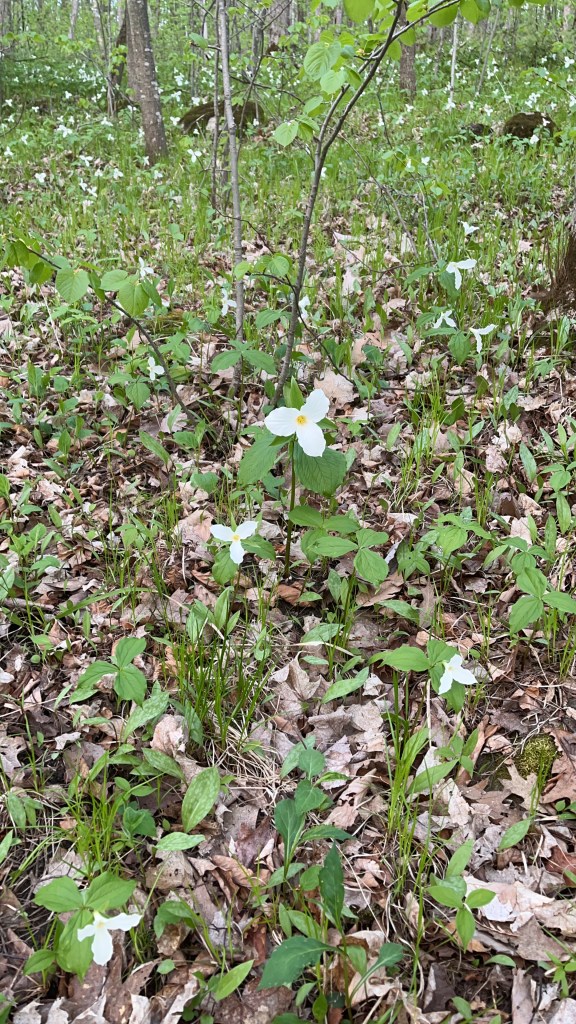
Most people know of the White Trillium (Trillium grandiflorum) as Ontario’s provincial flower. This is the flower featured on many of our provincial documents, from health cards to driver’s licenses. It was on March 25, 1937 that the Province of Ontario gave the trillium this honour.
Trilliums have three broad leaves, three small green sepals, three petals, and a three-sectioned seedpod. The “tri” in the Latin word trillium refers to these collections of three.
Trilliums are very slow-growing plants; their seeds take at least two years to fully germinate. The plant itself takes seven to 10 years to reach flowering size. After first flowering, it will bloom annually in early spring, with the blooms lasting for around three weeks. Trilliums can live for up to 25 years.
Did you know that the plants are phototropic? This means that the blooms will bend toward the sun and follow it across the sky.
You may not know that ants are involved in the dispersion efforts of the trillium. Ants are attracted to the protein-rich seed sac on the seeds which they eat after carrying the entire seed back to their nests. The actual seeds are not harmed during this process, and are later discarded to grow a new plant in a new location.
As a spring ephemeral, trilliums have a few short weeks in the spring to collect as much sunlight and nutrients as possible to be able to survive for the rest of the year. If trilliums are picked in the height of their flowering glory, they may not be able to collect enough resources to survive.
There’s a pervasive myth that it’s against the law in Ontario to pick or relocate these native plants. In 2009, former Peterborough-Kawartha MPP Jeff Leal introduced a private members’ bill called the Ontario Trillium Protection Act. Although the bill passed first reading, it never became law. If you do relocate these spring beauties or buy them from a garden centre, mulch with leaf litter for best results. Filtered light is best as they cannot tolerate much direct sun. The soil needs to be rich in organic matter, well-drained, and moist.
There are several varieties of trilliums in Ontario, with the most common being the White Trillium. The next common variety in our region is the Red Trillium which is also called “Stinking Benjamin” (Trillium erecta). Why? Go out this spring and find one and take a sniff. You may discover it smells a bit like rotting meat. Yikes! The aroma’s purpose is to attract pollinators, and in this case, the pollinators are green flesh-flies who are out in search of rotting meat on which to lay their eggs. Instead of finding the perfect nursery, however, they end up assisting the plant in its procreative efforts.
Plants are rarely boring, once you get to know them!
I’ve been gardening for more than 25 years and, like many of you, thrill at the opportunity to discover new plants for my gardens. Over the past few years these have been mostly native plants, as I learn about all the benefits that they bring – here’s just a few examples of why native wildflowers, grasses, shrubs and trees do so much more than just add beauty to the landscape:
They support birds, pollinators and wildlife – native gardens attract birds and butterflies and provide habitat and food for native pollinators
They increase biodiversity – native plants increase garden health and resilience, and help contribute to a broader effect to nurture and sustain living landscapes
They’re tough and low maintenance – because they’re adapted to grow in their native range, locally native plants tend to thrive with little to no care and conserve one of our most precious resources – water
They help you save money AND create a healthier environment for people – native plants don’t require expensive fertilizers and chemicals, or toxic pesticides and herbicides
They help with climate change – no lawn mower costs or exhaust! and long lived native trees help store carbon dioxide
They make gardening easier – if you select the right native plants for your garden, you don’t have to modify or amend your soil
I’m just going to share three favourite native plants in my garden, with hopes that you may consider them for yours.
Culver’s Root offers a strong upright, architectural accent to any perennial garden that attracts attention from both people and pollinators!! It can reach heights of 5 feet if it’s happy (although mine hasn’t achieved that yet) and the spikes of white flowers open from the bottom up in mid-summer. It has finely toothed leaves that are lanceolate and occur in a whorl of 3 to 8 leaflets. The inflorescence has several wand-like flowering spikes that resemble an elegant candelabra.
Culver’s Root grows in zones 3-8, in full sun to part shade but it does like moist, well-drained soil. The seeds are so tiny that they should be directly sown on the soil surface in fall or in the spring – I’ve tried winter sowing some this year so we’ll see how that goes.
The plant really has no other synonyms; apparently the name was derived from a Dr. Coulvert, a late 17th to early 18th century pioneer physician who found laxative properties in the plant. More information here.
Cardinal Flower in bloomCardinal Flower and Boneset in my garden
Cardinal Flower (Lobelia cardinalis)
Who doesn’t love bright red flowers in the garden? For those who say native plants can’t be showy I give you this amazing example to disprove that theory. Named for its scarlet red flowers, its tubular flowers are a magnet and important nectar source for hummingbirds and swallowtail butterflies.
Like Culver’s Root the flowering spikes open from the bottom to top and bloom for several weeks. They grow best in moist, rich soils in full sun to partial shade.
I’ve only had my plants for two seasons but I understand that the parent plants will not persist after a few years, so it’s important to either let it go to seed (so it reseeds naturally) or collect seed – this is another plant where I am trying out winter sowing (native plants are a great choice for this propagation method). While many sites will tell you it needs a really moist site mine have done fine, although I do keep the plants well watered in drier times. More information here.
Green Headed Coneflower in my gardenGoldfinches enjoying the seedheads in the fall
Green Headed Coneflower (Rudbeckia laciniata)
Also commonly called Cut Leaved (or Cut Leaf) Coneflower, this is the straight species, not to be confused with the double cultivar many of us have in our rural gardens (often called the Outhouse Plant – or Rudbeckia laciniata “Golden Glow”).
Not a small plant (it grows 4 to 5 feet tall in my garden), it clumps and spread by rhizomes so only one to consider if you have the space! Its bright yellow, daisy-like drooping flowers with green centre disks (which can be about 3 inches across) bloom later in the summer season. It prefers moist soil, but grows well in average, medium, well-drained soil in full sun to part shade. In nature it is often found in woods, meadows, streambanks, and roadside ditches.
The Cherokee natives call this plant Sochan and the spring basal leaves are a traditional Cherokee food. Butterflies are attracted to nectar from the blooms and songbirds, especially American Goldfinches, eat the seed in the fall. It is moderately deer resistant. More information here.
So I hope you’ll take the opportunity to seek out native plants to add to your garden, finding ones that are native to your region and appropriate to your conditions. Happy Gardening!!