All posts by peterboroughmastergardeners

Philodendron — An Easy Care Houseplant

By Chris Freeburn, Master Gardener

The Philodendron is a tropical plant found in South and Central America and the Carribean. It is the second largest group in the Araceae family. This family of plants includes Pothos (which are often confused with Philodendron), Alocasias (Elephant Ears), Monstera (this plant is its own genus), Aglaonema (Chinese Evergreen), and ZZ plants. There are many different varieties of Philodendron from vine types to large tropicals which grow at different height levels in the jungles of their tropical homes. Many vine type species live as epiphytes in their native environment, growing like air plants and climbing up their host plant to reach more sunlight. Most have large heart shaped leaves that grow alternately on stems.

Philodendron and Pothos are often difficult to distinguish. When you look closely at the base of the leaves, philodendrons will have a covering or sheath, called a calaphylls, over the leaf which form where the stem and petiole (leaf stem) attach.

(Philodendron showing cataphylls, and pothos showing no cataphylls)

P. Hederadeum is the most common species available as a houseplant. Heartleaf will trail or can be trained to grow up a trellis.

Upright or bush philodendrons also can have aerial roots similar to orchid roots which grow above the soil. These roots form because the plants originally grew in tropical jungles where philodendrons grow into the trees.

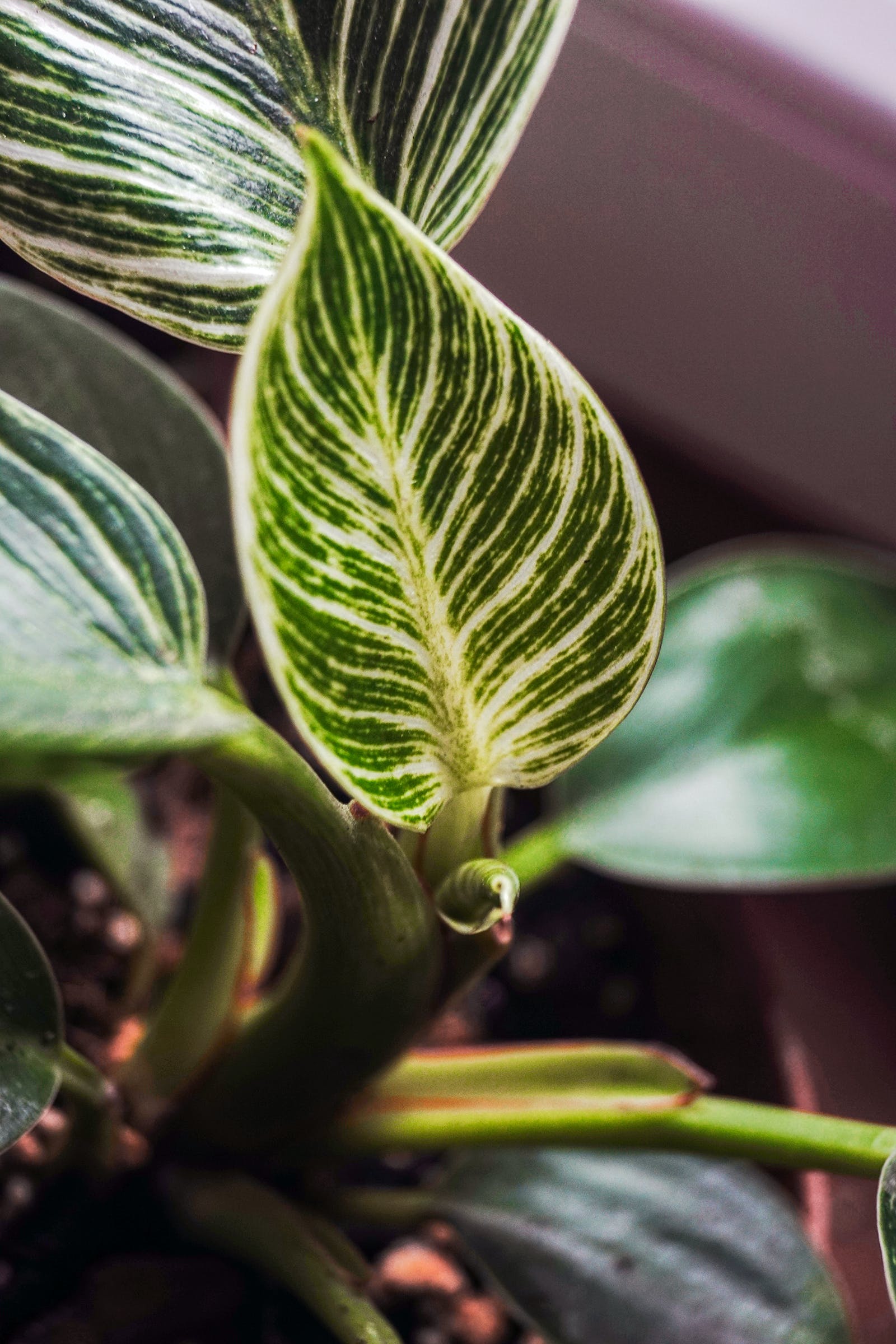
 If you are looking for an easy to grow houseplant, try the philodendron. Or if you want to increase your houseplant varieties, there are many different varieties to choose from.There are upright types like ‘Birkin’ which has dark glossy leaves with white streaks in the veins. Many varieties have dark green leaves while others have chartreuse leaves like ‘Moonlight’ or ‘Mekloni Gold’. Growers have introduced cultivars named ‘Prince of Orange’, ‘Ceylon Beauty’, Black Cardinal’, Narrow Escape’ and ‘Brazil’.

(“Imperial Red”, and “Birkin”)

In our homes, philodendron are one of the easier houseplants to grow. They prefer bright indirect light, but will tolerate lower light. Do not over water. Let the soil dry out between watering.

Fertilizing with a 20-20-20 solution in spring and summer is okay, but let your plant rest in the fall and winter, watering less as well. Philodendrons rarely have pest or disease problems. They contain calcium oxalate which is poisonous to humans and pets if ingested.

Philodendrons that vine tend to be slower growers but shouldn’t get pot bound. Repotting your houseplant when roots fill the pot with fresh potting soil will make your plant happier. You may also need to wipe dust from the shiny leaves by using a soft damp cloth.

I saw an article on a website recently where people were talking about the beauty of tropicals in their native environment. They wondered about bringing them home to Canada. Please remember that transporting living plants into other countries is not legal. Also, that gorgeous gigantic tropical would not be happy in your home. The plants that are for sale in Canada have been bred to be in your home, but will never get as lush as those that grow in hot humid countries. Enjoy them while visiting in their environment and love their hybridized cousins in your home.

Winter: When Bunnies Can Wreak Mortal Havoc on Gardens

By Mary-Jane Pilgrim, Master Gardener

Two weeks ago, MG Lois Scott wrote an article about Burning Bush (Euonymous alatus) and other invasives now on the Invasive Species lists that she is eradicating from her gardens in favour of natives. I actually used to have a beautiful Burning Bush, right at the front of my garden. And then winter came, and a furry rodent.

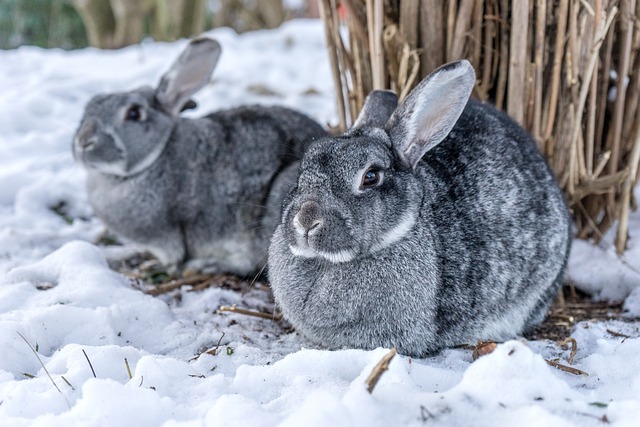
Rabbits might look cute and fluffy, but they’re not a welcome sight for gardeners; especially between December and March. As cute as they might be, they can cause serious damage to plants in the winter when greens aren’t available for them to easily munch on.

Pretty sure that Bugs Bunny, who we could see in the snow through the living room window, caused the demise of the burning bush. In the spring, it didn’t bud. Most of the outer bark was missing and tooth marks were very evident. It was as dead as a doornail. (Aside: “Dead as a doornail” is one of the oldest idioms found in print, going back to the 14th century. It referred to nails having been pounded through a door, and having the pointed end pounded flat against the door. That nail could not be reused!)

Back to my story. Apparently, our neighbourhood cottontail had made a lunch or dinner (or several of each) out of the soft bark on our small burning bush shrub and also my prized “Perry’s Gold” pine (Picea abies ‘Perry’s Gold’), purchased from Anna’s Perennials; my favourite local garden centre. Sigh. Happily, Anna had another one for me.

Obviously, rabbits don’t hibernate. When winter arrives and greens disappear, they turn to nibbling on the bark of young trees such as birch, crabapple, mountain ash, honey locust, willow and oak. Older trees with their thick rough bark aren’t as tempting as a young tree where the bark is smooth and thin. Green food material is just under the surface of young trees.

The rabbit’s menu also includes bushes/shrubs, such as roses, sumac, Japanese Barberry, viburnum, Burning Bush, Rose of Sharon, arborvitae/cedars and other broadleaf evergreens. It’s all about survival and they won’t be picky when their populations are high. Once a rabbit has chewed the outer bark of a small tree or shrub, little can be done to save it.

While I feel for the starving rabbits out there, there are a few preemptive steps you can take to stop rabbits from wreaking mortality havoc in your gardens. The most effective is to place chicken wire fencing around vulnerable plants like a cylinder. The fencing material needs to be high enough that rabbits won’t be able to climb or reach over the fence after a heavy snow. In most cases, a fence that stands 2-3 ft should be sufficient. To prevent them from crawling underneath the fencing, pin the fencing to the soil with U-shaped anchor pins.

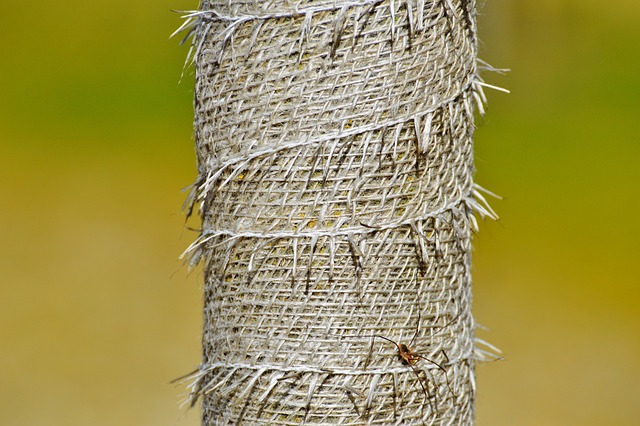
Small trees can also be protected by placing white spiral tree guards around their trunks or by wrapping them/their trunks in burlap. Damage may be further reduced by removing brush, junk piles and other places where rabbits live and hide from around your home.

Lastly, there are a few plants that rabbits seem to find less appealing, particularly plants with thick or prickly leaves, and plants with very strong scents. It may be worth it to experiment around your prized shrubs with hellebores, foxgloves, allium, acanthus (bear’s breeches), and salvia (sage).

A final parting note: One or two rabbits that overwinter in your garden this year could mean dozens returning to munch on your prized shrubs next winter, given the fertility of these furry rodents!

Exploring Two Special English Gardens (and the Gardeners behind them)

by Emma Murphy, Master Gardener

This week I had the pleasure of doing my first in-person presentation in almost three years to the Peterborough Horticultural Society on some very special south England gardens that my husband and I were able to visit in May 2022.

National Garden Scheme

I also talked about the amazing UK National Garden Scheme (NGS), where gardeners open their private gardens on specific days during the year to raise funds for primarily health charities. Since many people had never heard of the NGS, I thought I’d share with a wider audience with my blog for this month.

Screen capture from NGS website

The NGS gives access to over 3,500 exceptional private gardens in England, Wales, Northern Ireland and the Channel Islands, which in turn raise impressive amounts of money for nursing and health charities through admissions, teas and cake. And it’s not just about seeing beautiful gardens – there is a strong focus on physical and mental health benefits of gardens too. They also support other charities doing amazing work in gardens, and provide health and grant bursaries to help community gardening projects. You can read more here.

How I wish we could start something similar here in Canada (or Ontario, or Peterborough)! Imagine all the good that could happen just from sharing our gardens with people. I’ll have to think more about this.

So we managed to see two very special private gardens (that both open for the NGS as well) and get to meet the gardeners behind the garden, which is always my favourite thing to do when I visit to a garden. I want to understand the inspiration, the goals and objectives, and the plans for the future…because we all know our gardens are ever evolving places.

Waterperry Gardens

Waterperry Gardens (east of Oxford in Oxfordshire) has a long legacy and an amazing history as one of the few horticultural schools for women (from 1943 to 1971) – run by two outstanding women – Beatrix Havergal and her partner Avice Sanders.

Photo courtesy of Waterperry Gardens

It’s an 80 acre estate with 8 acres of formal gardens, and is famous for the herbaceous border. This is what it looked like May 2022 when we visited, and how it looks now (fall 2022, photo courtesy of Head Gardener Pat Havers, who I was lucky enough to meet in person in probably the busiest time of the year!) I love this blog written about her in 2017.

You know you’re a hard core gardener when your Mum takes you to work in a wheelbarrow!

Photo courtesy of Pat Havers

Pat grew up in the gardens as her mother worked there, and has been working there herself for the past 20 years -10 years as Head Gardener.

“Living in the village it was every little girl’s dream to have this haven on their doorstep”, says Pat. “I would spend hours running through the beds and asking all the gardeners questions about their work. This soon caught Miss Havergal’s eye and I became the youngest student of hers at just the age of 4. My guess is perhaps she did this to keep me out of trouble.

Her passion for the gardens were evident in everything she said. I found out about her favourite quiet space (down by the River Thame), and the incredible legacy established by Havergal and Sanders, that continues to this day in terms of courses, plant identification tags, and garden design.

This garden is the Formal Garden/Silent Garden, where people are encouraged to turn off the phones and just enjoy the beautiful knot garden, sculptures, and seasonal changes.

St Timothee Garden

Just a bit further east near Maidenhead in Berkshire is St Timothee, a spectacular 2 acre private country garden planted for year-round interest with a variety of different colour-themed borders, each featuring a wide range of hardy perennials, shrubs and ornamental grasses.

The garden artist at work here is Sarah Pajwani, and I love her approach to gardening (similar to my own), and especially her focus on making her gardens appealing all year round, including those winter months. While England obviously doesn’t have the harsh winters we have here, her focus is on maintaining structure and colour in the garden.

photo courtesy of Sarah Pajwani

An overgrown field area when she moved in (2006), Sarah created a design rationale with the help of professional landscapers, but then set about filling her garden with plants of her choice, border by border. She definitely loves her purples and pinks, but also has a few ‘hot’ borders with lovely reds, oranges and yellows.

There are so many lovely aspects to her gardens, including a large pond, wild meadow, potting shed, and formal parterre garden. While we were there in May, her photos of her winter garden are amazing, designed to have year round interest that’s easy to manage.

Sarah’s garden received national recognition in 2021, being recognized by The English Garden magazine as the National Winner for favourite garden. A garden not to be missed if you are in the area!

This excellent garden blog shows the beauty of the St Timothee Garden in wintertime, when it’s one of the first to open for the NGS.

While we did enjoy seeing many of the ‘signature’ ‘must see’ gardens on our English trip – like Sissinghurst, Hidcote, Kiftsgate Court Gardens, and Great Dixter – it was these private gardens – where we had the opportunity to meet the gardeners – that were the highlight of our trip. So if you’re in the UK, be sure to check out the NGS website for what gardens are open while you are there – they have a great interface to help you – either by week or by arrangement.

(Special thanks to the magic of Twitter for connecting me to Ontario gardener Lynette, who connected me to master gardener Nicki in Sussex, who helped me find these very special gardens and gardeners. You will both be on my list of gardens to see next time I’m in your area.)

The Fall of a Fall Favourite

By Lois Scott, Master Gardener

Sometimes it feels like my garden will never reach the ‘mature’ stage even though I have been gardening in the same spot for 36 years.  There are a variety of reasons for that, but one major one was my need to remove plants that are now considered invasive. “Invasive species are considered one of Canada’s greatest threats to the survival of our wild animal and plant life.  Invasive species kill, crowd out and devastate native species and their ecosystems”.  https://www.invasivespeciescentre.ca/learn.

So, who were the super villains in my garden?  I’m looking at you, Burning Bush (Euonymus alatus) and also you, Barberry (Berberis).  I was initially truly disappointed when I realized they needed to go but then my short attention span came into play and I was on to the next thing.  What new plants could I get to replace said villains?!!!  And they are environmental villains:

Burning Bush
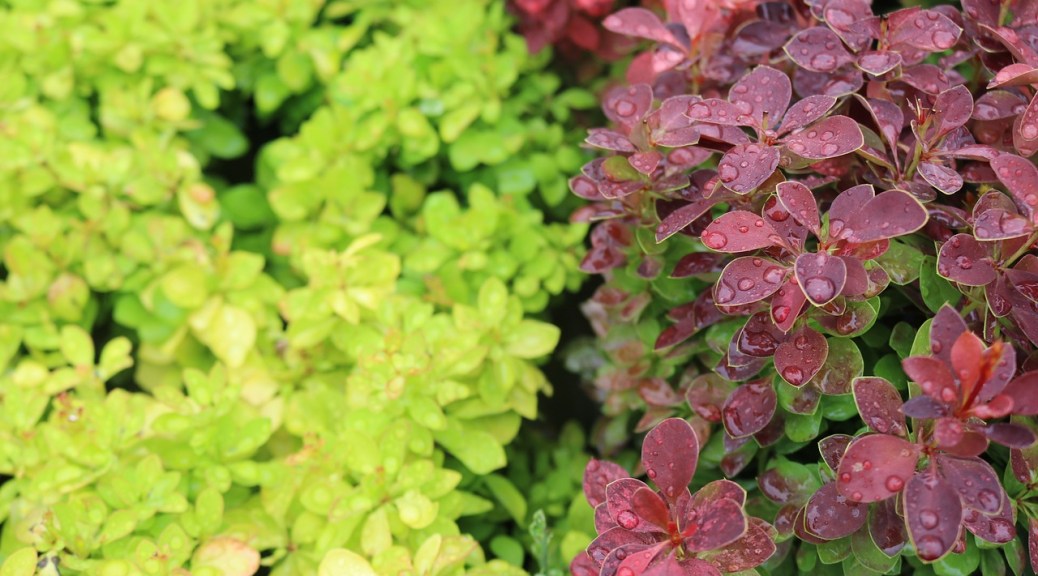
Japanese Barberry

Burning bushes are certainly very visible at this time of year due to their intense red foliage, but Chokeberry (Aronia melanocarpa) makes a wonderful substitute for both Burning Bushes and Barberry.  They are native to Ontario, will grow up to 2.5 metres tall, have white flowers in spring and their fall colour is dramatic.  They will grow in moist or dry areas and they attract pollinators and songbirds.  There are actually many native shrubs that are very ‘ornamental’ and worthy garden additions.  https://www.inournature.ca/best-native-shrubs

Chokeberry (Aronia melanocarpa)

At the risk of blathering on about native plants, one small benefit for me is that if I choose a native plant that is not aggressive (rampant spreader etc) and is suited to the conditions of the site (right plant, right place) I won’t find myself having to hack out this year’s fan favourite that turns into next year’s invasive disaster.  Always a good thing for me and the wildlife and pollinators in my garden!

For Garlic Lovers Only … How to Grow and Harvest Garlic in Ontario

By Carol Anderson, Master Gardener in Training

Unlike many of our more tender vegetable and herb favorites, garlic prefers to spend the winter “contemplating” spring from a safe and protected spot in your outdoor garden bed. And the good news is that the timing is perfect – planting garlic in October, after the first frost (or two), is ideal for ensuring a healthy crop of garlic that will be ready for harvest the following summer (usually mid to end of July).

The reason for this is that garlic is considered a “winter annual” and exposure to the cold temperatures ensures proper bulb development. The cold of winter, also known as vernalization, prompts the clove to break open after a period of dormancy. However, the garlic cloves that you plant (also called “seed stock”) must be planted to the correct:

  • Depth: to ensure that they are insulated from extreme or harsh conditions, and
  • Distance: to ensure that the stock has enough room to multiply into large and healthy buds.

What you will need:

-small trowel
-garlic seed stock (*see special note)
-leaves or hay (as mulch)
-compost (recommended)
-pen and paper
-toothpicks (optional)

Planting Guidelines:

  1. Condition your Soil. Although garlic will grow in many soil types, adding 2 inches of compost and working this into your soil is recommended. A soil that can hold nutrients and water easily (making them available to your plants) will improve your overall yield.
  2. Split the garlic bulb into the seeds while trying to keep as much of the soft shell on each of the cloves.
  3. Make a “map” of your garlic field on the ground with either toothpicks or the end of your trowel marking where each garlic “seed” will be placed. It is recommended that each seed (clove) is planted ~6” apart and ~4” deep in rows that are 10” apart. (Note: the clove should be planted to a depth that is 4 X the length of the clove – e.g. 4” for a 1” clove).
  4. Place the clove with the pointy side up in the 4” deep hole and cover gently with soil.
  5. Make a paper “map” of your garlic field so that you remember where each garlic bulb will be growing in the Spring.
  6. Cover our garlic field with 12-18” of leaf or straw mulch.

Growing and Harvesting Recommendations:

  1. In the Spring, you may need to remove or refresh the mulch. It is recommended to keep the garlic field mulched with a few inches of mulch to keep the moisture in and reduce weed growth.
  2. Using a standard garden hoe, weed frequently between the rows to uproot any early weed growth.
  3. Most garlic varieties produce a garlic “scape” – a thin curly green end of the plant. If the scape is left on the plant, energy will go to flower formation, instead of bulb growth. Remove the scape immediately after it has curled (see below) by cutting or snapping it off (see Special Note below).
  1. Harvest the garlic by using a garden fork or spade – loosen the soil 4-6 inches around the bulb and then lift the entire plant with bulb attached gently from the soil. (Note: garlic is usually ready to harvest in July when some of the leaves have begun to turn brown. Leaving them too long will allow decay. It is recommended, however, that during a moist summer a “test” is done by digging up a bulb before the leaves start to brown to avoid premature decay).
  2. Tie 5-10 garlic bulbs together in a bunch with garden twine/hemp and hang to dry/cure for 2-3 weeks in a dry well-ventilated area.
  1. Cut the dried garlic stem close to the bulb using garden cutters and remove the dried roots close to the bulb using kitchen scissors. Store the bulbs in a cold cellar or cool dark location for later use (never in the refrigerator), keeping as much of the sheath/covering of the bulb intact as possible. Garlic can be stored for up to one year in the right conditions.
  2. Enjoy!!!!

Special Notes:

Garlic Stock: Do not use imported garlic purchased from the grocery store as this could introduce unwanted diseases into your garden. Garlic stock (or seed garlic) can be purchased from local growers near you….and the good news…once you grow your own…you will have an endless supply of “stock” acclimatized to your own growing conditions.

Spring Planting: Garlic can be planted in the spring. However, you must keep your “stock” in cold storage prior to spring planting to ensure that the bulbs experience a prolonged cold period to stimulate flowering/bulb development.

Garlic Scapes are not garden waste, they are delicious in salad…and they make a deliciously potent pesto!!!! Try this garlic pesto recipe out.

Sources:

Garlic Growers of Ontario
Garlic Growers Association – Toronto Garlic Festival
The Old Farmer’s Almanac

Reflecting on the Past Season

By Marilyn Homewood, Master Gardener

The frost has made its first appearance marking the end of the summer growing season.  Before plunging headlong into bulb planting, I find it valuable to use this time to take stock of the past season as it serves to help me plan for next year (although I must admit I have already submitted a lengthy list of dahlia tubers for next spring).  I find it helpful to keep a gardening journal throughout the year for reference purposes and it becomes an important part of this process. There are many entries especially in spring when I am propagating, not so much in the summer but I always do a fall summary.  This written record has served me well over the past few years.  I also take this opportunity to look back over the photos I took throughout the season. They sometime remind me of just how much I enjoyed a certain plant.  One plant whose value seems to fade from my memory is sweet peas. Time consuming to grow, somewhat fleeting in our climate, I am always ready to drop them from next year’s list until I look at the photo.  Then I recall just how much I enjoyed their appearance and scent!!

Successes: It can be hard to see all the good things that happen when you are in the midst of seed starting, weeding, transplanting and harvesting.  I tend to dwell on what is not working (don’t all gardeners?) and often pass over the good stuff.  Evaluating the successes allows you to repeat or expand on your wins for next year.  This year I grew lisianthus (prairie gentian) for the first time.  It grew well in our climate and produces a bloom that is both attractive and long lasting.  It has continued to push out buds and I am still cutting it for the vase.  Next year, I will try starting it from seed, grow more of them and also plant some in the landscape for bloom from August to frost.

Challenges: Identify what did not go well and try to ascertain what the problem was and if it can be addressed.  Sometimes things just don’t work in your situation and its worth evaluating if the time, effort and money is worth allocating to this endeavor.  After a couple years of trying, I have decided to give up on ranunculus.  They are labour intensive as they require pre-sprouting in March with planting out in April under hoops and frost cloth.  Growth was great on the plants however each time a plant budded up an unidentified varmint would come in and make off with the flower bud.  So it’s a choice between adding rabbit protection to the already busy growing regime or devoting the resources elsewhere.

Future Opportunities: Always be on the lookout for possibilities for next season.  Whether it is a major project or a plant acquisition, this is a good time to firm up ideas.  I watch a lot of different types of gardening webinars and do a lot of reading and am always jotting down plant ideas that might work for me.  This is a good time to evaluate that list and based on available space, determine what to try for next year.  If it involves propagation, it might mean acting now.  I have decided to expand my planting of perennial poppies and am going to take root cuttings for the first time which will be overwintered in my extension.  With any luck, I will have new plants for next spring.

Try investing in a few hours musing over you garden and you reap the rewards next year.

https://extension.psu.edu/evaluating-the-garden

https://www.canr.msu.edu/news/garden-health-evaluation-part-1

Native Plant Gardening for Birds, Bees & Butterflies

by MJ Parker, Master Gardener

I recently downloaded “Native Plant Gardening for Birds, Bees & Butterflies” from my local library. This book was a fabulous find for me because I am currently planning a buffer area by the water in our new place. Going through this book reminded me of when I was a kid with a new Sears or Eaton’s catalogue – always an exciting event – something only people of a certain age will remember.

Book cover

The book was written by an entomologist, Jaret C. Daniels, currently living in Florida but the area covered by the book is the upper Midwest which is roughly parallel to us here. I have ordered plants from Minnesota before with no problems and some of the plants I currently grow are in the book.About 1/4 of the book is devoted to why we should plant gardens for birds, bees and butterflies. He does a brief summary on a number of topics about the actual mechanics.

False Indigo (Baptisia australis)

Most of the book, however, was a precis of individual plants roughly divided into sun, shade, and bog. Each plant started with a picture, then a summary of what it would attract and ended with specific location and cultivar tips. And this plant section was the part that I found extremely interesting and helpful.

New Jersey Tea (Ceanothus americanus)

So what I did was I sat down with a pen and paper over a number of days and compiled a list of what would work for me and plants I wanted to get. I ended up with a comprehensive list of plants, some I had forgotten to bring from the old place and some completely new to me.

And to date I have already placed 2 seed orders for some of the things on my list.

Insect Galls on Trees

By Laura Gardner, Master Gardener in Training

I was out for a walk earlier this summer and noticed that a number of trees in my neighbourhood have lumps on their leaves, leaf stalks, shoots, or at the ends of their branches. At first glance you might be alarmed and think they are diseased, but many are the homes of tiny insects such as aphids, mites, sawflies, psyllids, and midges. They are often quite numerous and they come in different shapes and sizes. A gall is formed through the expansion of plant cells—similar to a tumour. This may be triggered by organisms such as viruses, bacteria, fungi, nematodes, or insects. Insects induce the galls through actions such as oviposition (inserting the egg into the plant tissue), the release of chemicals by the female and eggs, and through feeding. It is a shelter for the young and protects them from predators. While sometimes causing leaf deformity, in the majority of cases, galls are a cosmetic concern and do not harm the tree.

Here are a few you may encounter that are caused by insects:

These variable shaped galls specific to Populus deltoids (Eastern cottonwood) are the homes of an aphid called Mordwilkoja vagabunda (Poplar Vagabond Aphid). New galls are a light colour but become darker with age. Each gall releases upwards of 2,000-winged offspring in mid-July to early August. Sounds like it could have been the inspiration for a science fiction novel or movie.

Rabdophaga strobiloides (Willow Pinecone Gall Midge) are found at the ends of branches of various Salix spp. (Willow). What is amazing about these structures is that up to 31 different insects use them for their young—residing in the papery-like folds of the gall.[i] The galls are also frequently predated by birds and parasitic wasps.[ii] The biodiversity that Willows support is wide and for this they are known to be keystone species—they are also among the earliest plants to flower in the spring and support emerging pollinators like Queen Bumblebees.

Euura proxima (Willow Redgall Sawfly) frequents certain Salix spp. (Willow). This gall can be identified by its red bean-like appearance on the leaves. Sawfly larvae are often mistaken for Butterfly or Moth caterpillars. They can be distinguished by the number of abdominal prolegs: the former has six or more and the latter five or less.

Pachypsylla celtidismamma (Hackberry Nipple Gall Maker) is a Psyllid (Jumping Plant Lice) that forms round, often clustered galls on the underside of Celtis (Hackberry) trees. Adults spend the winter in cracks of the tree bark itself or even in nearby buildings.

The Eriophyid mite, Vasates quadripedes (Maple Bladder Gall) forms on Acer spp (Maple) such as the upper leaves of this Acer x freemanii ‘Autumn Blaze’ (Freeman Maple ‘Autumn Blaze’). The galls first appear as green, then turn to red, and finally black. The mites overwinter in the creases of the tree’s bark.

So, if your trees have strange growths on them, check out the wonderful web site https://gallformers.org. There you can identify galls by their specific host trees, the form of the galls, and their location on the trees. You can also narrow your search down to those that occur in Ontario. Another good site for identification is https://www.bugguide.net, a comprehensive database of insects for the US and Canada.


[i] Willow Pinecone Gall Midge. Minnesota Seasons. http://www.minnesotaseasons.com/Insects/willow_pinecone_gall_midge.html#:~:text=It%20consists%20of%20numerous%2C%20stunted,shape%20resembles%20a%20pine%20cone

[ii] Van Hezewijk, B.H. and Roland, J. (2003), Gall size determines the structure of the Rabdophaga strobiloides host–parasitoid community. Ecological Entomology, 28: 593-603. https://doi.org/10.1046/j.1365-2311.2003.00553.x

Jumping Worms & Invasive Species Awareness

By Christine Freeburn, Master Gardener

Master Gardeners have been talking about the importance of controlling invasive species for years. Purple Loosestrife, Giant Hogweed, Buckthorn, Garlic Mustard and Dog-strangling Vine are on a long list of Invasive Plant Species.

You can check the list out at www.invasivespeciescentre.ca  or www.invadingspecies.com

But there are more than just invasive plants. There are also invasive insects like Spongy Moths and Emerald Ash Borer. There are invasive fish and invertebrates like Zebra Mussels and Asian Carp. We have invasive pathogens like Dutch Elm disease (Dutch Ed: “Identified by the Dutch, not CAUSED by the Dutch”). And just recently, we have begun to hear about Wild Pigs and Jumping Worms.

I took part in a webinar presented by the Royal Botanical Gardens on Jumping Worms (JWs) earlier this month. Two speakers, Brook Schryer from the OFAH who works with the Invading Species Awareness Program and Dr. Michael McTavish with the Smith Forest Health, University of Toronto, spoke about the need to be aware of jumping worm sightings in Ontario. They gave information about Eddmaps.org where interested citizens can share their own findings. You can find a recording of this event at https://www.youtube.com/user/royalbotanicalgarden

Now is a good time to find JWs as they are adults at this time of year and can be better identified.

Jumping Worms are an invasive species of Asian worm that are slowly moving their way from the United States. They are voracious eaters and can consume much of the compost, topsoil and debris that lays on forest floors. They leave behind worms castings that are loose and crumbly similar in appearance to coffee grounds. They are often found in wet and shady spots and castings are spread evenly rather than in clumping piles. The castings can be a thin layer or can be 10 cm deep. It will appear as though the ground has been previously dug as the soil will be loose. Jumping worms are distinguished by their thrashing behaviour when moved or picked up. They have also been known to amputate their tails as a method of evasion from predators. There are usually many worms found together close to the soil surface. The worm body is smoother than our earthworm and tends to be more gray than red. The milking band or clitellum goes all the way around their body. Although the worm dies in the cold winter months, their cocoons survive, becoming juvenile worms in May and June and adults in July.

Left on their own, these worms can spread up to 10 meters per year. However, without human help, the spread could happen much quicker.

Research in Canada is happening, but we should all be aware of the dangers of this invasive species, and take precautions.  We just need to think of the days before Phragmites showed up in every wetland and ditch in our area. Awareness and education are important.

Check out the EDDmaps.org site where you can see where actually sightings of invasives have been recorded. The two presenters encouraged us to go out and search for signs of the Jumping Worm and report it to the EDDmaps, whether a positive sighting or a negative one. You can also call the Invading Species Hotline at 1-800-563-7711 if you have a concern.

Google Lens (free!) for all of your identification needs

By Mary-Jane Pilgrim, Master Gardener

If you’re outside enjoying the fresh air, and happen across a flower or bird or insect and you’re not sure what you’re looking at, a new feature from Google can help you out.

Google Lens lets you search what you see. Using a photo, your camera or almost any image, Lens helps you discover visually similar images and related content, gathering results from all over the internet.

All you need to do is: On your phone, open the Google app and in the search bar, tap Google Lens. Point your camera at the flower to identify the plant. Swipe up to learn about the discovery.

On Android, Google Lens is likely already built right in — open the Google App or Google Photos app. Tap Discover or tap the Google Lens icon.

On Apple, Google Lens is part of the Google app — a separate app from using Google on Chrome, Firefox or Safari. Go to the App Store and download/install Google as a unique app if you haven’t already done so.

When you open the Google App, you’ll see a screen like this with the Lens icon. It’s your window to discovery!

Last week, I went for a long walk and checked out a lot of the volunteer trees and plants along the rural roadway. Sometimes I wanted to verify an item I thought I already knew, but more often I wanted to determine the name of a common but name-unknown item. Google Lens scored on both fronts. Now if only I could remember all of those names!

If you have a bug infestation, use Google Lens to identify the bug if you can get it to sit still long enough!

There’s plenty more you can do with Google Lens, too, including pulling the contact information from business cards, identifying unusual foods and almost anything else. It can also translate words on the screen into other languages, and read them back to you.

The ability of the app to actually CORRECTLY identify plants and bugs is pretty decent, and will get better over time. It helps to allow Google to use location services, so that it’s not searching through the entire rain forest to determine the name of the plant in your neighbourhood. You can also allow Lens access to your photos, so that you can identify items you’ve already taken pictures of.

Best of all, it’s free and will always be free. Try it!