Category Archives: Websites

Spring bulbs, plant them now!

By Cheryl Harrison, Master Gardener

Nothing compares to walking through a garden in spring with the heady scent of hyacinths wafting through the air!  Hyacinths not only have an incredible fragrance but they also have beautiful blooms and glossy green strap-like leaves. Their wonderfully scented flowers provide early nectar for pollinators.  They bloom in spring (mid-March – early May) and their flowers come in a rainbow of colours. Another great thing about hyacinths, they are deer and rabbit resistant.  For more, check here Hyacinth.

We are all familiar with tulips but did you know that there are now so many varieties that you may plant a tulip garden that begins blooming in early spring and may continue into June depending on the planting location and variety.  Tulips too come in a multitude of colours and shapes … some are also fragrant.  Unfortunately, squirrels and chipmunks appear to love the taste of tulip bulbs so try covering them with chicken wire, or try sprinkling the planting site with bone meal or chicken manure, to keep the little critters away.  For more, check here Tulips.

Daffodils, also known by the fancier name narcissus, are long lived often continuing to appear each spring at old homesteads well after the original inhabitants have moved on.  They too come in many varieties with different flower shapes and colours including yellow, white, red, orange, green or pink.  Daffodils will grow in sun or shade and naturalize amazingly well.  Also good to know that daffodils are not of interest to squirrels or chipmunks and, when planted interspersed among other more susceptible bulbs, may help to keep rodents away.  For more, check here Daffodils.

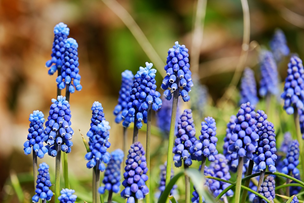
The diminutive Muscari, or grape hyacinth, are not a variety of hyacinth although they are in the same family.  Muscari also readily naturalize. Because of their small size, plant lots for the best spring show.  For more, check here Muscari.

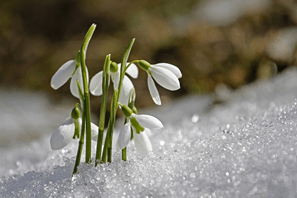
Snowdrops are another diminutive plant that will be the first bulb to bloom in your garden perhaps even through the snow as their name suggests.  For more, check here Snowdrops.

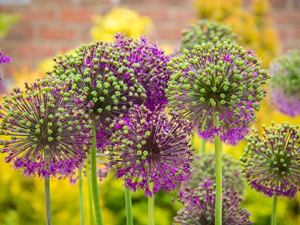
Alliums bloom late spring to early summer so a bit later than many of the bulbs already discussed.  Their unusual flowers can be quite striking as their globe shapes nod in the breeze.  Don’t be surprised if you purchase an allium to find that they are usually sold singly and may be more expensive than many other bulbs.  For more, check here Alliums.

Bulb Care

Most spring flowering bulbs are planted in the fall (September or October) before the ground freezes. 

Purchase the largest, best quality bulbs that you can find.  Large bulbs have lots of food energy for the emerging plant which will result in strong stems and large flowers.  Avoid bulbs that appear to be soft, damaged or discoloured.  Check on the product package to make sure that you have chosen bulbs  that will grow in your zone.  If you don’t know your gardening zone, find it here Canadian Gardening Zones

Plant bulbs in full sun (6-8 hours/day) to produce the largest blooms and strong straight stems.  However, many will flower in light shade … blooms may not be as large and stems may not be as strong.

Follow the package directions for planting your bulbs.

Bulbs need time after blooming to store energy for the next year. To remove the dead leaves, either snip them off at the base, or twist the leaves while pulling gently.

Some bulbs will not flower as robustly the second year eg. hyacinths.  Some gardeners treat these as annuals, removing the bulbs after flowering and planting fresh bulbs each fall.  Note that many bulbs are toxic so store them appropriately so that your pets or little people are not able to access them.

Plant them now!  A spring garden with a mixture of different bulbs looks lovely!  Plant bulbs along a path or close to your home’s entrance to be able to enjoy their dramatic scent.  They will also add a burst of colour to your perennial garden before other early flowers are up. A mass planting of spring flowering bulbs will make a bold statement in your garden!

Planting garlic (Allium sativum)

By Sharleen Pratt, Master Gardener

Happy Thanksgiving! While we navigate through this pandemic, we hope that you will be able to enjoy some happy moments in a safe and healthy environment. The colours have been beautiful this year and I have marveled at the many different shades of red, orange, yellow and green that still exist in my small urban backyard.

Photo credit: Sharleen Pratt

Thanksgiving reminds me that it is time to plant garlic for next years’ harvest. Here is a ‘Fact Sheet’ that I have put together for those who might be interested in planting this very easy to grow root vegetable.

PLANT DESCRIPTION:

Garlic is part of the Onion Family (Alliaceae) and although there are hundreds of varieties, they all fall under two main categories; Hardneck and Softneck.

Hardneck have a long flowering stem called a scape which eventually develops tiny bulbils at its top end. They usually have a single row of cloves and tend to do best in colder climates. They peel easier than softneck but do not store as long. They last approximately 4 to 6 months.

Softnecks are best for warmer climates, will last 9 to 12 months and have more than one row of cloves in each head. They do not develop a flowering stalk or scape. Softneck garlic are the type that are used to make garlic braids.

Elephant Garlic (Allium ampeloprasum) is a type of leek that is grown like garlic, but is 6 to 7 times bigger and has a milder flavour.

PLANTING NEEDS:

Full sun and well-drained soil with infrequent watering.

WHEN TO PLANT:

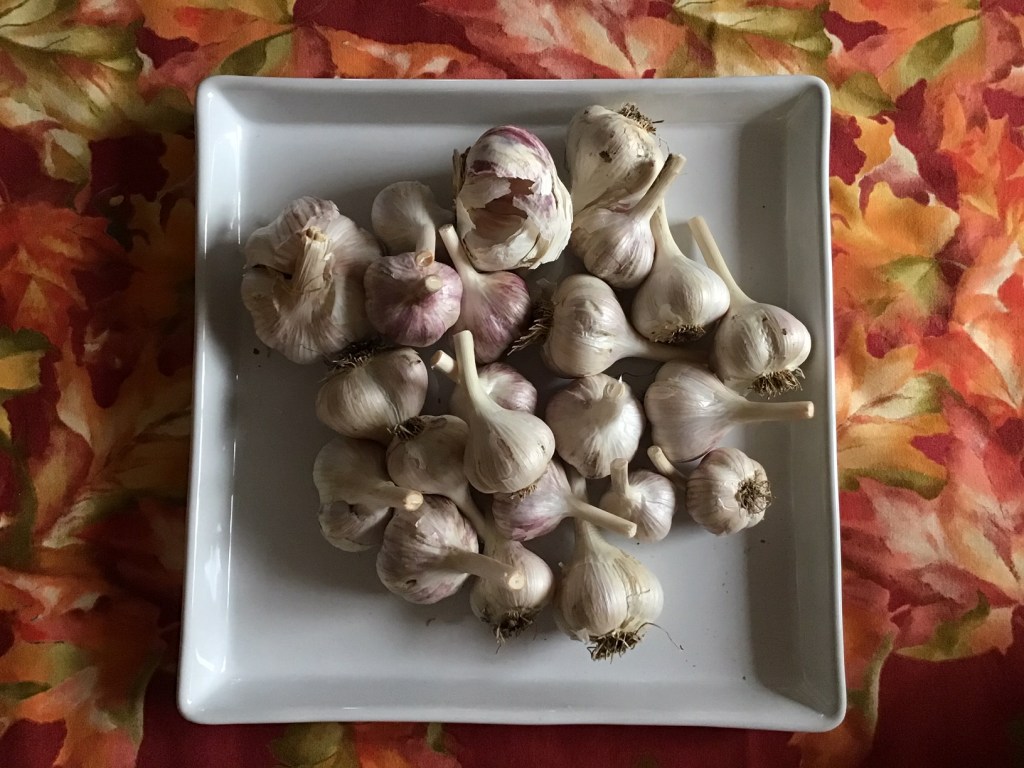
In the Peterborough area, October is the best month to plant your garlic. It can be done in early spring but you will produce a larger harvest if done in the previous Fall. Do not use garlic from your local grocery store as it may not be the best variety for your region and it’s often treated with an anti-sprouting chemical to inhibit growth. I purchase my garlic from my local nursery or Farmer’s Market and I also use my own garlic that was harvested in early August.

Photo credit: Sharleen Pratt

HOW TO PLANT:

Separate the inner cloves but do not remove the papery covering. Plant the largest cloves with the pointy end up. Space cloves five to six inches apart and two to three inches deep. You can mulch with straw, but I always mulch the garlic bed with shredded leaves which will be plentiful in the next couple of weeks.

CHALLENGES:

I have never had any garlic concerns; however, my daughter did deal with the leek moth this year. Adult moths lay their eggs and the hatched larvae tunnel into the leaves. She was able to keep it under control by going out each morning and removing the leaves that were encasing the larvae. If you have the space, it is always best to rotate your garlic each year.

HARVESTING SCAPES:

Garlic produces a garlic scape which appear on hardneck varieties, usually in June. They look a little like green onions that spiral and have a small bulbil at the end (which looks like a small hat). They should be cut once you see the spiral or they will become tougher the longer you leave them. Cut it at the base where it comes out of the stalk. Chop them up and fry with a little olive oil or they can be made into garlic scape pesto. It is wise to remove the scapes even if you don’t plan on eating them. This allows the energy to go back into growing the underground bulb.

HARVESTING GARLIC:

You will know your plant is ready to harvest when two to three sets of the bottom leaves have died or turned yellow. Do not leave them too long as the bulb will begin to split. Gently pull out the bulbs with a garden fork.

CURING GARLIC:

Garlic needs to be dried. Gently remove the dirt and trim the dangling white roots to approximately 1 cm. I tie my garlic together in bunches and hang it in my shed to dry for two weeks. Keep it out of direct sunlight and ensure it doesn’t get wet.

STORAGE:

Once dried, clean gently. Trim the long stalk off and store in a cool dry area. Garlic does not like to be refrigerated. You could also store them in empty egg cartons.

If you would like to learn more about growing garlic, read this extensive article from the Ontario Ministry.

Beware the caterpillar

By Suzanne Seryck, Master Gardener

Fall is my favourite time of the year to bicycle; not too hot and the scenery on trails in the Kawartha Lakes is beautiful. Asters and golden rod are in full bloom; the sumacs and Virginia creeper are just turning red, whilst the maple trees are slowly turning various shades of orange, yellow, red and brown. My only problem is trying to miss all the caterpillars, grasshoppers, and chipmunks, not to mention the odd rabbit or snake that crosses my path. I can’t count the number of times I have almost ended up in a ditch.  Everything mostly jumps or slithers out of my way, though, with the exception of the woolly bear caterpillars.

Photo taken by author whilst out riding

You would think that these caterpillars would be fairly easy to spot, but at this time of year, and probably at my age too, I tend to have problems distinguishing them from leaves, especially from a distance. The caterpillars normally emerge around this time of year, slowly inching their way across the paths.

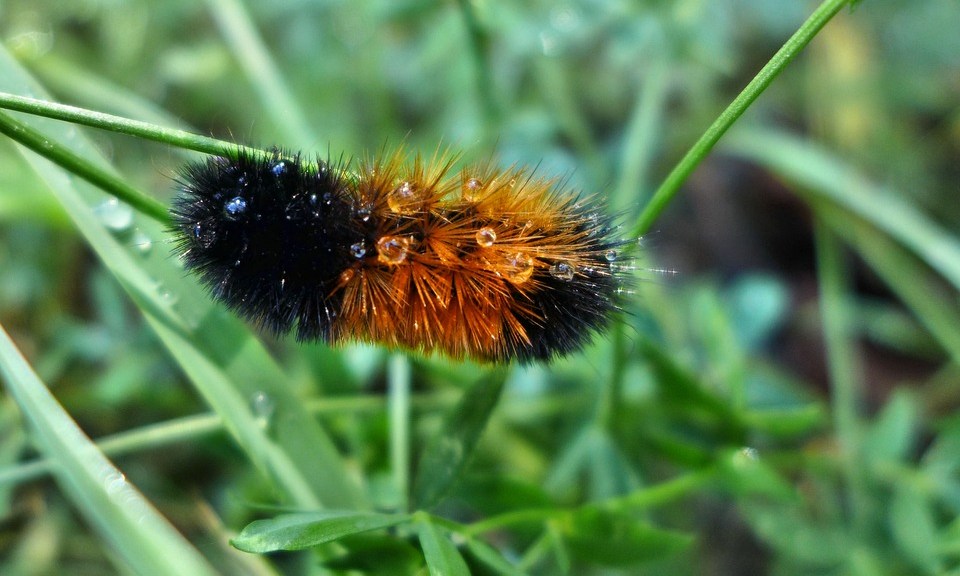
Picture of woolly bear caterpillar (taken by author)

The woolly bear caterpillar will emerge from its larva in the fall, and overwinter in its caterpillar form. It does this by finding a safe spot to hibernate under leaves or bark or inside rocks or logs and then freezing solid. It is able to survive being frozen by producing a cryoprotectant, which is a substance that protects its tissue from freezing. The search for a safe hibernation spot is why you see so many of these caterpillars crossing roads and paths.

In the spring the caterpillar will wake up hungry, eat for a few days and then spin a cocoon emerging after a couple of weeks into an Isabella Gypsy Moth.

There are many old wives tales that specify that the size of the brown bands in the middle of the caterpillar or the number of brown bands will determine how hard a winter we will have. This was investigated in 1948 by Dr. C. H Curran who was the Curator of insects at the American Museum of Natural History in New York. To read more about this, please refer to the following article: https://www.almanac.com/content/woolly-bear-caterpillars-and-weather-prediction

Whilst I eagerly await the time when all the caterpillars have finished crossing roads and paths and begun their hibernation, I will continue my daily bike rides looking down at the paths whilst attempting to ensure that I do not cycle into any more ditches.

For additional information, the following is an interesting article: https://blogs.massaudubon.org/yourgreatoutdoors/why-did-the-woolly-bear-cross-the-road/

A new kind of lawn?

By Mary-Jane Pilgrim, Master Gardener

If you scroll through some of the gardening groups on Facebook these days, you’ll often see people asking “How do I get rid of the clover in my lawn?” Shortly thereafter, you’ll see a lot of people respond with “Love my clover”, “Leave it”, “Food for pollinators”, etc., all of which is true. This post follows fellow MG Emma Murphy’s post from last week quite well, I think!

As a contract gardener/landscaper, if I had a loonie for every person who asked me what to do about their weed-ridden lawns post-herbicides, I’d be a rich person.

Clover may be just the ticket, as it requires less water, fertilizer and weeding than lawns without clover. It stays green all summer. It requires little or no mowing as it only grows 10-20cm (4 -8″) high. It out-competes other weeds, as it has a dense root structure. It grows well in poor soil. It feels great on bare feet. The seed is inexpensive (see below for a tip on where to buy it!)

White clover (Trifolium repens) or Dutch white clover can be established in an existing lawn by overseeding whatever is currently there or by planting a mixture of clover and basic grass seed in a new lawn. From my reading, I’ve found that people have had disappointing results when trying to establish a pure clover lawn. You really need both clover AND grass as they are complementary to each other and one supports the other. Clover does best in full sun, but can do OK in partial shade. It doesn’t grow well in full shade. When mixed with grass, it does well in high traffic areas as well.

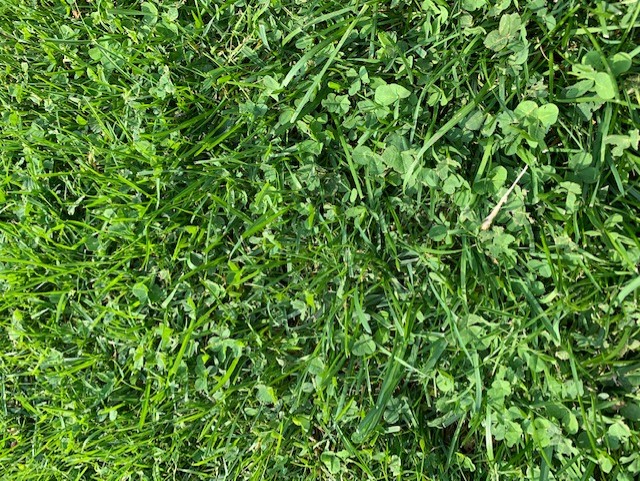
Author’s back lawn showing already successfully combined grass and white clover

For us, it started with the white grubs. Whole sections of grass in the front yard are gone. Just gone. Turns out that grubs also do not like clover. Bonus.

Be sure to use Dutch white clover and not the larger red clover. The best time to plant clover is in the early spring before the grass starts growing quickly because the other broadleaf plants are not in competition with it. Early seed sown will germinate when the soil starts to warm up in late April. Clover seed can be purchased at your neighbourhood garden centre or hardware store, but I’ve found it to be much cheaper (less than half price) at my local co-op as it is also a farm product. Clover seed to cover my large front lawn (150ft x 150ft) cost about $10 at the Co-op. About 2 ounces of clover is needed for every 1,000 sq ft of lawn, so my front yard required about 3 pounds or 1.4kg of clover, mixed with about $30 worth of grass seed.

Late summer/early fall is an alternative time to plant. The grass should be cut short and raked first to remove any existing thatch. Clover seed can be spread onto the soil along with grass seed on a 10:1 or 15:1 grass/clover ratio. I’d suggest top-dressing with some triple mix for best results so that the seeds are covered well. Most seed will germinate in less than a week if the temperature is above 15C and if it’s well watered.

It may be necessary to overseed with clover every 2-3 years for the first few years until the mixture gets established.

One caution: If you or any of your loved ones are allergic to bee stings, clover may not be right for you. The clover will flower, and bees will be attracted to the flowers! You can, however, minimize this risk by mowing regularly from June through August during flowering time.

Author’s front lawn showing recent overseeded and top-dressed grass/clover mix.

Resources:

How to Overseed Clover Into a Lawn
Establishing White Clover in Lawns:
Advantages and Disadvantages of Clover Lawns

Starting from scratch — 2 months later

By Judy Bernard, Master Gardener

As mentioned in the my previous blog, creating healthy soil is to be the topic of this article.

Healthy soil is made up of the following components:

Sand, silt and clay – in any soil they are the bones, the structure that is the foundation on which the rest is built. About 48% of the soil.

Air spaces – are the lungs of the soil. They allow for movement of oxygen, water, and nutrients. About 25% of the soil

Organic material – is the food which nourishes the soil to make it a living microcosm for plants to grow in. The microorganisms in the soil process the organic material into a form that plants can use when they need it. The larger organisms in the soil help to maintain its structure. The organic material in the soil is also like a sponge which will hold many times its weight in water. This represents ideally about 4% of the soil.

Water – is like blood. It carries the nutrients from the soil to the roots of plants in a form the plants can use.

In the housing development where I live, we have been provided with good bones. Some of the soils may have more or less of one component than another, but for the most part the bones are good.

From my perspective, the biggest issues are:

  1. compaction from all of the heavy construction equipment that has been driven over and over the sites. Even when the topsoil was put down, dump trucks and bulldozers were used. The soil and sub soil are deeply compacted.
  2. lack of organic material in the soil.
  3. the inability of the soil to retain water.

To overcome these problems the soil needs to be aerated, whether by mechanical means with a core aerator or by hand with a shovel. The plugs of soil, although unsightly, can be left on top of the soil to dry out and then run over with a lawn mower to break them up and spread them over the ground or lawn. Then organic material needs to be added to the soil. For the grass, I would add compost which you can purchase in bulk from garden centres. Spread 1-2 cm (1/2”) over the lawn and rake it in. You may want to add a little grass seed where there are bare spots. With the compost, you won’t have to add any other fertilizer and you won’t have to water very much. For my flower and vegetable beds I add a more generous amount of compost or manure, working the manure into the soil so it doesn’t smell.

It takes 2.5cm (1”) of water to penetrate 15cm (6”) into the soil. With air spaces and multiple surfaces for the water to adhere to and with organic material to act as a sponge and hold the water, the water will stay In the soil better and not run off. For growing vegetables 2.5cm per week is a good rule of thumb. Add more if it’s very hot or windy. With healthy soil, watering the lawn and garden is less of an issue.

The most common grass used for sodding is Kentucky Blue Grass. It is natural for this grass to go dormant in the hot summer months. With good healthy soil to support it, the grass will be able to overcome the drought and revive as the weather gets cooler.

You know you have healthy soil when it has a nice crumbly texture, the surface of the soil doesn’t crack from the heat and when the soil absorbs water instead if having the water sit in pools or run off into ditches. I’ve added a couple of web sites with further information about healthy soils and adding compost to lawns.

Resources

Healthy Soils, UMass Extension
Compost for Summer Lawns, Planet Natural Research Center

Bewitching Witch Hazel

By Lois Scott, Master Gardener in Training

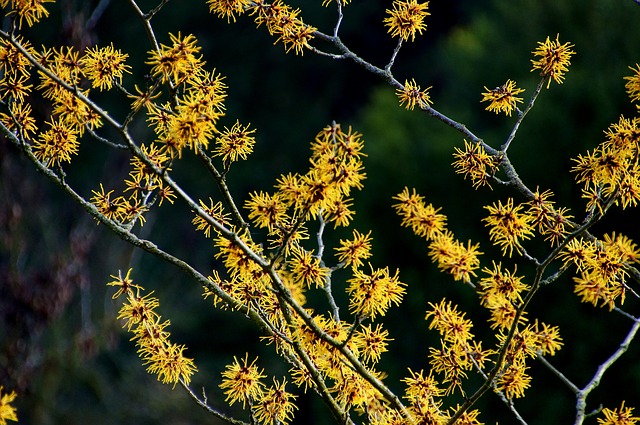
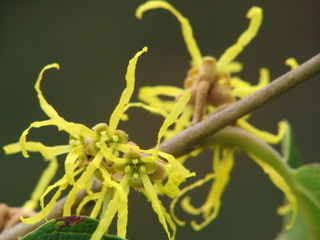
Although the title to this blog may sound overstated, I find my Common Witch Hazel, known botanically as Hamamelis virginiana, to be anything but common. This native, deciduous shrub has a rounded crown with a graceful, vase shaped growth habit and yellow, fragrant flowers that emerge September to October along with yellow fall leaf colour. The flowers are ‘stem hugging’ clusters with four ‘crinkly, strappy, ribbon shaped petals’ that usually emerge while the leaves are still on the tree.

thumbnail_Witch hazel blossoms_3302 2
Witch-Hazel blossoms in the author’s garden

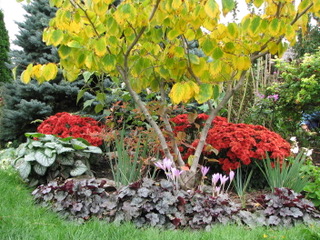
The Common Witch Hazel grows in eastern North America including eastern and southern Ontario and can be found in woodlands, and along forest margins and stream banks.  In the garden it can be used as a shrub, hedge, or as in my case, pruned into a small, multi-stemmed specimen ‘tree’, which suits my small suburban garden.  Growing 15-20 feet high and wide, in full sun to part shade it grows well in average, medium moisture well drained soil.  It is a low maintenance shrub with no serious insect or disease problems and requires only minimal pruning done in spring.  (As with any woody plant pruning out dead, damaged or diseased wood should be done when discovered.) Among its many charms this native shrub has a beautiful winter silhouette, attractive grey bark, attracts birds and is considered tolerant of road salt, deer, erosion and clay soil.  According to the Morton Arboretum, Common Witch Hazels also serve as a host plant for the larvae of the spring azure butterfly.  What’s not to love!

thumbnail_Witchhazel garden_3341-0
Witch-Hazel in the author’s garden

Hamamelis virginiana has an interesting reproductive process.  The flowers are wind or insect pollinated but after pollination fertilization of the ovules is delayed until the following spring with the fruit developing during that growing season.  The fruits are greenish seed capsules that become woody by fall.  These woody seed capsules then split open ‘exploding’ its one to two black seeds up to 30 feet away.  According to the Brooklyn Botanical Garden fruit set is very low.

If you are eager to add this or some other native plant to your garden/property, drop in to Peterborough’s GreenUP Ecology Park for plants and expert advice.

References

Missouri Botanical Garden: Hamamelis virginiana
The Morton Arboretum: Common Witch-Hazel
Brooklyn Botanic Garden: Native Witch-Hazel

Reliable Annuals

By Sharleen Pratt, Master Gardener

Annuals are happily planted out in late spring and early summer into our garden beds, into containers or hanging baskets. They give us a splash of colour which lasts through most of the season and are often referred to as bedding plants. There are some annuals that are grown for their foliage, such as dusty miller and coleus. They are generally free of disease and pests and other than the benefits of deadheading and the application of fertilizer every couple of weeks to keep them healthy and blooming throughout the season, they are very easy to grow!

Botanically speaking, an annual is a plant that grows from seed, blooms, sets seed, and dies, all in one season. Many of them are actually tender perennials that could be left in the landscape all year if we lived in a much warmer climate than we experience here in the Peterborough area. If you have ever visited a subtropical country, you would notice geraniums that are several feet tall. A few years back I visited Madeira and marvelled at the poinsettias that were the size of shrubs!

During my father’s time, annuals were very popular and most of the garden centres sold more annuals than perennials. As a child, I remember many visits to Edwards Gardens in Toronto, which is now located in the Toronto Botanical Garden. The garden beds were spectacular and featured extensive displays of impatients, petunias and geraniums. (Impatients were hit by downy mildew a few years back and have gone out of favour to other more hardy bedding plants). I have always enjoyed the use of annuals, not only in containers, but also planted throughout my garden to give me some constant summer colour. They can also be very useful in order to encourage pollinators to your vegetable gardens.

Here are three of my favourite annuals that are blooming in my garden this year:

GERANIUMS (PELARGONIUM)

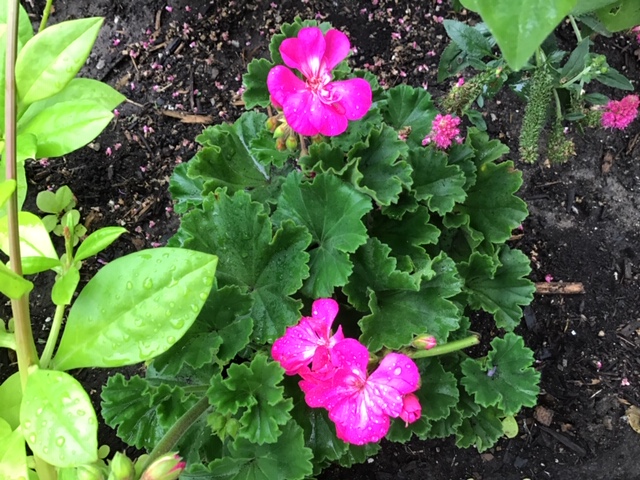
GeraniumGeraniums, which are part of the Pelargonium family are perennials in their native region of South Africa, but here in Peterborough they are treated as annuals, although you can overwinter them in the fall. You could try the ‘pot it up and put it in the window’ method or the ‘bare-root’ method. This Mark Cullen article gives you detailed instructions.
The familiar annual flower in red, pink, purple or white blooms with thick, pleated leaves are not really geraniums at all, but rather members of the Pelargonium genus. True members of the Geranium genus are the hardy perennial plant also known as cranesbill. Originally, they were both part of the Geranium genus and are still known by this common label.

They are a favourite for containers or hanging baskets, but I enjoy planting some throughout my perennial bed. There are more than 200 species, but the most common are Pelargonium x hortum, where the flowers are generally solid tones and the leaves are oval; Pelargonium paltatum, which is the ivy-leaved geranium which has a bit of a trailing habit, and Pelargonium domesticum which is the scented-leafed geranium with smaller insignificant flowers and various leaf shapes.

JEWELS OF OPAR (TALINUM PANICULATUM)

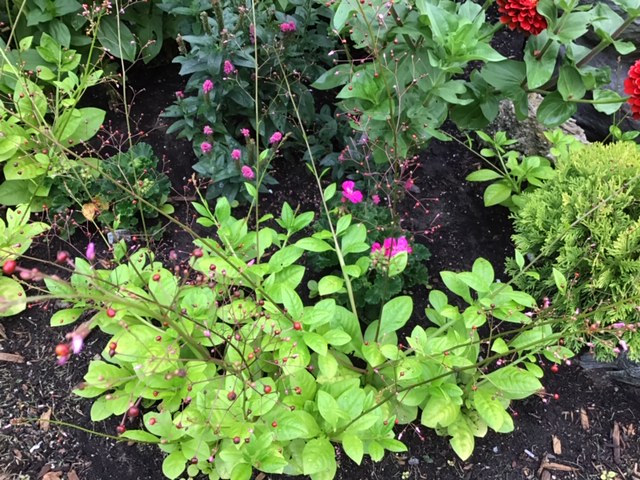
TalinumTalinum has fleshy lime green leaves with delicate, wiry flower stalks. The flowers are hot pink followed by carmine-colored seed pods that are showier than the flowers. It is related to Portulaca and has a tuberous rootstock.
I got this annual about 3 years ago and was surprised to see that it self-seeds in the same area each year. They are easy to remove and replant in other areas if desired.

They prefer full sun and grow to approximately 18 – 24 inches. It is a pollinator magnet and I love the bright colour of the leaves at the front of my perennial beds.

ZINNIAS (ZINNIA)

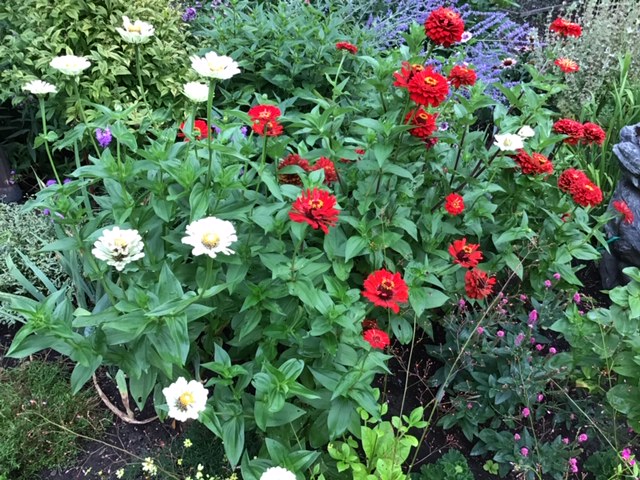
ZinniasZinnias grow in a variety of brilliant shades and come in various types, such as single, double, ruffles and pompoms. They are a reliable annual that are, without a doubt, one of the best cut flowers you will ever grow in your garden! They attract many bees and butterflies and are easy to grown from seed. They also come in a variety of sizes, from 8” to 36”. Each flower blossom is just as perfect as the next, delightfully supported on attractive green stems with stunning colours that are ideal in any fresh bouquet.

Zinnias have pointy seeds, shaped like little arrowheads and they require only basic garden prep to sprout. Give them a well-drained soil in full sun and you will have little seedlings in days. Zinnias are low maintenance and because they are fast-growing, they shade out weeds. They don’t require much in the way of fertilizing (just an occasional well-balanced mix), and they don’t need mulching. Deadheading will help to produce more flowers.

Because zinnias are native to the grasslands of the southwestern states, Mexico, and South America, they know how to handle the hot, dry conditions such as the heat we experienced this July.


What We Want and What Trees Need–Or Which Tree do I Buy?

By Cheryl Harrison, Master Gardener

We plant trees for various reasons. Trees are one of the main contributors to a beautiful landscape. They provide shade and can provide a windbreak. Trees sequester carbon and help to clean the air … some can even help to clean toxins from the soil. They serve as homes, shelters, and food for many birds and other small and large creatures including humans. A stroll through a forest can cool, calm, and inspire us!

harrison3

There is a lot to consider in order to choose the right tree for you.

Make a List:

  • Do you want shade, shelter, privacy or just something to fill a spot?
  • Do you want a tree that produces fruit or flowers?
  • Do you prefer leaves (deciduous trees) or needles (coniferous trees)? · Do you want a native tree?  See Ontario Tree Atlas to see which trees are native to your area of Ontario.
  • Think about your budget. Some trees are more costly than others.

Location Considerations:

Stand in your chosen potential tree planting location and look around.

  • How close is your home and other buildings including the neighbour’s?
  • Are there any overhead wires that the tree’s branches will interfere with as it matures? Will the mature tree block window views?
  • Will mature tree roots eventually interfere with a building’s foundation or septic system? Will it’s branches scrape against walls, roofs or hang over the neighbour’s yard?
  • Will the tree drop fruit, seeds, twigs or large amounts of leaf debris on your sidewalk or deck?
  • How close are you to a road or parking area? Pavement impedes water and air from getting to the tree’s roots. Air pollution and road salt are very hard on many kinds of trees.

harrison2

Growing Conditions:

Next, lets look at what trees need. Different trees need different growing conditions.

Soil

  • Determine your soil’s texture. Sandy soil will not retain water or contain many nutrients. Clay soil has lots of nutrients but may not drain well. Silt soil may not drain at all. Most soils are a combination of sand, clay and silt and will benefit from the addition of organic matter. Seee Soil Types and Soil Texture for more information.
  • Test your soil’s pH, if very acid or very alkaline, it will affect a trees ability to access soil nutrients. There are home test kits available or you may send a soil sample to a soil testing laboratory in Ontario. See Soil Testing Laboratories List for more information.
  • Evaluate your subsoil especially if you live in a new subdivision. Newer subdivisions often have a thin layer of topsoil on compacted subsoil. You may need to replace some of the subsoil with topsoil or at least break the subsoil up so that the tree will not develop a shallow root system. A tree’s roots need to be able to spread out to access water and air.

See All About Soil for lots more information on soil.

Water

  • Water is necessary for the tree roots to absorb nutrients and for other life processes. Some trees prefer more water while others prefer a well drained site and there are lots of variations in between. How much moisture will be available to your tree?

Sun

  • Buildings, other structures and other trees can shade the soil. Many trees need full sun but many will tolerate partial shade. How much sunlight will your tree receive in a day?

Plant Hardiness Zone

  • The plant hardiness zone of your potential tree planting location will indicate the weather conditions that your tree needs. In Canada, the zones are based on maximum temperature, minimum temperature, rainfall, snowfall, frost free period and wind. See Plant Hardiness of Canada to figure out your plant hardiness zone.

“Which Tree do I Buy” Example:

You love trees that flower. You have decided to plant a tulip tree in the small courtyard of your condo in Peterborough, great, they grow in zones 3-4 … so far so good for the Peterborough area. However, tulip trees can grow over 35 m (115 ft) according to the University of Guelph, so a tulip tree is not a good choice for the tiny yard of a condo. The mature tree will be far too large!

In summary, make a list of what you want and your specific growing conditions. We have many locally owned plant nurseries nearby. The staff will use their expert knowledge to help you choose a tree appropriate for your needs and growing conditions.

harrison1

Additional Resources

Arboretum at the University of Guelph

Ontario Trees and Shrubs

Plant Resources, Landscape Ontario – scroll through has lots of info on various kinds of trees

Lupins

By Suzanne Seryck, Master Gardener

I have just finished cutting back my lupins for a possible second bloom, scattering their seeds and transplanting baby lupins that have popped up in all the wrong places.

Lupinus, or more commonly known as Lupins, are one of my favourite plants especially in the late spring when they are first in bloom. I tend to lean towards plants that need little to no care, that will attract insects, will self seed but are not invasive, and that give me joy when they are in bloom. Lupins fit that category for me perfectly.

suzanne1
Lupins in the author’s garden

Lupin is a genus of flowering plants in the legume family Fabaceae, along with peas and beans. They have been grown since the days of the ancient Egyptians and were eaten by the Romans. Lupins like well drained soil, preferring sandy soil, but in my garden they grow well in clay. They grow in either sun or partial shade conditions. I will often let some of the flowers on my plants go to seed, self-seeding throughout the garden. But depending on where they decide to grow, I tend to transplant them and move them around. When digging up a lupin, take care to dig up the large tap root. I prefer to dig them up when they are very small, so I don’t damage the root any more than necessary. I also find it easier on both me and the plant to transplant them into a pot, rather than directly in the ground. This enables me to keep the plant in the shade for a few days, water more often and just baby them along more.

suzanne2
Photo showing the large taproot on lupin seedlings

For me, lupins in my garden tend to be short-lived perennials, lasting anywhere from 3-5 years. They do not grow true from seed so to ensure that you have a true seedling you should take basal cuttings. A basal cutting is best done before the plant has flowered; you cut a shoot close to the root, take off all the leaves, nip out the top of the cutting and then transplant into a pot filled with compost and soil. When you see roots coming from the bottom of the pot, you can then transplant the lupin into your garden.

Because lupins are members of the legume family they are nitrogen fixer plants. Using a specific bacteria, ‘rhizobia bacteria’, that allows them to draw nitrogen from the air, convert and then store the nitrogen in nodules that grow on their roots. The nitrogen can become available to other plants in a number of ways. If a nodule breaks off and decomposes, the nitrogen becomes available in the soil and when the plant dies or if the plant is tilled back into the ground, the nitrogen also becomes available. In addition, lupins have a large tap root that is great for breaking up compact soils.

Most of the lupins you buy in garden centres are not native to Canada, as there is a native lupin–the wild lupin or Lupinus perennis which is considered native in Ontario. It is normally blue or purple and prefers a dry, sandy soil, but will grow in any well-drained soil. Wild lupins are often used in restoration projects because the large tap root helps to control erosion. It is also essential to the endangered Karner Blue butterfly which feeds exclusively on it and is a host to other butterflies. If you want to add this plant to your garden, you are best to buy the seed from wildflower farms and ensure you follow the instructions carefully as the seeds need specific conditions to germinate.

An example of a wildflower nursery selling the seed is given below:

https://www.wildflowerfarm.com/index.php?route=product/product&path=18&product_id=112

Starting from Scratch

By Judy Bernard, Master Gardener

My dream is coming closer to being realized. The construction company cleaned up the construction area, removed a lot of the larger stones and graded the property. When it rains this grading directs water to the road in front and to the catch basin in the back. (I’m going to have to plan how to plant my water loving plants to take advantage of this drainage.) We have told the excavating people that we will be putting in a walkway and water barrels. They kindly set up the fill to accommodate that.

As soon as the topsoil was delivered in mid June, I did the mason jar soil composition test, using the Clemson fact sheet I posted in the previous blog and again below. The soil test results show loam. However there is no organic material in this soil. Heavy equipment was used to spread and grade the soil. It is extremely compacted. We ordered enough compost to cover the topsoil to a depth  1-2cm. We really need 5-10 cm of compost.

Clemson Soil Texture Analysis

Once we got the sod installed we were told to water it well twice a day for 5-7 days, then daily  for a week. I watered as required, making sure the water had penetrated the sod. In spite of my best efforts the sod turned yellow within a couple of days in places. After 2 weeks it was coming back, but needed continued watering of those difficult areas.

Before we had received our sod, I’d gone crazy planting trees and shrubs. I’ve dug holes and loosened up the soil as much as possible, added organic material, and I’m hoping for the best. I’ve planted my vegetables, loosened the soil and added more organic material. Some beds I’ve made for future plants by turning the sod upside down and covering with cardboard and mulch. Next spring they will be ready for planting.

It is going to be an ongoing process of trying to create a healthy soil environment for lawns and gardens. That will be the topic of my next blog.

judy 1