By MJ (Mary-Jane) Pilgrim, Master Gardener
Last year at around this time on a beautiful, sunny and mild Saturday, I found myself in an apple orchard south of Norwood learning the intricacies of pruning apple trees. Fruit trees need to be pruned in order to open up the tree canopy to sunlight and air circulation which promotes fruit production and a healthy plant.
Most trees benefit from some pruning, but an important aspect of the task is knowing when to prune. Proper timing helps to insure attractive, healthy, productive trees and shrubs.
February through March is generally regarded as the best time to prune most deciduous trees. The absence of foliage at this time of year gives the individual a clear view of the tree and allows the selection and removal of appropriate branches.
The best time to prune flowering trees or shrubs is right after they’ve finished blooming. Unlike other trees in this article, pruning of these is unlikely to have anything to do with February or March!
Prune evergreen shrubs, such as juniper and yew, in late March or early April before new growth begins. Light pruning may also be done in mid-summer. Avoid pruning evergreen shrubs in the fall as fall pruned evergreens are more susceptible to winter injury. Late winter is the best time to remove unwanted lower branches on evergreen trees.
Back to the apple orchard. Late February to early April is the best time to prune fruit trees in our area. Pruning should be completed before the fruit trees begin to break bud (leaf out) in early spring.

I learned that the first rule of pruning is to remove any dead, injured or diseased branches. Cut just past the “branch collar”–the wrinkled part where the branch connects to the trunk or another branch.
Then, moving up and around the tree, look for branches that cross each other and eliminate the ones that are not evenly spaced or are not at the best angle. Competing branches will cause problems for the tree. Fruit trees should only have one central leading branch. If two or more exist, choose the healthier one and remove the others.
It was definitely an interesting afternoon. Much thanks to my friend Carl for the lesson!
Three Items of Likely Interest
While we’re on the subject of trees, I thought the following timely items would be of interest to our readers.
Ecology Park Spring Sale, Victoria Day Weekend. Mark your calendar now and plan to support Ecology Park programs with purchases of over 150 species of edible and native plants, shrubs, and trees that thrive in our region of Ontario and provide important habitat for wildlife and pollinators.
ORCA Seedling Program — Otonabee Conservation can assist you in reforesting or planting additional trees on your property through the Tree Seedling Program. Orders for trees can be placed in early March for delivery in late April. Tree whips (3-4yrs old) come bare root. Trees range in price from $1 per tree to $4 per tree, but there is a minimum order of 25 trees of a single variety so you may want to split an order with a friend or two (or three). See the link below for more information. Order deadline this year is March 10, 2020.
Coincidentally, the Peterborough Horticultural Society speaker this coming Wednesday February 26 (2020) is Vern Bastable from Peterborough Green Up. Vern will be speaking about “Choosing the Right Tree”. Guests are always welcome for a nominal $2 charge. The meeting is held at the Peterborough Lions Centre in Ashburnham from 7pm-8:30pm sharp and refreshments are served before the meeting.
Lastly, here are some resources that you may find helpful.









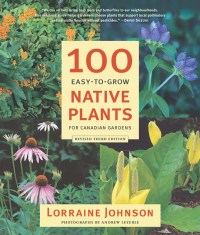 This book is, without a doubt, one of my favourite go-to gardening books! The new revised third edition of Lorraine Johnson’s book, 100 Easy-to-Grow Native Plants for Canadian Gardens, is a testament to Lorraine’s expertise. She writes in the forward that “one of the greatest satisfactions of growing native plants is that you are supporting a complex web of ecological relationships that are the basis of a healthy, resilient ecosystem.” Lorraine Johnson is the former president of the North American Native Plant Society and the author of numerous other books. She lives in Toronto.
 The photos by Andrew Layerle, along with detailed descriptions of the plants, make this book most helpful when trying to decide what native plants you would like to incorporate into your garden. I think many of us can relate to her point that “gardeners tend to be voyeuristic creatures and plant lists are our chaste form of porn”! We all crave the perfect plant and often browse through books over the winter months with dreams of starting a new garden and we wait patiently for the spring weather that allows us to once again get our hands dirty.
 The plants are divided into a number of different categories and Lorraine does a good job at listing the common name (although she warns there are sometimes many), the botanical name, the height, blooming period, exposure, moisture, habitat and range. She gives a good description, the maintenance and requirements, along with suggestions on propagation and good companions. I love that she also mentions the wildlife benefits of each plant.
 Lorraine has also included Quick-Reference Charts at the back of the book that separate the plants by region as well as specific conditions, such as acidic soil, water requirements, etc. She has lists of plants suitable to prairie habitat, drought-tolerant plants, plants for moist areas, and plants that attract butterflies and other pollinators.