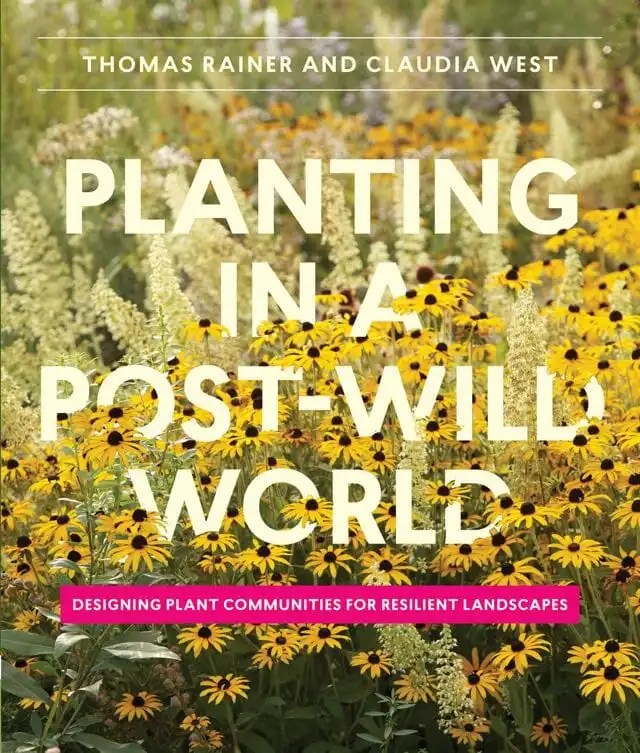
Planting in a Post-Wild World by Thomas Rainer and Claudia West, is a book described by Doug Tallamy as a how-to guide to sustainable landscaping. The prescribed way to create this sustainable landscape is referred to as matrix planting, wildscaping or new American style. Check out this link for a very good description of this type of planting. https://www.hortmag.com/gardens/matrix-planting-garden-design
The book spends a lot of time describing ‘landscape archetypes’, design processes and site preparation etc., with the finished planting being a matrix or array of plants that thrive in related habitats with root systems that don’t compete. Planting is done in layers using structural/framework plants (10-15%), seasonal theme plants (25-40%), and ground cover plants (50%). Plant spacing is based on the mature width of plants and their growing behaviour. This method usually requires a large number of plants so using ‘plugs’ is the most economical way of starting. This style of garden does rely on some plants self-seeding to create a dense planting, so this may not be to everyone’s liking!
As an example, I have a stretch of garden along the sidewalk that I refer to as my ‘hell-strip’ and I have found few plants that have thrived there. A boulevard tree that shaded part of this area was damaged last year and was taken down, so I can now use sun-loving plants that I have had success with in an adjacent area. So, to translate that into what I might plant, I could use 25 Prairie Dropseed (Sporobolus heterolepsis) plugs as a ground cover plant, 15 Lance-leafed Tickseed (Coreopsis lanceolata) plugs as a seasonal theme plant and 9-10 Dense Blazing Star (Liatris spicata) plugs as a structural/framework plant. Or maybe … ??? Isn’t that the fun part?
The goal is to have a dense planting that will discourage weeds, be resilient, provide habitat, sequester carbon, reduce storm water run-off and to create a beautiful garden!
Ironically enough, some speculate that the term probably came from the appearance of flowers after they’ve shed their seeds, when they start to lose colour and eventually die.
However, that all changed in 1990, when the first Seedy Saturday was held at the VanDusen Botanical Garden in Vancouver, BC. At the time, the idea of conserving heritage seeds from garden plants or agricultural crops wasn’t really a thing, and it was hard to find heritage varieties of vegetables, fruits, flowers, and grains.
In 1988 Sharon Rempel wanted to find period-appropriate heritage vegetables, flowers and wheat for the 1880s heritage gardens she was creating at the Keremeos Grist Mill museum. As a pioneer in Canada’s organic and heritage seed movements, she organized the first Seedy Saturday event, and has kept the titles “Seedy Saturday” and “Seedy Sunday” dedicated to the public domain.
In Canada, these events have continued to be locally or regionally organized events, although the amazing organization Seeds of Diversity maintains a national presence. Almost all of these events occur in the late winter, with a few in the autumn.
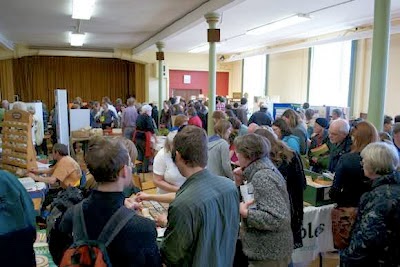
We totally get it. Canadian winters are long and cold and by February, gardeners are already looking forward to the springtime and planting. Seedy Saturdays/Sundays are non-profit, public events organized by individuals and community groups to bring together gardeners, seed companies, nurseries, gardening organizations, historic sites, and community groups so they can learn from one another, exchange ideas and seeds, and purchase seeds and plants in a social setting. Seeds of Diversity promotes these events on their website.
Many Master Gardener and Ontario Horticultural Association organizations are critical partners in these events – I love this poster from the London Middlesex Master Gardeners for this year’s event.
Every year more communities join the movement – according to Seeds of Diversity more than 170 events were held in 2019 across Canada. These events can be small or large, depending on the community. I love that they all have the same themes of encouraging use of open-pollinated and heritage seeds, enabling local seed exchanges, and educating the public about seed saving and environmentally-responsible gardening practices.
They’re a great opportunity to swap and exchange your seeds with others, get new varieties from other seed savers, meet seed companies in person, attend workshops/talks, and of course buy seeds!
In the Peterborough area, we are finally getting back to an in-person event. 2023’s Seedy Sunday will be held on Sunday March 12th from 11am to 3pm in a new location at the Peterborough Square Mall in downtown Peterborough (where the winter Farmers’ Market is being held). It’s a great venue, with lots of space (the pre-pandemic Seedy Sunday was held at the Emmanuel United Church and George St United Church).
Long time organizer Jillian Bishop (who runs her own UrbanTomato business and hosts seed saving workshops) says the event is “the perfect place to get inspired for spring. Come out to get all the knowledge, tools and resources needed to get growing this season.”
Jillian Bishop with her Urban Tomato sales stand.
This year’s Peterborough Seedy Sunday event includes:
An incredible diversity of vegetables, flowers, herb seeds available for sale
Community groups showcasing the great work they do locally
Informative hands-on workshops
A popular Seed Exchange Area where you can trade seeds with other gardeners
Jillian says the last few years have been challenging because of the pandemic.
“As many of you know, in 2020, two days before we were set to host our 15th annual event, we had to cancel as the world began to shut down. As disappointed as we were, we knew it was the right thing to do! Of course, no one could have predicted what happened in the weeks, months and years to come, particularly in the world of seeds and gardening.
All of a sudden seeds became a hot commodity, and seed vendors across the world saw unprecedented demand as people became more concerned about securing their food sources, and had more time at home to plan, plant and enjoy their gardens.”
Peterborough Seedy Sunday, like similar events, went virtual for a few years, but Jillian is very happy to be planning a return to in-person seed fun and spring mania for the 15th annual event, with 13 vendors selling seeds, compost supplies and more! Workshops will be focusing on hands-on skills sharing.
If you’d like to take part in the Seed Exchange, please bring your seeds divided into smaller envelopes (approx. 25 seeds) labeled with the name of the plant, year harvested, and any other information you would like to share! Once you have them all ready, you can bring them down to the Seed Exchange and swap them for other fun varieties you have yet to try in your garden!
Hope to see you in Peterborough, or join your local ‘seedy’ event!
Words of Wisdom from Jillian Bishop
Why I Save Seeds
“Saving seeds means a lot to me. It means a lot to the world. Each heirloom seed contains history and future. Past and present, the ability to adapt to unforeseen climate change and unique environments, to spread stories and knowledge through generations it contains the capacity for communities to grow their own food in sprawling fields, community gardens, abandoned lots and fire escape pots.
Those seeds are living beings. They want to grow. They needs stewards. Citizens willing to give them water, sun, soil and yes, cheesily enough, love.”
More links and information
Seed Companies in Canada-list of seed companies in Canada, as well as the vegetable and fruit seed they’ve sold in recent years.
Peterborough Seed Savers Collective – Great short film (2015) about seed saving work happening locally – follow local seeds being grown out by the emerging Seed Savers Collective, and being shared at an annual Seedy Sunday event.
Canadian Seed Security – The Bauta Family Initiative on Canadian Seed Security works with farmers, researchers, universities, and other organizations to develop resources that can help farmers and seed growers advance their knowledge on seed in Canada.
Seed Savers Exchange – Stewards America’s culturally diverse and endangered garden and food crop legacy for present and future generations. We educate and connect people through collecting, regenerating, and sharing heirloom seeds, plants, and stories.
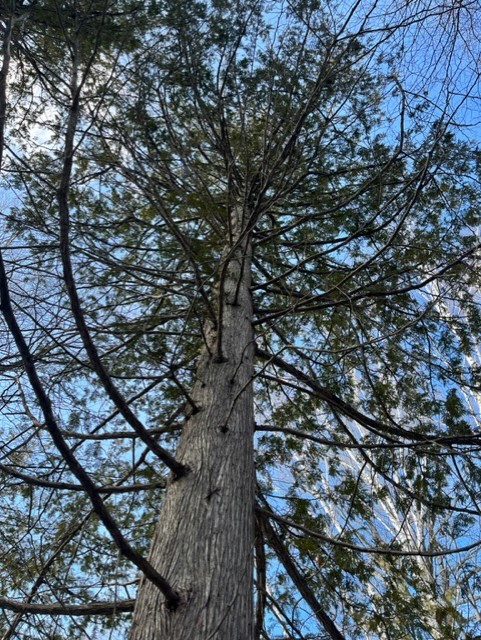
The Eastern White Cedar (Thuja Occidentalis) is also known as the swamp-cedar. Although it’s most often found in the wild in wet areas, it is also widely cultivated as an ornamental plant. It’s a slow to moderate growing evergreen that has a pyramidal shape; some of them live over 800 years. Despite having “cedar” in its name, this particular tree is not a true cedar but a cypress tree (Cupressaceae).
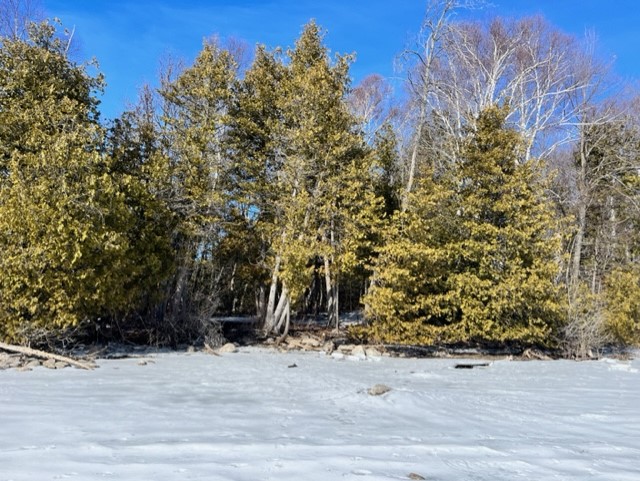
Cedar trees lining Chemong Lake at the Selwyn Conservation Area. Photo credit: MJ Pilgrim
While on a hike today at the Selwyn Conservation Area, this tree could be seen skirting the hardwood forest with its roots on the lake edge. It was widely prolific in some areas but noticeably absent in others. It’s rare to find one growing separate and distinct from others — they grow in ever widening clumps.
Although cedars are not flowering plants, they produce reproductive organs called “cones.” Because of this, they fit in the conifer family. Winds facilitate the pollination of the cones which results in production of seeds. Both male and female cones occur, but only the female cones yield seeds which are then spread by the wind.
Cedar branch showing cones bearing seeds. Photo credit: MJ Pilgrim
This tree is a member of the redwood family and is important for people and animals alike. Snowshoe hares, porcupines, red squirrels, birds and insects take shelter in its branches, especially during harsh winters. White-tailed deer and moose utilize it for food and shelter.
This tree has a long history of medicinal and practical uses. In the 1500s, on his 2nd trip to Canada, Jacques Cartier called the tree “arborvitae,” which is Latin for “tree of life.” The indigenous peoples gathered branches and boiled them into a tea. The vitamin C from the branches helped to ward off the threat of scurvy for Cartier and his men.
Practically, the Eastern White Cedar is valuable as a decay-resistant timber for canoes, posts, shingles and more. In our area specifically, cedar split rail fences are often still seen — remnants of the challenging farming situation in our rocky landscape. Most of these fences have the rails stacked in an interlocking zig-zag fashion that is self-supporting, easy to create, easy to repair, and easy to disassemble. These fences are ecologically positive, in that while they do the job of keeping larger animals in or out, smaller wildlife can pass through them easily. Being made of wood, they are less intrusive on the landscape, and will naturally break down over time.
Photo credit: MJ Pilgrim
The native cedar’s mature size is 40-50′ tall and 10-15′ wide which is much too large for the average city lot. However, they can be pruned heavily to form dense hedges for windbreaks and privacy fences. Hybridizers have created several popular cultivars for smaller lots including ‘Emerald’, a compact and dense tree with a height of 12-15ft that does not require pruning.
The author would like to gratefully acknowledge the assistance of Darcy, Tom and Jim in the writing of this article.
“If it’s not easy, you’re doing it wrong” Trudi Davidoff
For the last few years I’ve been hearing people (especially those in the native plant field) raving about winter sowing. What’s that I asked? Simple, they said – a germination method where you put seeds in an enclosed container out in your garden in winter and let Mother Nature make you more plants.
Hmm, I thought, that sounds too easy. As someone who has struggled for year with starting plants from seeds (especially annuals, vegetables, or herbs) and lost many sad looking seedlings to damping off I was intrigued.
Now I know it really is straightforward (although it requires an Ontario twist – more later) – and I am all about using a KISS principle – Keep It Simple Stupid!
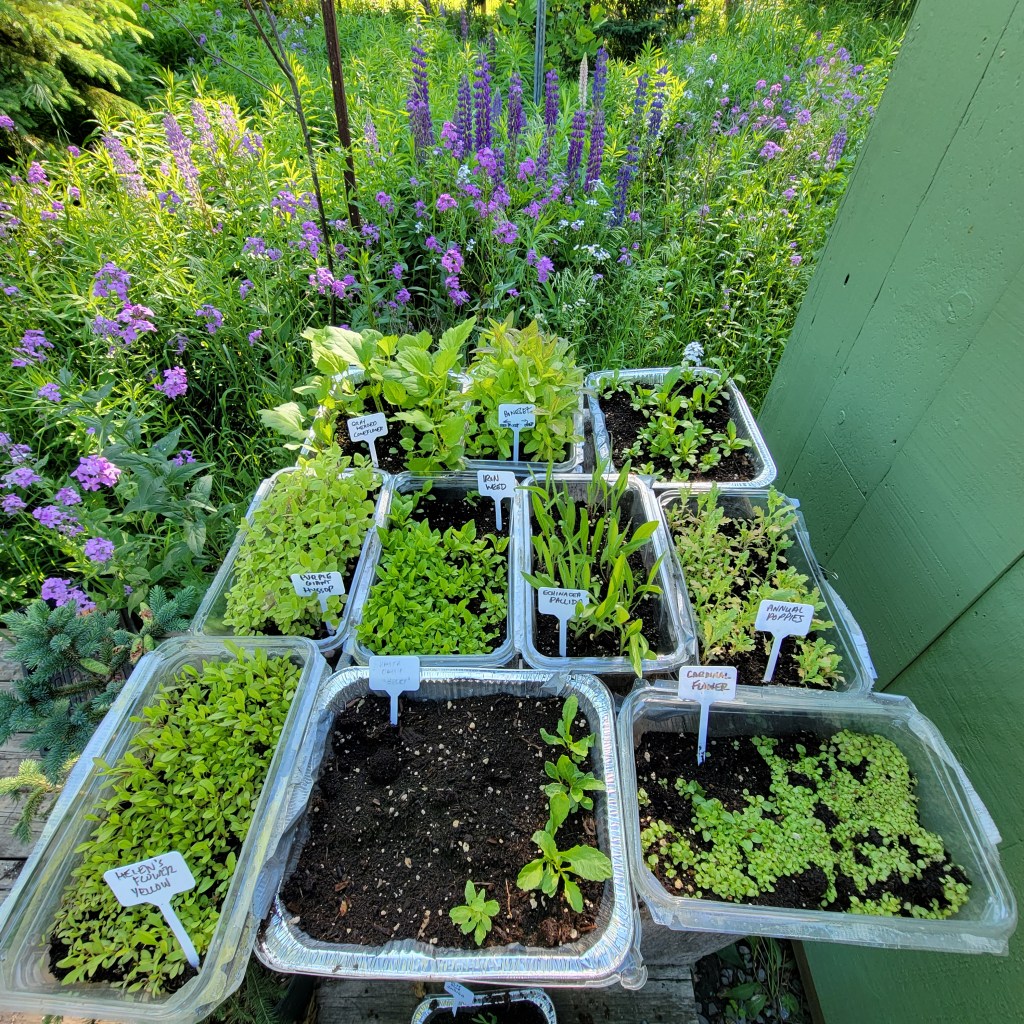
My plants – June 2022. As you can see not all successful. I love the Hunk O’ (or Chunk O’) transplanting method once they have grown (see FAQs)
Started in 2000 by Trudi Greissle Davidoff of New York in an essay, the Winter Sowing Method is a low cost (bonus!!!), temperate climate method of producing sturdy plants for your garden. There is no need to set up lights or have a space inside your house and best of all, no hardening off process. In 2006, the U.S. Department of Agriculture recognized the viability of the technique by adding the term to the National Agricultural Library Thesaurus.
The Basics
So how does it work? For winter sowing you use a recycled container (bonus!) to create a mini greenhouse that protects the seeds from animals, birds and other pests, as well as from our often variable spring weather, until they get big enough to transplant into your garden. This is one case when you actually want your seeds to be placed outdoors and exposed to the elements (including freezing temperatures, snow, and rain).
You can use any container that’s deep enough to hold sufficient potting mix and has a clear or translucent covering that is tall enough to allow the transplants to grow. It must have drainage holes in the bottom as well as ventilation holes in the top. You can use perennial or annual seeds – basically anything as long as it isn’t a tropical seed (for obvious reasons). Native seeds are particularly good because they need a period of cold stratification to germinate – why not take advantage of natural temperatures, rather than artificially refrigerating seeds that need this process?
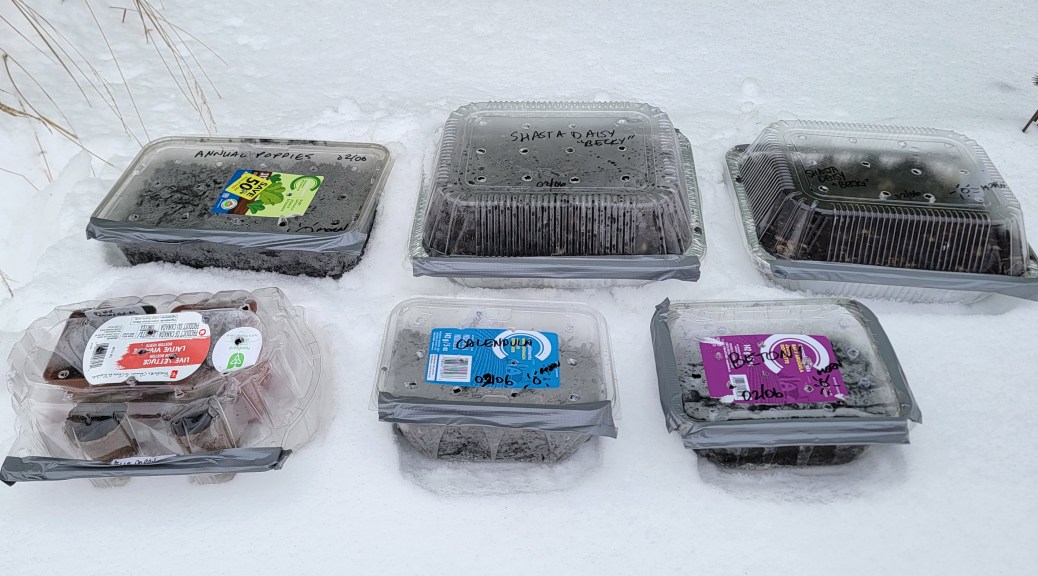
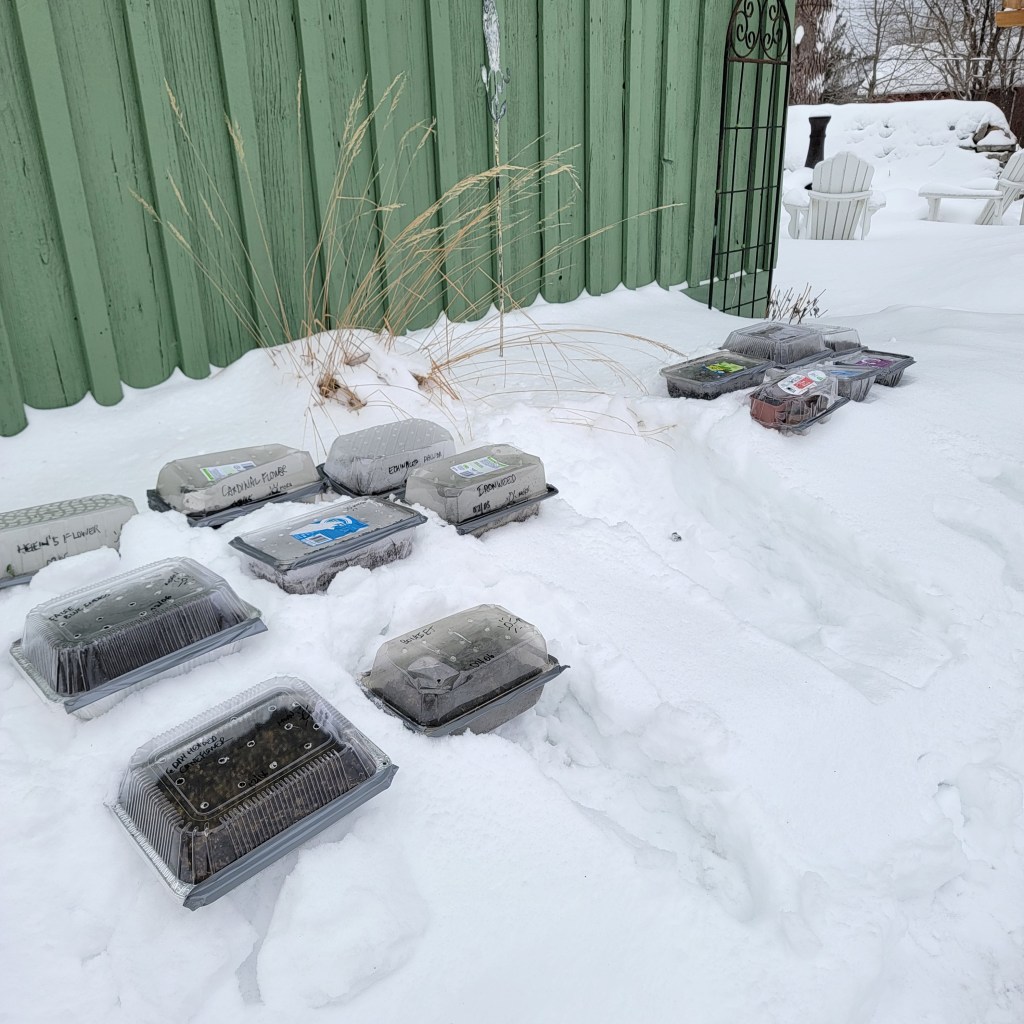
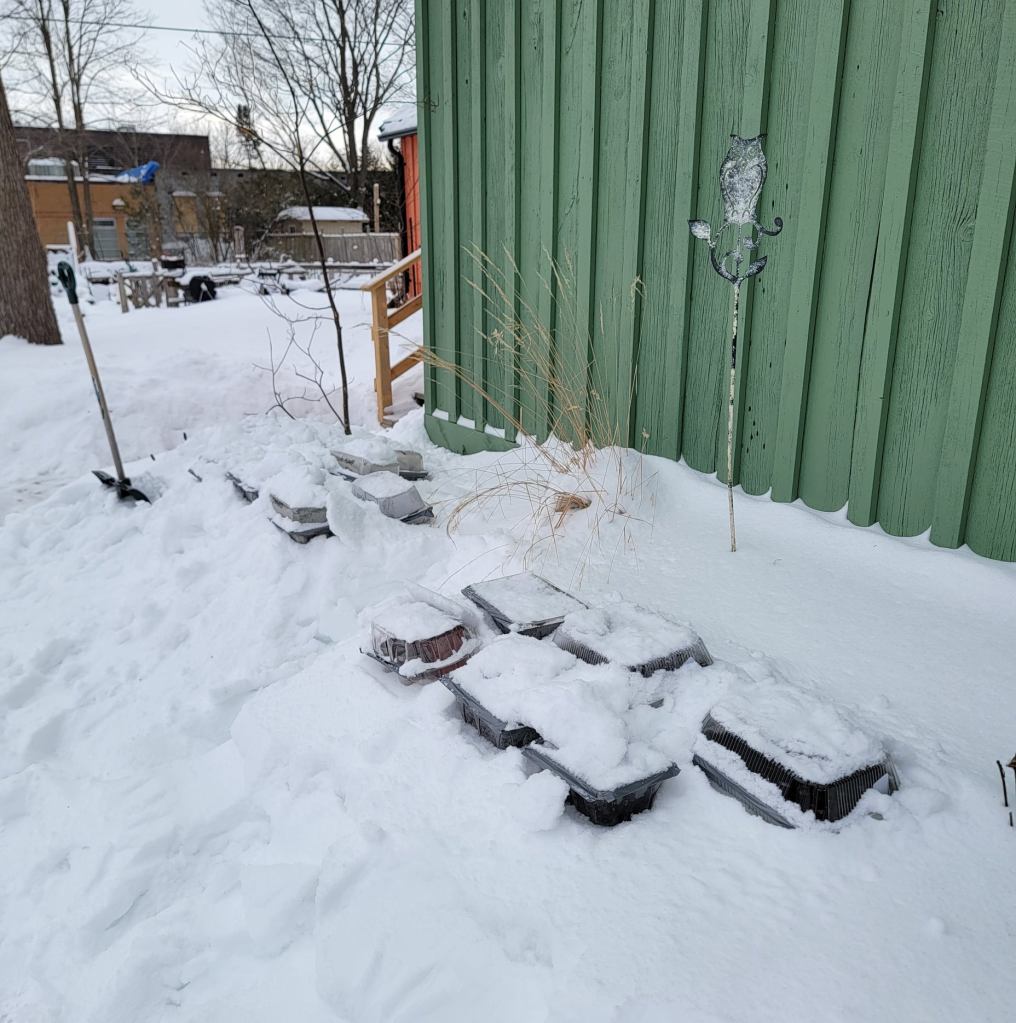
My winter sowing containers – January 2022
You fill the container with potting mix (at least 4-5 inches), sprinkle in your seeds, make sure the mix is moist, tape or secure the top of the container in some fashion, and put it outside. It’s good to check on the containers periodically so they don’t dry out or become waterlogged. Then you wait – it really is that simple.
Ok, I know there are questions – When do I start where I live? When do I plant x seeds? What soil do I use? Let me try and answer some of the basic ones and point you to other resources as well.
Trudi’s original website is no longer active but there is a very active Facebook page that follows her method – Winter Sowers – which I highly recommend for all the basic information and lively discussions amongst members. Trudi is an admin on the page.
Timing for Winter Sowing?
You can start winter sowing anytime after the Winter Solstice (December 21st). Perennials are generally done first, as they often require (or benefit from) cold stratification, then hardy annuals, then tender annuals. But the bottom line is that the seeds will germinate when the conditions are right for each kind of seed. That is the beauty of winter sowing! Many people winter sow their perennials in January but then wait until March to start their annuals. It really doesn’t matter – do what works for you!
They are ready to plant whenever the outside temperature has sufficiently warmed and they are the right size (2 to 3 inches or more importantly at least two sets of real leaves).
What Soil to use?
It’s recommended to use a sterile potting soil mix; avoid soil bags that say they are ‘weed free’ because they can contain chemicals mixed into soil to prevent any weed seeds in that bag from germinating. So they will also prevent the germination of seeds you sow in that same soil! If you live in an extremely dry environment, you might want to use soil that has moisture retentive crystals – otherwise this is not necessary (and can even be a problem in wet winter regions like the U.S. Pacific Northwest). Using fertilized soil for a sowing medium is a personal preference.
What Containers? The Ontario Twist
Most winter sowers tend to use milk jugs for their seeds, but these are not readily available in Ontario – we still love our milk bags! But the reality is that you can use any container for winter sowing as long as it can hold at least 3 inches (7.6 cm) of potting soil. I have seen various other things used – juice bottles, clear pop bottles, blue and green bottles, aluminum pans, salad boxes, plastic containers, pretzel barrels, cheese curl containers, ice cream buckets, nut containers, and vinegar jugs. They must be translucent (some light passes through) or transparent (all light passes through). Opaque materials will not work. Personally I have used the large fresh spinach containers or aluminum roasting pans with clear lids.
You do need some sort of cover on your container, as it helps keep heavy rains under control (so they drip slowly into your containers), it keeps more moisture in so that you have a higher germination rate of your seeds, and it keeps weed seeds out of your containers.
How do I Label?
Labelling is really important unless you’re a genius at identifying new sprouts! I recommend putting in two labels – one on the underside of your tray and one on a popsicle stick in the container. Trudi recommends using duct tape and an industrial sharpie. Tip – place your labels before you fill the tray with soil and put them so they don’t impede the water drainage holes. There is lots of discussion on the best pens to use for labelling – everything from paint pens to garden markers, livestock markers, and china/grease markers.
This will be my second year winter sowing just north of Peterborough – I learned a lot in my first year, most importantly to transplant my seedlings before they get too big and dry out. I wrote a blog earlier this year about some of the cool native plants that I winter sowed last winter.
I hope this blog encourages you to consider winter sowing for your garden, particularly for native species to your area – seeds are so much cheaper than plants and then once they go to seed you are all set to grow even more plants, either for yourself or to share with friends!
Want More Information?
Some videos (and posts) you may want to check out – there are lots of winter sowing videos out there (sometimes with conflicting information) but these are two that are recommended by the online group
The winter solstice, which this year happens December 21 at 4:47pm, marks the northern hemisphere’s furthest tilt from the sun and results in the shortest day and longest night of the year. Many ancient cultures celebrated at this time to welcome the return of longer days and the promise of spring with plants playing a large symbolic role. I certainly welcome the return of longer days and the pleasure in watching my garden wake up but for right now I enjoy the garden as it stands in winter.
I won’t be burning a yule log, which was traditionally Oak as it represented strength and endurance, but I enjoy the knowledge that the Oak trees in my environment are valuable contributors to supporting life in the garden. Oaks (Quercus spp.) support over 500 species of lepidoptera (butterfly and moths) caterpillars which is more than any other native tree or plant. Read more.
I don’t have the shiny, English holly (Ilex aquifolium which is invasive in the Pacific Northwest) in my garden. I do have a native holly, Ilex verticillata or Common Winterberry. I have a male and female plant as you need both for pollination and the resulting flowers and red berries. Although it is found naturally in swampy, acidic areas it is growing in my average garden soil. It doesn’t have evergreen leaves but the persistent red berries are loved by over 40 species of birds! Beautiful red berries and birds in the winter? That is a win-win for me!
A winter garden is certainly enhanced by including coniferous (evergreen) trees. Coniferous trees such as pines, spruce and cedar are considered by many cultures to be a symbol of resilience and renewal. For many of us we enjoy using the greenery to brighten our winter pots and interiors at this time of year. In our winter gardens native evergreens provide not only beautiful contrast with the snow but provide important sources of shelter and food for local wildlife. Well placed coniferous trees can also provide windbreaks for our homes. Read more.
I hope that this winter solstice finds you happily enjoying your winter garden and appreciating its benefit to our environment.
Sometimes it feels like my garden will never reach the ‘mature’ stage even though I have been gardening in the same spot for 36 years. There are a variety of reasons for that, but one major one was my need to remove plants that are now considered invasive. “Invasive species are considered one of Canada’s greatest threats to the survival of our wild animal and plant life. Invasive species kill, crowd out and devastate native species and their ecosystems”. https://www.invasivespeciescentre.ca/learn.
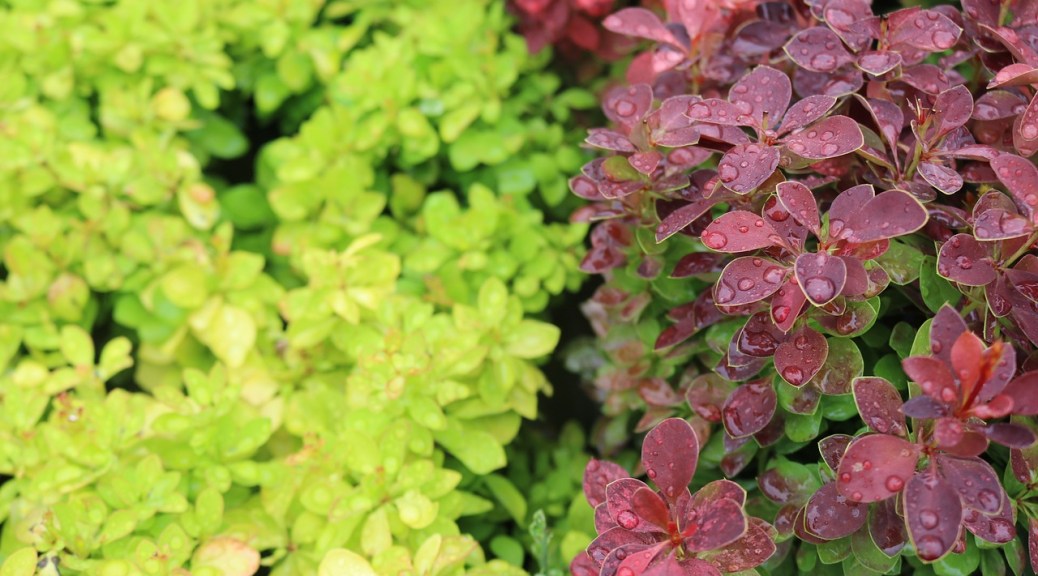
So, who were the super villains in my garden? I’m looking at you, Burning Bush (Euonymus alatus) and also you, Barberry (Berberis). I was initially truly disappointed when I realized they needed to go but then my short attention span came into play and I was on to the next thing. What new plants could I get to replace said villains?!!! And they are environmental villains:
Burning bushes are certainly very visible at this time of year due to their intense red foliage, but Chokeberry (Aronia melanocarpa) makes a wonderful substitute for both Burning Bushes and Barberry. They are native to Ontario, will grow up to 2.5 metres tall, have white flowers in spring and their fall colour is dramatic. They will grow in moist or dry areas and they attract pollinators and songbirds. There are actually many native shrubs that are very ‘ornamental’ and worthy garden additions. https://www.inournature.ca/best-native-shrubs
Chokeberry (Aronia melanocarpa)
At the risk of blathering on about native plants, one small benefit for me is that if I choose a native plant that is not aggressive (rampant spreader etc) and is suited to the conditions of the site (right plant, right place) I won’t find myself having to hack out this year’s fan favourite that turns into next year’s invasive disaster. Always a good thing for me and the wildlife and pollinators in my garden!
I recently downloaded “Native Plant Gardening for Birds, Bees & Butterflies” from my local library. This book was a fabulous find for me because I am currently planning a buffer area by the water in our new place. Going through this book reminded me of when I was a kid with a new Sears or Eaton’s catalogue – always an exciting event – something only people of a certain age will remember.
Book cover
The book was written by an entomologist, Jaret C. Daniels, currently living in Florida but the area covered by the book is the upper Midwest which is roughly parallel to us here. I have ordered plants from Minnesota before with no problems and some of the plants I currently grow are in the book.About 1/4 of the book is devoted to why we should plant gardens for birds, bees and butterflies. He does a brief summary on a number of topics about the actual mechanics.
False Indigo (Baptisia australis)
Most of the book, however, was a precis of individual plants roughly divided into sun, shade, and bog. Each plant started with a picture, then a summary of what it would attract and ended with specific location and cultivar tips. And this plant section was the part that I found extremely interesting and helpful.
New Jersey Tea (Ceanothus americanus)
So what I did was I sat down with a pen and paper over a number of days and compiled a list of what would work for me and plants I wanted to get. I ended up with a comprehensive list of plants, some I had forgotten to bring from the old place and some completely new to me.
And to date I have already placed 2 seed orders for some of the things on my list.
If you’re outside enjoying the fresh air, and happen across a flower or bird or insect and you’re not sure what you’re looking at, a new feature from Google can help you out.
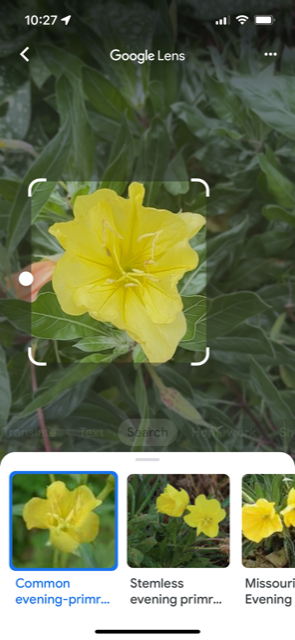
Google Lens lets you search what you see. Using a photo, your camera or almost any image, Lens helps you discover visually similar images and related content, gathering results from all over the internet.
All you need to do is: On your phone, open the Google app and in the search bar, tap Google Lens. Point your camera at the flower to identify the plant. Swipe up to learn about the discovery.
On Android, Google Lens is likely already built right in — open the Google App or Google Photos app. Tap Discover or tap the Google Lens icon.
On Apple, Google Lens is part of the Google app — a separate app from using Google on Chrome, Firefox or Safari. Go to the App Store and download/install Google as a unique app if you haven’t already done so.
When you open the Google App, you’ll see a screen like this with the Lens icon. It’s your window to discovery!
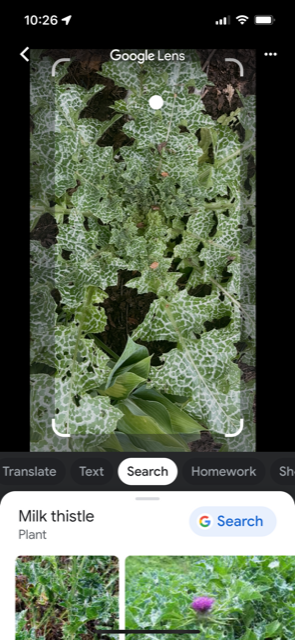
Last week, I went for a long walk and checked out a lot of the volunteer trees and plants along the rural roadway. Sometimes I wanted to verify an item I thought I already knew, but more often I wanted to determine the name of a common but name-unknown item. Google Lens scored on both fronts. Now if only I could remember all of those names!
If you have a bug infestation, use Google Lens to identify the bug if you can get it to sit still long enough!
There’s plenty more you can do with Google Lens, too, including pulling the contact information from business cards, identifying unusual foods and almost anything else. It can also translate words on the screen into other languages, and read them back to you.
The ability of the app to actually CORRECTLY identify plants and bugs is pretty decent, and will get better over time. It helps to allow Google to use location services, so that it’s not searching through the entire rain forest to determine the name of the plant in your neighbourhood. You can also allow Lens access to your photos, so that you can identify items you’ve already taken pictures of.
Best of all, it’s free and will always be free. Try it!
Last year around this time I wrote a blog about reclaiming a garden bed from the dreaded ditch lily (Hemerocallis fulva), now considered an invasive species by many organizations including Ontario Parks and the US Fish & Wildlife Service and the U. S. National Park Service. If you’ve ever struggled with this plant you know what I mean.
The other plant growing in our large Lakefield garden when we moved in (more than 20 years ago) is what I was told was called an ‘outhouse plant‘. I eventually learned that the Latin name for this plant (also called golden glow or tall coneflower) was Rudbeckia laciniata “Hortensia”.
Rudbeckia laciniata “Hortensia” or Outhouse Plant, circa 2005 in my garden
It’s a cultivar of our native Rudbeckia laciniata, also known as Cut Leaf Coneflower or Green Headed Coneflower, which has a lovely simple daisylike flower (whereas the Hortesia cultivar is a double ‘puffy’ flower).
Our lovely R. laciniata elsewhere in the garden. It will do better (and flop less) if it’s in a garden bed with other tall and native plants.
Native R. laciniata flower to the left and R. Hortensia (double flower) to the right
The outhouse plant was pleasant enough so I let them grow for years in what I call our ‘back 40’, meaning our naturalized garden area at the back of the property, behind the cedar rail fence. Yes they were tall and gangly, and fell over in thunderstorms. Yes they spread, but they gave the prolific Canada Goldenrod (Solidago canadensis) and New England Asters (Symphyotrichum novae-angliae) a run for their money in August/September. And hey, I had more than enough to deal with in the rest of my more organized garden!
However, as I started to learn more about both native (and invasive) plants over the years I realized that I might have a problem. The outhouse plant isn’t a huge problem per se, as it can be controlled through digging, Chelsea chop etc., but its double shape means that it offers minimal benefit as food for our pollinators. And I wanted plants that not only look beautiful but have an ecological benefit. So I sat in my hammock and pondered.
Sitting in my hammock contemplating the outhouse plant’s fate (he’s watching on the right)
As a result of winter sowing (first time this past winter – highly recommend!) I have lots of new native plant seedlings, including some of the ones I featured in my May blog – A Few of My Favourite Native Plants – Culver’s Root (Veronicastrum Virginicum), Cardinal Flower (Lobelia cardinalis), and Green Headed Coneflower (Rudbeckia laciniata). I certainly have lots of the native Rudbeckia, as well as Boneset (Eupatorium perfoliatum), Giant Ironweed (Vernonia gigantea), and Purple Giant Hyssop (Agastache scrophulariifolia).
So the clearing of the outhouse plant began in earnest last week, and by the end of two afternoons I had an area to work with.
The initial chop of material
Then removal of the actual plants and roots
Definitely not light work, but not too difficult either compared to other plants. The area is now clear, and I’ll be putting in Green Headed Coneflower (the native), Boneset, Giant Ironweed, and Purple Giant Hyssop. They can all tolerate a little competition (a good thing for native plants, especially tall ones) and basic soils.
If I have space I might even mix in some shorter plants like native Bush honeysuckle (Diervilla lonicera) and Pearly Everlasting (Anaphalis margaritacea) in at the front as they can tolerate dry conditions. The area is mostly sunny all day. Unfortunately my beloved Cardinal Flower and Turtlehead are too dry for this location.
We’ll see how this experiment works and check back in with you all on another blog. If it works we’ll expand into another area of outhouse plant that I recently cut down, but haven’t removed yet…a work in progress. There are only so many hours in my (still working part time) day. And I still need to get that Canada Ggoldenrod under control…but that’s another story…
This article was published in err a couple of weeks ago, and is being republished today as a corrective measure. Apologies. -Ed.
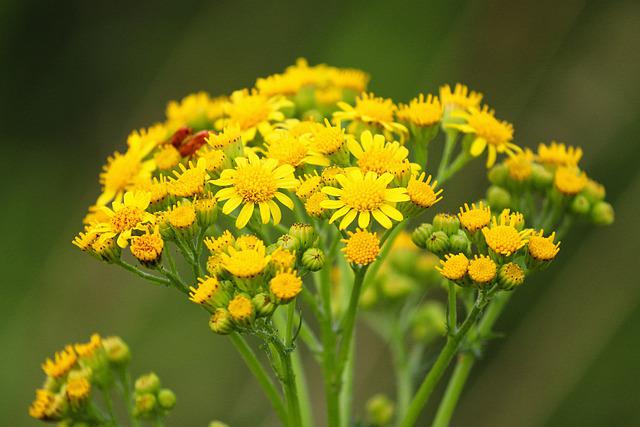
Back in a June post[i], I referenced the Ontario Native Plant Council’s best management practices for Alliaria petiolata (Garlic Mustard).[ii] In it they referred to certain native plants that can be used to outcompete it. I would like to mention one other that I am fond of having in my garden. Packera aurea (Golden Groundsel) has a diminutive orange inflorescence and is native to the Peterborough area. It can be aggressive as it reproduces through rhizomes and adventitious shoots on the stems. It is better situated in moist soils and so it may be more subdued in a drier location. In her blog, The Humane Gardener[iii], Nancy Lawson discovered that when she inserted clumps of Golden Groundsel into patches of Garlic Mustard, the latter quickly became surrounded. Garlic Mustard is known to be allelopathic and inhibits the growth of some plants. However, Golden Groundsel does not appear to be inhibited by it.
Golden groundsel, Packera aurea
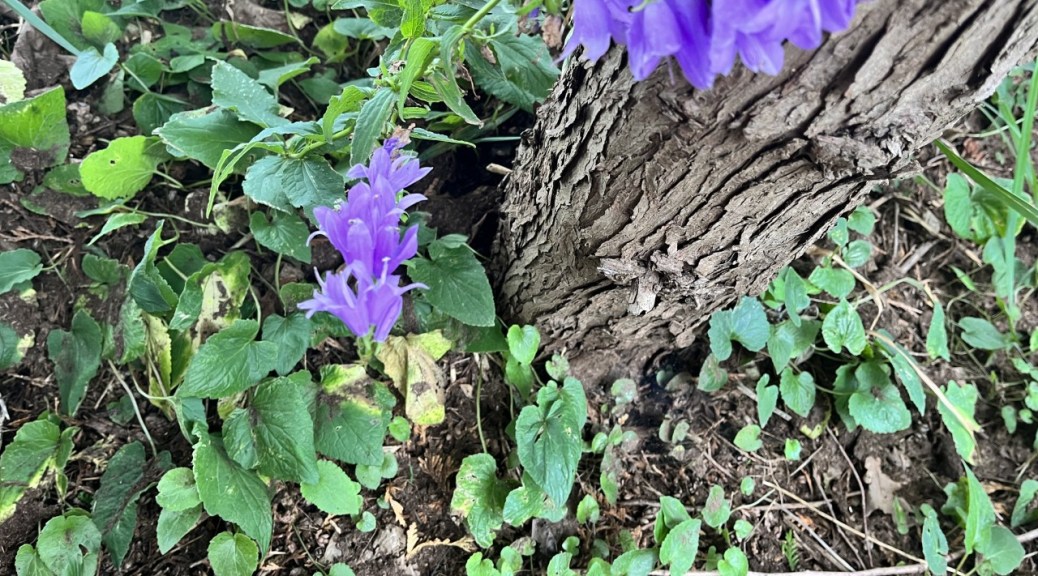
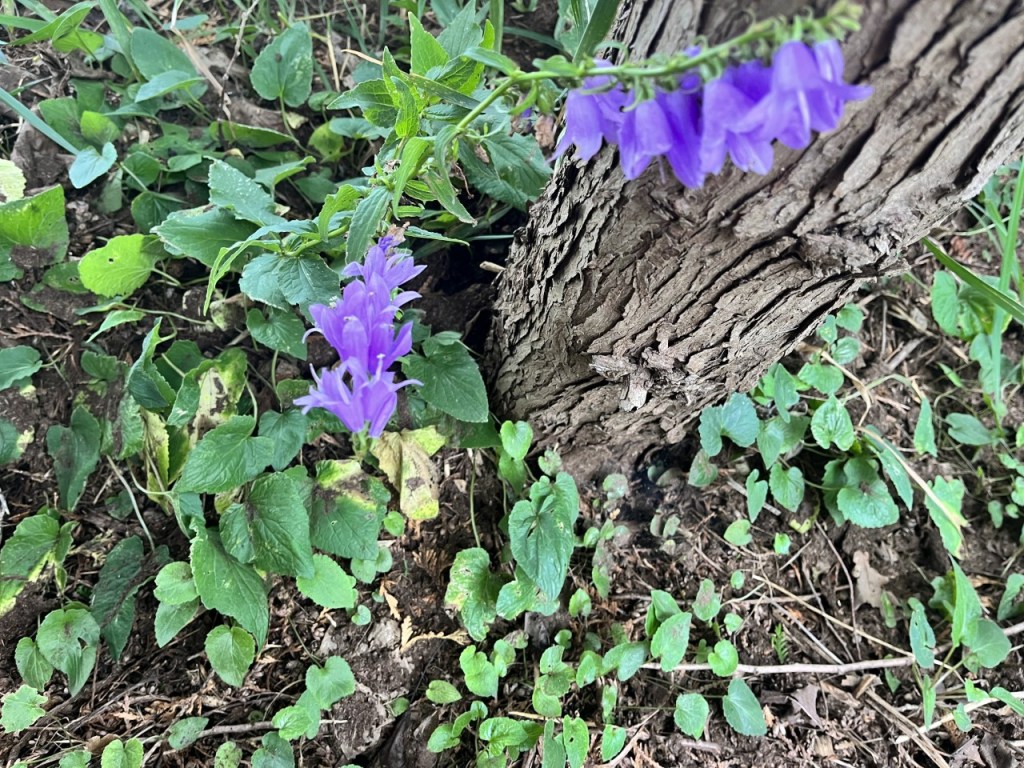
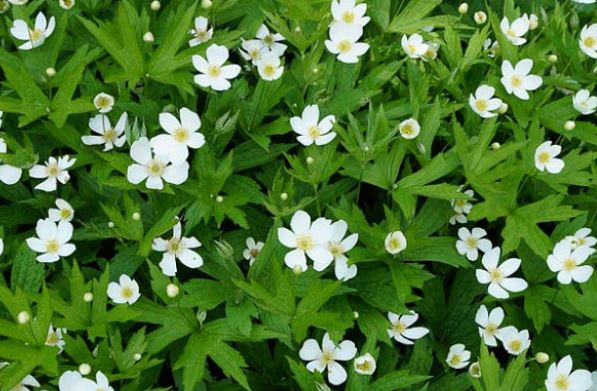
Anemonastrum canadense (Canada Anemone) is a beautiful vigorous native ground cover that performs well in sun to shaded environments; although it can develop brown leaves in more arid conditions. I am using it to limit the advance of Campanula rapunculoides (Creeping Bellflower). The intent is to envelope it so that it is unable to photosynthesize, grow more foliage, and store energy in its roots. One might argue that this is simply a matter of replacing one problem with another. While it is true that Canada Anemone can be overwhelming, it may be limited by deadheading the flowers, removing rhizomes, adding mulches, and by installing edging below the soil surface. As a native plant, it supports pollinators such as miner bees, sweat bees, and hover flies. The Xerces Society notes that it supports “conservation biological control.”[iv] This is a plant that attracts beneficial insects to your garden which in turn will help control other insects that damage your other plants.
So far, the Creeping Bellflower’s development has been slowed but there are still some basal leaves within the patch and at the perimeter. Right now, it is still a team effort: Canada Anemone and me.













 The Peterborough & Area Master Gardeners