
By Cheryl Harrison, Master Gardener
When I was growing up, my mother always had a big green and red poinsettia sitting in the centre of the dining table during the holiday season. By the middle of January, it had lost all of its leaves so out it went in the trash. Oh yes, we also called it a “pointsetta”.
In Mexico, where it grows wild as a leggy shrub or small tree, the native plant (Euphorbia pulcherrima) has been associated with the Christian Christmas holiday since the 16th century. Thanks to Joel Robert Poinsett, the first U.S. Ambassador to Mexico, poinsettias were introduced to the United States in 1825. They did not really take off, though, until the California based Ecke family grew plants using a grafting technique discovered by Paul Ecke Sr. in the 1960s. They began aggressively marketing the holiday season blooming poinsettia as a holiday tradition. In the 1980s, John Dole identified the technique used by the Ecke family to produce their compact poinsettias. This led to many more growers entering the retail market.
Poinsettias are members of the Euphorbia family. The brightly coloured “flowers” are actually bracts (modified leaves). Their bright colour helps to attract pollinators in the wild.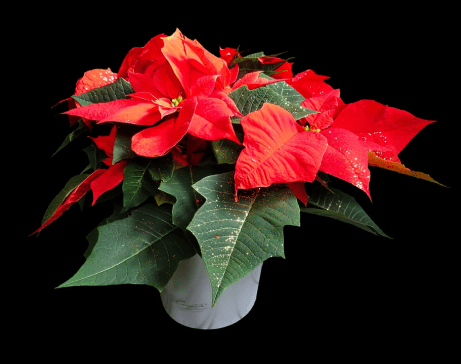
When purchasing poinsettias, look for an erect plant that has dark green leaves down to the soil and fully coloured bracts. The actual flowers, located at the centre of the bract, should be immature and red-tipped or green, not yellow with pollen because these more mature blooms will not last as long as the immature blooms. Plants displayed in plastic sleeves or crowded together may be stressed and deteriorate quickly after purchase. When purchasing any plant, always check for disease or insects. Yellow leaves, wilt or the presence of insects (check the underside of leaves too) always indicate problems and a plant that you do not want.
Poinsettias are not poisonous to humans but may cause pets to experience vomiting and diarrhea if consumed. Like all Euphorbia, damaged poinsettia stems and flowers exude a white sap that may cause skin irritation to susceptible individuals and pets.
There are over 100 varieties of poinsettias. They come in many colours from the traditional red to white, pink, cream and marbled or speckled.


Poinsettias prefer 6 hours of indirect light each day away from heat registers and cold drafts. Water the plant when it is dry but do not overwater because it may wilt and drop its bracts. (I think that is likely what happened with my mother’s poinsettias!) Allow the water to drain into a saucer after watering then discard this water. Do not let your plant sit in water. If you would like to keep your plant past the holiday season, fertilize it once a month with a houseplant fertilizer once the plant has stopped blooming.
Poinsettias may be put outside in the summer after all danger of frost has passed. But if you would like it to rebloom during the following holiday season, bring the plant back indoors before frost. Then, beginning in October, keep it in total darkness for 14 hours each night. The combination of total darkness and warm, bright days should cause the bracts to colour. This might be fun to try but to guarantee that you have a blooming poinsettia during the following holidays, purchase a new one and compost your old plant.
Poinsettias have long been associated with the holiday season. They come in several colours which will help to add holiday cheer to any home decor. Enjoy them while they last!
For more information on poinsettia care and reblooming, please see the links below.

 gardener has a long list of things they wish they had because many of these items will make their gardening hobby just a little bit easier. Also, most of them will rarely treat themselves.
 A Garden Show! Treat someone to a trip to Canada Blooms or the awesome

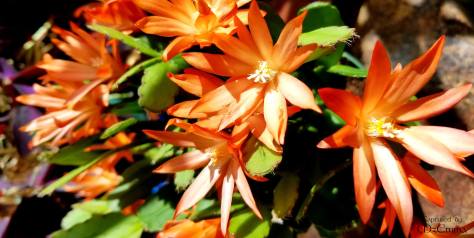

 Plant garlic! Yes, this is the time of year to plant garlic for harvesting next summer. You can probably still find garlic bulbs at farmers markets. Buy locally grown garlic, not product of China. Separate the cloves from the bulb and plant at a depth of 3 times the height of the bulb in rows in the garden. Cover two-thirds deep with soil and then top off with straw or mulch. For full details, see this fact sheet on
  Plant tulips! Although it may be too late to plant daffodils, you can still pop some tulips into the ground, even up to freeze up. Squirrels do love tulips, but if you plant them deep enough (6 to 8 inches), use hen manure or bone meal, and cover up the bare spot with leaves or mulch, you should deter them. Check this link for more
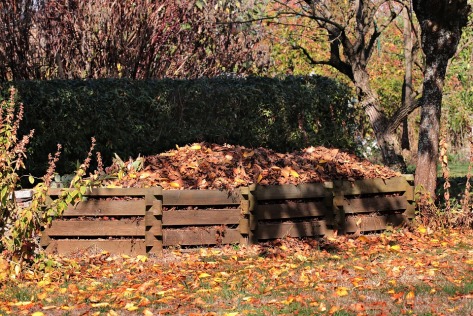
  Don’t rake! Mulch those leaves into your lawn with your lawn mower. It’s easier on your back and is so good for the lawn. Use your leaf blower to mulch into your flower beds too.


 I started my seeds inside under lights. When I planted the seedlings outside, one went into the ground in my garden and the other went into a 5 gallon bucket with holes drilled in the bottom. The bucket plant went into my little greenhouse.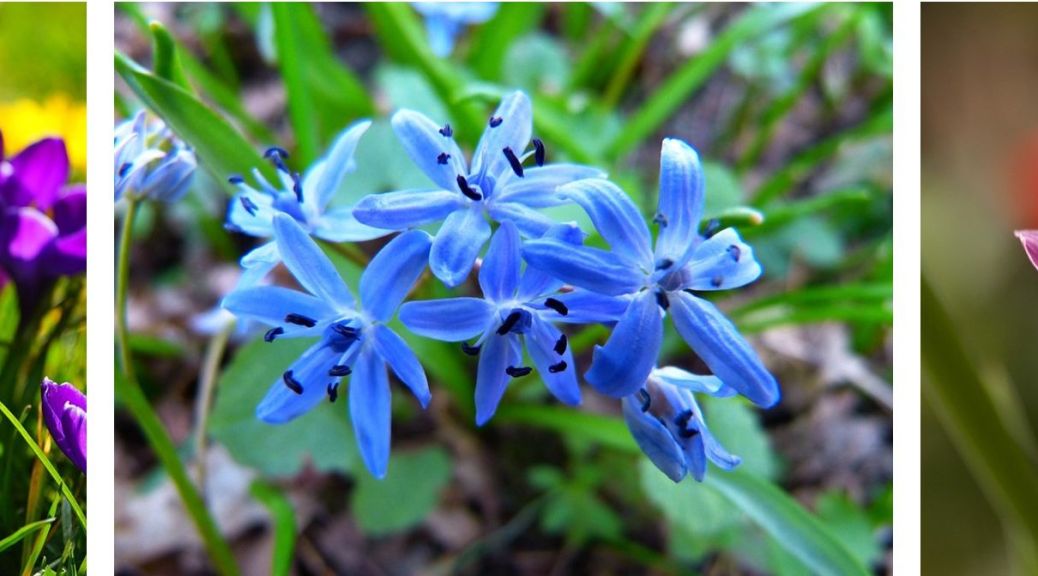
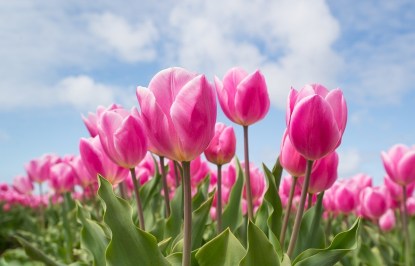 Tulips are to Turkey and Central Asia. In the 1600s, they made their way to the Netherlands. Tulipmania took hold in the 1620s and tulip prices skyrocketed. A single bulb could be worth as much as an average family farm. The market collapsed in 1637, but tulips remain widely grown in the that country. Canadians liberated much of the Netherlands during the final months of the Second World War. More than 7,200 Canadians were lost in that conflict. The Dutch have gifted Canadians with 20,000 bulbs a year since that time and they are used in Ottawa’s now famous Canadian Tulip Festival every May. This year marks the 75th anniversary of liberation and the Dutch royal family will mark the celebration by thanking Canadians this year with a gift of 100,000 tulip bulbs. If you want to join the celebration, you can purchase your own Liberation75 tulips for $15.00 through the Royal Canadian Legion. By purchasing the bulbs, you will also be entitled to win a trip to the Netherlands. To place an order visit the
 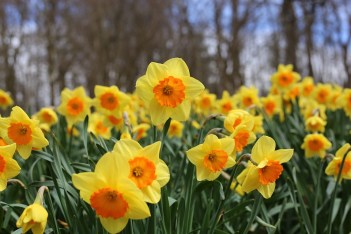 Daffodils and narcissus bloom earlier than most tulips. Spring sun is needed and they like soil that is well draining or they will rot. Oxalic acid on the bulb make them unpalatable to rodents. ‘Tete a tete’ is a mini daffodil that is very fragrant and also good for cut flowers. However, never include daffodils with other flowers in a vase as they have a sap that will cause the other flowers to wilt.
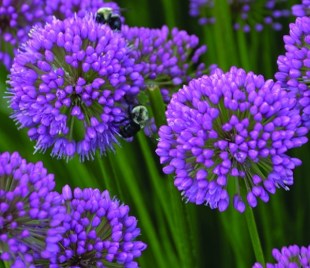 Alliums are ornamental onions. Most of the varieties bloom in June. They need free draining soil with 6 to 8 hours of sun. They make lovely dried flowers. It is best to plant alliums amongst other plants as the foliage is not desirable.


 The Peterborough & Area Master Gardeners