Quarantines are Not Just for Humans

By Mary-Jane Pilgrim, Master Gardener

Seeing bugs outside is generally pretty tolerable as we know that many of them are pollinators, but seeing them inside our houses is a completely different story, right? Fortunately, it’s usually easy to manage most indoor pests with little more than some water, a cotton swab, and a soap solution. It all starts with a few preventative actions:

Aphids
  1. Whenever you happily bring home a new treasure (or sometimes, victim!), make sure that you carefully inspect them. Many types of houseplant bugs piggyback their way into your house from friend’s homes or stores. Look on leaf undersides, along the stems, and even in the soil for signs of common pests (sticky substances, flying cloud when disturbed, little bumps, fine silky webbing).
  2. Put your new treasure in solitary confinement for a few weeks, like in a spare room. Even if you think a new plant is pest-free, it may have pest eggs or larvae that you can’t yet see. Watch it carefully and only put it in close contact with other plants after it’s been confirmed to be pest-free. If the pandemic has taught us anything, quarantining is right at the top of the list and it applies to plants as well as humans.
  3. Place a few yellow sticky cards in among your plants. Many pest insects are attracted to the color yellow, and they’ll quickly get trapped on the card. Check the card every few days for any insects. If you have some on the card, you probably have many more on the plant itself.

What if You Detect an Infestation?

The most common pests are aphids, fungus gnats, mealybugs, scale, spider mites and white flies. See this resource for bug-specific instructions.

For all infestations, the first thing to do is to move the affected plant away from all other plants. Quarantine!

Then, take the plant to the bathtub/shower and spray it with water. Many bugs are tiny and are easily washed off the plant. Be sure to rinse both upper and lower leaf surfaces. After the plant has fully dried, use a light-weight horticultural oil or insecticidal soap to smother the pests. Reapply the oil/soap every 10-14 days for two more applications for the best control.

If you detect small bumps, wipe the plants with a cotton ball soaked in rubbing alcohol and remove the bumps if possible.

If you detect pests in the soil, it’s often caused by overwatering. Reducing the amount of water, or watering your plants from the bottom instead of the top should take care of the problem. Spraying the soil lightly with insecticidal soap occasionally often helps as well.

Resources

How to Get Rid of Bugs on Houseplants
Common Houseplant Insects & Related Pests
How to Get Rid of Common Houseplant Pests

Spider mites


Dreams of Spring Gardens

By Emma Murphy, Peterborough Master Gardener

It’s really cold out. I mean REALLY cold. -25 degrees Celsius cold. With lots of snow. And wind. And ice. So it’s got me dreaming of springtime and things that are green and not white.

So indulge me while I research and share with you some of my favourite English gardens in southern England that we plan to visit later this spring. Hoping things improve to celebrate my aunt’s 95th birthday and fulfill a long held dream to visit England in late springtime. While I’m planting many more natives in my messy “English-style” garden, I’m still fascinated with the diversity, structure, and composition of more formal English gardens.

Here’s my top 5 ‘not to be missed South England gardens” – there are (of course) more on our list but these are the key ones. Some of these may be familiar to you, and some not…

Hoping that these profiles help ease the January blues. Since I’ve haven’t been there yet these are photos taken by others. If you have been lucky enough to visit these gardens please share your photos in the comments.

1. Great Dixter House and Gardens, Rye, East Sussex

Great Dixter is an historic house, a garden, a centre of education, and a place of pilgrimage for horticulturists from across the world. Certainly it’s the one garden that has the highest reputation with overseas visitors.

Surprisingly, it’s maintained this reputation for many decades, even through a change of hands. Initially famous through its owner Christopher Lloyd (1921-2006) – who lived in the half-timbered fifteenth-century house all his life – Lloyd (or “Christo” as he was known) was not only a gifted and artistic gardener but a prolific and knowledgeable writer whose articles and books inspired a generation of gardeners.

Today, the gardens are managed by the Great Dixter Charitable Trust and Fergus Garrett, who became head gardener in 1992. I was lucky enough to hear him speak at a Toronto Master Gardeners’ Technical Update a few years ago.

The two gardeners had a creative working relationship, both loving plants and their combinations, and even though Lloyd is gone more than 50,000 visitors a year find Great Dixter as vibrant a garden as ever, and full of things to learn from.

This is an ‘arts and crafts’ style garden, with topiary, a long border, an orchard and a wild flower meadow. The planting is profuse, yet structured, and has featured many bold experiments of form, colour and combination.

On the grounds are three 18th-century oast houses, under a common roof, and a 15th-century barn. Find out more here.

2. Sissinghurst Castle Gardens, Sissinghurst, Kent

Located in beautiful Kent, Sissinghurst Castle Garden was created by poet and writer Vita Sackville-West and her husband Harold Nicolson, author and diplomat in 1930 and developed over 30 years with some notable head gardeners.

Designated Grade I on Historic England’s register of historic parks and gardens, it’s among the most famous gardens in England. They transformed a farmstead of “squalor and slovenly disorder” into one of the world’s most influential gardens.

Following her death in 1962, the estate was donated to the National Trust for Places of Historic Interest or Natural Beauty. It is one of the Trust’s most popular properties, with more than 200,000 visitors each year (and I hope to be one of them!).

There are a number of specialty gardens, including the Rose Garden, the (famous) White Garden, the South Cottage Garden, the Herb Garden, the Nuttery, the Lime Walk (Spring Garden), the Delos Garden (Mediterranean garden), Moat Walk, the Orchard, and the Purple Border. Learn more here.

3. Hidcote Gardens, Hidcot Bartim, Gloucestershire

Hidcote is a world-famous garden located in the north Cotswolds (not far from [the original] Stratford-upon-Avon). Created by the talented horticulturist Major Lawrence Johnston (and inspired by the work of designers Alfred Parsons and Gertrude Jekyll), yew, holly and beech hedges define a series of outdoor garden rooms – the Circle, the Fuchsia garden , the Bathing Pool Garden, the Red Borders and the steps up to the two gazebos. The outbreak of the Great War (1914 – 1918) in which Lawrence fought, suspended progress.

You might recognize the narrow-leaved lavender, Lavandula angustifolia ‘Hidcote’, and Penstemon ‘Hidcote Pink’, as developed by Johnston. Many of the plants found growing in the garden were collected from Johnston’s many plant-hunting trips to faraway places so it will be the perfect source for gardening inspiration. More history here.

4. Gravetye Manor, East Grinstead, Sussex

Created in 1885 at the former home of William Robinson, who championed naturalistic planting, the site today is a prestigious hotel, but visitors can still enjoy the gardens which are curated and cared for by Tom Coward (who trained with Fergus Garrett at Great Dixter).

An oasis of calm with over 35 acres of beautiful grounds, Robinson created a landscape that celebrates nature rather than controls it. He also introduced the idea of the modern mixed border and popularized common place items such as secateurs and hose pipes. In many ways Robinson created modern gardening as we know it.

Some of his most influential books include The Wild Garden and The English Flower Garden, which remains the bestselling gardening book ever printed. He also ran several gardening journals such as The Garden and Garden Illustrated.

Robinson made Gravetye “the paradigm in which house, garden, fields, and forest are united in a pastoral work of art as quintessentially English as a painting by Constable,” wrote landscape designer Elizabeth Barlow Rogers. Some ideas on how to create the Gravetye look here.

5. Wisley Gardens, Wisley, Surrey

Royal Horticultural Society (RHS) Garden Wisley is operated by the RHS and is a beautiful garden with romantic half-timbered Tudor-style buildings. Unlike many English gardens, the soil is mainly acid sand which is poor in nutrients and fast draining.

There is a canal designed by Sir Geoffrey Jellicoe, a rock garden, formal and walled gardens by Lanning Roper, a country garden by Penelope Hobhouse and long borders by Piet Oudolf.

Then there are long herbaceous borders, the alpine gardens, the model gardens, soft fruit garden, rose-garden, summer garden, winter garden and woodland garden, a fruit field, glasshouses and an arboretum.

This garden is home to some of the largest plant collections anywhere in the world, with constantly evolving planting schemes to inspire visitors. In June 2021, Hilltop – The Home of Gardening Science opened at Wisley so I’m looking forward to exploring this impressive exhibition space and three beautiful new gardens.

Well that’s it for this blog – I hope you feel inspired to explore gardens wherever you live or travel – they are so many incredible gardens here in Canada and the U.S. alone. Even if we can’t travel much at the moment, many gardens have developed virtual visits, presentations, and videos so you can explore that way until we can move more freely. One of my favourites is the Lewis Ginter Botanical Garden in Richmond, Virginia, which I hope to visit in person in the future. Check it out here.

I leave you with a photo of my messy Lakefield “English garden” from last summer, my hardworking husband and our 2021 new greenhouse and dreams of springtime.

Hybrid or Heirloom?
By Lois Scott, Master Gardener

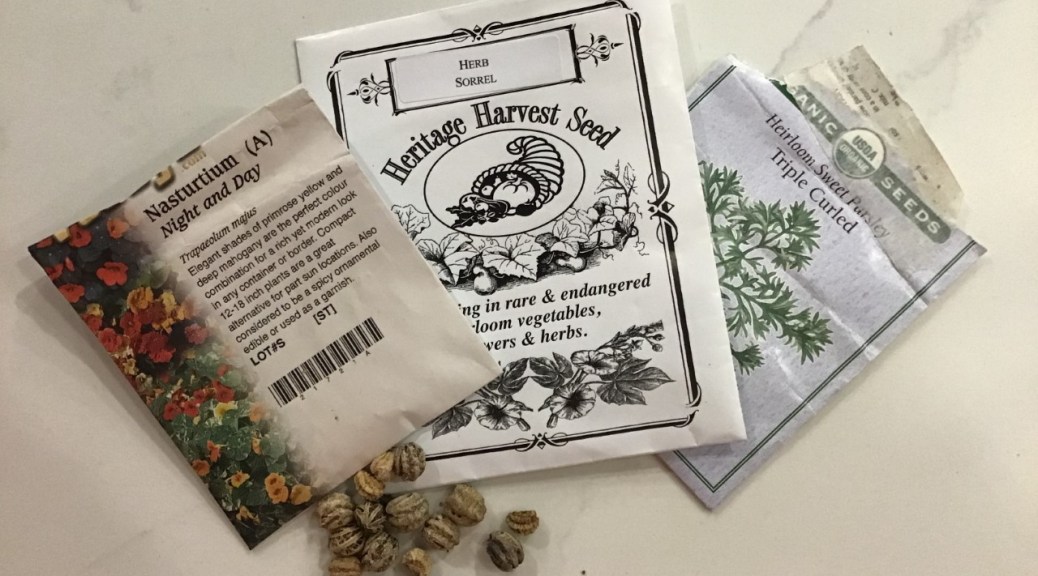
It’s that wonderful time of year when the seed catalogues are arriving in the mail.  The many seed choices may be both enticing and overwhelming and for some, possibly confusing.  Terms like F-1 hybrid, heritage, and open pollinated may accompany tantalizing names like Red Ace F-1 hybrid beets or Brandywine Heirloom tomatoes.  What do these designations mean for a gardener?

Let’s start with the term F1 hybrid.  This term is used for first generation seed that follows the successful pollination of one genetically uniform plant variety with another specific genetically uniform variety.  From the University of California, see “What does “F1 Hybrid mean?”   It potentially takes years to develop the parent plants for these seeds which is why hybrid seeds are usually more expensive. The benefits of growing hybrid seed include a more vigorous plant, higher yield, improved disease resistance, shorter time to fruit maturation and consistent performance.  This is known as hybrid vigor.  If you grow a plant from hybrid seed, the seeds produced by your plant will not be ideal for saving as the offspring from these seeds will have unpredictable characteristics.

Open-pollinated seeds are from plants that get pollinated naturally by insects, the wind, birds, or people.  These plants are more genetically diverse which is considered beneficial as plants adapt from year to year to local growing conditions.  Some consider the flowers or fruit from open-pollinated seeds to have superior beauty or flavor.  Of importance to seed collectors is the fact that seed from open-pollinated plants will grow plants very similar (true-to-type) from year to year and are ideal for saving.  There are some details to know about seed saving which could be discussed in another blog but this link explains some of them: University of Minnesota Extension: Saving vegetable seeds.

Heirloom (sometimes referred to as Heritage) seeds are always open-pollinated and have a history of being passed down within a family or community for a number of years, with 50 years being the minimum for some seed companies. 

In my garden I grow both hybrid and open-pollinated seeds, including some heirlooms.  For a few reasons, I like growing mini cucumbers which are a hybrid variety, but I also enjoy growing heirloom greens, tomatoes, and open-pollinated annual flowers, and saving seed.  Having all options allows gardeners to choose the seeds that are best for their needs.

Resources

https://blog.seedsavers.org/blog/open-pollinated-heirloom-and-hybrid-seeds

https://www.growveg.com/guides/which-are-better-hybrid-or-open-pollinated-seeds/

Regenerative Agriculture and the Garden

By Marilyn Homewood, Master Gardener

Regenerative Agriculture describes soil management practices that help to reverse climate change while rebuilding soil organic matter and restoring degraded soil.  Through photosynthesis, plants remove carbon from the atmosphere and sequester it in the soil. In addition to carbon sequestration, practices that increase soil organic matter also increase biodiversity both above and below the soil surface, while increasing water holding capacity and improving soil structure helping to reverse soil loss. 

Carbon cycle diagram with nature farm landscape illustration

While the movement was initially geared towards farmers, more and more gardeners, particularly those involved with the growing of annual crops, have adopted some of these principles recognizing the benefit for both the garden and the environment.   In fact, many of the practices have been employed by gardeners for years without realizing how the benefits for the environment.

Regenerative Agriculture aims to:

  • generate/build soils, increase soil fertility and health;
  • increase water percolation and water retention;
  • increase biodiversity, ecosystem health and plant resiliency;
  • increase carbon sequestration thereby helping to cleanse the atmosphere of excess CO2.

Specific Practices include:

  1. No-till/minimum tillage. Tillage breaks up soil and destroys soil structure. Tillage greatly increases soil erosion and releases carbon sequestered in the soil.  A secondary effect is soil capping and slaking that can plug soil spaces reducing water percolation creating  more water runoff and soil loss.

Conversely, no-till/minimum tillage, enhances soil aggregation, water infiltration and retention, and carbon sequestration. Some soils benefit from interim ripping to break apart hardpans which can increase root zones, improved soil structure and carbon sequestration. At a low level, chiseling in some beds may have similar positive effects.  Cracking the soil slightly allows amendments such as compost to infiltrate the soil without damaging it.  A broadfork can be a very effective tool here.

Lasagna gardening or Charles Dowding’s No Till Gardening Methods are good examples of these practices.  One can put away the roto-tiller and get a broadfork instead.

Fall garden after upper stalks have been removed leaving plant crowns and roots

2. Increase soil fertility biologically through application of cover crops,crop rotations, compost, and animal manures.  These increase the soil organic matter and restore the plant/soil biome which promotes the cycling of essential soil nutrients. Increased organic matter (OM) enhances soil structure, increases porosity which increases water infiltration and drainage.  Increased OM also stores and supplies micronutrients and enhances soil microbial populations. A tip for annual beds; When removing the plant in the fall, only remove the portion above ground.  Leave the root ball in the ground to decompose over winter.

3. Build biological ecosystem diversity with inoculation of soils with composts or compost extracts to restore soil microbial community population and functionality. Restore soil system energy through full-time planting of inter- crop plantings, multispecies cover crops, and borders planted for bee habitat and other beneficial insects.

Increased organic matter means more friable soil.  Friable soil means deep roots; increased biological activity mean more nutrients released for plant use and microbial diversity means less disease.  The result is healthy, vigorous plants that need less watering, less additional feeding/supplementation and less treatment for disease while sequestering carbon at the same time.  That is a win win!

“Earth is what we all have in common” Wendell Berry

Resources:

https://www.csuchico.edu/regenerativeagriculture/ra101-section/ra101-definitions.shtml

https://www.bbc.com/future/article/20211020-carbon-farming-a-better-use-for-half-earths-land

Are You in the Zone?

By Cheryl Harrison, Master Gardener

Gardeners are used to seeing the “zone” as part of the information provided on the label of most perennial plants, trees and shrubs purchased from a nursery.  Some labels will list a zone with the corresponding temperature in brackets afterwards.  This seems like an easy way to determine if your chosen plant will successfully grow in your garden–you will need to know the average lowest winter temperature, in your region, then figure out your zone.  You then just buy the plant labelled with your zone for success!  Easy, right?  Yes and no!

In Canada, the original 1960’s plant hardiness zones were based on information gathered at 640 weather stations across the country along with the survival results of selected trees and shrubs.  In 2012, revised maps were released using elevation, more locations and more environmental details resulting in a hardiness index which corresponds to a zone .   At present, there are 13 zones ranging from 1-13.  You may also see an “a” or “b” beside the number.  This indicates a slight variation within that region. See Plant Hardiness Zone by Municipality to find your zone.

Zone 5, author’s garden.

In the USA, the system is different.  Again, there are 13 zones ranging from 1-13 and  “a” or “b” indicates variation within the region. See US Plant Hardiness Zones.   However, the US system is only based on minimum temperature and no other factors.  You may read about a plant grown in the US and designated US zone 5.  A US zone 5 labelled plant may require warmer winter conditions than it’s corresponding zone 5 labelled Canadian plant.  Bottom line, US zones may not be the same as Canada’s.

Canadian data is based on previously collected information but we know that the weather does not always follow past patterns — it can, and will, fluctuate (e.g. freeze/thaw cycles).  There may be microclimates (see Microclimate in Wikipedia) in your own gardening space.  Good gardening practices (e.g. soil preparation)  will contribute to the successful growth of your plant.  Plant survival and growth depends on your gardening expertise and knowledge.  The zone is just one indicator of whether, or not, the plant that you are contemplating will grow well in your garden.  Oh, and Peterborough is a Canadian plant hardiness zone 5 b.

Tips: 

#1 The plant hardiness zone site now can be used to explore where the specific plant that you are thinking about purchasing will grow through the “Species-Specific Models and Maps”.  It does this by creating a “climate profile” of the plant and then mapping where it will grow in Canada.  These are preliminary maps but click here to try it out.

#2 Grow native plants!  Native plants are specifically well suited to an area especially if you can purchase locally grown plants or find locally sourced seeds. 

#3 Consult local nursery staff and your knowledgeable fellow gardeners.  They will know what will successfully grow in your area.

#4 Experiment!  If there is a plant that you really must have, but the zone is off a little…..try it.  You will need to choose a protected location for planting and probably baby it along but sometimes it may be worth it. Talking to other knowledgeable local gardeners may be especially helpful….someone may have successfully grown that special plant in their garden and may share their growing tips with you!

Zone 5, author’s garden.

Two Plants that Never Stop Giving

By Sharleen Pratt, Master Gardener

My Mom passed away last October at the age of 97 during a difficult period of the pandemic.  A dear friend gifted me a miniature rose plant that is a beautiful coral pink.  My parents were from Ireland and they always grew roses in their garden.  I adore the flowers but have never been a huge fan because of the many common diseases they get such as powdery mildew, rust and block spot.  Also, it seems that every time I am near a bush, the thorns love to grab me and wreak havoc on my skin!

Close-up of the Coral Pink Rose!  November 2021 in Author’s Garden

However, this rose was special and I managed to keep it alive during the winter months and after all signs of frost, I planted it in my front garden, tucked amongst other annuals such as the Impatiens walleriana ‘Variegata’, common name Variegated Impatiens.  This plant belonged to Norma Evans, a well-known founding member of the Peterborough Master Gardeners as well as a member of both the Peterborough and Omemee Horticultural Societies.  She passed away in 2017 at the age of 90.  Through cuttings, this gorgeous plant that is a perennial in warmer climates, has been passed amongst many friends and family.

Rose beside the Impatiens, October 2021, Author’s Garden

I was gob smacked by how well that little rose and that one small cutting of the variegated impatiens performed in my garden this summer.  The rose was blooming well into November.  The impatiens succumbed to the frost on November 4th, however, it was as large as a small bush.  It also had lovely deep pink flowers all summer long.

The Rose continues to bloom! Author’s Garden, November 2021

I have two cuttings of the impatiens growing in my kitchen window so that this plant can continue to be grown year after year.  As for the rose, I have heaped it with lots of leaves and soil in the hopes that it survives our Peterborough winter.

My Mom and Norma would be smiling and I believe they both have had an invisible hand in the success of these plants.  I know they have brought me peace and happiness. Memories are what we hold on to, and what better way to honour a person’s life than through the growth of a plant!

Happy holidays!  I hope you have all been able to safely celebrate Christmas with a few loved ones. Wishing you all the best in 2022.

Deck the Halls with Boughs of Holly

By Mary-Jane Pilgrim, Master Gardener

Common European holly (Ilex aquifolium) has a long history of use as a Christmas symbol. It appears on Christmas cards, in holiday arrangements, in Christmas carols, and my personal favourite: in stained glass ornaments. This shiny, spikey evergreen plant is easy to use for decorating, plus it has a long history of cultural significance.

Holly is a shrub-like tree that can grow up to 10-15 feet in height. Its leaves are thick and leathery, with serrated edges and spiky points. The female versions of the tree produce the red berries we’re so used to seeing everywhere at Christmastime. It is sold as a perennial in our region, but very few of the over 400 species are actually hardy in zone 5 (Peterborough). One such variety is American holly (Ilex opaca). The plant requires four or more hours of direct, unfiltered sunshine per day, and requires acidic, rich, and well-drained soil.

For centuries this magical shrub-tree has been been used in winter solstice decorating in central and northern Europe, specifically among the Celts who wore crowns of holly for good luck. They would hang holly sprigs from their windows and doorways to keep evil spirits away. Holly gradually became a symbol of hospitality and welcome.

In pre-Victorian times Christmas trees were not pines, but holly bushes. Christian culture adopted the holly – along with ivy – in Christmas celebrations; holly symbolized Christ’s crown of thorns; the crimson berries represented His blood and the evergreen a metaphor for life after death.

Holly is a real showstopper in winter when little else is green. The same features that make it so attractive today are what made holly a mythical plant to ancient cultures.

Holly’s red berries, toxic to humans and most household pets, are only produced on female plants. Hollies are dioecious, which means male and female flowers occur on separate plants (female flowers must be pollinated by male flowers to produce berries). So if you would like to see those bright red holly berries in winter, you’ll have to plant one male for every 5-10 female plants. The berries are a food source for some of our native birds in the winter.

While most of us no longer believe in the magic of plants, holly is indeed a beautiful adornment for our winter homes (“deck the halls with boughs of holly”), and has a long history of significance throughout the world.

From the Peterborough Master Gardeners to each of our amazing subscribers, we’d like to wish you all a blessed Christmas & holiday season!

Resources

Houseplant Facts and Fictions

By Laura Gardner, Master Gardener in Training

We turn to searching for information online or in books on how to care for our plants. Unfortunately there are a lot of inaccuracies surrounding certain beliefs and practices concerning them. Since most of our attention is now focused on indoor gardening, let’s look at five questions concerning houseplants.

1. Are Poinsettias Poisonous?

You may have been gifted with a Poinsettia (Euphorbia pulcherrima) and you may be concerned because you have heard that they are poisonous. The plant, while not edible, would need to be consumed in large quantities to be harmful. That being said, it still is wise to keep the plants out of reach of pets and children as some consumption may lead to digestive distress. Like other members of the Euphorbiaceae family, Poinsettias produce a milky sap and so handling the plant without gloves may affect those with a latex allergy.1

2. Can Houseplants Filter or Absorb Pollutants?

Recently I read in a book on houseplant care that plants draw in harmful volatile organic compounds (VOCs) such as formaldehyde and benzene and clean the air for us. Two examples mentioned included the Peace Lily (Spathiphyllum) and the Spider plant (Chlorophytum comosum). It stated that the former can filter out formaldehyde and the latter both formaldehyde and benzene. While it is true that plants have the ability to absorb pollutants, large numbers are required to have a significant impact. The belief that plants clean the air may be associated with a single NASA study2 from the 1980s that was conducted in an air-controlled laboratory setting and not in an open home or office setting. More recent research has determined that a building’s air handling system or open windows is more effective at reducing pollutants than plants. One would require 10-1000 plants per square meter in order to be comparable.3

3. Will Misting and Pebble Trays Increase Humidity?

We may struggle with maintaining optimum humidity levels in the winter for our tropical houseplants. Many books and online sources recommend increasing relative humidity around plants through misting and placing the plant pots on trays filled with pebbles and water. Misting is generally ineffective because the water evaporates so quickly. It would have to be done constantly to have an impact. Concerning pebble trays, an experiment published in the American Orchid Society Bulletin found that in the winter (set in a home in Minnesota), relative humidity levels were raised only slightly. The RH at 40 mm above the tray was measured at 3%; at 110 mm 2%; and at 300 mm it measured 0%.4 Using a humidifier is really the only method that has the ability to increase humidity levels significantly.

4. Should you Use Ice Cubes for Watering Orchids?

Recently I read a comment on the Master Gardeners of Ontario Facebook site that someone said that their Moth Orchid (Phalaenopsis) came with a tag advising them to use ice cubes as a method of watering it. It seems that this advice is really intended to help prevent new Orchid owners from overwatering their plants. While there is a study that found that using ice cubes did not negatively affect the health of the orchids, it was only conducted for a period of 4-6 months. A problem with using ice cubes is that it has the potential to accumulate salt build-up (from water and fertilizer) that can affect the plant’s longevity in the long term.5

5. Should you use Leaf Shining Products or Oils?

Some sources advise using commercial shine products or oils to help make a plant’s leaves shiny and reduce build-up of dust. However, there is research indicating that the use of leaf shine on Weeping Fig (Ficus benjamina) caused the plants to have a reduced tolerance to low light stress, resulting in three times as much leaf loss as untreated plants.Treated plants required higher light levels.6 Another problem is that they can block the pores or stomata in the leaves of some plants, resulting in reducing the plant’s ability to photosynthesize and respire.

Here are three easy to care for houseplants:
Schefflera, Aloe Vera, and Epipremnum aureum (Pothos)

References

  1. Newman, S.E. and B.E. Edmunds. Poinsettias. Colorado State University Extension. Online: https://extension.colostate.edu/topic-areas/yard-garden/poinsettias-7-412
  2. Wolverton, B.C. et al. Interior Landscape Plants for Indoor Air Pollution Abatement. Online: https://ntrs.nasa.gov/citations/19930073077
  3. Cummings, Bryan E. and Michael S. Waring. Potted plants do not improve indoor air quality: a review and analysis of reported VOC removal efficiencies. Journal of Exposure Science & Environmental Epidemiology. Volume 30, pp. 253–261 (2020). Online: https://www.nature.com/articles/s41370-019-0175-9
  4. Kohl, Douglas. A Study in Humidity: Douglas Kohl Evaluates the Effectiveness of a Common Method to Raise Humidity around Orchids Growing in the Home. American Orchid Society Bulletin, 63(8). 1994. pp. 916-917.
  5. American Orchid Society. Greenhouse Chat Webinar. June 2021. Online: https://www.aos.org/All-About-Orchids/Webinars/chat/Greenhouse-Chat-June-2021.aspx
  6. Steinkamp, K. et al. Acclimatization of Ficus benjamina: A Review. Online: https://mrec.ifas.ufl.edu/foliage/resrpts/rh_91_5.htm

Winter Favourites

By Lois Scott, Master Gardener

As I begin to hunker down for winter, the garden outside my windows still gives me pleasure.  Some plants are blackened and not particularly attractive but grasses continue to look beautiful throughout the winter months. 

Two of my favourite grasses for winter are Little Bluestem (Schizachyrium scoparium) and Switchgrass (Panicum virgatum).  These are both native grasses that are not only beautiful but well behaved in my garden.  Little Bluestem is a great choice for a dry, sunny spot or even a rain garden that may flood and then dry out.  It can grow up to 4 feet high and 2 feet wide. Switchgrass is a taller grass that grows to 6 feet with a 3-foot spread.  It prefers soil that is medium to wet and is also a great choice for rain gardens. 

Bluestem in author’s garden

Both these grasses are host plants for many species of butterflies.  They also provide seeds and nesting materials for birds and shelter for small mammals.

Switchgrass in author’s garden

Little Bluestem and Switchgrass are “warm season” grasses which means that unlike “cool season” grasses they don’t go dormant in the heat of summer.  Warm season grasses thrive in the heat.  They start growing later in springtime and flower later in the summer. 

This brings me to why I love them in winter.  They hold up their beautiful seed heads that look stunning when frosty, they create movement in the garden, provide colour all winter long and they help make my garden a winter refuge.

Resource:

https://www.inournature.ca/native-grasses-for-ontario-gardens

The Plastic Dilemma

By Marilyn Homewood, Master Gardener

The recent severe weather experienced by the west coast drives home the reality of our changing climate. Gardeners pride themselves on being good stewards of the land and are always trying new techniques to improve. However, there is a fly in the sustainability ointment.

The horticultural industry uses a lot of plastic. Pots, weed barrier, netting, propagation equipment; it’s overwhelming.  On a global basis, about 4 percent of world oil production is used as a feedstock for all plastic and another 4 percent is consumed as energy in the manufacturing process. Emissions are just the beginning of the problem.  The Earthways Center at the Missouri Botanical Garden estimates that about 350,000 lbs. of horticultural plastic enters the waste stream each year in America. Plastic is ubiquitous, does not degrade rather it disintegrates and some types (PVC and polystyrene) leech toxins into the soil and groundwater.  As it disintegrates, it becomes microplastic fragments that can be found both in marine settings and in the soil.  We are all aware of the impact on marine life but it has now been discovered that these fragments are in the soil and have a significant negative impact on arthropods and roundworms (all important in the breakdown of organic matter). 

Freedom from plastic is the goal but will take time. There are things gardeners can do right now to reduce their plastic consumption.

  • Extend the life of plastic you already own by careful handling and reuse
  • Forgo plastic when workable alternatives exist. Use biodegradable pots made of coir or fibre and try soil blocking for starting seedlings. Use wooden plant markers.
  • Buy bare root plants and or start plants from seeds to cut down on plastic pots
  • Use planters made of terra cotta, metal or ceramics.
  • Only use tools made from metal and wood
  • Skip the use of bagged products and purchase these products at a bulk outlet using preowned containers.
  • Use weed barriers that biodegrade such as cardboard or biofilm (made from corn)
Metal tools that last a lifetime

There may still be items for which no good alternative exists in your situation.  In these cases, purchase higher quality versions that are more durable and last a long time.  Companies such as Bootstrapped Farmer are now specializing in this type of product.

Many years ago (1996) I purchased 2 large plant trays from Lee Valley Tools and am still using them.  The trays are still in the catalogue and I am going to purchase more.  I have a metal watering can which I have had since I started to garden.  These things can be passed along to younger gardeners.  As the urgency of this issue becomes apparent, additional products come to market assisting in the transition to freedom from plastic.

“We have forgotten how to be good guests, how to walk lightly on the earth as its other creatures do.” ~ Barbara Ward


Resources

https://www.gardenorganic.org.uk/say-no-plastic-garden

https://www.npr.org/2019/07/09/735848489/plastic-has-a-big-carbon-footprint-but-that-isnt-the-whole-story

https://www.bootstrapfarmer.com/