January is a very challenging time for garden writers. Gardens are pretty empty, the flowers are gone, and the beds are frozen; hopefully everything is resting under a deep pile of insulating snow. Garden topics are hard to come by! This one jumped out at me on a recent snowshoeing trek north of Gannon’s Narrows this week with my friend Ange.
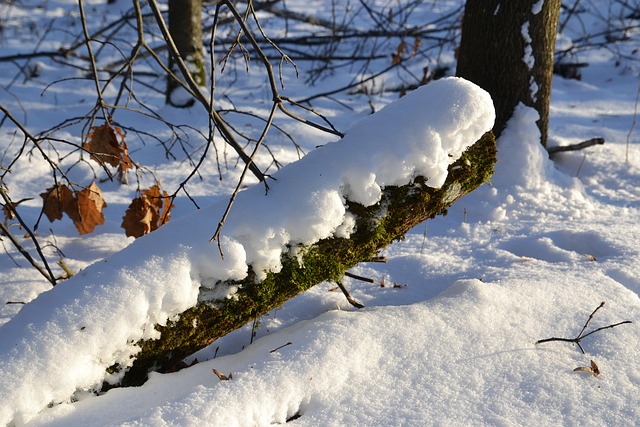
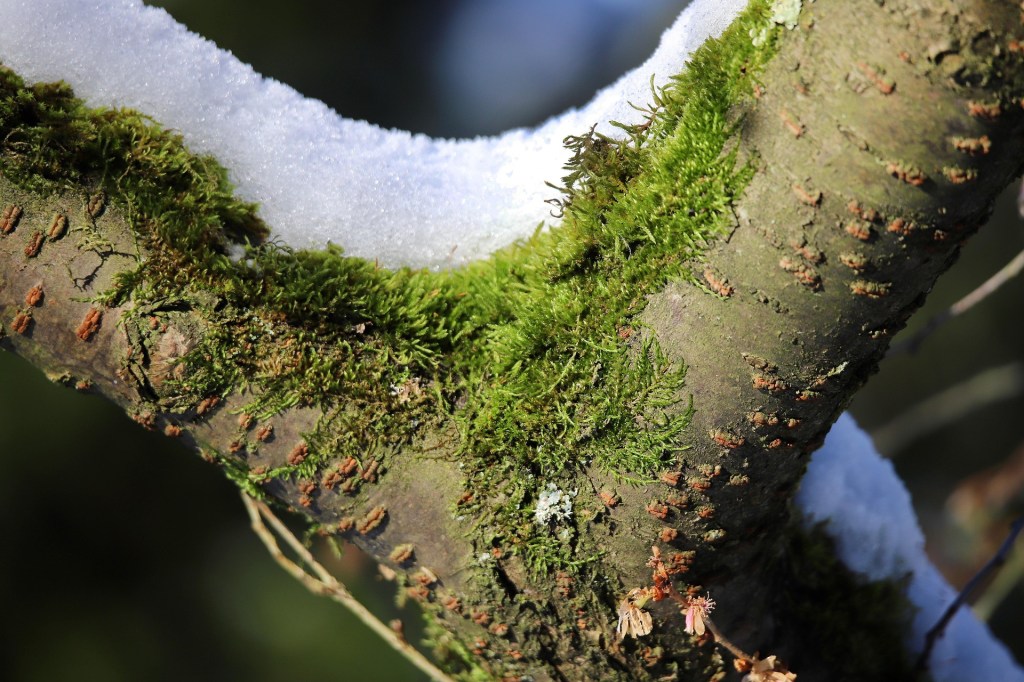
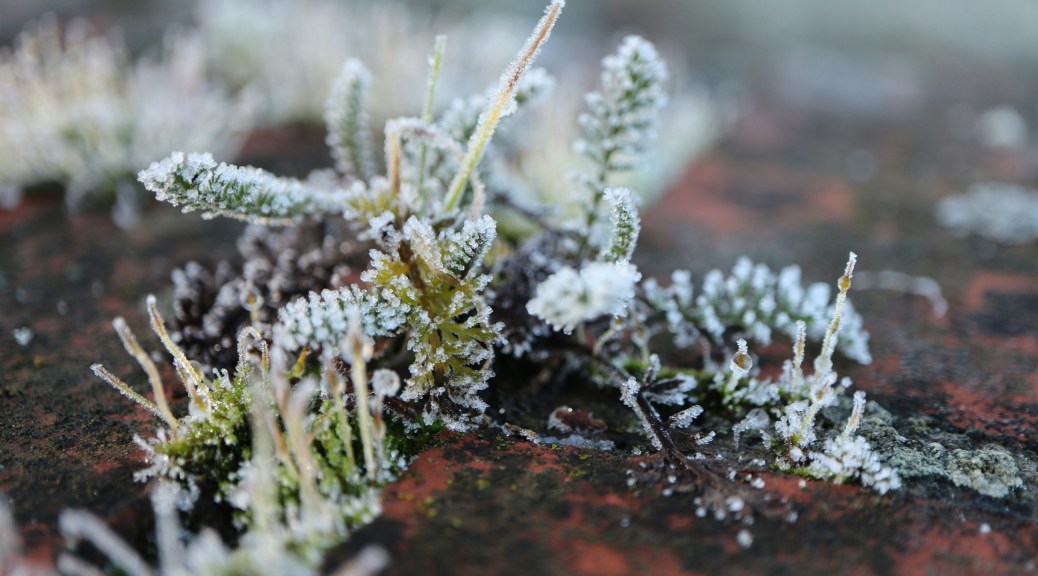
On this trip, I took a close look at the north side of many of the trees. I confirmed that not everything in nature is resting. I saw a lot of soft green patches on the bark. That’s moss.
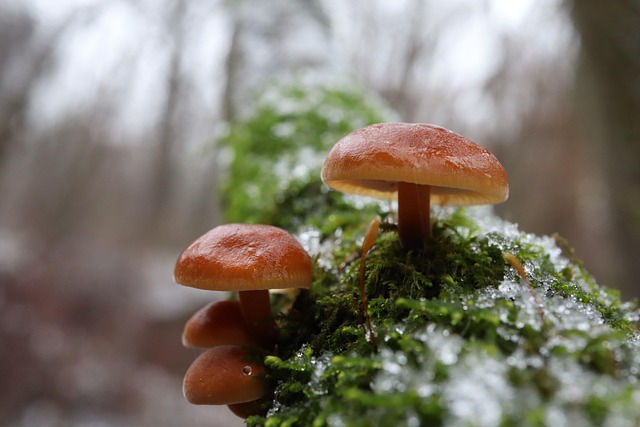
Moss is one of the oldest plants on earth. It’s classified as Bryophyta (bryophytes) in the plant kingdom along with its cousins the liverworts. It doesn’t have roots. It doesn’t flower. It survives by taking in moisture from rain, fog, and snow. Even in cold weather, moss can stay green. Moss also supports tiny life. Small insects and microorganisms live in it.
Many gardeners worry that moss on trees is a problem. It isn’t. Moss does not steal food or water from the tree. It does not damage the bark. Moss simply uses the tree as a place to sit.
Interesting fact: In the southern hemisphere, moss is more likely to grow on the south side of trees. Here’s why, in simple terms:
Moss prefers shade, moisture, and cooler conditions.
In the northern hemisphere, the north side of trees gets less direct sunlight, so it stays damper and cooler.
In the southern hemisphere, the sun is mostly to the north, which means the south side of trees is shadier and often more moist.
So the pattern flips across the equator. Road trip to confirm, anyone?
That said, moss is not a reliable compass. It can grow on any side of a tree if conditions are right. Factors like nearby buildings or fences, dense canopy cover, local humidity, or prevailing winds will all influence where the moss will grow or not grow.
In conclusion, moss isn’t a threat, and it is not always trying to point us north; it’s simply growing where the conditions are right.
Snow after Christmas has a public relations problem. It blocks driveways and arrives just in time for the morning commute. But ecologically speaking, snow is a quiet hero; less frozen nuisance, more life-support system.
Freshly fallen snow is light and fluffy, packed with tiny air pockets that make it an excellent insulator. This airy layer acts like a thermal blanket, keeping soil temperatures relatively stable even when the air above plummets. Beneath it, plants are spared damaging freeze–thaw cycles, roots avoid frost heave, and soil microbes continue their slow, essential work (Pauli et al., 2021; Saccone et al., 2013).
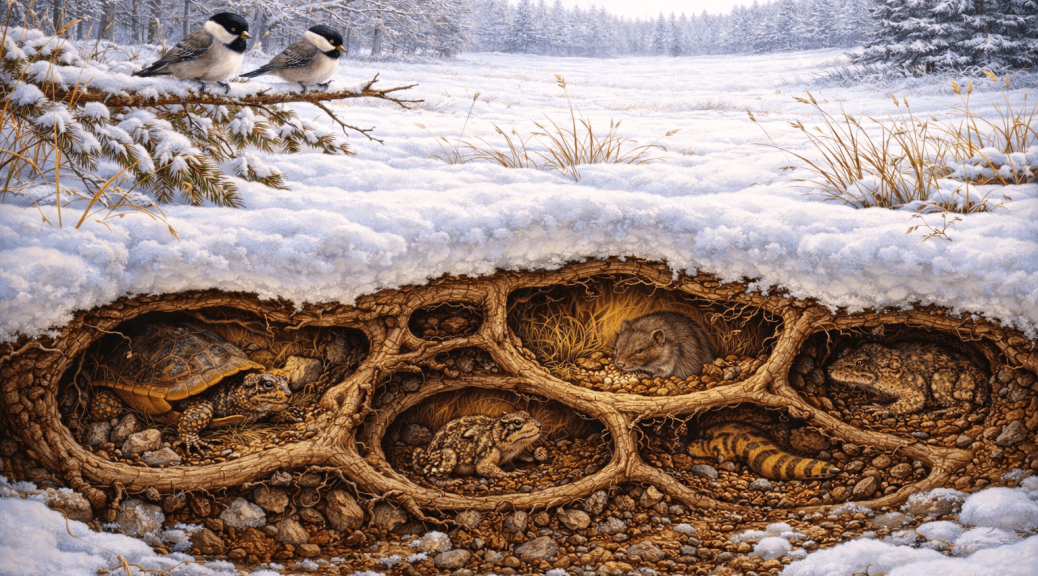
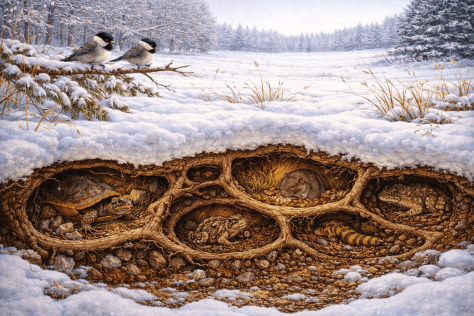
As snow ages, it settles and compresses into denser layers. Below these compressed layers is a gap between the snow and soil, the subnivean zone—a hidden world of tunnels for voles, mice, shrews, and overwintering insects. Stable snow layers mean stable winter habitat for these creatures which directly influences survival migrating birds and awakening mammals (Pauli et al., 2021).
The subnivean zone — Photo Credit: AI generated Image
Snow also plays the long game. Acting like a frozen reservoir, it stores winter precipitation and releases it slowly during melt. This gradual release recharges groundwater, sustains streams, and prevents spring flooding. Crucially, snowmelt fills ephemeral pools—temporary wetlands that appear just long enough for frogs, salamanders, and invertebrates to breed before drying out. These pools are biodiversity hotspots, and many amphibians depend on them entirely for reproduction (Brooks, 2004).
Climate change, however, is rewriting snow’s script. Warmer winters mean thinner, more variable snowpacks, frequent mid-winter melts, and icy crusts instead of fluffy insulation. These unstable layers expose soil and roots to harsh temperature swings, collapse subnivean habitats, and increase winter mortality for small mammals and plants alike (Saccone et al., 2013; Pauli et al., 2021). Reduced snowpack also means less spring meltwater, shrinking ephemeral pools and compressing breeding windows for amphibians.
In short, inconsistent snow is not just inconvenient; it’s ecologically disruptive. When snow comes late, melts early, or freezes into ice instead of insulating layers, entire food webs feel the impact. And we are feeling it this year.
The next time snowflakes fall, take a moment. That squeaky, shovelled nuisance is buffering ecosystems, storing water, protecting roots, and quietly setting the stage for spring. Snow may be cold, but for nature, it’s doing some very warm-hearted work.
I always enjoy flowers in the house at this time of year and Cyclamens (Primula family) are a lovely and available plant option to satisfy that desire. Readily available for the holiday season these plants may continue to bloom for weeks afterwards.
The florist plant that is sold during the winter is a hybrid of Cyclamen persicum originating in southern Europe, and the Mediterranean to Iran. In its native range it comes into bloom in the cooler temperatures of autumn going dormant in the summer.
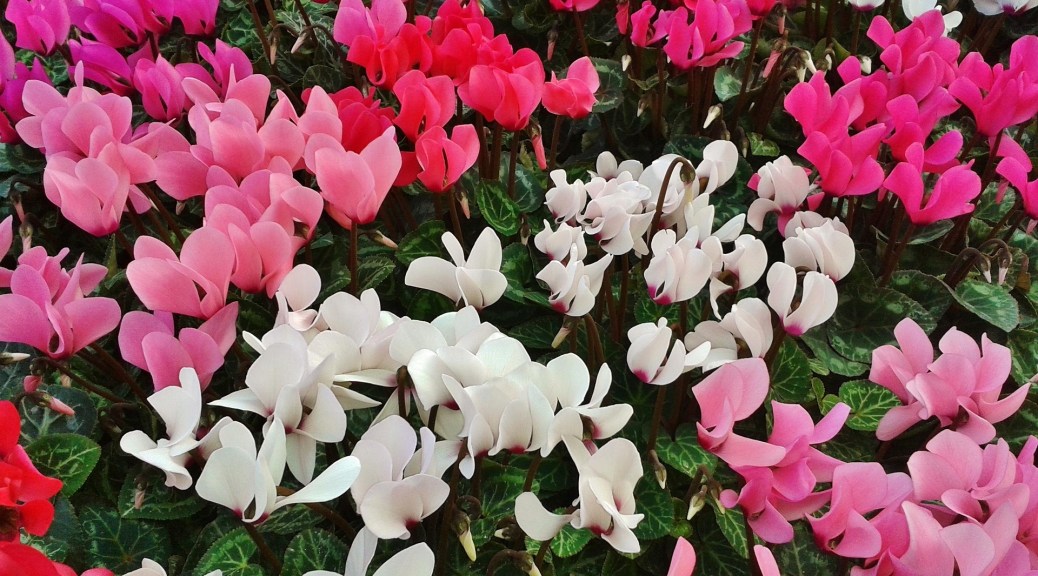
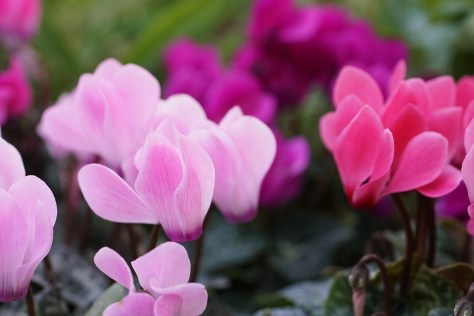
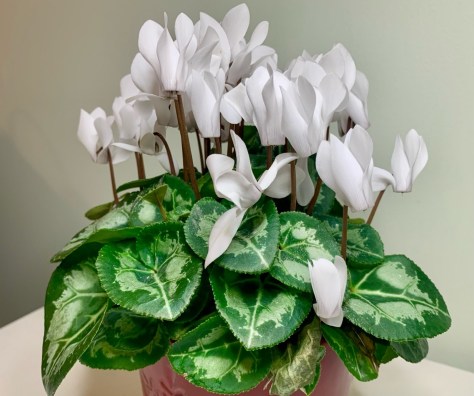
Cyclamen is a lovely plant that you may find in sizes ranging from 15 to 30 cm. Its heart shaped leaves may be dark green or mottled white or silver and bears flowers of white, pink, mauves or reds. Flowers may be double, bicoloured or frilly. The flowers have five petals that reflex back looking somewhat like badminton birdies. Very charming!
As an indoor plant it does prefer a cooler environment ranging from 15 to 18C and although I have read and experienced the fact that today’s hybrids will tolerate warmer temperatures, a cool windowsill for example would be ideal. Cooler temps will help prolong blooming time.
Cyclamen like a brightly lit spot and our winter sun is tolerated. Keep the soil moist by bottom watering to avoid getting water in the crown as that may cause rot. Fertilize with diluted houseplant fertilizer every 2 weeks. Deadheading will encourage continuous blooming. To deadhead twist the stem and pull sharply to remove it from the crown.
Cyclamen will naturally stop blooming in late spring and go into dormancy for 2 to 3 months. Dormancy means that the leaves will fade and drop off. If you want to save the tuber you can plant it outside for the summer in a shady spot or store it in vermiculite for 6 to 12 weeks. Repot your stored tuber with the upper half of the tuber above the planting medium. Water as the tuber starts forming new leaves and fertilize until flower heads form.
Typically, cyclamen is treated as a short-lived plant if one doesn’t have the right light conditions to get it to rebloom. The photo below with the bicoloured petals was purchased in December 2024.
Source: Lois Scott
After blooming it sat dormant in a pot, was not watered and then started sprouting in late 2025. Watering was resumed and it has been blooming since then.
Second year cyclamen can be a bit leggy with perhaps fewer blooms but can still provide a colourful accent which is always appreciated at this time of year!
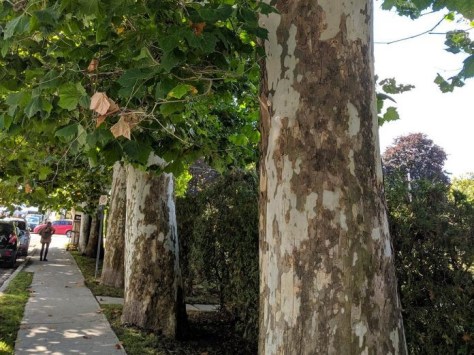
We are now on the uphill climb towards increasing daylength. However, the bleakness of the season will be with us for some time yet. Increasing winter interest by incorporating trees and shrubs with unique bark is one way of dealing with the view. There are some striking options available to us in this area.
Paperbark Maple (Acer griseum)
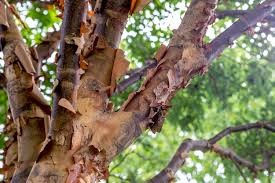
This is a small tree that once would not have wintered well here. With the changing climate, it can now be grown in our area but I should caution that it still prefers a sheltered area and will not tolerate strong wind. It has a mature height is about 25 feet with a spread of 15 -25 feet. It’s trunk and limbs remind one of cinnamon sticks and the peeling bark is similar to that of a birch tree. As a maple, it also has an impressive fall show when leaves turn shades of yellow, red and orange. As for placement, it will grow in full sun to partial shade in well-drained soil.
Striped Maple (Acer pensylvanicum)
This is a native, understory tree in southern Ontario topping out at 30 feet. It prefers partial to full shade in cool, moist, slightly acidic soil. The bark is distinct with green and white stripes. One warning however, the tree is also known as “moosewood” as the deer and moose love to browse on the twigs. Young trees should be netted to prevent damage from these critters.
Shagbark Hickory (Carya ovata)
This is a large tree growing 60-80 feet in height with a trunk diameter that can reach 1 -2.5 feet. The bark separates into long plates as the tree ages which loosen from the trunk giving the tree a shaggy appearance. This tree also produces sweet tasting nuts making the tree popular with squirrels and birds. Hickory is best grown in moist soil and full sun but can tolerate some shade. It prefers rich soil and is often found on hillside and in valleys where there is more moisture. These are long lived trees (200 years).
River Birch (Betula nigra)
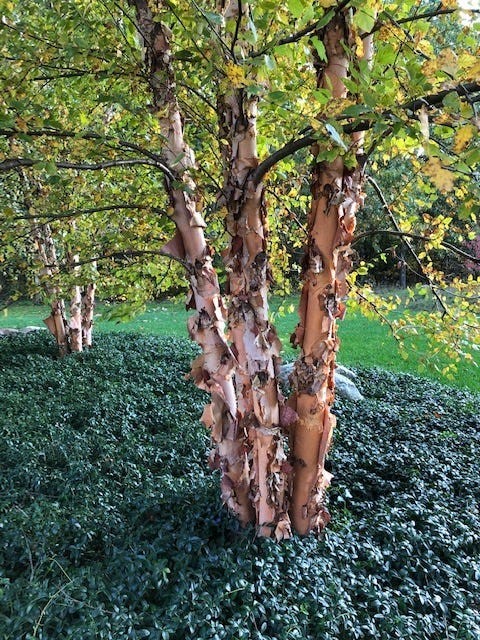
With a graceful form and attractive bark, river birch is a deciduous tree frequently used in ornamental plantings. It is a fast-growing shade trees, valued for the colorful exfoliatingbark. River birch is one of the most culturally adaptable and heat tolerant of the birches and a good substitute for white birches. It is also reputed to be more resistant to the birch borer that plagues the white birch. Another appealing feature is the shimmering contrast when theleaves flutter in the wind, with lower leaf surfaces a different color than the upper surface. A medium to tall tree, growing 60-80 feet at maturity and about 40 wide. Trees typically live 50 -75 years. Although it naturally forms just a single trunk, it is frequently sold in multiple-trunked form with two to five trunks per tree.
Because it is a large tree, river birch makes a wonderful specimen planting for largerproperties. The canopy casts light dappled shade when young but provides medium shade when older. This species is a good choice for low spots and wet soils and should be planted in full sun. It does well on clay as that type of soil retains moisture well. It can tolerate dry summers once established.
“Heritage” is a popular, vigorous cultivar often used as alternatives to white barked birches in landscapes due to its lighter bark color. It has heavily exfoliating bark, with layers of cinnamon, salmon and brown bark peeling back in big sheets to reveal creamy white inner bark. It looks best planted in multi-stemmed clumps.
This is just a smattering of what is available. Why not spend a cold day searching the internet trees with interesting bark and see what pops up.
Do you ever wonder what’s going on in the garden when temperatures drop below freezing? How do perennials, shrubs and trees withstand the cold and dehydration of winter? As we prepare for the colder season above ground, a process of adapting to this change is also going on below ground.
What is Garden Dormancy?
Dormancy is a period of reduced growth in plants, allowing them to survive intense conditions such as cold temperatures or drought. During dormancy:
Trees and shrubs shed their leaves, reducing water loss and protecting against freezing temperatures.
Perennials retreat underground, focusing their energy on the roots rather than above-ground growth.
Dormancy is essentially a plant’s version of hibernation. Even though the plant may appear lifeless, it’s very much alive, just in a resting state.
Why Do Plants Go Dormant?
Survival Mechanism: Dormancy helps plants endure harsh conditions, preventing them from growing in unseasonal warm spells only to be killed by a subsequent freeze.
Rest and Rejuvenation: It allows plants to rest, develop stronger root systems and trunks, and accumulate the energy needed for vigorous growth in the spring.
Timing and Environmental Cues: Plants respond to environmental cues like shorter day lengths, decreasing temperatures, and reduced light to signal the onset of autumn and the need to prepare for dormancy.
The Gardener’s Role During Dormancy
Understanding the Cycle: Gardeners learn to recognize the signs of dormancy and understand its importance for plant health and the overall garden ecosystem.
Winter Protection: Proper care during dormancy, such as using mulch or wrapping to protect against frost, helps safeguard plants from potential damage.
Be patient: In spring, don’t panic if some perennials take longer to re-emerge. Late risers like perennial hibiscus, Rose of Sharon and some ornamental grasses may take several weeks longer than others to show signs of growth.
Rest and Relaxation: Just like the plants in their gardens need rest, so too does the gardener. The slower seasons of fall and winter allow us to take stock of our gardens — what worked, what didn’t work, what needs to change — so that we approach next spring and summer rejuvenated!
November can be a odd and awkward time for gardeners. The blooms of summer are long gone, and even the hardiest plants are starting to fade. As we temporarily pack up our tools for winter, many of us go through something like the five stages of grief—only with more dirt under our fingernails than we usually have when grieving.
1. Denial It starts with pretending the frost and snow aren’t really that bad. You convince yourself that a touch of frost won’t actually kill your tomatoes and that they’ll bounce back by noon when they get a bit warmer. Spoiler: They won’t.
2. Anger Then comes the frustration. Why did you forget to cover the basil? Why didn’t the weather app warn you about that early freeze? You glare at the sky, muttering about how unfair it all is, and plan to move south at the earliest opportunity.
3. Bargaining You start making deals with nature: “If I bring the pots inside, maybe they’ll survive.” You shuffle plants indoors, rearranging windowsills in a desperate act of hope with space in the south window at a serious premium. You conveniently forget that most plants won’t actually survive inside of our dry as a desert homes—but you’ve gotta try, right?
4. Mulching Reality sets in, and you finally take action. You clean up the garden beds (leaving flower stalks for our nesting insects, of course), spread mulch, finally finish planting those tulip bulbs, and then tuck everything in for winter. The tools have been oiled and the mushy hosta leaves are in the composter, just in time for the fluffy stuff to start falling. It’s a quiet, grounding ritual—part farewell, part promise to return but mostly it’s acceptance of our fate as Canadians in a four season climate.
5. Hibernation At last, peace. You sip tea by the window, dream over seed catalogs, and plan next year’s garden. November reminds us that rest is part of the growing cycle too—and even gardeners need a little dormancy.
Last year I grew salad greens and herbs in my basement to supplement our supply of fresh food throughout the winter while I was missing my veggie garden. It was a rewarding (and tasty) experience but at the end of the season I felt I didn’t get enough food to be worth the time and effort required to grow those greens inside my house (on a budget, with limited space, and no sunny windows available).
Growing indoor greens, early last winter
This year I tried something different. I purchased some sprouting seeds and am trying to supplement my greens in smaller quantities but with a more consistent output and lots of bang for my buck in terms of nutrition. I am pleasantly surprised by how easy the process is and how little of my brain space (and time) it is requiring so far.
What are Sprouts & Microgreens?
Sprouts – A germinated seed, about 3-5 days old, with a long pale root and the beginnings of their first leaves (cotyledons) emerging. It is a baby plant that has not started photosynthesizing yet and is only utilizing the energy stored in the seed for its growth so far. You eat the entire thing, including the seed and root. It is mild in taste with a high water content but the nutrients from the seed have been unlocked.
Radish sprouts
Microgreens – A sprouted seed, about 7-14 days old, with cotyledons and its first true leaves emerging. The leaves have turned green, the plant is photosynthesizing and beginning to draw nutrients from its growing medium. When ready, you cut them at the bottom of the stem and eat the top. It has a high nutritional density and begins to develop its own unique flavour at this point. Allowing the plant to grow past this stage will turn it into a ‘baby green’ if space, moisture and nutrition allow.
Sunflower microgreens, freshly harvested
How do you grow them?
Here are some supplies you can use to get started:
You can germinate a seed into sprouts in any container that can hold moisture and provide drainage to the seeds. A mason jar or ‘sprouter’ can be used.
Sprouting lids – a mason-jar compatible lid that allows for easy addition and drainage of water when inverted and minimal loss of seeds. You could also use fabric, cheesecloth or some type of mesh.
Jar & Sprouting Lid.
Sprouting trays – Perforated trays with a dish underneath and a lid to hold in moisture. These trays can be used with the seeds directly in them for sprouts or with a small layer of soil or growing medium for microgreens. You could also use a recycled berry container with a tray or plate underneath.
Left: Tray for microgreens or sprouts Right: Growing microgreens in a berry container
Seeds – There is a wide variety available. Alfalfa, sunflowers, brassicas, peas and beans are some of the most common. Radish, beets, and herbs can also be used. You could also buy regular seed packets but sprouting seeds are sold with more in each bag, more suitable for sprouting quantities.
Sprouting seed packets
Most sprouting seed packets will include simple instructions. They usually direct you to cover the seeds with water and soak them (about 1-2 tbsp per litre mason jar) for 6-12 hours, then drain them and proceed to rinse and drain them twice per day until the sprouts are ready (3-5 days).
Left: Getting started with simple directions on the packet. Right: Draining the water from the seeds after they have been soaked. The jar will stay inverted like this until the next time I need to rinse and drain the seeds.
Alfalfa sprouts, ready to eat (approx. day 5). 1 tbsp of seeds filled the 1L jar with sprouts by the time they were ready. In this picture, I have already eaten some.
Microgreens are grown more like baby plants grown in a tray with soil or other growing medium underneath. The seeds are usually soaked in water first, then spread on top of a thin layer of soil and sprayed with water. They are then covered to keep it dark and moist around the seeds until they germinate, uncovered and then ideally bottom watered as needed until they are ready (7-14 days). A grow light or sunny window is required once they germinate.
Microgreens under grow light. In this case I am just sprouting them on a piece of unbleached paper, to keep it simple, tidy and easy to remove and compost once I’m done eating from it. You can also use soil or other growing mediums like coconut coir, cotton or hemp mats, etc. The more nutrients in the medium, the further you can mature your greens.
NUTRITION – They are known to be an excellent source of many vitamins and minerals but are also beginning to be known for their ability to improve digestion and gut health (Wright, 2022). Not only that, but they are also high in phytochemicals and antioxidants, proving themselves to be able to prevent and/or improve conditions such as Type 2 diabetes, cancer, heart disease, anemia, Alzheimer’s, and macular degeneration (Cleveland Clinic, 2023).
FRESH, YEAR-ROUND – Since you don’t need a lot of space for this, it is easy to grow these year-round.
INEXPENSIVE – Jars – $1.50 ea. Sprouting Lids – $4 ea, Seeds – $4/ bag (price varies based on type of seed)
QUICK & REWARDING – The time to harvest is so quick, which makes the experience of eating them just so rewarding. They are also very versatile. You can use them on sandwiches, in salads, as a soup garnish, or however you like! I even put them on my eggs in the morning.
Sprouts with breakfast!
Here is a list of Canadian companies that sell sprouting seeds and supplies:
Last April, I wrote an article entitled “How do my outdoor plants survive the winter?” Although not as popular a subject topic, a quick dip into the world of all things creepy crawly when the temperatures plummet may be of similar interest.
When winter hits our region, we head indoors, but what about insects? These creatures have incredible ways of making it through the cold winter months. So much for my favourite October joke: “What’s the best thing about October? The mosquitoes are dead.” True, but also not for long.
Some insects, like ladybugs and cluster flies, find shelter and enter a hibernation-like state called diapause. They slow their bodies down to a near standstill, using very little energy while tucked away in cracks, under leaves, or even in homes. Those sneaky lady beetles seem to be able to find a way into houses too!
Other insects, like woolly bear caterpillars, use natural antifreeze. Their bodies produce special chemicals called cryoprotectants, which prevent their cells from freezing. This allows them to survive temperatures well below zero.
Some insects, like mosquitoes, leave behind their eggs, which are tough enough to endure the cold. Come spring, these eggs hatch, and a new generation begins. Sigh. Similarly, some butterflies, like the Mourning Cloak, overwinter as adults in tree bark or woodpiles, waking up early in the spring.
For honeybees, survival is a team effort. They cluster together in their hives, shivering their bodies to create heat and keep the colony warm.
And then there are insects like crickets, which die off in the fall, leaving behind their eggs to carry on their legacy.
Winter may seem quiet, but beneath the snow, insects are surviving in remarkable ways. Whether through hibernation, antifreeze, or teamwork, our local insects prove how tough and adaptable nature can be—even in the coldest months. For some, like pollinators, that’s great news. For others, like the red lily beetle, the Japanese beetle, and aphids, we simply have to grin and bear it.
It’s the darkest time of the year, daylight is at its lowest, and most gardening has ended for the season. That doesn’t mean, however, that there is nothing in the garden to be enjoyed. Garden design and planting choices should take into account the many months when the garden is still and inactive. It’s during this time when, despite the lack of light and active growth, the garden is revealed. It is stripped bare of colour and the exuberance of growth is set aside. With the leaves gone and many small plants succumbing to frost, the garden reveals itself openly and honestly. It’s odd, but in the dark days of winter there is more light in the garden. Unencumbered by layers of leaves, loud colours, or scrambling growth, the garden becomes airy and lets us see its bones and form. There is a lot to consider and enjoy when the garden, no matter how big or how small, is revealed.
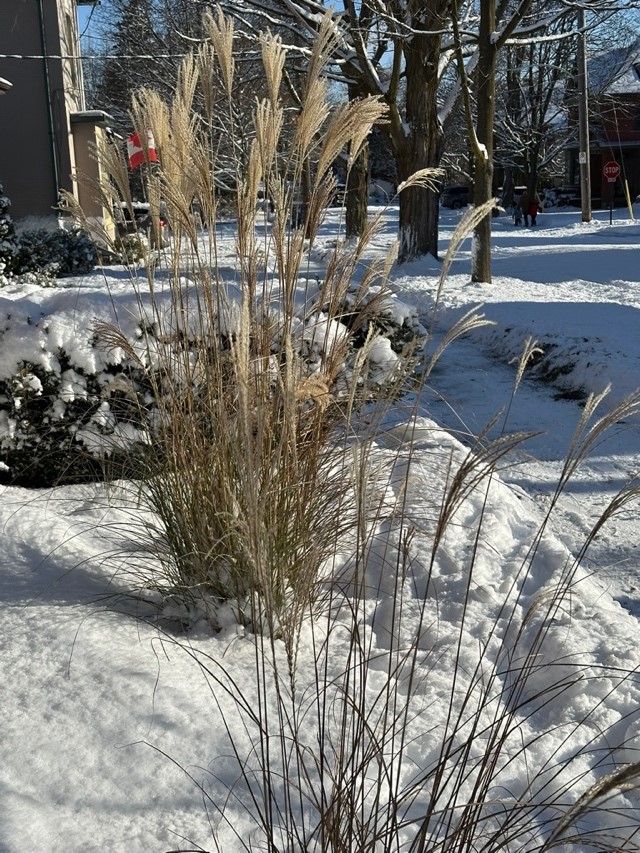
The low slanting light of late autumn and winter is an important piece of the beauty of the garden. Glancing out my bedroom window first thing every morning, I’m drawn to the morning light shining behind the swollen, grey buds of the magnolia tree next to the driveway. The buds are soft and fluffy, vulnerable yet so full of promise. In a nearby garden, there are a few large clumps of Karl Foerster grass (Calamagrostis x acutiflora) that sway and drift with the slightest breeze. Their slender stalks are a soft gentle brown, somehow able to withstand strong winds and pelting rain. Fall blooming grasses are a particular treat in fall and early winter, the slanting light is illuminated through the fluffy plumes making a beautiful statement. Hameln (Pennisetum Alopecuroides ‘Hameln’) is a favourite but there are many to choose from including some special native ones such as Side -oats Grama (Bouteloua curtipendula) and Prairie Dropseed (Sporobolus heterolepis).
Another subtle feature of winter light is the shadow effect. The gentle lengthened shadows created by tree structure, moving grasses, seed heads, or conifer form merit consideration when choosing plants and placement. They are certainly worth more than a glance on a spectacular bright winter day.
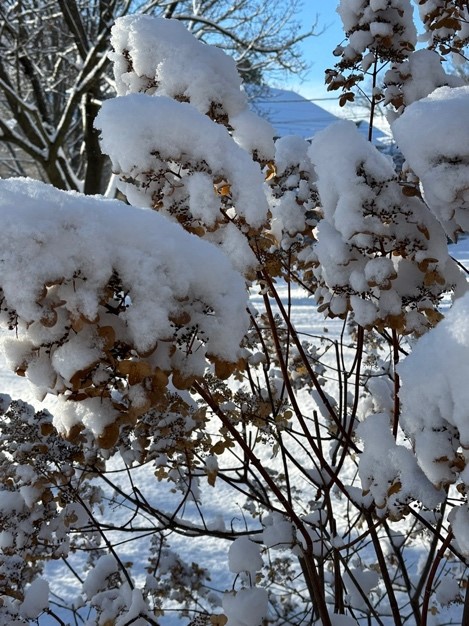
The dried flower heads of ever popular hydrangeas are a common winter garden treat especially when topped with a light dusting of early snow. Summersweet (Clethra alnifolia), a small summer flowering shrub, also retains dried flower heads through fall and winter. Other shrubs offer interest because of bark colour and texture (red twig dogwood, cornus sericea) or growth habit. Staghorn Sumac doesn’t take centre stage in the summer, but offers spectacular colour in fall. In winter, its red fruits, antler-like branches, and graceful form make it a show-stopper. Another shrub favourite in my fall and winter garden is Seven-Son Flower (Heptacodium miconiodes). It is an all-around wonderful, unique shrub with added appeal for its beautiful peeling bark in winter. Other shrubs that hold particular appeal in the winter are Witch Hazel (Hamamelis virginiana) and Corkscrew Willow (Salix babylonida).
Limelight hydrangea in the snow
Summersweet in the snow
Of course, conifers are the bones of any garden in winter. With different needle textures and lengths, and different shapes and forms, they provide obvious interest to every garden. When everything else is grey and brown, the rich textured green of a conifer stands out and when the snow comes along their interest increases. It’s important to have a variety of shapes and forms: cylindrical, mounding, conical, and weeping. In a small urban garden such as mine, I’ve found dwarf varieties and columnar species. One of my favourites is a weeping white pine (Pinus strobus ‘Pendula’), which is supported and pruned to fit a small spot. It’s a lovely unique specimen tree with gentle movement, at certain times of the day its pleasure is doubled when the sun throws it shadow on the nearby shed.
Each year, I marvel when the colour returns to the garden in the form of spring bulbs and each year I make a plan to add more! The beds are full of narcissus so much so that I have started planting in spots in my front fields. However, this fall I am aiming to do a Stinzenplanten (a Dutch term also known as a stinze lawn or stinze). A stinzenplanten is a naturalized and wild bulb garden that lives underground and emerges in the earliest spring. Why am I writing about a fall project now?? Some of the best fall bulb prices by retailers such as Veseys and Brecks take place in May when everyone is busy planting their summer gardens.
Because stinzes are planted using many of the “minor” bulbs, they begin to bloom very early thereby extending your season. Generally, they (and their foliage) are gone by the time you need to mow the lawn. (This is important since bulbs recharge for the following year by absorbing sunrays through their green foliage. Once the foliage has yellowed it is safe to mow). This does of course depend on the bulbs you choose to use. In my own experience daffodils do not make great candidates for this type of endeavour. Their long, heavy foliage does not yellow until mid June. That is a long time to go without mowing!!
In our zone by picking bulbs from the very early spring, early spring and midspring groups you should have 6 plus weeks of solid bloom.
Very Early Spring Bulbs include Snowdrops (Galanthus woronowwii) the first to appear, often from under the snow; Winter aconite (Eranthis cilicica) a sunny yellow hardy bulb.
Early Spring varieties include Snow glories (Chiondoxa forbesii) whose star shape flowers comes in a variety of blue colours, Crocus (Crocus vernus and species crocus) is a striking bloom that is available in many different colours.
Early to Mid Spring bulbs to consider are Blue Shades Anemone (Anenome blanda) with its daisy like appearance which look a little less formal than the other bulbs; Snakes Head Fritillary (Fritillaria meleagris) is an unusual bloom with its checkerboard appearance; Grape Hyacinth (Muscari) known for its unique, grape like clusters of flowers in a variety of colours.
Selecting the best spot for your display
For most of us, underplanting the entire lawn would not be feasible so why not choose a spot that will give the best show for your viewing pleasure. Remembering that the stinze will start in winter when we are still very housebound. Pick a well-drained area as you would for any bulb. Not only do you avoid the bulbs rotting but this will encourage spread and naturalization of your planting. Some folks choose areas under and around deciduous trees.
For me, I am going to borrow an idea from @mettebfauerskov and lay my stinze out following a random pattern of the garden hose on a section of lawn that is between the laneway and an island bed. It will be easily seen from the house and driving in and out.
Bulbs should be planted about 3 inches deep and can be planted as close as 3 inches. Many people use their bulb agars to drill the holes and then throw 2 or 3 bulbs into each hole and cover with dirt. I will probably just use my hori hori knife to dig. Most of these bulbs are not bothered by wildlife. Crocus is the exception but, in my experience, when you are planting large numbers, the squirrels never get them all (I overplant this bulb to account for some loss). As well, if you put your planting off until the end of October the feeding frenzy has begun to subside and there is less pressure on your bulbs.











 The Peterborough & Area Master Gardeners