Category Archives: Perennials

Patience in the Garden

By Chris Freeburn, Master Gardener

When spring finally arrives, gardeners are outside daily looking for signs of life in our flower beds. Snowdrops, crocus, tulips and daffodils along with many other spring bulbs give us that pop of colour we have missed. Hellebores, primula, magnolia, Iris reticulata, lungwort are all beginning to bloom. Spring perennials like ground phlox, poppies, pasque flowers, daylilies are showing their green shoots and will soon be flowering. Bleeding Hearts, trilliums, lupins and salvia are all growing in leaps and bounds. 
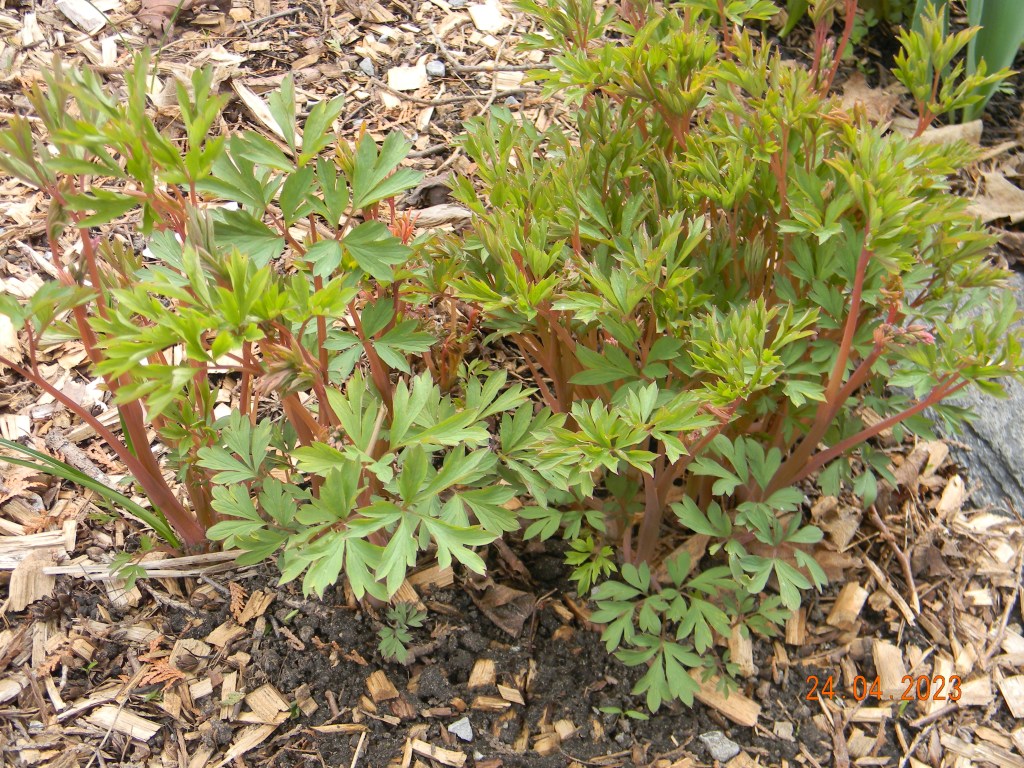
Bleeding heart is well on its way

This past April, we experienced a week of abnormally hot weather that encouraged plants like peonies to jump up. Note to self – get peony rings up. The return to “normal” temperatures is better for all the plants. And it reminds us that spring is an unpredictable season and we can’t rush it.

As gardeners, we need to practice a bit of patience. We need to leave our gardens to thaw, give the soil time to warm up and give the overwintering insects time to awaken from the garden litter we are so excited to “clear up”. We also need to be aware that not all perennials show life at the same time.

Hostas show their poking dark shoots just as we are getting into the flower beds, so we need to watch when stepping around or moving mulch in those gardens. Perennial Hibiscus are probably one of the the later showing perennials that will look dead until mid June. Be patient! When Hibiscus decide to begin growing, they grow quickly, inches in a day. Lilacs are making buds and maples are leafing out, but hydrangeas are still looking asleep. Although early flowering clematis like Blue Bird and other group 1 types will be popping up, later bloomers with still be sleeping. Don’t despair. Be patient!

Hibiscus is very late to show growth

Grasses can also be deceptive. Cool season grasses begin to grow in early spring and have reached their best by mid summer. Karl Foerster, which is a Calamagrostis or feather reed grass is a well known cool season, zone 5 grass that grows 5′- 6′ tall. It likes sun, will take it wet or dry and tolerates poor soil. Overdam and Avalanche are two other feather reed grasses that will be showing green now.
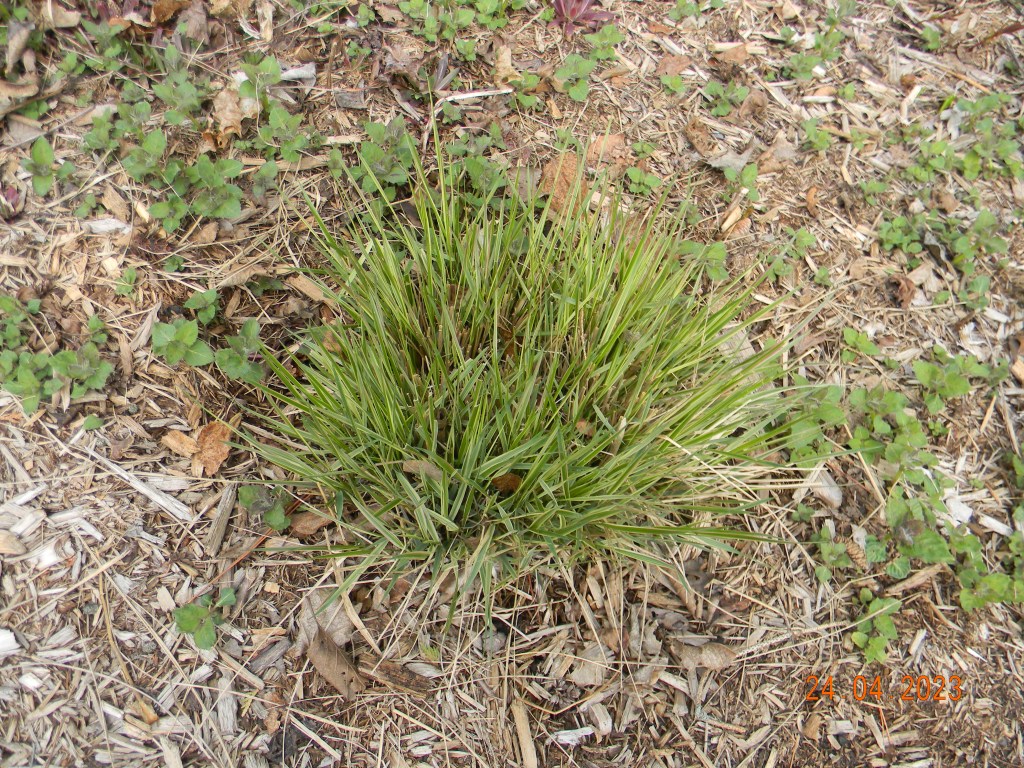
Cool season grass

Warm season grasses do not come up until June and are at their best in fall. They will look dead until the weather warms up. Patience! Because they will not show green until later in the spring, you can plant warm season grasses behind other earlier growing perennials to hide their brown bottoms.
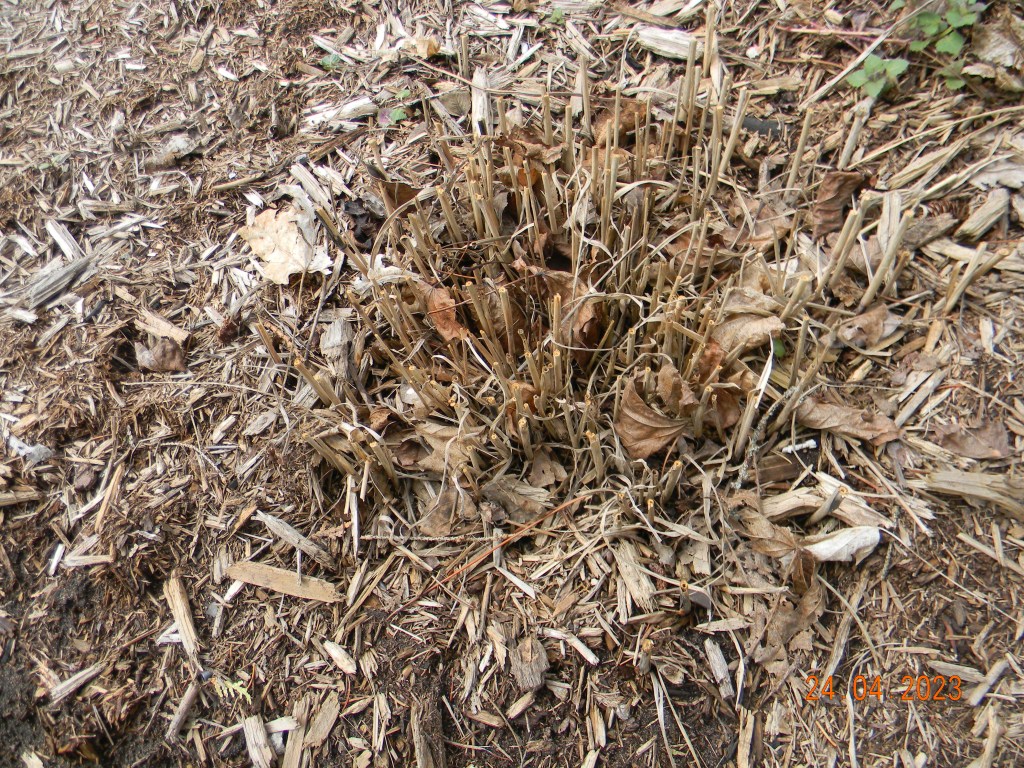
Warm season grass

Miscanthus grasses are warm season types and are available in different heights from 3′ to 8′ tall. Miscanthus sinensis & M. Sacchariflorus are classed as invasives, spreading by rhizomes and seeds. Other warm season grasses include Japanese Forest Grass or Hakonechloa, Japanese Blood Grass and Sedges. Panicum or switch grass is a warm season grass with many varieties native to North America. ‘Northwind’ is the most commonly know variety and it is drought resistant, will grow in any type soil and likes full sun.

Native grasses like Little Bluestem  (Schizachyrium scoparium), Big Blue Stem (Andropogon gerardii)  and Indian Grass (Sorghastrum nutans) are warm season grasses. These are beautiful additions to your garden, but will not green up until the weather warms.

May is the most active month in the garden. Sometimes we forget to enjoy the moments, slow down, breath deeply and have patience. New wonders will be happening for many days ahead. Enjoy them!

https://landscapeontario.com/perennials-in-bloom-month-by-month

https://www.invadingspecies.com/

The Matrix

By Lois Scott, Master Gardener

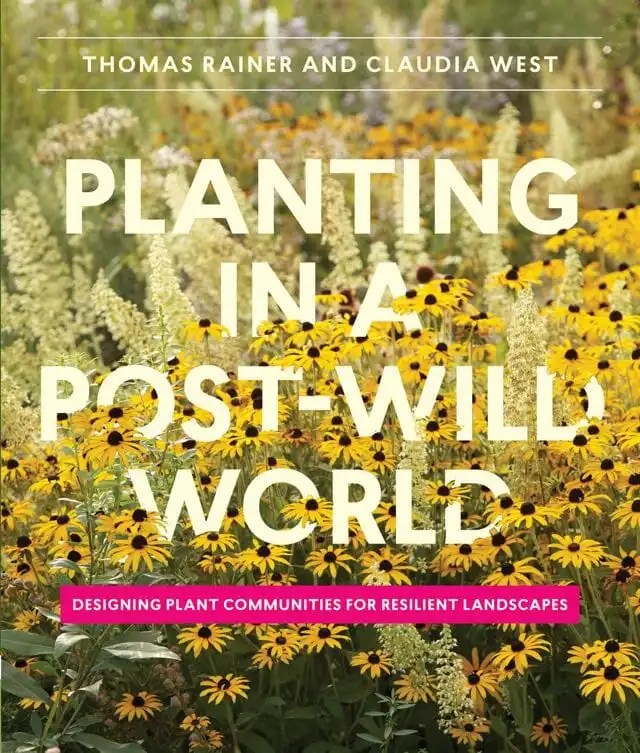
Planting in a Post-Wild World by Thomas Rainer and Claudia West, is a book described by Doug Tallamy as a how-to guide to sustainable landscaping.  The prescribed way to create this sustainable landscape is referred to as matrix planting, wildscaping or new American style.  Check out this link for a very good description of this type of planting.   https://www.hortmag.com/gardens/matrix-planting-garden-design

The book spends a lot of time describing ‘landscape archetypes’, design processes and site preparation etc., with the finished planting being a matrix or array of plants that thrive in related habitats with root systems that don’t compete.  Planting is done in layers using structural/framework plants (10-15%), seasonal theme plants (25-40%), and ground cover plants (50%).  Plant spacing is based on the mature width of plants and their growing behaviour.  This method usually requires a large number of plants so using ‘plugs’ is the most economical way of starting.  This style of garden does rely on some plants self-seeding to create a dense planting, so this may not be to everyone’s liking!

As an example, I have a stretch of garden along the sidewalk that I refer to as my ‘hell-strip’ and I have found few plants that have thrived there.  A boulevard tree that shaded part of this area was damaged last year and was taken down, so I can now use sun-loving plants that I have had success with in an adjacent area.  So, to translate that into what I might plant, I could use 25 Prairie Dropseed (Sporobolus heterolepsis) plugs as a ground cover plant, 15 Lance-leafed Tickseed (Coreopsis lanceolata) plugs as a seasonal theme plant and 9-10 Dense Blazing Star (Liatris spicata) plugs as a structural/framework plant.  Or maybe … ???  Isn’t that the fun part? 

The goal is to have a dense planting that will discourage weeds, be resilient, provide habitat, sequester carbon, reduce storm water run-off and to create a beautiful garden!

Divide to Multiply

by Marilyn Homewood, Master Gardener

Despite the lingering snow, the longer days and stronger sun tell us that spring is indeed here! With that we begin to think about all of the chores we wish to accomplish. Division of perennials is a common task. So why do we divide?

Division is a common means of vegetative propagation. It is an easy way to increase the number of plants you have available. Division is also required maintenance for some perennials in order to achieve maximum bloom year after year. Although a fairly simple process, there are a couple of considerations you must make.

Time of Year

Because successful division depends on the growth of new roots, the best times of the year to divide are spring and fall when the soil is warm, water is available and stressors are at a minimum.

Many perennials can also be divided during the summer months but high temperatures mean an increase in water loss. This leads to a stressed plant so extra care must be provided to ensure the plant remain well hydrated. Also, there are some ornamental grasses that only grow new roots in the spring. These plants should not be divided in the fall as they will not grow new roots that can take up water.

Method of Division

This will depend on the type of root and crown system the plant has. No matter the type of plant, keep in mind that each plant division must contain at least one bud or growing point and a few healthy roots. If you are unsure of the what you are dealing with, there is a link to a list from the University of Minnesota at the end of this blog.

Clumpers – These plants often have fibrous root systems sometimes with rhizomes but grow many smaller crowns at the base of the original each having its own root system. This often makes for easy separation with little tissue damage. Examples include ajuga, daylily and hosta.

Runners – These are plants that spread by covering the ground by shallow horizontal stems. They root along their nodes and send up new shoots making them easily dividable by separating the root ball. Examples include bee balm and goldenrod.

Tight, woody crowns – These plants are a little more challenging to divide as the buds are often tightly packed on a hardened crown. For best results the plant must be older when split to ensure that divisions with have growing points. Examples include baptisia and peony.

Thick rhizomes or tubers – Rhizomes are technically stems that grow underground. Divided sections must contain at least one growing eye. Examples in this group would be bearded iris and dahlia. These varieties should only be divided when dormant.

Tap rooted plants –These cannot rarely be divided unless multiple tap roots have developed and are better propagated by using root cuttings. Plants in this group includes oriental poppies.

Basic Steps for Division

  1. Dig out the plant. If not replanting immediately, protect from desiccation. Removing the plant from the ground can destroy tiny root hairs (responsible for water uptake). Protecting the plant means a faster recovery on the division is replanted. I often place the root ball in a plastic bag and place in a shaded area.
  2. Separate your plant into pieces using the most appropriate method. Make sure to take generous divisions of sufficient size to ensure growing points and healthy roots.
  3. Replant, digging hole wide enough. Roots like to grow out and down so give them enough space to spread out. Be sure that the soil has good contact with the root system by firming the soil then water the division in, slowly allowing the soil to further settle against the roots.

Resources

The Science Behind Plant Division

Divide and Conquer: How to Divide and Multiply Perennials

How and When to Divide Perennials

Table for Dividing Perennials

Winter Weeds

By Laura Gardner, Master Gardener

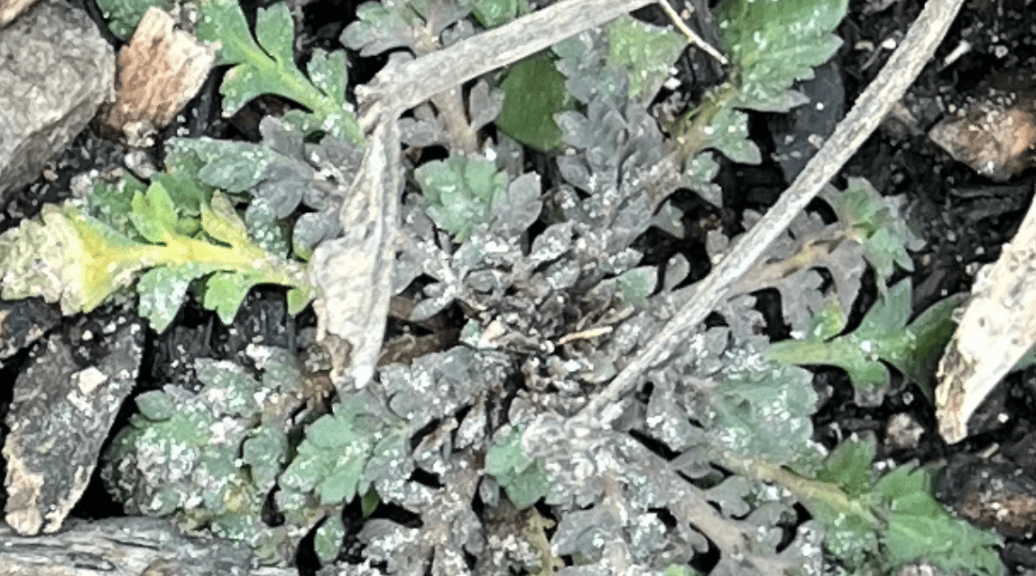
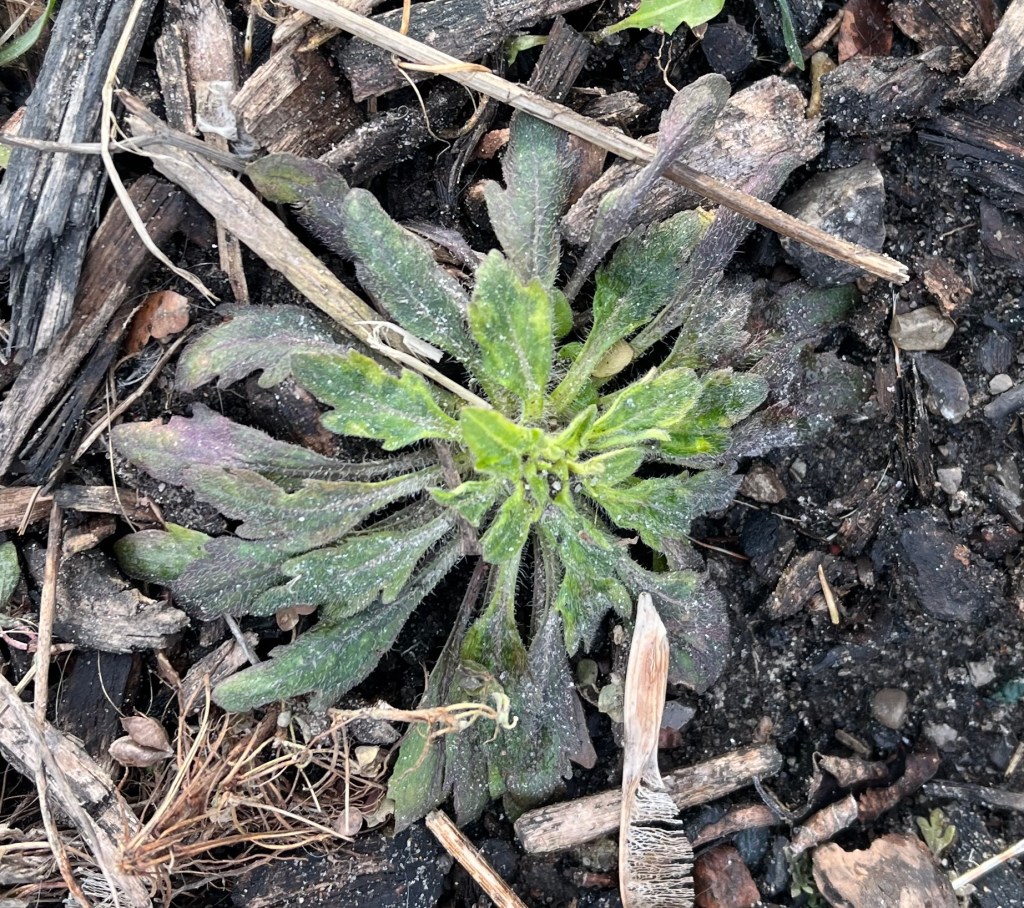
At this time of year there are two kinds of easily identifiable weeds: “winter annuals” and “biennials.” Biennials begin their lifecycle by germinating from seed in the first growing season. Winter annuals germinate from seed in the fall. They both form a vegetative basal rosette that lies in a suspended state over winter. The rosette protects what is known as the shoot apical meristem—stem cells of the plant that are responsible for the generation of shoots and leaves later in the spring. They will then grow more upright, flower, produce seeds, and then die, finishing their lifecycle. Some species may function as either a winter annual or a summer annual. Summer annuals germinate from seed in the spring and complete their life cycle that same year. One of the challenges of managing summer annuals is that they can reproduce more than once a year, potentially contributing to a large seed bank. Biennials generally take two years to complete their lifecycles. However, some so called biennial species may extend into subsequent growing seasons and be more like perennials if they have sufficient root energy stores and have not had the opportunity to flower and go to seed. This can happen if you do not remove at least the root crown of the plant when weeding.

In the Peterborough Public Library’s native plant garden, I took some photographs of some basal rosettes with the idea of identifying them later at home. Coincidentally, a copy of a book that I had on order for more than a year finally arrived: Weeds of the Northeast, 2nd Edition, by Joseph C. Neal et al. (Cornell University Press). In addition to the US Northeastern, Mid-Atlantic, and Upper Midwestern states, the book includes Southern Canada. In the 26 years since the first edition was published in 1997, more than 200 new species have been added. Many of these new species are invasive plants from the horticultural trade [e.g. Common Periwinkle (Vinca minor)]. It is strictly an identification guide and so if you are looking for weed management guidance, this type of information will need to be found elsewhere.

The book has a dichotomous key that is a bit different from others. It relies on identifying the plants through their vegetative parts such as leaf lobes, leaf arrangement, leaf margins, leaf hairs, etc., but not on their floral traits. It also does not lead you to an immediate single species identification, but rather enables you to compare your plant with several possible matches through their photos and descriptions. The photos are particularly valuable for identification purposes—showing plants in various stages of life—from seedling to maturity. The glossary is helpful for those that are unfamiliar with some of the botanical terms. This is a great resource for anyone to use to confirm the findings of a plant identification app.

Here are some of the weeds I found and identified using this guidebook:

Shepherd’s Purse (Capsella bursa-pastoris): A summer or winter annual.

Shepherd’s Purse (Capsella bursa-pastoris)

Field Pennycress (Thlaspi arvense): A Summer or Winter Annual

Field Pennycress (Thlaspi arvense)

Canada Horseweed (Erigeron canadensis): Summer or Winter Annual

Canada Horseweed (Erigeron canadensis)

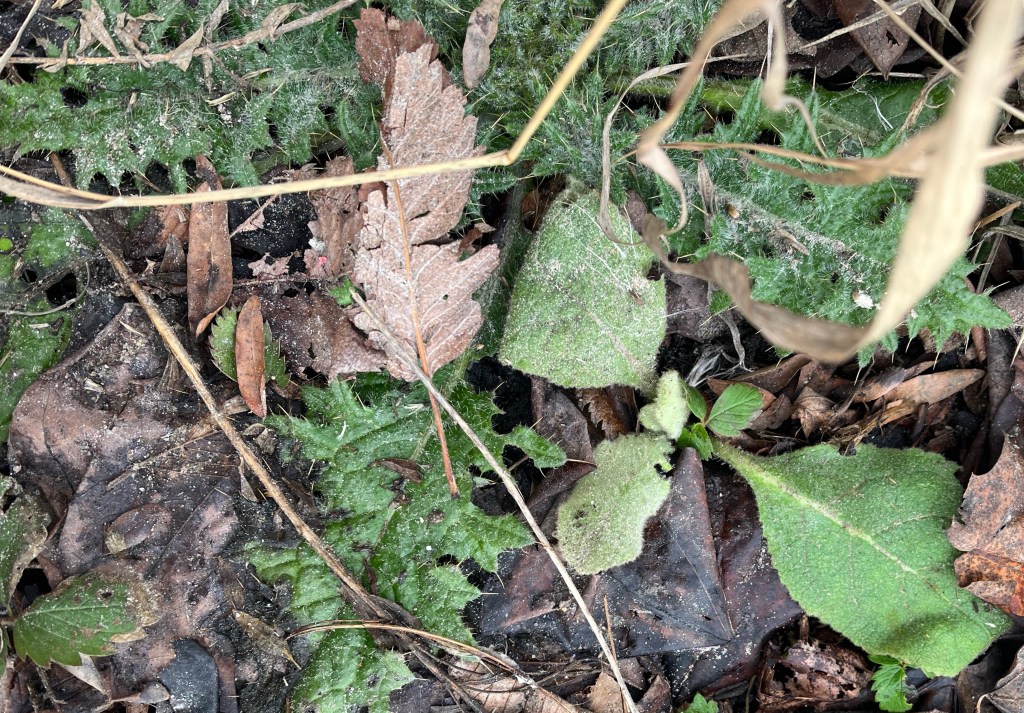
Bull Thistle (Cirsium vulgare) and Common Mullein (Verbascum thapsus): Biennials

Bull Thistle (Cirsium vulgare) and Common Mullein (Verbascum thapsus)

Seedy Saturdays and Sundays – What are They?

by Emma Murphy, Master Gardener

Prior to 1990, the word ‘seedy’ tended to be associated with shabby or run down areas or clothes, or a somewhat disreputable reputation.

Synonyms for Seedy. (2016). Retrieved 2023, February 24, from https://thesaurus.plus/synonyms/seedy

Ironically enough, some speculate that the term probably came from the appearance of flowers after they’ve shed their seeds, when they start to lose colour and eventually die.

However, that all changed in 1990, when the first Seedy Saturday was held at the VanDusen Botanical Garden in Vancouver, BC. At the time, the idea of conserving heritage seeds from garden plants or agricultural crops wasn’t really a thing, and it was hard to find heritage varieties of vegetables, fruits, flowers, and grains.

In  1988 Sharon Rempel wanted to find period-appropriate heritage vegetables, flowers and wheat for the 1880s heritage gardens she was creating at the Keremeos Grist Mill museum. As a pioneer in Canada’s organic and heritage seed movements, she organized the first Seedy Saturday event, and has kept the titles “Seedy Saturday” and “Seedy Sunday” dedicated to the public domain.

In Canada, these events have continued to be locally or regionally organized events, although the amazing organization Seeds of Diversity maintains a national presence. Almost all of these events occur in the late winter, with a few in the autumn.

Screen capture from Seeds of Diversity website http://www.seeds.ca

We totally get it. Canadian winters are long and cold and by February, gardeners are already looking forward to the springtime and planting. Seedy Saturdays/Sundays are non-profit, public events organized by individuals and community groups to bring together gardeners, seed companies, nurseries, gardening organizations, historic sites, and community groups so they can learn from one another, exchange ideas and seeds, and purchase seeds and plants in a social setting. Seeds of Diversity promotes these events on their website.

Many Master Gardener and Ontario Horticultural Association organizations are critical partners in these events – I love this poster from the London Middlesex Master Gardeners for this year’s event.

Every year more communities join the movement – according to Seeds of Diversity more than 170 events were held in 2019 across Canada. These events can be small or large, depending on the community. I love that they all have the same themes of encouraging use of open-pollinated and heritage seeds, enabling local seed exchanges, and educating the public about seed saving and environmentally-responsible gardening practices.

They’re a great opportunity to swap and exchange your seeds with others, get new varieties from other seed savers, meet seed companies in person, attend workshops/talks, and of course buy seeds!

In the Peterborough area, we are finally getting back to an in-person event. 2023’s Seedy Sunday will be held on Sunday March 12th from 11am to 3pm in a new location at the Peterborough Square Mall in downtown Peterborough (where the winter Farmers’ Market is being held). It’s a great venue, with lots of space (the pre-pandemic Seedy Sunday was held at the Emmanuel United Church and George St United Church).

Long time organizer Jillian Bishop (who runs her own UrbanTomato business and hosts seed saving workshops) says the event is “the perfect place to get inspired for spring. Come out to get all the knowledge, tools and resources needed to get growing this season.”

Jillian Bishop with her Urban Tomato sales stand.

This year’s Peterborough Seedy Sunday event includes:

  • An incredible diversity of vegetables, flowers, herb seeds available for sale
  • Community groups showcasing the great work they do locally
  • Informative hands-on workshops
  • A popular Seed Exchange Area where you can trade seeds with other gardeners

Get more information at:

Facebook: @SeedySundayPeterborough

Search for #PtboSeedySunday

PeterboroughSeedySunday

Jillian says the last few years have been challenging because of the pandemic.

“As many of you know, in 2020, two days before we were set to host our 15th annual event, we had to cancel as the world began to shut down. As disappointed as we were, we knew it was the right thing to do! Of course, no one could have predicted what happened in the weeks, months and years to come, particularly in the world of seeds and gardening.

All of a sudden seeds became a hot commodity, and seed vendors across the world saw unprecedented demand as people became more concerned about securing their food sources, and had more time at home to plan, plant and enjoy their gardens.”

Peterborough Seedy Sunday, like similar events, went virtual for a few years, but Jillian is very happy to be planning a return to in-person seed fun and spring mania for the 15th annual event, with 13 vendors selling seeds, compost supplies and more! Workshops will be focusing on hands-on skills sharing.

If you’d like to take part in the Seed Exchange, please bring your seeds divided into smaller envelopes (approx. 25 seeds) labeled with the name of the plant, year harvested, and any other information you would like to share! Once you have them all ready, you can bring them down to the Seed Exchange and swap them for other fun varieties you have yet to try in your garden!

Hope to see you in Peterborough, or join your local ‘seedy’ event!

Words of Wisdom from Jillian Bishop

Why I Save Seeds

“Saving seeds means a lot to me. It means a lot to the world. Each heirloom seed contains history and future. Past and present, the ability to adapt to unforeseen climate change and unique environments, to spread stories and knowledge through generations it contains the capacity for communities to grow their own food in sprawling fields, community gardens, abandoned lots and fire escape pots.

Those seeds are living beings. They want to grow. They needs stewards. Citizens willing to give them water, sun, soil and yes, cheesily enough, love.”

More links and information

Seed Companies in Canada -list of seed companies in Canada, as well as the vegetable and fruit seed they’ve sold in recent years.

Peterborough Seed Savers Collective – Great short film (2015) about seed saving work happening locally – follow local seeds being grown out by the emerging Seed Savers Collective, and being shared at an annual Seedy Sunday event.

Why is Biodiversity Important? – Learn why diversity of plants and animals is important.

Canadian Seed Security – The Bauta Family Initiative on Canadian Seed Security works with farmers, researchers, universities, and other organizations to develop resources that can help farmers and seed growers advance their knowledge on seed in Canada.

Seed Savers Exchange – Stewards America’s culturally diverse and endangered garden and food crop legacy for present and future generations. We educate and connect people through collecting, regenerating, and sharing heirloom seeds, plants, and stories.

The KISS Principle – Winter Sowing 101

By Emma Murphy, Master Gardener

“If it’s not easy, you’re doing it wrong” Trudi Davidoff

For the last few years I’ve been hearing people (especially those in the native plant field) raving about winter sowing. What’s that I asked? Simple, they said – a germination method where you put seeds in an enclosed container out in your garden in winter and let Mother Nature make you more plants.

Hmm, I thought, that sounds too easy. As someone who has struggled for year with starting plants from seeds (especially annuals, vegetables, or herbs) and lost many sad looking seedlings to damping off I was intrigued.

Now I know it really is straightforward (although it requires an Ontario twist – more later) – and I am all about using a KISS principle – Keep It Simple Stupid!  

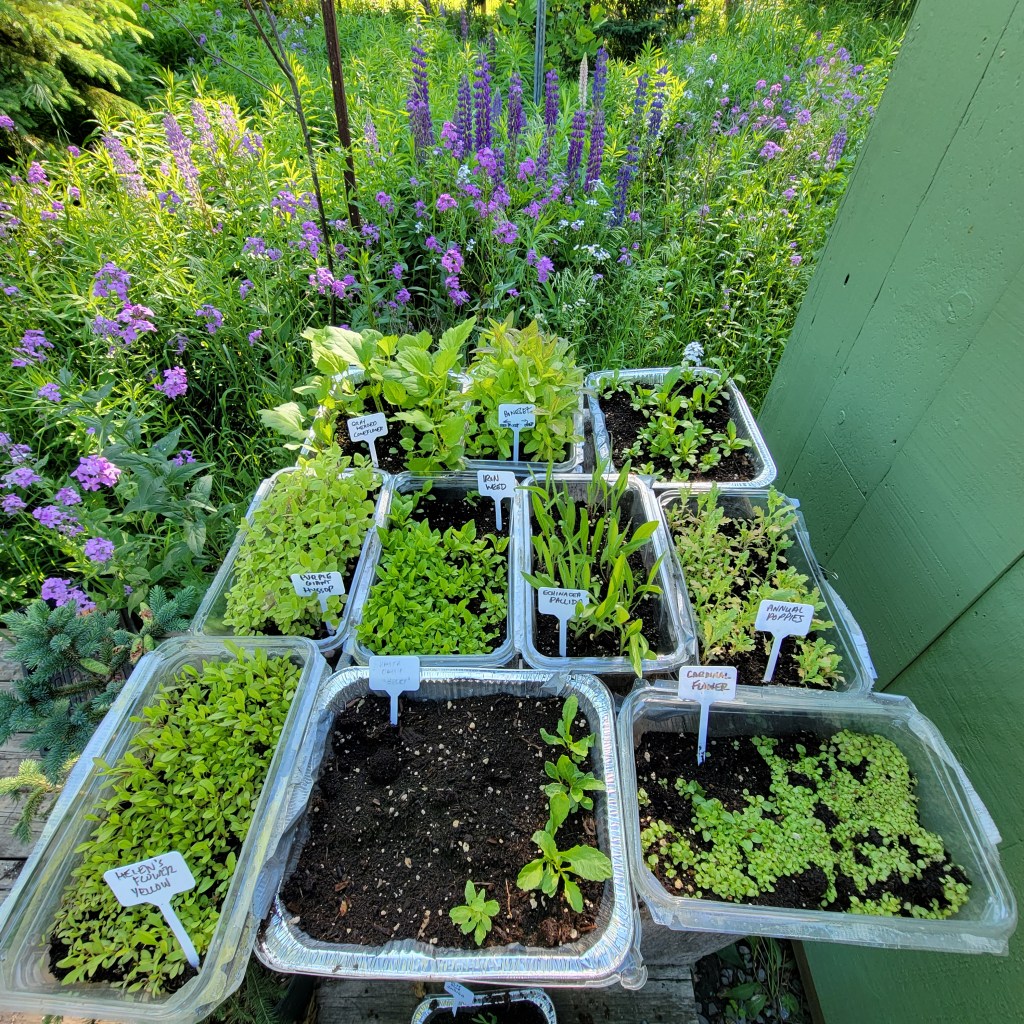
My plants – June 2022. As you can see not all successful. I love the Hunk O’ (or Chunk O’) transplanting method once they have grown (see FAQs)

Started in 2000 by Trudi Greissle Davidoff of New York in an essay, the Winter Sowing Method is a low cost (bonus!!!), temperate climate method of producing sturdy plants for your garden. There is no need to set up lights or have a space inside your house and best of all, no hardening off process. In 2006, the U.S. Department of Agriculture recognized the viability of the technique by adding the term to the National Agricultural Library Thesaurus.

The Basics

So how does it work? For winter sowing you use a recycled container (bonus!) to create a mini greenhouse that protects the seeds from animals, birds and other pests, as well as from our often variable spring weather, until they get big enough to transplant into your garden. This is one case when you actually want your seeds to be placed outdoors and exposed to the elements (including freezing temperatures, snow, and rain).

You can use any container that’s deep enough to hold sufficient potting mix and has a clear or translucent covering that is tall enough to allow the transplants to grow. It must have drainage holes in the bottom as well as ventilation holes in the top. You can use perennial or annual seeds – basically anything as long as it isn’t a tropical seed (for obvious reasons). Native seeds are particularly good because they need a period of cold stratification to germinate – why not take advantage of natural temperatures, rather than artificially refrigerating seeds that need this process?

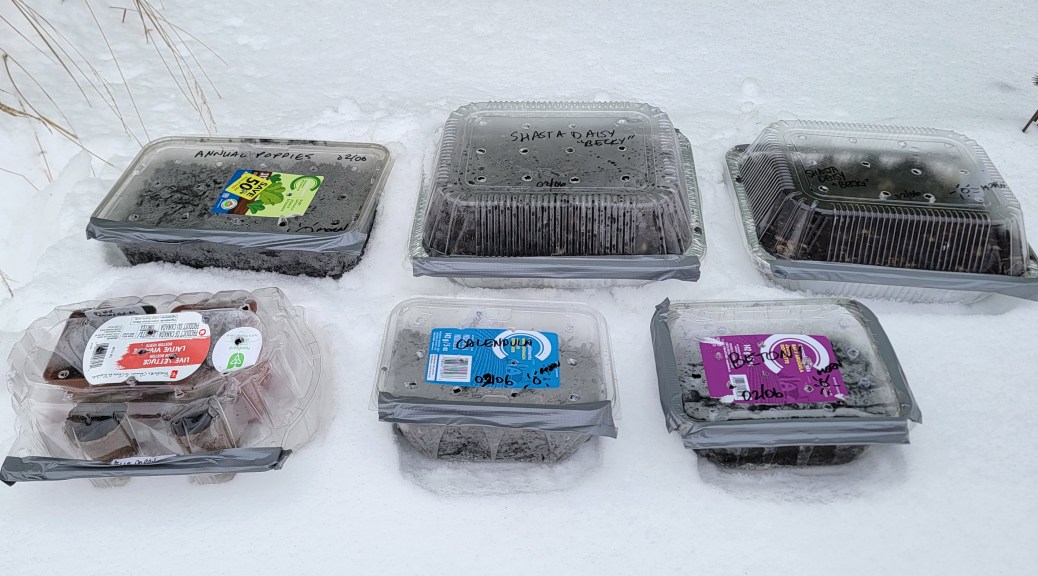
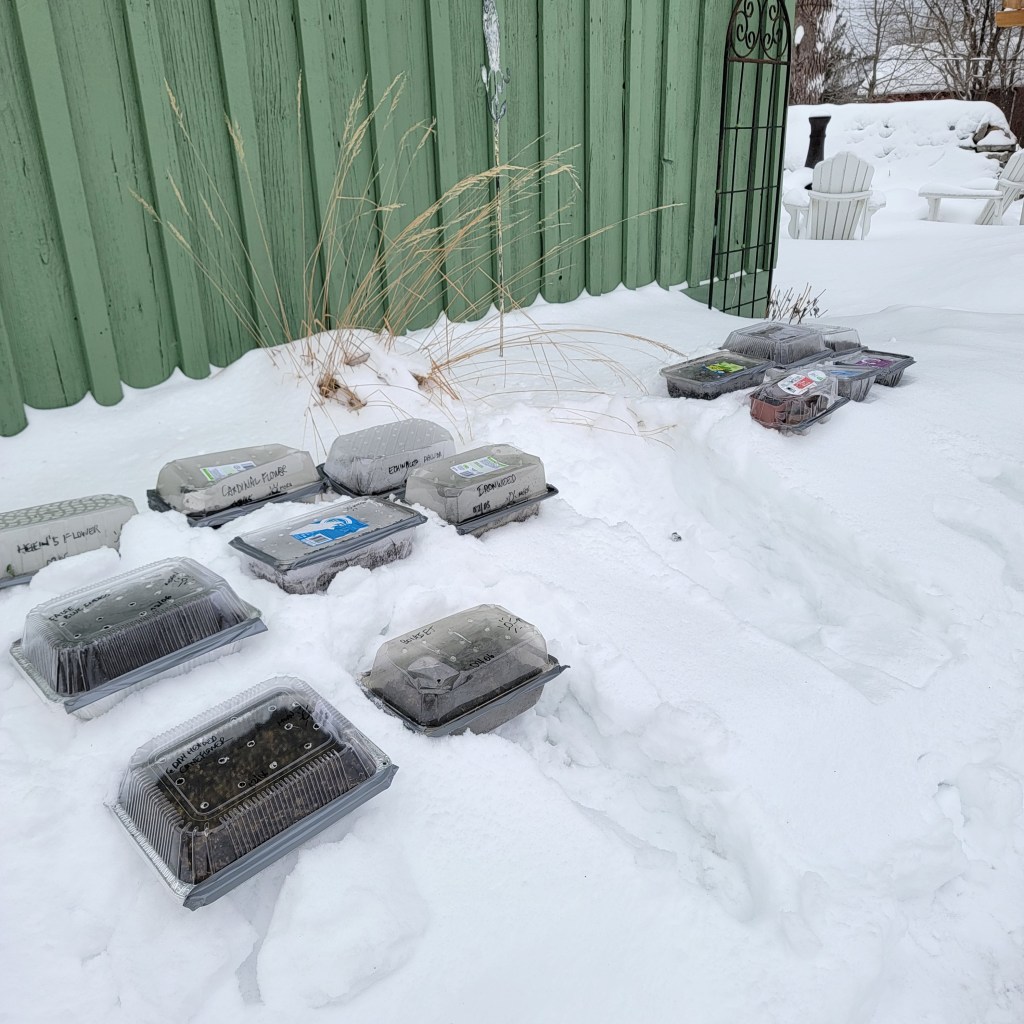
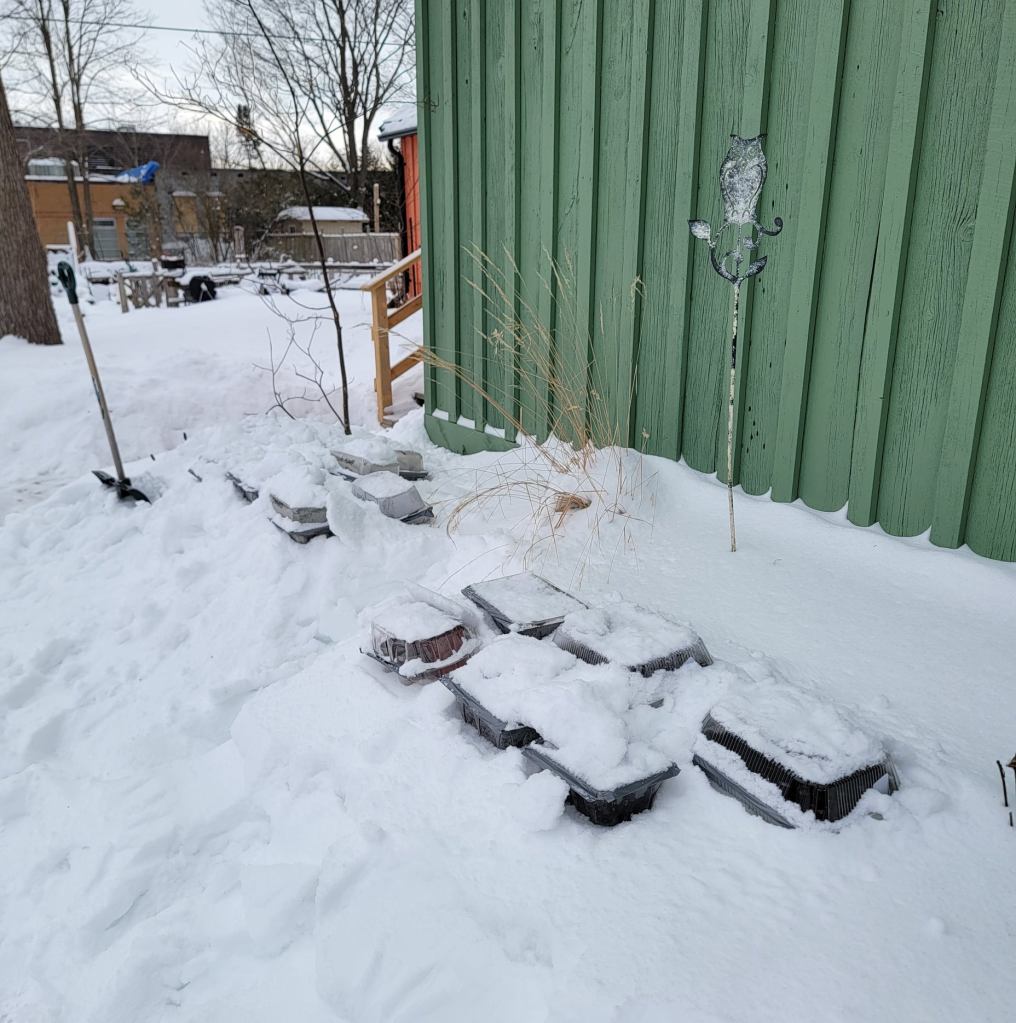
My winter sowing containers – January 2022

You fill the container with potting mix (at least 4-5 inches), sprinkle in your seeds, make sure the mix is moist, tape or secure the top of the container in some fashion, and put it outside. It’s good to check on the containers periodically so they don’t dry out or become waterlogged. Then you wait – it really is that simple.

Ok, I know there are questions – When do I start where I live? When do I plant x seeds? What soil do I use? Let me try and answer some of the basic ones and point you to other resources as well.

Trudi’s original website is no longer active but there is a very active Facebook page that follows her method – Winter Sowers – which I highly recommend for all the basic information and lively discussions amongst members. Trudi is an admin on the page.

Timing for Winter Sowing?

You can start winter sowing anytime after the Winter Solstice (December 21st). Perennials are generally done first, as they often require (or benefit from) cold stratification, then hardy annuals, then tender annuals. But the bottom line is that the seeds will germinate when the conditions are right for each kind of seed. That is the beauty of winter sowing! Many people winter sow their perennials in January but then wait until March to start their annuals. It really doesn’t matter – do what works for you!

They are ready to plant whenever the outside temperature has sufficiently warmed and they are the right size (2 to 3 inches or more importantly at least two sets of real leaves).

What Soil to use?

It’s recommended to use a sterile potting soil mix; avoid soil bags that say they are ‘weed free’ because they can contain chemicals mixed into soil to prevent any weed seeds in that bag from germinating. So they will also prevent the germination of seeds you sow in that same soil! If you live in an extremely dry environment, you might want to use soil that has moisture retentive crystals – otherwise this is not necessary (and can even be a problem in wet winter regions like the U.S. Pacific Northwest). Using fertilized soil for a sowing medium is a personal preference.

What Containers? The Ontario Twist

Most winter sowers tend to use milk jugs for their seeds, but these are not readily available in Ontario – we still love our milk bags! But the reality is that you can use any container for winter sowing as long as it can hold at least 3 inches (7.6 cm) of potting soil. I have seen various other things used –  juice bottles, clear pop bottles, blue and green bottles, aluminum pans, salad boxes, plastic containers, pretzel barrels, cheese curl containers, ice cream buckets, nut containers, and vinegar jugs. They must be translucent (some light passes through) or transparent (all light passes through). Opaque materials will not work. Personally I have used the large fresh spinach containers or aluminum roasting pans with clear lids.

You do need some sort of cover on your container, as it helps keep heavy rains under control (so they drip slowly into your containers), it keeps more moisture in so that you have a higher germination rate of your seeds, and it keeps weed seeds out of your containers.

How do I Label?

Labelling is really important unless you’re a genius at identifying new sprouts! I recommend putting in two labels – one on the underside of your tray and one on a popsicle stick in the container. Trudi recommends using duct tape and an industrial sharpie. Tip – place your labels before you fill the tray with soil and put them so they don’t impede the water drainage holes. There is lots of discussion on the best pens to use for labelling – everything from paint pens to garden markers, livestock markers, and china/grease markers.

This will be my second year winter sowing just north of Peterborough – I learned a lot in my first year, most importantly to transplant my seedlings before they get too big and dry out. I wrote a blog earlier this year about some of the cool native plants that I winter sowed last winter.

I hope this blog encourages you to consider winter sowing for your garden, particularly for native species to your area – seeds are so much cheaper than plants and then once they go to seed you are all set to grow even more plants, either for yourself or to share with friends!

Want More Information?

Some videos (and posts) you may want to check out – there are lots of winter sowing videos out there (sometimes with conflicting information) but these are two that are recommended by the online group

Dolly Foster – Hort4U Winter Sowing Presentation

All The Dirt on Winter Sowing

Planting Native Seeds (Facebook link)

WinterSowing 101 – Jug Prep (if you have milk jugs) (Facebook link)

Frequently Asked Questions (Facebook link)

A Garden for the Winter Solstice

by Lois Scott, Peterborough Master Gardener

The winter solstice, which this year happens December 21 at 4:47pm, marks the northern hemisphere’s furthest tilt from the sun and results in the shortest day and longest night of the year.  Many ancient cultures celebrated at this time to welcome the return of longer days and the promise of spring with plants playing a large symbolic role.  I certainly welcome the return of longer days and the pleasure in watching my garden wake up but for right now I enjoy the garden as it stands in winter.

I won’t be burning a yule log, which was traditionally Oak as it represented strength and endurance, but I enjoy the knowledge that the Oak trees in my environment are valuable contributors to supporting life in the garden.  Oaks (Quercus spp.) support over 500 species of lepidoptera (butterfly and moths) caterpillars which is more than any other native tree or plant. Read more

I don’t have the shiny, English holly (Ilex aquifolium which is invasive in the Pacific Northwest) in my garden. I do have a native holly, Ilex verticillata or Common Winterberry.  I have a male and female plant as you need both for pollination and the resulting flowers and red berries.  Although it is found naturally in swampy, acidic areas it is growing in my average garden soil.  It doesn’t have evergreen leaves but the persistent red berries are loved by over 40 species of birds!  Beautiful red berries and birds in the winter?  That is a win-win for me! 

A winter garden is certainly enhanced by including coniferous (evergreen) trees.  Coniferous trees such as pines, spruce and cedar are considered by many cultures to be a symbol of resilience and renewal.  For many of us we enjoy using the greenery to brighten our winter pots and interiors at this time of year.  In our winter gardens native evergreens provide not only beautiful contrast with the snow but provide important sources of shelter and food for local wildlife. Well placed coniferous trees can also provide windbreaks for our homes. Read more.

I hope that this winter solstice finds you happily enjoying your winter garden and appreciating its benefit to our environment.

Foraging for Winter Décor

By Marilyn Homewood, Master Gardener

As we enter the holiday season, the time has come to start collecting some of nature’s bounty to create seasonal trimmings for your home.  Much of this bounty is right under our noses and can be gathered easily. Foraging should begin at home on your own property.  It is surprising at what you can find in your own garden not just in terms of evergreens but also dried material such as seed pods.  For those items not immediately on your doorstep, look elsewhere where you have the permission (I visit friends for a few snips of things from their gardens) or forage on public spaces such as roadsides.  Remember to harvest sustainably taking only what you will use and take minimum amounts from each plant.  When harvesting boughs, only use trees larger than 6 feet and cut your boughs 2-4 feet from the tip of a branch and above a node to encourage regeneration. Make it look like you were never there.

Swag on potting shed

Cedar, white pine, white spruce and scotch pine can be found in abundance locally but don’t overlook the junipers (I like to use wild junipers), yews and euonymus.  Fir is really nice but more difficult to source in my area but it is available for purchase.

Boughs can be used as garlands or in planters.  The soil in the planter acts as a source of moisture until freeze up and also stabilizes the display.  Conifer branches can also be cut down to be used in table arrangements or in wreaths.  For arrangements kept indoors, fill the container with a mixture of potting mix and vermiculite and keep damp to prevent needle drop. 

Winter wreath

Woodies: Two species that are used extensively in this area are white birch and red osier dogwood.  Both provide colour contrast and add a structural element.  I keep my birch from year to year so only had to source once. Birch is available for purchase at many stores.  Dogwood is available anywhere it is moist so remember to be mindful of your footwear when foraging.

This arrangement lasted 6 weeks before the needles began to drop

What says the holidays better than pinecones?  They come in many different sizes and shapes depending on their species.  Closed cones can be opened by placing on a cookie sheet and baking at 250 degrees for 1 hour.  Cones can be used as accents in planters/arrangements/wreaths or by filling bowls full of them.  I have dipped the edges of my pinecones in white craft paint so they appear to be snowtipped.

Other additions to my gatherings include seedpods from Siberian iris and oriental poppy, seedheads from coneflowers and penstemon and dried allium heads.  Some types of perennial foliage such as that from Heuchera “Palace Purple” and the Penstemon “Dark Towers” is long lasting and adds interesting contrast to an arrangement. I also used some of my dried hydrangea in the planters.

Coneflower in planter helps to provide winter interest

Berries add a nice pop of colour and it is hard to beat those from the winterberry bush (Ontario’s native holly, Ilex verticulata) but these are not commonly found wild in this area due to our higher soil pH. Some of the local nurseries and florists have it available for sale however.  I do purchase some for my planters, for my wreath, I use the berries from the choke cherry bush (Prunus virginiana).  The bright red berries retain their colour throughout the entire winter and are not eaten by the birds (unlike the berries from the grey dogwood that were eaten after the first cold night).

When you’re done, if you still crave more variety, local nurseries have greens and other decorations available for sale.  For ideas on how to use what you collected, go no further than YouTube and Instagram.  One of my personal favorites are the Instagram live sessions done by Claus Dalby (Denmark’s version of Monty Don). They are posted to his IG page (clausdalby) as “Master Classes in Nordic Christmas”. It is a great source of inspiration and puts one in the holiday mood.

Not into foraging? Visit your local nursery. The offerings are astonishing!

Winter planter after a snowstorm

Exploring Two Special English Gardens (and the Gardeners behind them)

by Emma Murphy, Master Gardener

This week I had the pleasure of doing my first in-person presentation in almost three years to the Peterborough Horticultural Society on some very special south England gardens that my husband and I were able to visit in May 2022.

National Garden Scheme

I also talked about the amazing UK National Garden Scheme (NGS), where gardeners open their private gardens on specific days during the year to raise funds for primarily health charities. Since many people had never heard of the NGS, I thought I’d share with a wider audience with my blog for this month.

Screen capture from NGS website

The NGS gives access to over 3,500 exceptional private gardens in England, Wales, Northern Ireland and the Channel Islands, which in turn raise impressive amounts of money for nursing and health charities through admissions, teas and cake. And it’s not just about seeing beautiful gardens – there is a strong focus on physical and mental health benefits of gardens too. They also support other charities doing amazing work in gardens, and provide health and grant bursaries to help community gardening projects. You can read more here.

How I wish we could start something similar here in Canada (or Ontario, or Peterborough)! Imagine all the good that could happen just from sharing our gardens with people. I’ll have to think more about this.

So we managed to see two very special private gardens (that both open for the NGS as well) and get to meet the gardeners behind the garden, which is always my favourite thing to do when I visit to a garden. I want to understand the inspiration, the goals and objectives, and the plans for the future…because we all know our gardens are ever evolving places.

Waterperry Gardens

Waterperry Gardens (east of Oxford in Oxfordshire) has a long legacy and an amazing history as one of the few horticultural schools for women (from 1943 to 1971) – run by two outstanding women – Beatrix Havergal and her partner Avice Sanders.

Photo courtesy of Waterperry Gardens

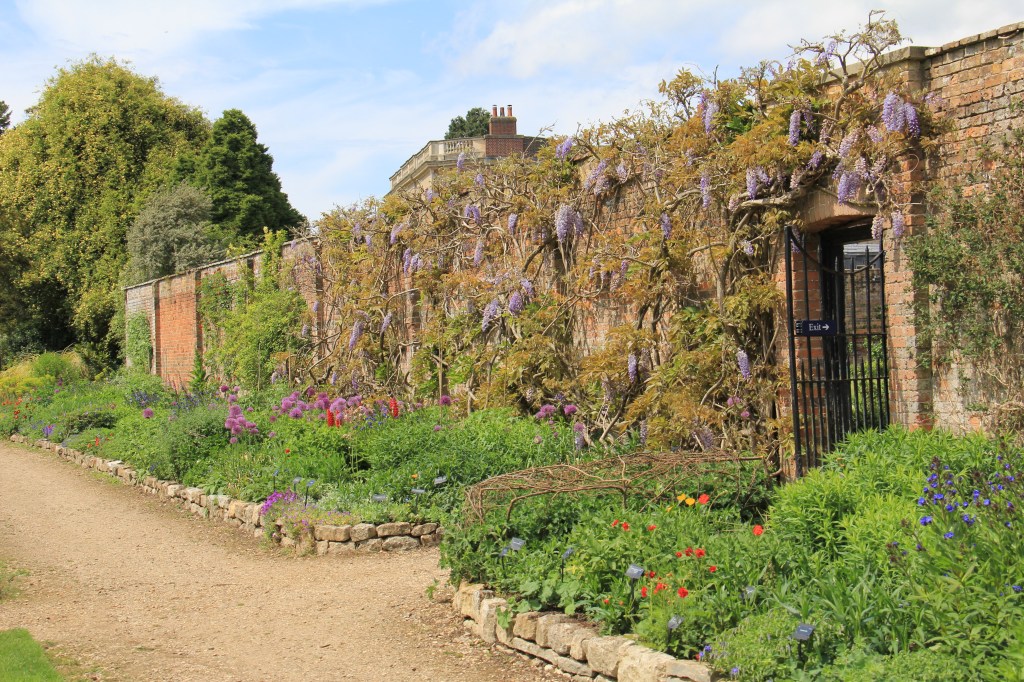
It’s an 80 acre estate with 8 acres of formal gardens, and is famous for the herbaceous border. This is what it looked like May 2022 when we visited, and how it looks now (fall 2022, photo courtesy of Head Gardener Pat Havers, who I was lucky enough to meet in person in probably the busiest time of the year!) I love this blog written about her in 2017.

You know you’re a hard core gardener when your Mum takes you to work in a wheelbarrow!

Photo courtesy of Pat Havers

Pat grew up in the gardens as her mother worked there, and has been working there herself for the past 20 years -10 years as Head Gardener.

“Living in the village it was every little girl’s dream to have this haven on their doorstep”, says Pat. “I would spend hours running through the beds and asking all the gardeners questions about their work. This soon caught Miss Havergal’s eye and I became the youngest student of hers at just the age of 4. My guess is perhaps she did this to keep me out of trouble.

Her passion for the gardens were evident in everything she said. I found out about her favourite quiet space (down by the River Thame), and the incredible legacy established by Havergal and Sanders, that continues to this day in terms of courses, plant identification tags, and garden design.

This garden is the Formal Garden/Silent Garden, where people are encouraged to turn off the phones and just enjoy the beautiful knot garden, sculptures, and seasonal changes.

St Timothee Garden

Just a bit further east near Maidenhead in Berkshire is St Timothee, a spectacular 2 acre private country garden planted for year-round interest with a variety of different colour-themed borders, each featuring a wide range of hardy perennials, shrubs and ornamental grasses.

The garden artist at work here is Sarah Pajwani, and I love her approach to gardening (similar to my own), and especially her focus on making her gardens appealing all year round, including those winter months. While England obviously doesn’t have the harsh winters we have here, her focus is on maintaining structure and colour in the garden.

photo courtesy of Sarah Pajwani

An overgrown field area when she moved in (2006), Sarah created a design rationale with the help of professional landscapers, but then set about filling her garden with plants of her choice, border by border. She definitely loves her purples and pinks, but also has a few ‘hot’ borders with lovely reds, oranges and yellows.

There are so many lovely aspects to her gardens, including a large pond, wild meadow, potting shed, and formal parterre garden. While we were there in May, her photos of her winter garden are amazing, designed to have year round interest that’s easy to manage.

Sarah’s garden received national recognition in 2021, being recognized by The English Garden magazine as the National Winner for favourite garden. A garden not to be missed if you are in the area!

This excellent garden blog shows the beauty of the St Timothee Garden in wintertime, when it’s one of the first to open for the NGS.

While we did enjoy seeing many of the ‘signature’ ‘must see’ gardens on our English trip – like Sissinghurst, Hidcote, Kiftsgate Court Gardens, and Great Dixter – it was these private gardens – where we had the opportunity to meet the gardeners – that were the highlight of our trip. So if you’re in the UK, be sure to check out the NGS website for what gardens are open while you are there – they have a great interface to help you – either by week or by arrangement.

(Special thanks to the magic of Twitter for connecting me to Ontario gardener Lynette, who connected me to master gardener Nicki in Sussex, who helped me find these very special gardens and gardeners. You will both be on my list of gardens to see next time I’m in your area.)

Google Lens (free!) for all of your identification needs

By Mary-Jane Pilgrim, Master Gardener

If you’re outside enjoying the fresh air, and happen across a flower or bird or insect and you’re not sure what you’re looking at, a new feature from Google can help you out.

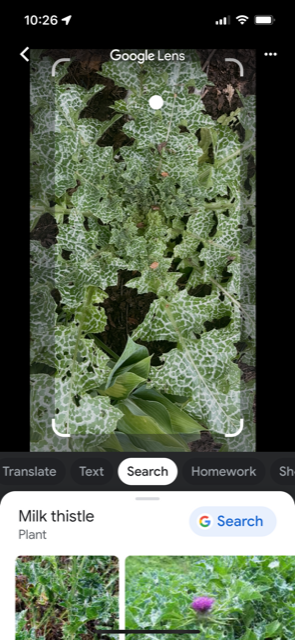
Google Lens lets you search what you see. Using a photo, your camera or almost any image, Lens helps you discover visually similar images and related content, gathering results from all over the internet.

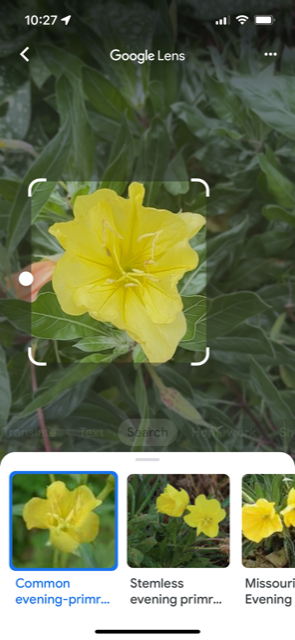
All you need to do is: On your phone, open the Google app and in the search bar, tap Google Lens. Point your camera at the flower to identify the plant. Swipe up to learn about the discovery.

On Android, Google Lens is likely already built right in — open the Google App or Google Photos app. Tap Discover or tap the Google Lens icon.

On Apple, Google Lens is part of the Google app — a separate app from using Google on Chrome, Firefox or Safari. Go to the App Store and download/install Google as a unique app if you haven’t already done so.

When you open the Google App, you’ll see a screen like this with the Lens icon. It’s your window to discovery!

Last week, I went for a long walk and checked out a lot of the volunteer trees and plants along the rural roadway. Sometimes I wanted to verify an item I thought I already knew, but more often I wanted to determine the name of a common but name-unknown item. Google Lens scored on both fronts. Now if only I could remember all of those names!

If you have a bug infestation, use Google Lens to identify the bug if you can get it to sit still long enough!

There’s plenty more you can do with Google Lens, too, including pulling the contact information from business cards, identifying unusual foods and almost anything else. It can also translate words on the screen into other languages, and read them back to you.

The ability of the app to actually CORRECTLY identify plants and bugs is pretty decent, and will get better over time. It helps to allow Google to use location services, so that it’s not searching through the entire rain forest to determine the name of the plant in your neighbourhood. You can also allow Lens access to your photos, so that you can identify items you’ve already taken pictures of.

Best of all, it’s free and will always be free. Try it!