As fall arrives, many gardeners notice an increase in earwigs lurking around their plants. These small, dark brown insects with pincers on their tails can look a bit intimidating, but their impact on your garden is a mix of good and bad.
Earwigs get their name from the old European myth that they crawl into your ears and tunnel into your brain to lay their eggs while you are sleeping. YIKES! Lucky for us, this old wives’ tale is not true. But the pincers on the back on an earwig’s body are still enough to freak people out.
Earwigs are most active at night and can often be found hiding in damp, dark spots during the day. In the fall, they seek shelter from the cooler weather, often in garden beds, under mulch, or in piles of leaves. While earwigs have a bad reputation for munching on plants, their role in the garden isn’t all negative.
On the downside, earwigs do eat leaves, flowers, and vegetables like lettuce, strawberries, and soft fruits, which can cause damage to your garden. However, they don’t typically cause significant harm unless their population is out of control like in a season that’s wetter than normal.
On the positive side, earwigs help clean up the garden by eating decaying plant matter and even feeding on pests like aphids and mites. This makes them useful in keeping some pest populations down naturally. Earwigs will even eat other earwigs!
If you find earwigs causing damage, there are simple ways to manage them. Traps made from rolled-up newspaper or damp cardboard can attract them overnight. In the morning, simply dispose of the traps.
While earwigs can cause some harm to plants, they also play a helpful role in garden cleanup and pest control, making them a creature worth understanding in the fall garden ecosystem.
Wow. What a pleasure to finally see this book in print. Written by two very knowledgeable Ontario gardeners — Rick Gray and Shaun Booth — this is the native plant gardening resource I wish I had more than 5 years ago when I started incorporating native plants in my garden.
Focused specifically on the Southern Great Lakes Region, it’s an all-in-one, easy to use resource for those interested in plants that not only look wonderful but fulfill a critical role in our gardens in supporting wildlife, birds, and pollinators like butterflies, moths, bees, and insects.
It reminds me of an encyclopedia, with a full page spread on each native plant (and there’s over 150!). It’s not surprising to me that’s it’s already #4 on the Globe & Mail’s bestseller list.
The book is visually designed to make it easy to see key information at a glance, using quick guide key icons and two colour-coded bars providing exposure/light and moisture requirements. We’ve been blessed with several excellent native plant books in the past few years, but I appreciated several unique elements I hadn’t seen before – numerous appendices (matching soil types, seed collection and preparation, propagation, and butterflies and their host plants), as well as each plant’s Ontario’s Species at Risk status.
You’ll understand what each plant needs to thrive, how big they will get, and how to make more plants to share with your friends!
Sample spread page
As a Peterborough Master Gardener I have long been engaged in two Facebook groups – theOntario Native Plant Gardeninggroup (started by Shaun) and the Master Gardeners of Ontario group (where I am an admin and moderator). I remember clearly in May 2023 Rick trying to gauge interest from members on their proposed native plant book, and the incredibly positive response that they received. So full disclosure – I knew I was going to love this book before it was ever published.
The authors explain why the plants are organized by botanical/Latin name, which is important because common names can vary by region. However, if you only know the common name you can always search using the alphabetical index at the back of the book.
Essentially, each entry is a ‘checklist in a page’ on what you need to grow the plant. There are lots of photos (whole plant, leaves, flowers, fruiting bodies), a detailed description, easy to see symbols (the Quick Guide), information on the USDA Hardiness Zone, lifespan, propagation, and wildlife/pollinator value.
Skill levels are also mentioned but don’t be alarmed – most are listed as beginner, but there are certainly a few native plants that are a bit more challenging to grow and propagate.
Table of Contents plus shameless plug for my wonderful local, independent bookstore where I ordered the book.
I appreciate that in the introductory chapters the authors clearly explain things such as:
What is a native plant?
Aggressive vs invasive
Origin of the term weed
Nativar vs cultivar
Value of native plants
The authors clearly have a good sense of humour – there are pages titled “How to use this book”, “A coneflower by any other name”, “Fifty shades of…shade” and my favourite “2b or not 2b” (on the rationale for using USDA Hardiness zones). I loved the section on propagation and codes as I’m actively trying to grow more native plant material in my area.
I have to say that as a seasoned gardener I was surprised to see Echinacea pallida (pale purple coneflower) is not in the book (not native to most of this region but often sold as a native apparently) and Agastache foeniculum (Anise hyssop) is one that is included specifically because it is non-native to Ontario (it’s a western prairie plant). Oops! I have both in my garden north of Peterborough.
Was anything missing? Technically no, as the authors were clear that this was not a garden design book. Perhaps after putting out Vol. 2 (the other 150+ plants I know they wanted to include), they’ll consider something on understanding planting density and creating root competition, which I am learning is different to conventional perennials, and good plant pairings (which native plants support others).
One quick comment I will add is that native plants are wonderful once they are established, so you may need to do a bit of watering that first year, but after that they need no watering or fertilizing.
This book is perfect for reading at home (my husband gave me a quick quiz contest this afternoon on the Latin names) or taking with you to your local nursery as you search for native plants to add to your garden. Having trouble finding these plants? The Halton Region Master Gardeners maintain a dynamic map listing native plant nurseries around the province. Check it out!
The bottom line – a wonderful addition to my garden library, and to anyone interested in incorporating more native plants in their Ontario gardens.
The Gardener’s Guide to Native Plants of the Southern Great Lakes Region
By Rick Gray and Shaun Booth Publisher: Firefly Books, 2024 Paperback: 352 pages ISBN-10: 0-2281-0460-2 Price: C$45.00; available through local booksellers and larger book companies
About the Authors
Rick Gray (The Native Plant Gardener) has more than 300 species of native plants in his garden in southwestern Ontario and provides native plant garden design services.
Shaun Booth runs In Our Nature, an ecological garden design business, and launched the Ontario Native Plant Gardening group on Facebook.
Want More Information?
Many wonderful books on native plant gardening and naturalization have been published in the past few years – anything byLorraine Johnsonis a great complement to this book, and I love Piet Oudolf’s work (although he doesn’t always use native plants).
Dr Linda Chalker-Scott (and the Garden Professors blogon Facebook) is a great source of good, solid scientific information on gardeners keen to avoid the misinformation often seen on social media.
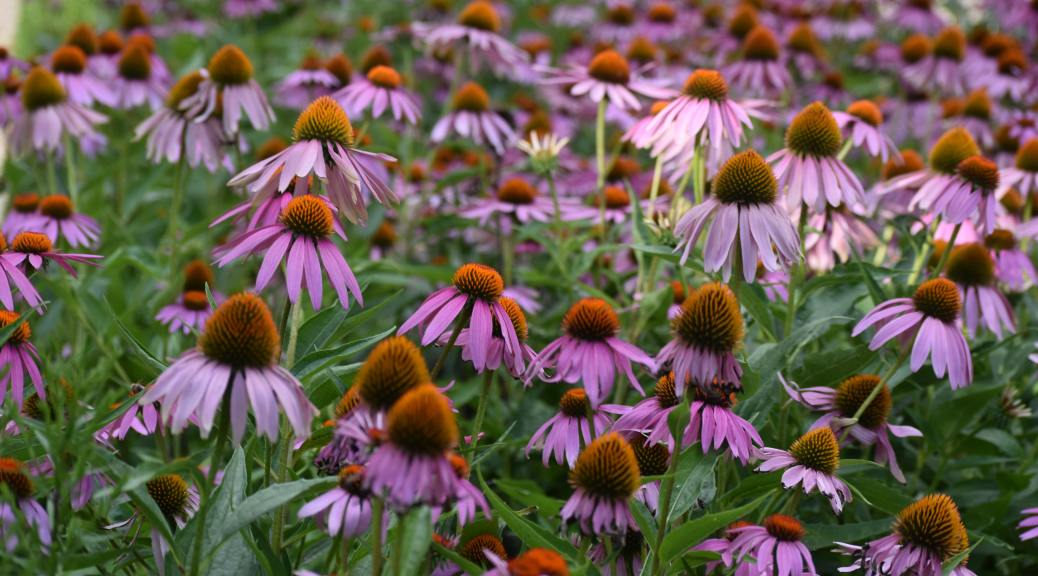
Coneflowers (Echinacea), with their vibrant blooms and potential health benefits, are a favorite among garden enthusiasts. However, these beauties can sometimes face challenges, notably from insects and disease. While both can cause issues, they’re quite different in their effects and how they impact your beautiful echinacea.
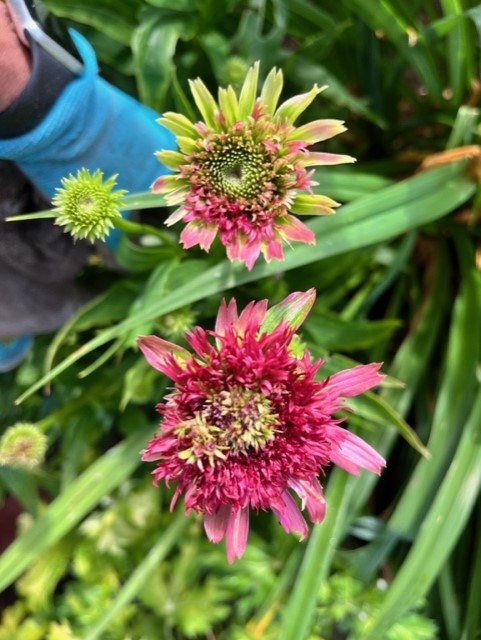
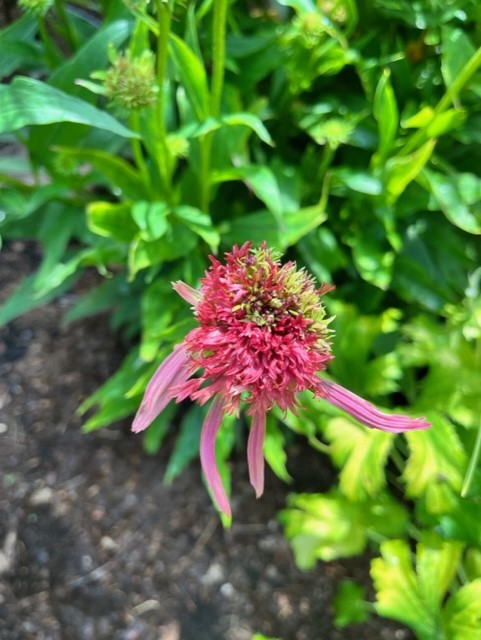
Coneflower rosette mites, or eriophyid mites, are microscopic pests that can infest your echinacea plants. They’re like those unwanted houseguests that sneak in unnoticed and cause havoc before you even realize it. These mites suck the sap from the flower cones, leading to stunted growth and a generally unhealthy appearance. To treat for eriophyid mites, remove the flowers and do not compost. The flower heads below both show damage from mites.
On the other hand, aster yellows is a plant disease caused by a bacterium called a phytoplasma. It spreads through leafhoppers, which are tiny insects that feed on plant sap. Unlike erythroid mites, aster yellows is more like a viral cold that your echinacea catches. Plants infected with aster yellows show symptoms like distorted flowers, leaf-like structures in place of flowers, and overall stunted, often yellowed, growth. The plant may have growths out of its cone or tufts of green where the petals should be. Unfortunately, there’s no cure for this disease, so the best approach is to promptly remove and destroy infected plants (including the roots) to prevent the bacteria from spreading to others. The disease primarily affects black-eyed susan (Rudbeckia hirta) and coneflowers (Echinacea spp.)
Lastly, the main difference between mite and disease symptoms are the colors of the rosettes. Aster Yellows produces yellowish-green rosettes while the mites produce rosettes that usually retain some of the original color of the cones. Of course, the mites do not affect the rest of the plant; their damage is confined to the flower cones.
For an excellent side-by-side comparison with photos of aster yellows and eriophyid mites on coneflowers, check out this page from Ohio State University.
Have you ever wondered how certain insects are able to discover a plant in your garden? How do they know it is there? Some of them may already have been hanging out there but others fly in from afar. How does a predatory insect seem to find its prey without much effort? Both insects and plants engage in the production and release of chemicals such as pheromones and allelochemicals. These can act as insect attractants and deterrents.
Last year I grew Tomatillos. I usually grow Tomatoes but I thought I would try Tomatillos instead. One of my plants was visited by Three-Lined Potato Beetles (Lema daturaphila). These insects feed on plants in the Solanaceae family such as Tomato, Potato, Eggplant, Tomatillo, and Groundcherry. From my reading, this species is not very damaging so I was willing to monitor and see if beneficial insects would step in to act as biological control agents. Sure enough, soon afterwards, when I was inspecting my plants, I found an assassin bug eating the beetle larva that were under a leaf. Just like Lily Leaf Beetle (Lilioceris lilii) larvae, the Three-Lined Potato Beetle larvae cover their backs with their own excrement called a “fecal shield,” as a means of defence. Clearly the assassin bug was undeterred. Plant volatiles had likely been released by the plant in response to the larvae feeding damage to the leaves. This has been described as an indirect defence mechanism[i].” The assassin bug responded as it detected the plant volatiles.
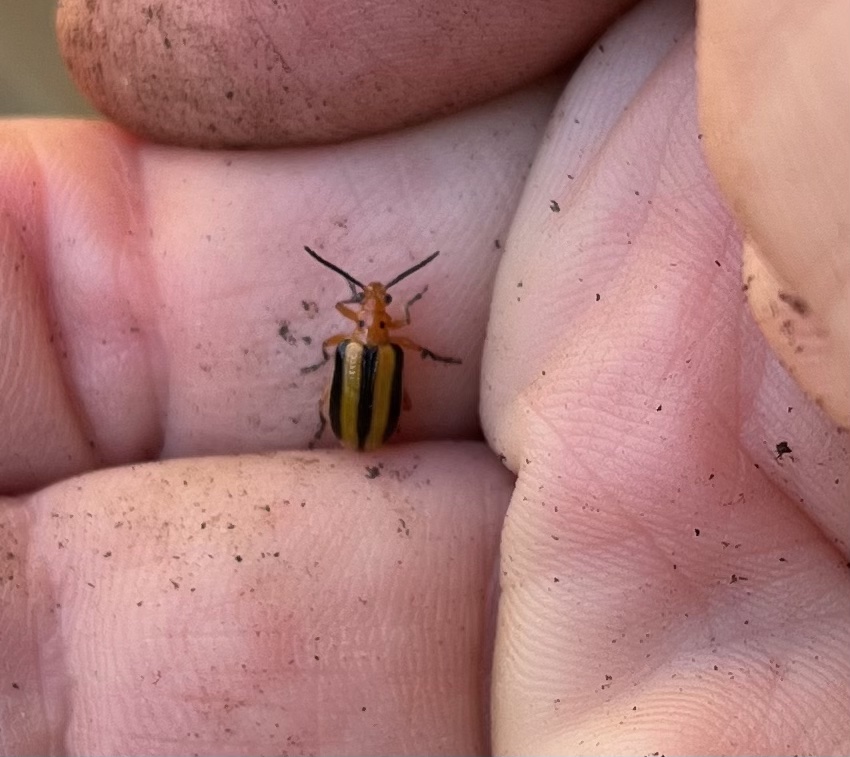
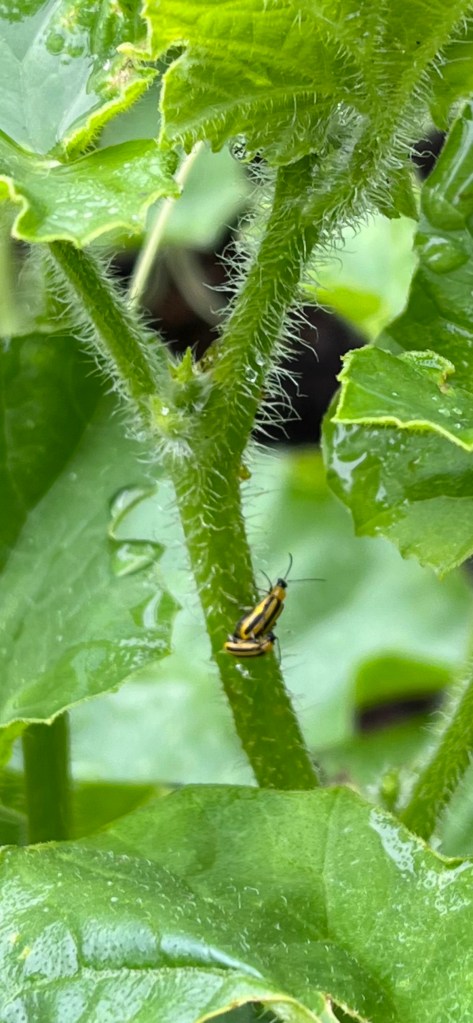
This spring, I planted some cantaloupe and watermelon seedlings in a raised bed. I read up on the various insects that are attracted to these plants—their life cycles and behaviours. One of the insects that favours cantaloupe and other members of the cucurbit family is the Striped Cucumber Beetle (Acalymma vittatum). Up until recently, I hadn’t seen any on my plants. Often, I will use floating row covers for protection from insect damage but these plants are currently flowering so they are uncovered so pollinators can access them. When I saw my first beetle, I thought about how it knew I was growing cantaloupe. Cucurbit plants emit floral volatiles in the air that travel. Adult cucumber beetles are attracted because the pollen of the plants makes up a part of their diet.[ii] These same and other volatiles also attract pollinators of these plants such as Squash Bees (Eucerini spp.).[iii]
Cucurbit plants also contain a chemical called cucurbitacin. This is the substance that gives some cucurbits a bitter taste. When cucumber beetles feed on the leaves and other parts of the plant, they absorb the cucurbitacin, rendering them unpalatable to many predators. Young plants produce more cucurbitacin than older plants—which make them more attractive and vulnerable to damage.[iv] Cucurbitacin is so attractive to the beetles that it encourages more and more feeding—called a “phagostimulant.”[v] (Is this the same as sugar, salt, and fat for us humans?) As the beetle feeding progresses, adult male beetles give off an aggregation pheromone called vittalactone that invites others to come and join the party.[vi] Cucurbitacin also plays a role in their reproductive activities as males transfer it to the females as “nuptial gifts.”[vii]
The beetles can also transmit bacteria via their feeding that causes a fatal wilt in the plant. What is also unfortunate is that the wilting plant gives off more volatiles that attract more beetles. The flowers of wilting plants are not as attractive as non-wilting plants—this encourages the beetles to move on to other nearby plants, thus causing further spread of the disease.[viii]
In the end, the key is to try to deter adult beetle feeding as much as possible. This can be achieved in a number of ways such as using floating row covers; delaying planting in the spring; planting more developed transplants; hand-picking beetles in early evening when they are most active; planting cucurbit varieties with lower levels of cucurbitacin,[ix] interplanting plants like radishes and nasturtium with melons,[x] and using straw mulch around plants to attract beneficial wolf spider predators.[xi] Some cucurbits like watermelon are resistant to bacterial wilt,[xii] unlike cantaloupe. So perhaps by the end of the summer I will at least have watermelon.
[x] Cline, G. R., Sedlacek, J. D., Hillman, S. L., Parker, S. K., & Silvernail, A. F. (2008). Organic Management of Cucumber Beetles in Watermelon and Muskmelon Production, HortTechnology hortte, 18(3), p. 444. https://doi.org/10.21273/HORTTECH.18.3.436
I was out for a walk earlier this summer and noticed that a number of trees in my neighbourhood have lumps on their leaves, leaf stalks, shoots, or at the ends of their branches. At first glance you might be alarmed and think they are diseased, but many are the homes of tiny insects such as aphids, mites, sawflies, psyllids, and midges. They are often quite numerous and they come in different shapes and sizes. A gall is formed through the expansion of plant cells—similar to a tumour. This may be triggered by organisms such as viruses, bacteria, fungi, nematodes, or insects. Insects induce the galls through actions such as oviposition (inserting the egg into the plant tissue), the release of chemicals by the female and eggs, and through feeding. It is a shelter for the young and protects them from predators. While sometimes causing leaf deformity, in the majority of cases, galls are a cosmetic concern and do not harm the tree.
Here are a few you may encounter that are caused by insects:
These variable shaped galls specific to Populus deltoids (Eastern cottonwood) are the homes of an aphid called Mordwilkoja vagabunda (Poplar Vagabond Aphid). New galls are a light colour but become darker with age. Each gall releases upwards of 2,000-winged offspring in mid-July to early August. Sounds like it could have been the inspiration for a science fiction novel or movie.
Rabdophaga strobiloides (Willow Pinecone Gall Midge) are found at the ends of branches of various Salixspp. (Willow). What is amazing about these structures is that up to 31 different insects use them for their young—residing in the papery-like folds of the gall.[i] The galls are also frequently predated by birds and parasitic wasps.[ii] The biodiversity that Willows support is wide and for this they are known to be keystone species—they are also among the earliest plants to flower in the spring and support emerging pollinators like Queen Bumblebees.
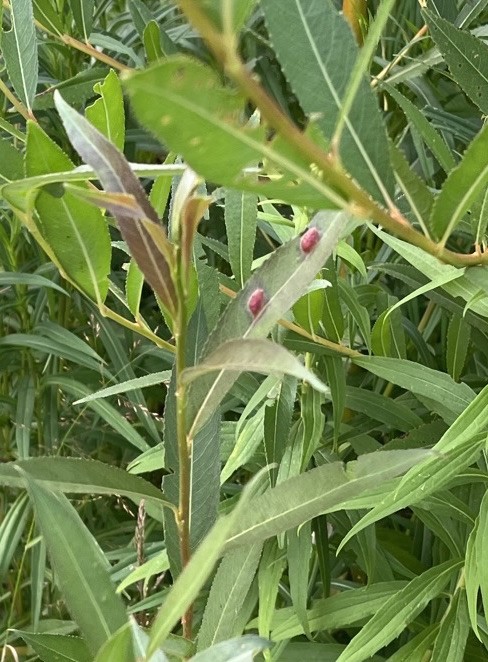
Euura proxima (Willow Redgall Sawfly) frequents certain Salix spp. (Willow). This gall can be identified by its red bean-like appearance on the leaves. Sawfly larvae are often mistaken for Butterfly or Moth caterpillars. They can be distinguished by the number of abdominal prolegs: the former has six or more and the latter five or less.
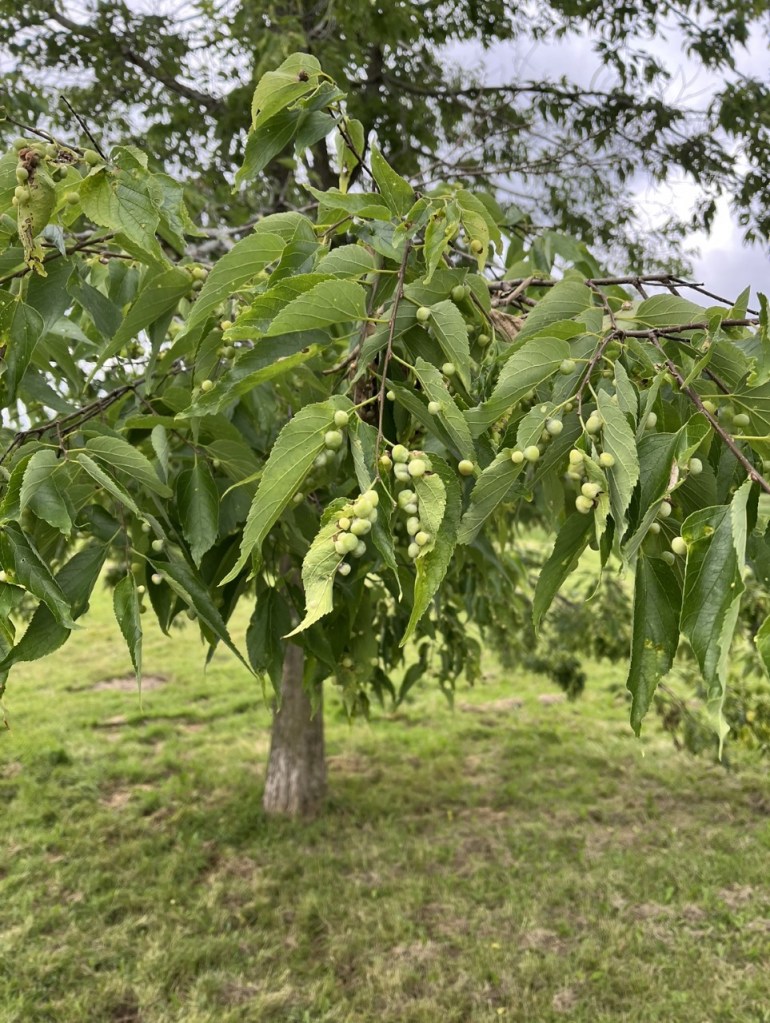
Pachypsylla celtidismamma (Hackberry Nipple Gall Maker) is a Psyllid (Jumping Plant Lice) that forms round, often clustered galls on the underside of Celtis (Hackberry) trees. Adults spend the winter in cracks of the tree bark itself or even in nearby buildings.
The Eriophyid mite, Vasates quadripedes (Maple Bladder Gall) forms on Acer spp (Maple) such as the upper leaves of this Acer x freemanii ‘Autumn Blaze’ (Freeman Maple ‘Autumn Blaze’). The galls first appear as green, then turn to red, and finally black. The mites overwinter in the creases of the tree’s bark.
So, if your trees have strange growths on them, check out the wonderful web site https://gallformers.org. There you can identify galls by their specific host trees, the form of the galls, and their location on the trees. You can also narrow your search down to those that occur in Ontario. Another good site for identification is https://www.bugguide.net, a comprehensive database of insects for the US and Canada.
[ii] Van Hezewijk, B.H. and Roland, J. (2003), Gall size determines the structure of the Rabdophaga strobiloides host–parasitoid community. Ecological Entomology, 28: 593-603. https://doi.org/10.1046/j.1365-2311.2003.00553.x
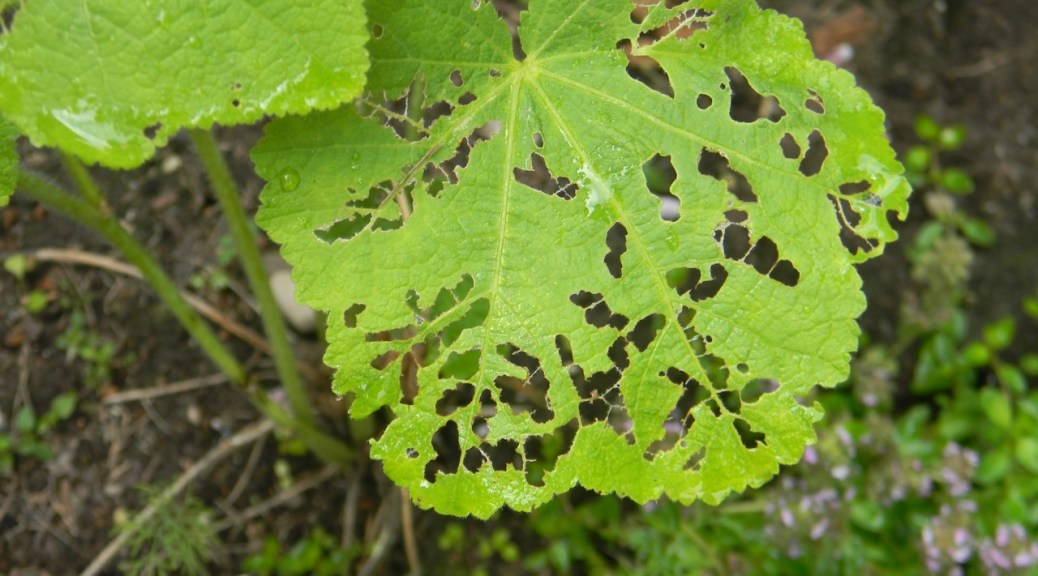
Several years ago I heard a wonderful talk by Martin Galloway on “Holes in Leaves.” His philosophy was that you can never totally eradicate pests from your gardens, so you should enjoy the beautiful lacing they do to your leaves. At the time, I was skeptical about how I could love holes in leaves and the pests that put them there. However as a Master Gardener, I now understand his perspective and I do try for a balance using safe methods to control pests. Integrated Pest Management (IPM) is a practice where pests are controlled using environmentally safe and economically sound values. Biological controls like BTK or parasitic nematodes can be used. Barriers such as diatomaceous earth, wood ashes or sticky boards are mechanical control methods as well as hand picking. Cultural methods include plant nutrition, sanitation, planting pest resistant varieties and plant rotation (in the case of vegetables).
Although we don’t want bad bugs in our garden, we do want the beneficial bugs that are predators and parasites. These include dragonflies and damselflies, lady bugs, lacewings, spiders, wasps and some types of flies.
Aphids or plant lice are one of the most common pests to attack your plants. They are tiny soft bodied creatures that can be black, red or green in colour. They suck the sap from your leaves, and leave a sticky substance behind. You will often see them in a long line on your stems. Red aphids are common on garden phlox. You can use an insecticidal soap for aphids. Or use a blast of hose water to knock them off your plants.
Beetles are hard bodied insects that are generally easy to find on your plants. There are many types and they are often named after their plant of choice, like scarlet lily beetle. The most effective method for controlling beetles is hand picking. Look for the striped cucumber beetle inside the blossoms. When handpicking, place a hand under where the beetle is to catch it as they tend to jump when you touch them.
Caterpillars are another garden pest that are easily spotted. In spring you may find your Hydrangea arborescens has closed, puckered leaves which are holding the common leaftier. You can gently open the leaf and remove and destroy the caterpillar inside or pluck of the entire leaf and squish.
Slugs and snails are sometimes difficult to find as they like dark damp places and feed at night. But you will know you have them when they are munching on your hosta leaves. Check out Gardens Plus for Dawn’s formula for slugs.
As we enter the dog days of summer, we are all battling voracious bugs eating our beautiful flowers and vegetables. The healthier your plants are, the less they will suffer from a deluge of bad bugs. That is why it is important that you give your plants the water and nutrients they need to be their best. Good soil health and good fertilizing methods will give you healthier plants.
Remember that anything you apply to your plants to kill those pests can also hurt pollinators and will be on the vegetables and fruit that you ingest.
To make your garden less inviting to pests
plant the right plant in the right spot to keep it happy and not stressed
do not overcrowd plants which encourages dampness and pests
diversity in your garden will help with pest control – if there are a variety of plants, specific pests will not take over
keep nitrogen levels moderate as many pests like aphids thrive on plants with high levels of N.
Remove garden litter; if pests are present as they can overwinter there.
My favourite method of hand picking beetles and slugs and hosing down aphids is no cost and gets you out into your gardens….where you can enjoy your own “Holes in Leaves.”
It’s been a tough few years for all of us because of COVID-19, but I had time to reflect this weekend on why it’s been hard for me as a gardener. While it’s been wonderful to have our gardens as an oasis and source of comfort during the pandemic, I realized that other than a few close friends, no one had seen all the work (and the results) that my husband Grant and I had achieved over that time.
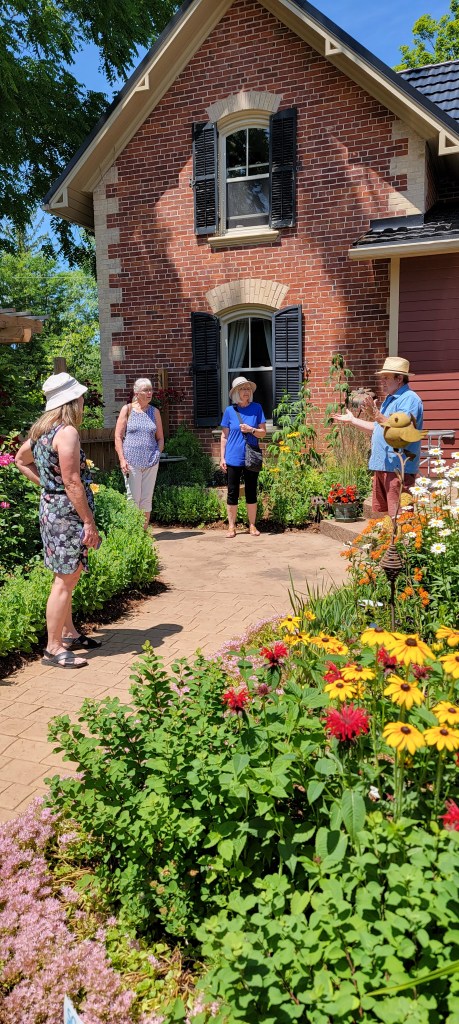
So it was with great anticipation that we looked forward to our Lakefield garden being featured on a garden tour organized as a fundraiser to celebrate 60 years of theLakefield Horticultural Society.
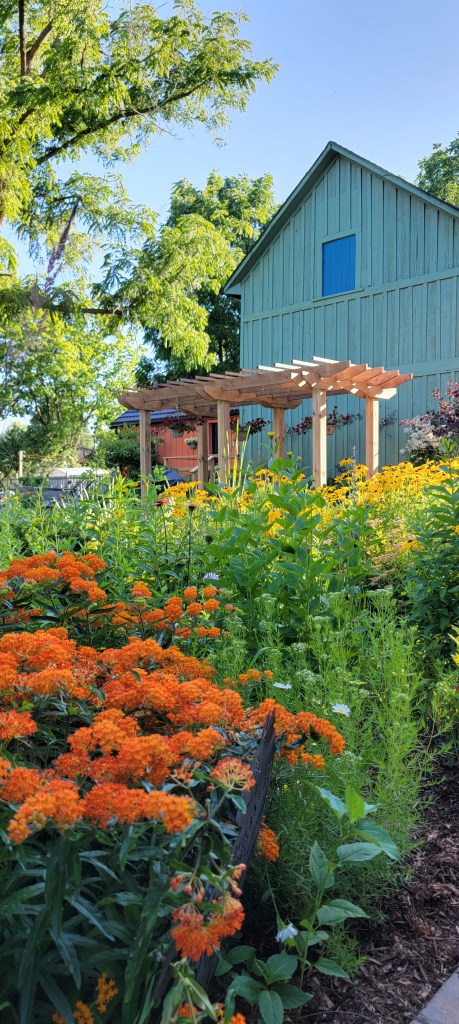
While we spent a few very crazy days trying to put the final touches on our garden (my husband decided he would build a beautiful pergola [awesome] a week before the event [not so awesome] so plants had to be moved into pots and then back into the beds just a few days before) — sorry I digress — everything was perfect on the day — the weather was spectacular, we placed the last bits of mulch to cover a few empty patches and we looked forward to welcoming our guests.
The new pergola.
As the first people arrived (I think our first visitor was a man on a bicycle!) I began to realize how much I had missed the joy of sharing our gardens with others. And as the day progressed, it was wonderful to hear other people’s perceptions — for some it was inspiring, for some a bit overwhelming (we have a 3/4 acre property in a small village), for some they loved that we had plants they had never seen before (not your typical garden). Everyone seemed to leave with a smile on their face, which made our day.
Grant created numerous raised beds over the past few years — at my request — and we’ve had great success with them. We also purchased a “COVID present” for ourselves — a long wished-for greenhouse to extend our gardening season, and it’s been put to good use.
We’ve spent time over the past few years planting more native plants as I learn more about the benefits of creating habitat as well as having an aesthetically pleasing garden. Hey, it’s not all about me!! Doug Tallamy’s book is a great start to understanding the benefits we can provide in our humble gardens to the greater ecosystem.
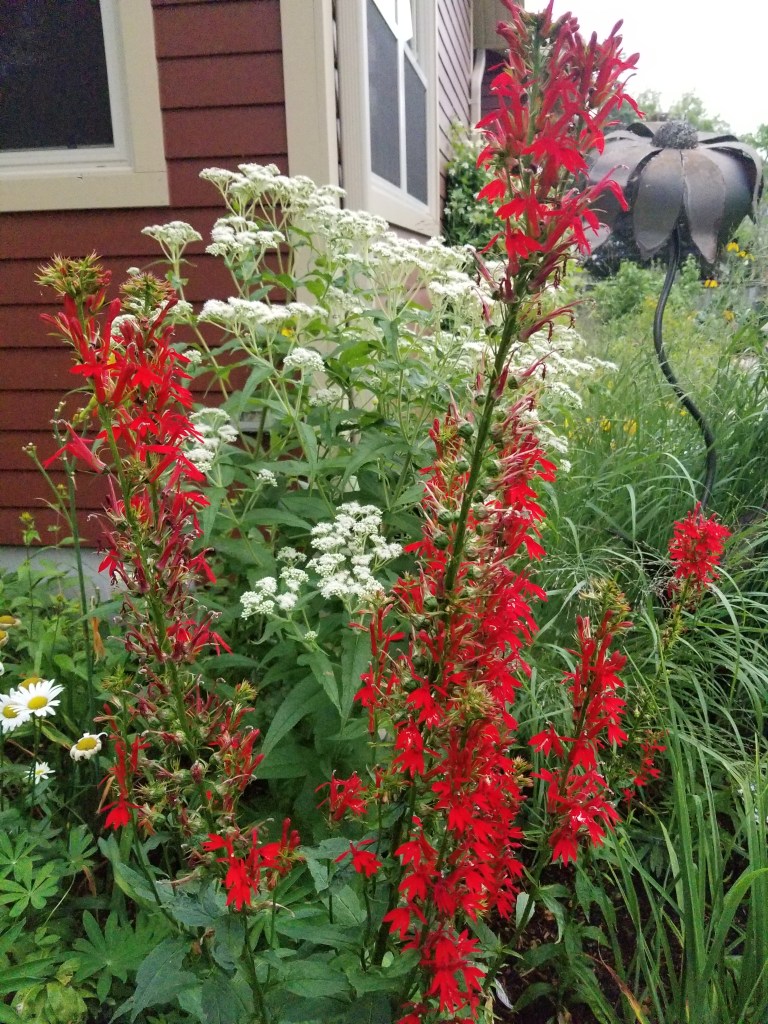
There is definitely a balance — we’re aiming for a 50/50 balance of native/non-native — because I love my daylilies and peonies and don’t want to give them up (they give me pleasure), but I also love the hundreds of pollinators (bees, butterflies, wasps etc.) that flock to my Common Boneset (Eupatorium perfoliatum), Pearly Everlasting (Anaphalis margaritacea), Cup Plant (Silphium perfoliatum), and Cardinal Flower (Lobelia cardinalis) because I am choosing to plant native plants.
Boneset (white) and Cardinal Flower (red)
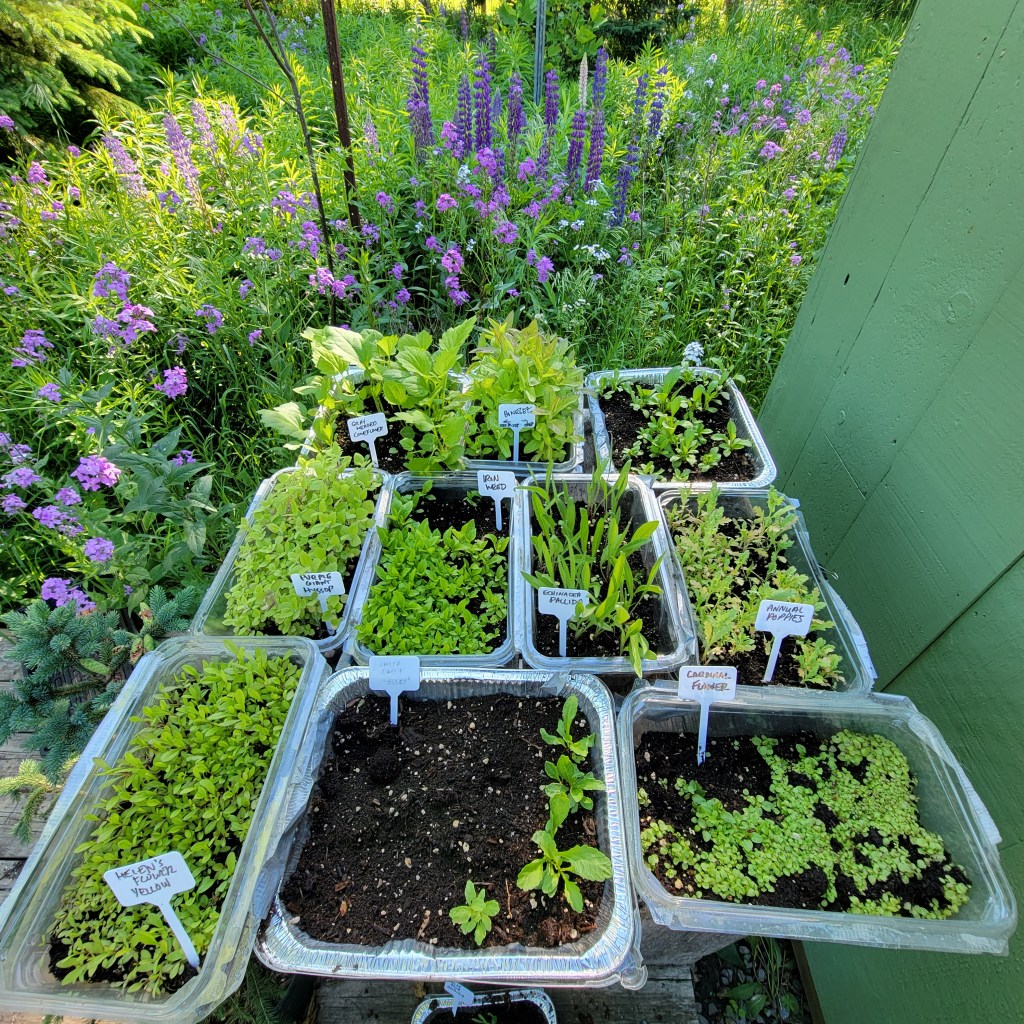
Last winter I grew some native (and non-native) plants using the Winter Sowing technique (because most native plant seed requires winter/cold stratification) and it was a great success (with some lessons learned – but that’s another blog).
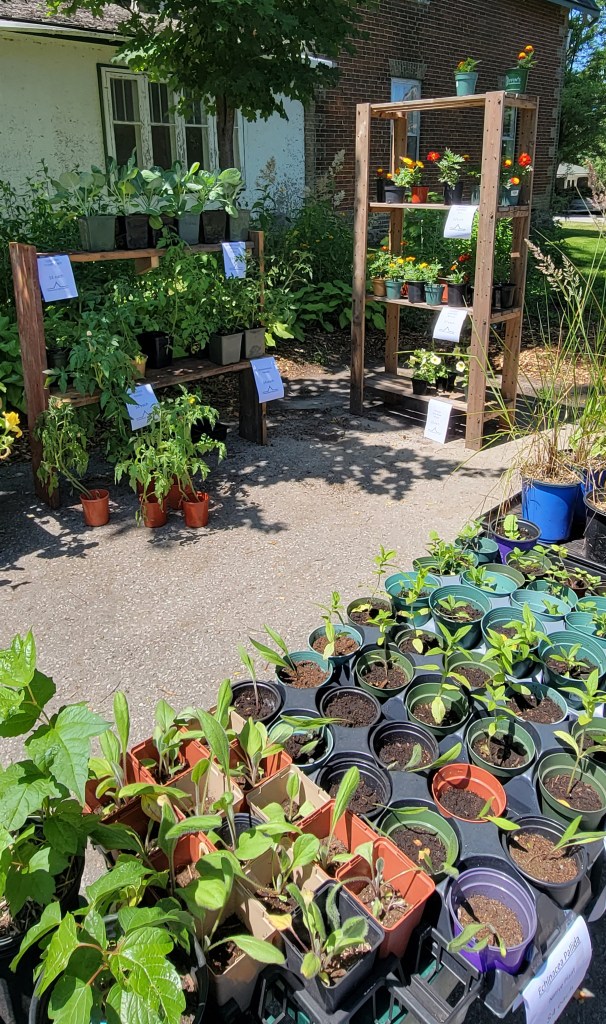
Grant set up a Plant Sale area for the garden tour and people were able to buy plants that they saw in the garden (although alas, I did not take any cuttings on my amazing orangeButterfly Weed – a type of milkweed – which really caught everyone’s attention).
The Plant Sale area
Over the day I saw many gardening friends I hadn’t seen in several years, and made all sorts of new friends. It felt like my community was coming together — like we were reconnecting after a long time apart in a beautiful place. And I realized that gardening is both a solitary and a very social activity. We even got featured in the local newspaper.
We raised funds to support our local horticultural society, we got back to feeling ‘a bit normal’, and most importantly we got to reconnect with people over a common passion — the love of gardening.
I hope that all of you will find opportunities to reconnect with people this summer and share your gardens and plants and trade stories about attracting pollinators etc. with others. It’s a feeling like no other. #happygardening
Our lovely rudbeckia and greenhouse in the background.
“To plant a garden is to believe in tomorrow.” Audrey Hepburn
If you’re like me, you love to garden. Time in my garden provides me with joy on so many levels — emotional, physical, social, creative — and connects me with the outdoors and the environment. And while the COVID-19 pandemic has turned our lives upside down, one of the silver linings is that we’ve seen a renewed interest in gardening and its benefits, whether you’re working in a large garden or a few containers on your balcony. So I thought I would explore some of the top reasons I think we garden.
Physical and Emotional Health
Gardening is physical. As a low to medium impact exercise that requires both strength and stretching, you’ll see increased muscle strength and cardiovascular fitness over time, as well as improved sleep and diet (if you grow your own produce). On the emotional side, gardening reduces stress, anxiety, and depression and improves self esteem.
It’s good for the mind — gardening calms me down and helps me be more patient with myself and those I interact with on a daily basis. It gives me time to contemplate as I go about my tasks, up to my elbows in soil. Even weeding is cathartic, pulling out those little terrors by the root!
Just visiting gardens helps to calm the mind, bringing a sense of contentment and tranquility from looking at beautiful landscapes, flowers, or just colour and texture.
Building Relationships
While gardening can be a solo activity (some of my favourite moments are just by myself in my green oasis), it’s also a fabulous way to connect with people, whether they be family or strangers!
Teaching people how to nurture a living thing and to be responsible for a little bit of the environment is a lesson and gift we can share with others. Gardening knowledge is shared through generations — I love hearing about plants handed down from grandparents, or children working with their parents to grow seeds for the first time. It’s a great way to pass on critical life lessons — about patience as plants and vegetables grow, responsibility as they look after their care, and loss when flowers die at the end of a season.
Beyond family, gardening helps us connect with the broader community. Whether you plant too many tomatoes or zucchinis and end up giving them away to neighbours, or participate in a community garden plot, gardening can be a very social activity and a chance to learn from, and share your bounty, with others.
Learning Life Values
Gardening teaches you important life values like patience, determination, caring, and hard work. It also makes you very humble as you realize that there is always something new to learn. You need to observe the seasons and the weather, and this puts you in contact with the natural world. I love that I can get dirty and do this very physical activity, working with seeds and plants and seeing growth in all I do.
Growing Your Own Food
Gardening provides benefits for your wallet, your nutrition, and reduces your environmental footprint. By growing your own food (either from seeds or small plants), your food is automatically more sustainable simply because you are doing it onsite or in a community garden. If you control the ‘inputs’ and do it well, you can save a lot of money.
But ultimately there is nothing more rewarding than planting and maintaining your own vegetable garden and harvesting (and sharing) your results. And we all know how much better homegrown produce tastes versus conventional produce at the grocery store. If you have too much produce, then you can just share the love with others!
Connecting With Nature
I think this is one of the best reasons why people have a garden — the sunshine on your face, hands in the dirt, and feeling connected to nature. The garden is so much more than just plants and flowers — it’s the birds, the bugs, the bees, the spiders, the snakes and all the small mammals. I feel like I am establishing a little ecosystem in my own garden and that I am trying to give back for all the benefits that I receive.
Working in the garden also gives you that sense of wonder, accomplishment, and reward. To grow plants is to give life. It keeps you busy but reminds you to be one with the earth. To see the results of something growing from seed to six feet tall is just incredible.
Exploring Creativity
I find gardening to be an incredibly creative activity. Finding the right plant for the right spot, mixing colours, and making sure there is interest for every season — these are real challenges. I’ve spent much of the past few years learning about new plants to consider in my garden, especially natives.
Helping The Environment
Finally, gardening is so important for our planet. Even though we create our gardens (so they are human made) they do represent natural environments, with trees and shrubs and plants that are all taking in carbon and releasing oxygen. The plant roots stabilize the soil and filter water, and the plants themselves support our pollinators.
We live in a symbiotic relationship with our gardens. We give back by planting and maintaining them, but we receive so much more from them than we give.
Seeing bugs outside is generally pretty tolerable as we know that many of them are pollinators, but seeing them inside our houses is a completely different story, right? Fortunately, it’s usually easy to manage most indoor pests with little more than some water, a cotton swab, and a soap solution. It all starts with a few preventative actions:
Aphids
Whenever you happily bring home a new treasure (or sometimes, victim!), make sure that you carefully inspect them. Many types of houseplant bugs piggyback their way into your house from friend’s homes or stores. Look on leaf undersides, along the stems, and even in the soil for signs of common pests (sticky substances, flying cloud when disturbed, little bumps, fine silky webbing).
Put your new treasure in solitary confinement for a few weeks, like in a spare room. Even if you think a new plant is pest-free, it may have pest eggs or larvae that you can’t yet see. Watch it carefully and only put it in close contact with other plants after it’s been confirmed to be pest-free. If the pandemic has taught us anything, quarantining is right at the top of the list and it applies to plants as well as humans.
Place a few yellow sticky cards in among your plants. Many pest insects are attracted to the color yellow, and they’ll quickly get trapped on the card. Check the card every few days for any insects. If you have some on the card, you probably have many more on the plant itself.
For all infestations, the first thing to do is to move the affected plant away from all other plants. Quarantine!
Then, take the plant to the bathtub/shower and spray it with water. Many bugs are tiny and are easily washed off the plant. Be sure to rinse both upper and lower leaf surfaces. After the plant has fully dried, use a light-weight horticultural oil or insecticidal soap to smother the pests. Reapply the oil/soap every 10-14 days for two more applications for the best control.
If you detect small bumps, wipe the plants with a cotton ball soaked in rubbing alcohol and remove the bumps if possible.
If you detect pests in the soil, it’s often caused by overwatering. Reducing the amount of water, or watering your plants from the bottom instead of the top should take care of the problem. Spraying the soil lightly with insecticidal soap occasionally often helps as well.
If your houseplants are on “vacation” on the back deck this summer, then at around this time you should think about getting them ready to move back inside for the winter.
Bring your houseplants indoors before night time temperatures dip below 7 or 8 degrees (C). Most tropicals will suffer damage at temperatures below 5 degrees, a few even below 10 degrees.
Sudden changes in temperature, light, and humidity can be traumatic to plants, resulting in yellowed leaves, dieback, wilting, and even death. To prevent shock when you bring houseplants back indoors, expose plants gradually to reduced lighting.
Before moving day, inspect plants for insects and diseases, and treat as appropriate before bringing plants back inside. Spray them a couple of times over a 2 week period with a mild soap and water mix so that you don’t bring bugs from outdoors in with your plants. Alternatively, soaking the pot in a tub of lukewarm soapy water for about 15 minutes will force insects out of the soil. Allow the plant and pot to dry completely afterwards. If snails, earthworms, or other insects burrowed in the soil, you might want to repot the plants, placing a piece of wire screening over the drainage hole to keep them out next year.
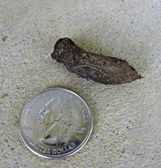
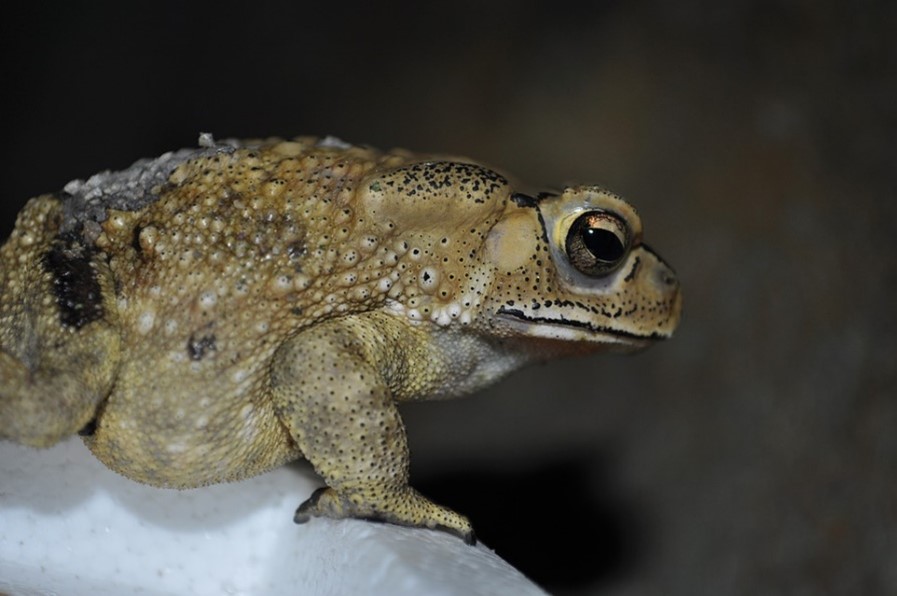
Personal anecdote: A couple of years ago, I brought a large cactus planter inside without inspections or the soaking method. The next day, we found a curious “deposit” left behind by some unknown critter on our kitchen floor and we kinda freaked out. We set live traps in the house and were on high alert for a chipmunk or squirrel or even something huge with big teeth that could drag us out of bed by the big toe. It was a little bit traumatic. A day or so later, my son found a large toad in the living room and we connected the dots. Turns out that toads leave very large deposits for their body size (Google it!) and closer inspection of the cactus planter showed an open hibernation hole. Whew!
Moral of the story? Check your plant pots for toads too!
Toad ‘deposit’
Toad — they’re looking for prime hibernation locations at this time of year.












 The Peterborough & Area Master Gardeners