Category Archives: Bees & Pollinators

Time to take stock of your garden…and collect seeds!

By Silvia Strobl, Master Gardener in Training

Summer is flying by. You can feel the growing season coming to a close with the cooler morning temperatures in late August. Now is a good time to reflect on which vegetables did well in your garden and, if heirloom or open-pollinated varieties, allow some to go to seed for next year’s planting. Or you could collect more seed than you need and package them to exchange for more new varieties at next spring’s Seedy Saturday/Sunday events.

It is important to only collect seeds from open-pollinated varieties as these will retain their genetic diversity and produce plants that adapt to changing growing conditions. They produce seeds that can be legally grown, saved, and shared. Do not collect seeds from hybrid varieties as these will not grow like their parents.

Last spring, I picked up seeds of several new (to me) varieties that diversified both my vegetable garden and my diet this summer, including:

  • An heirloom basil lettuce leaf variety with a milder peppery basil flavour that enhanced mixed lettuce salads throughout the growing season
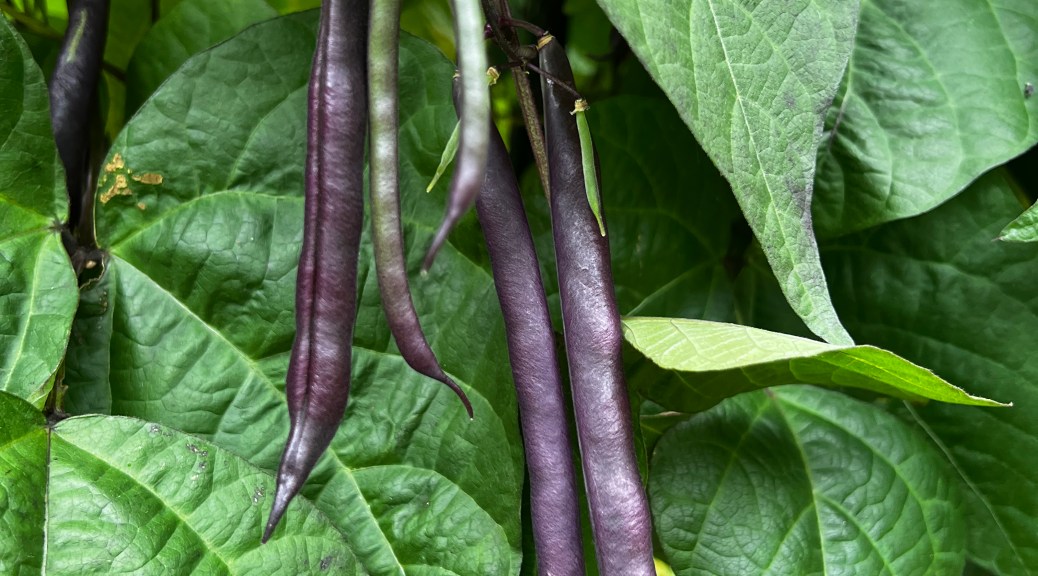
  • A purple pole bean, Trionfo Violetto, that unlike the purple pole bean, Blauhilde, that I usually grow was more tender and stringless, although not quite as productive
  • A purple podded sugar snap pea, Sugar Magnolia Pea, that is still producing pods today. The peas are very sweet and unlike the purple pole beans do not turn green when cooked, plus they are easy to spot in the tangle of 6 feet tall vines
  • A cantaloupe, Minnesota Midget,that started producing juicy, sweet, ripe fruits by the second week of August
  • A mix of 2 different Armenian cucumbers with light green, ribbed tender skins rather than the dark green skinned Lebanese cucumbers typically grown and available year-round at the grocery store. Surprisingly, Armenian cucumbers are the same species as cantaloupe! Their denser, less watery flesh makes them ideal for tabouli and cucumber salads.
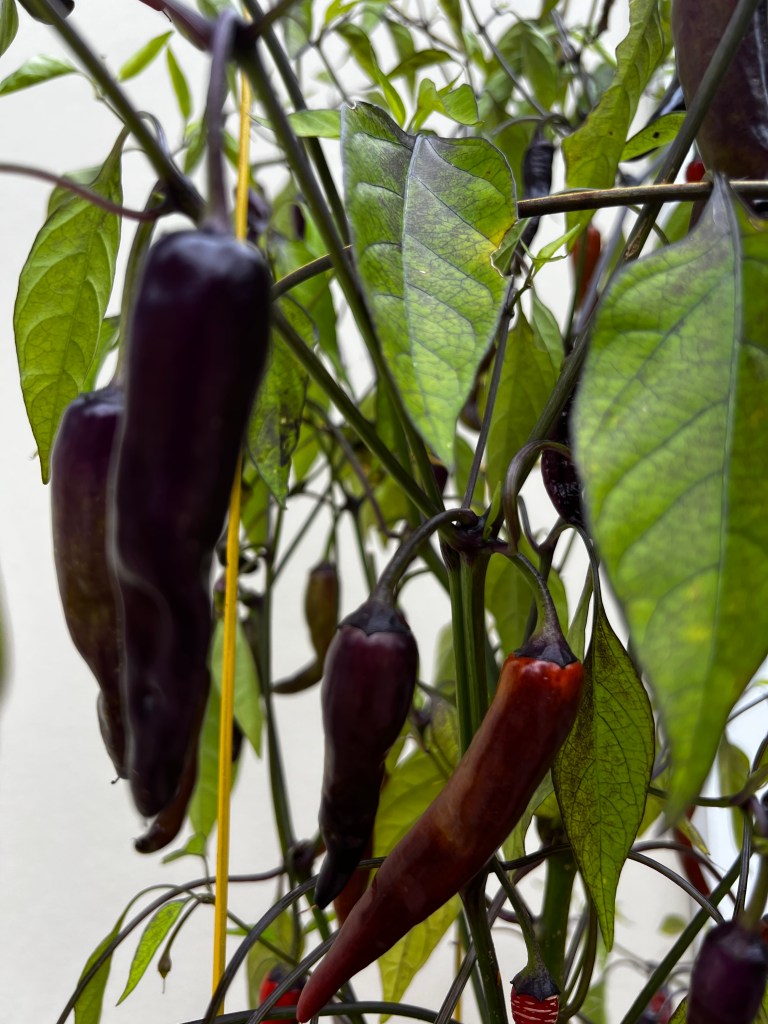
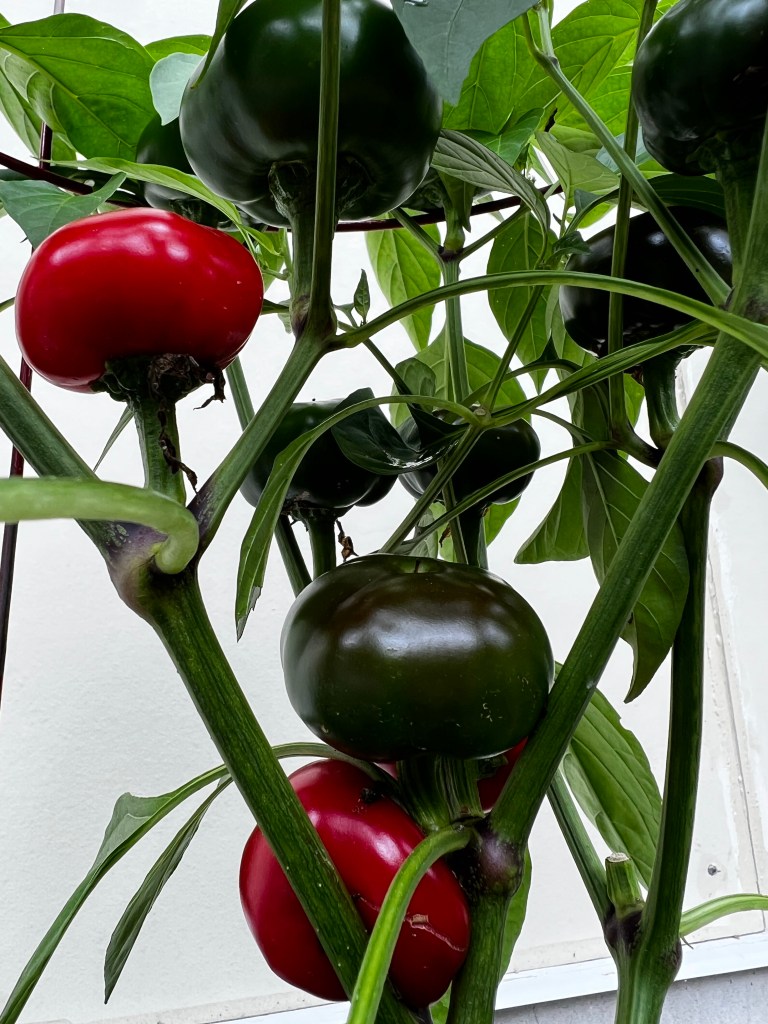
  • Two different peppers that I grew as container plants: (i) Mini Red Bell that produced early sweet peppers that are 1-1/2 inches tall and wide and (ii) Buena Mulata a hot cayenne variety that changes from a pretty purple to red when ripe although we also enjoyed the early milder purple peppers in fresh salsas. Both pepper varieties are very productive, yielding dozens of peppers on one plant!

Why try growing something new?

While it is easy to get into a routine of growing the same varieties of vegetables each year, there are several reasons to experiment with new varieties. A different variety of beans or tomatoes might grow better in your soil conditions and produce a bigger crop, it might taste better, be easier to harvest, mature earlier, or be better suited to the vagaries of our new climate change world with more drought and/or rainy weather. Aside from these good reasons, growing something new can be a lot of fun!

Contributing seeds to your local Seedy Saturday/Sunday event is an economical way to support experimentation with new varieties. You can trade your seeds for seeds of other varieties collected by other gardeners.

How do you get started with seed collection?

As I learned during a seed collection workshop with Jill Bishop of Urban Tomato, here are some general steps to follow:

  • Ensure the variety is open-pollinated or heirloom. The original seed package should provide this information. Or search for the variety name on the internet.
  • Identify the vegetable varieties you enjoyed and mark healthy plants that you will let go to seed. For example, this year I identified 2 plants in my pole bean row where pods could go to seed.
  • Let seeds mature on the plant and observe carefully to ensure you harvest seed heads just before they start to split open.

For beans and peas which are self-pollinated let pods over-ripen and turn brown on the plant. Keep green beans away from purple ones. When seeds rattle inside pods they are ready to harvest. Let the pods dry further indoors.

For lettuce greens, cruciferous vegetables (e.g., kale, cauliflower, broccoli, etc.) and herbs let a plant bolt. Keep different varieties (e.g., of lettuce) apart to avoid cross-pollination or only let one variety bolt. It will take some time for seeds to form and turn completely dry and brown. You might want to cover the seed head with a gauze bag to capture the seeds when seed heads split open. Note that kale is a biennial and won’t form seeds until Year 2 while most spinach varieties are dioecious and both a male and a female plant are required to obtain seed set.

Pepper seeds are simple to collect but make sure to grow varieties separated from one another to avoid cross-pollination. Growing peppers in pots makes this easy to do as you can move the pot during the flowering period. Scrape seeds from a fully ripe pepper and set seeds on newspaper to dry.

Both tomato and cucurbit seeds require a bit more effort to collect.

  • A recent Peterborough & Area Master Gardener blog post, “Tasty Tomatoes”, provided steps for saving tomato seeds from ripe healthy tomatoes. As described in the blog, seeds should be fermented in water for a week to separate viable seeds and improve seed germination and longevity.
  • For cucumbers, squash and melon, let the fruit get big, overripe, and mouldy on the vine, open the fruit, scoop out seeds and let them ferment like tomato seeds, then rinse and let dry.

Ensure that you label and date the seeds you collect through the drying and packaging process. When packaging seeds in smaller envelopes for Seedy Saturday/Sunday events include variety name, year collected, days to maturity, and spacing for sowing. Store seeds in paper envelopes in a dry cool place. If you use jars to store seeds, put an envelope with a fully gummed flap in the jar as well. If the envelope is sealed when you check the jar a week later, humidity levels are too high in the jar. Seeds will start to germinate if kept in humid conditions.

Follow these steps and you’ll be ready to leave a few seed envelopes of your favourite varieties at a Seedy Saturday/Sunday event that will soon be scheduled near you. And you’ll be able to pick up a few free new heirloom varieties to try in 2024!

Seed Collection Resources

Seeds of Diversity a Canadian organization with 1000+ members that grow rare seeds to exchange. They support Seedy Saturday and Sunday events across the country.

How to Save Your Own Seeds–A handbook for Small Scale Seed Production available from Seeds of Diversity for $15.00

The Seed Savers Exchange publishes a Seed Saving Guide in table format that identifies the primary pollination method, how many plants you should grow to collect viable seeds, and how far apart plants should be from other varieties to avoid cross-pollination for more than 80 varieties of vegetables. For example, for vegetables like tomatoes, beans, lettuce and squash, you should grow each variety at least 10 to 20 feet apart from other varieties. If you have a small garden, you can still grow more varieties together but cover a flower with a gauze or blossom bag to only allow that variety to self-pollinate.

There are lots of resources on the internet for making your own seed envelops, including this one: Make Your Own Seed Envelopes For Cheap

Around My Garden

by Laura Gardner, Master Gardener

To Squish or Not to Squish?

For over 13 years, I have had a Hydrangea arborescens ‘Annabelle’ (Smooth Hydrangea) in my garden. A few years ago, contractors put in a fence, and I thought it was a goner — trampled into the ground. It was their version of rejuvenation pruning.

Well, I learned they are hard to kill. Every summer there is a profusion of blooms. Every spring, some of the leaves are curled and fused together—a temporary home for Olethreutes ferriferana (Hydrangea Leaftier Moth) caterpillar—a native insect. Anecdotally, it seems to favour Hydrangea arborescens over others, although the food plant database for Tortricid (Leafroller) moths indicates simply Hydrangea spp.

Most sites I have seen online advise you to squish the caterpillars because they can cause a reduction in blooms. They feed on the leaves and the flower buds. While my Hydrangea has likely seen a reduction, I have not noticed.  It does not affect the overall health of the plant. Another consideration is that often within these rolled-up leaves, spiders make their home. It is thought that they take up residence before the moth leaves but do not predate the caterpillar.[i] Year after year, I just let this moth complete its lifecycle.

In Integrated Pest Management (IPM) there is something called a threshold of action. Is the damage enough to warrant taking any action to control the pest? Is it possible that other beneficial organisms may be harmed in the process? If there are only a few blooms that could be affected, consider not doing anything.

Hydrangea arborescens ‘Annabelle’ in July
Curled and fused leaves of Hydrangea arborescens ‘Annabelle’ in June. Note the pupal skin hanging out of the leaf pouch—this indicates that there is no caterpillar within and the adult moth had exited.

Is it Real or an Imposter?

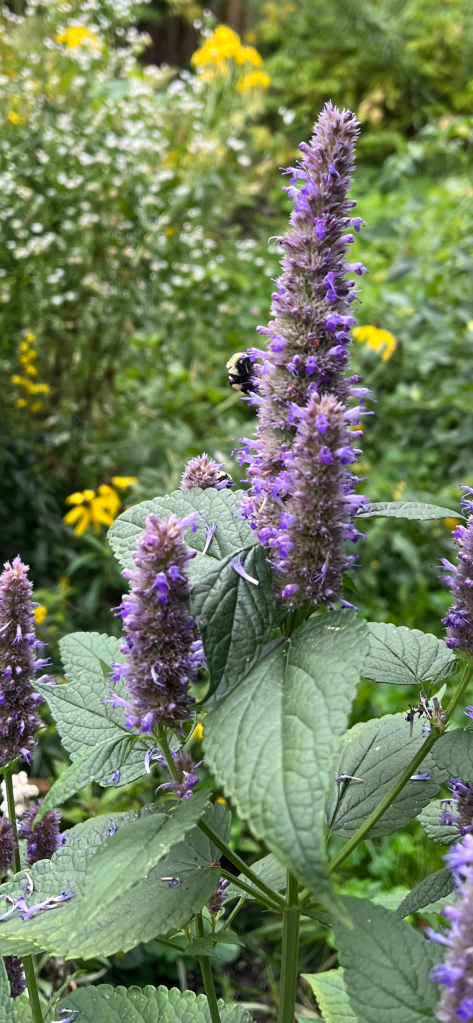
Last year I planted what I thought was Agastache foeniculum (Anise Hyssop). It was a huge Bombus (Bumblebee) magnet and flowered virtually up until frost. It did not come back this spring — apparently it is considered a short-lived perennial, but in the end, I concluded that its demise was mainly due to a sustained dog pee assault. I am the crazy gardener that runs after my dogs with a watering can. I digress.

Agastache rugosa (Korean Mint) and a Bumblebee visitor

Like many in the mint family, there were many seedlings that popped up in its place. Fast forward to this week, and I noticed a discussion online about how some nurseries are inadvertently selling Agastache rugosa (Korean Mint) instead of A. foeniculum.

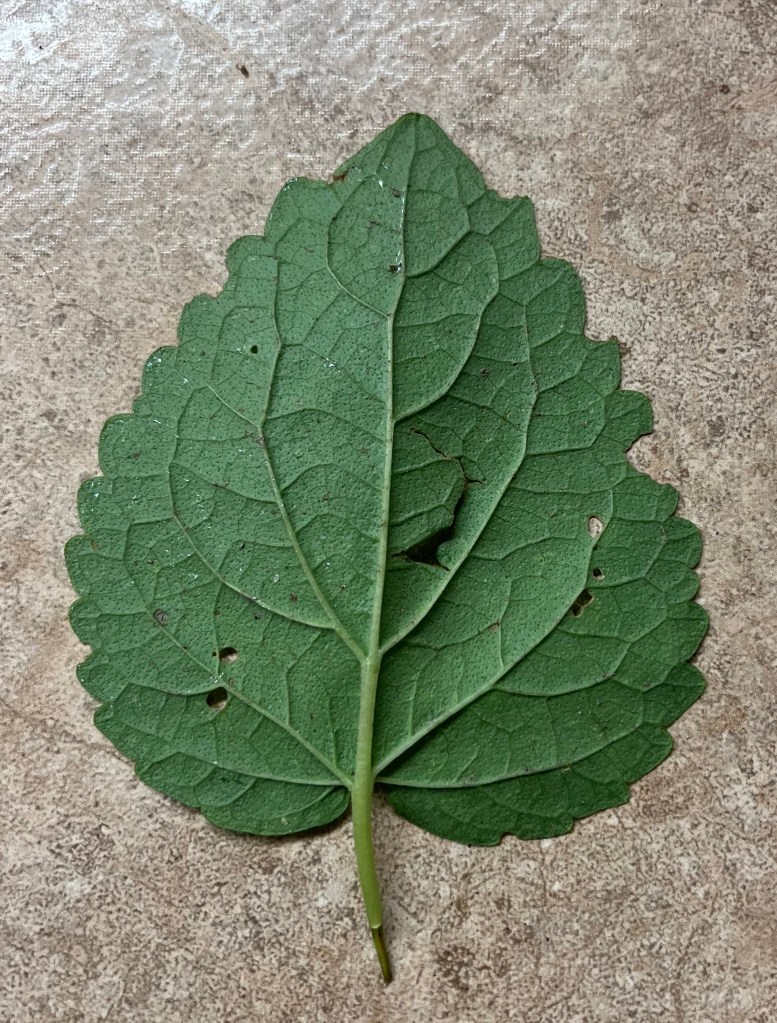
After careful inspection, I am now certain that I am one of many who got the non-native species. “Both these species are aromatic and have flowers of similar colors, but Korean mint has rugose, dark green leaves with cordate bases, whereas Anise Hyssop has shiny, bright green leaves with feltlike undersides and cunate bases.”[ii] The undersides of the leaves of A. rugosa also have little indentations (areoles) that A. foeniculum lacks.[iii]

Underside of Agastache rugosa leaf

The question is, should I keep it in my garden? A field study of Agastache spp. in Iowa over a three-year period found that more Apis mellifera (European Honey Bee) visited the Korean Mint and hybrids than Anise Hyssop.[iv]

Judging from the number of Bumblebees on the few plants that sprung up this year, it would seem like a keeper. If I were to find and plant Anise Hyssop, there would be a high probability that it would cross-pollinate with the Korean Mint, creating hybrid plants. According to the literature, these hybrids are sterile[v] and so there would not be a problem of the hybrids re-seeding. Korean Mint is also morphologically like Anise Hyssop.[vi] This means that there is a greater chance that pollinators can benefit from the non-native species. I am waffling.


[i] Boggs, Joe. Hydrangea Leaftier. Buckeye Yard and Garden Online. May 22, 2022. Ohio State University. Online: https://bygl.osu.edu/node/1979 Accessed August 24, 2023

[ii] Widrlechner, Mark P. A Field Evaluation of Native Mint Family Plants as Honey Bee Forage in Iowa. Proceedings of the Twelfth North American Prairie Conference 1990. p. 40. Online: https://dr.lib.iastate.edu/handle/20.500.12876/55985 Accessed: August 24, 2023.

[iii] Serres, Terry. Buyer Beware. Agastache foeniculum vs. Agastache rugosa. September 2018.

https://bigriverbigwoods.org/wp-content/uploads/2019/03/ThreeProblemSpecies_v3.pdf Accessed: August 24, 2023.

[iv] Ibid., p.40.

[v] Vogelmann, James E. “Crossing Relationships among North American and Eastern Asian Populations of Agastache Sect. Agastache (Labiatae).” Systematic Botany 10, no. 4 (1985): p. 451. Online: https://doi.org/10.2307/2419137 Accessed: August 24, 2023.

[vi] Ibid., p. 451.

Native Ontario Goldenrods for Your Garden

by Emma Murphy, Master Gardener

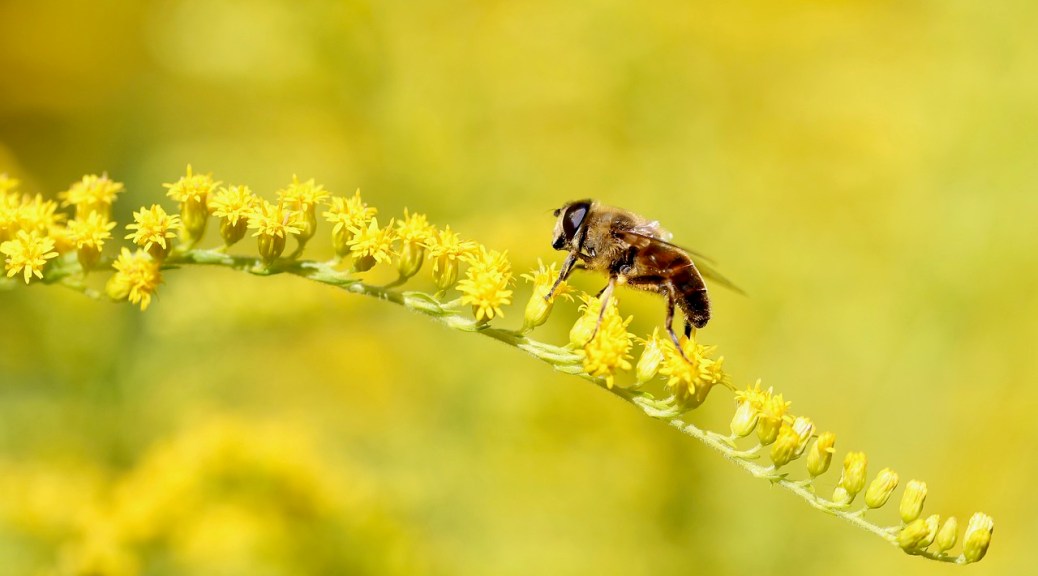
The burst of bright yellow in our late summer gardens and surrounding countryside heralds the blooming of our iconic native goldenrods. Although there are more than 25 goldenrods native to Ontario, most people are familiar with Canada Goldenrod (Solidago canadensis), which is likely the tall one you see as you are out driving.

I have lots of Canada Goldenrod in the naturalized back of my garden, but I also call it my garden thug, because it’s very happy there and trying to take over the world (or at least my backyard). First it outcompeted my New England Asters, and then started crowding out my newer planted trees.

So I started exploring other, more well-behaved goldenrods to add to my garden that still bring all the benefits of this lovely plant, including acting as important nectar and pollen sources for many specialist pollinators and host plants for many moth and butterfly caterpillars. Goldenrods are important late season fuel for migrating butterflies (like monarchs) and our bumblebees.

Here are 3 goldenrods that you should be able to find at native plant nurseries (and maybe eventually in our regular nurseries) that I am experimenting with in my garden.

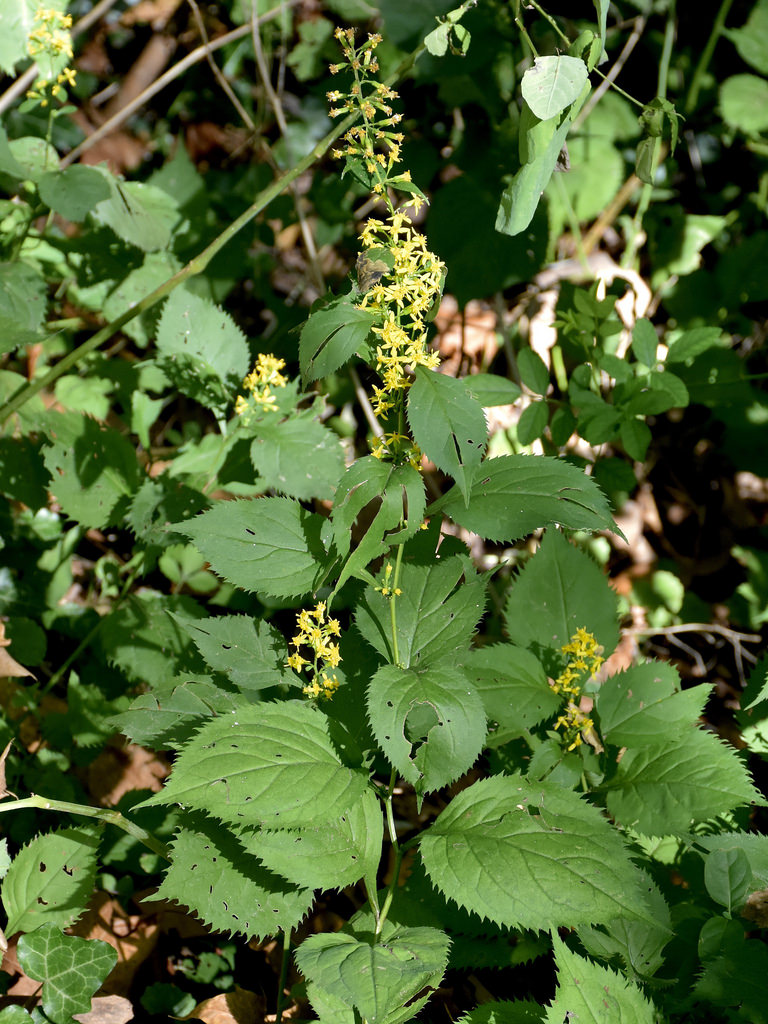
Zigzag Goldenrod (Solidago flexicaulis)

I first saw this goldenrod in a local provincial park and fell in love with it because it thrives in shade/part shade! It can take fairly dry conditions and will grow up to 3 feet high. I’m told if it’s happy it will spread nicely by rhizomes and seed. The name refers to the “zigzaggy” form of the stems. Added bonus? It’s fragrant.

Photo credit: Kirsten Johnson

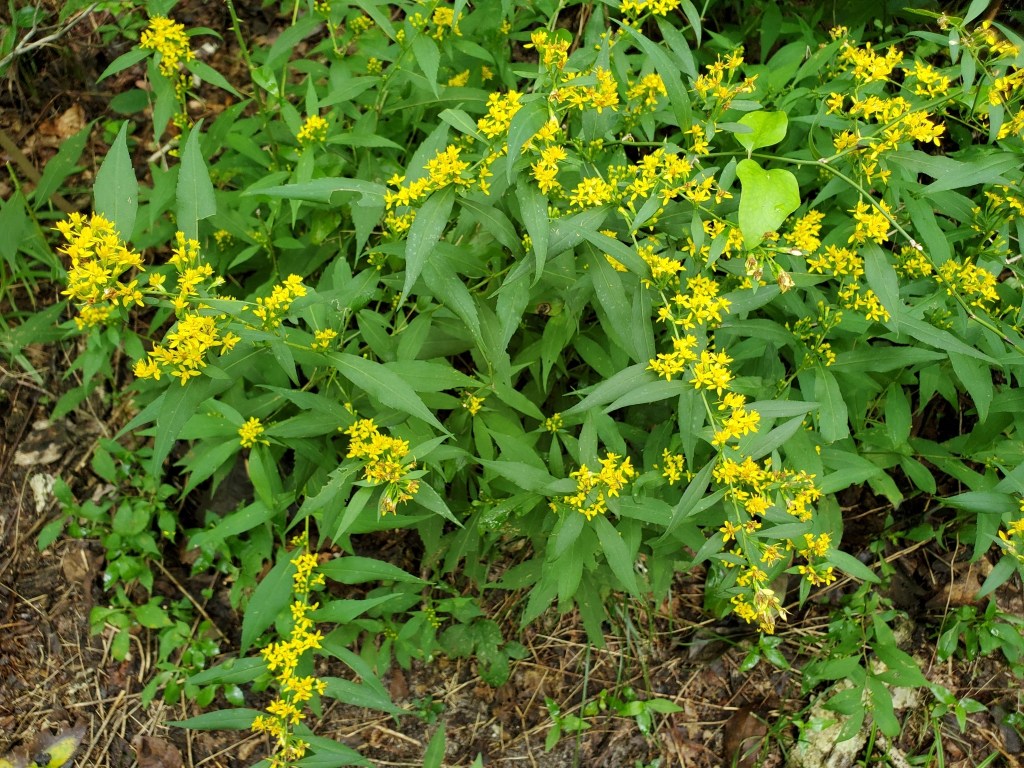
Bluestem Goldenrod (Solidago caesia)

Another winner in my book (before it’s even flowered) because it also brightens up shade gardens, although this one prefers moister soils. Bluestem Goldenrod has graceful, arching stems and bright yellow flowers and can reach 3 feet tall – the name comes from the purplish stems. It will colonize over time by self seeding. Also known as Wreath Goldenrod.

Photo credit: Tom Feild

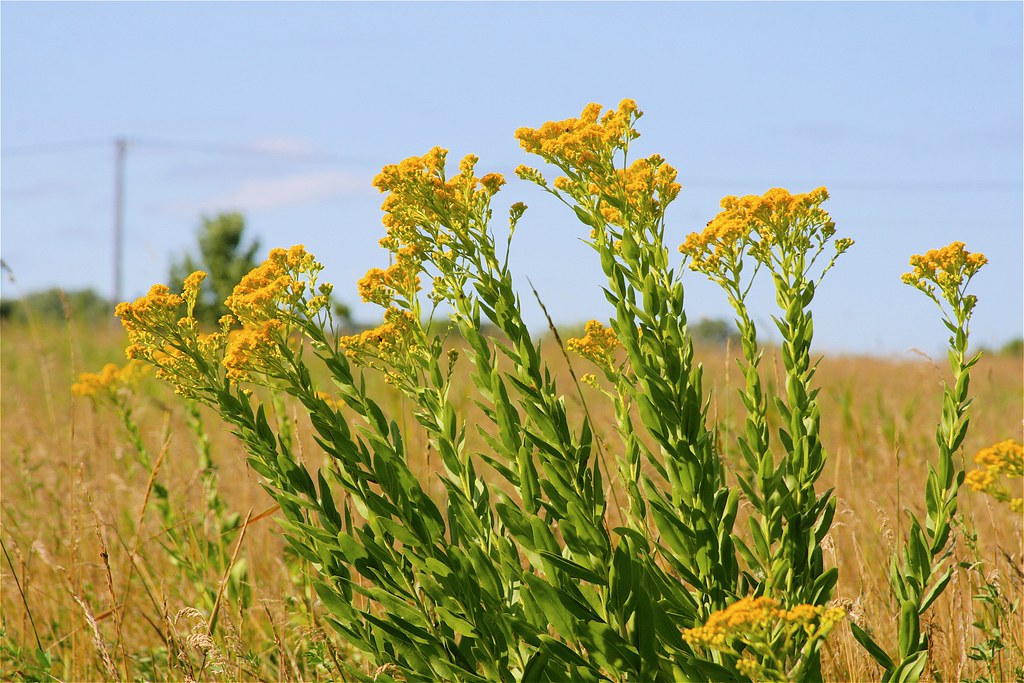
Stiff Goldenrod (Solidago rigida)

This one’s a sun lover and can reach 5 feet; I’m trying it in my front garden bed with my New England Asters (Symphyotrichum novae-angliae), cup plant (Silphium perfoliatum) and false sunflowers (Heliopsis helianthoides) because it needs similar height plants to avoid floppiness. Unlike the bluestem goldenrod, this one is upright and has large oval leaves and a cluster of yellow flowers at the top of the stems.

Photo credit: Dan Mullen

The City of Toronto’s LiveGreen initiative has some excellent additional information on various other goldenrods here. There is one to meet whatever garden conditions (sun/shade; dry/wet etc) you might have. You can also grow some in containers!

For those interested in more information on identifying and learning about goldenrods here are a few resources:

Ontario Wildflowers – Goldenrods Group

Ontario Wildflowers – Learn the Goldenrods

Goldenrods

Native Goldenrods for Ontario Gardens

So what new goldenrods will you try in YOUR garden?

Do Goldenrods Cause Hay Fever?

And finally (because we’re always asked this question as soon as fall hay fever starts) no, goldenrods do not cause hay fever. Their pollen is far too heavy to be blown around in the wind – the real culprit is Common Ragweed (Ambrosia artemisiifolia) which is easily blown around by the wind and while native, will never find a place in our garden (my husband gets hay fever). NOTE: yes I acknowledge that some people are allergic to goldenrod but they have to literally stand beside them to get the pollen on them). I love what Horticulture Magazine has to say

So why do we blame goldenrod instead of ragweed? Probably because goldenrod flowers are so showy. Ragweed’s green flowers are inconspicuous. It makes sense that people suffering from allergies suspect the plant that they can see is in full, abundant bloom.

Horticulture Magazine

Why are my Columbines Changing Colour?

by Emma Murphy, Master Gardener

Columbines (Aquilegia spp) are lovely perennials. I have had them in my garden for many years, and they always offer a pop of colour in the late spring/early summer garden here in Lakefield, Ontario.

These easy care perennials come in a variety of colours, shapes and sizes – most are bi-coloured, ranging from pastel shades to vibrant hues. Columbines have distinctive five-petaled flowers with long backward-extending spurs as pouchlike extensions of the petals, containing nectar. Sepals and petals are brightly coloured. The leaflets of the compound leaves are usually rounded and notched.

In my garden I have both cultivars and straight species (native) columbines, but it was a query on our Master Gardener of Ontario’s Facebook page about someone’s columbines changing colour from year to year that caused me to go down the research rabbit hole to try and find an answer for them.

What Did I Find Out?

Well, apparently columbines really like to hybridize with other columbines. They really do. They are also sensitive to their soil conditions and a number of other factors.

There has been some fascinating research done at universities like UC Santa Barbara (here and here). In one study they used two columbine varieties – red columbines pollinated by hummingbirds, and white or yellow columbines pollinated by hawk moths. Apparently hummingbirds prefer medium length nectar spurs (the ‘tails’ on the columbines), while hawk moths prefer the relatively longer-spurred species.

The study also noted that columbines can change from blue to red, then white to yellow. According to the researchers, the colour shift from red to white or yellow in columbines has already happened at least five times in North America.

So Why Do They Change?

There are several reasons why columbines change colours:

  • DNA mutation
  • Natural selection
  • Adaptive radiation
  • Hybridization
  • Changes in soil conditions

DNA Mutation

Based on the UC Santa Barbara findings, at least 34 genes produce different columbine flower colours. Because of the presence of various genes, there’s an increased likelihood that the colours will change simply due to gene mutation. It doesn’t happen because of creation of new genes, but just because of current gene mutation.

Natural Selection

In the studies and mentioned above, if most pollinators are hummingbirds, most of the columbine colours are red. However, when the population shifts and most of the pollinators become hawkmoths, there’s a potential for the colour to modify. The resulting blooms can be white or yellow.

Adaptive Mutation

Another concept explored in the study of the columbine colour changes is adaptive radiation, based on Charles Darwin’s Theory of Evolution, which assumes that living organisms change their structures to better adapt to the changes in their surroundings. For columbines, flowers develop new traits as a response to changes in their environment. In this case, the changes include the pollinators

Research shows that columbine flowers are tailored to the tongues of their pollinators, which shows an example of how they evolve based on their environment.

Hybridization

Columbine colour change can also be due to cross-breeding, when male and female parts are pollinated. The goal? Combining the positive attributes of two species, changing the physical characteristics, resulting in a better yield and disease resistance, among others. 

Hybridization can also occur non-deliberately – for example when we plant two columbine varieties near each other, this will often create colour changes from the original plants.

To prevent problem hybridization, especially with our native Eastern Red columbine (Aquilegia canadensis), the best thing you can do is plant the native species as far away from the cultivars as you – not foolproof but an important thing to consider. Or don’t have any cultivars on your property, but that doesn’t guarantee they will stay the same as pollinators move from garden to garden.

Changes in Soil Conditions

It’s common for columbine colours to shift because of slight changes in the soil’s pH, as well as the presence or absence of metal ions in the soil. A pH lower or higher than 6.0 to 6.5 can result in nutrients being unavailable, which in turn can affect colour.

Our beautiful native Eastern Red Columbine (Aquilegia canadensis)

Colour change in columbines is a fascinating phenomenon, as you can see from my “rabbit hole research”.

But here’s the bottom line – if you want to keep your native columbines from hybridizing with cultivars you have to keep them as far away from each other as possible. If you like the idea of them changing colours (for a variety of reasons) just sit back and enjoy!

MORE READING

Sudden evolutionary change in flowers (2022)

Biologists discover a gene critical to the development of columbines’ iconic spurs (2020)

‘A Hopeful Monster’ (2022)

Dramatic diversity of columbine flowers explained by a simple change in cell shape (2011)

Like Moths to a Flame – Rethinking Outdoor Lighting in Your Garden

by Emma Murphy, Master Gardener

A few weeks ago, the incomparable Lorraine Johnson spoke at my local horticultural society. She summarized four key actions gardeners could do to help our pollinators, and the last one stuck out for me — reduce/reconsider outdoor lighting (see her full list of actions at the bottom of the blog).

I thought, what does outdoor lighting around my house or garden have to do with pollinators? I know that the presence of lighting (or even more importantly, light frequency) is disruptive for migrating birds and nesting sea turtles, but for pollinators in my garden?

However, what I’ve learned in my research is that artificial lighting at night (aka ALAN) poses a hazard to nocturnal pollinators and prevents proper navigation, reproduction, and their ability to find food.

This really cool graphic (from Kenilworth Park and Aquatic Gardens in Washington DC) shows some examples of day and night pollinators.

Why is it a problem?

Use of ALAN has rapidly spread around the globe over the past few decades. This 2021 Nature Communications journal article states increasing evidence that ALAN adversely affects the behaviour, physiology, and survival of animals and plants, ultimately leading to a significant decline in their abundance and diversity.

This 2020 Biological Conservation journal article says that although habitat loss, pesticide use, invasive species, climate change all play a role in insect decline, ALAN is another important—but often overlooked—bringer of the “insect apocalypse”.

A Nature journal article back in 2017 also sounded the alarm, showing that in ALAN plant–pollinator communities, nocturnal visits to plants were reduced by 62% compared to dark areas.

This UK Royal Horticultural Society article lists some of the effects of ALAN, not just on pollinators but all wildlife:

  • Nocturnal insects (including many moths) who navigate using natural light sources (like the moon) are disoriented by ALAN (although research is now indicating that ALAN disrupts circadian rhythms in both nocturnal and diurnal animals).
  • Security lights appear to temporarily blind some animals and may even attract them (for example, frogs – I have seen this in my backyard near my pond).
  • Birds are disturbed from sleep by sudden lighting and can begin singing before dawn (robins especially seem sensitive to light). Birds that start migration flights at night can become disoriented.
  • In ALAN areas, shorter periods of nighttime darkness means less time for foraging/hunting for crepuscular (dawn/dusk) or nocturnal species.
  • ALAN is thought to be partly to blame for the decline of fireflies/glow worms; the females emit low, greenish light to attract mates and even low level ‘skyglow’ from distant light sources such as floodlit playing fields or towns will lessen their breeding success.

The type (frequency) of light seems to affect species differently. For example, research indicates that LEDs seem to attract more moths and flies, but fewer beetles than sodium lamps. And LEDs with cool white light (blue end of the spectrum) attract more insects than warm white ones. As a general rule insects are more sensitive or attracted to short-wavelength (UV, blue and green) than long-wavelength (orange, red and infra-red) light.

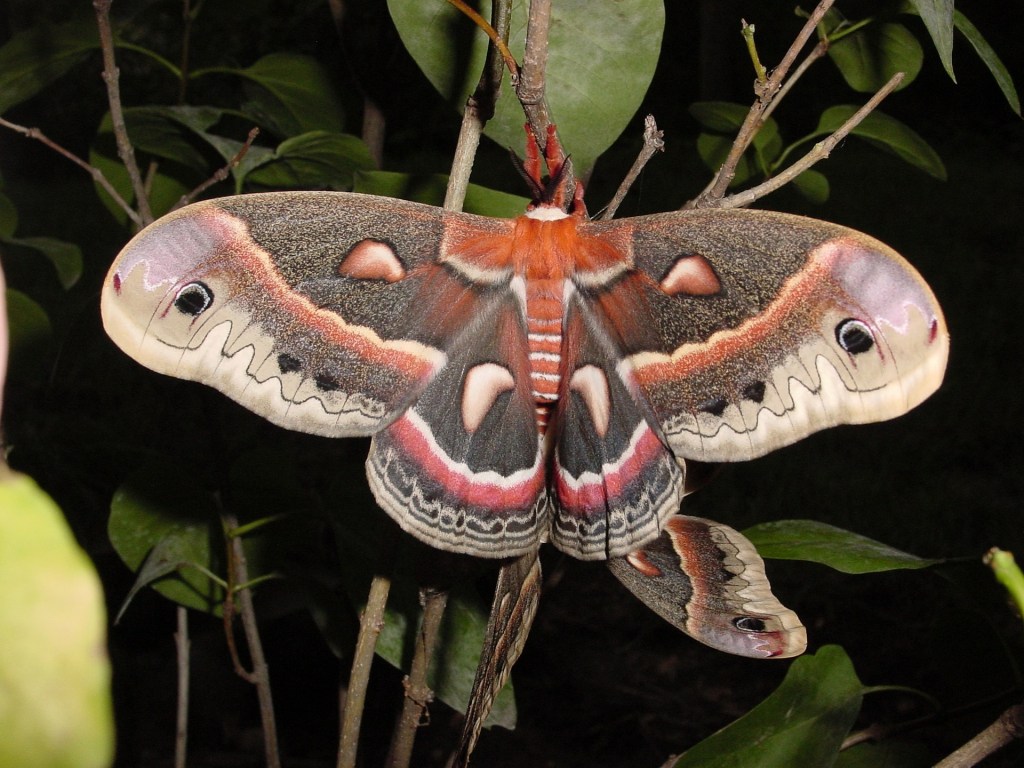
Cecropia moth (Hyalophora cecropia)

So what can gardeners do?

While ALAN has become a trendy part of our outdoor living spaces, consider whether you really need it, or modify it to minimize its impact. In my back garden I definitely need some path lighting for visiting guests, but I make sure it’s shielded lighting that is on a motion sensor so it’s only on for a short time. The International Dark-Sky Association has some great information on keeping our skies dark, including using shielded light fixtures that minimize glare, light trespass, and skyglow.

Besides, a garden can be just as magical a place enjoyed in moonlight or simply with the aid of a flashlight! And if you minimize ALAN you might just see more fireflies/glow worms in your garden, like I do (hint: having a pond or water feature also attracts them).

Want More Information?

Moths do the pollinator night shift – and they work harder than daytime insects

Fatal attraction: how street lights prevent moths from pollinating

The Darkness Manifesto: On Light Pollution, Night Ecology, and the Ancient Rhythms that Sustain Life by Johan Eklöf (on my to read list)

Seedy Saturdays and Sundays – What are They?

by Emma Murphy, Master Gardener

Prior to 1990, the word ‘seedy’ tended to be associated with shabby or run down areas or clothes, or a somewhat disreputable reputation.

Synonyms for Seedy. (2016). Retrieved 2023, February 24, from https://thesaurus.plus/synonyms/seedy

Ironically enough, some speculate that the term probably came from the appearance of flowers after they’ve shed their seeds, when they start to lose colour and eventually die.

However, that all changed in 1990, when the first Seedy Saturday was held at the VanDusen Botanical Garden in Vancouver, BC. At the time, the idea of conserving heritage seeds from garden plants or agricultural crops wasn’t really a thing, and it was hard to find heritage varieties of vegetables, fruits, flowers, and grains.

In  1988 Sharon Rempel wanted to find period-appropriate heritage vegetables, flowers and wheat for the 1880s heritage gardens she was creating at the Keremeos Grist Mill museum. As a pioneer in Canada’s organic and heritage seed movements, she organized the first Seedy Saturday event, and has kept the titles “Seedy Saturday” and “Seedy Sunday” dedicated to the public domain.

In Canada, these events have continued to be locally or regionally organized events, although the amazing organization Seeds of Diversity maintains a national presence. Almost all of these events occur in the late winter, with a few in the autumn.

Screen capture from Seeds of Diversity website http://www.seeds.ca

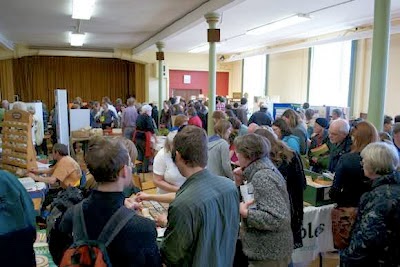
We totally get it. Canadian winters are long and cold and by February, gardeners are already looking forward to the springtime and planting. Seedy Saturdays/Sundays are non-profit, public events organized by individuals and community groups to bring together gardeners, seed companies, nurseries, gardening organizations, historic sites, and community groups so they can learn from one another, exchange ideas and seeds, and purchase seeds and plants in a social setting. Seeds of Diversity promotes these events on their website.

Many Master Gardener and Ontario Horticultural Association organizations are critical partners in these events – I love this poster from the London Middlesex Master Gardeners for this year’s event.

Every year more communities join the movement – according to Seeds of Diversity more than 170 events were held in 2019 across Canada. These events can be small or large, depending on the community. I love that they all have the same themes of encouraging use of open-pollinated and heritage seeds, enabling local seed exchanges, and educating the public about seed saving and environmentally-responsible gardening practices.

They’re a great opportunity to swap and exchange your seeds with others, get new varieties from other seed savers, meet seed companies in person, attend workshops/talks, and of course buy seeds!

In the Peterborough area, we are finally getting back to an in-person event. 2023’s Seedy Sunday will be held on Sunday March 12th from 11am to 3pm in a new location at the Peterborough Square Mall in downtown Peterborough (where the winter Farmers’ Market is being held). It’s a great venue, with lots of space (the pre-pandemic Seedy Sunday was held at the Emmanuel United Church and George St United Church).

Long time organizer Jillian Bishop (who runs her own UrbanTomato business and hosts seed saving workshops) says the event is “the perfect place to get inspired for spring. Come out to get all the knowledge, tools and resources needed to get growing this season.”

Jillian Bishop with her Urban Tomato sales stand.

This year’s Peterborough Seedy Sunday event includes:

  • An incredible diversity of vegetables, flowers, herb seeds available for sale
  • Community groups showcasing the great work they do locally
  • Informative hands-on workshops
  • A popular Seed Exchange Area where you can trade seeds with other gardeners

Get more information at:

Facebook: @SeedySundayPeterborough

Search for #PtboSeedySunday

PeterboroughSeedySunday

Jillian says the last few years have been challenging because of the pandemic.

“As many of you know, in 2020, two days before we were set to host our 15th annual event, we had to cancel as the world began to shut down. As disappointed as we were, we knew it was the right thing to do! Of course, no one could have predicted what happened in the weeks, months and years to come, particularly in the world of seeds and gardening.

All of a sudden seeds became a hot commodity, and seed vendors across the world saw unprecedented demand as people became more concerned about securing their food sources, and had more time at home to plan, plant and enjoy their gardens.”

Peterborough Seedy Sunday, like similar events, went virtual for a few years, but Jillian is very happy to be planning a return to in-person seed fun and spring mania for the 15th annual event, with 13 vendors selling seeds, compost supplies and more! Workshops will be focusing on hands-on skills sharing.

If you’d like to take part in the Seed Exchange, please bring your seeds divided into smaller envelopes (approx. 25 seeds) labeled with the name of the plant, year harvested, and any other information you would like to share! Once you have them all ready, you can bring them down to the Seed Exchange and swap them for other fun varieties you have yet to try in your garden!

Hope to see you in Peterborough, or join your local ‘seedy’ event!

Words of Wisdom from Jillian Bishop

Why I Save Seeds

“Saving seeds means a lot to me. It means a lot to the world. Each heirloom seed contains history and future. Past and present, the ability to adapt to unforeseen climate change and unique environments, to spread stories and knowledge through generations it contains the capacity for communities to grow their own food in sprawling fields, community gardens, abandoned lots and fire escape pots.

Those seeds are living beings. They want to grow. They needs stewards. Citizens willing to give them water, sun, soil and yes, cheesily enough, love.”

More links and information

Seed Companies in Canada -list of seed companies in Canada, as well as the vegetable and fruit seed they’ve sold in recent years.

Peterborough Seed Savers Collective – Great short film (2015) about seed saving work happening locally – follow local seeds being grown out by the emerging Seed Savers Collective, and being shared at an annual Seedy Sunday event.

Why is Biodiversity Important? – Learn why diversity of plants and animals is important.

Canadian Seed Security – The Bauta Family Initiative on Canadian Seed Security works with farmers, researchers, universities, and other organizations to develop resources that can help farmers and seed growers advance their knowledge on seed in Canada.

Seed Savers Exchange – Stewards America’s culturally diverse and endangered garden and food crop legacy for present and future generations. We educate and connect people through collecting, regenerating, and sharing heirloom seeds, plants, and stories.

Start a New Habitat

By Marilyn Homewood, Master Gardener

Over the past few years, it has become increasing clearer that loss of biodiversity due to loss of habitat is at a crisis level.  It is also well documented that the planting of native species provides us with an opportunity to help reverse this process by creating or enhancing ecological networks.

Renowned entomologist Douglas Tallamy has been beating this drum for some time.  It is his belief that all of us can provide part of the solution no matter our area of interest and no matter the scale of effort (no need to be a native plant purist!). He believes that small efforts by many people can make a significant contribution. Tallamy provides practical, positive advice for adapting his principles into your situation.  His philosophy is about encouraging folks to participate in regenerating biodiversity in the way they are most comfortable versus prescribing “must do’s” or formulas. He doesn’t let the perfect be the enemy of good. To this end, he is spearheading a grass roots, science-based solution called Homegrown National Park. Participants in both the US and Canada involved in this effort are encouraged to register their properties on the parks map in order to be counted towards the park’s goal of planting 20 million acres.  The website provides extensive resources to gardeners such as blogs and videos as well as a newsletter.  You can also follow the park on Instagram  @homegrownnationalpark.

Tallamy suggests 10 steps that anyone can all do to get started and make a contribution (see the link for more detail). They are as follows:

  1.  Shrink your lawn – All of us could probably do with a little less lawn to cut but no need to go without.  Replace some turf with trees, shrubs or gardens.
  2. Remove invasive species – Invasive species interfere with the ecosystems ability to function and will affect any type of garden. Removing some if not all out will reduce the impact on your plants and reduce the amount of seed that is shed into the environment.
  3. Encourage Keystone Genera – Research has shown that a few genera of plants are the backbone of local ecosystems especially as a food source for insects. Without local keystone plants, food webs will fail. Common keystone plants in the east are oak, willow, birch, elm, goldenrod, aster and sunflower. In my own case, goldenrod and aster is abundant on the farm. I now let it grow along the perimeter of my fields instead of cutting it down.
  4. Be generous with your plantings. Increasing the abundance and diversity of our plantings will assist in realizing the ecological potential of our landscape.
  5. Reduce Nighttime Light Pollution. White porch lights and security lights are a major cause of insect decline. Consider switching lighting with motion sensors or replace white bulbs with yellow (less attractive to bugs).
  6. Network with neighbours and encourage them to get involved.  Be a role model by transforming your property in attractive ways.  Display a sign to show your commitment.
  7. Build a conservation hardscape by using window well covers to prevent toads and frogs from falling into the wells where they starve to death. Mowing your lawn no lower than 3 inches helps to ensure that you mow over the turtles, toads and other small critters.
  8. Create caterpillar pupations sites under trees. Most caterpillars drop from trees to pupate in duff on ground. Replace the lawn under trees with well planted beds full of ground cover to encourage pupation.
  9. Avoid use of chemical fertilizer. Create soils rich in organic matter instead.
  10. Educate, educate and educate. Spread the word.

    “Education is the most powerful weapon which you can use to change the world.” -Nelson Mandela

Native Plant Gardening for Birds, Bees & Butterflies

by MJ Parker, Master Gardener

I recently downloaded “Native Plant Gardening for Birds, Bees & Butterflies” from my local library. This book was a fabulous find for me because I am currently planning a buffer area by the water in our new place. Going through this book reminded me of when I was a kid with a new Sears or Eaton’s catalogue – always an exciting event – something only people of a certain age will remember.

Book cover

The book was written by an entomologist, Jaret C. Daniels, currently living in Florida but the area covered by the book is the upper Midwest which is roughly parallel to us here. I have ordered plants from Minnesota before with no problems and some of the plants I currently grow are in the book.About 1/4 of the book is devoted to why we should plant gardens for birds, bees and butterflies. He does a brief summary on a number of topics about the actual mechanics.

False Indigo (Baptisia australis)

Most of the book, however, was a precis of individual plants roughly divided into sun, shade, and bog. Each plant started with a picture, then a summary of what it would attract and ended with specific location and cultivar tips. And this plant section was the part that I found extremely interesting and helpful.

New Jersey Tea (Ceanothus americanus)

So what I did was I sat down with a pen and paper over a number of days and compiled a list of what would work for me and plants I wanted to get. I ended up with a comprehensive list of plants, some I had forgotten to bring from the old place and some completely new to me.

And to date I have already placed 2 seed orders for some of the things on my list.

Google Lens (free!) for all of your identification needs

By Mary-Jane Pilgrim, Master Gardener

If you’re outside enjoying the fresh air, and happen across a flower or bird or insect and you’re not sure what you’re looking at, a new feature from Google can help you out.

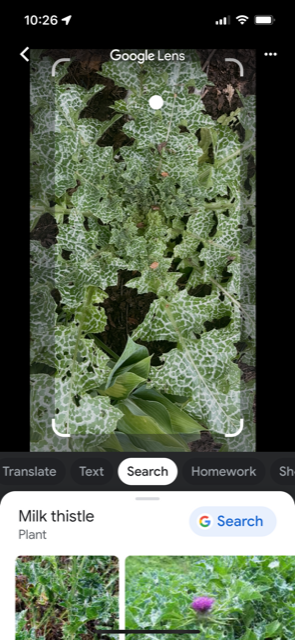
Google Lens lets you search what you see. Using a photo, your camera or almost any image, Lens helps you discover visually similar images and related content, gathering results from all over the internet.

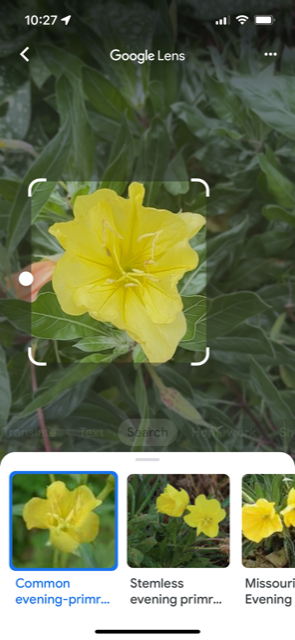
All you need to do is: On your phone, open the Google app and in the search bar, tap Google Lens. Point your camera at the flower to identify the plant. Swipe up to learn about the discovery.

On Android, Google Lens is likely already built right in — open the Google App or Google Photos app. Tap Discover or tap the Google Lens icon.

On Apple, Google Lens is part of the Google app — a separate app from using Google on Chrome, Firefox or Safari. Go to the App Store and download/install Google as a unique app if you haven’t already done so.

When you open the Google App, you’ll see a screen like this with the Lens icon. It’s your window to discovery!

Last week, I went for a long walk and checked out a lot of the volunteer trees and plants along the rural roadway. Sometimes I wanted to verify an item I thought I already knew, but more often I wanted to determine the name of a common but name-unknown item. Google Lens scored on both fronts. Now if only I could remember all of those names!

If you have a bug infestation, use Google Lens to identify the bug if you can get it to sit still long enough!

There’s plenty more you can do with Google Lens, too, including pulling the contact information from business cards, identifying unusual foods and almost anything else. It can also translate words on the screen into other languages, and read them back to you.

The ability of the app to actually CORRECTLY identify plants and bugs is pretty decent, and will get better over time. It helps to allow Google to use location services, so that it’s not searching through the entire rain forest to determine the name of the plant in your neighbourhood. You can also allow Lens access to your photos, so that you can identify items you’ve already taken pictures of.

Best of all, it’s free and will always be free. Try it!

The Golden Glow Has Got To Go

By Emma Murphy, Master Gardener

Last year around this time I wrote a blog about reclaiming a garden bed from the dreaded ditch lily (Hemerocallis fulva), now considered an invasive species by many organizations including Ontario Parks and the US Fish & Wildlife Service and the U. S. National Park Service. If you’ve ever struggled with this plant you know what I mean.

The other plant growing in our large Lakefield garden when we moved in (more than 20 years ago) is what I was told was called an ‘outhouse plant‘. I eventually learned that the Latin name for this plant (also called golden glow or tall coneflower) was Rudbeckia laciniata “Hortensia”.

Rudbeckia laciniata “Hortensia” or Outhouse Plant, circa 2005 in my garden

It’s a cultivar of our native Rudbeckia laciniata, also known as Cut Leaf Coneflower or Green Headed Coneflower, which has a lovely simple daisylike flower (whereas the Hortesia cultivar is a double ‘puffy’ flower).

Our lovely R. laciniata elsewhere in the garden. It will do better (and flop less) if it’s in a garden bed with other tall and native plants.

The outhouse plant was pleasant enough so I let them grow for years in what I call our ‘back 40’, meaning our naturalized garden area at the back of the property, behind the cedar rail fence. Yes they were tall and gangly, and fell over in thunderstorms. Yes they spread, but they gave the prolific Canada Goldenrod (Solidago canadensis) and New England Asters (Symphyotrichum novae-angliae) a run for their money in August/September. And hey, I had more than enough to deal with in the rest of my more organized garden!

However, as I started to learn more about both native (and invasive) plants over the years I realized that I might have a problem. The outhouse plant isn’t a huge problem per se, as it can be controlled through digging, Chelsea chop etc., but its double shape means that it offers minimal benefit as food for our pollinators. And I wanted plants that not only look beautiful but have an ecological benefit. So I sat in my hammock and pondered.

Sitting in my hammock contemplating the outhouse plant’s fate
(he’s watching on the right)

As a result of winter sowing (first time this past winter – highly recommend!) I have lots of new native plant seedlings, including some of the ones I featured in my May blog – A Few of My Favourite Native Plants – Culver’s Root (Veronicastrum Virginicum), Cardinal Flower (Lobelia cardinalis), and Green Headed Coneflower (Rudbeckia laciniata). I certainly have lots of the native Rudbeckia, as well as Boneset (Eupatorium perfoliatum), Giant Ironweed (Vernonia gigantea), and Purple Giant Hyssop (Agastache scrophulariifolia).

So the clearing of the outhouse plant began in earnest last week, and by the end of two afternoons I had an area to work with.

The initial chop of material
Then removal of the actual plants and roots

Definitely not light work, but not too difficult either compared to other plants. The area is now clear, and I’ll be putting in Green Headed Coneflower (the native), Boneset, Giant Ironweed, and Purple Giant Hyssop. They can all tolerate a little competition (a good thing for native plants, especially tall ones) and basic soils.

If I have space I might even mix in some shorter plants like native Bush honeysuckle (Diervilla lonicera) and Pearly Everlasting (Anaphalis margaritacea) in at the front as they can tolerate dry conditions. The area is mostly sunny all day. Unfortunately my beloved Cardinal Flower and Turtlehead are too dry for this location.

We’ll see how this experiment works and check back in with you all on another blog. If it works we’ll expand into another area of outhouse plant that I recently cut down, but haven’t removed yet…a work in progress. There are only so many hours in my (still working part time) day. And I still need to get that Canada Ggoldenrod under control…but that’s another story…