All posts by peterboroughmastergardeners

Multiplying Streptocarpus

By Lois Scott, Master Gardener

Don’t worry if math isn’t your thing.  Multiplying, or more correctly, propagating Streptocarpus (Cape Primrose), a beautiful flowering house plant, is not complicated at all. 

If you have a streptocarpus, an efficient way to propagate to get more plants is to take a leaf cutting.  The way you prepare a leaf cutting varies somewhat depending on the plant. Check this link for different propagation methods for other plants.     

Many plants will root well in water but some, like Streptocarpus, will form stringy, fibrous roots that may have difficulty becoming established when planted in soil.  That is why a leaf cutting is advised.  It is quite an amazing process as both leaves and roots are formed and the leaf cutting does not become part of the new plant.

You should have all your equipment clean and ready. Take a healthy leaf from a well hydrated plant and either cut out the midrib of the leaf, creating two leaf pieces or cut the leaf into 5cm sections from top to bottom.  Have a clean pot already prepared with moistened soilless potting mix or half and half potting mix and perlite (medium).  Your moistened medium should still be crumbly, not forming clumps, as that may mean it is too wet and may cause your leaf cutting to rot.  Take your leaf cuttings and place them in the soil.  Placing them about 2.5cm deep is advised but my leaf cutting wasn’t that big.  As you can see parts of the leaf curled up but I still managed to get results.  Five plantlets so far!

After your cuttings are in the soil, place your pot in a plastic bag to keep the humidity high.  Leaf cuttings have no roots to support them so they need the high humidity.  Place your bagged pot in a warm, bright spot but not in direct sun.  It is advised to open the bag every week to release excess humidity and to water as needed.  You may find you never need to water while the pot is bagged. 

In about 6-12 weeks you will hopefully have little plantlets forming.  Wait until they have developed enough leaf and root tissue and then pot on to 3-4” pots and enjoy your new plants.

See also this link: https://www.rhs.org.uk/plants/streptocarpus/growing-guide

Invite Spring Indoors

By Marilyn Homewood, Master Gardener

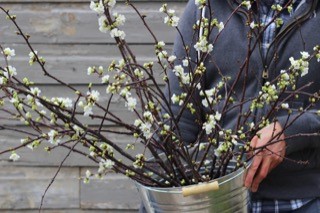
As winter seems to drag on, why not have spring start inside by forcing blooms from some of your favorite woody plants?

Many ornamental trees and shrubs set their flower buds during the previous growing season. These buds must experience a period of dormancy (usually 6 weeks of cold weather) before they will open.  As a rule, the buds will usually come out of dormancy within two to three weeks of exposure to warmth and moisture.

Coincidentally, late winter can be a good time to “clean up” deciduous trees and shrubs.  Prune plants lightly by removing crossed branches and old or diseased wood keeping in mind to leave some buds to bloom in the garden. From the cuttings, select out branches of less than ½ inch diameter for forcing and trim them to a manageable length.

Pruning is best done on a mild winter day when the temperatures are above freezing. The branches and buds are softer and more pliable and transition from cold outdoor temperatures to the indoor temperatures more readily. Try to select branches that seem to have a lot of plump flower buds.  In general, flower buds are round and fat, whereas leaf buds are smaller and pointed.

Once inside, recut the branches to open up the vascular system of the branch and encourage water uptake.  Woody branches do not take up water as easily as green flower stems so they should be cut at the end of the stem for roughly an inch or so with sharp pruners. 

Larger diameter branches can be cut twice at right angles. Place the branches into a bucket of warm water to rehydrate. Keep the bucket in a cool, dark place overnight to allow branches to rest (this also helps them to transition from the outdoors).

After resting, prepare a vase of fresh water for your branches and recut the stems again before placing in vase. Adding a few drops of bleach to the water will help keep bacteria from multiplying in the water and plugging up the vascular system. Place your branches in a bright, cool place away from direct sunlight.  

Changing the water every few days is recommended.  The time taken to bloom depends on when the branches were harvested. Branches harvested in mid-winter can take 2 to 3 weeks for flowers to open. Branches harvested in late winter will bloom in 7 to 10 days.

After blooming, keep the branches away from direct sunlight and away from any direct heat source, which will dry out the buds and branches and reduce overall bloom color and quality. Ideally, try to duplicate the cool, moist environment of the spring.  Once in flower, branches should last in the vase for 10 days. Changing the water frequently and adding flower food will also help to extend their life.

Some of the species that force well are forsythia, fothergilla, witch hazel, ornamental pear, cherry, birch (for catkins), eastern redbud, lilac, magnolia, serviceberry and willow (for catkins).  Or try experimenting.  I have some Red Osier Dogwood in a vase at the moment. The red stems are attractive and although I expect to get foliage perhaps a few tiny flowers may appear.

Resources

Forcing Branches for Winter Colour

Forcing Spring Flowering Branches

Forcing Flowering Branches

Am I a Problem?

By Cheryl Harrison, Master Gardener

Well, yes … I am, but I have a plan.  February 28-March 4/22 is National Invasive Species Awareness Week.   This is an international event whose purpose is to raise the awareness of invasive species.  “Invasive terrestrial plants in a forest ecosystem can be trees, shrubs, or herbaceous plants that have been moved from their native habitat to an introduced area where they are able to reproduce quickly and crowd out native species. These plants are introduced and spread by infested packaging material, seed dispersal by both environmental and human sources, or by escaping from gardens.”  Also look at Ontario’s Invading Species Awareness Program  for more information.

Biodiversity is essential to the continued healthy life of an ecosystem.  Invasive plants can quickly destroy it and humans require the natural resources found in a healthy ecosystem.  We need food and we need water to survive.  We are a part of the ecosystem too.  Doug Tallamy says it best in his book, “Bringing Nature Home” where he writes “…ecosystems with more species function with more efficiency, are better able to withstand disturbances, are more productive, and can repel alien invasions better than ecosystems with fewer species.”

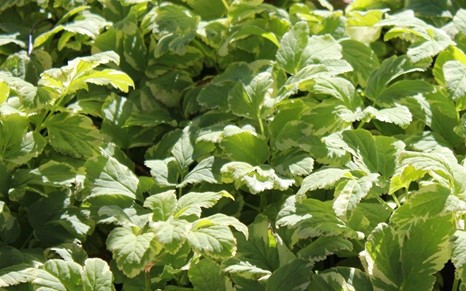
I became aware of invasive species about 15 years ago when on my walk to work, I noticed some English ivy (Hedera helix) growing in a small wooded area.  Then, I realized that English ivy had totally carpeted that area.  There were no other plants!  A couple of years later, I saw the same thing but this time, it was a larger forested area and the culprit was goutweed (Aegopodium podagraria).  Since then I have read more about invasive plants and, sadly, now often see problem areas. 

So, back to my plan.  I was aware of some of the invasive herbaceous perennials so had steered away from them.  See terrestrial plants and  aquatic plants for more information.  However, my husband and I are tree lovers and have a rural property so we frequently indulge in purchasing new trees to add to our collection.  Unfortunately, we ended up with two Norway maple (Acer platanoides) trees, two burning bush (Euonymus alatus) and a barberry (Berberis thunbergii) shrub.  This year, I plan to convince my husband that they must go.  I would like to replace the trees with two red maple (Acer rubrum) or perhaps a couple of sugar maple ((Acer saccharum).  The burning bush will be replaced by a couple of native viburnum maybe nannyberry (Viburnum lentago) and the barberry, well, it will be replaced by a native bush honeysuckle (Diervilla lonicera).  See Southern Ontario Grow me Instead Beautiful Non-invasive Plants for Your Garden. This is a great resource.  It includes some native and some non-native plants to include in your garden plans.

I am inspired to be a better gardener every time I write a blog for the Peterborough & Area Master Gardeners.  I hope that you will have a look at some of the links above and below and be inspired too.  Please only use non-invasives in your gardening plans this year. 

I also recommend reading, or re-reading, a blog by Laura Gardner, Master Gardener in Training posted on February 2/2022: Expanding Your Native Garden Palette.  For more information on what to do if you have a problem, see Best Management Practices Data Base

A new group on Facebook is the Canadian Coalition for Invasive Plant Regulations. The group is very concerned about the spread of invasive plants in Canada and would like to do something about it.

Expanding Your Native Plant Palette

By Laura Gardner, Master Gardener in Training

Last year I posted about Doug Tallamy’s most recent book and talked about how Quercus (Oaks) are the number one “keystone plant species.” A keystone plant is one that supports the entire life cycle of many different wildlife species—all critical to the food web. The list of keystone plants is actually quite short as only 14% of native plants support 90% of butterfly and moth species.[i] Some of these, like Danaus plexipplus (Monarch Butterfly), are specialists in that they require host plants from the genus Asclepias (Milkweed) to complete their lifecycles. Recently I learned that while most native bees are generalists and they seek out a range of plants for pollen, there are certain specialist native bees that are restricted to either a single plant genus or to a few genera. Horticulturist Jarrod Fowler determined that of native bees in the Northeastern United States, only 15% restricted pollen foraging to 33 plant genera and only 201 native host plants.[ii]

Bombus (Bumblebee) on Asclepias incarnata (Swamp Milkweed)

As examples of specialist bees, authors Lorraine Johnson and Sheila Colla mention in their book A Flower Patch for the Rusty-Patched Bumblebee: Creating Habitat Gardens for Native Pollinators in the Greater Toronto Area, two whose sole pollen source plants include Oenothera (Evening Primrose) and Monarda (Bee Balm): Lasioglossum oenotherae (Evening Primrose Sweat Bee) and Dufourea monardae (Bee Balm Sweat Bee). The former is considered vulnerable and the latter is imperiled in Ontario. A recent online presentation by biologist Heather Holm indicated that there are also specific plants that are the sole providers of pollen to Bombus (Bumblebees). For example, Monarda (Bee Balm) provide nectar to them but they do not provide pollen. Pollen is a necessary protein source as is also nectar as a carbohydrate source. Other plants are required for their pollen sources. This list can help as a guide to some of these.

When I first started gardening, I planted different Milkweed and it was all for the endangered Monarch Butterfly. I think I was influenced more by aesthetics and an influential marketing campaign than anything else. While I will continue to have these plants in my garden and continue to support Monarchs, I have become more thoughtful in my choices—especially since the percentage of native plants that are supportive is so small. What can we do to improve our native garden palettes? A good approach is to choose a wide range of geographically appropriate native plants from the top keystone genera that have flowers of different shapes, colours, season-wide blooming periods, and provide nectar and pollen. Plants that historically or genetically evolved in our region will be the most supportive of the native wildlife in our region. Consider also adding some individual species that support specific specialists. As with all plants, you still need to consider whether your planting site is suitable [e.g., light level, soil type (loam, clay, sandy), pH (acidic, alkaline), moisture, drainage, etc.].

Danaus plexippus (Monarch Butterfly) on Asclepias incarnata (Swamp Milkweed)

To help, here are two lists provided by the National Wildlife Federation that can apply to gardeners of the Peterborough area—one for northern gardens in the Northern Forests ecoregion and one for southern gardens in the Eastern Temperate Forests ecoregion. There are also two other related lists for Eastern Temperate Forests and Northern Forests—these also provide examples of ferns, vines, and grasses that are host plants and/or provide nectar and pollen. Heather Holm has also put together a wonderful list of native trees and shrubs for pollinators with their flowering periods. There are a few plants on a couple of the lists that are not found in nature in Peterborough County, however, the majority are.

Euchaetes egle (Milkweed Tussock Moth)

You may be surprised to see Solidago spp. (Goldenrod) listed as the top flowering keystone plant genus. There are 25 species native to Ontario and some of them are easily managed and do not spread like the ubiquitous S. canadensis (Canada Goldenrod) that you tend to see along roadsides and in fields. Last year I added S. caesia (Blue-Stem Goldenrod) to my garden and this year I am looking forward to adding S. rigida (Stiff Leaf Goldenrod) and S. flexacaulis (Zig-Zag Goldenrod). What will you be planting this year?

For Expanded Learning

Johnson, Lorraine and Ryan Godfrey. Get to Know Goldenrod. Online: https://www.toronto.ca/wp-content/uploads/2021/09/97fc-DS-21-0224-GoldenRodFactsheetDigital.pdf

Holm, Heather. Pollinators of Native Plants: Attract, Observe and Identify Pollinators and Beneficial Insects with Native Plants (Pollination Press, 2014).

Ohio State University’s online learning program: Tending Nature: Native Plants and Every Gardener’s Role in Fostering Biodiversity

Pollinator Partnership Canada. Selecting Plants for Pollinators: a Guide for Gardeners, Farmers, and Land Managers in the Manitoulin-Lake Simcoe Ecoregion. Online: https://pollinatorpartnership.ca/assets/generalFiles/Manitoulin.LakeSimcoe.2017.pdf


[i] Narango, D.L., Tallamy, D.W. & Shropshire, K.J. Few keystone plant genera support the majority of Lepidoptera species. Nat Commun 11, 5751 (2020). https://doi.org/10.1038/s41467-020-19565-4

[ii] Fowler, Jarrod. “Specialist Bees of the Northeast: Host Plants and Habitat Conservation.” Northeastern Naturalist 23, no. 2 (2016): 305–20. https://www.jstor.org/stable/26453772.

Happy Valentine’s Day!

By Chris Freeburn, Master Gardener

Many will be receiving a beautiful bouquet of flowers today in celebration of Valentine’s Day. If you are one of the lucky ones who has a sweetheart who will bring you flowers,here are some tips to help you keep your Valentine flowers fresher longer.

Cut flowers need food in the form of carbohydrates or sugar to last for one to two weeks in your home. They also need citric acid to get the pH level correct allowing the stems to draw up water. It has been scientifically proven that water travels faster through the xylem (tissues that carry water through the plant) when the pH is around 3.5. Flowers also need to keep their stems clear of bacteria that can clog and prevent the uptake of water. This can be addressed with bleach. When you add  the small package of floral preservative you receive with your bouquet you are giving your flowers the food, pH level and  bacterial killing agent they need to stay fresh longer.  You don’t necessarily have to use the entire package. Save some to add when you need to refresh your arrangement. You can also buy floral preservative if you bring in flowers from your own garden. Home remedies using vodka, aspirin, pennies or bleach may work, but the little package you get with your bouquet is effective and easy.  One good home remedy is 1 tsp. of bleach and 1 tsp. of sugar in 1 litre of water.

  • When you get your flowers, unwrap them as soon as possible and get them into water.
  • Use a clean vase filled with warm or room temperature water. If you have hard water, let it sit for 24 hours before using. Add your preservative and mix until dissolved.
  • Using a sharp knife or pair of scissors or pruners, cut stems under warm running water and place immediately into the vase. Cutting stems on an angle will give more surface for stems to draw water and the stems won’t lay flat on the bottom of the vase cutting off that ability.
  • Remove any leaves that will go below the water line. These will rot and can cause bacterial problems.
  • Keep your flowers out of direct sunlight and in a cooler rather than warmer room.
  • Keep the water topped up daily. Your flowers will drink if they are happy.

You may find that flowers wilt or droop. If this happens, re-cut the stems at least half an inch and move to another clean prepared vase. I suggest that you remember this when you do your first cut on your flowers and keep the stems longer, so you are able to re-cut and move your bouquet to smaller and shorter vases a few times before they are totally spent.

Some types of flowers will last longer than others, so if you have a mixed bouquet, you will probably lose some blooms before others. Zinnia, carnations, larkspur and glads all should last longer than two weeks.

One of our Peterborough Master Gardeners wrote a great article last summer on growing and harvesting flowers for cutting.  For that article go to Reaping the Flower Harvest.

The reason we love fresh flowers is they are with us for only a short time. Accept that fact and enjoy your bouquet!

Resources

https://ag.umass.edu/greenhouse

https://www.mydomaine.com/how-to-make-cut-flowers-last-longer

https://www.bbg.org/gardening/article/cut-flower_care

https://www.kenoraminerandnews.com/opinion/columnists/display-your-floral-bounty-with-cut-flowers/wcm/0fb663f4-493d-480c-89ed-08fdef396834/amp/

Cool Season Crops

By Sharleen Pratt, Master Gardener

It is that time of year where we turn our attention to thoughts of what we would like to grow in the coming season.  Because of the pandemic, many of us have dabbled in sowing some seeds indoors. It does require time, space, proper lighting and the patience to check your seedlings every few days for proper moisture levels or any signs of disease.

Author’s Seed Catalogues for 2022

Begin planning your garden early.  Now is a good time to browse through the seed catalogues and decide what crops you want to grow based on your own likes and dislikes, as well as how much of each you will need.

If you don’t have the time or desire to start seedlings indoors, there are many vegetables that can be seeded outdoors in the very early spring. They are known as cool season crops.

I look forward to getting out into my garden in the early spring, however, we should not start digging too soon as there are many beneficial insects and native bees that overwinter in the soil or under leaf litter.  They all need time to emerge from their long winter nap.  By growing cool season crops, I get to play in my garden early and benefit from a good supply of fresh vegetables.

Courtesy of Pixabay.com

All the following vegetables can be seeded outdoors as soon as the soil is workable.

LETTUCE & GREENS

There are so many varieties of salad greens such as leaf, mustard, arugula and mesclun. Lettuce is generally a cool season plant, but newer varieties have been developed that will grow happily in the summer.  Salad greens can bolt quickly when the weather gets really warm, however, there are varieties that are more bolt tolerant.  I usually choose seed that I can sow early in the season.  These particular varieties can withstand some shade in the summer so I plant the seed behind a larger vegetable such as kale so that they get the protection they need from the hot sun. Be sure to check the seed package to understand when to sow, how to harvest, and how quickly the lettuce will bolt.

CARROT

Carrots need good drainage and work very well in raised beds.  They work best when planted as soon as the soil can be worked. They require plenty of sun.  The cultivated carrot originated in Afghanistan and was purple.  According to William Dam Seeds, they believe the orange carrot was developed around the 16th Century.  There are many different varieties and some of my favourites are the Nantes and I had great success last year with Nantes Napoli.

KALE

I find Kale a very easy vegetable to grow and it will last well into the fall.  It likes well drained soil.  It is best to harvest the young leaves as the older leaves will get quite tough and stringy.  It is rich in Vitamin C and frost will actually improve its flavour.  I really enjoy Vates, which is ruffled with a medium dark green leaf.  By using a row cover, we were enjoying kale in our salads well into the fall.

RADISH

Radish is amazingly quick to germinate.  I think they add the perfect crispy, peppery taste to a salad. If you plant the seeds early, it will be one of the first vegetables ready for harvest. Radishes also work well for Succession Planting.  Radish varieties have evolved over the years and there are now several different sizes and colours.  I enjoy the French Breakfast varieties.

PEAS

Homegrown peas, whether cooked or raw always taste amazing.  Taller varieties do require some kind of support and will benefit from a fence or string for the vines.  Dwarf varieties are ideal for smaller gardens and don’t require support.  They do need lots of sun but will tolerate some shade in the summer.  Smaller peas are tastier than larger ones, so be sure to harvest often.  The edible garden pea dates back to 16th century England.  I will admit not to have a lot of luck with peas.  I may be getting them planted too late in the spring and with instant summer heat, they do not do well! I am determined to try again this year.  My favourite are sugar snap peas and I would like to try one called Sugar Ann, that matures in 55 days and is a dwarf variety.

SPINACH

A favourite cool season vegetable to grow is the vitamin-rich spinach.  Spinach can be eaten cooked or raw and is full of vitamins and minerals, especially iron and calcium. They mature quickly.  As the plants grow, harvest the outer leaves often to encourage fresh leaf production, but pull the plants before they bolt. Once the flowering process begins, spinach quickly turns bitter, so don’t wait to harvest. Row covers are advisable to protect the plants from leaf miner.  Many varieties have been developed to resist Downy Mildew.

Resources

A good resource for seed planting is Planting Chart Cheat Sheets – Square Foot Gardening

To understand your first and last frost date and when to plant, check out the following on-line tools OMAFRA Frost Dates

Quarantines are Not Just for Humans

By Mary-Jane Pilgrim, Master Gardener

Seeing bugs outside is generally pretty tolerable as we know that many of them are pollinators, but seeing them inside our houses is a completely different story, right? Fortunately, it’s usually easy to manage most indoor pests with little more than some water, a cotton swab, and a soap solution. It all starts with a few preventative actions:

Aphids
  1. Whenever you happily bring home a new treasure (or sometimes, victim!), make sure that you carefully inspect them. Many types of houseplant bugs piggyback their way into your house from friend’s homes or stores. Look on leaf undersides, along the stems, and even in the soil for signs of common pests (sticky substances, flying cloud when disturbed, little bumps, fine silky webbing).
  2. Put your new treasure in solitary confinement for a few weeks, like in a spare room. Even if you think a new plant is pest-free, it may have pest eggs or larvae that you can’t yet see. Watch it carefully and only put it in close contact with other plants after it’s been confirmed to be pest-free. If the pandemic has taught us anything, quarantining is right at the top of the list and it applies to plants as well as humans.
  3. Place a few yellow sticky cards in among your plants. Many pest insects are attracted to the color yellow, and they’ll quickly get trapped on the card. Check the card every few days for any insects. If you have some on the card, you probably have many more on the plant itself.

What if You Detect an Infestation?

The most common pests are aphids, fungus gnats, mealybugs, scale, spider mites and white flies. See this resource for bug-specific instructions.

For all infestations, the first thing to do is to move the affected plant away from all other plants. Quarantine!

Then, take the plant to the bathtub/shower and spray it with water. Many bugs are tiny and are easily washed off the plant. Be sure to rinse both upper and lower leaf surfaces. After the plant has fully dried, use a light-weight horticultural oil or insecticidal soap to smother the pests. Reapply the oil/soap every 10-14 days for two more applications for the best control.

If you detect small bumps, wipe the plants with a cotton ball soaked in rubbing alcohol and remove the bumps if possible.

If you detect pests in the soil, it’s often caused by overwatering. Reducing the amount of water, or watering your plants from the bottom instead of the top should take care of the problem. Spraying the soil lightly with insecticidal soap occasionally often helps as well.

Resources

How to Get Rid of Bugs on Houseplants
Common Houseplant Insects & Related Pests
How to Get Rid of Common Houseplant Pests

Spider mites


Dreams of Spring Gardens

By Emma Murphy, Peterborough Master Gardener

It’s really cold out. I mean REALLY cold. -25 degrees Celsius cold. With lots of snow. And wind. And ice. So it’s got me dreaming of springtime and things that are green and not white.

So indulge me while I research and share with you some of my favourite English gardens in southern England that we plan to visit later this spring. Hoping things improve to celebrate my aunt’s 95th birthday and fulfill a long held dream to visit England in late springtime. While I’m planting many more natives in my messy “English-style” garden, I’m still fascinated with the diversity, structure, and composition of more formal English gardens.

Here’s my top 5 ‘not to be missed South England gardens” – there are (of course) more on our list but these are the key ones. Some of these may be familiar to you, and some not…

Hoping that these profiles help ease the January blues. Since I’ve haven’t been there yet these are photos taken by others. If you have been lucky enough to visit these gardens please share your photos in the comments.

1. Great Dixter House and Gardens, Rye, East Sussex

Great Dixter is an historic house, a garden, a centre of education, and a place of pilgrimage for horticulturists from across the world. Certainly it’s the one garden that has the highest reputation with overseas visitors.

Surprisingly, it’s maintained this reputation for many decades, even through a change of hands. Initially famous through its owner Christopher Lloyd (1921-2006) – who lived in the half-timbered fifteenth-century house all his life – Lloyd (or “Christo” as he was known) was not only a gifted and artistic gardener but a prolific and knowledgeable writer whose articles and books inspired a generation of gardeners.

Today, the gardens are managed by the Great Dixter Charitable Trust and Fergus Garrett, who became head gardener in 1992. I was lucky enough to hear him speak at a Toronto Master Gardeners’ Technical Update a few years ago.

The two gardeners had a creative working relationship, both loving plants and their combinations, and even though Lloyd is gone more than 50,000 visitors a year find Great Dixter as vibrant a garden as ever, and full of things to learn from.

This is an ‘arts and crafts’ style garden, with topiary, a long border, an orchard and a wild flower meadow. The planting is profuse, yet structured, and has featured many bold experiments of form, colour and combination.

On the grounds are three 18th-century oast houses, under a common roof, and a 15th-century barn. Find out more here.

2. Sissinghurst Castle Gardens, Sissinghurst, Kent

Located in beautiful Kent, Sissinghurst Castle Garden was created by poet and writer Vita Sackville-West and her husband Harold Nicolson, author and diplomat in 1930 and developed over 30 years with some notable head gardeners.

Designated Grade I on Historic England’s register of historic parks and gardens, it’s among the most famous gardens in England. They transformed a farmstead of “squalor and slovenly disorder” into one of the world’s most influential gardens.

Following her death in 1962, the estate was donated to the National Trust for Places of Historic Interest or Natural Beauty. It is one of the Trust’s most popular properties, with more than 200,000 visitors each year (and I hope to be one of them!).

There are a number of specialty gardens, including the Rose Garden, the (famous) White Garden, the South Cottage Garden, the Herb Garden, the Nuttery, the Lime Walk (Spring Garden), the Delos Garden (Mediterranean garden), Moat Walk, the Orchard, and the Purple Border. Learn more here.

3. Hidcote Gardens, Hidcot Bartim, Gloucestershire

Hidcote is a world-famous garden located in the north Cotswolds (not far from [the original] Stratford-upon-Avon). Created by the talented horticulturist Major Lawrence Johnston (and inspired by the work of designers Alfred Parsons and Gertrude Jekyll), yew, holly and beech hedges define a series of outdoor garden rooms – the Circle, the Fuchsia garden , the Bathing Pool Garden, the Red Borders and the steps up to the two gazebos. The outbreak of the Great War (1914 – 1918) in which Lawrence fought, suspended progress.

You might recognize the narrow-leaved lavender, Lavandula angustifolia ‘Hidcote’, and Penstemon ‘Hidcote Pink’, as developed by Johnston. Many of the plants found growing in the garden were collected from Johnston’s many plant-hunting trips to faraway places so it will be the perfect source for gardening inspiration. More history here.

4. Gravetye Manor, East Grinstead, Sussex

Created in 1885 at the former home of William Robinson, who championed naturalistic planting, the site today is a prestigious hotel, but visitors can still enjoy the gardens which are curated and cared for by Tom Coward (who trained with Fergus Garrett at Great Dixter).

An oasis of calm with over 35 acres of beautiful grounds, Robinson created a landscape that celebrates nature rather than controls it. He also introduced the idea of the modern mixed border and popularized common place items such as secateurs and hose pipes. In many ways Robinson created modern gardening as we know it.

Some of his most influential books include The Wild Garden and The English Flower Garden, which remains the bestselling gardening book ever printed. He also ran several gardening journals such as The Garden and Garden Illustrated.

Robinson made Gravetye “the paradigm in which house, garden, fields, and forest are united in a pastoral work of art as quintessentially English as a painting by Constable,” wrote landscape designer Elizabeth Barlow Rogers. Some ideas on how to create the Gravetye look here.

5. Wisley Gardens, Wisley, Surrey

Royal Horticultural Society (RHS) Garden Wisley is operated by the RHS and is a beautiful garden with romantic half-timbered Tudor-style buildings. Unlike many English gardens, the soil is mainly acid sand which is poor in nutrients and fast draining.

There is a canal designed by Sir Geoffrey Jellicoe, a rock garden, formal and walled gardens by Lanning Roper, a country garden by Penelope Hobhouse and long borders by Piet Oudolf.

Then there are long herbaceous borders, the alpine gardens, the model gardens, soft fruit garden, rose-garden, summer garden, winter garden and woodland garden, a fruit field, glasshouses and an arboretum.

This garden is home to some of the largest plant collections anywhere in the world, with constantly evolving planting schemes to inspire visitors. In June 2021, Hilltop – The Home of Gardening Science opened at Wisley so I’m looking forward to exploring this impressive exhibition space and three beautiful new gardens.

Well that’s it for this blog – I hope you feel inspired to explore gardens wherever you live or travel – they are so many incredible gardens here in Canada and the U.S. alone. Even if we can’t travel much at the moment, many gardens have developed virtual visits, presentations, and videos so you can explore that way until we can move more freely. One of my favourites is the Lewis Ginter Botanical Garden in Richmond, Virginia, which I hope to visit in person in the future. Check it out here.

I leave you with a photo of my messy Lakefield “English garden” from last summer, my hardworking husband and our 2021 new greenhouse and dreams of springtime.

Hybrid or Heirloom?

By Lois Scott, Master Gardener

It’s that wonderful time of year when the seed catalogues are arriving in the mail.  The many seed choices may be both enticing and overwhelming and for some, possibly confusing.  Terms like F-1 hybrid, heritage, and open pollinated may accompany tantalizing names like Red Ace F-1 hybrid beets or Brandywine Heirloom tomatoes.  What do these designations mean for a gardener?

Let’s start with the term F1 hybrid.  This term is used for first generation seed that follows the successful pollination of one genetically uniform plant variety with another specific genetically uniform variety.  From the University of California, see “What does “F1 Hybrid mean?”   It potentially takes years to develop the parent plants for these seeds which is why hybrid seeds are usually more expensive. The benefits of growing hybrid seed include a more vigorous plant, higher yield, improved disease resistance, shorter time to fruit maturation and consistent performance.  This is known as hybrid vigor.  If you grow a plant from hybrid seed, the seeds produced by your plant will not be ideal for saving as the offspring from these seeds will have unpredictable characteristics.

Open-pollinated seeds are from plants that get pollinated naturally by insects, the wind, birds, or people.  These plants are more genetically diverse which is considered beneficial as plants adapt from year to year to local growing conditions.  Some consider the flowers or fruit from open-pollinated seeds to have superior beauty or flavor.  Of importance to seed collectors is the fact that seed from open-pollinated plants will grow plants very similar (true-to-type) from year to year and are ideal for saving.  There are some details to know about seed saving which could be discussed in another blog but this link explains some of them: University of Minnesota Extension: Saving vegetable seeds.

Heirloom (sometimes referred to as Heritage) seeds are always open-pollinated and have a history of being passed down within a family or community for a number of years, with 50 years being the minimum for some seed companies. 

In my garden I grow both hybrid and open-pollinated seeds, including some heirlooms.  For a few reasons, I like growing mini cucumbers which are a hybrid variety, but I also enjoy growing heirloom greens, tomatoes, and open-pollinated annual flowers, and saving seed.  Having all options allows gardeners to choose the seeds that are best for their needs.

Resources

https://blog.seedsavers.org/blog/open-pollinated-heirloom-and-hybrid-seeds

https://www.growveg.com/guides/which-are-better-hybrid-or-open-pollinated-seeds/

Regenerative Agriculture and the Garden

By Marilyn Homewood, Master Gardener

Regenerative Agriculture describes soil management practices that help to reverse climate change while rebuilding soil organic matter and restoring degraded soil.  Through photosynthesis, plants remove carbon from the atmosphere and sequester it in the soil. In addition to carbon sequestration, practices that increase soil organic matter also increase biodiversity both above and below the soil surface, while increasing water holding capacity and improving soil structure helping to reverse soil loss. 

Carbon cycle diagram with nature farm landscape illustration

While the movement was initially geared towards farmers, more and more gardeners, particularly those involved with the growing of annual crops, have adopted some of these principles recognizing the benefit for both the garden and the environment.   In fact, many of the practices have been employed by gardeners for years without realizing how the benefits for the environment.

Regenerative Agriculture aims to:

  • generate/build soils, increase soil fertility and health;
  • increase water percolation and water retention;
  • increase biodiversity, ecosystem health and plant resiliency;
  • increase carbon sequestration thereby helping to cleanse the atmosphere of excess CO2.

Specific Practices include:

  1. No-till/minimum tillage. Tillage breaks up soil and destroys soil structure. Tillage greatly increases soil erosion and releases carbon sequestered in the soil.  A secondary effect is soil capping and slaking that can plug soil spaces reducing water percolation creating  more water runoff and soil loss.

Conversely, no-till/minimum tillage, enhances soil aggregation, water infiltration and retention, and carbon sequestration. Some soils benefit from interim ripping to break apart hardpans which can increase root zones, improved soil structure and carbon sequestration. At a low level, chiseling in some beds may have similar positive effects.  Cracking the soil slightly allows amendments such as compost to infiltrate the soil without damaging it.  A broadfork can be a very effective tool here.

Lasagna gardening or Charles Dowding’s No Till Gardening Methods are good examples of these practices.  One can put away the roto-tiller and get a broadfork instead.

Fall garden after upper stalks have been removed leaving plant crowns and roots

2. Increase soil fertility biologically through application of cover crops,crop rotations, compost, and animal manures.  These increase the soil organic matter and restore the plant/soil biome which promotes the cycling of essential soil nutrients. Increased organic matter (OM) enhances soil structure, increases porosity which increases water infiltration and drainage.  Increased OM also stores and supplies micronutrients and enhances soil microbial populations. A tip for annual beds; When removing the plant in the fall, only remove the portion above ground.  Leave the root ball in the ground to decompose over winter.

3. Build biological ecosystem diversity with inoculation of soils with composts or compost extracts to restore soil microbial community population and functionality. Restore soil system energy through full-time planting of inter- crop plantings, multispecies cover crops, and borders planted for bee habitat and other beneficial insects.

Increased organic matter means more friable soil.  Friable soil means deep roots; increased biological activity mean more nutrients released for plant use and microbial diversity means less disease.  The result is healthy, vigorous plants that need less watering, less additional feeding/supplementation and less treatment for disease while sequestering carbon at the same time.  That is a win win!

“Earth is what we all have in common” Wendell Berry

Resources:

https://www.csuchico.edu/regenerativeagriculture/ra101-section/ra101-definitions.shtml

https://www.bbc.com/future/article/20211020-carbon-farming-a-better-use-for-half-earths-land