Canna lily (Canna X generalis) is an herbaceous perennial. This means that Cannas will die back over winter and regrow from the root in spring. However, in our zone 5 area, it is too cold for the Canna’s underground rhizome to survive and regrow the following spring. What to do?
Cannas may grow to be very large (that is, up to 6 feet tall). They may be used as a mass planting, at the back or center of a border or flower bed, and in pots as the “thriller”. They have large colourful blooms and large leaves that appear almost tropical. The foliage and flower colour vary depending on the cultivar. Even the seed pods are interesting.
Cannas in a mixed garden
Cannas prefer full sun but will still do well in part shade. They will bloom all summer. They prefer slightly acidic, well-drained soil which contains lots of organic matter.
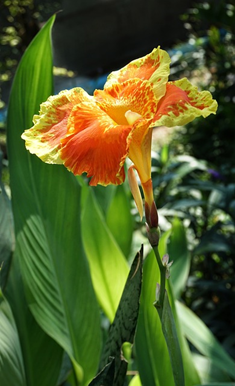
I used a bright orange Canna in a large pot this year on our deck. It was quite striking against our pale gray house…..definitely worth saving for next year!
Canna closeup
I have been emptying pots over the last week or so and decided it was time to tackle the Canna. It is best to do this after the first frost. Up until the first frost, the plant is still growing and putting energy into the roots. As mentioned, Cannas may grow quite large. Mine was about 60 cm (2 ft) tall.
I thought that it would be a difficult task to remove the Canna and prepare it for winter storage. I was happily surprised to find it an easy task. Gently remove the Canna from the pot using a garden trowel to loosen it first. Grasp the stem and lift the entire plant, with root attached, out of the pot. The Canna has a fibrous rhizome which may then be divided into individual stems. Do not wash the rhizomes but do gently remove as much soil as possible. Allow the rhizomes to airdry for a few days. The Canna rhizomes may then be stored in peat or vermiculite in a cool dry space.
You may also leave your Canna in its pot, cut back the foliage and store the pot in a cool, above freezing, spot over the winter. I do not have a cool space where I can store potted plants so I chose to store just the rhizomes.
Seed pod
Next spring, after all danger of frost has past, repot or plant your Canna rhizomes. You will be thrilled to see that your beautiful Canna survived the winter and is soon ready to start blooming again for another season.
For more information on overwintering Cannas and other plants, please check out the links below.
Book Review: Tiny + Wild: Build a Small-Scale Meadow Anywhere by Graham Laird Gardner (Cool Springs Press, 2023).
More and more, gardeners are looking to transform their spaces with an ecological focus in mind. The goal may be to provide food and habitat for pollinators and other wildlife, or to reduce or eliminate traditional high-maintenance and less environmentally friendly practices (e.g., mowing, watering, fertilizing, tilling, weeding, pesticide use). There is a treasure-trove of how-to guidance on the web but sometimes it is nice to pick up a book that also contains photos of ecological gardens that are practical as well as beautiful. I recently picked-up such a book called Tiny + Wild: Build a Small-Scale Meadow Anywhere by Graham Laird Gardner (no relation, lol). A meadow-styled garden on a small scale can be both aesthetically pleasing as well as have high ecological impact. Gardner provides step-by-step guidance on how to evaluate your property, how to select the best location, learn basic design principles, determine how best to prepare your site, as well as how to choose, install, and maintain the plants for your project.
Some people have eliminated their lawns entirely and have converted them to gardens. However, it may be daunting to think about a whole-scale lawn conversion project. What I like about this book is that it encourages beginners that starting small is ok. Gardner advises selecting a small area to experiment with first and then look at expansion later (p. 51). Some examples of starting small include creating a “micro meadow” on a balcony, stoop, patio, or rooftop using containers; or creatively incorporating flowering plants in raised beds or a vegetable garden that are both edible to humans and are attractive to pollinators. Other possible interesting small-scale projects include developing a meadow in a rain garden, a drainage swale, a boulevard, or even a gravel garden.
The book is full of great tips. For example, when considering adopting a meadow-styled garden, it is important for the design to emphasize grasses and sedges over flowering plants. Incorporating too many of the latter can make it disjointed and unnatural. The former serve as the foundation that brings everything together. Aim for 1/4 tall, structural species, 1/2 medium-height species, and 1/4 ground cover species (p. 69).
Another suggestion that did not occur to me is to use annuals in the first couple of years after installing the native plants (p. 150). The reason for this is because it usually takes three years for native plants to become established and annuals can be used for a short time to fill in the initial gap. The only disadvantage I can see with using annuals is that most are not native species and they do have a tendency to self-seed. The latter can be managed with some dead-heading maintenance, however.
This book in some areas is only a starting point and the reader still needs to do more research. In the last chapter, there are some suggested plants in lists grouped by height, bloom colour, bloom time, lighting, and moisture; however, some of these are not native to our area or may be difficult to acquire. In some cases, you can select a plant from the same genus that is listed in the book. For example, the listed Erigeron compositus (Cutleaf Fleabane) is not native to Ontario but Erigeron pulchellus (Robin’s-Plantain Fleabane) is. They both are comparable in size (height).
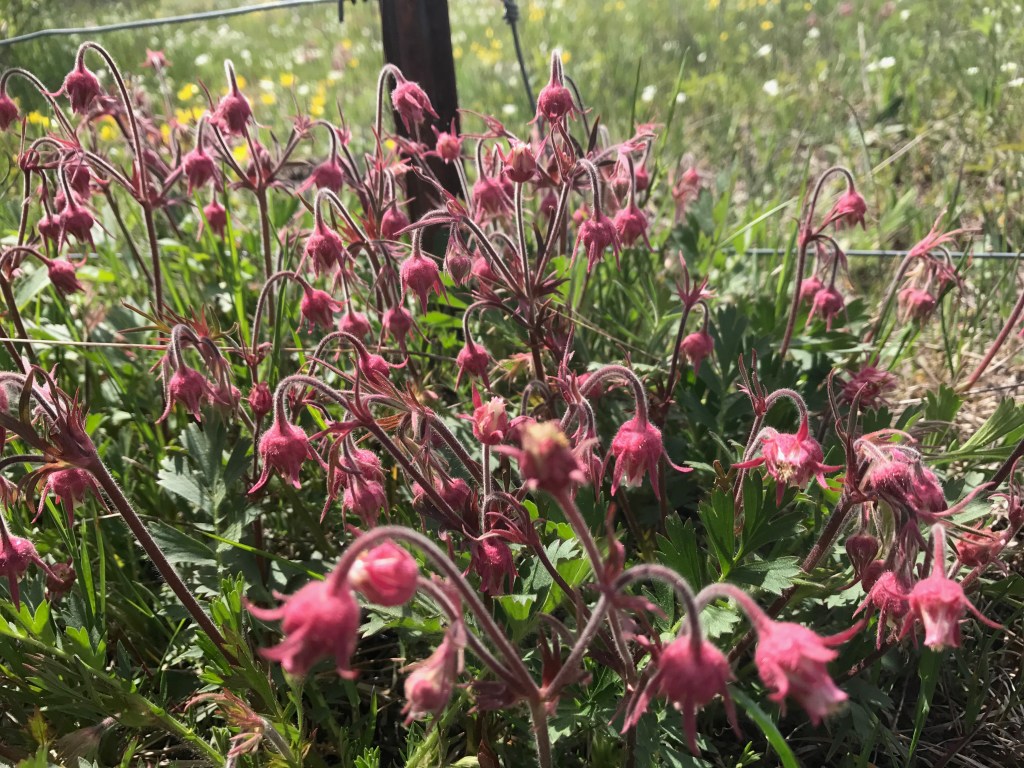
Geum triflorum: a great native selection for a meadow
There are just a few parts of the book where I have suggestions:
1) Although there is a warning to the reader to verify that the plants listed in the book are not invasive in their area (p. 139), I think that there are a couple known to be widely problematic that should have been left out: Ajuga reptans (Bugleweed) and Scilla siberica (Siberian Squill).
2) In the section on shade meadows (p. 50), I would point out that gardeners should be careful when planting in the vicinity of trees. Some species are more sensitive than others. Planting under trees should be a gradual process that is staggered over the course of a few seasons. In addition, small plugs are more appropriate than larger potted plants. These practices can minimize disturbances to tree roots. Gardeners should think of the tree’s health first.
3) The section on removing the existing vegetation (e.g., sod) suggests that you can forgo using layers of organic matter and cardboard and simply top dress with topsoil. After applying the topsoil, you can plant and at the same time; the vegetation below is smothered and decomposes (p. 88). It is not clear how thick a layer of topsoil is needed as I suspect grass and other weeds will poke through. While Gardner is generally opposed to using wood mulch in a meadow garden (p. 89), I think that a very thick layer can be used initially to eliminate the grass and it will break down over time quickly enough and does not need to be replenished—allowing for the plantings to expand.
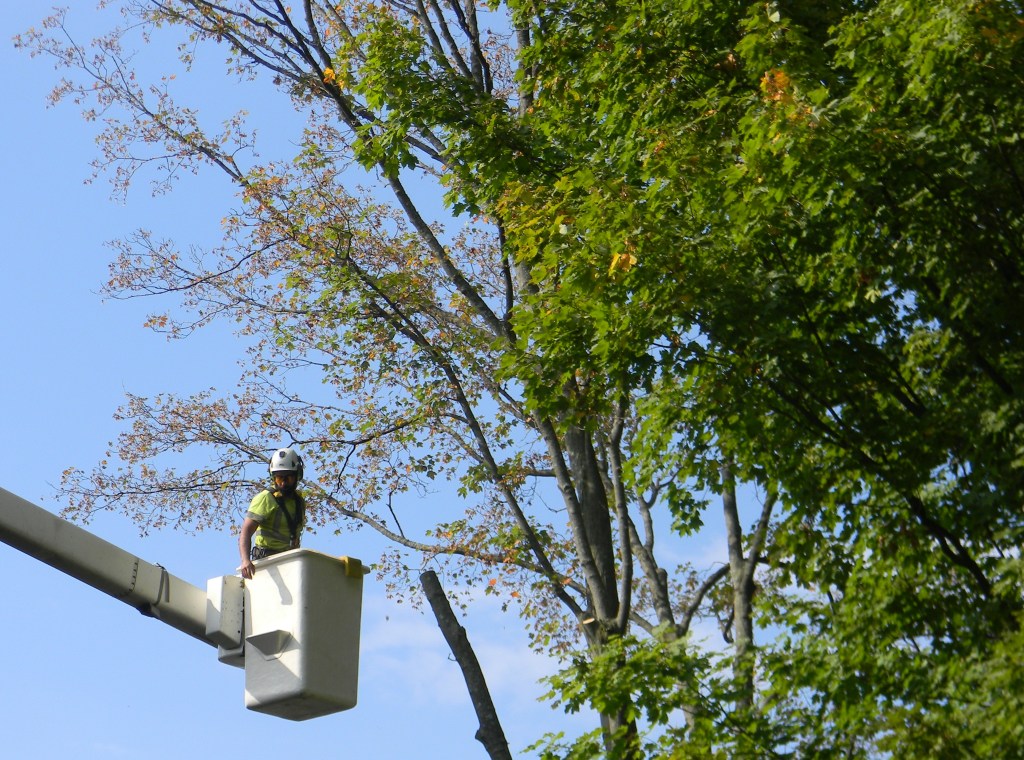
As gardeners, we are aware of the importance of trees. In our yards they give us shade from the hot sun, dropping the temperature beneath them and cooling the air. They give habitat to birds and insects. They purify the air and help reduce greenhouse gases. They anchor the soil and help with soil erosion. They give us privacy. Studies have shown that trees also help our mental health. In the past few years, ice storms, spongy moths, wind storms, and the recent derecho have damaged many trees in our area. Around every neighbourhood, you hear the buzz of chainsaws throughout the year. Last week, we had one of our lovely big sugar maples cut down because it became diseased. Heartbreaking but necessary to have it taken down.
Fungal diseases are often the culprit of the decline and death of many species of trees. Trees that are planted where their roots have no good earth to grow in become stressed. A stressed plant is easier for pests and diseases to invade. Our sugar maple was close to our driveway and although it is not paved, the ground is compacted.
Years of drought also affect a tree’s health. Wind storms can damage branches and leave open wounds where disease can find its way in. We are all familiar with Dutch Elm disease which has been in Ontario since 1946. It is a highly contagious fungal disease that has almost wiped out elm trees. Many of the dead trees you see along roadsides are elms.
Anthracnose is a common disease in maple and oak trees. It often appears after a damp cool spring. Brown blotches appear on leaves, they dry up and fall off. When combating this disease, you need to rake up and dispose of infected leaves. Tar Spot is common on norway maples. Although it may not kill your tree, it is a fungal disease and will continue to spread. It is recommended to rake up leaves and dispose of them rather than mulching them.
Spruce trees were stressed by the spongy moths and drought and we are seeing them suffering with Cytospora Canker. Signs of this disease are needles turning purple, then brown, then dropping off leaving branches bare but covered with a white resin. Cankers appear on the branches near the trunk.
Last week’s post was on Oak Wilt, a recent fungal disease which has no chemical control yet. Pests are also a huge problem with our trees. Emerald Ash Borer has been in Ontario since 2002. The metallic green beetle emerges in late June, laying eggs in crevices of bark. Larvae overwinter under bark and tunnel under the bark leaving “S” shaped marks which cuts off the trees ability to draw food and water. There is an insecticide that a professional can inject into the tree.
Spruce budworm is native to North America. It attacks balsam fir (Abies balsamea), white and black spruce (Picea), hemlock (Tsuga), jack and eastern white pine (Pinus) and Larch (Larix). BTK has been used to control, however if you have a mature tree this option is overwhelming. We all need to be aware of the health of the mature trees on our property. Ensure they are getting enough water, watch for small leaves or broken branches and pest infestations. Call an expert arborist to give advice on an ailing trees. They can also help with any pruning issues that might need to be addressed.
If you are investing in a tree for your property, be sure to do some research and find the right tree for the right spot. Take into consideration how big the tree will get, where the sun will shine on it, how much ground it will have to absorb moisture and what competition it might have. Young trees need lots of water to get established and grow. What’s that old saying? Hug a tree? Well, after you hug your tree, check out the references below for more information on diseases and pests and ways to help your trees.
Oak trees are an essential part of Ontario’s natural beauty, providing shade, wildlife habitat, and a sense of nostalgia. However, these majestic trees face a silent threat known as oak wilt, a deadly fungal disease that can devastate entire oak populations if left unchecked. In this article, we’ll discuss what oak wilt is and how you can help prevent its spread.
What is Oak Wilt? Oak wilt is a disease caused by the fungus Bretziella fagacearum. It primarily affects oak trees, especially red oaks and pin oaks. The fungus clogs the tree’s water-conducting vessels, causing wilting, leaf loss, and eventually death. Oak wilt is highly contagious, spreading through root grafts between neighboring trees or by sap-feeding beetles that transport the fungus spores.
Avoid Pruning Oaks in Spring and Early Summer: Oak wilt spores are most active during these seasons. Pruning creates wounds that can attract sap-feeding beetles carrying the fungus. Instead, prune oak trees during the dormant season in late fall or winter.
Use Pruning Paint: After pruning, seal the wounds with pruning paint or a latex-based paint to prevent beetles from entering and spreading the disease.
Dispose of Infected Wood Properly: If you suspect oak wilt, remove and destroy infected wood by burning or burying it. Do not use it for firewood or mulch.
Report Suspected Cases: If you notice oak trees showing signs of oak wilt, contact your local forestry department or arborist immediately. Early detection and intervention can help contain the disease. This link may help: Signs and Symptoms of Oak Wilt.
Promote Tree Health: Healthy trees are less susceptible to oak wilt. Ensure your oaks receive proper care, including regular watering, fertilization, and protection from other stressors like construction damage.
Oak Wilt has been found in the following locations in Ontario: City of Niagara Falls, township of Springwater (north of Barrie), and Niagara-on-the-Lake, ON.
There is currently no available treatment for oak wilt.
We must take collective action to protect our oak trees from oak wilt. By following these prevention measures and staying vigilant, we can help preserve the beauty and ecological importance of these remarkable trees for generations to come.
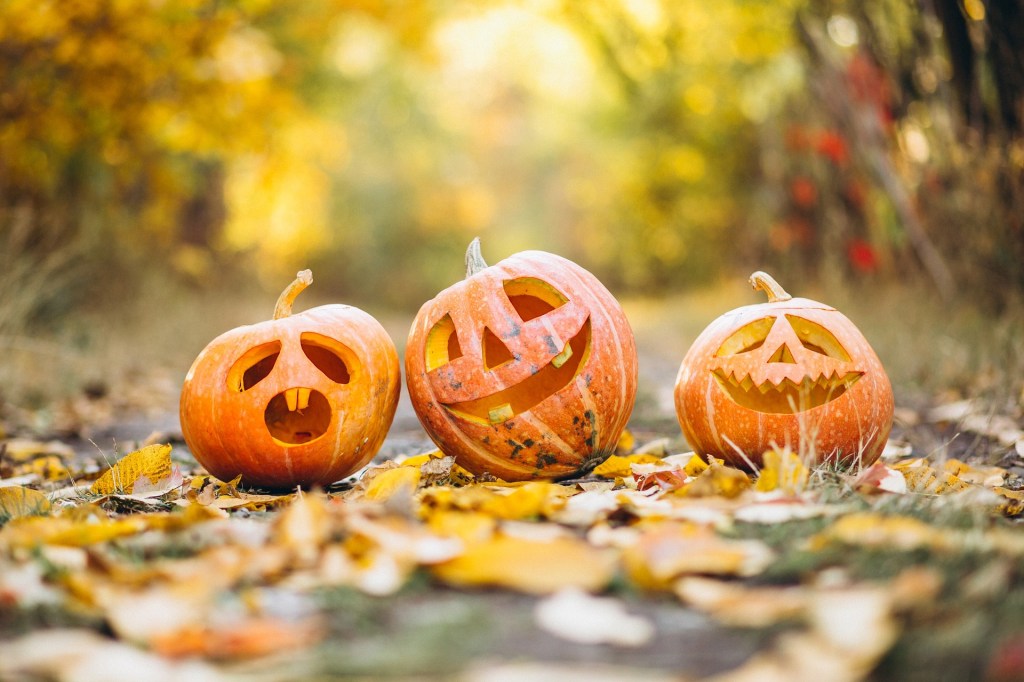
What says fall or October more than the iconic pumpkin? But how much do you really know about them?
Here’s 10 things about pumpkins that might surprise you.
They’re technically a fruit, not a vegetable. Pumpkins are a winter squash in the family Cucurbitaceae (which includes cucumbers, melons, and gourds.) Pumpkins, along with cucumbers, tomatoes, and avocados, grow from the flowers of their plants. So yes, all squashes are technically fruits as well. It is the official State Fruit of New Hampshire.
They’re native to the Americas. Scientists believe that pumpkins originated in the Americas about 9000 years ago. The oldest pumpkin seeds were found in Mexico and date to somewhere between 7000-5550 B.C.. Originally small and bitter, they were selectively bred by native peoples to be bigger, sweeter, and have more flesh.
They weren’t originally called pumpkins. The word “pumpkin” originates from “pepon” – which means “large melon” in Greek. Then it evolved to “pompon” (in French) and “pumpion” (in Britain). The evolution in North America was to “pumpkin,” what we use today.
Every single part of a pumpkin is edible. That means the skin, leaves, flowers, pulp, seeds, and stems. And they’re 92 percent water. Pumpkin and other squash blossoms can be eaten raw or I’m told they are tasty when lightly battered and fried. Pumpkin pie is a traditional part of Thanksgiving meals in Canada and the United States.
Bumble bees and squash bees are the primary pollinators of the cucurbit family of plants. They help transfer pollen from the male flower to the female flower by visiting each flower to drink the nectar located in the flower. As the bee drinks nectar it vibrates and moves its body around and in doing so, collects grains of pollen on the fine hairs of its body and in pollen baskets located in some species on their legs.
Pumpkins (along with other squash) were a historically important food staple among Native Americans. Using the “Three Sisters Method,” three crops (squash, maize, beans) were grown together – usually near riverbanks – so they could sustain each other. Corn is the trellis upon which the beans climb; beans keep the corn stalks stable on windy days, while also nourishing their soil; and pumpkins/squash shelter the corn’s shallow roots and prevent weeds from forming.
They’re a great source of beta carotene (which is what gives it the orange colour). It turns into vitamin A after you eat it, so it’s excellent for your eye and skin health.
They can get REALLY big. The heaviest pumpkin ever recorded was a staggering 1,226 kg (2,702 lb 13.9 oz), grown by Stefano Cutrupi (Italy) in Tuscany, Italy in 2021.
How long do they last? After a pumpkin is cut, it will usually last about seven to 10 days. Find out how to pick the perfect pumpkin.
Each pumpkin contains about 500 seeds. Once they sprout, pumpkins take between 90 and 120 days to reach maturity, which is why it’s recommended to plant them between May and July.
A LAST NOTE: Just a reminder that you’ll see lots of social media posts after Halloween about giving your pumpkins a second life by putting them out for wildlife. In your own garden, break the pumpkin into small pieces and monitor and remove the pieces when they rot, mold, or aren’t eaten.
Check and see whether local zoos or wildlife rehabilitation centres are interested in donations for animal enrichment. NOTE: they must still be fresh – carved pumpkins break down quickly and whole pumpkins that have been sitting in the sun for weeks can quickly become contaminated and shouldn’t be given to animals to eat. Some municipalities also offer a drop-off program.
Please don’t put them on the side of the road or in natural areas, as this creates problems because if they are near ditches or roadsides, animals will be drawn in close to traffic where they may get hit.
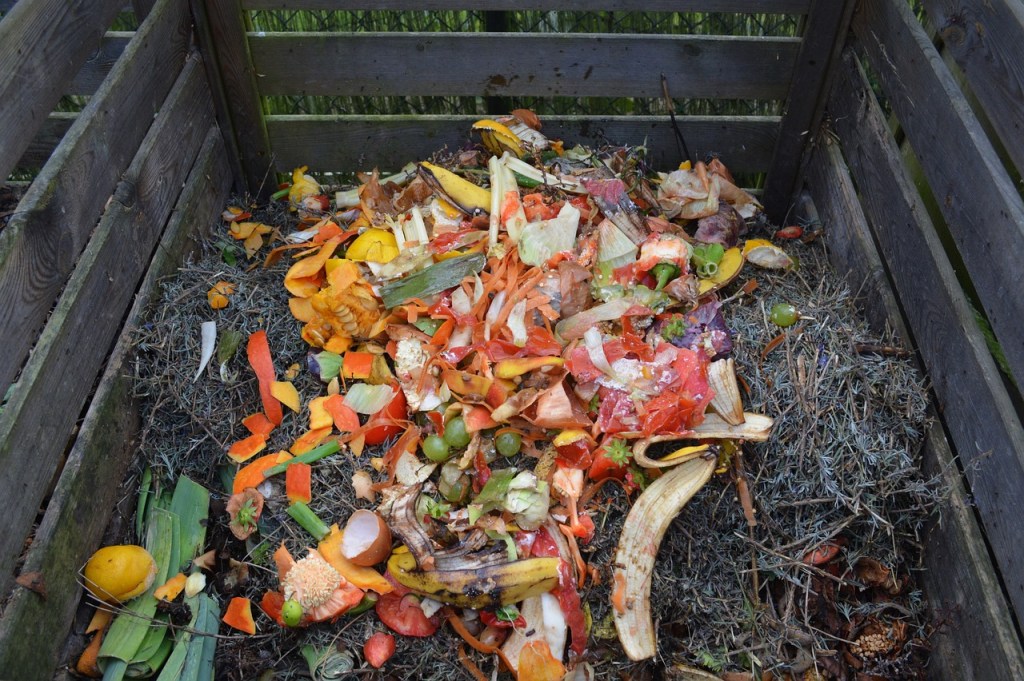
Last but not least, if a pumpkin is starting to decompose, turn it into compost! Chop it up to speed up the process.
Many gardeners plant and harvest their own herbs throughout the summer either in outdoor planters, garden beds or even indoors where the aroma can be enjoyed throughout the season. And for some, fresh herbs from the garden come to an end as the growing season tapers off and fall temperatures and cool nights prevail. However, enjoying your herb bounty throughout the winter is not only possible, but easy to do. Frozen herbs can be enjoyed throughout the winter (I have used mine up to six months after freezing) in soups, casseroles, and other cooked dishes, using the same quantities in recipes as you would if they were “fresh”. However, they do tend to darken in color with freezing and as such cannot be used in some applications where raw fresh herbs are required (such as pesto and/or garnish).
To freeze herbs, the process is as simple as this:
Harvest your herbs before the frost takes them from you,
Ensure that they are clean (wash if unsure) and pat dry,
Lay them flat (leaves and stems) on a tray,
Put in freezer for one hour (“flash freeze”),
Remove and place in labeled freezer bags, and
Remove the air from the bags (use of a vacuum sealer may be helpful if freezing individual batches for later use.
Herbs that freeze well for use later in cooking include Basil, Chives, Dill, Lemongrass, Mint, Oregano, Rosemary, Sage, Savory, Tarragon and Thyme. An interesting option is to make an herb blend from your favourite herbs that you enjoy together. To do this, simply use 2 cups of fresh herbs and 1/3 cup of olive oil and blend thoroughly in a blender. Place the paste in an ice cube tray to freeze and then place frozen cubes in an airtight bag. Simply use the “herb paste” in any of your favourite dishes. I have used rosemary, thyme, basil, oregano, and mint together in a skillet chicken dish with fresh lemon zest, garlic and orzo pasta…simply delicious!!!
Alternatively, fresh herbs can be dried, stored and used throughout the winter as well. The process is as simple as this:
Bundle together 3-6 stems and bind end with garden yarn/string (see pic above),
Hang upside down in a dry and dark location,
Wait 2-3 weeks for them to be completely dry (ensure stems are brittle), and
Remove leaves and store in airtight jars or bags and use as per recipe as a “dry spice”.
Personally, I cannot see my summer herb bounty go to waste. It is well worth the effort to freeze, dry and/or make a paste blend…ensuring that you have fresh herbs throughout the season. Just add this activity to your fall canning party and share the wealth 😊.
At this time of year that nasty five letter word “frost” starts making an appearance in the weather forecast. Our hardy perennials will manage just fine with freezing temperatures but some of your plants may be tender perennials that won’t survive winter. As a reminder, a perennial is a plant that will live for more than two years. This can include bulbs like begonias and dahlias, rosemary, and geraniums just to name a few. Annuals complete their life cycle in one year and biennials in two. Tender perennials can give us years of beauty if we treat them well.
Pelargoniums, commonly called geraniums (which are different from hardy Geraniums/Cranesbill) are a tender perennial in our climate but they are easily wintered over using one or all of three different methods. You can take a stem cutting, overwinteras a potted plant, or overwinter as a bare-root plant. This link gives clear instructions for all three methods.
Personally, I will be taking a stem cutting from a geranium and a Dorotheanthus bellidiformis ‘Mesbicla’, commonly known as Mezoo Trailing Red, another tender perennial. Cuttings produce a plant identical to the parent, avoids any difficulty with starting from seed and will frequently produce a plant that matures faster and flowers sooner than a plant grown from seed.
I will be using an 8-10 cm stem that includes a few leaves. Make sure your cutting contains as much water as possible by watering your plant the day before and taking your cutting before the heat of the day reduces water content. Plants lose most of their moisture through leaves so I will remove half to a third of the leaves. Ideally, process the cutting right away or place it in water.
Using clean pots and tools, and soilless potting mix or vermiculite is important to reduce the chance of disease killing your cuttings. Once your pot is ready, secure the cutting by placing it into the medium far enough that the cutting can support itself. Put your pot in a closed plastic bag and place it in a warm, bright spot but not in direct sun. The plastic bag should keep the plant’s environment humid enough to prevent water loss in the cutting and reduce the need for any further watering. Too much moisture and the cutting will rot. More info here.
In a few weeks you should be rewarded with good root growth on your cutting which you can then repot and grow on for use in the garden next year.
Most of us are familiar with using stem cuttings to make a replica of a specific plant. Less commonly used in Canada are root cuttings, a form of asexual reproduction which can be used to propagate a range of herbaceous perennials and even a few woody plants in the later part of autumn when plants have gone dormant (full plant listing in references).
Beauty of Livermere Oriental Poppies (parents)
Last fall, I determined that I would need approximately 25 new oriental poppy (Papaver orientale) plants to place at the back border of one of my beds. “Beauty of Livermere” was already planted in another bed and I wished to have more of that variety. However, poppies have tap roots and are notoriously difficult divide. As oriental poppies do not come true from seed when looking to reproduce a particular cultivar, root cuttings seemed to be the answer.
As I had never done this before, I choose to take cuttings at more than one time – late September, late October and in the end of December when we had a surprising warm spell. I lifted a couple of plants brushing away the soil from the roots (washing would have worked better). I selected out roots with a diameter of a pencil and cut them off with secateurs taking less than 1/3 of any one plant. The donor was replanted immediately (and the crown mulched for winter protection).
Next, the roots were cut into 2–4-inch (5-10 cm) lengths making a horizontal cut at the upper end (part that was closest to the plant crown) and an angled cut at the bottom. You must preserve the polarity of the cutting. They will not grow if planted upside down. I filled pots with a 50/50 mixture of potting soil and vermiculite (perlite also works). I inserted the cuttings vertically into compost, ensuring that the angled end of the cutting was put in first to preserve polarity. The compost was watered until it was moist and then put out in my extension for the winter where they would be cool but would not freeze. Root cuttings do not require light until green growth begins to show and they can be kept in the basement if need be.
2 months (left) and 3 months (right)
In my case, it took about 2 months before any of the cuttings showed any green. The September cuttings were a flop as only a single cutting out of 10 had growth (too early to take root cuttings). I had almost 100 % strike from both the October and December batch. The cuttings were in a high light area so as they grew on, I did repot them up. In late April, the new plants were hardened off and planted out. They grew well in their new location and I look forward to next year’s bloom.
Potted up separately
Planted out!!
There are other advantages to using root cuttings instead of other means of propagation:
Root cuttings require no special aftercare (no humidity bag etc)
Large numbers of new plants can be generated from a single parent plant (good for larger gardens)
Plants derived from root cuttings are relatively large and vigorous
Cuttings are taken in a quieter season when a gardener may have a bit of time (I don’t know about you, but my spring stem cuttings have a high failure rate as I don’t keep as close an eye on them as I should and they either burn up in the plastic humidity bag or dry out from lack of water)
Growing on…
Perennials such as Japanese anemones (Anemone hupehensis) and Phlox (Phlox paniculata) can be propagated in this way. These plants have thinner roots and contain less food reserves so it is recommended for these species to use longer sections (3-5 inches) and lay them horizontally on top of compost in a tray covering with a thin layer of compost.
Whatever plant you wish to propagate, give root cuttings a try. You may be pleasantly surprised.
Summer is flying by. You can feel the growing season coming to a close with the cooler morning temperatures in late August. Now is a good time to reflect on which vegetables did well in your garden and, if heirloom or open-pollinated varieties, allow some to go to seed for next year’s planting. Or you could collect more seed than you need and package them to exchange for more new varieties at next spring’s Seedy Saturday/Sunday events.
It is important to only collect seeds from open-pollinated varieties as these will retain their genetic diversity and produce plants that adapt to changing growing conditions. They produce seeds that can be legally grown, saved, and shared. Do not collect seeds from hybrid varieties as these will not grow like their parents.
Last spring, I picked up seeds of several new (to me) varieties that diversified both my vegetable garden and my diet this summer, including:
An heirloom basil lettuce leaf variety with a milder peppery basil flavour that enhanced mixed lettuce salads throughout the growing season
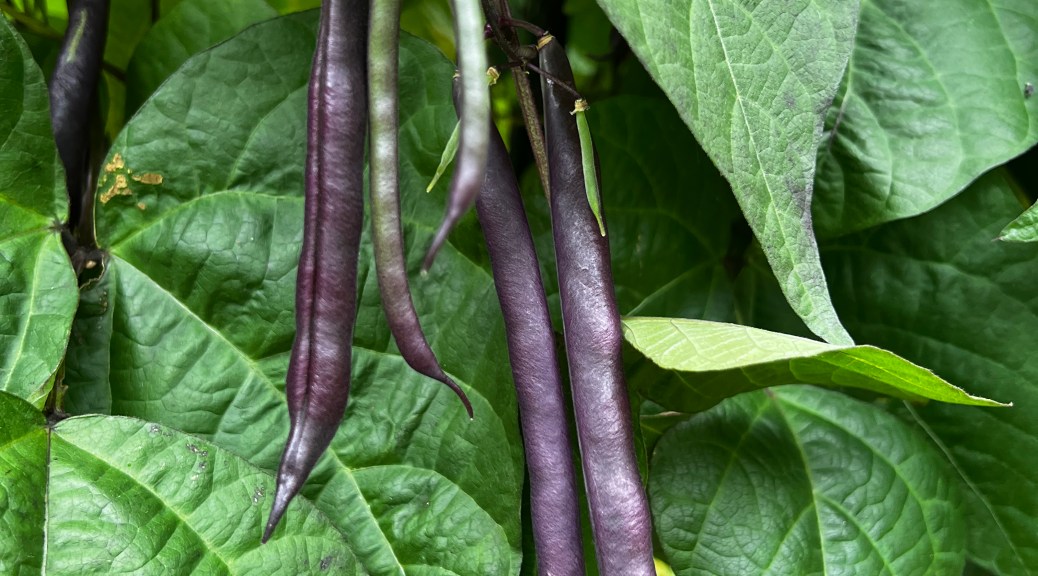
A purple pole bean, Trionfo Violetto, that unlike the purple pole bean, Blauhilde, that I usually grow was more tender and stringless, although not quite as productive
A purple podded sugar snap pea, Sugar Magnolia Pea, that is still producing pods today. The peas are very sweet and unlike the purple pole beans do not turn green when cooked, plus they are easy to spot in the tangle of 6 feet tall vines
A cantaloupe, Minnesota Midget,that started producing juicy, sweet, ripe fruits by the second week of August
A mix of 2 different Armenian cucumbers with light green, ribbed tender skins rather than the dark green skinned Lebanese cucumbers typically grown and available year-round at the grocery store. Surprisingly, Armenian cucumbers are the same species as cantaloupe! Their denser, less watery flesh makes them ideal for tabouli and cucumber salads.
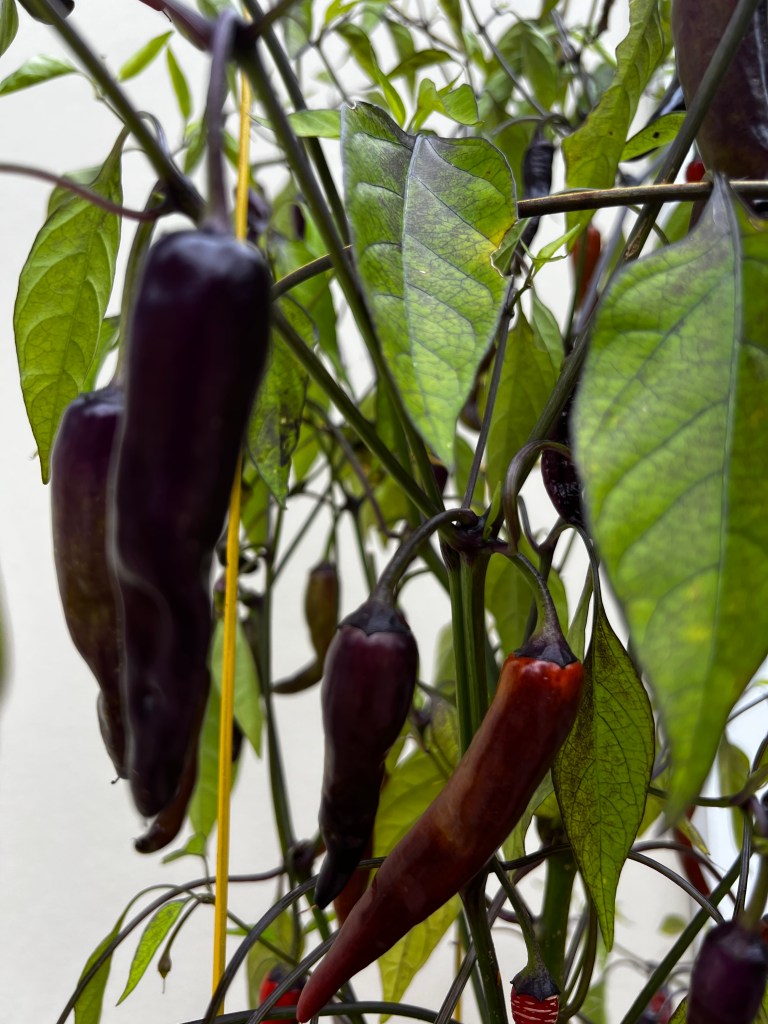
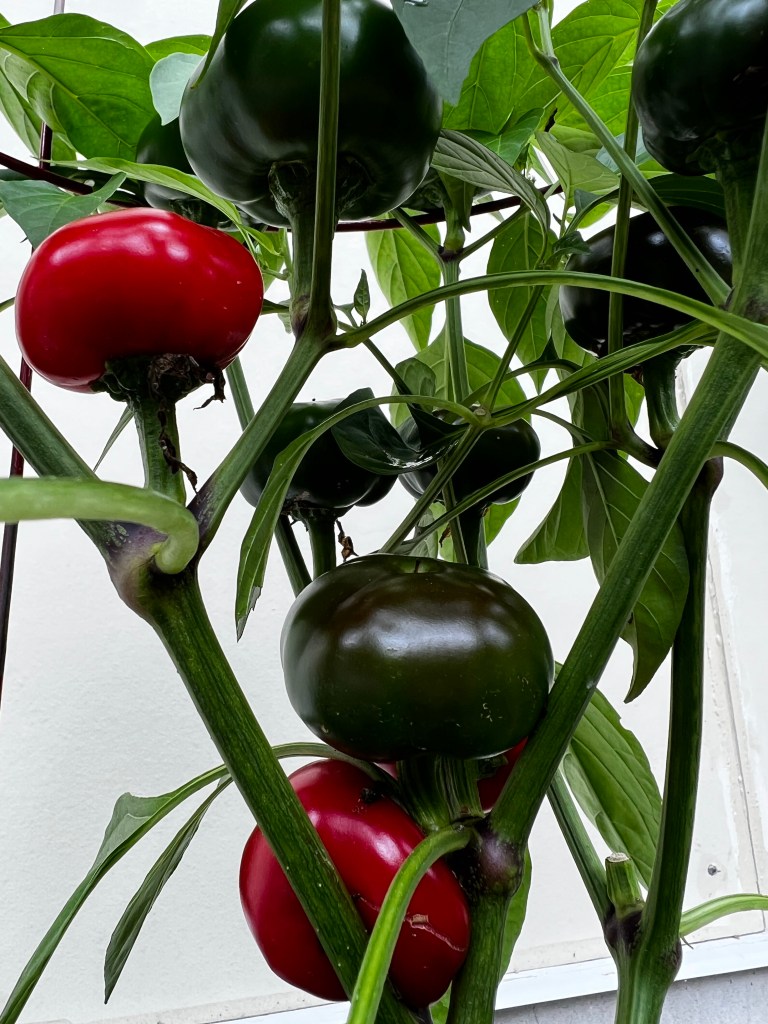
Two different peppers that I grew as container plants: (i) Mini Red Bell that produced early sweet peppers that are 1-1/2 inches tall and wide and (ii) Buena Mulata a hot cayenne variety that changes from a pretty purple to red when ripe although we also enjoyed the early milder purple peppers in fresh salsas. Both pepper varieties are very productive, yielding dozens of peppers on one plant!
Why try growing something new?
While it is easy to get into a routine of growing the same varieties of vegetables each year, there are several reasons to experiment with new varieties. A different variety of beans or tomatoes might grow better in your soil conditions and produce a bigger crop, it might taste better, be easier to harvest, mature earlier, or be better suited to the vagaries of our new climate change world with more drought and/or rainy weather. Aside from these good reasons, growing something new can be a lot of fun!
Contributing seeds to your local Seedy Saturday/Sunday event is an economical way to support experimentation with new varieties. You can trade your seeds for seeds of other varieties collected by other gardeners.
How do you get started with seed collection?
As I learned during a seed collection workshop with Jill Bishop of Urban Tomato, here are some general steps to follow:
Ensure the variety is open-pollinated or heirloom. The original seed package should provide this information. Or search for the variety name on the internet.
Identify the vegetable varieties you enjoyed and mark healthy plants that you will let go to seed. For example, this year I identified 2 plants in my pole bean row where pods could go to seed.
Let seeds mature on the plant and observe carefully to ensure you harvest seed heads just before they start to split open.
For beans and peas which are self-pollinated let pods over-ripen and turn brown on the plant. Keep green beans away from purple ones. When seeds rattle inside pods they are ready to harvest. Let the pods dry further indoors.
For lettuce greens, cruciferous vegetables (e.g., kale, cauliflower, broccoli, etc.) and herbs let a plant bolt. Keep different varieties (e.g., of lettuce) apart to avoid cross-pollination or only let one variety bolt. It will take some time for seeds to form and turn completely dry and brown. You might want to cover the seed head with a gauze bag to capture the seeds when seed heads split open. Note that kale is a biennial and won’t form seeds until Year 2 while most spinach varieties are dioecious and both a male and a female plant are required to obtain seed set.
Pepper seeds are simple to collect but make sure to grow varieties separated from one another to avoid cross-pollination. Growing peppers in pots makes this easy to do as you can move the pot during the flowering period. Scrape seeds from a fully ripe pepper and set seeds on newspaper to dry.
Both tomato and cucurbit seeds require a bit more effort to collect.
A recent Peterborough & Area Master Gardener blog post, “Tasty Tomatoes”, provided steps for saving tomato seeds from ripe healthy tomatoes. As described in the blog, seeds should be fermented in water for a week to separate viable seeds and improve seed germination and longevity.
For cucumbers, squash and melon, let the fruit get big, overripe, and mouldy on the vine, open the fruit, scoop out seeds and let them ferment like tomato seeds, then rinse and let dry.
Ensure that you label and date the seeds you collect through the drying and packaging process. When packaging seeds in smaller envelopes for Seedy Saturday/Sunday events include variety name, year collected, days to maturity, and spacing for sowing. Store seeds in paper envelopes in a dry cool place. If you use jars to store seeds, put an envelope with a fully gummed flap in the jar as well. If the envelope is sealed when you check the jar a week later, humidity levels are too high in the jar. Seeds will start to germinate if kept in humid conditions.
Follow these steps and you’ll be ready to leave a few seed envelopes of your favourite varieties at a Seedy Saturday/Sunday event that will soon be scheduled near you. And you’ll be able to pick up a few free new heirloom varieties to try in 2024!
Seed Collection Resources
Seeds of Diversity a Canadian organization with 1000+ members that grow rare seeds to exchange. They support Seedy Saturday and Sunday events across the country.
How to Save Your Own Seeds–A handbook for Small Scale Seed Production available from Seeds of Diversity for $15.00
The Seed Savers Exchange publishes a Seed Saving Guide in table format that identifies the primary pollination method, how many plants you should grow to collect viable seeds, and how far apart plants should be from other varieties to avoid cross-pollination for more than 80 varieties of vegetables. For example, for vegetables like tomatoes, beans, lettuce and squash, you should grow each variety at least 10 to 20 feet apart from other varieties. If you have a small garden, you can still grow more varieties together but cover a flower with a gauze or blossom bag to only allow that variety to self-pollinate.
For over 13 years, I have had a Hydrangea arborescens ‘Annabelle’ (Smooth Hydrangea) in my garden. A few years ago, contractors put in a fence, and I thought it was a goner — trampled into the ground. It was their version of rejuvenation pruning.
Well, I learned they are hard to kill. Every summer there is a profusion of blooms. Every spring, some of the leaves are curled and fused together—a temporary home for Olethreutes ferriferana (Hydrangea Leaftier Moth) caterpillar—a native insect. Anecdotally, it seems to favour Hydrangea arborescens over others, although the food plant database for Tortricid (Leafroller) moths indicates simply Hydrangea spp.
Most sites I have seen online advise you to squish the caterpillars because they can cause a reduction in blooms. They feed on the leaves and the flower buds. While my Hydrangea has likely seen a reduction, I have not noticed. It does not affect the overall health of the plant. Another consideration is that often within these rolled-up leaves, spiders make their home. It is thought that they take up residence before the moth leaves but do not predate the caterpillar.[i] Year after year, I just let this moth complete its lifecycle.
In Integrated Pest Management (IPM) there is something called a threshold of action. Is the damage enough to warrant taking any action to control the pest? Is it possible that other beneficial organisms may be harmed in the process? If there are only a few blooms that could be affected, consider not doing anything.
Hydrangea arborescens ‘Annabelle’ in July
Curled and fused leaves of Hydrangea arborescens ‘Annabelle’ in June. Note the pupal skin hanging out of the leaf pouch—this indicates that there is no caterpillar within and the adult moth had exited.
Is it Real or an Imposter?
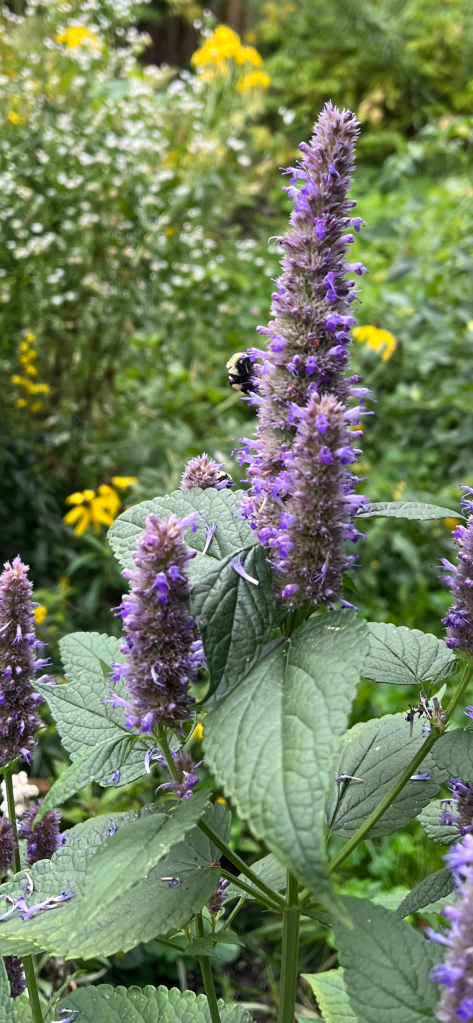
Last year I planted what I thought was Agastache foeniculum (Anise Hyssop). It was a huge Bombus (Bumblebee) magnet and flowered virtually up until frost. It did not come back this spring — apparently it is considered a short-lived perennial, but in the end, I concluded that its demise was mainly due to a sustained dog pee assault. I am the crazy gardener that runs after my dogs with a watering can. I digress.
Agastache rugosa (Korean Mint) and a Bumblebee visitor
Like many in the mint family, there were many seedlings that popped up in its place. Fast forward to this week, and I noticed a discussion online about how some nurseries are inadvertently selling Agastache rugosa (Korean Mint) instead of A. foeniculum.
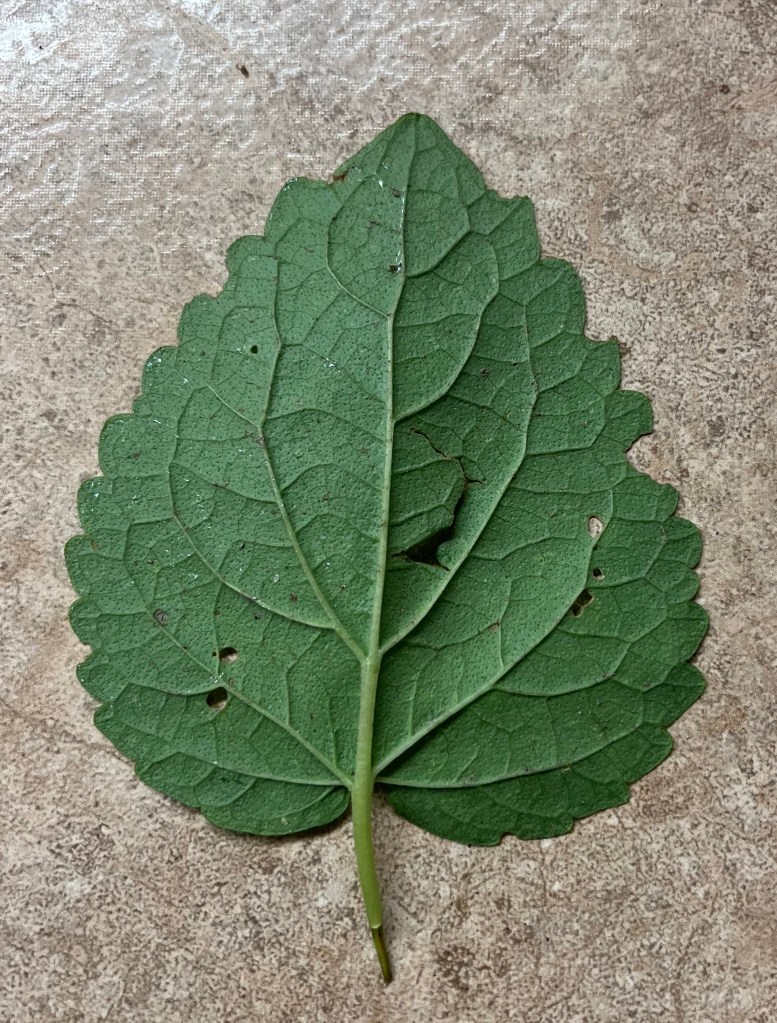
After careful inspection, I am now certain that I am one of many who got the non-native species. “Both these species are aromatic and have flowers of similar colors, but Korean mint has rugose, dark green leaves with cordate bases, whereas Anise Hyssop has shiny, bright green leaves with feltlike undersides and cunate bases.”[ii] The undersides of the leaves of A. rugosa also have little indentations (areoles) that A. foeniculum lacks.[iii]
Underside of Agastache rugosa leaf
The question is, should I keep it in my garden? A field study of Agastache spp. in Iowa over a three-year period found that more Apis mellifera (European Honey Bee) visited the Korean Mint and hybrids than Anise Hyssop.[iv]
Judging from the number of Bumblebees on the few plants that sprung up this year, it would seem like a keeper. If I were to find and plant Anise Hyssop, there would be a high probability that it would cross-pollinate with the Korean Mint, creating hybrid plants. According to the literature, these hybrids are sterile[v] and so there would not be a problem of the hybrids re-seeding. Korean Mint is also morphologically like Anise Hyssop.[vi] This means that there is a greater chance that pollinators can benefit from the non-native species. I am waffling.
[i] Boggs, Joe. Hydrangea Leaftier. Buckeye Yard and Garden Online. May 22, 2022. Ohio State University. Online: https://bygl.osu.edu/node/1979 Accessed August 24, 2023
[ii] Widrlechner, Mark P. A Field Evaluation of Native Mint Family Plants as Honey Bee Forage in Iowa. Proceedings of the Twelfth North American Prairie Conference 1990. p. 40. Online: https://dr.lib.iastate.edu/handle/20.500.12876/55985 Accessed: August 24, 2023.
[iii] Serres, Terry. Buyer Beware. Agastache foeniculum vs. Agastache rugosa. September 2018.
[v] Vogelmann, James E. “Crossing Relationships among North American and Eastern Asian Populations of Agastache Sect. Agastache (Labiatae).” Systematic Botany 10, no. 4 (1985): p. 451. Online: https://doi.org/10.2307/2419137 Accessed: August 24, 2023.