Category Archives: Annuals

Horticultural Hiccups

By Marilyn Homewood, Master Gardener

At times, these blogs seem a little like an Instagram Post. We show our successes in the hope of inspiring you and in turn, provide something of value to you.  However, that can be a little intimidating to less experienced gardeners. Today, I thought I would showcase some of my 2025 failures (so far).

Lisianthus germination (or not)

Lisianthus

This one is a heartbreaker! In January, I had almost 100% germination of my lisianthus. A couple weeks after germination, they looked like this.

What happened? After reading somewhere that cinnamon prevents growth of algae, this grower overzealously applied cinnamon (I had purchased a large bottle at Costco). The covering of spice initially smothered some of the young seedlings.  I then tried to rectify the situation by wetting the plants (cinnamon is extremely hard to wet). 

The overwatering led to a slow decline, killing more seedlings by rotting the roots.  All was not lost however, I potted up the remaining seedlings into other containers and they have been growing on.  Hopefully they will catch up in size over the long growing season.

As Julia Child was fond of saying “everything in moderation….including moderation”

Bells of Ireland

Bells of Ireland

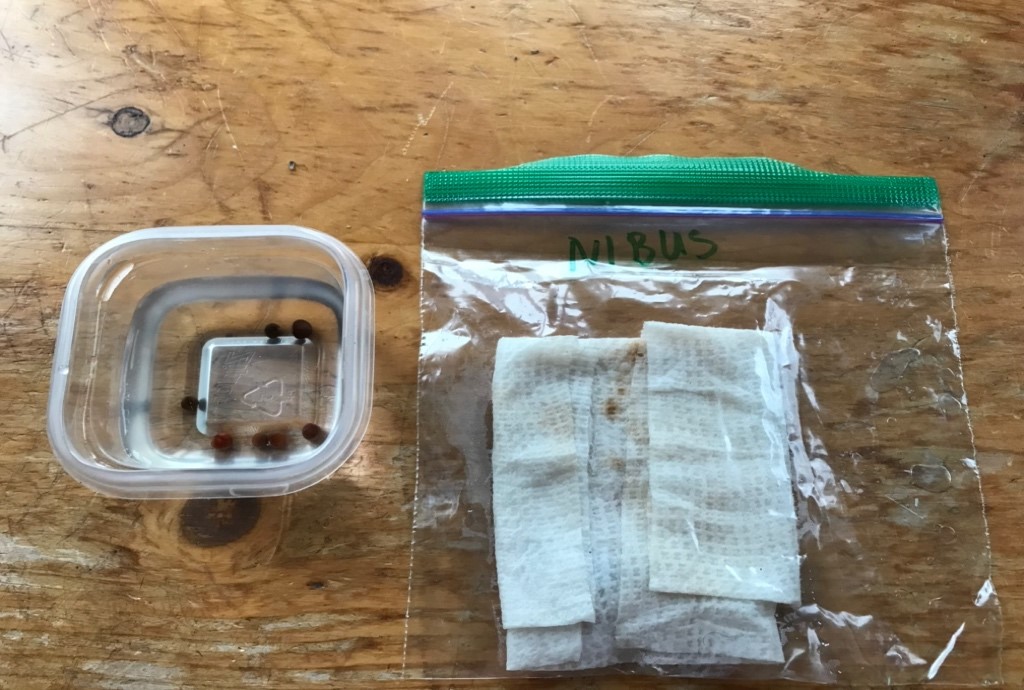
These seeds are notoriously hard to germinate.  They need to be stratified by exposing the seed to cool, moist conditions to help to break dormancy.  The seed is placed on moistened paper towel that is then folded and placed into a Ziploc bag.  Then placed into the fridge for a couple of weeks. After that, remove to a warm place (I use a heat mat). 

After a period of time, the seeds are checked for germination and placed on the surface of prepared soil.  The daily checking goes on for a few days and hopefully you get enough germinated seeds.  This years’ results speak for themselves.  Hard to know what went wrong but it may be the seed source.  My usual source (that does germination testing on every lot) was out of seed so I purchased from another.

Dahlia Splitting

Last fall I used a new method of splitting dahlias that saved time.  I use flagging tape to identify the plants dug up and the tubers being stored.  As the dahlia afternoon wore on, some of the tubers seem to get mixed up and the quality of the labeling seemed to decrease. This tuber might be a Ferncliff Copper and then again, it might not be. Note to self – Take a little more care with the labelling.

Forcing Tulips in Bulb Crates

Seemed like a great idea last October. I do not have a cool place that does not freeze so I opted to chill my bulbs in the refrigerator. Bulbs in paper bags went into the crispers of the fridge for over 14 weeks.  During that time ethylene producing produce could not be kept in the fridge as ethylene can negatively affect bulbs and their bloom. 

After the chill period, bulbs were planted in soiless mix in bulb crates and kept dark for a couple of weeks to develop roots.  The crates were then placed in a sunroom to grow.

I got a total of 20 lovely tulips from about 150 bulbs.  Other bulbs did grow leaves but produced no flowers, some did not grow at all.  When I removed the bulbs from the soil, I did notice reduced root growth on many of the bulbs. This may be from inadequate chilling. 

The crate method is clearly more successful when you can plant the bulbs up in the fall and place in a very cool spot that does not freeze (or a cooler like the flower farmer).  Bulb crates full of soil is messy in the house even if they are on tarps!

Despite these hiccups, I have a roomful of healthy seedlings and large landscape beds awaiting more garden gaffes. 

In the words of Janet Kilburn Phillips “There are no gardening mistakes, only experiments.”

March Madness

by Cheryl Harrison, Master Gardener

March is the start of gardening season!  Let the seed starting begin.  My husband is the “seed starter” at our house.  I am the “seed buyer”, the occasional “assistant transplanter” and a very helpful critic.

Husband has the seed packets organized by type of plant (e.g. perennials, vegetables – tomatoes, Brussel sprouts etc., and annuals – zinnias, marigolds etc.) and by the date that the seeds need to be started. The dates are calculated by looking at the back of the seed packets to find the length of time from seed planting to when the plant may be moved outdoors (i,e. the last expected date for frost), which is early to mid-May in the Peterborough area.  For us, this means that the perennials are started first then the vegetables and the annuals.

Some supplies.

 In fact, the back of the seed packet will also tell you:

  • How deep to plant the seed and how far apart to space the seeds when planting in a tray or for direct sowing in the garden.  Planting in individual pots may be the way to go for some plants (e.g. tomatoes). 
  • The number of days from planting to when the seed sprouts (germination) and to when you may expect to harvest.
    • The growing conditions required for the plant.  This includes light, moisture and temperature.  Seeds are often started in a special seed starting mixture which is sterile.

Husband and I check the seeds every day to ensure that moisture levels are adequate.  The surface may be dry or barely moist but there should always be moisture below the surface.  There is a fan set up to circulate air back and forth over the seeded areas.  This helps prevent damping off.  Damping off is a serious disease of seedlings that are grown in cool and wet conditions. 

Repotting tomato seedlings.

A heated home is usually warm enough to start seeds – i.e. 21-27 degrees C (70-80 degrees F).  Seedlings need 14-16 hours of light a day.  Sadly, we do not have that many hours of sunlight in a day until near the end of April.  We use indoor grow lights which do work very well. Plants that do not have enough light will stretch and become weak and spindly as they stretch towards the available light.  This makes them more susceptible to disease and they may not do well when they are moved outside.

The seedlings are transplanted from their tiny starter pots, or tray, into larger pots after they have 2-6 new leaves.  These new leaves are in addition to the 2 small leaves (cotyledons) that are the first to emerge from the seed starter after germination.  The soil in the larger pots is potting soil not seed starter. 

Seedling with only cotyledons.

We are grateful to have a homemade greenhouse where the plants, in their larger pots, are moved to continue growing until they are ready to be planted in a garden.  Prior to the greenhouse, plants were kept inside under the indoor grow lights until the weather co-operated enough to plant them outside.

Tips

  • If you are new to starting seeds, I suggest starting small.  Seed starting, while fun, can be labour intensive with planting.  There is also the cost of startup supplies.
  • Remember to label your seeds with plant type and variety (e.g. tomato – Beefsteak).  Nothing is more frustrating than when you plant seeds but do not know if you planted a tomato or a Brussel sprout.
  • Ensure that you are not using old seeds.  Old seeds may not germinate.  Purchased seed packets will be printed with an expiry date. 
  • Moisten soil and seed starter before use.
  • Seed starting is great for children.  They get to plant seeds, then care for and watch their plants grow. 

For more information:

Don’t Let Facts Keep You From Gardening – An Observation

by Marilyn Homewood, Master Gardener

Master Gardeners (MGs) in the Province of Ontario are experienced gardeners who have studied horticulture extensively and who continue to upgrade their skills through technical training. With this training MG’s are able provide quality horticultural advice to the general public via garden clinics, telephone, letters, displays, workshops, television, radio, the web and newspaper articles. This provides the public with advice based on science.

BUT… “Book Learning” (as the older farmers in my neighbourhood refer to it) doesn’t always tell the whole story. There are many instances where the “right” answer is not always the best or the only answer. For example, Dr. Keith Hammett, a famous sweet pea breeder and researcher maintains that sweet pea seeds do not require soaking in order to aid in germination.

However, at my house any of the unsoaked sweet peas seeds never germinate while the soaked seeds of the same varieties do. Same seeds, same potting mix, same growing conditions. What’s up??? In order to ensure I have plants; I simply soak my seeds.

For the past couple of years I have been trying (unsuccessfully) to grow breadseed poppies. Conventional wisdom states that these seeds are best direct seeded outside in early spring as poppies do not tolerate root disturbance and transplanting. But when I direct seed nothing comes of it.

This past winter, I decided to ignore conventional wisdom and to conduct my own trial at home. I sowed the same type of bread seed poppies three different ways: Winter sowing, in trays indoors that would later be transplanted and direct sown into the ground.

The winter sown seeds were not as plentiful as I thought they may be but some germinated which I transplanted in the bed. I suspect that a heavy rain had washed the seed to the side of the shed the seed to the sides of the container where only a few germinated.

Winter sown seedlings at container’s edge

The direct sown seeds for the most part did not germinate and the few that developed did so late in the year. However, the indoor raised seeds did well. So much so that I always seemed to be thinning them.

Being mindful of their sensitive roots I sowed a number of seeds into larger cells. Plants were thinned not by pulling which might disturb the remaining roots but by cutting off at the soil surface with scissors. When it came time to transplant outside, the entire cell was lifted and transplanted into the soil.

Seedlings started indoors in large cells.
Seedlings transplanted to garden. Tiny seedlings are from direct sowing.

I had direct sown 4 lines of seed in the area that I transplanted the winter sown and indoor started plants. As time passed the indoor started seedlings overtook the others and produced the best and the most plants. The other methods did work but not well and the method cautioned against was the most successful. I suspect that I mitigated the problems of root disturbance by using an overly large cell to start them in and handle them as a unit.

Mature Sissinghurst White Breadseed Poppies.
Seed pod on Bowling Ball Poppy.

It isn’t that the conventional recommendation is wrong, it is wrong for my situation (I often do not have enough consistent moisture in order for direct seeding to be successful).

Here’s how I look at it. The facts are the guidelines we use to get started and our experience can fill in rest. Never stop experimenting with new methods. After all, someone had to be the first to try winter sowing or no till gardening.

Off with Their Heads

By Christine Freeburn, Master Gardener

Deadheading is an important garden maintenance chore for July and there are several reasons for deadheading (or not). When deadheading, it is important to not just take the blossom off, but to cut the stem right back to the first junction and cut above that. Often you can just break the stem by hand, but be sure not to rip it. Use good pruning shears to make a clean cut. This applies to almost all deadheading, whether it is hosta, daylily or annuals.

The reason a plant grows and flowers is so it will go to seed and reproduce. If you remove the seed head you are encouraging the plant to put its energy back into the roots and leaves, making it become a stronger plant. Doing this as soon as possible after the flower is spent, is important for the overall look of the plant and the energy redirected.

Perennials that rebloom such as salvia, dianthus, delphiniums and roses should be deadheaded to encourage new blooms. Many new hybrids have tags that say “reblooming”, so watch for this when purchasing. Annuals like dahlias, marigolds and zinnia all benefit from cutting spent blooms to encourage new flowers.

Another reason to deadhead is to control self seeding in the garden. Many perennials and biennials will multiply by dropping seed. Forget Me Nots, Oriental Poppies, Lupins and Native Coneflowers will all appear in your garden if you don’t deadhead or disturb the soil.

Deadheading also makes the garden a bit neater. I deadhead Iris right after they bloom; cutting the stem right back. I often leave Siberian Iris to form seed pods as I use them in dried arrangements.  I don’t particularly like the washed out purple flowers on Hosta, so I usually cut them back. There are some Hosta flowers that are fragrant and white, and I like to leave those on. The profusion of flowers on the daylilies this year are stunning. I like to snap off the spent blossoms, so they don’t distract from the fresh new flowers. Peony petals separate and settle through the flower bed, so I like to remove them before this happens. Other perennials that benefit from deadheading include yarrow, cranesbill, phlox, and astilbe.

Clematis form a lovely fluffy seed head which can be left on. I also leave my Monarda didyma for the birds and the pretty seed heads.

Your hanging annual pots and containers also may need a bit of TLC by now. Annuals like to be cut back. It encourages new fresh growth and flowers, makes them bushier because when you cut a stem it will branch out. Cutting back also brings the planting back under control so it doesn’t look overgrown.
Removing seed heads is removing food that birds may enjoy. If you are growing natives, you may want to leave them for the birds, butterflies and other pollinators, however you can deadhead and leave in an open compost pile.  Although I deadhead throughout the summer, by late August, I stop and let the seed heads form on perennials like coneflower and black eyed susan so the chickadees and finches can feast.

So, get in your garden, enjoy the beautiful blooms and “off with the heads” of those that need it!

https://extension.psu.edu/to-deadhead-or-not-your-final-answer-is

Annuals in a Pollinator Garden?

by Laura Gardner, Master Gardener

If you’re thinking of creating a pollinator garden with native perennial plants, there will be a period where your space will be rather underwhelming or undeveloped.

There is a saying, “first year they sleep, second year they creep, and third year they leap.” In the first year of their growth, many native plants focus channeling their energy into root development instead of flowering. It is important to consider other ways to increase floral resources for pollinators while you wait for these plants to grow.

Consider adding a few native species that are short-lived annuals or biennials—either potted plants or directly sown seed. If started early in the spring, Black-Eyed Susan (Rudbeckia hirta), for example, will bloom in the first year. It usually produces enough seed to ensure future generations.

Spotted Horsemint (Monarda punctata) and Lanceleaf Coreopsis (Coreopsis lanceolata) are a couple of others that will also bloom the first year when started early. Near-native annual sunflowers (Helianthus annuus) are another great choice for new pollinator gardens. An important consideration for choosing annual sunflowers is to make sure that they are not pollenless types.

That said, there really are not a whole lot of native annual species that you can add. To help fill in the gap, it is possible to consider some non-native annuals. An aspect of this that is concerning is whether these plants provide adequate nectar and/or pollen to pollinators.

Many annuals have been bred for size, colour, vigour, and length of bloom period and not so much for their nectar and pollen production. When I visit a garden centre, I pay attention to see if there are any insects visiting the plants. I usually don’t see a whole lot of activity. Of course, this is anecdotal, so what does the research say?

From my cursory reading, the research is a bit uneven. A UK study in 2017 found that most ornamental flowering plants found in garden centres were unattractive to pollinators.[i]

Another US study that looked at a select group of annuals found that while native plants were superior overall, there were some non-native annuals that could be important forage for pollinators. It was found that in comparison with Zinnia, Marigold (Tagetes), Lantana, and Starcluster (Pentas), Sweet Alyssum (Lobularia maritima) was the top performer. In particular, the cultivars “Frosty Knight” and “Snow Princess” showed the greatest diversity and abundance of pollinators compared to the other Lobularia types as well as the other species.[ii]

This year I planted some Lobularia near my vegetable garden in the hopes of attracting beneficial parasitic wasps. The adult wasps will seek out the nectar from the flowers and look for caterpillars on my Brassicas for their young.

Image source: “”Sweet Alyssum” by Mustang Joe is marked with CC0 1.0. To view the terms, visit https://creativecommons.org/publicdomain/zero/1.0/?ref=openverse.

Another more recent study from June of this year also found that while the native plants in the study were visited more by pollinators than the non-native plants, there were still some desirable non-native annuals. Specifically, Begonia and Impatiens were visited more frequently by pollinators than Pansy, Petunia, New Guinea Impatiens, and Geranium.

Similar to the previously mentioned study, these researchers found that there was variability between cultivars of a species. Of the cultivars, the four most visited were Begonia ‘Cocktail Brandy’, Begonia ‘Ambassador Rose Blush’, Impatiens ‘Accent Coral’, and Impatiens ‘Super Elfin XP White.’[iii]

Now, an important question that comes out of this is whether these plants provide quality floral resources for pollinators. Pollinator visits to flowers does not necessarily mean that they are benefiting from the resource. More research is needed in this area. Until then, we can make a few reasonable annual plant choices to help in the interim while the other plants in our new pollinator gardens mature.


[i] Garbuzov, Mihail & Alton, Karin & Ratnieks, Francis. (2017). Most ornamental plants on sale in garden centres are unattractive to flower-visiting insects. PeerJ. 5. e3066. 10.7717/peerj.3066.

[ii] E Erickson, S Adam, L Russo, V Wojcik, H M Patch, C M Grozinger, More Than Meets the Eye? The Role of Annual Ornamental Flowers in Supporting Pollinators, Environmental Entomology, Volume 49, Issue 1, February 2020, Pages 178–188, https://doi.org/10.1093/ee/nvz133

[iii] David Smitley, Colin Oneil, Erica Hotchkiss, Erik Runkle, Jared Studyvin, Evaluation of the most popular annual flowers sold in the United States and Europe indicates low visitation rates by pollinators and large variation among cultivars, Journal of Economic Entomology, Volume 117, Issue 3, June 2024, Pages 1057–1070, https://doi.org/10.1093/jee/toae084

‘Garden Jeopardy’ Seed Starting Edition

by Lois Scott, Master Gardener

I don’t know about you but when I am listening to people talk about specialized topics it can seem like they are speaking a different language. 

Gardeners and gardening can be like that! 
So welcome to the first edition of Garden Jeopardy.

Image by pch.vector on Freepik

You can learn about or review a few terms and definitions and then “dazzle” your friends and family with your seed starting knowledge and vocabulary!

The process by which a plant grows from a seed into a seedling. 
What is germination?

Optimal water, oxygen and proper temperature. 
What are the conditions a seed needs for germination?

The absorption of water by a seed.  
What is imbibition?

The part of a seed which acts as a food source for the developing plant embryo. 
What is the endosperm?

The first leaf or one of the first pair of leaves developed by the embryo of a seed. 
What is a cotyledon?

The part of a plant embryo that develops into the primary root.  
What is a radicle?

The process by which plants use sunlight, water and carbon dioxide to create oxygen and energy in the form of sugar. 
What is photosynthesis?

A sterile, lightweight, free from weed seed product that is usually composed of vermiculite and peat or coir with no true soil in it. 
What is a soil-less seed starting mixture?

The process in which seedlings/plants grow leggy (long), pale and yellowed due to insufficient light. 
What is etiolation?

A disease of young seedlings caused by certain fungi and water mold that thrive in cool, wet conditions.  Providing constant warmth under seedlings can help prevent this. 
What is damping off? 
Learn how to prevent damping off!

The process of allowing a plant to transition from a protected indoor area to the harsh outdoor conditions of fluctuating temperatures, wind and full sun. 
What is hardening off?
Learn how to harden off!

Moving a plant into the garden so it can continue to grow. 
What is transplanting or planting out?

Thanks for playing!

Cotyledons
Photo: Gavin Scott

Rediscovering an Old-Fashioned Favourite

By Marilyn Homewood, Master Gardener

In 1696, a Sicilian monk discovered a vividly coloured flower with a bountiful fragrance in the hills surrounding the monastery.  He transplanted it into his garden to grow on and was soon sending seeds from these transplants to other countries.  He had discovered the sweet pea (Lathyrus odoratus).  This variety is still readily available today and is known as Cupani’s original.

Cupani’s original

Over the subsequent years, plant breeders (especially in England) went onto develop numerous varieties and by 1910, the sweet pea was considered one of the most popular annual flowers under cultivation. It was often a garden favorite here in Ontario.  Unfortunately, the sweet pea is not featured as often in our gardens.  Our changing climate (more heat, less rain) has made it more of a challenge to grow this plant successfully.  However, it can be done with a little planning.

Sweet peas are plants that thrive in cool weather and can withstand a fair degree of frost.  I aim to plant mine outside 4-6 weeks before the last frost. This gives them time to establish a strong root system when temperatures are moderate and moisture plentiful.  This also helps them to withstand the high temperatures of summer.

Sweet peas are deep rooted even as seedlings and need to be potted into a large container such as a 4 inch pot.  My preference is to use “root trainers”.  These are containers that open like a book, are five inches in depth and are have longitudinal grooves in their sides.  These grooves encourage roots to grow straight down and prevent root circling.  When it comes time to plant our, you just open up the trainer and lift out the plant intact.

Root trainers closed and open
Root trainers in rack with humidity dome

Starting the seed.  Sweet peas have a hard outer coat.  Many people soak the seed in water for 24 hr. prior to sowing to allow the seed coat to soften.  There are others that “pre-sprout” the seeds by placing them in a folded wet paper towel that is placed in a plastic Ziploc bag and left in a warm place.  Seeds are checked, those that have begun to sprout are planted into prepared pots.  I have done both and found that the paper towel method results in a better germination rate but takes place over a much longer time period.  Sweet peas take on average 14 -21 days to germinate when kept at 55-65 F.  This time frame can vary widely between different varieties.  This year, one variety was above ground before the others had even made an appearance. Once germinated, I grow my seedlings along at 50F which encourages root development and less top growth.  Sweet peas are a climbing vine and require pinching when they are about 6-8 inches.  Pinching encourages side shoots to develop which results in a stronger bushier plant.

Seeds soaking (left) and seeds being presprouted in paper towel; Presprouted seed (right)

About a week before planting out, I start to harden the plants off in order that they will be able to withstand the move to outdoors in mid-April.  Once hardened, they can be planted out.
Site selection.  Sweet Peas prefer slightly alkaline, well drained soil that has been amended with organic matter (as they are heavy feeders).  They should be kept moist and will require trellising.  Although they are full sun plants, they benefit from protection the harsh afternoon summer sun.  In my case, I grow them on two trellises on the east side of my brick house.  This provides protection from the harsh western sunshine. As well, the brick of the house provides some warmth early in the season that helps to moderate any very cold weather events that may occur.  The location near the house makes it easy to remember to provide supplemental water when needed.

Sweet Peas require deadheading or harvesting on a regular basis (twice per week) to prevent seed from developing as once seed formation takes place the plants ceases to flower.  I harvest mine for cut flowers and while they have only a short vase life (4 days) the scent is wonderful in the house.  During the heat of the summer, the plant will eventually stop flowering however it will start again in the cooler days of autumn.

A myriad of colours and varieties are available to choose from.  Heritage varieties such as Cupani or Painted Ladies are still popular.  There are many English Spencer types (large and very frilly although less tolerant of the heat).  Modern selections such as Mammoth and Old Spice have been bred to be somewhat heat resistant. The Elegance series is a short day variety that can be planted for fall bloom.

Once you have sweet peas, you will find it difficult to go without them.

Sweet peas were the kind of flowers fairies slept in.”  Allison Pearson

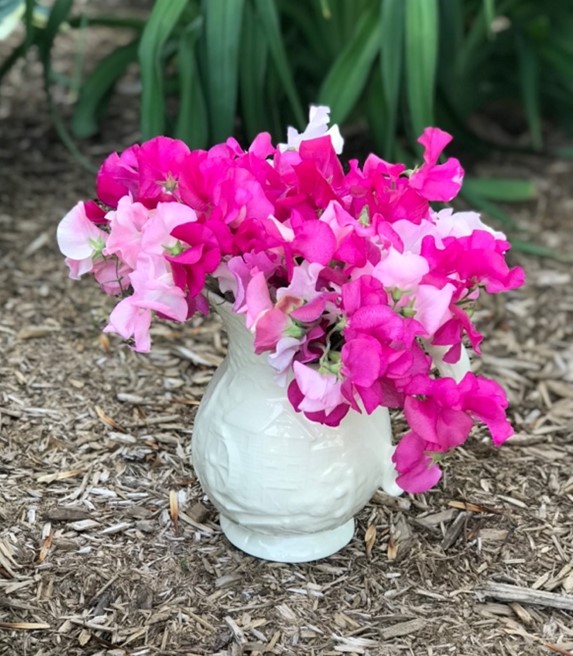
Harvested sweet peas

Resources

https://www.johnnyseeds.com/growers-library/flowers/sweet-peas/sweet-pea-production.html

https://www.drkeithhammett.co.nz

Container Gardening Basics

By Carol Anderson, Master Gardener in Training

Whether you have found yourself in a small space with limited capacity for planting garden beds or enjoy the opportunity to be creative, container planting can brighten any spot in the garden. Containers add dimension, interest and instant colour to a patio, deck, or garden. Containers can be grouped together at different heights and can be used alone in the garden to add height and/or colour in an area where this is needed. Container gardening, however, is both a science and an art. Understanding and providing the right conditions (e.g. light, moisture and nutrition) for your plants is just as important as building an esthetically appealing container garden that can be enjoyed throughout the season. Understanding the basics will go a long way to ensuring a season of enjoyment and success.

Considerations to factor in:

  • What kind of conditions are present (e.g. How much sunlight and what time of day? Is there significant radiant heat from concrete/pavement, etc.? Is there protection from the afternoon summer heat?) Once this is understood, then plants which thrive in the same conditions can be grouped together.

Figure 1. Plants in this area must be heat and drought tolerant             
Figure 2. Any container or group of containers will do!                     
Figure 3. Monochromatic shade. Container can be calming.

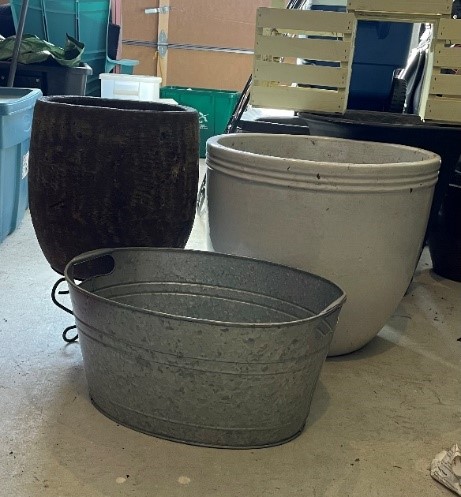
  • What type of containers you should use depends a great deal on the local conditions and the effect you are trying to create (e.g. formal or rustic, etc.). While terracotta pots can be pleasing to the eye, they dry out faster than glazed or fiberglass pots, requiring more frequent watering. Keep in mind, any container that holds soil can be used as a planter if drainage holes are made in the bottom. Always select planter soil that meets the requirements of the plants and conditions; usually one with peat, perlite and organic matter.
  • What kind of effect am I trying to create? Opposite colours (like orange and purple) create drama and excitement, while corresponding colours create calm and harmony. A “punch” of white will catch the eye…something that can be stunning in a shade container.
  • Consider the basic design principles of colour, texture, and shape.  As with colour, texture can be used to create visual interest to a space. Fine texture of a leaf or flower can feel whimsical, and often needs to be observed up close. Large coarse textured leaves with contrasting venation can create a bold impact observed from a distance.
  • And finally shape. Consider constructing your container with 3 types of plants: Thrillers, fillers, and spillers. Plant your tallest plant first (and consider vantage point), then add your feature plant (thriller), then add some filler plants and lastly the trailing variety which spill out of the container. Or…consider a single plant in a container as a feature.

Remember that whatever you choose to do, the combinations of plants are endless. Large tropicals, perennials and annuals all have their place in containers. Some can be brought indoors at the end of the season to winter inside, some can be placed into the garden bed directly, and unfortunately some will only have one season in your garden. Regardless, experiment and take lots of notes so that the following year you can recreate an impact that you enjoyed or change up a container that didn’t have the effect you desired… 

Figure 4. Use of tropical Elephant Ear (Colocasia) adding a bold impact.
Figure 5. Monochromatic shade plants with similar leaf shape.
Figure 6. Large leaf perennial with texture (Siberian bugloss) adds drama.

Figure 7. A single ornamental grass can be combined with other containers adding height and texture.
Figure 8.  Striking colour combination for shade tolerant container planting


Save the Cannas!

by Cheryl Harrison, Master Gardener

Canna lily (Canna X generalis) is an herbaceous perennial. This means that Cannas will die back over winter and regrow from the root in spring.  However, in our zone 5 area, it is too cold for the Canna’s underground rhizome to survive and regrow the following spring.  What to do?

Cannas may grow to be very large (that is, up to 6 feet tall). They may be used as a mass planting, at the back or center of a border or flower bed, and in pots as the “thriller”.  They have large colourful blooms and large leaves that appear almost tropical. The foliage and flower colour vary depending on the cultivar.  Even the seed pods are interesting.

Cannas in a mixed garden

Cannas prefer full sun but will still do well in part shade.  They will bloom all summer.  They prefer slightly acidic, well-drained soil which contains lots of organic matter. 

I used a bright orange Canna in a large pot this year on our deck.  It was quite striking against our pale gray house…..definitely worth saving for next year!

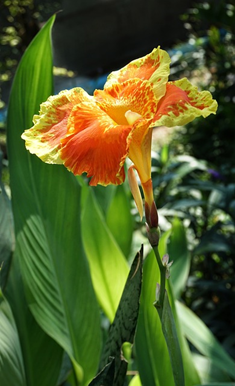
Canna closeup

I have been emptying pots over the last week or so and decided it was time to tackle the Canna.  It is best to do this after the first frost.  Up until the first frost, the plant is still growing and putting energy into the roots.  As mentioned, Cannas may grow quite large. Mine was about 60 cm (2 ft) tall. 

I thought that it would be a difficult task to remove the Canna and prepare it for winter storage. I was happily surprised to find it an easy task. Gently remove the Canna from the pot using a garden trowel to loosen it first. Grasp the stem and lift the entire plant, with root attached, out of the pot. The Canna has a fibrous rhizome which may then be divided into individual stems. Do not wash the rhizomes but do gently remove as much soil as possible. Allow the rhizomes to airdry for a few days. The Canna rhizomes may then be stored in peat or vermiculite in a cool dry space.  

You may also leave your Canna in its pot, cut back the foliage and store the pot in a cool, above freezing, spot over the winter.  I do not have a cool space where I can store potted plants so I chose to store just the rhizomes.

Seed pod

Next spring, after all danger of frost has past, repot or plant your Canna rhizomes. You will be thrilled to see that your beautiful Canna survived the winter and is soon ready to start blooming again for another season.

For more information on overwintering Cannas and other plants, please check out the links below.

Overwintering Plants: What is Overwintering

Overwintering Plants in Containers

Time to take stock of your garden…and collect seeds!

By Silvia Strobl, Master Gardener in Training

Summer is flying by. You can feel the growing season coming to a close with the cooler morning temperatures in late August. Now is a good time to reflect on which vegetables did well in your garden and, if heirloom or open-pollinated varieties, allow some to go to seed for next year’s planting. Or you could collect more seed than you need and package them to exchange for more new varieties at next spring’s Seedy Saturday/Sunday events.

It is important to only collect seeds from open-pollinated varieties as these will retain their genetic diversity and produce plants that adapt to changing growing conditions. They produce seeds that can be legally grown, saved, and shared. Do not collect seeds from hybrid varieties as these will not grow like their parents.

Last spring, I picked up seeds of several new (to me) varieties that diversified both my vegetable garden and my diet this summer, including:

  • An heirloom basil lettuce leaf variety with a milder peppery basil flavour that enhanced mixed lettuce salads throughout the growing season
  • A purple pole bean, Trionfo Violetto, that unlike the purple pole bean, Blauhilde, that I usually grow was more tender and stringless, although not quite as productive
  • A purple podded sugar snap pea, Sugar Magnolia Pea, that is still producing pods today. The peas are very sweet and unlike the purple pole beans do not turn green when cooked, plus they are easy to spot in the tangle of 6 feet tall vines
  • A cantaloupe, Minnesota Midget,that started producing juicy, sweet, ripe fruits by the second week of August
  • A mix of 2 different Armenian cucumbers with light green, ribbed tender skins rather than the dark green skinned Lebanese cucumbers typically grown and available year-round at the grocery store. Surprisingly, Armenian cucumbers are the same species as cantaloupe! Their denser, less watery flesh makes them ideal for tabouli and cucumber salads.
  • Two different peppers that I grew as container plants: (i) Mini Red Bell that produced early sweet peppers that are 1-1/2 inches tall and wide and (ii) Buena Mulata a hot cayenne variety that changes from a pretty purple to red when ripe although we also enjoyed the early milder purple peppers in fresh salsas. Both pepper varieties are very productive, yielding dozens of peppers on one plant!

Why try growing something new?

While it is easy to get into a routine of growing the same varieties of vegetables each year, there are several reasons to experiment with new varieties. A different variety of beans or tomatoes might grow better in your soil conditions and produce a bigger crop, it might taste better, be easier to harvest, mature earlier, or be better suited to the vagaries of our new climate change world with more drought and/or rainy weather. Aside from these good reasons, growing something new can be a lot of fun!

Contributing seeds to your local Seedy Saturday/Sunday event is an economical way to support experimentation with new varieties. You can trade your seeds for seeds of other varieties collected by other gardeners.

How do you get started with seed collection?

As I learned during a seed collection workshop with Jill Bishop of Urban Tomato, here are some general steps to follow:

  • Ensure the variety is open-pollinated or heirloom. The original seed package should provide this information. Or search for the variety name on the internet.
  • Identify the vegetable varieties you enjoyed and mark healthy plants that you will let go to seed. For example, this year I identified 2 plants in my pole bean row where pods could go to seed.
  • Let seeds mature on the plant and observe carefully to ensure you harvest seed heads just before they start to split open.

For beans and peas which are self-pollinated let pods over-ripen and turn brown on the plant. Keep green beans away from purple ones. When seeds rattle inside pods they are ready to harvest. Let the pods dry further indoors.

For lettuce greens, cruciferous vegetables (e.g., kale, cauliflower, broccoli, etc.) and herbs let a plant bolt. Keep different varieties (e.g., of lettuce) apart to avoid cross-pollination or only let one variety bolt. It will take some time for seeds to form and turn completely dry and brown. You might want to cover the seed head with a gauze bag to capture the seeds when seed heads split open. Note that kale is a biennial and won’t form seeds until Year 2 while most spinach varieties are dioecious and both a male and a female plant are required to obtain seed set.

Pepper seeds are simple to collect but make sure to grow varieties separated from one another to avoid cross-pollination. Growing peppers in pots makes this easy to do as you can move the pot during the flowering period. Scrape seeds from a fully ripe pepper and set seeds on newspaper to dry.

Both tomato and cucurbit seeds require a bit more effort to collect.

  • A recent Peterborough & Area Master Gardener blog post, “Tasty Tomatoes”, provided steps for saving tomato seeds from ripe healthy tomatoes. As described in the blog, seeds should be fermented in water for a week to separate viable seeds and improve seed germination and longevity.
  • For cucumbers, squash and melon, let the fruit get big, overripe, and mouldy on the vine, open the fruit, scoop out seeds and let them ferment like tomato seeds, then rinse and let dry.

Ensure that you label and date the seeds you collect through the drying and packaging process. When packaging seeds in smaller envelopes for Seedy Saturday/Sunday events include variety name, year collected, days to maturity, and spacing for sowing. Store seeds in paper envelopes in a dry cool place. If you use jars to store seeds, put an envelope with a fully gummed flap in the jar as well. If the envelope is sealed when you check the jar a week later, humidity levels are too high in the jar. Seeds will start to germinate if kept in humid conditions.

Follow these steps and you’ll be ready to leave a few seed envelopes of your favourite varieties at a Seedy Saturday/Sunday event that will soon be scheduled near you. And you’ll be able to pick up a few free new heirloom varieties to try in 2024!

Seed Collection Resources

Seeds of Diversity a Canadian organization with 1000+ members that grow rare seeds to exchange. They support Seedy Saturday and Sunday events across the country.

How to Save Your Own Seeds–A handbook for Small Scale Seed Production available from Seeds of Diversity for $15.00

The Seed Savers Exchange publishes a Seed Saving Guide in table format that identifies the primary pollination method, how many plants you should grow to collect viable seeds, and how far apart plants should be from other varieties to avoid cross-pollination for more than 80 varieties of vegetables. For example, for vegetables like tomatoes, beans, lettuce and squash, you should grow each variety at least 10 to 20 feet apart from other varieties. If you have a small garden, you can still grow more varieties together but cover a flower with a gauze or blossom bag to only allow that variety to self-pollinate.

There are lots of resources on the internet for making your own seed envelops, including this one: Make Your Own Seed Envelopes For Cheap