Winter Protection for Your Garden

By Christine Freeburn, Master Gardener

The new year arrived with not a speck of snow on the ground and although the ground was frozen and well watered from rainfall, that lack of snow can cause damage in your gardens. Snow, beautiful snow is a great insulator for your perennial beds. I often throw extra snow on things like my rhododendron or hibiscus as I am shoveling sidewalks. Mulch or leaves will also insulate the ground so it is always good to mulch up your garden in the fall, because we can’t depend on snowfall through the cold winter months.

February often brings a thaw as well as the ice and storms that can do damage to trees and flowering shrubs. Cold temperatures, biting winds and the strong winter sun can bleach or dry evergreens when they are not protected by snow. Wrapping in burlap will not save plants from the cold, but it will protect them from wind and sun.

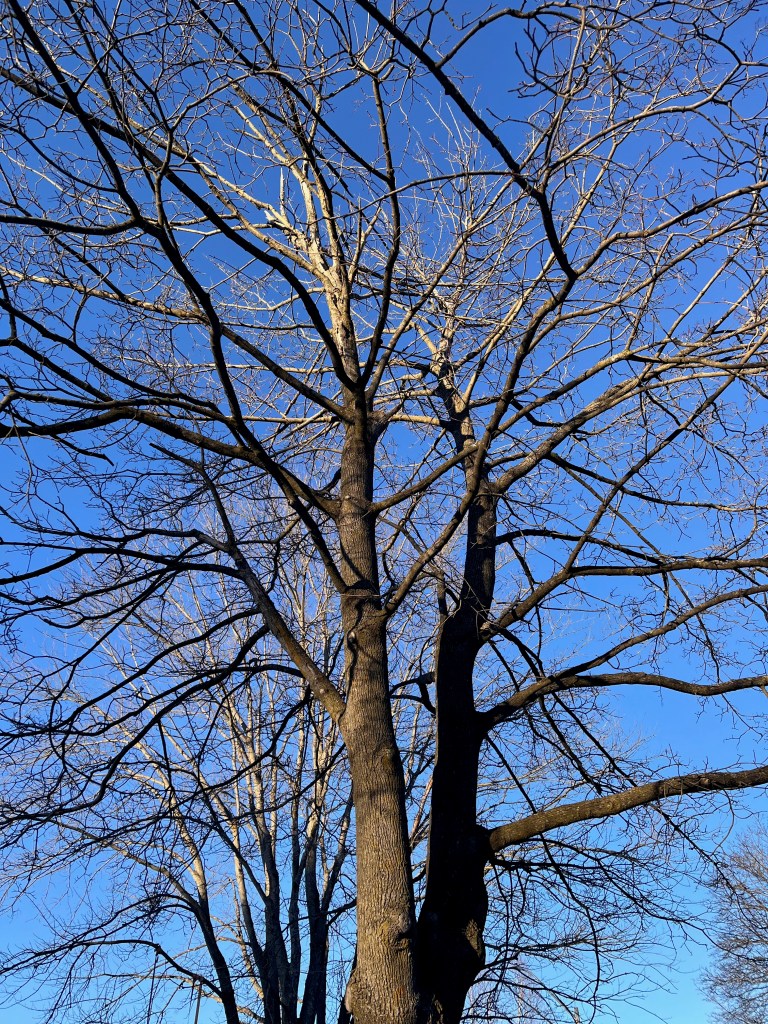
Sunscald can happen when the sun shines brightly on cold winter days, raising the temperature on tree bark which can trigger it to start to grow. When the sun sets and temperatures drop, bark cells in the cambium layer are killed. The cambium layer is just below the tree bark where nutrients travel between roots and leaves. Sunscald will cause scarring or cankers on the trunk and tends to be on the south side of the tree. It usually will not kill a tree but it can put stress on it. It can be harmful on young trees whose bark is thinner. Wrapping your young tree trunk with white tree guards can help with this. Tree guards will also help keep rabbits and other creatures from chewing the bark. Remember to remove this guard in spring.

Dieback can happen on flowering shrubs during a cold dry period. Flower buds that set in the fall can also be killed off from the cold. Plants like forsythia and rhododendron may need to be planted in protected areas with good snow protection and without wind so they produce flowers.  Other shrubs like hydrangea that are not for our zone 5b gardens may not flower in our area because they set their buds in fall and when we get those cold winter days and nights, the buds die. Pruning in fall can encourage growth when the plant should be beginning to rest for winter, so don’t prune too late into fall.

Frost heaving happens when soil freezes and thaws, and when there is not enough snow cover to keep the ground insulated. The semi evergreen coralbell (heuchera) can suffer and die if they heave. Be sure these perennials are well watered and planted into the ground well before freeze up.

When the freezing temperatures and snow arrives, animals like rabbits, mice, voles and deer often feed on the flowering shrubs and trees in your garden, eating bark, twigs and flower buds. I have had rabbits eat euonymus, bridal wreath spirea, yews and willow trees. This winter I have put up burlap fencing around some of my bushes so rabbits can’t “prune” them. I want snow, but I hope it doesn’t pile up too high so the little varmints can just hop over!

References

https://www.gardenmyths.com/sunscald-trees-prevention

extension.umn.edu/planting-and-growing-guides/protecting-trees-and-shrubs-winter

laidbackgardener.blog/2023/12/13/how-will-this-mild-weather-affect-our-plants

www.gov.mb.ca/agriculture/crops/plant-diseases/print,winter-sunscald-frost-cracking

tidcf.nrcan.gc.ca/en/diseases/factsheet/1000135

Embracing the Chill: The Secret Dance of Vernalization

By Mary-Jane Pilgrim, Master Gardener

In the heart of downtown Selwyn where a heavy winter blanket covers my gardens, a magical process is unfolding in the underworld of some of my plants.

In the heart of my living room, I’m actively crossing off the days until Spring.

But, back to the plants. To monitor the seasonal progression and to time their reproductive development, plants must be able to sense and remember environmental cues such as temperature. The process by which plants use a prolonged cold period – winter – to promote flowering is known as vernalization.

Vernalization is the botanical equivalent of a winter sleepover, but instead of cozying up with blankets and hot cocoa, plants snuggle up to the cold. This process is essential for plants like winter wheat, rye, and most spring flowering bulbs in our region. Basically it is a cold period where specific plants not only go dormant (they hit the pause button until the weather warms) but must be exposed to a certain number of days with minimum temperatures or they will not grow properly and flower. It acts as a sort of safety mechanism to ensure that the growing and blooming process takes place at the correct time.

Picture this: a seed or bulb lies dormant in the frozen soil, patiently waiting for winter’s icy touch. As the temperature drops, the plant detects the chill and starts a biochemical countdown for a certain number of days. It’s as if the cold serves as a bell ringer, signaling that it’s time to prepare for the grand spectacle of spring. It’s amazing that even in the harshest conditions, nature has its own way of orchestrating the grand spectacle of life.

So, in my living room I continue to mark the winter days off one by one, reminding myself that the bulbs I planted in October need a cold cold winter to make my garden spring to life. It will definitely be worth it!

Creating a Wildlife Friendly Hedgerow in my Ontario Garden

by Emma Murphy, Master Gardener

Although I’ve lived in Canada for almost 50 years, I grew up in Bristol, England for some of my formative years, and always loved the traditional hedgerows that existed along rural roads and properties. Every time we return to the UK on a trip, I marvel at the diversity and intricacy of these functional garden/farm structures.

On our three quarter of an acre property in a small village north of Peterborough (Zone 4b/5a) I have a neighbour on one side who has a chain link fence and loves their golf green lawn. On the other side there is no fence at all, but I’ve been growing a few elderberries (Sambucus canadensis) and cup plants (Silphium perfoliatum) to hide a poorly maintained house – the first shrub suckers well and the second plant grows fast and tall.

So I’d love to have a traditional English-style hedgerow on both edges that would provide visual screening as well as animal and bird habitat…so I went looking to see how to adapt the traditional English hedgerow to Ontario.

Hedgerows can provide amazing bird habitat

The origins of hedgerows

It’s thought that hedgerows (or hedges) were first used by humans as ‘dead hedges’ to enclose livestock using thorny plants. Once agriculture began, clearing woodlands created fields with tree and shrub boundaries that were managed to create livestock-proof ‘living fences’.

Hedgerows have been planted since the time of the Romans and reached their peak in Britain during the Enclosure Acts of the 1700s when an estimated 200,000 miles of mostly hawthorn (Crataegus spp) hedgerows were planted.

Credit: People’s Trust for Endangered Species, UK

Hedgerows have many purposes, as you can see from this graphic from the People’s Trust for Endangered Species. They have an excellent video on how to manage a hedgerow here, but it’s not quite the same in Ontario, as we don’t have the same hedgerow species or coppicing techniques.

In their best form I think hedgerows can be a mini-ecosystem with key ingredients that animals and birds need to survive — food, shelter, nesting and denning sites. Hedgerows also function as corridors, connecting one habitat to another and offering a safe passage for wildlife. They help muffle sound, create privacy, and act as windbreaks.

Definitely not a short term project

According to the Ottawa Field Naturalists Club (OFNC), the ideal hedgerow is

  • Planted with a variety of berry- and seed-bearing shrubs for food
  • Interspersed with cedar for added cover
  • Thick, bushy, largely unpruned and entangled with vines

The Ontario Rural Skills Network suggests that hedgerows can be single species but are best if they comprise a diversity of plants. Planting should be very dense, with a double line spaced 40cm (16in) apart with plants in a staggered pattern at 30cm (12in), giving 5 plants per metre.

Because they’re comprised of living shrubs, hedgerows grow and require management. It’s all about creating a balance between growth and avoiding them becoming gapped and unmanageable. A hedgerow may take seven to 10 years to establish, depending on the species composition.

This young hedgerow bordering a field features native plants that provide habitat for beneficial insects and pollinators. Photo: Janet Donnelly, © Oregon State University

Making a plan

I’m just at the beginning of my plan for hedgerows on our property, but winter is a great time to do research. Both sites are sunny and have well drained soil, and I want to focus on using Ontario native plants as much as possible. I’m looking at a combination of seed- or nut-bearing shrubs (like speckled alder and hazel) and berry producers (serviceberry, chokecherry, red osier dogwood). Thorny shrubs (native roses, wild raspberry, hawthorns) will give added wildlife protection. The design will probably be different for each one, but that’s the fun of it.

The OFNC has excellent lists of plants you can consider for an Ontario hedgerow. I’m thinking about using

  • Speckled alder (Alnus incana)
  • Beaked hazel (Corylus cornuta)
  • Hawthorns (Crataegus spp.)
  • Common elderberry (Sambucus canadensis)
  • Flowering raspberry (Rubus odoratus)
  • Willow spp. (Salix spp.) – native if I can find them – there is an amazing group in
  • Choke cherry (Prunus virginiana)
  • Red osier dogwood (Cornus stolonifera or C. sericea)
  • Eastern white cedar (Thuja occidentalis)
  • Wild (riverbank) grape (Vitis riparia)

Next steps

I’m just at the beginning of my journey. In my next blog post on March 25th, I’ll give you an update on my research and my plans for my spring hedgerow projects. Until then, here’s some interesting sites to look at if you are thinking about something similar. And, by all means, if you have created a hedgerow in your Ontario garden, I would love to hear about it.

More resources

Creating a hedgerow for wildlife (Canada)

Hedgelink (UK)

National Hedgelaying Society (UK)

The traditional farm hedgerow (Canada)

Surrey Wildlife Trust – how to lay a hedge (UK)

1000 Islands Master Gardeners – Wildscaping with hedgerows (Canada)

How to plant a hedgerow in the home landscape (Ohio, US)

How to Start a Hedgerow (5 Steps) (Washington State, US)

A Guide to Hedgerows: Plantings That Enhance Biodiversity, Sustainability and Functionality (Oregon State U Extension)

Healthy hedgerows on your land (UK)

What have hedgerows ever done for us? how hedges benefit us (UK)

Gardening for Birds Through the Seasons

By Silvia Strobl, Master Gardener in Training

More than 1 in 4 birds have disappeared in North America since 1970, primarily due to habitat loss according to a recent study. As gardeners we can help to mitigate further declines by adding native plants to our gardens that meet seasonal bird habitat needs. If you would like to help, consider whether you can add one or more of the Ontario native plants noted below in your 2024 garden plans. All these are easy to grow, low maintenance, prefer full to part sun, and tolerate a wide range of soil conditions—ideal for almost any garden! Click on the plant names for Ontario specific growing information and photos.

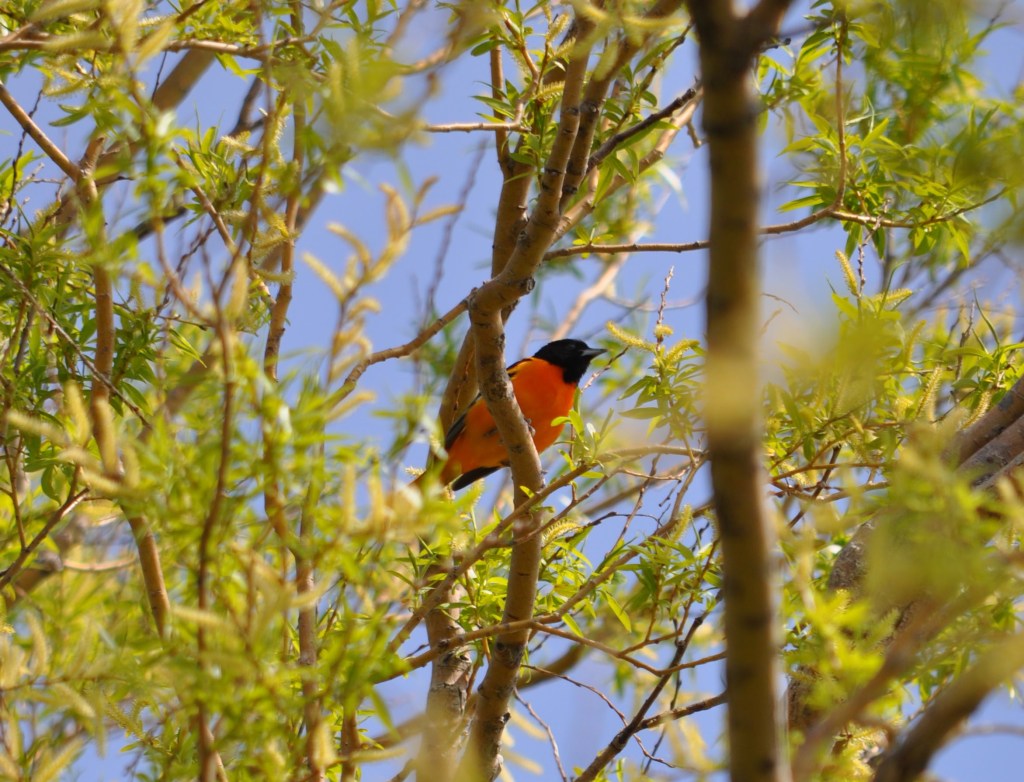
In spring, food for early returning migrants is critical. The catkins of Pussy Willow (Salix discolor) and other willow species are an important early nectar and pollen source for native bees, but they also attract insects which feed returning Eastern Phoebes, Ruby-crowned Kinglets, Chickadees, and other insect eating birds.

Northern Oriole among Willow catkins in early spring (photo credit: Beth McEwen)

For returning Ruby-throated Hummingbirds, growing a patch of Wild Columbine (Aquilegia canadensis) provides a critical source of early nectar. Providing a succession of nectar sources for hummingbird parents will entice them to nest and let you enjoy the flight chases of the juvenile birds in late summer. Include native plants with red, orange, or pink tubular flowers such as Scarlet Beebalm (Monarda didyma), Fly Honeysuckle (Lonicera canadensis), or Northern Bush Honeysuckle (Diervilla lonicera).

If you have room to plant only one tree in your yard, make it a Bur Oak (Quercus macrocarpa), Red Oak (Q. rubra), or Black Cherry (Prunus serotina). These trees support the greatest numbers of caterpillar species and hence provide important food high in protein for Chickadees and other birds raising nestlings in our short, temperate summers. To rear one clutch, Chickadees require up to 9000 caterpillars. Trees also provide structure and cover for nests.

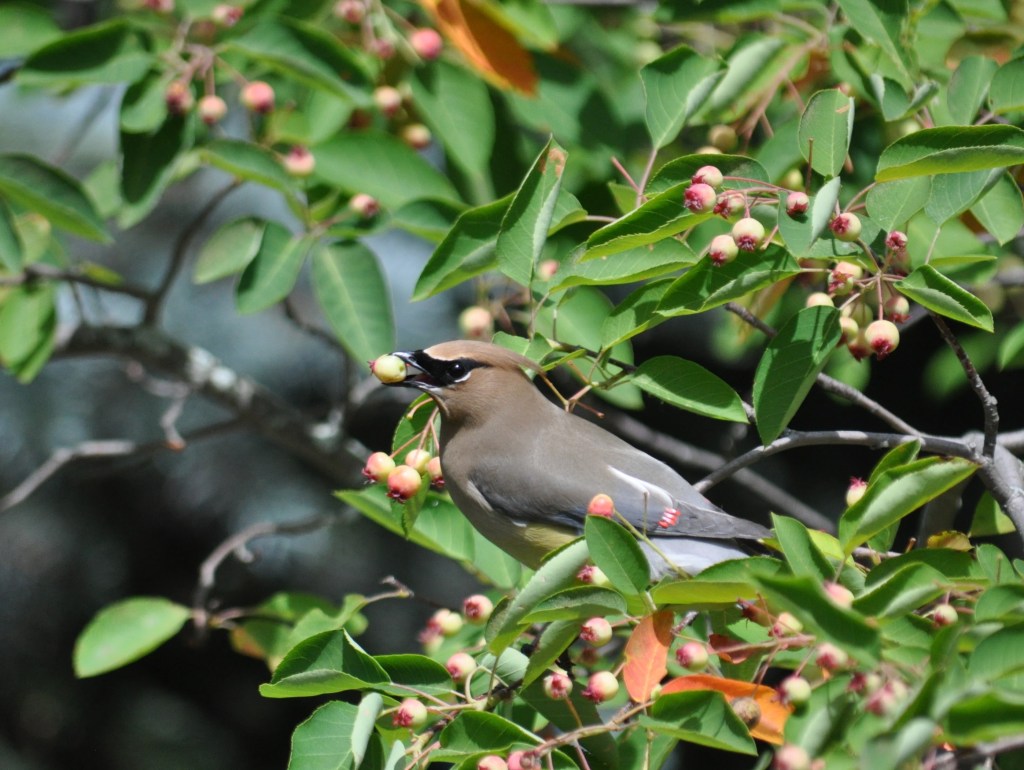
Small, garden-size shrubs such as Serviceberries (Amelanchier spp.), Common Elderberry (Sambucus canadensis) and Chokecherry (Prunus virginiana) produce early season berries that provide food for Cedar Waxwings, Rose-breasted Grosbeaks, Catbirds, and Robins. These shrubs also provide cover for nesting birds.

Cedar Waxwing eating a Smooth Serviceberry (Amelanchier laevis) berry in late June/early July in the author’s former Peterborough Garden (photo credit: Silvia Strobl)

For fall and winter bird habitat, grow a variety of plants that provide food, including:

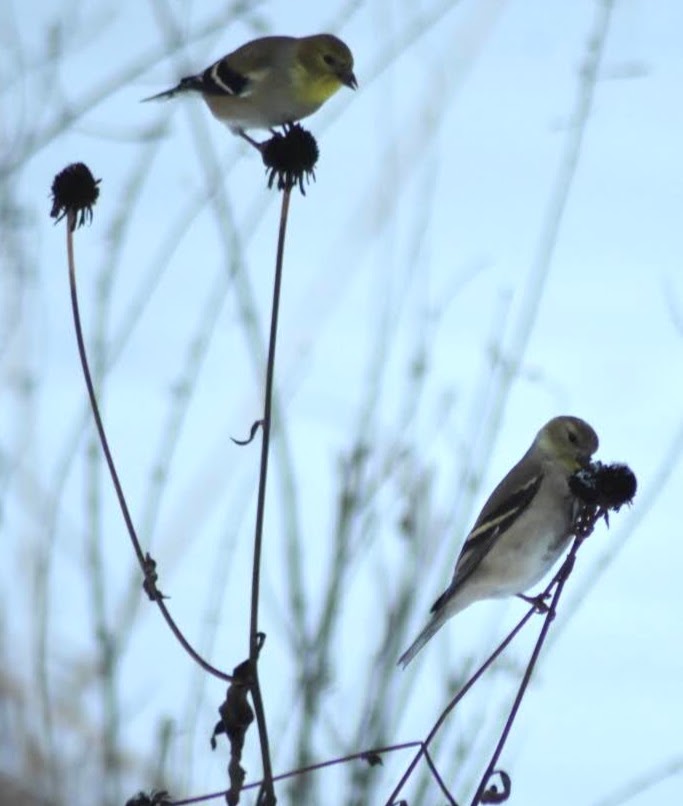
  • Native Sunflowers, Purple Coneflower (Echinacea purpurea), Black-eyed Susan (Rudebekia hirta), and Asters (Symphyotrichum spp.) and stop deadheading at the end of August to promote production of seeds. Leave these plants standing overwinter to provide food for Goldfinches, Northern Cardinals, and Dark-eyed Juncos.
  • Shrubs such as Grey Dogwood (Cornus racemosa), American Plum (Prunus americana), Chokeberry (Aronia melanocarpa) and the vine, Virginia Creeper (Parthenocissus quinquefolia) produce late-season berries that are rich in fats. Many insect-eating birds switch to eating berries in fall to store fat under their chests and wings to support either long journeys south or survival in our chilly winters. Berries of native shrubs have higher percentages of fat (6.5% to 48.7%) than most non-native shrubs (less than 1%) according to this study.
  • Conifer trees and shrubs such as Eastern White Cedar (Thuja occidentalis) provide sheltering cover for year-round resident birds such as Chickadees, Nuthatches and Mourning Doves.
  • Decaying stumps and logs attract numerous beetles and ants. If you must remove a tree that has died or outgrown your garden, consider leaving the standing dead tree or stump to decay and provide insect food for Pileated and other Woodpeckers.
Goldfinches enjoying seeds of Purple Coneflower against a backdrop of winter snow in the author’s current garden (photo credit: Silvia Strobl)

You can have a spectacular garden by adding native plants. And, when you see birds using your garden, you will not only feel good about your contribution to bird conservation, but you will enjoy your garden even more!

The author’s (mostly native plant) garden in early August (photo credit: Silvia Strobl)

Native Plant Sources

A key issue for those trying to grow native plants is finding them. To help you, the Halton Master Gardeners maintains a map of Ontario native plant nurseries that also provides websites and contact information. Always phone the nursery first to confirm they will be open.

Other Resources

In Our Nature. Nd. Native Plants for Hummingbirds. https://www.inournature.ca/plants-for-hummingbirds

In our Nature. N. 30 Native Shrubs for Ontario Gardens: Your go-to reference for the best shrubs for gardeners and wildlife. https://www.inournature.ca/best-native-shrubs

Tallamy, D.W. 2019, Nature’s Best Hope: a new approach to conservation that starts in your yard. Timber Press. 256 pp.

Related Over the Fence Blogs

EXPANDING YOUR NATIVE PLANT PALETTE

ATTRACTING BIRDS 1

ATTRACTING BIRDS, PART 2

ATTRACTING BIRDS PART 3

Bolting, Botanically Speaking

By Lois Scott, Master Gardener

Bolting? Run to seed? Wait, my plants are going to pull up roots and escape?! No! These terms are used when vegetable crops prematurely flower and go to seed, very likely making the plant unpalatable and possibly unusable. https://www.rhs.org.uk/vegetables/bolting

According to https://www.canr.msu.edu/news/bolting-in-spring-vegetables, ‘flowering in most annual vegetables (ex. lettuce, arugula, spinach) or biennial vegetables (ex. kale, onions, carrots) is influenced by complex interactions between temperature, daylength and stresses of various kinds. Among these, periods of cool temperature during early growth followed by long daylight hours are often the most important determinant of unwanted bolting in vegetables’. Sounds complicated!

Can a gardener prevent bolting? From my research there does not seem to be a general rule of thumb for all vegetable crops. Suggestions include timing your sowing of seed or planting out of seedlings until temperatures are relatively stable. One could employ succession planting such as planting cool weather crops like arugula in the spring and then again in August to have a more consistently available crop. Providing good growing conditions so that your crop will mature enough to provide a usable portion before flowering, is another suggestion. Dry soil is also reported as a cause of bolting so careful watering may help. Careful watering is never a bad thing. Lastly, using bolt-resistant cultivars is on most lists as a way to ‘control’ bolting.

So why am I talking about vegetable crops going to seed in January? At this time of year, we have the wonderful opportunity to peruse seed catalogues and there you will see specially bred plant cultivars being described as ‘slow to bolt’ or ‘bolt resistant’. They may not always be what I choose when ordering seed but they are an option to potentially extend and improve the vegetable harvest.

5 Simple New Year’s Resolutions for Gardeners

by Emma Murphy, Master Gardener

As this year ends, I’m offering a few New Year’s resolutions for gardeners for 2024. If you want more of a challenge, the Chicago Botanic Garden offers 50.

Add Native Plants To Your Garden

  • We’re all seeing the effects of climate change on our gardens.
  • Native plants adapt more readily to stressful and changing weather patterns, such as prolonged droughts or winter cold snaps, than hybrids and non-natives often seen in our nurseries.
  • Native plants help sustain beneficial insects and bird populations because they attract native pollinators and birds that might not be drawn to non-natives.
  • Create less work for you, as native plants tend to be lower maintenance than non-native ones.
  • The Native Conservancy of Canada offers some suggestions to get you started, or consult with your local Master Gardener group or Horticultural Society.
Bloodroot, Sanguinaria canadensis

Start A Compost Bin

  • Composting helps keep waste out of landfill by collecting and processing organics into material that can be used to create nutrient-rich compost used to feed and nourish soil.
  • Canadian Living offers a simple outline, as shared by Ed Begley  Jr.
  • Or more here from the Thames Region Ecological Association, including troubleshooting issues.
Compost bin

Grow More Of Your Own Food

  • The pandemic has highlighted how our agricultural systems are vulnerable to global shocks. Issues with supply chains, migrant workers, transport, trade and border closures have resulted in some foods being in short supply or prices going up (while quality goes down).
  • Insects do all the hard work, and all pollinators benefit.
  • Gardening provides benefits for your wallet, your nutrition, and reduces your environmental footprint. By growing your own food (either from seeds or small plants), your food is automatically more sustainable simply because you are doing it onsite or in a community garden. If you control the ‘inputs’ and do it well, you can save a lot of money.
  • Ultimately there is nothing more rewarding than planting and maintaining your own vegetable garden and harvesting (and sharing) your results. And we all know how much better homegrown produce tastes versus conventional produce at the grocery store. If you have too much produce, then you can just share the love with others!
  • Royal City Nursery in Guelph offers 8 Reasons to Start Growing Your Own Food from Seed
Creating a vegetable garden

Continuous Learning

  • Do what you love but keep on top of what’s trending in garden design to see if anything sparks your interest.
  • Keep track of what’s working and what’s not by documenting your garden happenings in a journal.
  • Expand your garden library and treat yourself to a new gardening book.
  • There are so many amazing (and free) garden webinars available now – learn from the experts.
  • Some of my favourite bloggers – The Impatient Gardener (in Wisconsin, similar climate to us), The Empress of Dirt (Ontario), Niki Jabbour (Halifax), The Laidback Gardener (Montreal), and Garden Myths (Robert Pavlis in Guelph, Ontario).
Online learning is a great opportunity

Reduce Your Use Of Plastic

  • Plastic is a major component in the garden, from plastic plant pots and seed trays to watering cans, and compost bins. Most plastic gardening equipment will end up in landfills, where plastic pots alone can take up to 500 years to decompose.
  • There are a few easy swaps you can make in going plastic-free: Many of us want to use less plastic in the garden, from plant labels to watering cans, tools, plant pots and the sheeting used to suppress weeds. Buying (and therefore using) less plastic will not only reduce your plastic footprint but also sends a message to manufacturers that gardeners want alternatives to plastic (especially single-use plastic).
  • Try to find biodegradable pots that made from natural materials such as coir, bamboo, wood chips, or seaweed (or commit to using your plastic pots year after year).
  • If you use plastic string, make the swap for a natural jute or hemp, and protect your fruits and vegetables with metal mesh instead of plastic netting – it lasts for years.
Find alternatives to plastic pots, or commit to using (and reusing them) for many years

Happy gardening dreams until we can get out into our gardens again….

Little Forests

By Cheryl Harrison, Master Gardener

A little forest … seems like a bit of an oxymoron.  I always thought of a forest as a loose grouping of trees and other plants that covers a large area?  I was introduced to a little, or Miyawaki, forest this past spring at the Lilac Festival in Warkworth, Ontario.  The Peterborough & Area Master Gardeners partnered with the Northumberland Master Gardeners to offer a Native Plant educational event on the same May weekend as the Festival.  We had a successful educational event, the Lilac Festival was great fun AND I saw my first little forest!

The Miyawaki forest method was created by Japanese botanist Akira Miyawaki.  He developed the idea of restoring damaged ecosystems by layering various species of native trees, shrubs and ground cover.  A site is chosen and prepared by layering cardboard and mulch.  Various species of young native plants are then planted close together in a relatively small area, as compared to traditional planting methods, for the number of plants chosen.  This method has been used in urban areas to demonstrate native plant forest environments.

The Miyawaki method of planting a forest is relatively new to Canada but there are more of this type of forest creation popping up across the country.  All mixed native plant forests have many benefits including improving air quality, providing wildlife habitat, sequestering carbon and more.  However, even though the Miyawaki forest creation method is a fairly new concept, it is bringing the forest closer to people by getting the benefits, and importance, of forests more widely noticed just because it is a relatively new concept.  I know that I enjoyed looking at the plants in the Warkworth little forest.  It gave me ideas about what I could do on my own property.  Let’s face it, a walk through a forest, even a little one, is always a relaxing way to spend an afternoon!  

For more information, check out the links below:

A Community Miniature Forest

The Many Benefits of the Miniscule but Mighty Miyawaki Forests

Miyawaki Forest – Do Mini-Forests Really Work?

Green Communities Canada, National Mini Forest Pilot

The Social Network of Trees

by Anne Trudel-Inglis, Master Gardener

Trees have had a social network for hundreds of years!

Do trees communicate?  This concept is still up for discussion.

Trees communicate amongst themselves – one form of communication is through electrical impulses through their roots.  Another form of communication is by scent released into the air.  

For example:

“On the African savannah, giraffes were feeding on Vachellia tortilis (umbrella thorn acacias), the trees didn’t like this, so minutes later they started pumping toxic substances into their leaves to rid themselves of the large herbivores. The tree gave off a “warning gas” and other trees in the vicinity got the signal and followed suit.”1

The giraffes got the message and moved onto other trees.

Communication by electrical impulses through their root system to other trees is accomplished through the fungal networks around their root tips.  Messages are transmitted to the fungi which in-turn “operate like fiber-optic Internet cables”2 sending messages for miles along the fungal network to other trees in the forest about insects and other dangers lurking.

There are various scent compounds depending on the attack that is occurring.  Trees have the ability to identify which species of insect is attacking by its saliva.  The identification is so specific, it can release pheromones which attract the predator of the species attacking the tree.

If a tree finds itself in harm’s way it sends a message through the tree’s internal network which in turn signals the leaves to release a scent compound. “Not just any old scent compounds, but compounds specifically formulated for the task at hand”3.

The transmission of scent compounds travels in the air for miles.  Animals and small critters in the forest detect the scents being released.  If a predator picks up the scent, it knows a food source is nearby and follows the scent.

Tree Root Facts

  1. Most tree roots do not penetrate deep into the soil. Root depths range from 6 – 18 inches, staying close to the surface of the soil in order to absorb water, nutrients and oxygen from the soil.
  2. Tree root systems cover more ground horizontally. Some irregular root patterns extend 2 – 3 times larger than the crown of the tree.
  3. There are three basic root systems:
    a. Tap root systems (straight, thick and tapering) include species such as Pine, Eastern Redbud, Walnut, White Oak, Sycamore, American Hornbeam and Douglas Fir.
    b. Heart root systems (combination of large and small roots descending down and across) include species such as Norway Maple, Larch, Lime and Beech.
    c. Flat root systems (no obvious primary root, several horizontal roots spreading laterally) include species such as Spruce, Sugar Maple, Silver Maple, Hackberry, Birch, Fir and Cottonwood.

I  believe this is a form of communication or social networking – communicating to other trees, animals, fungi, insects, pests and beneficial predators.

    References

    1. Wohlleben, Peter (forward by Tim Flannery; translated by Jane Billinghurst) The Hidden Life of Trees: What They Feel, How They Communicate – Discoveries from a Secret World. Greystone Books Ltd. Vancouver, BC 2015, P.7.
    2. ibid, page 10.
    3. ibid, page 8.

    A Guide for Ontario Gardeners in December

    By Mary-Jane Pilgrim, Master Gardener

    As the snow blankets our gardens in Ontario, many might assume it’s time to hang up the gardening gloves until spring. However, seasoned gardeners know that December can be a time of indoor/outdoor preparation for the upcoming growing season.

    One key activity for this month is winter mulching. While it may seem counterintuitive to spread mulch in the cold, it’s a crucial step to protect your plants from the harsh Canadian winter. A thick layer of mulch acts as a cozy blanket, shielding the soil and plant roots from extreme temperature fluctuations. Thankfully in our region, Mother Nature does this job for us in the form of snow!

    For those dreaming of vibrant spring blooms, December is the ideal time to start forcing bulbs indoors. Tulips, daffodils, and hyacinths can be coaxed into early flowering by providing them with a period of cold storage, mimicking the winter chill they would experience outdoors.

    Don’t forget about your compost! While your outdoor compost pile may slow down in the winter, it’s still a valuable resource. If you don’t do this already, consider continuing your indoor composting with kitchen scraps to keep the nutrient-rich compost coming, even in the colder months. People living in the city will probably be already doing this thanks to the new green bin program, but for others living outside of the city limits, sometimes the outdoor compost pile seems like it’s just too far to venture to in the cold. However, a little bit of effort now will divert a lot of food waste from the landfill.

    Lastly, embrace the festive spirit by incorporating evergreen plants into your outdoor decor. Hollies, spruces, and winterberry bushes add a touch of green to the winter landscape and can be adorned with festive lights or ornaments.

    December in Ontario might be chilly, but for gardeners, it’s a time of planning, protecting, and finding joy in the small wonders that the winter garden has to offer. So, bundle up, grab your gardening tools, and let the December gardening adventures begin!

    Winter Greens to Brighten our Homes

    By Christine Freeburn, Master Gardener

    When we are using plant nomenclature, there are a couple family names for the evergreens we love and include in our winter decorating.  Phinaceae includes hemlock (Tsuga), spruce (Picea), pine (Pinus) and fir (Abies).  Cedar (Thuja) and cypress are in the Cupressaceae family.

    One good way to identify evergreens is to look at the needle arrangement. Pine needles are bunched together in two, three or five groupings rather than single needles like hemlock or balsam. Spruce needles are four sided, so when you roll them in your fingers you can feel the sides.

    Cone size and shape also helps with evergreen identification. PIne cones hang down as do spruce cones, but spruce cones are flexible while pine cones are stiff and more woody. Balsam cones grow upwards.

    Native Evergreens

    White Pine (Pinus strobus) has 5 needles bunched together which can be up to 15 cm long. They give the appearance of being wispy and soft. These boughs flow over your container, giving it shape.

    Red Pine (Pinus resinosa ) has needles in bunches of two that will snap if bent. Needles tend to be stiffer than white pine and are longer. These branches can be the “bones”  of your container, including the centre piece.

    Ontario Cedar (Thuja occidentalis) has a lighter underside to the fan-like branches which give a pop of lime green colour to your display.  It also drapes nicely in your arrangement.

    Balsam Fir (Abies balsamea) has smooth, flat needles that are soft and aromatic. Balsam are the most popular tree for live Christmas trees because of the soft needles and bushy appearance. Adding another texture to your pines and cedar gives more dimension to your creation.

    Hemlock (Tsuga canadensis) is another native tree that is similar to balsam with flat needles that have a white stripe on the underside. Hemlock needles are shorter than balsam and have stalks that the needles form on. They have a lighter coloured underside.

    Spruce needles are square and prickly growing all the way around the twig. Black spruce, white spruce & red spruce are native while Norway Spruce (Picea abies) are not..White spruce (Picea glauca) needles are much longer than black spruce (Picea mariana) needles.Check out this article from the Toronto Master Gardeners on the difference between white and black spruce.

    Non Native Evergreens

    Scotch Pine (Pinus sylvestris) is easy to spot along roadsides in the area.  Needles are grouped in twos, slightly twisty, sharp and 4-8 cm long. It was one of the first trees to be brought to Canada from Europe. It was imported to help with soil erosion in the early 1900s. This tree is listed on the Ontario Invasive Species list. Its sturdy branches make it another good choice for the “bones” of your container if you don’t use red pine.

    Natural additions like pine cones or dried flowers like hydrangea, sedum, sumac or allium add to the natural look. Coloured ornaments can add a pop of colour, but the textures and colours of the greens are the true stars of an arrangement.

    There are boughs that you can purchase that you cannot find in the wild. BC cedar has beautiful drapey branches. Incense cedar has lovely seed pods that you won’t want to put in your indoor displays as they will burst when the warmth hits them. Carolina Sapphire Cypress, Noble Fir and Leyland Cypress will add different shades and textures. Many of us cut from ditches and our own properties. Remember if you are out cutting to do it responsibly and respect private property.

    Enjoy the green of the season….along with the white of the sparkling snow.

    References

    https://ontariotrees.com

    Botanica North America by Marjorie Harris

    GT Trees of Canada and North America by Alan Mitchell