Category Archives: Invasive

Roadside Attractions – Ontario Wildflowers (or are they?)

by Emma Murphy, Master Gardener

Growing up in southwestern Ontario, I loved seeing these bluish star flowers in summer along roadsides. When we stopped to take a look, we were surprised to see them somehow growing out of straight gravel or other disturbed soil. Eventually, I found out they were Wild Chicory (Cichorium intybus), not native to Ontario. This plant is opportunistic and hardy, but incredibly hard to grow in a home garden (believe me, I tried, before I knew better). The root, roasted and ground, is used as a coffee substitute.

Wild Chicory flowers (Cichorium intybus)

It’s interesting how many people assume that the Ontario roadside flowers they see out their car windows are native to our province – in fact, many are non-native opportunists from Europe or Asia that colonize quickly on disturbed sites or ditches and wetlands and outcompete native species, negatively affecting biodiversity and increasing habitat loss.

Here are some of the plants you may recognize from your travels – none of them are native to Ontario. Are you surprised?

Chicory (Cichorium intybus)
This plant grows everywhere, often in close proximity to Queen Anne’s Lace (see below), and the colour combination of white and blue is very pretty. Both the leaves and roots of chicory are used for culinary and medicinal purposes, and it’s also known for its use as a coffee substitute. More info HERE.

Dame’s Rocket (Hesperis matronalis)
From Europe, people also refer to this as spring phlox, but it’s not our true native spring wild blue phlox (Phlox divaricata) – as the ditty goes – Dame’s Rocket has 4 petals, while our native phlox has 5 petals. Dame’s Rocket also has ALTERNATE leaves and phlox has OPPOSITE leaves. It is a prolific self-seeder and fast-grower and thrives in roadsides, forest edges, and disturbed areas. More info HERE and HERE.

Common Dandelion (Taraxacum officinale)
Yes, the dandelions we see on the roadside (and in our lawns and gardens) are not native to Canada. While they show up early and provide some pollen, they definitely don’t support our native bees. More info HERE.

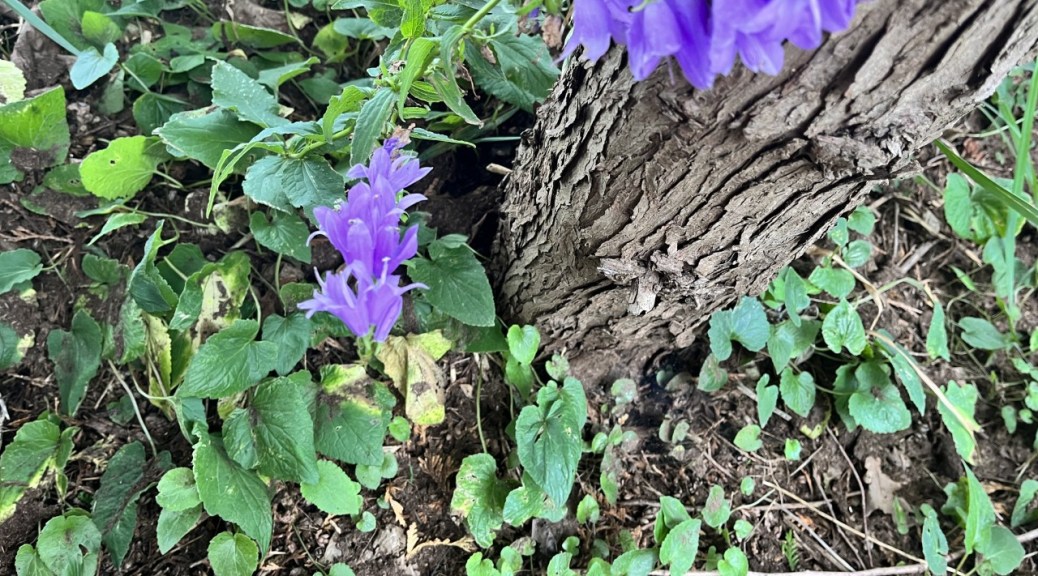
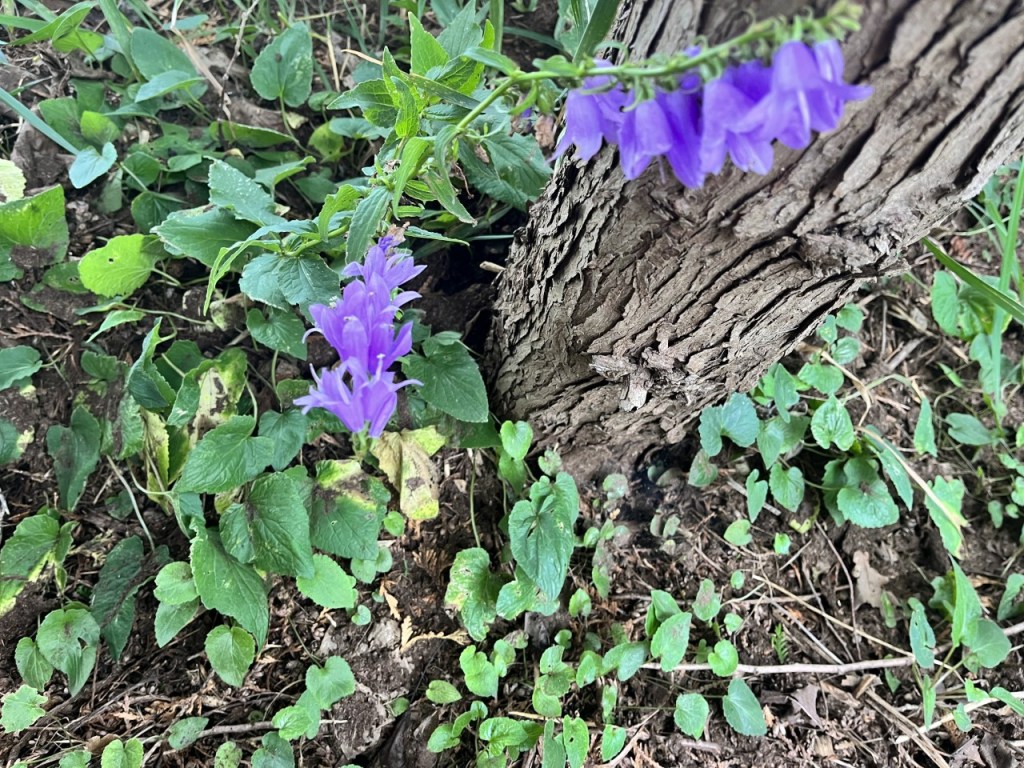
Creeping Bellflower (Campanula rapunculoides)
Introduced from Siberia, this pretty looking plant spreads aggressively in gardens and natural areas. As many gardeners know, once you have it, it’s really hard to get rid of the long, parsnip-like roots as even small root fragments can regrow. More info HERE and a Facebook support group HERE.

Red, White, and White Sweet Clovers (Trifolium repens, T. pratense, and Melilotus albus)
While Ontario has three native clovers – Purple Prairie Clover (Dalea purpurea), White Prairie Clover (Dalea candida) and Slender Bush-clover (Lespedeza virginica), the white, red, and sweet white clovers you see on the roadsides are likely to be non-native escapees from agricultural operations. The worst of these is sweet white clover. All are legumes, so they fix nitrogen in the soil. More info HERE.

Bird’s-foot Trefoil (Lotus corniculatus)
Brought to North America as a forage crop for animals and a green manure, this low growing plant with bright yellow flowers is now found along roadsides all over Ontario. Its name comes from the seed pods splayed in the shape of a bird’s foot. It’s attractive to bees and converts nitrogen, so it is often used in soil stabilization or rehabilitation projects. More info HERE.

Crown Vetch (Securigera varia)
In decades past, this dense, quickly spreading plant was used by highway department crews to stabilize new road cuts. Though it looks pretty with its pink flowers, it’s often grows wildly out of control. More info HERE.

Yellow and red hawkweed (Pilosella aurantiaca formerly Hieracium aurantiacum)
While very colourful, these are aggressive plants that can outcompete native species and form dense mats, reducing biodiversity and forage for wildlife. They are known to spread through seeds, stolons (aboveground stems), and rhizomes (below ground stems). More info HERE.

Oxeye Daisy (Leucanthemum vulgare)
This colourful white daisy resembles the English daisy but it not a true daisy, and is smaller than a Shasta daisy. The white petals are, in fact, discrete flowers. It’s the same with the yellow central disc, which is made up of hundreds of tiny individual flowers. It seeds profusely (I speak from experience) which makes it very hard to remove from your garden. More info HERE.

Queen’s Anne Lace/Wild Carrot (Daucus carota)
Native to Europe and Asia, it is a common roadside plant with white flowers and feathery leaves. If you crush the leaves of this familiar, flat-topped flower, which looks like a flurry of tiny snowflakes, and you will smell carrot. It’s a secondary Noxious Weed in Canada and appears on invasive lists in some US states. This is the species which developed into our domestic carrot, Daucus carota subsp. sativus. More info HERE.

Mullein (Verbascum thapsus)
Non-native mullein is easy to spot with its very distinctive appearance. About 2-3 ft tall (but can be taller), flowers appear on the top of the stalk, but it’s well-known in herbal medicine for use in coughs and skin irritations. While not typically a concern in cultivated agricultural land, it can be problematic in pastures and roadsides due to its ability to colonize disturbed soil. More info HERE.

Invasive Terrestrial Plant Species in Ontario – A Refresher

by Cheryl Harrison, Master Gardener

What is an invasive terrestrial plant?

Invasive terrestrial (grows on land) plants are non-native trees, shrubs, and herbaceous plants that are spread by global trade, humans and animals, and gardening. These plants have the ability to out-compete our native plants for space, nutrients and moisture.  This means that they can damage the environment, human health and can have an economic impact.

Some also contaminate the soil so that it is difficult for other plants to grow even after the invasive has been removed (e.g. garlic mustard [Alliaria petiolate] – a herb).

Invasive plants may seem perfectly at home and under control in your garden.  However, seeds can be relocated by an animal or other means.  Other plant parts (e.g. rhizomes) can grow into new plants when you do a clean-up and dump your garden refuse in another perhaps wild area.  This sets the invasive plant free! 

Japanese Barberry

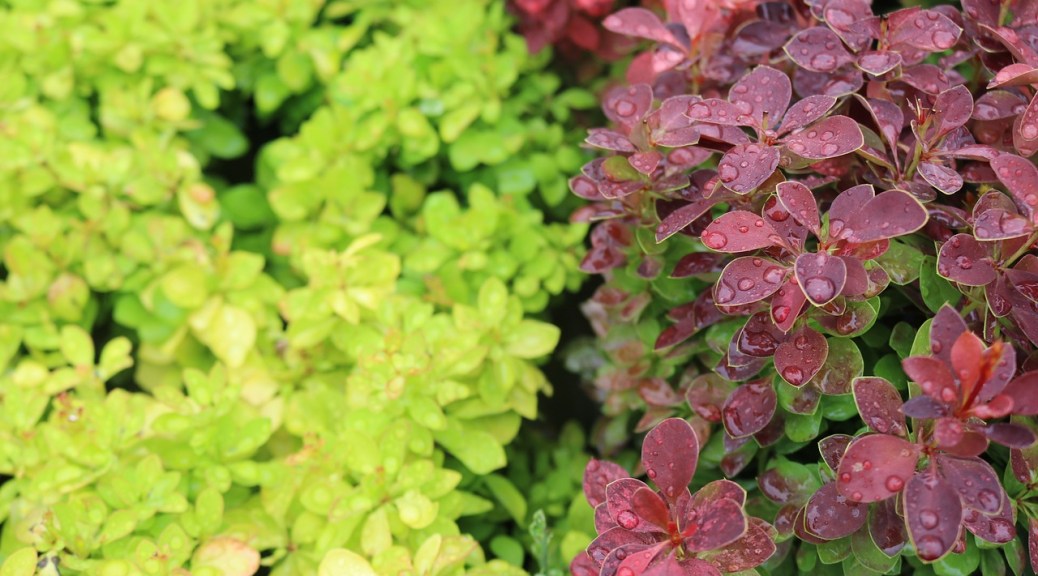
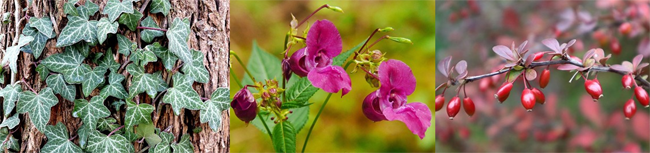
Japanese Barberry (Berberis thunbergii) is an invasive shrub which has green to dark reddish purple leaves.  It has many small, densely growing twigs and branches that have spines.  Its small flowers develop into red fruit which may be eaten then distributed by birds.  It can grow 1-2 m (3-6 ft) tall in full sun to part shade and well drained soil.

I brought home two Japanese Barberry a few years ago.  We had finished building our house and had started landscaping.  At that time, I did not know that Japanese Barberry was a poor choice.  They are not only invasive but also attract ticks.

Japanese Barberry (Berberis thunbergii)

Himalayan Balsam

Himalayan balsam (Impatiens glandulifera) is a striking, but invasive, plant that grows 1-3 m (3-10 ft) tall. It has a reddish stem and produces pink, white or purple flowers. Seed pods are produced which explode when mature. This helps to scatter the seeds. This plant not only out-competes other plants through its prolific seed production and its size, it also produces large amounts of nectar which attracts pollinators. The same pollinators which would normally be pollinating native plants.

This plant prefers a moister soil and grows well in sun or part shade. I have seen a massive area where this plant was growing near a residential location in a moist spot. A gardener showed it to me. She had been discarding her garden refuse in this spot for years. She had not realized that the Himalayan balsam, growing in her garden, was an invasive species until……

Himalayan balsam (Impatiens glandulifera)

English Ivy

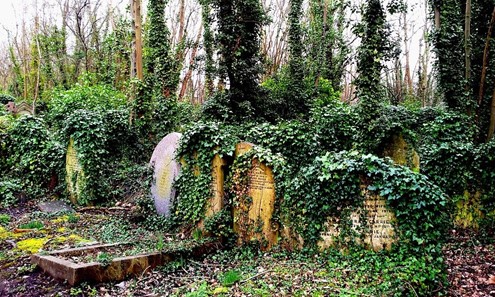
English ivy (Hedera helix) is an invasive evergreen (leaves are present and stay green all year round) vine. It can form a thick ground cover and a dense canopy in trees. It prevents other plants from growing and can, eventually, even kill a tree.  

English ivy is also a reservoir for bacterial leaf scorch (Xylella fastidiosa).  This bacterium infects a plant (e.g. many species of trees) and eventually blocks the xylem cells. Xylem cells are responsible for moving water and nutrients from the roots upwards into the plant. This disease will eventually kill the affected plant.

English ivy needs little light once established. I have seen this plant where it had overgrown an area. It was an ugly and truly disheartening spectacle.

English ivy (Hedera helix)

You may come across any of these plants for sale in a garden centre, in a friend’s garden who wants to share, or one may have hitch-hiked with another plant into your own garden.  They are some of the plant world’s thugs and can do a lot of damage.

Please be aware of all of Ontario’s invasive terrestrial plants…..yes there are more.  Eradicate them and inform your garden centre if you see them for sale.

For more information:

Gardeners Action Plan – Government of Ontario

Invasive Terrestrial Plants – Government of Ontario Invading Species Awareness Program

Ontario Invasive Plant Council – list of invasive species and best management practices

When Ground Cover Plants Take Over – blog by Carol Anderson, Peterborough & Area Master Gardeners

When Ground Cover Plants Take Over

By Carol Anderson, Master Gardener

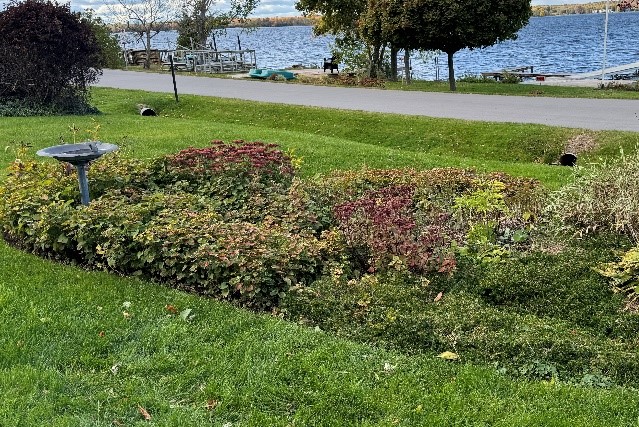
When I recently purchased a new home, I was too preoccupied with the beautiful lake view to truly notice some of the gardening challenges that lay ahead for me. Once I began the process of itemizing what garden treasures I had, I became acutely aware of the gardening style of my predecessor … a style that included utilizing ground cover plants to “fill in” raised beds … and apparently the faster they spread, the better!!! The challenge I have ahead of me is the removal or containment of numerous ground covers that have invaded every inch of the property. In this segment I will briefly touch on the management and/or extraction of 4 different commonly used ground covers that range from just “annoying” to outright invasive.

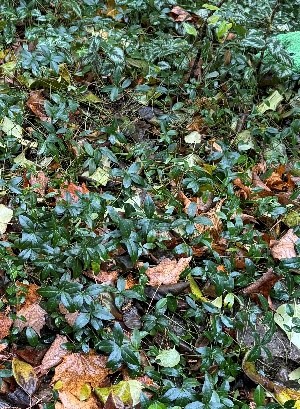
Chameleon Plant,  Bugleweed, Yellow Archangel, Periwinkle

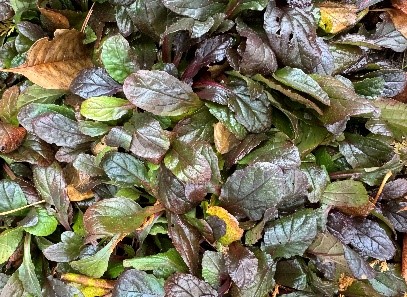
Bugleweed (Ajuga reptans):

Although not considered invasive, Bugleweed can become problematic if left on its own without management, as it has a tendency to spread into adjacent lawn areas. I personally like the dark burgundy-red foliage, however, on my property it has spread across an entire garden and into the lawn. Bugleweed spreads through “shallow” underground runners with new baby plants popping up at the end of the runners. As a result, it is not impossible to remove nor contain. In the spring, I will be digging up the new plants all around the edge of the garden border and installing edging below the garden surface to stop the spread into the lawn. Periodic thinning (by digging up and removing some of the parent plants in the clump) will help to keep it manageable as well.

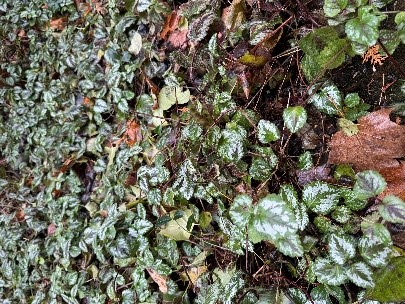
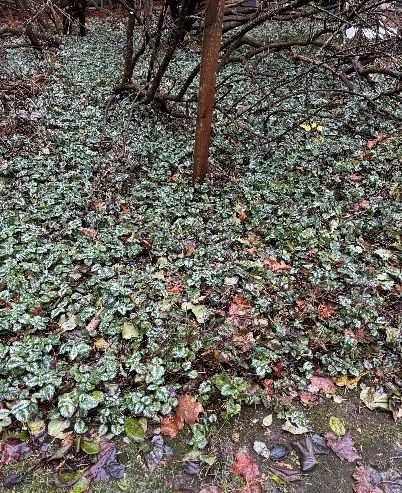
Yellow Archangel or Golder Deadnettle (Lamium galeobdolon):

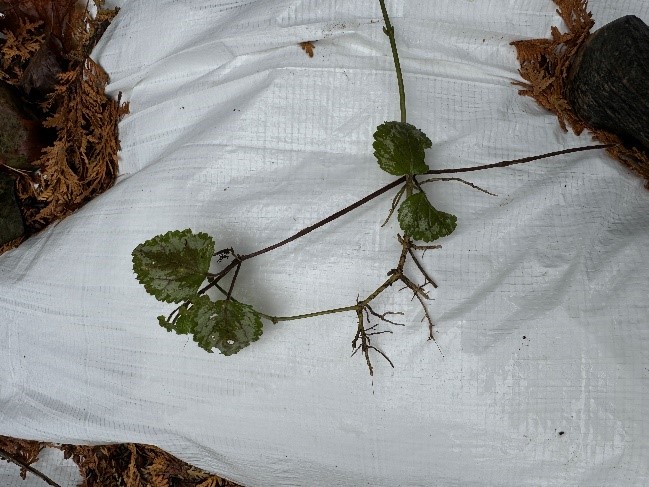
Although Lamium is a common ground cover used in many garden applications, it is invasive in Ontario. It has infested natural areas and will out-compete native groundcovers in the wild. Lamium  spreads by plant fragments, rooting along the surface on the stems (see photo below). However, it also can spread by seed which can then be carried into natural environments by birds.  For this reason, I will be completely removing it from several of the large shade gardens on the property and replacing with native species. Luckily it spreads along the surface and can be removed by mechanical means. This will be another spring project in the garden and once fully extracted, I will begin investigating other options such as anemone, wild ginger, bunchberry dogwood and ostrich fern for the heavily shaded areas of the garden.

Periwinkle (Vinca minor):

Periwinkle is a very common shade groundcover used by gardeners. It is considered to be invasive as it spreads quickly given the right climatic conditions. It poses a threat to natural biodiversity as it can out-compete other forest understory plants. However, because it spreads by rooting along the stems on the surface of the ground (stolons), it can be contained through proper management of the plant. I plan to dig up the roots and plants and cut back the excessive amount of Periwinkle in the garden, interspersing it with other shade loving plants. This will require ongoing observation and management on my part. 

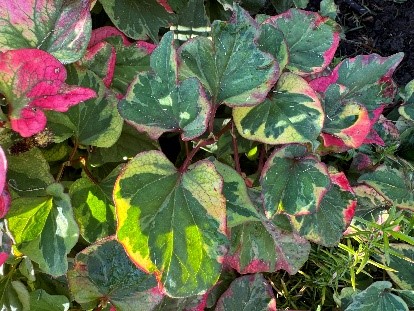
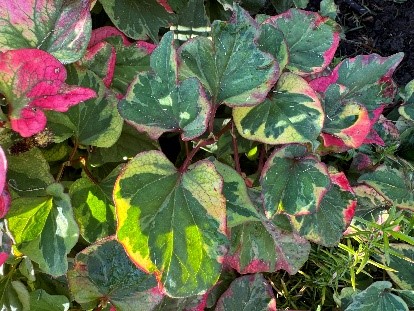
Chameleon Plant (Houttuynia cordata):

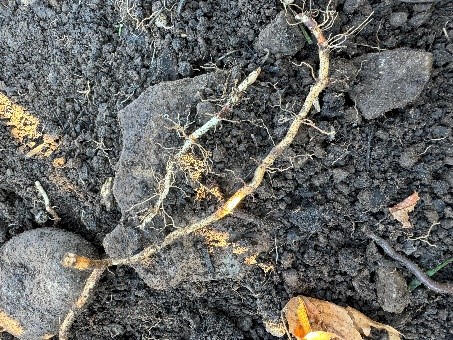
Avoid, avoid, avoid. Although an attractive groundcover, chameleon plant will invade your garden and lawn very quickly and became completely unmanageable. It is a non-native that spreads by a highly dense deep underground network of roots (rhizomes)(see pics below). Even a small segment of root left behind will live and spread for years to come making eradication very difficult. This fall, I began digging around the perimeter of the patch well outside of where the plant is visible on the surface. I dug down 12 inches and was still running into dense mats of roots!!!  I then sifted through the soil to remove all plant segments and put the soil back. At this point I have just begun the process of eradication (Step 1) and will keep you posted on my progress in my blog next spring. If I need to resort to solarization (using the sun’s heat to kill the plants under plastic), then this might be the next step for me. Stay tuned!!!

If you are a fan of using plants as groundcover in your gardens and raised beds, proceed with caution. If it spreads quickly, filling in bare areas, then it is likely invasive at worst and hard to manage at best. Proceed with caution and be prepared to observe and manage the groundcover to avoid the situation where the plant literally takes over the garden, eliminating all other species. In addition, there are many native Ontario alternatives to the traditional groundcovers…try them out and enjoy (https://www.inournature.ca/native-groundcovers).

Act now to keep jumping worms out!

By Silvia Strobl, Master Gardener in Training

At the 2024 Master Gardeners of Ontario Conference I had a chance to hear Dr. Michael McTavish, Ontario’s foremost expert on earthworms, speak about invasive jumping worms. First reported in southwestern Ontario in 2014, Ontario now has four species of these pheretemoid (litter dwelling) Asian worms. They’ve been observed as far north as Ottawa and their populations are growing at an alarming rate. In the USA, research on biocontrols is ongoing, but currently there are no registered pesticide options for either gardeners or land managers. Prevention is the only strategy.

Dr. McTavish’s message resonated with me. My conference roommate, a Master Gardener from Hamilton, has been dealing with them for two years. Her garden is one of the 44 confirmed jumping worm locations in Ontario (Figure 1). Since I visit Hamilton monthly to help in my mother’s garden, we both need to take precautions to avoid introducing this pest not only to mom’s Hamilton garden but also mine north of Peterborough.

Figure 1: Jumping worms have been reported to EDDMaps in the following Ontario jurisdictions: Lambton County (1), Niagara (2), Hamilton (12), Brant (1), Waterloo (1), Wellington (1), Halton (3), Peel (4), Dufferin (1), Simcoe (1), Toronto (14), York (1), Lennox & Addington (1), Lanark (1), but this is an under count since not everyone reports sightings (EDDMaps accessed April 29, 2024). For example, another Master Gardener, located in Ottawa, has found them in that jurisdiction.

In gardens, jumping worms quickly consume organic matter in the upper soil layer resulting in soil drying, erosion, loss of nutrients, and ultimately decreased plant growth. In forests, jumping worms rapidly consume the leaf litter disrupting nutrient cycles, preventing seed germination, decreasing biodiversity, damaging the soil biome, and degrading habitat. To learn more about the impacts, view this video by one of America’s leading researchers on jumping worms, Dr. Brad Herrick from the University of Wisconsin Madison Arboretum:

In the US jumping worms have been expanding their range since 1951, but in Ontario we still have opportunities to avoid introducing this pest to our gardens. Dr. McTavish identified three actions for gardeners.

  1. Learn to identify jumping worms

Look for these three things in your garden or any natural area you frequent regularly:

  • Loose, dry, crumbly worm casts in layers, not piles. Casts look like coffee grounds or ground beef and layers can be up to 10–15 cm thick (Figure 2, below).

Figure 2: Photo Credit, Michael McTavish.

  • Worms in the casting layer that thrash about wildly when disturbed
  • Adult worms with a milky white ring that completely encircles the worm fairly close (14 segments) to the head (Figure 3, below). As well, the skin has a distinctive glassy sheen, the body has a snappy, turgid feel when grasped, and the tail may detach when the worm is threatened. The clitellum is the reproductive structure where the cocoons are stored and secreted.

Figure 3: Photo Credit, Bev Wagar.

Cocoons hatch in May when soil temperatures are consistently 10oC. The juvenile worms don’t have the identifying white ring until about 60 days later in the summer when they become adults. At that time they reproduce asexually (parthenogenetic), and a single worm can produce several dozen egg cases (cocoons) in one season. Cocoons are small and indistinguishable from dirt, hence easily transported on our shoes, tools and when moving infested plant roots and compost (Figure 4, below). The adult worms die in late fall when the soil freezes, but the cocoons survive the winter.

Figure 4: Photo credit, Marie Johnston, UW-Madison Arboretum https://dnr.wisconsin.gov/topic/Invasives/fact/jumpingWorm).

The best time to identify jumping worms is at the adult stage in summer and fall.

  1. Report observations to EDDMaps

Most of the confirmed jumping worm records in Ontario are from gardens, but they have also been found on trails and in parks. If you do see one, report your sighting by taking and uploading a photo taken with your smartphone to EDDMaps. You can choose a privacy option to obscure the exact geographical location as has been done for most of the records in EDDMaps to date. There are several official verifiers, including Dr. McTavish, and distribution information contributed by citizen scientists will motivate further research on control of this invasive species.

  1. Use best practices to slow the spread

Practicing sanitation and dedicating tools and shoes for work only in known infested areas and not moving soil, plants and compost will limit spread of jumping worms. If you do have jumping worms you can still do a lot to slow the spread to other areas, and the following practices can also substantially decrease the likelihood that they won’t invade your garden in the first place.

  • Inspect any new plant, soils and mulch materials, including bagged leaves, coming into your garden. If you find jumping worms, put them in a jar filled with vinegar or isopropyl alcohol or a ziploc bag. Do not put them in the compost or throw them away.
  • Ideally, make your own mulch and compost on your own property. In New York State Jumping Worms spread was traced to wood chip mulch piles made from the 15,000 trees downed in Hurricane Sandy that were moved to different parks (Dobson 2024).
  • If exchanging plants, swish plant roots and gently massage the roots to remove most of the soil in first one bucket of lukewarm water and then if more soil is present, another bucket. Inspect the roots for cocoons which are visible to the human eye when not obstructed by soil. Let soil settle in the buckets for a couple of days before carefully draining the water and then solarize the soil (Görres 2024).
  • If you do bring in bulk soil, compost or mulch, solarize it by spreading it 15 to 20 centimetres thick on dry cardboard over a length of 3 to 4.5 metres and cover it with translucent painter’s plastic drop cloth (6 mil thick). Let it sit for 72 hours and get to more than 40oC which will kill worms and cocoons as these don’t survive temperatures over 40oC (Johnston and Herrick 2019).
  • Get in the habit of cleaning the soles of your shoes or boots before and after hiking in natural areas or visiting or working in other gardens. Not only will this help avoid spreading jumping worm cocoons, it will also help avoid spreading seeds of invasive plants.

Anything we do now to prevent or slow the spread of jumping worms gives researchers time to do studies to identify control options and seek regulatory approvals. It might also give native plants and wildlife time to adapt to yet another forest pest.

I left Hamilton last week after washing my garden shoes, gardening clothes, and Hori-Hori garden knife. I also showed my mother the video at the above link and, given the incidence of jumping worms in Hamilton, asked her not to accept any plants from other gardens.

What will you do differently to mitigate the possibility of bringing jumping worms into your garden?

References

Dobson, Annise. 2024. Jumping Worms: What you need to know, and how you can help prevent their spread. https://youtu.be/3qneehkTz_w?si=zTQcchMzzOTSEE3t

Görres, Josef. 2024. Spread, Impact and Control of Jumping Worms. Presentation to University of Rhode Island Master Gardener Program.  https://youtu.be/rtb4ffRNCS4

Herrick, Brad. 2020. Invasive Jumping Worms. https://youtu.be/8CPQH8q1Pfc?si=7dyrzNXFl91np7BI

Johnson, M.R. and B.M. Herrick. 2019. Cocoon Heat Tolerance of Pheretimoid Earthworms Amynthas tokioensis and Amynthas agrestis. The American Midland Naturalist Vol. 181, No. 2, pp. 299-309. https://www.jstor.org/stable/45434119?read-now=1#page_scan_tab_contents

McTavish, M. 2022. Jumping worms–white-collared invaders spreading in southern Ontario. https://www.invasivespeciescentre.ca/wp-content/uploads/2022/03/JumpingWormIDGuide_2022-02-17.pdf

Resources

McTavish, M. 2023. ATTENTION: Invasive jumping worms in Ontario. Factsheet.

Related

JUMPING WORMS & INVASIVE SPECIES AWARENESS

Sept. 19, 2022

.

Why Do You Garden?

By Cheryl Harrison, Master Gardener

This is an important question!  People garden for various reasons and the answer to that question is a wonderful guide for helping to create your garden.  If you do not know why you garden, then you may put a lot of effort, and money, into something that does not make you happy or meet your needs.  So, figure out why you garden, what inspires you and keeps you coming back for more!

I recently asked this question of the Peterborough Master Gardeners.  Some find gardening a creative, and passionate, process that gives them joy and peace and a feeling of gratitude.  They spoke of being in nature and being part of the relationship between the soil, bees, birds, butterflies and plants.  For some, it is the nurturing of the land and being able to feed their families, and share with neighbours, through the vegetables that they grow.  Others spoke about the enjoyment they get from the physical process of gardening.  Gardening is good exercise, especially if your job includes sitting at a desk all day.  One of our fairly new Master Gardeners talked about starting to garden because it was a lower-cost opportunity to take care of living things and the desire for her property to be pretty and attractive to pollinators.  Gardening has evolved for her to provide her with a sense of peace and accomplishment.  A final comment about the “why garden” question…..gardening can be a solitary activity or a very social activity where you talk to fellow gardeners or give advice to curious non-gardeners.

Thinking about why one gardens leads to asking yourself what type of garden you are most drawn to.  One Master Gardener shared that she prefers a more formal garden although she can appreciate a cottage style or meadow garden too.  The rest of us are a bit more on the wild side.  We prefer colourful cottage gardens that are informal but not out of control.   This type of garden might include bee balm (Monarda species), coneflowers (Echinacea species) and brown/black eyed susans (Rudbeckia species). The importance of growing for diversity with native plants and not growing invasives was mentioned as was a garden that appealed to pollinators.  Formal gardens can be more difficult to maintain because it may require more time and effort to keep a very specific style eg. pruning shrubs to a unique shape.  Cottage gardens tend to have a looser structure and may require less maintenance.  They may also include vegetables!

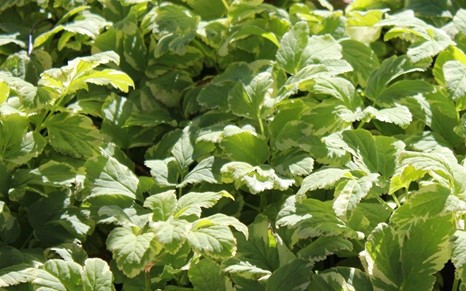
However, gardening is not all just pretty flowers and shiny vegetables.  Some Master Gardeners mentioned the frustration when garden pests or disease attack.  The best defense is to inspect your garden often to catch problems early.  Plants are also less susceptible when they are healthy.  For good health, plants need the appropriate moisture, light, temperature and soil for that plant.  Other Master Gardeners were challenged by out-of-control invasive plants (eg. goutweed, Aegopodium podagraria), weeds or limitations that occur as we age….for some, gardening from dawn until dusk is just a memory!

So, grab your pen and paper and answer the question, “why do I garden?”  You may feel that you are on the right track, or you may decide to make some changes.  Now is the time to dream and plan what you would like to do this year, to have a garden that feeds your soul and maybe your family and neighbours too! 

Thank you to the Master Gardeners who responded to my questions.  I loved reading your answers and thinking about how we are drawn to gardening in slightly different, but similar, ways.

The Fall of a Fall Favourite

By Lois Scott, Master Gardener

Sometimes it feels like my garden will never reach the ‘mature’ stage even though I have been gardening in the same spot for 36 years.  There are a variety of reasons for that, but one major one was my need to remove plants that are now considered invasive. “Invasive species are considered one of Canada’s greatest threats to the survival of our wild animal and plant life.  Invasive species kill, crowd out and devastate native species and their ecosystems”.  https://www.invasivespeciescentre.ca/learn.

So, who were the super villains in my garden?  I’m looking at you, Burning Bush (Euonymus alatus) and also you, Barberry (Berberis).  I was initially truly disappointed when I realized they needed to go but then my short attention span came into play and I was on to the next thing.  What new plants could I get to replace said villains?!!!  And they are environmental villains:

Burning Bush
Japanese Barberry

Burning bushes are certainly very visible at this time of year due to their intense red foliage, but Chokeberry (Aronia melanocarpa) makes a wonderful substitute for both Burning Bushes and Barberry.  They are native to Ontario, will grow up to 2.5 metres tall, have white flowers in spring and their fall colour is dramatic.  They will grow in moist or dry areas and they attract pollinators and songbirds.  There are actually many native shrubs that are very ‘ornamental’ and worthy garden additions.  https://www.inournature.ca/best-native-shrubs

Chokeberry (Aronia melanocarpa)

At the risk of blathering on about native plants, one small benefit for me is that if I choose a native plant that is not aggressive (rampant spreader etc) and is suited to the conditions of the site (right plant, right place) I won’t find myself having to hack out this year’s fan favourite that turns into next year’s invasive disaster.  Always a good thing for me and the wildlife and pollinators in my garden!

Jumping Worms & Invasive Species Awareness

By Christine Freeburn, Master Gardener

Master Gardeners have been talking about the importance of controlling invasive species for years. Purple Loosestrife, Giant Hogweed, Buckthorn, Garlic Mustard and Dog-strangling Vine are on a long list of Invasive Plant Species.

You can check the list out at www.invasivespeciescentre.ca  or www.invadingspecies.com

But there are more than just invasive plants. There are also invasive insects like Spongy Moths and Emerald Ash Borer. There are invasive fish and invertebrates like Zebra Mussels and Asian Carp. We have invasive pathogens like Dutch Elm disease (Dutch Ed: “Identified by the Dutch, not CAUSED by the Dutch”). And just recently, we have begun to hear about Wild Pigs and Jumping Worms.

I took part in a webinar presented by the Royal Botanical Gardens on Jumping Worms (JWs) earlier this month. Two speakers, Brook Schryer from the OFAH who works with the Invading Species Awareness Program and Dr. Michael McTavish with the Smith Forest Health, University of Toronto, spoke about the need to be aware of jumping worm sightings in Ontario. They gave information about Eddmaps.org where interested citizens can share their own findings. You can find a recording of this event at https://www.youtube.com/user/royalbotanicalgarden

Now is a good time to find JWs as they are adults at this time of year and can be better identified.

Jumping Worms are an invasive species of Asian worm that are slowly moving their way from the United States. They are voracious eaters and can consume much of the compost, topsoil and debris that lays on forest floors. They leave behind worms castings that are loose and crumbly similar in appearance to coffee grounds. They are often found in wet and shady spots and castings are spread evenly rather than in clumping piles. The castings can be a thin layer or can be 10 cm deep. It will appear as though the ground has been previously dug as the soil will be loose. Jumping worms are distinguished by their thrashing behaviour when moved or picked up. They have also been known to amputate their tails as a method of evasion from predators. There are usually many worms found together close to the soil surface. The worm body is smoother than our earthworm and tends to be more gray than red. The milking band or clitellum goes all the way around their body. Although the worm dies in the cold winter months, their cocoons survive, becoming juvenile worms in May and June and adults in July.

Left on their own, these worms can spread up to 10 meters per year. However, without human help, the spread could happen much quicker.

Research in Canada is happening, but we should all be aware of the dangers of this invasive species, and take precautions.  We just need to think of the days before Phragmites showed up in every wetland and ditch in our area. Awareness and education are important.

Check out the EDDmaps.org site where you can see where actually sightings of invasives have been recorded. The two presenters encouraged us to go out and search for signs of the Jumping Worm and report it to the EDDmaps, whether a positive sighting or a negative one. You can also call the Invading Species Hotline at 1-800-563-7711 if you have a concern.

Outcompeting Invasive Plants, Part II

By Laura Gardner, Master Gardener in Training

This article was published in err a couple of weeks ago, and is being republished today as a corrective measure. Apologies. -Ed.

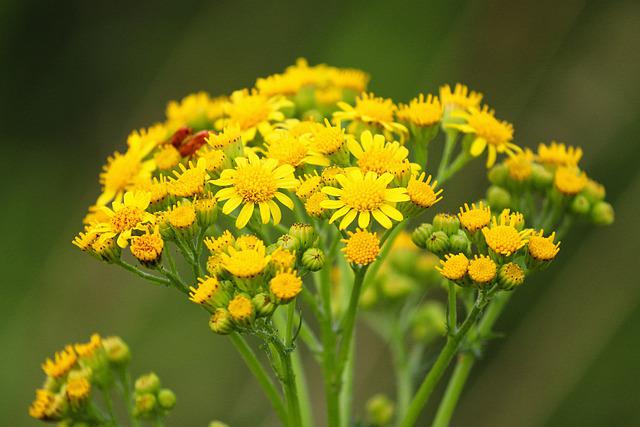
Back in a June post[i], I referenced the Ontario Native Plant Council’s best management practices for Alliaria petiolata (Garlic Mustard).[ii] In it they referred to certain native plants that can be used to outcompete it. I would like to mention one other that I am fond of having in my garden. Packera aurea (Golden Groundsel) has a diminutive orange inflorescence and is native to the Peterborough area. It can be aggressive as it reproduces through rhizomes and adventitious shoots on the stems. It is better situated in moist soils and so it may be more subdued in a drier location. In her blog, The Humane Gardener[iii], Nancy Lawson discovered that when she inserted clumps of Golden Groundsel into patches of Garlic Mustard, the latter quickly became surrounded. Garlic Mustard is known to be allelopathic and inhibits the growth of some plants. However, Golden Groundsel does not appear to be inhibited by it.

Golden groundsel, Packera aurea

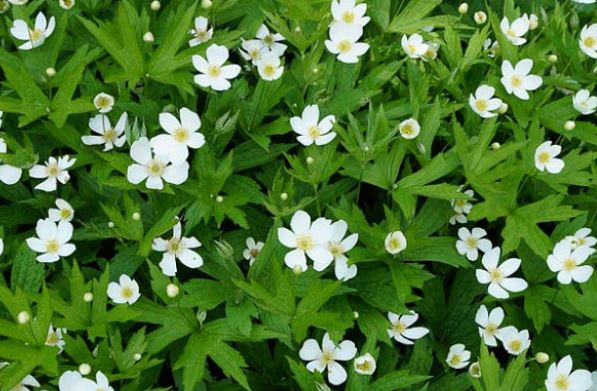
Anemonastrum canadense (Canada Anemone) is a beautiful vigorous native ground cover that performs well in sun to shaded environments; although it can develop brown leaves in more arid conditions. I am using it to limit the advance of Campanula rapunculoides (Creeping Bellflower). The intent is to envelope it so that it is unable to photosynthesize, grow more foliage, and store energy in its roots. One might argue that this is simply a matter of replacing one problem with another. While it is true that Canada Anemone can be overwhelming, it may be limited by deadheading the flowers, removing rhizomes, adding mulches, and by installing edging below the soil surface. As a native plant, it supports pollinators such as miner bees, sweat bees, and hover flies. The Xerces Society notes that it supports “conservation biological control.”[iv] This is a plant that attracts beneficial insects to your garden which in turn will help control other insects that damage your other plants.

So far, the Creeping Bellflower’s development has been slowed but there are still some basal leaves within the patch and at the perimeter. Right now, it is still a team effort: Canada Anemone and me.


[i] Outcompeting Invasive Plants: Part I. https://peterboroughmastergardeners.com/2022/06/13/outcompeting-invasive-plants-part-1/

[ii] Garlic Mustard (Alliaria petiolata): Best Management Practices in Ontario. Ontario Invasive Plant Council.  https://www.ontarioinvasiveplants.ca/wp-content/uploads/2016/07/OIPC_BMP_GarlicMustard.pdf

[iii] How to Fight Plants with Plants. The Human Gardener. Online: https://www.humanegardener.com/how-to-fight-plants-with-plants/

[iv] Habitat Planning for Beneficial Insects: Guidelines for Conservation Biological Control. Xerces Society. http://www.xerces.org/publications/guidelines/habitat-planning-for-beneficial-insects

Am I a Problem?

By Cheryl Harrison, Master Gardener

Well, yes … I am, but I have a plan.  February 28-March 4/22 is National Invasive Species Awareness Week.   This is an international event whose purpose is to raise the awareness of invasive species.  “Invasive terrestrial plants in a forest ecosystem can be trees, shrubs, or herbaceous plants that have been moved from their native habitat to an introduced area where they are able to reproduce quickly and crowd out native species. These plants are introduced and spread by infested packaging material, seed dispersal by both environmental and human sources, or by escaping from gardens.”  Also look at Ontario’s Invading Species Awareness Program  for more information.

Biodiversity is essential to the continued healthy life of an ecosystem.  Invasive plants can quickly destroy it and humans require the natural resources found in a healthy ecosystem.  We need food and we need water to survive.  We are a part of the ecosystem too.  Doug Tallamy says it best in his book, “Bringing Nature Home” where he writes “…ecosystems with more species function with more efficiency, are better able to withstand disturbances, are more productive, and can repel alien invasions better than ecosystems with fewer species.”

I became aware of invasive species about 15 years ago when on my walk to work, I noticed some English ivy (Hedera helix) growing in a small wooded area.  Then, I realized that English ivy had totally carpeted that area.  There were no other plants!  A couple of years later, I saw the same thing but this time, it was a larger forested area and the culprit was goutweed (Aegopodium podagraria).  Since then I have read more about invasive plants and, sadly, now often see problem areas. 

So, back to my plan.  I was aware of some of the invasive herbaceous perennials so had steered away from them.  See terrestrial plants and  aquatic plants for more information.  However, my husband and I are tree lovers and have a rural property so we frequently indulge in purchasing new trees to add to our collection.  Unfortunately, we ended up with two Norway maple (Acer platanoides) trees, two burning bush (Euonymus alatus) and a barberry (Berberis thunbergii) shrub.  This year, I plan to convince my husband that they must go.  I would like to replace the trees with two red maple (Acer rubrum) or perhaps a couple of sugar maple ((Acer saccharum).  The burning bush will be replaced by a couple of native viburnum maybe nannyberry (Viburnum lentago) and the barberry, well, it will be replaced by a native bush honeysuckle (Diervilla lonicera).  See Southern Ontario Grow me Instead Beautiful Non-invasive Plants for Your Garden. This is a great resource.  It includes some native and some non-native plants to include in your garden plans.

I am inspired to be a better gardener every time I write a blog for the Peterborough & Area Master Gardeners.  I hope that you will have a look at some of the links above and below and be inspired too.  Please only use non-invasives in your gardening plans this year. 

I also recommend reading, or re-reading, a blog by Laura Gardner, Master Gardener in Training posted on February 2/2022: Expanding Your Native Garden Palette.  For more information on what to do if you have a problem, see Best Management Practices Data Base

A new group on Facebook is the Canadian Coalition for Invasive Plant Regulations. The group is very concerned about the spread of invasive plants in Canada and would like to do something about it.

Ditch Lilies – a Cautionary Tale

By Emma Murphy, Master Gardener

Once upon a time there was a gardener who wanted something that grew quickly to screen a neighbour’s unsightly yard and house addition. She noticed that the ‘ditch lilies’ that surrounded her front yard tree (already there when she moved in) seemed to be pretty vigorous, so she planted a row of them between the yards, along with some small bridal wreath spirea (Spirae aprunifolia).

What she didn’t realize was that she had unleashed a horrible monster into her garden, one that quickly engulfed any other plants, sucked all the moisture out of the soil, and eventually killed most of those spirea.

Yes that gardener was me, many years ago, before I knew better and before I became a master gardener. So this year I knew I had to finally tackle the monster, remove all these plants, and reclaim this garden area. I knew how much work it would be (it took me three weekends this spring), but I got it done. Here’s my story…

Even though you see it growing in ditches around the province, Hemerocallis fulva (aka ditch lily, tawny daylily, orange daylily, tiger lily) is native to China, Japan and Korea and was introduced to North America in the early 19th century. They spread via seed and a network of tuberous roots, and can reproduce and proliferate from a small fragment left behind during removal. In 2020 the Ontario Invasive Plant Council added this plant to their invasives list, and their Grow Me Instead Guides offer some native alternatives to consider.

Screen capture from the Grow Me Instead Guide on Hemerocallis fulva

Garden bed, spring 2021

So this was my garden bed in May this year – just waiting to burst out and take over, again. Every single one of these plants had to be dug and lifted, making critically sure to get every last bulb. These photos show how many bulblets can be on just one stem – it was quite overwhelming to think of the job ahead.

All the plants that were dug out were put in black plastic garbage bags and left out in the hot sun beside our barn for a month. At last count I used 45 garbage bags, and they were a slog to carry as they were heavy!! Eventually they went to our rural dump, where the hot composting they do should ensure their demise.

Bit by bit, over three weekends, I got them all out. It was beneficial to have a dry spring, as it made digging them out a little easier. But still a workout!

Once everything was cleared out, I weeded the soil for anything else. All that remained were my tulips and a few hardy perennials that had been gasping for air for more than a decade.

Getting there.
Ready for a fresh load of soil.

With a fresh load of soil on top and a final check for bulblets done (and knowing that I would have missed a few), I put in some new plants, aiming for 50 percent native plants (those marked with a *). The area has both sun and shade spots so I needed to be careful with my choices.

For sun, Echinacea*, Gray-headed coneflower* (Ratibida pinnata), summer phlox (Phlox paniculata), American Witch Hazel* (Hamamelis virginiana), New England asters (Symphyotrichum novae-angliae), Sedums, Switch grass* (Panicum virgatum), Lesser catmint (Calamintha nepeta ssp. nepeta), Black-eyed Susans* (Rudbeckia hirta), lupins, Giant fleeceflower (Persicaria polymorpha), Cyclindrical Blazing Star* (Liatris cylindracea)[once I can convince the bunnies to stop eating it – see green covers], and Virginia Mountain Mint (Pycnanthemum virginianum).

For part shade/shade, Mourning Widow Geranium (Geranium phaeum), Purple Flowering Raspberry* (Rubus odoratus), hostas, Sensitive Fern* (Onoclea sensibilis), Virginia Waterleaf* (Hydrophyllum virginianum), Columbine (Aquilegia), Starry False Solomon’s Seal* (Maianthemum stellatum), Buttonbush* (Cephalanthus occidentalis), Zig-zag goldenrod* (Solidago flexicaulis) and Berry Bladder fern* (Cystopteris bulbifera). Also the infamous Outhouse Plant (Rudbeckia laciniata ‘Hortensia’), to be replaced with something else next year. Any suggestions for fast growing native shrubs that can handle part share welcome!

The garden bed needs time to fill in, so we’ll see what it looks like next year. In August I went back into the bed and sure enough, there were new ditch lilies growing in a few places. Remember it only takes one bulblet for them to grow. But half an hour later they were all gone as well.

I suspect I will on alert for the odd ditch lily plant showing up for the next few years, but I’m really proud to have removed this nasty invasive plant from my garden and rejuvenated it with native plants. And my two lovely sugar maple trees are glad for some more breathing room.

NOTE: The orange, single flower, diploid Hemerocallis fulva is the only daylily currently listed as invasive. Most daylily cultivars are diploid or triploid and do not spread invasively like the ditch lily.