by Emma Murphy, Master Gardener
During the winter months, Ontario gardeners have a number of survival techniques to make it through the “non-green” time of the year (this includes most of Canada, except for those lucky folks on Vancouver Island). We read gardening books, travel elsewhere to see lush green vegetation and flowers, pore over seed catalogues, or surf the web in search of colourful blooms in the Google Image Gallery.
Once spring arrives (still waiting in Central Ontario…) our thoughts turn to getting into our gardens and all the newest plants profiled online, in magazines, and by our favourite garden bloggers. While I love to look at new perennial plants, I thought I would share my five favourite, easy care perennials with all of you, along with the reasons why I love them. I am not a fussy gardener, and I don’t like fussy plants that require a lot of hand holding. To survive in my garden you have to be tough, but that doesn’t mean you can’t be beautiful. I also like my garden to add to the ecological diversity, so I like to plant things that attract pollinators and birds.

1. Daylilies (Hemerocallis)
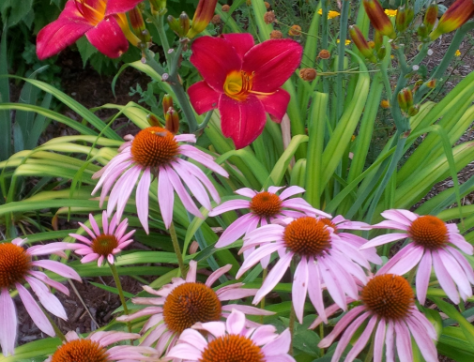
Daylilies may be one of the most carefree of all flowering perennials. They grow quickly and live for a long time (looking nice even when not in bloom). They thrive in almost any soil, will grow in sun or shade, and don’t seem to be troubled by insect pests or disease. Known for being tough, they dazzle us with their big, colourful flowers in all shapes and sizes. Blooms begin in midsummer and continue into early fall. The best part? New blooms every day. Daylilies combine well with other perennials like coneflowers (Echinacea), bee balm (Monarda), and summer phlox (Phlox paniculata). For me they are a mainstay in the garden, and I can share with friends, dividing as my clumps get big.
2. Blanket Flower (Gaillardia)
One of those flowers where I actually think the Latin name is prettier than the common name. It’s another summer and fall perennial that blooms right until the first frosts, providing a late season burst of colour in your garden. Part of the sunflower family (Asteraceae) and native to North and South America, blanket flowers come in a range of colours (yellows/reds/oranges), although I find that the tried and true Gaillardia x grandiflora is my favourite. These are not the longest lived perennials, but reproduce well so I have never had an issue with them dying out. They are easily divided, can handle poor soil, and will bloom continuously, although I find deadheading does extend their blooming (something to do while you drink your coffee or tea and wander around your garden in the morning).

3. Purple Coneflower (Echinacea)
I agree with many other that no garden should be without this tough native flowering plant with large, purplish pink flowers. The common name derives from the prominent cones in the center of a single layer of slightly reflexed petals. These plants are wonderful summer bloomers, providing food for butterflies, bees, and other pollinators. I love them in the fall and winter too, as I leave them up in the garden and wonder at the finches that land on them and hungrily eat the seedheads. All parts of the plant have medicinal properties and you often see it in natural cold and flu remedies.
Native Echinacea only comes in purple, pale purple, or yellow, but hybridized echinacea (derived from E. purpurea) can be red, orange, pink, and green. While there are lots of new hybrids out there now with different colours and shapes I am still partial to the tried and true varieties, although I confess to liking Echinacea ‘Merlot’ with its reddish stems. Read more here about which one to choose (true natives vs hybrids) and why. Coneflowers can propagated by root or clump divisions. This year I am on a search for our native Echinacea pallida, which has thinner reflexed petals and a pale purple hue.

4. Asters (Astereae)
Aster comes from the old Greek word ‘astér’ which means ‘star’ and refers to the shape of the flower. These lovely delicate daisy-like flowers come in all shades of pink, purple, lavender, and white. Flowering from early summer to fall (depending on variety), they can be started from seeds, but purchasing young plants is the best option. Plant them out in spring for summer blooming that usually extends to fall. Asters do well in full and partial sun conditions but like good soil and drainage for best show. I love the combination of fall asters and goldenrod in the late summer and fall in my garden – so much colour and texture! There are so many asters – you can learn more about this fascinating group of plants here (for Ontario) and also here.
5. Black-eyed Susans (Rudbeckia)
What can I say? I LOVE the Rudbeckia family of flowers. With lovely bright yellow petals and contrasting centres, these plants demand attention. Rudbeckias in general are perennial, but the smaller Rudbeckia hirta can be grown as an annual if started early enough. In most zones they start flowering from early summer and continue on until fall. The ‘Goldsturm’ black-eyed susan (Rudbeckia fulgida ‘Goldsturm’) is considered to be among the best perennials of all time (Perennial Plant of the Year in 1999), bringing a bursts of colour from late summer into October. These drought-tolerant plants can grow about two-feet tall and offer the best visual effect when planted en masse. A shorter variety Rudbeckia fulgida var. sullivantii ‘Little Goldstar‘ – grows to just knee height if that is more to your liking. Rudbeckia hirta ‘Irish Eyes’ and ‘Indian Summer’ are also popular.
My two favourites are the butterfly magnet Rudbeckia triloba and Rudbeckia laciniata ‘Hortensia’, commonly called the Outhouse Plant. The first (triloba) is an excellent native addition to naturalized areas, wildflower meadows, prairies, cottage gardens, native plant gardens and borders. Plants form a rosette of green leaves the first year, then the second year they produce bushy, upright stems loaded with thousands of tiny brown-eyed golden daisies from midsummer on. As a self-seeding biennial, it is ideal for naturalizing. The Outhouse Plant is an old heirloom selection – very tall, with many fluffy double chrome-yellow daisies on the top. It’s not a bad idea to pinch these down in June to get them to be bushier, as they tend to flop in the windy summer thunderstorms. Be warned – this one can be a vigorous spreader, so keep on top of it!





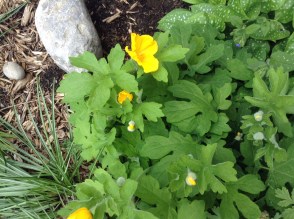 A few years back on a gardening bus trip, we were gifted with a small wood poppy from a fellow Master Gardener. It is a lovely plant with irregular lobed leaves that range in colour from light to dark green. This poppy requires shade and prefers moist conditions or the leaves may wither. You will be thrilled with the lovely yellow blooms that appear in late spring. It grows to about 1 ½ feet tall into a small, bushy plant. They readily self-sow in ideal conditions such as moist woodlands, but in my garden I have never found more than a few babies.
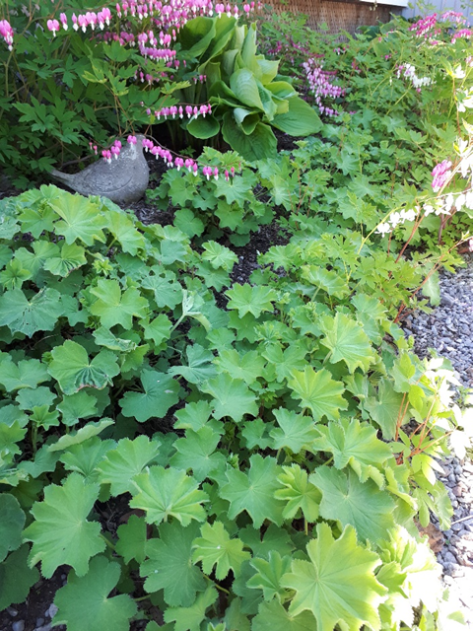
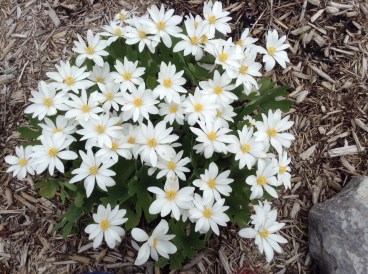 You know that spring has arrived when you are thrilled with the appearance of bloodroot’s cheerful white flowers that open during the day and close at night. The leaves are clasped to the stem and slowly unfurl to reveal large, saucer-shaped but deeply scalloped foliage. It is very effective as a groundcover and prefers rich, moist woodland soil. It will tend to go dormant in the hot summer months. You will notice the roots’ red juice, hence the name. The sap was used by Native Americans for dyes. We are lucky in Peterborough to have a beautiful mural of Bloodroot under the Hunter Street bridge that was painted by Jill Stanton.
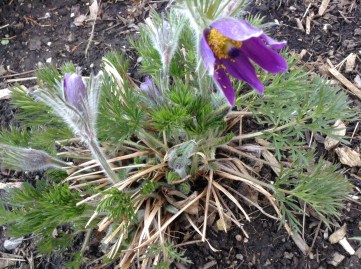 This is a very interesting plant due to its large bloom in relation to the overall size of the plant. The Pasque flower has a silky, hairy, fern-like foliage and erect open bell-shaped lavender flowers. The foliage is deeply divided. It is not that fussy about soil conditions. It generally requires full sun but mine does well in sun with partial shade. It grows to about 12 inches and is well behaved. It is a beautiful spring addition to the garden, but like the bloodroot, it may go dormant in the hot summer months. Pasque comes from Old French for Easter in reference to the spring bloom time. All Anemone plants come from the Latin meaning sway as the flowers sway in the wind



 Agastache (pronounced AG-a-stak-ee) has been chosen as Herb of the Year 2019. This name is actually the plant genus and includes many different species native to North America. All species attract bees and butterflies and deer do not usually eat. The plant we are most familiar with is Anise Hyssop (Agastache foeniculum) which has a strong anise or licorice fragrance to its leaves. It is a prairie plant that likes sun and grows 3′- 5′ tall in any type soil as long as it is well drained. Anise Hyssop has average moisture requirements and is a perennial herb zone 4. Bloom time is mid summer and common flower colour is purple, but it can be found in white and pink. The native strains can reseed, but you can find sterile cultivars like Blue Fortune which may need support. Use the leaves in teas, green salads, or fruit salads. The flowers are edible also. You can use as cut flowers or dry the flowers for arrangements.

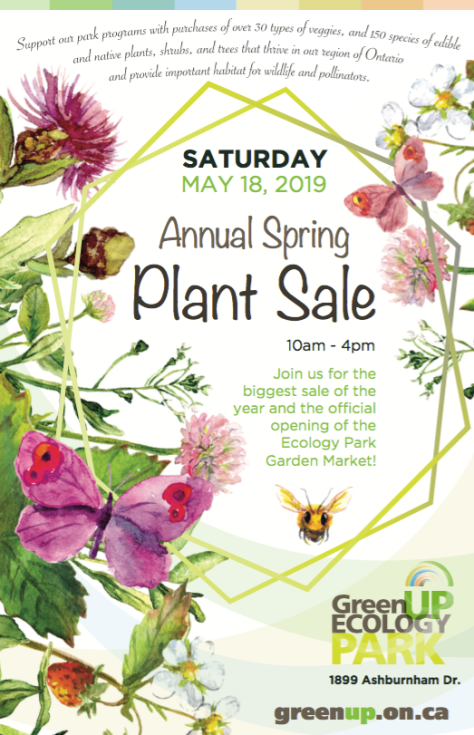
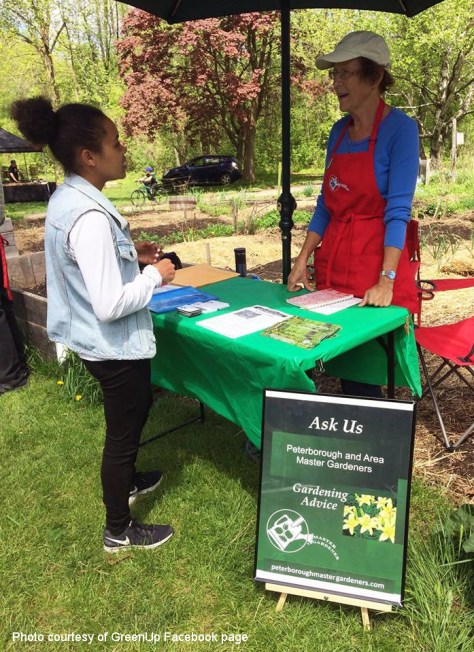




 All of these businesses and more can be found this weekend at the