Category Archives: Sedums

Monocarpic Succulents: The Plant That Blooms Once and Says Goodbye

By Mary-Jane Pilgrim, Master Gardener

If you’ve ever had a succulent like “Hens & Chicks” Sempervivum that suddenly produces a tall flower stalk and then begins to die, don’t panic—you probably didn’t do anything wrong. You may have discovered a monocarpic plant.
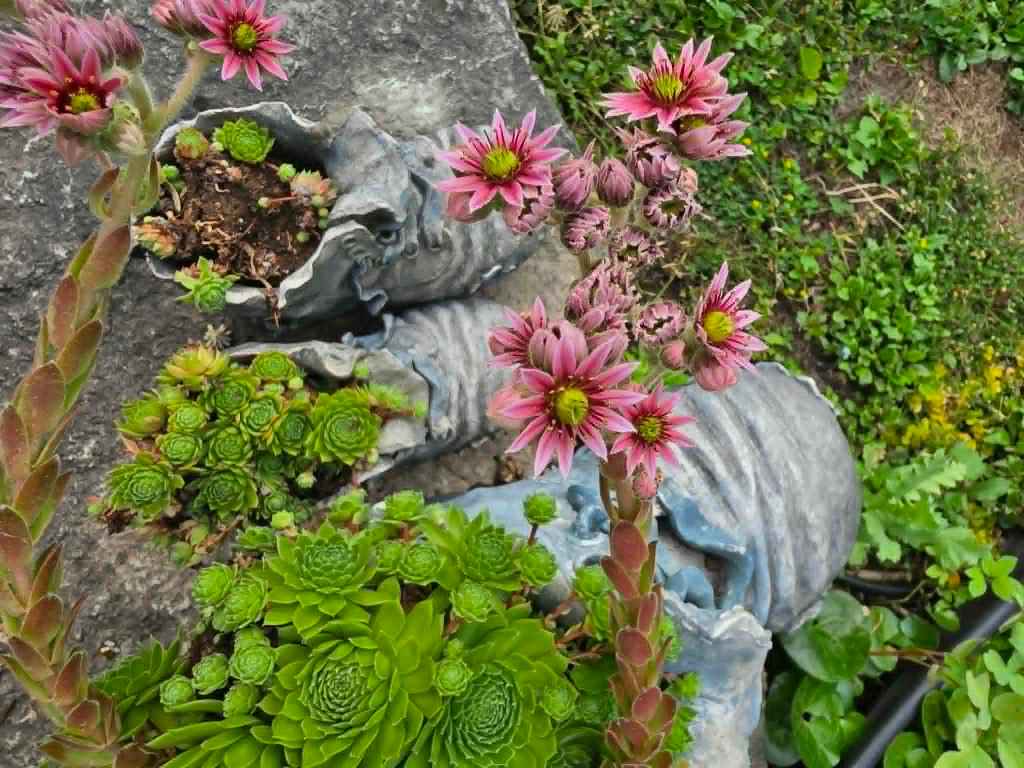
The word monocarpic simply means “flowers once.” These plants spend years growing into beautiful rosettes, storing energy in their thick, fleshy leaves. When conditions are right, they put all that energy into one spectacular flowering display. After the flowers fade, the main plant dies.

It may sound sad, but it’s actually a perfectly normal part of the plant’s life cycle.

Many popular succulents are monocarpic, including the already mentioned hens-and-chicks (Sempervivum), but also some Aeonium species (non-hardy succulents), and many Agave varieties (tequila, anyone?). The good news is that these plants often produce offsets, or “pups,” around their base before or during flowering. These baby plants continue growing long after the parent plant has finished its life.

If your monocarpic succulent starts to flower, enjoy the show if you appreciate them! Once the main rosette has completely died, simply remove it and allow the pups to fill in the space. Before long, you’ll have a healthy new generation of plants.

BUT if you’re like me and find the flowers messy, feel free to cut all of the flower stalks out — you aren’t removing anything that isn’t already on the way out. While you’re pruning, keep an eye out for the new offsets that will take their place and push them back into the soil if they pop out with the parent.

Nature has many surprising strategies, and monocarpic succulents remind us that sometimes the grandest finale is also a last hurrah!

An Overlooked Group of Plants

By Marilyn Homewood, Master Gardener

Now that the hot, humid days of summer are upon us, it is time to appreciate some of the unsung heroes of the garden such as the low growing sedums (aka stonecrops) and hens and chicks (Sempervivum). 

These are a large and diverse grouping of plants known for their thick, fleshy engorged parts that retain water making them incredibly drought resistant.  They are found on every continent but Antarctica and likely in all of our gardens.  Give them sunshine with good drainage and they will reward you for years to come.

Often, these plants are used as groundcovers playing second fiddle to our larger, showier specimens or artfully placed in rock gardens.  Why not consider bringing them out to centerstage? Their varied texture and colours can create a unique look. The drought resistant nature of the plants is on trend with our warming climate. 

sedum garden

Some years ago, I redid a south facing bed entirely in sedums and hens and chicks. The previous occupants were failing to meet the challenges of the climate. It has proven to be a bit of trial and error with some varieties working well, some being too aggressive necessitating their removal and some succumbing to winter kill.  The bed is still a work in progress.

Initially, I did lose plants to rot as the existing soil was rich and covered with cedar bark mulch.  After amending with a poorer quality of soil scavenged from the shoulder of my road as well as implementing the use of HPB (high performance bedding) as mulch, the plants took off. HPB is a type of washed, crushed, angular limestone chip that does not contain fines or dust, typically around 1/4 inch in size.  It is commonly used as a base material for patios, walkways, and other landscaping projects. It’s known for its excellent drainage properties and makes a lovely stone mulch.  As the plants grew, they expanded happily into the HPB.

Other applications for these plants include their use in containers.  I am fond of planting up an old boot for placement on the porch stairs.  The succulents do well and take little care.  At the end of the season, plants are tucked back into garden to overwinter.

More recently, specialized companies have been producing “sedum mats” for use on green roofs and on landscape applications.  Sedum mats are a mixture of hardy sedum species grown in 1.5 inch thick soil-less media on a biodegradable coconut fibre base.  These mats are cut and rolled up like sod and are laid out in a similar fashion to provide a continuous green covering.  They can tolerate light foot traffic and are often used in areas where conventional garden beds would prove difficult (rocky areas with little soil depth, accents around hardscaping, boulevards). 

Sedums and sempervivum are the ultimate in low maintenance, drought tolerant plants that are visually striking and unique. There are far too many varieties to list here but some that I have found attractive, hardy and would recommend growing are Sunsparkler Firecracker, Sunsparkler Lime Zinger, Angelina, Dragons Blood, Voodoo and John Creech.  Some nurseries specialize in these species and have a large selection to choose from. No need to worry about planting these in the heat or having to baby them along.  I have some empty spots to fill so I think I will be heading out to my favorite nursery near Bobcaygeon to acquire a few new varieties.

And thanks to Master Gardener MJ Pilgrim for the awesome photo of her hens and chicks in the vintage iron.