Category Archives: Planting

Truth or Fiction? Are Black Walnuts Toxic in my Garden?

by Emma Murphy, Master Gardener

As a Master Gardener, one of the most common questions I get asked is about the toxicity of walnut trees (Juglans nigra).

“Well I heard that the juglone stuff in the roots kills everything and that I can’t plant anything under or anywhere near a walnut tree.”

Well yes Virginia, you can plant a garden under a walnut tree, and have it thrive. Let’s look at Exhibit 1 below – an established perennial bed under a walnut tree. It’s at our house, so I guarantee it’s real, and it’s been there since late 2007.

BP4

Lots of lovely perennials here – hostas (Hosta spp.), daylilies (Hemerocallis), bearded iris (Iris germanica), summer phlox (Phlox paniculata), wild ginger (Asarum canadense), purple coneflower (Echinacea purpurea), ditch lilies (Hemerocallis fulva), although those last ones are doing just a little too well LOL. Don’t believe it’s a walnut tree? Here’s a photo from a bit further back on the street.
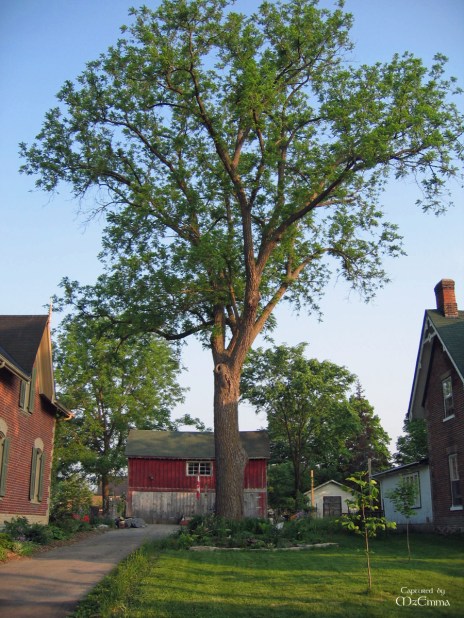
BP1

Yes, she’s a big old lady – we think she was planted around the same time the house was built, making her about 140 years old. I think she’s getting a bit tired out – most years she doesn’t produce too many walnuts. Her slightly younger cousin is to the left of the barn in the background – LOTS of walnuts off her (and yes a garden under that one too).

So where does this fallacy come from that ‘nothing grows under a walnut’? Well certainly all parts of the walnut tree contain a chemical called juglone (heck it’s even in the Latin name!). Juglone is a chemical that affects other plants growing nearby (a phenomenon called allelopathy). Simply put, allelopathy involves “living or dead plant parts that release chemicals into the soil which have an effect on other plants—positive or negative.” For walnuts it seems like an attempt at self preservation, with juglone acting like a natural herbicide on other plants.

As Professor Linda Chalker-Scott explains in her recent (2019) peer-reviewed Washington State University Extension paper, damage to tomatoes and other crops near walnut trees in the 1920s caused people to believe that toxic chemicals were involved, and this perception persisted and became widespread despite there being no evidence (and this was before social media existed!). The US Department of Agriculture did field testing – no problems. When applied in a laboratory setting to seeds and seedlings it did cause stunting, wilting, and necrosis, but the specific way it did this was unclear. The most recent science suggests that juglone disrupts photosynthetic and respiratory pathways and interferes with water uptake in plants.

Picture1

So! It does affect plants – the laboratory says so. Well yes, and no. Field tests do not support the laboratory work, which doesn’t accurately mimic real life conditions in your average residential garden (again, for more detail read the excellent paper referenced above). Two very old University Extension papers (1973 and 1993) continue to be used to state which plants are ‘sensitive’ and which are ‘tolerant’. However these were simply observational papers—meaning that they correlate the presence of walnut trees with damage to other species but do not confirm a causative relationship. Neither should be considered good scientific evidence.

Gardening With Walnut Trees – My Story

I am sure the scientists, arboretums, farmers, and garden writers will continue to debate this topic for a while. Meanwhile, here’s our story. In 2007 I wanted a garden bed under our black walnut in my front yard. At the time I had heard the walnut horror stories, so I thought – well, how about I just don’t disturb the roots of the tree? (not a good thing to do when establishing any garden beds under a tree). I put good topsoil and compost down, making sure to minimize tearing up of the soil and roots, and planted, and watered, and waited. Things grew. Winter happened. Next spring plants came up. For the most part I just moved perennials that were already on site, although some hostas were new. Here’s the garden in 2008 in the fall.

BP5_plants_2008

Fall asters (Astereae spp.), sedums (Sedum ‘Autumn Joy’ in this case), hostas (Hosta spp.), wild ginger (Asarum canadense), fall rudbeckias (Rudbeckia fulgida and triloba), purple coneflower (Echinacea purpurea), ninebark (Physocarpus opulifolius), iris (Iris spp.), astilbe (Astilbe spp.), sweet woodruff (Galium odoratum), Ozark sundrops (Oenothera macrocarpa), coral bells (Heuchera spp.), cranesbill (Geranium spp.). All doing just fine.

And 2009 below, in the spring. Irises (Iris spp.) lemon lilies (Hemerocallis lilioasphodelus), lungwort (Pulmonaria spp.), poppies (Papaver rhoeas), ditch lilies (Hemerocallis fulva), variegated solomon’s seal (Polygonatum odoratum ‘Variegatum’), bracken (Pteridium aquilinum), bleeding hearts (Dicentra spectabilis), daylilies (Hemerocallis spp.).

BP6_plants_2009

Certainly, planting in general under walnuts is challenging – they cast dense shade and have extensive, water hungry root systems. Watering after establishment and for the first season is critical. We also had our walnut tree pruned professionally (it needed it) so it actually gets decent sunlight in the latter part of the afternoon. Like any fruit or nut tree they are messy, from their spring pollen to their leaves and nuts…oh those nuts.. 2017 was a crazy year – buckets of walnuts (I even had to engage my neighbours’ lovely children from across the street to help collect them) to 2018, with almost no walnuts. My trees are old too – although well pruned, their leaves drop at that first hard frost. 1

In Defence of Walnut Trees

Black walnuts are not all bad, and I will continue to treasure them in my yard. They are an amazing shade tree, are highly valued for their fine grained dark wood (for furniture), a great food source for wildlife and birds, and my white breasted nuthatches’ favourite spot to hide their seeds.

We have definitely had our challenges with our walnut trees, and I’ve learned a great deal over the past 20 years. But one thing I know – I can garden with them around. You can too.


Note: Black walnuts are not the only tree that produce juglone – other members of the Juglandaceae also produce it as well as hickory trees. Butternut, English walnut, bitternut hickory, pignut hickory, pecan, shagbark hickory, mockernut hickory are in the same family.

Facebook Groups for the Green Community

By Mary-Jane Pilgrim, Master Gardener

Two weeks ago, I wrote about iPhone and Android apps that can help you to identify plants & trees, know where/when/how/what to plant and also help you to connect with like-minded people for discussion.  Facebook groups serve similar purposes.  At this time of year, these groups are eye-candy for the green community as they often remind us how few days are left until spring, where to attend local (indoor) green/gardening events, and how to care for those houseplants that need a fb groups bloglittle TLC.  During the gardening season, these groups magically transform to become a forum for a little bragging for those inclined to share pictures of the results of their hard work, and also a forum for those needing a little help.  I’ve posted a plant picture to one of them, and had a definitive answer to an identification question in literally less than ONE MINUTE (Thanks, Jeff Mason!).

Here’s a list of some of the (mostly local) groups that I’m a member of.  There certainly are a lot more!  Most are public, but don’t let the ‘closed group’ label scare you.  If anything, closed groups are completely welcoming to gardeners!  They just may ask you to answer a few simple gardening questions to make sure that the group doesn’t get infected by spammers.

Over the Fence with Peterborough Master Gardeners (530 members)

A local group specializing in plant identification, local events, and gardening questions answered by knowledgeable Master Gardeners. Novice, expert and professional gardeners are encouraged to join and post freely.

Ontario Gardeners (3, 571 members)

This group is for us Ontarian’s to post, chat or ask about plants we have in the yard, pond or house. Check out our files section newly created Oct.2016 and will be added to over time. Happy Gardening!!!

Canadian Gardeners (10,443 members)

This group is for anyone that wants to discuss flower gardens & vegetable gardens that live in Canada. Help others with tips, share your gardening secrets and stories and maybe learn a thing or two yourself! Lots of gardening links, self help and diy posts. Share your favorite gardening books, tools, websites and photographs with your fellow Canadian Gardeners! Add your zone to aid in advise, tips and to give your fellow Canadian Gardeners the idea of conditions you garden in 😊

GardenOntario (2,026 members)

To reach, connect and help educate all members through gardening related articles, videos, live broadcasts, activities and events happening with our societies across Ontario. Affiliated with the Ontario Horticultural Association.

Canadian Succulent & Cactus Hoarders (2,166 members, closed group)

A community place for Canadians who are addicted to collecting succulents and cacti. Ask questions and show off your collection! For now buy/sell/trade posts will be allowed until the group grows big enough that it warrants a separate group.

Plants for Peterborough Canada (657 members, closed group)

Peterborough Ontario Canada – A place to share plants for free. Upload pictures, share tips, get help thinning your gardens, get advice, play the *What on earth is growing in my garden game* offer plants, get plants, swap plants, its allllllllllll about plants! We encourage FREE share. Please save the selling of plants for kijiji. We also encourage you to share photos of your gardens, and upcycling ideas to beautify them!

Garden Deals for Peterborough, Canada (208 members, closed group)

If you know of a good deal on plants or gardening material in the Peterborough, Ontario, area – please post it here. Also – please share if you find unique plants that people may be interested in!!

Beware the Vigorous Plant!

By Suzanne Seryck, Master Gardener

Being the fairly recent owner of a small city garden, I find I no longer have the space for plants that either do not behave, need too much deadheading or pruning, spread too quickly becoming invasive, need to be staked or I’ve simply grown tired of. At least 90% of my garden is full of either fruit trees, shrubs, fruit bushes, perennials or raised vegetable beds. The remaining 10 or so percent contains a patio and a very, very small lawn that my husband tells me has to stay! So needless to say if I buy any new plants I have to give an existing plant or two away (thank heavens for plant sales).

I have a few plants in mind that I am considering replacing this spring so I have spent the last week or so looking through bulb and plant catalogues to see what is new this year. Catalogues are a great place to see what is new and exciting and also to fill the gardening void that generally happens this time of the year. However, I have heard both good and bad stories regarding plants purchased from these catalogues, so it is very much a personal choice. What I did notice though were the many different terms given to what I would describe as an invasive or ‘buyer beware’ plant, especially if, like me, you do not have a large garden.

allium

Allium were described as ‘carefree’. However, if you have ever tried removing hundreds of allium bulbs from a perennial bed that have self-seeded over many years ‘carefree’ is not a term I would immediately think of.

‘Vigorous’ is a term often used in these catalogues, which could mean either that the plant is strong, robust and grows well (which we would all like) or more likely that the plant grows very quickly and will take over your entire garden in a very short time. Examples of ‘vigorous’ plants include false sunflower (Heliopsis helianthoides), knotweeds (Persicaria) and orange trumpet vine (Campsis radicans).

Baby’s breath (Gypsophila) is listed with the description that it ‘readily fills gaps’, whereas bee balm (Monarda) is described as ‘multiplying quickly’.

lily-14254_1280

Lily of the valley (Convallaria majalis), need I say more! I actually inherited this plant in my shade garden and I think I could be digging it out for a good few years. I really do love this plant, but it has to be in the right location and in a bed all by itself. Lily of the valley is described in one catalogue as ‘creating a carpet of flowers’ and in another catalogue as ‘growing fearlessly among tree roots’.

But I think the term most often used to describe a plant that might become invasive in these catalogues is ‘naturalizing’. When I think of naturalizing I think of beds or daffodils or bluebells, but then I am English so that might explain why. Plants included in this category are masterworts (Astrantia), mountain fleece (Persicaria amplexicaulis), false sunflower (Heliopsis helianthoides) and meadow rue (Thalictrum flavum).

Being an avid gardener, some may even say obsessive, there are not many plants that I do not like and all of the plants listed above I have at one time or another grown, and still do. But gardening with only a limited amount of space has changed the way I look at and select plants.

Garden Tech for the Green-Finger Inclined

By Mary-Jane Pilgrim, Master Gardener

Gardening is supposed to be natural, right? Many who enjoy the outdoors and gardening downplay screens and technology and also tend to encourage others to put down the devices and experience what’s in front of them. But what if you don’t know anything about what IS in front of you? Your smart phone or tablet can be quite the gardening companion.

Here’s a selection of apps that can be found in the App Store that will help you know when/where/what to plant, and sometimes more importantly, how to find out what’s already growing in your yard or someone else’s that you admire.

LeafSnap: An Electronic Field Guide — Free (iPhone only)

How many times have you been in a public park or garden and fell in love with the trees, but with no one to ask what they are?  Using visual recognition software, Leafsnap can identify trees from a photo of their leaves alone. I can’t tell you how many times I could have used this!

myGardenAnswers Plant Identifier — Free (iPhone/Android)

With Garden Answers Plant Identifier, you can take a picture of a plant that you want to identify and presto — you’ll get its name and all of the information about it. It’s like having an encyclopedia in your pocket. This is easily one of the best free gardening apps in existence, namely because it can automatically recognize more than 20,000 plants. This app also identifies pests and has a robust Q&A section that covers more than 200,000 of the most common gardening queries.

GrowIt!: Garden Socially — Free (iPhone/Android)

GrowIt allows you to join an enthusiastic community of gardeners, helping you to find inspiration, gather information, and share your own gardens with the world. This app is good if you want to find out what plants will grow well in your local area.  As you find plants you love in their extensive database, you can organize them into projects to help you design your own green masterpiece.

BeeSmart Pollinator Gardener — Free (iPhone/Android)

Want to grow a beautiful garden that also helps the environment? BeeSmart is an app created by Pollinator Partners that helps you choose the best plants for bees that can thrive in your specific location. Win-win.

Gardenate — $1.39 (iPhone/Android)

If you’re looking for a simple calendar for planting garden vegetables that comes with an assortment of useful hints and tips, then you should take a look at this app. Gardenate will be your best companion when it comes to keeping your garden in the best condition. There is information about over 90 plants and herbs, and a calendar to know when it’s the best time for these plants to grow.

garden tech apps

Winter in Ontario – A Gardener’s Survival Guide

by Emma Murphy, Master Gardener

If you’re a passionate gardener like me, right now you are buried in the snow and cold of winter and suffering from the January blues. You dream of your garden every night, envisioning the bright colours and textures and green of your summer paradise. You consider heading south for a vacation, not just for the warmth and sun but just to see some incredible tropical plants and green things. You start thinking about moving to some place where you can garden year round…

But I digress. Don’t get me wrong. I like the winter season. My body needs a rest from the garden, I need time to plan for next year’s garden, it’s time to order seeds and attend garden workshops, and there are so many good gardening books and blogs to read.

I thought I would share my Top 5 Ways for Gardeners to Survive Winter. I have more ways, but that’s another story..

1. Review your Garden Photos

I love to spend particularly dull winter days reviewing photos of my garden from last year or previous years. Digital cameras and our smart phones make it so much easier these days to capture our gardens in all their glory, so take the time to enjoy the beauty you created when you need a pick up. I’ve sprinkled a few of mine throughout this blog (you’re welcome!).

peony

(created by Joe and Hazel Cook at Blossom Hill Nursery)

2. Join a Local Garden Club, Horticultural Society, or Master Gardener Group

Nothing feels better than sharing your gardening love with others who share your affection for all things growing. Find your local Ontario Horticultural Society, or think about becoming a Master Gardener. In my area we have many wonderful horticultural societies including Lakefield, Peterborough, NorwoodOmemee, Ennismore, Bobcaygeon, and Fenelon Falls. I meet interesting people, chat about gardening issues or successes, and get to hear from terrific presenters. Great value for money. I also love being a Peterborough Master Gardener, sharing my love and knowledge of gardening with others.

3. Seed Catalogues!

I am relatively new to growing my own plants from seed, as my garden is mostly full of perennials and shrubs. However, after a Master Gardener field trip to William Dam Seeds a few years ago, a new interest in growing dahlias (after being inspired by a vendor at the Peterborough Garden Show) and a new vegetable garden in our back yard (courtesy of my husband – the veggie gardener), I have entered this world, and there is no turning back. Reading through hardcover or online seed catalogues (even if you don’t buy anything!) is guaranteed to put a smile on any gardener’s face. Google Canadian seed companies and many should pop up.

hyacinth

4. Find a Great Garden Blog or Website

There are so many amazing gardening blogs and website out there. I tend to follow those who have similar growing conditions to me (Zone 4b, harsh winters, Central Ontario) but I do have several (including a few in the UK like The Frustrated Gardener and the Anxious Gardener) which I like to just view and enjoy. Some of my favourites below.

The Laid Back Gardener (Quebec)

The Impatient Gardener (southeast Wisconsin)

The Gang at Savvy Gardening (Pittsburgh, Halifax, Dundas)

The Gardening Girl (just north of Toronto, Ontario)

sunflower

5. Buy a new Houseplant (or 2, or 10)

Confession – I am a much better gardener outside than inside. While I love seeing the greenery all winter, our harsh interior conditions (furnace heat and no humidity) are not ideal for houseplants. However, the arrival of two rambunctious kittens into our home in October sparked a review of my houseplants. So many plants are problematic for felines that many got rehoused with friends or just thrown out. A week ago I had a craving for some greenery, so I ventured out to a local nursery with great houseplants (Burley’s Gardens) to find some ‘safe’ plants. I came home with some Peperomias, a prayer plant (Maranta leuconeura), African violets, a money tree (Pachira aquatica), and a Phalaenopsis orchid. It appears all of these are relatively safe for cats. There is a good list here of plants that are toxic (or non-toxic) for cats. However, it’s just a general list – it depends on how much is ingested, what plant part, age of cat etc. etc. Do your research.

I hope these ideas help get your through these cold winter days and nights. And just remember, all that snow provides a lovely warm blanket for your plants, so thank Mother Nature for that and dream of spring!

Can’t wait for Kermit to reappear at my pond.

kermit


Garden Seminars & Workshops: Every Gardener’s Should-Do List

By Lee Edwards, Master Gardener

As Gardeners, we already know that gardening has many benefits including improving our health and connecting us with nature, to name just a few.  That said, did you know that attending gardening seminars and workshops can also improve your health- brain gain, ramp up your gardening skills, get you out meeting others with similar interests, and increase your communication abilities?  Even more, seminars and workshops add new ideas to your horticultural know-how, empower your confidence in gardening, and help to propel you to new gardening heights.

So, what does a gardening seminar or workshop look like?  Well, unlike lectures, they tend to be short, interesting, educational talks or demonstrations usually featuring a speaker engaged with a small group of attendees focused on garden topics of interest to the attendees.  During the event attendees typically get the opportunity to ask questions, participate in hands-on activities if any, learn something new, connect with speakers and increase their existing knowledge.

Indeed, during the cold winter as outdoor gardening slows down, attending a garden seminar or workshop is a great way to break up the long winter months away from the garden while remaining involved in garden goings-on and being amongst gardening enthusiasts.  The lively energy and creative atmosphere that permeates these events are infectious to everyone, worth the time and fee to attend, not to mention downright fun most-times.  Truly, garden seminars and workshops should be on every gardener’s yearly to-do list.  If you’ve never been to a garden seminar or workshop, now may be the time to try one, to investment in yourself, inspire your creative growth and add to your gardening knowledge.

Did you know that the Peterborough & Area Master Gardeners annually present a wonderfully fun and informative gardening seminar called “A Day for Gardeners?”

2019 Save the Date

A Day For Gardeners Seminars by Peterborough & Area Master Gardeners

A day of fun, friendship, food and learning.  Select 3 of 6 seminars presented by Master Gardeners and speakers on topics of interest to both new and experienced gardeners.

Date:   Saturday, March 2nd, 2019
Place:  Activity Haven Centre – 180 Barnardo Ave, Peterborough, ON K9H 5V3
Time:  10:00am – 3:00pm
Price:   $35 – EARLY BIRD (register and pay by February 2nd, 2019)
$40 – after February 2nd.
Includes lunch.  Walk-ins on day of seminars are welcome if room is available.

Have Fun Gardening!


Butterfly Gardening – Monarch Waystation #204

by Mary Jane Parker, Master Gardener

Since 2008, my garden has been a monarch waystation.  In the beginning, when we purchased the property, we had to have a new septic system put in.  Because we are in a floodplain and the ground was saturated with water, we had to go up with the weeping tiles.  This meant that we had a berm at the front of the property and that was the beginning of my butterfly garden.

cottagejune23 038 (2)

Since then I have experimented with all kinds of native plants and wildflowers . The scope and layout of the property was such that formal gardens would have been impossible. Not all plants that I have tried have been successful but some have been my perennial favourites.

Monarda has self-sown over the years as has Phlox paniculata of which I probably have every colour available. Many plants have a personal history. Helianthus maximiliani came from Cathy Forget’s garden in Indian River and Glade Mallow (Napaea dioica) came from Mike and Sue Dolbey’s garden in Young’s Point. Many plants have come from gardens visited on horticultural trips near and far. I always leave room for native milkweed to grow. I have tried cultivated varieties of milkweed and unfortunately, they are not hardy here. The creek at the back of the property has an abundance of Joe Pye Weed (Eupatorium maculatum) growing naturally and I can’t think of anything prettier than when they are in bloom with the different shades of pink dancing in the breeze. I have always left room for Queen Anne’s Lace (Daucus carota) which not only attracts monarchs but a variety of interesting bugs. In the spring the Korean Lilac (Syringa meyeri) blooms are always a butterfly magnet.

Being a waystation has been fun. There are over 20,000 registered waystations around the world, most in North America, and although there are guidelines to follow, it does not appear that there are any hard and fast rules. The whole point is simply to provide habitat for monarchs and in doing so, you have a place that also attracts other butterflies, birds, and pollinators. Visit www.monarchwatch.org for more info.

houseonriver 044 (2)

Shady Gardens

by Sharleen Pratt, Master Gardener in Training

Now that the colder weather has arrived and the days are shorter, it’s time to dream about next year and possibly plan a new garden. Do you despair at the challenges surrounding a shade garden? We can enjoy the cooling effects of the shade and experience a garden that regales all of the senses. When choosing plants, consider interesting foliage and texture rather than solely depending on flower colour.

If you are planting under mature trees, especially non-native maples you must always remember that those vigorous, feeder roots quickly out-compete new transplants for water and nutrients. Every fall add several layers of shredded leaves as well as compost for additional nutrients. Remember to water often the first year.

There are many wonderful bulbs that would give you that burst of colour in the early spring before the trees get their leaves. The sun coming through the branches in early spring is perfect for encouraging Daffodil (Narcissus hybrids), Grape Hyacinth (Muscari botryoides) and Siberian Squill (Scilla Siberica) to flower before the tree canopy is in full leaf.

Hosta (Plantain Lily) are a must have in a shade garden and provides variations in leaf size, shape and colour. This perennial has hundreds of species and thousands of cultivars and they are tough, reliable plants. Along with the Hosta, you might consider Bleeding Heart (Lamprocapnos spectabilis). Their flowers hang down like dangling hearts and are a real source of delight. The dryer soil under a canopy of trees would quicken their disappearance shortly after flowering and would work well under the emerging large leaves of the Hostas. Another old-fashioned perennial is the Heartleaf Bergenia (Bergenia cordifolia) that has large waxy, heart shaped leaves. It also has some fall interest when the leaves take on a reddish winter hue.IMG_4094

Lungwort (Pulmonaria) are also shade tolerant and their delicately patterned foliage draws the eye throughout the summer. There are several species, some of which are variegated which can add texture and colour to the shade garden. Another perennial to consider is the Brunnera ‘Jack Frost’. This plant was named as the Plant of the Year for 2012. It bears panicles of light blue flowers held above silver leaves with green veins and edges. Once established, they can be fairly drought tolerant. An overlooked plant is the Foamflower (Tiarella cordifolia). It is a native groundcover and is happy in both full to light shade. It bears tall racemes of delicate white or pale pink flowers for six weeks in early summer. They grow best in moist, humus-rich woodland soil.

To give the shady garden some texture and shape, look at some of the broadleaf evergreen shrubs. The Oregon Grape Holly (Mahonia aquifolium) prefers moist, well-drained, acid soil. It produces very fragrant yellow racemes in mid-spring, followed by globose, dark blue fruit. Another broadleaf evergreen for shade is the Rainbow Leucothoe (Leucothoe fontanesiana ‘Rainbow’) a member of the Heath family with white urn-shaped flowers.

Take a close look at your growing conditions and plant accordingly. Put a bench under a tree and once established, the shade garden will be a wonderful oasis to roam and sit with a cup of tea and take in all the many senses surrounding you.

A good article that lists many perennials and groundcovers for a shade garden can be found at Landscape Ontario.

The Myth of Fragile Roots Planting Trees and Shrubs

By Emma Murphy, Master Gardener

(This blog entry builds on last week’s excellent post by Sue Flinders-Adams)

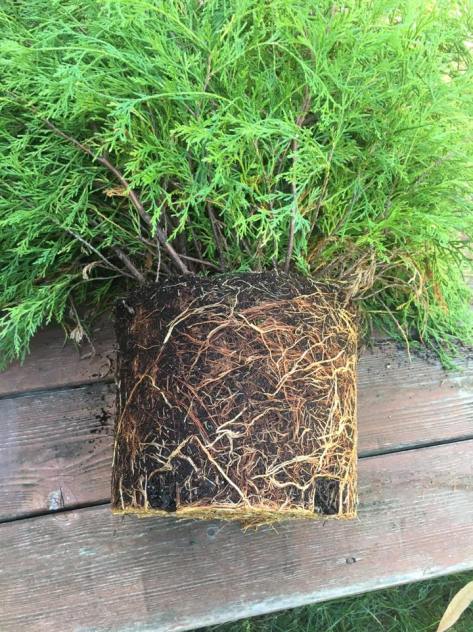
“When you transplant, try not to disturb the roots, just take the whole pot-shaped lump of soil/roots and pop it into its new home.” How many people have heard this story when purchasing a new tree or shrub from a nursery?

We take a shrub out of its container and see white fragile-looking roots and instinctively we don’t want to damage them or add to transplant shock. We know that healthy growth in a shrub is dependent on a good root system, so why would we mutilate or injure them?

nottoopotboundbutstill

Are Roots Really That Fragile?

Well, it turns out that those roots are not as fragile as we think. While you should take care with when transplanting seedlings, especially annual flowers and vegetables, woody perennials, shrubs, and trees all benefit from a more vigorous approach, according to Linda Chalker-Scott, Ph.D., Extension Horticulturist and Associate Professor at Washington State University and one of the ‘Garden Professors’ that I admire for their scientifically-based knowledge of horticulture.

Garden Professors on Facebook or Garden Professors Website

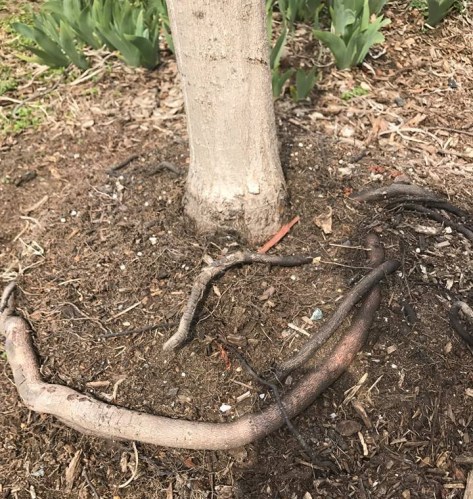
When we purchase gallon-sized pots in the nursery, the plants are often pot-bound, the often suffered from circled root systems, which if not corrected become even more problematic once the shrub is in the ground. Eventually they become girdling roots, which will lead to the early death of otherwise healthy trees and shrubs, as you see below.

timhamilton

(photo courtesy of Tim Hamilton)

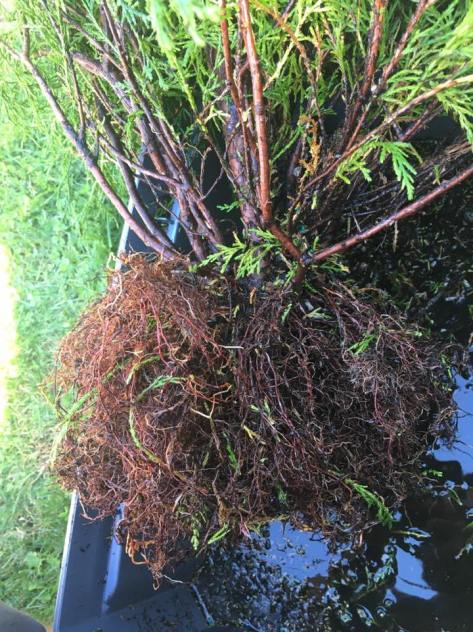
Think of it this way – roots respond to respond to pruning in much the same way as the crown—it stimulates new growth. If you prune the roots when you transplant, especially those that are excessively long or misshapen, the plant will respond by generating new, flexible roots that help them establish in the landscape. The best way to do this is by root-washing the shrub – taking it out of the pot, putting it in a wheelbarrow or other container, and washing off all the media so that you can see what the root system looks like.

cutcrossingandgirdlingroots

Two Critical Things to Do

  1. Prune the roots in a root-bound shrub or tree to avoid future problems
  2. Remove the media (soil) that shrub or tree came in

The second suggestion relates to the soil that comes with your tree or shrub. I always thought you just put it right in the ground, but evidence suggests that (generally) the container media is a soil-less mix with a large proportion of organic matter and pumice. It is best to remove this media as part of your root inspection, and use it as topdressing after planting, followed by mulch.

If you put the media in with your new plant, the material will inhibit root development outside the planting hole. It will also lose water more rapidly than the surrounding native soil (because of its porous nature), resulting in increased water stress to your new transplant.

Watering is Essential

As with all transplanting, regular and deep watering is needed to keep the new shrubs or trees happy while they establish their new root systems. The fall is a great time to plant trees and shrubs so happy planting!

Want To See How It’s Done?

Doug Gifford of Michigan recently posted to the Garden Professors Facebook page about his root washing, root-pruning, and planting of shrubs. You can check out the link here. Credit to Doug for most of the photos on this blog post.

shookoutandwet

A Special Note

If you plant a shrub or tree already in full leaf they will be more stressed than those that are dormant. Dormant planting is better as all resources go towards root establishment. You may see leaf damage or even death in the short run. But as long as the roots are kept cool and moist throughout the transplanting process, and as long as you keep the area mulched and watered, it should be fine in the long run.

Check out more detail on this issue in this blog post. It talks about the four things that result in landscape planting failures and how changes in the nursery industry have resulted in more problems with roots. Many of these issues also apply to balled and burlapped (B&B) trees – more information here.

This year, Dr. Chalker-Scott extended her experiment to perennials, as talked about in this blog entry  Three months later she revisited the site – here are the results.

For more information on other horticultural myths check out these pages. Even better? Spread the word to others 😊
Horticultural Myths – Dr. Linda Chalker-Scott
Garden Myths (Robert Pavlis’ site – he is based in Guelph, Ontario)

Planting to Encourage Proper Root Growth and Branching

By Sue Flinders-Adams, Master Gardener

Here are a few tips to ensure that the new shrub or tree you just brought home will thrive and grow to its full potential.

1. Before planting, soak the plant in the pot, in a pail of water for a few hours or even overnight to hydrate the roots.

2. Carefully remove plant from the pot. If it doesn’t come out easily gently press on the sides so that the roots will come away from the pot, and tap on the bottom.

3. There are usually roots circling the pot – gently coax these roots away from the root ball to encourage outward growth. If roots are left in the ‘circling’ position, they will continue to grow in this direction, circling the plant and even girdling the trunk of the tree in 10 or 15 years.flinders pic 1

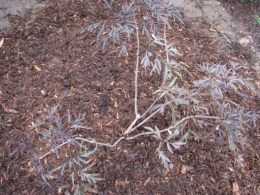
4. The picture shows the roots that have been spread out in the very large hole. Partially cover the roots to hold them in place and water thoroughly with transplant fertilizer, according to the directions. Fill in the hole with the surrounding soil. Top dress with an inch or two of composted manure, and then 3 inches of mulch. Prune off any dead branches.flinders pic 2

5. Branches are often cramped and a little twisted from shipping. Gently pull them away to a better positon and secure with plant supports (pictured). In a couple of weeks you can take the supports away and the branches will continue to grow in that direction.

6. flinders pic 3Three weeks later, the Black Lace Elder is looking very happy. It is October which explains the lack of new growth.