Category Archives: Bulbs

Yes, You Can Still Plant Tulips!

By Christine Freeburn, Master Gardener

Unlike daffodils, which should be in the ground by Thanksgiving, tulip bulbs can be planted anytime from September until when the ground freezes in December. When you plant later in the season, squirrels are not as active, so may not discover and dig up your bulbs.

Planting in circles or groups rather than in a straight line is more pleasing to the eye.  Plant tulips in well drained soil at least 6-8 inches deep and 2-3 inches apart.

Hen manure is a good fertilizer and it will also deter squirrels. For 5 or 6 bulbs, dig your hole (digging that 8” deep will also deter squirrels), put in a couple tablespoons of fertilizer in the hole, place bulbs (one in middle with the rest around), cover with soil, pat firmly, sprinkle more fertilizer, cover bare earth with leaves or mulch (to disguise it from squirrels) and water thoroughly.

You can also use heavy wire to cover the area to keep squirrels from digging or place a board or rock over the area, removing it when the ground has frozen.

After your flowers fade in spring, you can cut back the flower stem but let the leaves die back naturally. This allows photosynthesis to continue, giving food back into the bulb so it will produce again the next year. Plant perennials close by so they emerge and hide the tulip leaves as they decline.

There are thousands of different tulip varieties in many colours, shapes and sizes. Below is a list of some of the main tulip varieties with their characteristics.  

NOTE: Don’t forget our first ever Peterborough Master Gardener Spring Blooming Bulb sale still has tulips (and other beautiful spring bulbs) available. Click here for more information and to order! Pickup is in Peterborough.

Single early tulip

Single Early     

  • blooms in cooler weather with daffodils              
  • cup shape with 6 petals
  • average height of 10-18 inches
  • live for 3-4 years
Single late tulip

Single Late

  • also called Cottage tulip
  • tallest varieties standing 18-30 inches tall          
  • bloom when temperatures warm           
  • long lasting blooms but shorter life
Double early tulip
Double late tulip

Double Early and Late

  • also known as Peony tulips because of their multi-petaled structure       
  • can be early or late varieties     
  • blooms can be 6 inches on 10-16 inch stems     
  • sensitive to rain and may flop
  • shorter lived type
Darwin hybrid tulip

Darwin Hybrid

  • cross between Fosteriana and late blooming single tulips
  • tall sturdy stems 22 to 34 inches                       
  • large blooms    
  • perform year after year
Triumph tulip

Triumph

  • sturdy stemmed variety growing 16 to 24 inches tall       
  • cross between single early and Darwin  
  • blooms mid season      
  • edges on petals are often a different colour        
Parrot tulip

Parrot

  • vibrant colours and feathery or ruffled petals      
  • long stems and large blooms make them tend to be more delicate          
  • tend to be later blooming
  • not long lived, but showy
Fringed tulip

Fringed

  • also known as Crispii tulips       
  • nice frilly edges which can sometimes contrast with rest of bloom           
  • often late bloomers
  • will only live a few years
Fosteriana tulip

Fosteriana

  • also known as Emperor tulips    
  • early to mid season bloomer with big blooms and large narrow leaves     
  • perform year after year 
Greigii tulip

Greigii

  • also known as Turkestan tulips 
  • big colourful flowers tend to be on shorter stems
  • mid season bloomer     
  • leaves are streaked or spotted maroon  
  • perform year after year
Kaufmanniana tulip

Kaufmanniana

  • early to mid season blooming time        
  • blooms resemble waterlilies as they tend to open float in bright sunlight  
  • usually short stemmed, about 6 to 10 inches tall
  • perform year after year 
Lily flower tulip

Lily Flower

  • late blooming   
  • long pointed petals which arch outwards
  • 14 to 30 inches tall
Viridiflora tulip

Viridiflora

  • known as a green tulip for the green markings on the petals       
  • late season but long blooming
  • 16 to 24 inches tall
Rembrandt tulip

Rembrandt

  • variegated petals in deep purple or reddish streaks                    
  • 18 to 26 inches tall       
  • original cultivar no longer available, but you may find Rembrandt type
Species tulip

Species

  • known as botanical
  • smaller and shorter but prolific  
  • naturalize well  
  • perform year after year
  • squirrels do not dig or eat
  • (If you’ve read this far, this is my favourite tulip…long lived, squirrel-proof, multiply well)

References

Toronto Master Gardeners Gardening Guide for Growing Tulips

Best Tulips Guide

The Magic of Transformation

By Marilyn Homewood, Master Gardener

As we draw closer to the Autumn Equinox, my thoughts dwell more frequently on the topic of fall planted bulbs.  For me, they evoke a powerful sense of anticipation similar to what I felt as a child when the Eaton’s and Simpson’s Christmas catalogues arrived.  The suspense and delayed gratification that both provide is beyond words.  A seemingly lifeless bulb has the potential to create a stunning spring display of bloom after the harshness of the Canadian winter!

Participating in this ritual is easy with not too many things to looks for.  When purchasing in person, look for the largest bulb for the type you can find (good quality tulips are typically 12+ cm in circumference, daffodils may be larger or smaller depending on variety).  The larger the bulb, the more blooms that you will have in the spring.  Bulb size is probably most important in tulips as not all varieties size up well once planted.  Major bulbs known to perennialize (narcissus, allium for example) will size up.  I once bought some Leucojum (summer snowflake) bulbs late in the year locally knowing nothing about them, planted them and had to wait 2 years for bloom. They were worth the wait. Last year, I dug some of them up and the bulbs were at least three times the size of what I planted.  Bulbs should also be plump and firm with no mold or black spots.

Local nurseries are a good source of bulbs as are some of the larger outlets with nurseries. 

More frequently, bulbs are purchased online.  Online suppliers will usually be able to provide bulb size and the bulbs they ship should be healthy.  Ask for a recommendation from someone in your horticultural society (there is always at least one bulb nut in every club). Vesey’s and Brecks are long time reputable suppliers of bulbs.  Also, have a look at the local flower farmer’s webpage.  It is quite common for them to retail some of the varieties they have ordered for themselves.  In this area Dahlia May Flower Farm and Antonio Valente Flowers both have attractive offerings each fall.  With online orders of course, there is the additional cost of the shipping.

A British Columbia company, “Wildwood Express” offers packaged bulbs for sale that are sourced from a reputable importer in BC.  They often have last minute sales that are hard to resist and of course end of year sales late in the season.  Bulbs can be planted very late into the season (if the ground can still be worked, and YOU are hardy enough).

Of course, there are often good local sales.  Not for profit organizations often sell bulbs as a fundraiser.  Consider these sales, both to buy some magic and to support a good cause.  In our area the Port Hope Garden Club and the Peterborough Master Gardeners have bulbs for sale. Consult the PMG website for details on their sale and for Port Hope, drop me an email through this website.

Some of us have succumbed to temptation long ago.  For this year, I ordered around 1700 bulbs last spring (less than last year!), have bought some from the club sale in Port Hope and still broke down and ordered a few fancy new narcissus from a flower farmer. 

Sharing the Love of Gardening

by Emma Murphy, Master Gardener

I’ve always loved nature and the environment, but my all consuming love for everything gardening didn’t hit until we owned our first home in West Rouge, Ontario. Finally, we had a place where we could put our own “stamp” on the landscape, and we loved trying new plants in our gardens.

We made a lot of mistakes in those beginning years, but over the past 30 years both I (and my husband) have learned so much. Most of that learning came through joining local horticultural societies and eventually (for me) becoming a Master Gardener (MG) in 2012 after taking the requisite courses and becoming part of my local MG group in Peterborough.

Reaching out to the Younger Generation

While we don’t have kids, we are grateful for all the youngsters in our Lakefield neighbourhood and this summer, our neighbour’s son, who is 3.5 years old, has shown an interest in gardening.

He first saw our lovely summer phlox in all shades of pink, purple and white in August and decided he would like it in ‘his garden’. So we proceeded with some hands on learning, digging up some plants (with his supervision), and replanting them in their front garden (after consulting with mom, who asked to have both pink and white in the garden).

Summer phlox moving across the road from our house to L’s house
Learning about watering their new plants

This past week, little L saw me out in the garden planting bulbs, and his curiosity was peaked. His mom had picked up some Grape Hyacinth (Armeniacum) and I happened to have a few extra Daystemon Species Tulips, which we are naturalizing in our garden.

Species/botanical tulips originated in the Asia and Turkey back in the 1800s and are the basis of all our modern tulips. They are short, naturalize, and the Daystemon variety have white tipped star shaped yellow flowers. Bonus? They are deer and critter resistant.

Daystemon Tarda Species Tulips

So, rake and small spade in hand, this past weekend L, his mom and I cleared off the leaves in their front garden bed and proceeded to learn about how to plant bulbs.

Putting our special bulbs in the ground.

L learned all about ‘pointy end up, furry end bottom’ and all the bulbs got planted in their spots, along with a bit of dried chicken manure (just to try and put off the squirrels). He was very excited to hear that these little bulbs would be pretty purple and yellow flowers in the spring.

After raking the leaves back in place (again to dissuade the squirrels from being too inquisitive), we will have to wait until the spring to see the results.

It’s not all about the youngsters

Gardening is for everyone, and I’m also so impressed with some of the work that our Peterborough Master Gardeners do in our community, particularly with seniors.

For many years, several of my colleagues have been volunteering at a local retirement home, assisting elderly residents with raised garden beds, and sensory therapy. Their work really touches me deeply as moving into a senior’s residence and leaving your home (and garden) doesn’t mean that your love of gardening is any less (or that you can’t take up a new hobby if you haven’t gardened before).

Studies have proven that horticultural therapy significantly improves senior’s mental and physical well-being by reducing depression and anxiety, enhancing cognitive function, boosting self-esteem, promoting social interaction, providing gentle physical activity, and offering a sense of purpose through gardening activities.

Photo credit: Grand Strand Comfort Care

So, no matter what your age, if you love to garden, try and find a way to share that with both the younger and older generations. Gardening is for everyone.

Finding Freedom: Guerilla Dahlia Dividing

By Marilyn Homewood, Master Gardener

As the days shorten and the leaves fall, it is time to engage in the annual ritual that I call the dahlia conundrum.  Dahlia growers spend sleepless nights wondering whether to wash clumps or store with the dirt on; what to store in—peat, shavings, vermiculite or saran wrap; store as a clump or as individual tubers. They fill the Amazon coffers by ordering the newest recommended snips as though these snips will miraculously reveal the tiny hidden eyes in the crown of the tubers.  They pack every individual tuber away, ending up with far too many containers of dahlia tubers.  After all, how many tubers do you really need next year??

This year, I decided to make my own life easier and divide with the goal of having enough tubers for planting next year (with a backup in case of bad storage).  And discard the extra tubers no matter the volume.  First, I dug up my tubers, shook off the dirt and let them dry overnight.  Before dividing I check each plant for signs of disease or damage. Potentially diseased plants are discarded and damaged tubers removed.

Freshly dug dahlia tuber

When I come across a large clump, I split the stem (and hence the clump) with a chisel and mallet.  Effective and fast if not a little messy.  Next step, I look for a small grouping of tubers that can be stored as a unit.  This is what is more commonly done in Europe.  If small clumps are saved, then you no longer need to search for eyes.  There will be sufficient crown material to provide an eye or two.  Just be sure the tubers are firm, not damaged and that the necks are intact. 

Clumps labelled with flagging tape

I label each small clump with flagging tape which can be easily attached to the clump and tied in place.  I repeat this process only until I have the desired number of units of tubers.  The rest goes to the compost pile.  I was ruthless!  Before moving onto the next plant, I disinfected my tools. 

Dahlias are known to be infected by a large number of viruses which can be transmitted from plant to plant by pruning equipment.  Studies in the USA have shown that over 80% of dahlia stock is infected by a virus.  While good data is not available for Canada, it only seems likely that a significant portion of our tubers may be infected as many growers here import new varieties from the USA.  Insects also transmit these viruses between plants.  In the live plants, viruses are often discovered by observing changes in the coloration of the leaves.  Sometimes it is hard to be absolutely certain but with dahlia’s there is a saying “When in doubt, throw it out”.  It is not uncommon that when I discover a plant showing chlorotic changes in the leaves, that I simply pull the entire plant up tubers intact and discard it in the waste (never the compost!).  Left in the garden, these plants can infect all of your other dahlias.

Disinfectants known to be effective are 10% bleach solution using  a contact time of 10 minutes, Virkon S, a viricidal agent commonly used in veterinary cleaning applications; Virkon has the advantage of being non corrosive and has a contact time similar to bleach. Lysol All Purpose Cleanser has also shown viricidal activity provided that a contact time of 2 minutes is achieved.  70% rubbing alcohol is a common viricidal agent with a minimal contact time making it suitable for the wiping of snips between plants when harvesting blooms.  Remember to clean all dirt and sap from tools prior to using a disinfectant.

Once all the needed clumps have obtained, tubers can tucked away into the storage medium of your choice (vermiculite medium grade for me) and put into an area that is 50 degree F or less for the winter.  Check on tubers monthly to adjust moisture levels and wait for the next spring.

 Left: Vermiculite in bulb crate
Right: Tubers packed in bulb crates ready to store in basement

My efforts this year reduced my time dividing by 66% and cut the volume of dahlias stored in half!  More time for planting fall bulbs!

Resources

Clean and disinfect gardening tools and containers:
https://extension.umn.edu/planting-and-growing-guides/clean-and-disinfect-gardening-tools

American Dahlia Society: https://www.dahlia.org/docsinfo/understanding_virus_in_dahlia/virus-documentation-index

Dahlia Mosaic Virus: https://dahlia.org/wp-content/uploads/2018/01/ADS-DMV_Symptoms_Slides.pdf

Preparing a Spring Bulb Container…why wait for Spring?

By Carol Anderson, Master Gardener

This is the time of year when spring bulbs begin to appear on store shelves…creating a sense of joy and excitement about what awaits us in the garden at the end of a long cold winter in Ontario.

While many gardeners will plan their bulb display in a prominent garden bed with high visibility, what about those of us living in small spaces, or without a prepared bed at the ready. We too can enjoy that first sight of spring by creating and storing a spring planter in the cool temperatures of the Fall.

In my mind, one of the most beautiful container displays is that of a layered spring bulb container planting with a variety of bulbs offering successive blooming. Here is what you need to consider.

Keep in mind that overwintering cold hardy bulbs in a container is not always easy. To force cold hardy bulbs into bloom you must first encourage them to produce new roots. Unlike other hardy perennials that are dormant throughout the winter, spring bulbs when planted in the fall must grow new roots to establish themselves. This can be accomplished by keeping the bulbs cool and moist for a period of time in their container. Dropping the temperature during the cooling period to mimic the shift in soil temperatures that occurs naturally during the winter is a very effective method to encourage rooting.

Bulbs grow right through the winter, producing roots and sprouts. Source: International Flower Bulb Center (from Laidback Gardener article)

To safely overwinter, either put the entire pot into the ground where the heat radiating up from the earth will prevent freezing or place it in an unheated garage where the temperature remains between 33-46 degrees F. Do NOT place the container in a heated garage or basement as bulbs need the chill period in order to produce bloom in the Spring.

To prepare a layered spring bulb container, consider the mature height of each plant, the timing of flowering, and the colour scheme. For example, a blue, yellow, and white colour scheme can be achieved by planting a white variety of tulip (Tulipa hybrids), yellow daffodil (Narcissus hybrids), and blue grape hyacinth (Muscari botryoides).

Layering is accomplished by planting the tallest bulb first (3 times the height of the bulb), layering soil on top, planting the next layer of bulbs, followed by soil, and finally the third layer of bulbs (the shortest and smallest) with the final layer of soil on top. The container should be watered well and finally stored where the bulbs will have a successful cold period of at least 3 months without freezing.

Source (used with permission – K. van Bourgondien Dutch Bulb Supplier)https://www.dutchbulbs.com/how_to_landscaping_with_bulbs_design_ideas

In early Spring, the container can be moved outside into the warm sunlight to encourage the bulbs to begin their spring growth. Keep in mind that although bulbs planted in a south or western exposure garden may sprout very early (often with snow on the ground), their roots are protected underground from frost penetration.

This is not the case with containers. As such, if there are persistent cold temperatures after the sun sets, you may need to move the container into the shelter of the garage at night until the nighttime temperatures remain above freezing.

Although this may sound like a lot of work, the early blooms of hardy spring bulbs make it worth it…they offer the first splash of colour against the often-dull gray backdrop of winters’ end, signaling the beginning of the growing season.

Having the container ready to go can mean that you will have a beautiful display of spring colour to adorn your front porch or deck.

Maximizing the Beauty of Spring Bulbs

By Marilyn Homewood, Master Gardener

Each year, I marvel when the colour returns to the garden in the form of spring bulbs and each year I make a plan to add more!  The beds are full of narcissus so much so that I have started planting in spots in my front fields.  However, this fall I am aiming to do a Stinzenplanten (a Dutch term also known as a stinze lawn or stinze).  A stinzenplanten is a naturalized and wild bulb garden that lives underground and emerges in the earliest spring.  Why am I writing about a fall project now??  Some of the best fall bulb prices by retailers such as Veseys and Brecks take place in May when everyone is busy planting their summer gardens.

Because stinzes are planted using many of the “minor” bulbs, they begin to bloom very early thereby extending your season.  Generally, they (and their foliage) are gone by the time you need to mow the lawn.  (This is important since bulbs recharge for the following year by absorbing sunrays through their green foliage.  Once the foliage has yellowed it is safe to mow).  This does of course depend on the bulbs you choose to use.  In my own experience daffodils do not make great candidates for this type of endeavour.  Their long, heavy foliage does not yellow until mid June.  That is a long time to go without mowing!! 

In our zone by picking bulbs from the very early spring, early spring and midspring groups you should have 6 plus weeks of solid bloom.

Very Early Spring Bulbs include Snowdrops (Galanthus woronowwii) the first to appear, often from under the snow; Winter aconite (Eranthis cilicica) a sunny yellow hardy bulb.

Early Spring varieties include Snow glories (Chiondoxa forbesii) whose star shape flowers comes in a variety of blue colours, Crocus (Crocus vernus and species crocus) is a striking bloom that is available in many different colours.

Early to Mid Spring bulbs to consider are Blue Shades Anemone (Anenome blanda) with its daisy like appearance which look a little less formal than the other bulbs; Snakes Head Fritillary (Fritillaria meleagris) is an unusual bloom with its checkerboard appearance; Grape Hyacinth (Muscari) known for its unique, grape like clusters of flowers in a variety of colours.

Selecting the best spot for your display

For most of us, underplanting the entire lawn would not be feasible so why not choose a spot that will give the best show for your viewing pleasure.  Remembering that the stinze will start in winter when we are still very housebound.  Pick a well-drained area as you would for any bulb.  Not only do you avoid the bulbs rotting but this will encourage spread and naturalization of your planting.  Some folks choose areas under and around deciduous trees. 

For me, I am going to borrow an idea from @mettebfauerskov and lay my stinze out following a random pattern of the garden hose on a section of lawn that is between the laneway and an island bed.  It will be easily seen from the house and driving in and out.

Bulbs should be planted about 3 inches deep and can be planted as close as 3 inches.  Many people use their bulb agars to drill the holes and then throw 2 or 3 bulbs into each hole and cover with dirt.  I will probably just use my hori hori knife to dig.  Most of these bulbs are not bothered by wildlife.  Crocus is the exception but, in my experience, when you are planting large numbers, the squirrels never get them all (I overplant this bulb to account for some loss).  As well, if you put your planting off until the end of October the feeding frenzy has begun to subside and there is less pressure on your bulbs. 

Resources

https://fedcoseeds.com/bulbs/naturalizing-with-bulbs.html

Embracing the Chill: The Secret Dance of Vernalization

By Mary-Jane Pilgrim, Master Gardener

In the heart of downtown Selwyn where a heavy winter blanket covers my gardens, a magical process is unfolding in the underworld of some of my plants.

In the heart of my living room, I’m actively crossing off the days until Spring.

But, back to the plants. To monitor the seasonal progression and to time their reproductive development, plants must be able to sense and remember environmental cues such as temperature. The process by which plants use a prolonged cold period – winter – to promote flowering is known as vernalization.

Vernalization is the botanical equivalent of a winter sleepover, but instead of cozying up with blankets and hot cocoa, plants snuggle up to the cold. This process is essential for plants like winter wheat, rye, and most spring flowering bulbs in our region. Basically it is a cold period where specific plants not only go dormant (they hit the pause button until the weather warms) but must be exposed to a certain number of days with minimum temperatures or they will not grow properly and flower. It acts as a sort of safety mechanism to ensure that the growing and blooming process takes place at the correct time.

Picture this: a seed or bulb lies dormant in the frozen soil, patiently waiting for winter’s icy touch. As the temperature drops, the plant detects the chill and starts a biochemical countdown for a certain number of days. It’s as if the cold serves as a bell ringer, signaling that it’s time to prepare for the grand spectacle of spring. It’s amazing that even in the harshest conditions, nature has its own way of orchestrating the grand spectacle of life.

So, in my living room I continue to mark the winter days off one by one, reminding myself that the bulbs I planted in October need a cold cold winter to make my garden spring to life. It will definitely be worth it!

A Guide for Ontario Gardeners in December

By Mary-Jane Pilgrim, Master Gardener

As the snow blankets our gardens in Ontario, many might assume it’s time to hang up the gardening gloves until spring. However, seasoned gardeners know that December can be a time of indoor/outdoor preparation for the upcoming growing season.

One key activity for this month is winter mulching. While it may seem counterintuitive to spread mulch in the cold, it’s a crucial step to protect your plants from the harsh Canadian winter. A thick layer of mulch acts as a cozy blanket, shielding the soil and plant roots from extreme temperature fluctuations. Thankfully in our region, Mother Nature does this job for us in the form of snow!

For those dreaming of vibrant spring blooms, December is the ideal time to start forcing bulbs indoors. Tulips, daffodils, and hyacinths can be coaxed into early flowering by providing them with a period of cold storage, mimicking the winter chill they would experience outdoors.

Don’t forget about your compost! While your outdoor compost pile may slow down in the winter, it’s still a valuable resource. If you don’t do this already, consider continuing your indoor composting with kitchen scraps to keep the nutrient-rich compost coming, even in the colder months. People living in the city will probably be already doing this thanks to the new green bin program, but for others living outside of the city limits, sometimes the outdoor compost pile seems like it’s just too far to venture to in the cold. However, a little bit of effort now will divert a lot of food waste from the landfill.

Lastly, embrace the festive spirit by incorporating evergreen plants into your outdoor decor. Hollies, spruces, and winterberry bushes add a touch of green to the winter landscape and can be adorned with festive lights or ornaments.

December in Ontario might be chilly, but for gardeners, it’s a time of planning, protecting, and finding joy in the small wonders that the winter garden has to offer. So, bundle up, grab your gardening tools, and let the December gardening adventures begin!

Save the Cannas!

by Cheryl Harrison, Master Gardener

Canna lily (Canna X generalis) is an herbaceous perennial. This means that Cannas will die back over winter and regrow from the root in spring.  However, in our zone 5 area, it is too cold for the Canna’s underground rhizome to survive and regrow the following spring.  What to do?

Cannas may grow to be very large (that is, up to 6 feet tall). They may be used as a mass planting, at the back or center of a border or flower bed, and in pots as the “thriller”.  They have large colourful blooms and large leaves that appear almost tropical. The foliage and flower colour vary depending on the cultivar.  Even the seed pods are interesting.

Cannas in a mixed garden

Cannas prefer full sun but will still do well in part shade.  They will bloom all summer.  They prefer slightly acidic, well-drained soil which contains lots of organic matter. 

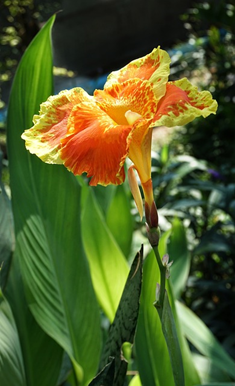
I used a bright orange Canna in a large pot this year on our deck.  It was quite striking against our pale gray house…..definitely worth saving for next year!

Canna closeup

I have been emptying pots over the last week or so and decided it was time to tackle the Canna.  It is best to do this after the first frost.  Up until the first frost, the plant is still growing and putting energy into the roots.  As mentioned, Cannas may grow quite large. Mine was about 60 cm (2 ft) tall. 

I thought that it would be a difficult task to remove the Canna and prepare it for winter storage. I was happily surprised to find it an easy task. Gently remove the Canna from the pot using a garden trowel to loosen it first. Grasp the stem and lift the entire plant, with root attached, out of the pot. The Canna has a fibrous rhizome which may then be divided into individual stems. Do not wash the rhizomes but do gently remove as much soil as possible. Allow the rhizomes to airdry for a few days. The Canna rhizomes may then be stored in peat or vermiculite in a cool dry space.  

You may also leave your Canna in its pot, cut back the foliage and store the pot in a cool, above freezing, spot over the winter.  I do not have a cool space where I can store potted plants so I chose to store just the rhizomes.

Seed pod

Next spring, after all danger of frost has past, repot or plant your Canna rhizomes. You will be thrilled to see that your beautiful Canna survived the winter and is soon ready to start blooming again for another season.

For more information on overwintering Cannas and other plants, please check out the links below.

Overwintering Plants: What is Overwintering

Overwintering Plants in Containers

Oh no! My Spring Bulbs are Flowering, and it’s Starting to Snow!

By Mary-Jane Pilgrim, Master Gardener

Spring bulbs are hardy plants that are adapted to survive even in cold and unpredictable weather conditions. While a late frost or spring snow may cause damage to the leaves and flowers of spring bulbs, it is unlikely to kill them altogether.

One of the main reasons why spring bulbs can survive a late frost or spring snow is their ability to go dormant during periods of extreme cold or drought. During dormancy, the bulbs store energy and nutrients in their underground structures, allowing them to survive until conditions improve.

Spring bulbs have a unique growth habit that enables them to emerge from the soil before the last frost date. They grow and develop quickly, taking advantage of the early spring sun and warmth to build up their energy reserves. By the time a late frost or spring snow arrives, most of the growth and development has already taken place, minimizing the impact of the cold on the plant. You may lose any blooms at the time of the adverse weather, but new blooms will likely wait until the weather changes again, and it will!

Snowdrops, hyacinths and some daffodils seem to be particularly resistant to cold, wet spring precipitation. Tulips and lilies are a little more prone to damage once they’ve formed buds or blooms. If a hard freeze or extended cold period is in the forecast, it may be wise to cover budding or flowering tulips and lilies to ensure that you get to enjoy their blooms this year. Make sure that you uncover them if daytime temps rise above freezing. If they’re not budding or blooming, no covering is necessary as the foliage is quite robust.

When planting spring bulbs in the fall, make sure that they are planted deep enough in the soil to avoid the worst effects of a late frost or spring snow. This means that even if the surface of the soil is frozen or covered in snow, the bulbs remain insulated and protected underground.

If frost damage does occur, don’t cut off the leaves as bulbs need even damaged foliage to feed the bulb for next year’s blooms!

In conclusion, while a late frost or spring snow may cause some damage to spring bulbs, they are unlikely to be killed off completely. These hardy plants have developed a range of adaptations to cope with the unpredictable and often harsh conditions of spring, allowing them to survive and thrive year after year.