By Pat Freistatter, Master Gardener
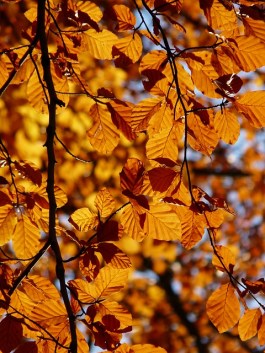 Have you ever wandered through a forest or a neighbourhood in the winter and hear rattling in the trees and looked up to see brown leaves still in a few of the trees? Why did those leaves stay on when all of the other trees lost their leaves? We know that, by definition, deciduous trees drop their leaves in the fall. Coniferous trees, such as pine (Pinus) and spruce (Picea), keep most of their needle-like leaves all year round with some needles dropping throughout the year. There are also trees that are coniferous trees with deciduous characteristics as they lose their leaves in the fall (e.g. larch and tamarack Larix). So how do we explain deciduous trees that retain their dead and brown leaves?
Marcescence
The term developed by scientists that is applied to trees that retain dead and drying leaves in the fall and winter is “marcescence”. A typical deciduous tree has an area at the base of each leaf (petiole) that contains thin walled cells that break easily and allow the leaf to drop. A marcescence leaf does not have this area.
Why do some deciduous trees experience marcescence?
Deciduous trees are thought to lose their leaves in the fall in an effort to reduce water loss and frost damage. So why do some deciduous trees retain their dead leaves?
The scientific evidence available to explain this phenomenon is limited. However there are several theories as to why the dead leaves are retained. The dead leaves may hide the leaf buds from being eaten by browsing animals such as deer and moose. Leaves left on trees also trap snow which results in more moisture being available at the base of the tree. The leaf buds on the tree may be protected from frost damage and drying by the leaves. Also when the leaves do finally drop in the spring, they will provide a source of nutrients that can give the tree a competitive advantage.
What trees are most likely to have marcescence leaves?
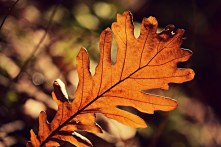 Marcescence is more often seen on young trees and may disappear as the tree matures. It may also be seen only on a few branches or on the lower branches of taller trees. If the retained leaves are on a conical-shaped tree with bleached, light tan leaves, it’s probably an American beech (Fagus grandiflora). There are also many species of oak (Quercus), witch hazel (Hamamelis), and hornbeam (Carpinus) that retain leaves in the winter.
What is really interesting is that beech and oak tree species are closely related. Also the beech family of trees includes many evergreen species that do not grow in our area (e.g. Tanoaks – Notholithocarpus densiflorus). It may be that the beech and oak trees are still evolving to becoming fully deciduous trees from their evergreen past. Humm… who said plants are not interesting. Enjoy the rattle in the trees in your area!
More information on this topic can be found at:
What is a TanOak Tree April 4, 2018
Why do Some Leaves Persist on Beech and Oak Trees? Nov 22, 2010
About Marcescence March 20, 2017
Leaves that Don’t Leave Feb 9 2016






 Hint: If you’re looking for ideas for something different check out this GardenMaking



 Three weeks later, the Black Lace Elder is looking very happy. It is October which explains the lack of new growth.