Category Archives: Links

The 12 Plants of Christmas – Part 1

by Emma Murphy, Master Gardener

The snow is on the ground and the cold winds in the air. Canadian gardeners are reflecting on their gardening season (why does it always go by so fast?) and thinking about next year’s garden (has your first seed catalogue arrived yet?).

So in the spirit of the Christmas season, this week’s blog is about the 12 plants of Christmas—some decorative, some food, and some traditions! In Part 1 we’ll look at Christmas plants and one food; you’ll have to wait until next week for more food and other plant traditions.

CHRISTMAS PLANTS
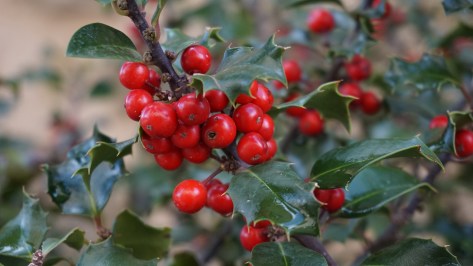
holly-tree-1030595_1920

1. Holly

Decorative green plants like holly, ivy, and mistletoe originate in pre-Christian times and were associated with celebrating the Winter Solstice by warding off evil spirits and celebrating new growth (well the latter only in warmer climate). Many countries (especially the UK and Germany) still decorate their homes with these plants today, often in Christmas arrangements or wreaths. The beautiful berries of the Christmas holly are produced by some of the approximately 400 species of holly (Ilex) that growing wild around the world. Typically, holly trees and shrubs are smooth-barked and have small flowers, fleshy red or black berries, and leathery, shiny leaves.

In pagan times, Holly was thought to be a male plant and Ivy a female plant. An old tradition from the Midlands of England says that whatever one was brought into the house first over winter, tells you whether the man or woman of the house would rule that year! But it was unlucky to bring either into a house before Christmas Eve. For the Christian faith, the prickly leaves symbolize the crown of thorns that Jesus wore when he was crucified. The berries are the drops of blood that were shed by Jesus because of the thorns.

If you are interested in five fascinating facts about holly, check out this link.

mistletoe

2. Mistletoe

Mistletoe has long been a symbol of love, peace and goodwill. The custom of using mistletoe to decorate houses at Christmas is also pre-Christian and the habit of kissing under the mistletoe continues today in many countries. Mistletoe is the common name for obligate hemi-parasitic plants in several families in the order Santalales. The plants in question grow attached to and within the branches of a tree or shrub. In the past, mistletoe was often considered a pest that kills trees and devalues natural habitats, but has recently been recognized as an ecological keystone species. Studies have shown that rather than being a pest, mistletoe can have a positive effect on biodiversity, providing high quality food and habitat for a broad range of animals in forests and woodlands worldwide.

For a whole host of information on mistletoe myth and legend, plus practical details of how to grow it in your own garden, Jonathan Briggs’ Mistletoe Pages.

cactus

3. Christmas Cactus

The Christmas cactus (Schlumbergera xbuckleyi) is popular for its colourful flowers that appear during the Christmas season. It is native to the coastal mountains of south-east Brazil where it is found growing on trees and rocks.

However, if you have picked up a “Christmas cactus” in the past month or so that is now blooming beautifully it probably is a Thanksgiving cactus (Schlumbergera truncate), which usually blooms about a month before Christmas cacti and has very cool flowers– I have heard them described as “leaping shrimps” or “lobster claws”. You can read more about the varieties, and how to tell them apart (hint it’s all in the leaf segments) here.

poinsettia

4. Poinsettia

Euphorbia pulcherrima is is a shrub native to Mexico where it is known as “Noche Buena”, meaning Christmas Eve. The Aztecs called it cuetlaxochitl (brilliant flower), and made a purple dye from its bracts and a fever medicine from its sap. The plant’s association with Christmas began in Mexico 400 years ago. According to legend a young girl who was too poor to provide a Christmas gift for the birth of Jesus was inspired by an angel to gather weeds from the roadside and place them at the church altar. Crimson “blossoms” appeared from the weeds and became beautiful poinsettias. The poinsettia plant was named after Joel Robert Poinsett, who was an American ambassador to Mexico around 1829. Poinsett was an amateur botanist and liked the plant so much that he sent several back to his home in South Carolina where he grew them in his greenhouse and introduced them in the US.

Poinsettias are popular Christmas decorations in North America and Europe, and the colours have expanded far beyond the traditional red to all shades of pink, salmon, apricot, yellow, cream, and white. While lovely at Christmas they are tough to keep as a houseplant given our dry indoor conditions. During the 1960s, plant breeders worked hard to make the poinsettia more colourful, compact and floriferous, which is what you see today. More information here.
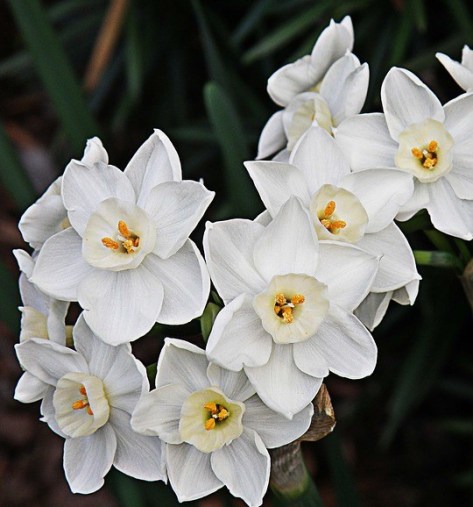
paperwhites

5. Paperwhites

Tazetta daffodil types – usually the paperwhite narcissus N. ‘Ziva’ – is specially prepared to flower in time for December 25. Cultivars of N. tazetta include ‘Paperwhite’, ‘Grand Soleil d’Or’ and ‘Ziva’, which are popularly used for forcing indoors.

If you want to try them out and have flowers all winter, here’s some information about how to do it. More here. (One word of warning: not everyone loves the perfume of paperwhites. One component of the paperwhites’ unmistakable scent is indole, and some people’s noses find this adds a fetid edge that’s really rather unpleasant. So you may want to sniff before you try.)

Paperwhites may grow tall and leggy, flopping over just as they begin to bloom. Tie a ribbon around the stems, about two thirds of the way up. According to a professor at Cornell University if you grow paperwhites in a 4 to 5% solution of alcohol it helps regulate the growth. Given that most liquors are 40% alcohol, this would be 1 part alcohol to 9 parts water. Don’t use beer or wine (just hard liquor – gin/vodka/whiskey/rum/tequila).
121-2135_IMG

6. Amaryllis

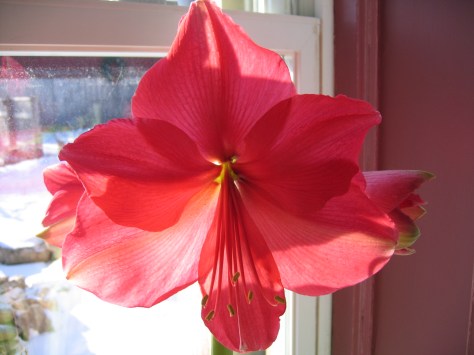
Everyone I know loves the amaryllis, and we closely associate them with the festive season. While the popular name is “amaryllis”, hippeastrum is generally accepted as being the correct name. It usually blooms around Christmas or into January or February in the Northern Hemisphere, then produces long green leaves that allow it to store energy for the following year.

Native to Peru and South Africa, amaryllis comes from the Greek word amarysso, which means “to sparkle.” Bulbs were brought to Europe in the 1700s and have been known to bloom for up to 75 years. Amaryllis flowers range from 4 to 10 inches in size, and can be either single or double in form. While the most popular colours are red and white, flowers may also be pink, salmon, apricot, rose or deep burgundy. Some varieties are bicolour such as purple and green, or picotee (having petals with a different edge colour). Lots of information here.

You can buy bulbs on their own or potted up. Select the largest bulbs available as they will produce more stalks and blooms the first year. Bulbs should be firm and dry with no signs of mold, decay or injury. It is common to see new growth (leaves, buds) emerging from bare or planted bulbs. Want to get your amaryllis to rebloom? Here’s some great advice.

CHRISTMAS FOOD

7. Cranberry

The cranberry (Vaccinium spp.) has been a festive favourite for hundreds of years, ever since Native Americans mashed up the fruit and mixed it with dried deer meat and fat to make pemmican (a concentrated mixture of fat and protein used as a nutritious food). In 1816, Dutch and German settlers in the New World planted the first ever “crane berry” crop (so-called for their blossom’s resemblance to the head and bill of a crane) on Cape Cod, using the fruit as a natural dye for rugs, blankets and clothing.

It was probably inevitable that the cranberry became linked with Christmas. With their bright red colour, they reflect the season perfectly. As early as the 1840s, people were stringing them with popcorn to make festive garlands for the Christmas tree. At the same time, with their winter availability and the fact they were slow to spoil, cranberries represented one of the few fruits that could be served fresh during the holidays. To settlers’ delight, it was discovered very early that the tartness of cranberry sauce helps cut the far and richness of such traditional holiday fare as pork, goose, duck and turkey, making it a perfect complement to festive dishes. Check out lots of lovely ways to use cranberries here.

Hope you enjoyed part 1 of the 12 Plants of Christmas.
Stay tuned until next Monday for our second segment.

What’s that Rattling in the Trees?

By Pat Freistatter, Master Gardener

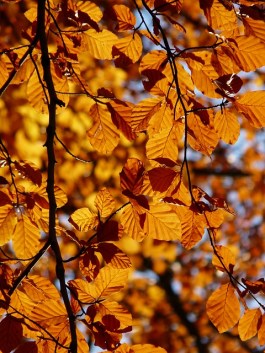
beech-10835_640Have you ever wandered through a forest or a neighbourhood in the winter and hear rattling in the trees and looked up to see brown leaves still in a few of the trees? Why did those leaves stay on when all of the other trees lost their leaves? We know that, by definition, deciduous trees drop their leaves in the fall. Coniferous trees, such as pine (Pinus) and spruce (Picea), keep most of their needle-like leaves all year round with some needles dropping throughout the year. There are also trees that are coniferous trees with deciduous characteristics as they lose their leaves in the fall (e.g. larch and tamarack Larix). So how do we explain deciduous trees that retain their dead and brown leaves?

Marcescence

The term developed by scientists that is applied to trees that retain dead and drying leaves in the fall and winter is “marcescence”. A typical deciduous tree has an area at the base of each leaf (petiole) that contains thin walled cells that break easily and allow the leaf to drop. A marcescence leaf does not have this area.

Why do some deciduous trees experience marcescence?

Deciduous trees are thought to lose their leaves in the fall in an effort to reduce water loss and frost damage. So why do some deciduous trees retain their dead leaves?

The scientific evidence available to explain this phenomenon is limited. However there are several theories as to why the dead leaves are retained. The dead leaves may hide the leaf buds from being eaten by browsing animals such as deer and moose. Leaves left on trees also trap snow which results in more moisture being available at the base of the tree. The leaf buds on the tree may be protected from frost damage and drying by the leaves. Also when the leaves do finally drop in the spring, they will provide a source of nutrients that can give the tree a competitive advantage.

What trees are most likely to have marcescence leaves?

acorn-leaf-3704584_640Marcescence is more often seen on young trees and may disappear as the tree matures. It may also be seen only on a few branches or on the lower branches of taller trees. If the retained leaves are on a conical-shaped tree with bleached, light tan leaves, it’s probably an American beech (Fagus grandiflora). There are also many species of oak (Quercus), witch hazel (Hamamelis), and hornbeam (Carpinus) that retain leaves in the winter.

What is really interesting is that beech and oak tree species are closely related. Also the beech family of trees includes many evergreen species that do not grow in our area (e.g. Tanoaks – Notholithocarpus densiflorus). It may be that the beech and oak trees are still evolving to becoming fully deciduous trees from their evergreen past. Humm… who said plants are not interesting. Enjoy the rattle in the trees in your area!

More information on this topic can be found at:
What is a TanOak Tree April 4, 2018
Why do Some Leaves Persist on Beech and Oak Trees? Nov 22, 2010
About Marcescence March 20, 2017
Leaves that Don’t Leave Feb 9 2016

Something’s eating my bulbs!

By Judy Bernard, Master Gardener

In an earlier post, I talked about digging up spring bulbs for planting them in the fall and about planting them. I didn’t talk about the little critters that dig them up. In addition to the usual tulip bulbs which disappear, I’ve had asiatic lily,  gladiola, and even garlic bulbs dug up. Most of them were eaten (except for the garlic). They don’t seem to dig up established bulbs, so what can we do to keep new bulbs where we want them to grow and bloom?

There are several strategies that fall into 2 categories–repellants and barriers.

Repellants

  • Blood meal – this also nourishes the soil naturally, so it’s a preferred one.
  • Urine – human male urine will deter most animals. Cat urine can be used in the form of cat litter.
  • Hot pepper sprinkled on the ground, although lately this treatment has been considered inhumane due to the pain that it causes the critter doing the digging.

Repellants will need to be reapplied when washed away with rain or after watering.

flower-bulbs-494399_640

Barriers

Chicken wire cages will be the most effective prevention. Just put a layer of chicken wire in the bottom of the hole, place the bulbs on top, put another layer of chicken wire on top of the bulbs and nothing will be able to get at the bulbs.

Another thing you can use is green plastic strawberry baskets for 2 or 3 bulbs.

The articles below will give more information about what you can do. Let us know how you make out!

https://www.gardeningknowhow.com/ornamental/bulbs/bgen/protect-flower-bulbs.htm

https://www.adrbulbs.com/page/Squirrels-Deer-Pests


Growing Clematis

By Sharleen Pratt, Master Gardener

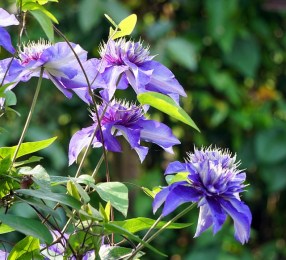
clematis-350358_640Clematis is a genus of about 300 species within the buttercup family, Ranunculaceae. They are a very popular perennial climber and produce many beautiful flowers in the summer months.
When purchasing a clematis, remove the plant from the pot and check for a tiny white bud on the very bottom roots. This will ensure a healthy plant. For best results, purchase a clematis that is at least two years old as they are tender when very young and take several years to mature.

Clematis absolutely demand good drainage. Either add sand to the soil, or line the bottom of the hole with a layer of gravel. When planting, it’s important to bury the crown of the plant at least two inches (6 cm) below the surface of the ground to encourage more stems to grow from the base. Water deeply at least once a week until the plant is well established.

To encourage good flowering, sprinkle superphosphate fertilizer onto the surface of the soil at planting time to promote good root growth and winter hardiness. For mature plants, add fertilizer once in the spring and again in June.flower-3394263_640

Clematis need at least six hours of sun per day, but their roots like to be kept cool. One suggestion would be to plant a large hosta at the base of the Clematis. Their roots are shallow so they won’t compete for nutrients. You could also use large rocks or flagstones.
If the stems of very young plants seem thin, pinch them back to just above a set of buds. This will help the stem to thicken, making them tougher and more resistant to damage.
You need to understand the kind of clematis you have before attempting to prune. Some clematis grow on last year’s vines, so you want to avoid cutting them to the ground in spring. Others flower on current-year vines, so they don’t mind being cut to the ground each year.

A very tough clematis is the Clematis x jackmanii, which is an old reliable climber, easily growing to three metres with large, deep purple flowers. It is the oldest large flowered cultivar, bred in 1858. Another easy to grow clematis is Clematis ‘Abundance’, which has a deep red flower with greenish-yellow stamens, which flowers in mid June.

You might consider checking The International Clematis Society website. It is full of valuable information for people new to growing clematis, with several links to catalogues, nurseries and education publications.

Preparing your garden beds for planting vegetables and annuals

By Judy Bernard, Master Gardener

It’s spring. You’ve got a lot of the clean-up well underway. You’re starting to look at your annual and vegetable beds to get them ready for bedding plants and seeds.

bannerpick

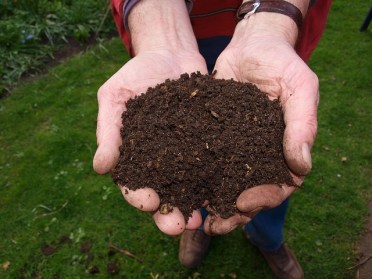
If you work the soil too early, it could be too wet and end up compacted. To test if it is time to prepare the soil, pick up a hand full and squeeze it into a ball. Then drop the ball from a height of about a meter or break it up with your fingers. If it shatters readily then it is ready to be worked. If it stays in clumps, then it is too wet and you need to wait a bit.

Can’t wait? Use a large flat board or two to step on. Move them around as you work. The board will distribute your weight and not compact the soil as much.

Remove any weeds that have sprouted over the winter.

If the soil is nice and light and easy to dig into, then all you need to do is add a good layer of compost and let the worms in the soil do the mixing for you. A healthy soil is moist, dark and crumbly with lots of organic matter. Compost is is full of all of the the nutrients the plants need which are released as the plants need them.fresh-2386786_640

Mulch the soil with some straw for the vegetable beds or shredded bark for the flower beds. This will discourage weeds and conserve moisture in the soil until it is time to plant. All you will need to do is to pull the mulch back, plant your plants, and put the mulch back in place.

For more information about soil check out this site:
https://www.planetnatural.com/garden-soil/

Happy Gardening!

Seeds: All of the Dirt

By Judy Bernard, Master Gardener

Spring is almost here!

rucola-salad-plant-leaf
Home gardening by Kaboompics, 2015, used under CC0 1.0.

The seed catalogues have arrived and been perused. Seed varieties have been chosen and ordered. Or not. It’s not too late. It’s almost never too late to buy and plant seeds as different things can be planted almost throughout the growing season.

In addition to Canadian gardening catalogues, you can buy seeds at hardware stores and garden centres. If you are looking for something different, Seedy Saturday or Seedy Sunday is a good option. In Peterborough, it is held on the second Sunday in March at the Emmanuel United (formerly George Street United) Church basement. Many local growers grow their own seeds including many heritage varieties and share/sell the extras they don’t need. There is also the Peterborough Garden Show in April where you can buy seeds not generally available elsewhere.

Let’s get started:

You can buy soil specially prepared for starting seeds. It had the best texture for small seeds to be able to put down roots. The soil should be damp like a wrung-out sponge. Using clean containers, fill them with the potting soil. Read the package carefully for the needs of the seeds. Label your seeds carefully so you will know what you are growing.

Spread the seeds on top of the soil, and then add a dusting of the soil mixture using a sieve to the recommended depth on the package for small seeds. Larger seeds can be pushed gently into the soil. Gently pat the soil, so the seeds are in good contact with the soil. Spray the top of the soil with water. Place a plastic cover lightly over the seeds, allowing for some air circulation.

Some seeds need light to germinate, others don’t. Again, follow the directions. Seeds germinate best with a little heat. The top of the refrigerator is a good place to put them. Once the seeds have their second pair of leaves they can be transplanted into bigger containers. The nice thing about starting seeds indoors is that it can extend the growing season for you and give you many vegetables (or flowers) earlier than you would otherwise have if you just planted them directly. Other plants like tomatoes and peppers need to be started early as they have a longer growing season for them to mature before frost takes them.

Here are some interesting websites which including Starting and Planting calendars:
http://littlecityfarm.blogspot.ca/2011/01/annual-seed-starting-planting-calendar.html

http://espacepourlavie.ca/en/seeding-and-planting-calendar-vegetables

https://www.almanac.com/content/starting-seeds-indoors

Got the Winter Road Salt Blues? Some Advice on What to Plant

by Emma Murphy, Master Gardener (Twitter @Hey_MzEmma)

It’s an unfortunate reality. We live in Canada and we get snow, lots of snow. And then there’s the ice. So our industrious public works folks are out there putting down road salt (sodium chloride) and sand to keep us moving. We also apply salt or sand on paths and walkways on our property. Unfortunately it seeps into the soil and kills plant roots. Road salt mixed with melted snow creates a mist that blows on to our properties, especially when cars splash through melted snow. Having lost a few very nice plants to a combination of huge snowbanks and road salt, I was curious about what plants can survive (and maybe flourish) in a front garden that inevitably gets doused in road salt.

What Does Road Salt Do?

The negative effects of road salt on humans and the natural environment have been well documented. The Smithsonian magazine has two great articles on the subject.
The Hidden Dangers of Road Salt  What Happens to All the Salt We Dump on the Roads? 

Road salt doesn’t just dissolve into thin air. It splits into sodium and chloride ions and gets absorbed into roadside plants, licked up by wildlife or accumulates in aquatic ecosystems—sometimes with devastating consequences. All that saltiness can help invasive or even toxic species spread, not to mention increase traffic danger due to deer and moose drawn to salt-covered roads. (From a gardening perspective, if you want to deep dive into the nasty things that happen to soil structure from salts, this article by the Soil Science Society of America provides some great insight.)

salting truck

What Perennials Can Handle Road Salt?

Our Savvy Gardening friend Tara Nolan (@ThatTaraNolan) (who you may remember as a speaker from our 2017 Peterborough Garden Show) recently posted a great blog post on how we can combat the road salt challenge in our gardens.

Salt-tolerant Plants that will Survive in Road Salt-laced Soil

So what are some of Tara’s favourites salt-resistant plants?

Autumn Joy Stonecrop (Sedum spectabile ‘Autumn Joy’)
Butterfly weed (Asclepias tuberosa)
Blanket Flower (Gaillardia)
Russian sage (Perovskia atriplicifolia)
Columbine (Aquilegia)
‘Karl Foerster’ reed grass (Calmagrostis acutifolia ‘Karl Foerster’)
Silver mound Artemisia (Artemisia schmidtiana Silver Mound)

IMG_4946
Gaillardia
100-0046_IMG
Autumn Joy Stonecrop

Some other ones I found doing an Internet search:

Rugosa roses (Rosa rugosa)
Lilacs (Syringa vulgaris)
Summersweet (Clethra alnifolia)
Lady’s Mantle (Alchemilla mollis)
Daylilies (Hemerocallis)
Catmint (Nepeta)

So, if your garden is looking less than wonderful due to winter salt damage, try some of these options!

IMG_0841
Daylilies

After Bloom Care Of Spring Bulbs

by Deb Gordon

Nothing signals the rebirth of a garden more to a gardener than the first splash of colour from spring bulbs. The fresh green colour of their leaves and their colourful palette of blooms are a welcomed sign of the departure of winter and the awakening of life in the garden with all the hope and expectations that they may bring. Be it tulips, daffodils, hyacinths, grape hyacinths or alliums these early bloomers all have one thing in common. They are all true bulbs and being so means their continued lives depend on letting them become dormant through the cold winter, allowing them to bloom in the spring and die back naturally in order to complete their life cycle. This ensures the bulb’s good health so it has the ability to endure freezing temperatures throughout the winter, produce optimum blooms for the gardener to enjoy the following spring and continue to do so for years to come.

The only drawback for growing these bulbs is waiting for the leaves to die back. Unfortunately it takes weeks for their leaves to wither and die. Especially with larger leaved bulbs like tulips and daffodils, the appearance of their dying foliage, long after the blooms drop or fade, can detract from the beauty of an early summer garden. Premature removal of the foliage is tempting in order to keep the garden neat and tidy however there are consequences to doing so. Take tulips for example. They grow and bloom using the food that they have stored in their bulbs from the previous year. Once this food is spent, the bloom drops and the foliage starts to die. During this post-bloom phase, the leaves, through photosynthesis, produce the food that is stored in the bulb to enable it to survive the winter and grow and bloom in the spring. Photosynthesis is a process where the energy in sunlight is harnessed and used to convert carbon, oxygen and water into sugars. Because leaves of all plants are the primary location for photosynthesis to occur, cutting off the leaves prematurely deprives the plant of the ability to restore the energy in the bulb for its future healthy growth and its production of those beautiful blooms.
So what are some of the options for a gardener to choose in order to keep a  more pristine-looking garden?
When blooms start to fade and petals drop, tidying up the garden at this time is easily accomplished by cutting off the stems of the flower. This will still allow the leaves to continue to absorb the sun’s rays. The time is right to remove the leaves once they have withered, turned brown and can be tugged gently away from the bulb. Wait another week or two if they are not separating from the bulb easily.
The following suggestions may help to avoid the distraction of the dying foliage.
  • Dig up the bulbs and replant new ones in the fall. This can be costly in time and money. This is done routinely in publicly sponsored gardens.
  • Transplant the tulips post-bloom to another bed to live out the foliages’ dying days then replant the bulbs in the fall. This requires an extra bed just for this purpose.
  • Choose a variety that have narrower leaves which might be less distracting.
  • Conceal the withering leaves.
Strategic planting of the right combination of perennials around your bulbs may be the answer to successfully camouflaging the unsightly foliage while still allowing them to complete the restoration of energy in the bulb undisturbed for next year’s growth. Annuals and summer blooming bulbs are also other options. When choosing perennials to use, consider the rate at which the plant matures. You want the bulb to be centre stage while it’s in full bloom, the perennial just starting to appear above ground and then mature as the tulip leaves start to yellow and wither.
Although the rate of maturity is important, also consider foliage type, colour, and bloom times when choosing these perennial plants.
Hostas, tall drooping grasses, and taller ground covers are examples of perennials that are idea lfor concealing a tulip’s dying foliage. Remember that placement is key. If you are planting bulbs in the fall around hostas, make sure you plant the bulb just inside the dripline of the hosta just under the leaves. Bulbs go in front of the drooping grasses.
There are combinations of perennials listed at Cornell University’s website.
Researchers at Cornell University actually tested and listed plant combinations to see which were successful at looking good and growing well together. They have great photos of these plants and bulbs at different stages of their growth.
Just remember to check the hardiness zone and growing conditions of some of the suggested plants (if choosing) to ensure they will grow in your zone and growing conditions. The research took place in Ithaca, New York with a USA hardiness zone of 5.
If you’ve been discouraged from growing or adding more spring blooming bulbs to your garden due to the lingering foliage that never seems to go away, these suggestions will hopefully encourage you to do so. The early visual impact is rewarding and will trigger feelings of hope and excitement of the wonderful things to come.

PlantWatch

by Cauleen Viscoff

(previously published in the Peterborough Examiner)

Now that the weather is softening, and we are convinced that spring really is around the corner, there are reasons to herald its arrival other than with Easter eggs, birdsongs and flowers to pick.

There is a little-known group of folks around the world who are quietly making a difference. They are monitoring birds, insects, frogs and plants. Recording the blossom times of some plants are good indicators of climate change. We all know that our climate is making some subtle as well as some not-so-subtle changes – some better and some not so much. So what does watching plants have to do with climate change?

Plant-watching has a long tradition and a rich history throughout the world. In 1750, the Swedish scientist and artist Linnaeus, turned plant-watching into a systematic science. He made calendars of flowering times for 18 places in Sweden, noting the exact climatic conditions at the time of blooming.

This became the foundation of modern plant phenology (the science dealing with the influence of climate on the recurrence of such annual phenomena of animal and plant life as budding and bird migrations- Dictionary.com). Phenology then spread to many European countries and revealed, over the centuries, that some spring wildflowers are super-sensitive weather instruments.

More than 100 years ago in Canada, Nova Scotia’s superintendent of education, Dr. Alexander H. MacKay, had students collect plant, animal, agricultural and weather phenology from 1897 to 1923. And then, in 1987, the Alberta Wildflower Survey started up and blossomed (pun intended) into a program that initiated the Alberta PlantWatch. This program then spread back to Nova Scotia, Newfoundland and now today, PlantWatch is part of our national Nature Watch series of volunteer monitoring programs designed to help identify ecological changes that may be affecting our environment.

There are PlantWatch programs in each province and territory.

PlantWatch enables “citizen scientists” (volunteers gathering research for scientists) to get involved by recording the flowering times for certain selected plant species and reporting these dates to researchers on the PlantWatch website. When the data is submitted electronically, it is instantly added to web maps showing bloom dates all across Canada … So those observations make a difference right away!

The collection of that much data across the vast expanse of our country would be impossible for the small existing group of scientists presently working in this field.

As Canadians, we are fortunate to live in a country with such a wide variety of plant species. By participating in PlantWatch, we can learn about our country’s great botanical diversity and at the same time, help scientists track the effects of global warming and climate change in Canada.

The plants chosen for this program bloom every spring, largely in response to rising temperatures. However, some species are flowering almost a month earlier than they were a century ago!. Some of these plants you are familiar with and grow in your own yards and gardens. Poplar, Common Purple Lilac, Dandelion (bet you have lots of those..), Red Maple and Trillium are just a few.

Scientists believe that climate change is affecting bloom times – a trend that is continuing. They predict that the greatest increases in temperature will be in Western and Northern Canada, while some parts of Eastern Canada may actually be cooling (although last summer was hotter than ever).

By reporting on the PlantWatch species found in our local communities, we can help researchers discover how common plants are responding to climate change, and track where those changes are taking place in Canada and at what rate.

And now, for the first time in Canada, the PlantWatch program has partnered with the Master Gardeners of Ontario. We are excited about our potential contributions to science because we believe that observing local plants can be fun, but more importantly, the data we collect can serve a greater purpose by assisting scientists, land managers and those responsible for our natural resources to help in the environmental decisions they will need to make both now and in the future.

We urge you to join us in making a difference. You don’t have to be a professional, or even a gardener.

Take a look at the website; the plants are described in detail with glorious photos. Gather up your your children, grandchildren, friends and neighbours – sign up, get outside and watch spring happen – make your observations and”¦.make a difference.

Peterborough gardener Cauleen Viscoff, PlantWatch co-ordinator, Master Gardeners of Ontario Inc., can be reached at plantwatchontario@gmail.com. For more information, visit www.naturewatch.ca