By Marjorie Vendrig, Master Gardener in Training
We visited Singapore in 2025, using it as our first stopover on a tour of SE Asia. Singapore was described as the ‘Switzerland of Asia’, an easy spot to get over jet lag, acclimatize, and ease into the pace. I’d seen pictures, heard of The Gardens by the Bay, but to me it looked like a huge soulless city that had shopping and commerce at the top of the list. My expectations weren’t very high; I hoped to be sleeping for a few days, perhaps getting a taste of some interesting food, at best tracking down a Singapore Sling.
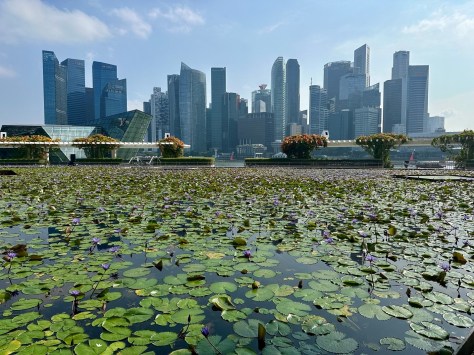
I was wrong: Singapore is a gardener’s paradise, there is greenery and nature everywhere, all of it connected; it’s landscaped yet natural, with green roofs, vertical gardening, containers and planters, small and large areas of grass, tree lined boulevards, paths and parks – wherever the eye falls there is greenery and nature. The airport itself is filled with plant material; the drive from the airport into the city centre is lined with magnificent trees and flowers, flower baskets hang from the sides of bridges and it never stops. Freshly cut flowers, uniquely designed floral arrangements and containers adorn hotels and restaurants. It’s a marvel to walk anywhere, even through the business district where every angle has incorporated greenery and plant life. It’s awesome, in the true sense of the word, all the more remarkable because it’s a huge, busy city with massive skyscrapers, complex road systems, and modern amenities.
None of this happened by chance. In the 1960’s, the first PM of Singapore undertook an ambitious plan to develop Singapore into a Garden City. Fast forward several decades, the dream has become a reality, Singapore is known as a City in a Garden and a City in Nature.
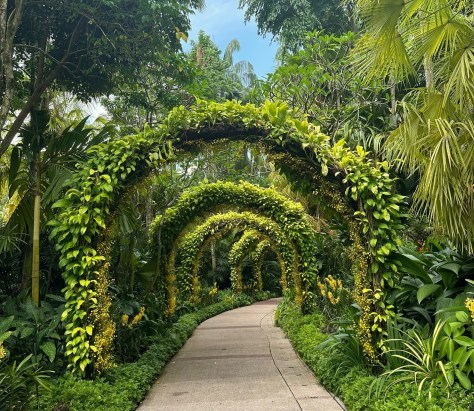
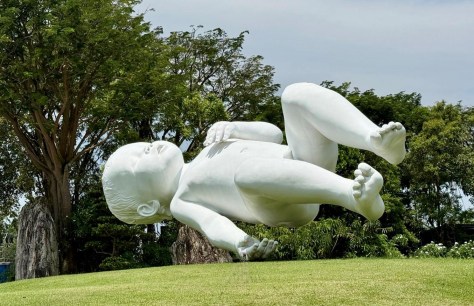
We spent two full days in the Singapore Botanic Garden and could have spent a week there. It’s a UNESCO World Heritage Site, free, a blend of history, research, education, relaxation, calmness and pure pleasure for the eyes and senses. As a botanic garden, there’s informative signage, interesting heritage trees, a beautiful pond, sculptures, museum and gallery, all presented with little to no commercial promotion or sponsorship. The National Orchid Garden (with a small admission fee) presents orchids (there’s an important orchid breeding program), bromeliads, gingers, rhododendrons, magnolias, and much more, all planted to simulate the ascent through a tropical montane forest. The original glass house has been upgraded with complex modern cooling and misting engineering to maintain a 1,000 metre altitude tropical montane environment at 24 – 26C.
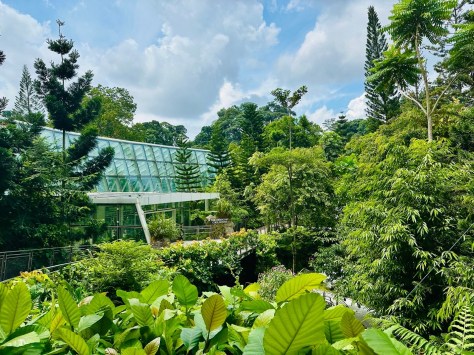
Gardens By the Bay is a tourist icon in Singapore. Certainly more commercial than the Botanic Gardens, it’s important to note that gardens and nature are at the core of the attraction. And the concept behind the Gardens is sustainability: in the glass house, a special coating on the glass minimizes solar heat gain while providing optimal light for plants, the roof has a sensor-operated retractable sail to provide shade, and a displacement cooling system maintains cool air at lower levels and vents warm air out a high levels. Outside, the lakes act as filtration systems, the supertrees harvest solar energy or act as air exhaust.
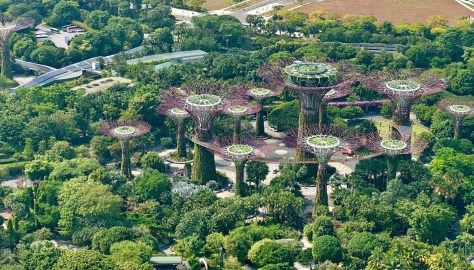
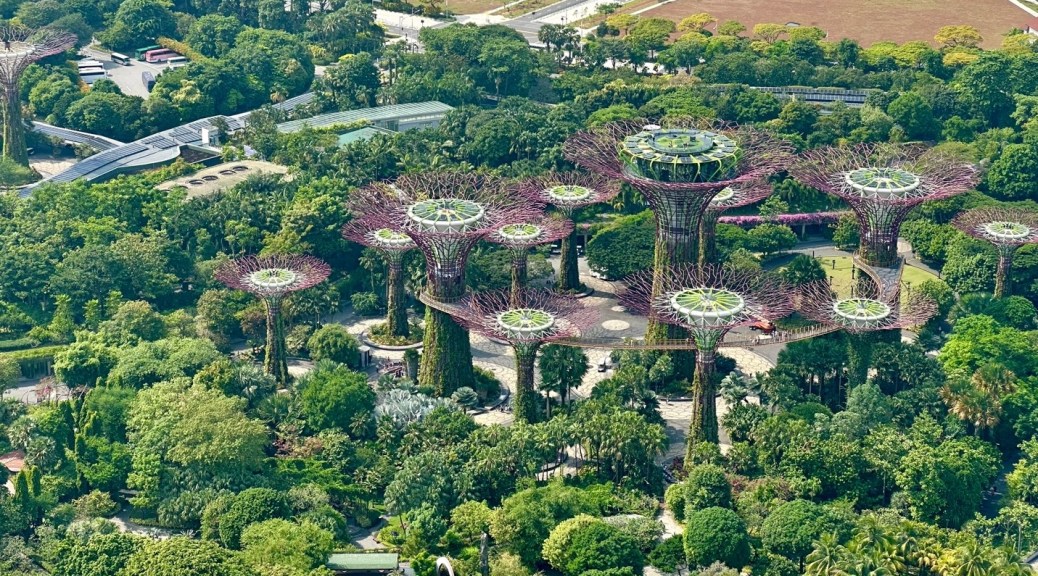
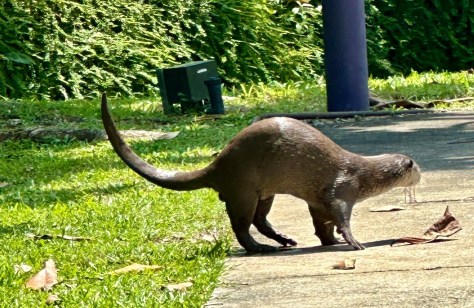
The Supertree Grove is a vertical garden with nighttime light and sound shows, the Flower Dome is the largest glass greenhouse in the world, and nestled quietly between is Kingfisher Grove, freshwater wetlands developed to allow ecosystems to recover and wildlife to reconnect despite the development. It’s filled with mangroves to act as carbon sinks and surprisingly, otters, which are everywhere.
Additional References:
Singapore Botanic Gardens: https://www.nparks.gov.sg/SBG
Gardens By the Bay: https://www.bbc.com/storyworks/travel/garden-of-wonders/gardens-by-the-bay
Singapore, Biodiversity: https://www.cbd.int/doc/meetings/city/subws-2014-01/other/subws-2014-01-presentation-singapore-en.pdf








 The Peterborough & Area Master Gardeners