
by Laura Gardner, Master Gardener
To Squish or Not to Squish?
For over 13 years, I have had a Hydrangea arborescens ‘Annabelle’ (Smooth Hydrangea) in my garden. A few years ago, contractors put in a fence, and I thought it was a goner — trampled into the ground. It was their version of rejuvenation pruning.
Well, I learned they are hard to kill. Every summer there is a profusion of blooms. Every spring, some of the leaves are curled and fused together—a temporary home for Olethreutes ferriferana (Hydrangea Leaftier Moth) caterpillar—a native insect. Anecdotally, it seems to favour Hydrangea arborescens over others, although the food plant database for Tortricid (Leafroller) moths indicates simply Hydrangea spp.
Most sites I have seen online advise you to squish the caterpillars because they can cause a reduction in blooms. They feed on the leaves and the flower buds. While my Hydrangea has likely seen a reduction, I have not noticed. It does not affect the overall health of the plant. Another consideration is that often within these rolled-up leaves, spiders make their home. It is thought that they take up residence before the moth leaves but do not predate the caterpillar.[i] Year after year, I just let this moth complete its lifecycle.
In Integrated Pest Management (IPM) there is something called a threshold of action. Is the damage enough to warrant taking any action to control the pest? Is it possible that other beneficial organisms may be harmed in the process? If there are only a few blooms that could be affected, consider not doing anything.


Is it Real or an Imposter?
Last year I planted what I thought was Agastache foeniculum (Anise Hyssop). It was a huge Bombus (Bumblebee) magnet and flowered virtually up until frost. It did not come back this spring — apparently it is considered a short-lived perennial, but in the end, I concluded that its demise was mainly due to a sustained dog pee assault. I am the crazy gardener that runs after my dogs with a watering can. I digress.
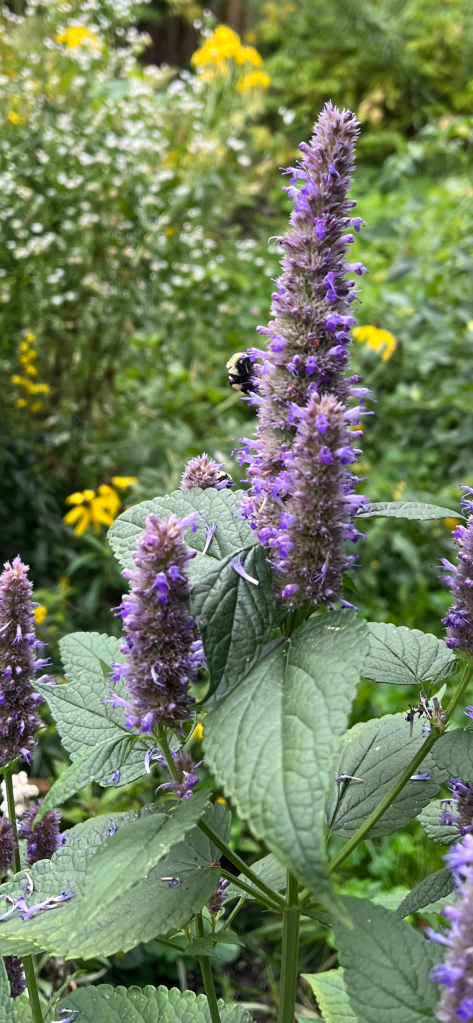
Like many in the mint family, there were many seedlings that popped up in its place. Fast forward to this week, and I noticed a discussion online about how some nurseries are inadvertently selling Agastache rugosa (Korean Mint) instead of A. foeniculum.
After careful inspection, I am now certain that I am one of many who got the non-native species. “Both these species are aromatic and have flowers of similar colors, but Korean mint has rugose, dark green leaves with cordate bases, whereas Anise Hyssop has shiny, bright green leaves with feltlike undersides and cunate bases.”[ii] The undersides of the leaves of A. rugosa also have little indentations (areoles) that A. foeniculum lacks.[iii]
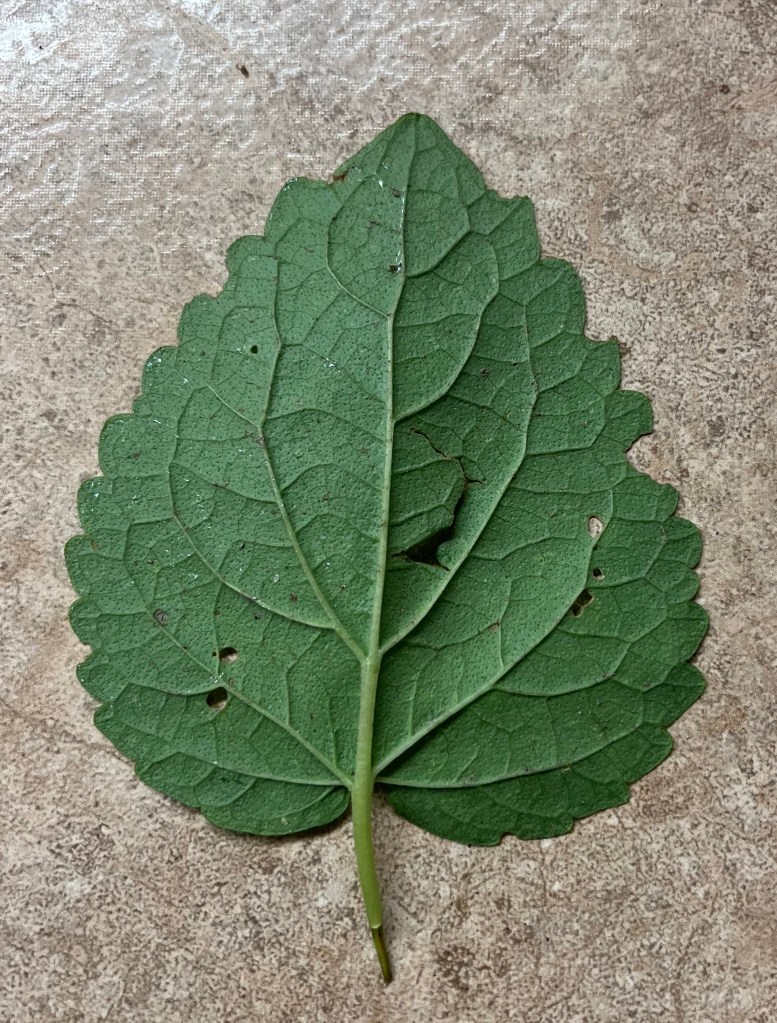
The question is, should I keep it in my garden? A field study of Agastache spp. in Iowa over a three-year period found that more Apis mellifera (European Honey Bee) visited the Korean Mint and hybrids than Anise Hyssop.[iv]
Judging from the number of Bumblebees on the few plants that sprung up this year, it would seem like a keeper. If I were to find and plant Anise Hyssop, there would be a high probability that it would cross-pollinate with the Korean Mint, creating hybrid plants. According to the literature, these hybrids are sterile[v] and so there would not be a problem of the hybrids re-seeding. Korean Mint is also morphologically like Anise Hyssop.[vi] This means that there is a greater chance that pollinators can benefit from the non-native species. I am waffling.
[i] Boggs, Joe. Hydrangea Leaftier. Buckeye Yard and Garden Online. May 22, 2022. Ohio State University. Online: https://bygl.osu.edu/node/1979 Accessed August 24, 2023
[ii] Widrlechner, Mark P. A Field Evaluation of Native Mint Family Plants as Honey Bee Forage in Iowa. Proceedings of the Twelfth North American Prairie Conference 1990. p. 40. Online: https://dr.lib.iastate.edu/handle/20.500.12876/55985 Accessed: August 24, 2023.
[iii] Serres, Terry. Buyer Beware. Agastache foeniculum vs. Agastache rugosa. September 2018.
https://bigriverbigwoods.org/wp-content/uploads/2019/03/ThreeProblemSpecies_v3.pdf Accessed: August 24, 2023.
[iv] Ibid., p.40.
[v] Vogelmann, James E. “Crossing Relationships among North American and Eastern Asian Populations of Agastache Sect. Agastache (Labiatae).” Systematic Botany 10, no. 4 (1985): p. 451. Online: https://doi.org/10.2307/2419137 Accessed: August 24, 2023.
[vi] Ibid., p. 451.
 The Peterborough & Area Master Gardeners