Category Archives: Active Meditation

Finding Natural Connections in a World That is Busier than Ever!

By Thom Luloff, Master Gardener in Training

Our schedules are brimming, and life is back to “normal” after those challenging years of a global pandemic.  We may be busier than ever, but are things truly back to normal? 

Crises–locally and internationally–politically, socially and economically are unfolding everywhere, and our social bonds and community engagement appear more distant than ever.  

Or does it just seem that way? 

If we take a step back just a couple of years, we had a very different perspective that is worth remembering and taking forward as those memories start to fade.  

Amidst the confusion, anxiety, and fear of the onset of the Coronavirus pandemic, we all took a deep pause.  Without distractions, we were able to focus on the important.  Synchronously with the first lockdown announcement, public health agencies began promoting safe activities.  Without much surprise, almost all of them involved the outdoors and being immersed in nature.  Walking, hiking, biking, roller blading; these merchandise items flew off shelves just as fast as skis, snowmobiles, and fat bikes did.  Not to mention everybody was baking bread and planting seeds in soil, many for the first time in their lives!

We found connections by connecting with and within nature.

As the lockdown progressed, we celebrated stories showing how the retreat of human impact allowed nature the room to thrive.  Whether it be clearer skies, fewer cars on the roads, or less garbage in nature areas, we could see the human impact.  

Yet within almost moments of relaxation of restrictions, our old ways returned.  Our newfound appreciation gave way to the rush for normalcy.

Can we do better than normalcy? 

We think of our human normalcy as being set apart from nature.  In control.  We live in houses, drive cars, and eat food which is specially grown to feed us; and nature exists “somewhere” else. Somewhere where you can go on your terms.  But there are examples from nature that do provide us valuable insight and one of the is in the form of a fungus, Armillaria solidipes (honey fungus).

Armillaria solidipes

Like humans, this honey fungus has enormous potential to affect its local environment.  One of these organisms lives in Oregon’s Malheur National Forest and covers 3.7 square miles (2,400 acres) and is roughly 8,000 years old and weighs over 34,000 tons, making it both the single largest and heaviest terrestrial organism on the planet.

But interesting, this remarkable fungus is not a product of individual success.  It is a product of connections, where individuals connecting together strengthen and enlarge the whole.

Honey fungi grow in individual networks using fibers called mycelia. Mycelia work in a similar fashion to plant roots whereby they take water and nutrients from the soil. At the same time, they make chemicals that are shared with other soil organisms.  When mycelia from different individual honey fungus bodies meet, they can attempt to fuse to each other. When the mycelia successfully fuse to each other, they link their very large fungal bodies together. This, in turn, has created the largest terrestrial organism on the planet.

All. Accomplished. By. Connections. 

This giant organism plays an essential role soil development and maintenance, with mycelium working to prevent soil erosion.   It also happens to be a parasite, killing and consuming conifer trees, and has wrecked havoc on Fir stands throughout the area.

I can’t help but compare this fungus–built by connections–to us, as humans. We are more connected than ever before and our potential to impact our environment (positively or negatively) has never been greater.

We must choose to grow positive connections with positive impacts. 

And you (yes you!) are likely doing exactly that and reaping the rewards of those natural connections that you have carefully nourished.  As gardeners tend to their plants, we develop a deep appreciation for the environment, understanding the intricate relationships between soil, water, sunlight, and living organisms. This hands-on interaction promotes mindfulness and a sense of responsibility toward ecological health.

The act of nurturing plants from seeds to full bloom cultivates patience and respect for the time it takes for nature to flourish and reinforces the idea that the best things are worth waiting for and done for others.  What an incredible feeling of joy it is when we see pollinators thriving on the plants we planted, along with the birds and biodiversity that they in turn support.   

As we grow these connections, we show our neighbours, friends, and visitors a living example of this positivity; making it so much easier to follow themselves.

Our stewardship mentality that encourages a harmonious coexistence with the natural world needs water and sunlight and effort, just like our gardens.  Late July is the perfect time to reset from a busy year, giving us the opportunity to embrace a slower pace and regain balance, prioritize self-care, and set intentions for the rest of the year with renewed energy and clarity. 

Let’s prioritize nature and reap the rewards of those natural connections with those around us!

Photo Credit: Keith Riggs. (2012).  United States Forest Service

Grateful for the Garden: Reflecting on the Past Year and Looking Forward to Spring

By Mary-Jane Pilgrim, Master Gardener

As the final days of the year tick past and the garden gets ready for winter, it’s the perfect time to reflect on the lessons that the past gardening season have meant to me. From the first tentative sprouts of spring to the vibrant foliage of autumn, many moments in the garden have been a source of inspiration and gratitude.

In the quiet solitude of my gardens, I find peace and beauty. The garden has tried to teach me patience as I witnessed the transformation of tiny shoots into flourishing plants, reminding me that growth takes time, both in nature and in life. Each new plant, bulb, tree and shrub has been a learning experience as I determine how best to care for them. Watering, weeding, watching things grow – it’s a simple kind of satisfaction. Success and failure are both reflected in the final layout at the end of the gardening season.

Fall brings a slow-down as the garden prepares for the coldest months of the year; dormancy for some, death for others. I’m grateful for the colours & textures in the autumn garden and the resiliency that many plants display.

As winter settles in, I’m grateful for the quiet months too. The garden might be sleeping, but it’s not forgotten. It’s there, waiting for the days to get longer and the sun to warm up the soil. I’m grateful for open spaces, hills, fields and parks nearby where I can wander through trees and rocks throughout this season, sometimes regardless of the temperature. I do have to admit that I’m not always a fan of the ultra cold, though!

Looking forward to spring, it’s like a natural reset button. New shoots, new colors – everything waking up again. Planning for the next season is already on my mind. What to plant, where to plant it – it’s the anticipation of starting the cycle all over again.

In this simple plot of earth that I call home, there’s a lot to be thankful for. The lessons, the wonder, the beauty – it’s all there, waiting for the next round. Here’s to another year of growing, learning, and being grateful for what the garden brings.

Meditation in Motion – Gardening as Therapy

By Emma Murphy, Master Gardener

“Caring for your garden can be a great form of mindfulness meditation. By connecting with the earth and with the practice of gardening, you can cultivate a healthy mind and feel calm and connected. Simply planting a seed with intention, or touching soil, can be transformative. Go ahead and get a little dirty.” — Suze Yalof Schwartz, founder of Unplug Meditation and author of “Unplug: A Simple Guide to Meditation for Busy Skeptics and Modern Soul Seekers.”

As I watched the first snowflakes fall on my gardens the other day, I reflected on this growing season and how much my gardens (and gardening) have supported my physical, mental, and emotional health, especially during this COVID-19 pandemic where so many other activities have not been possible.

Gardening is just so therapeutic on many levels. What I love best from year to year is the transformation from an area of soil with some structure (shrubs etc.) to a lush environment buzzing with pollinators and birds and chipmunks just a few months later. A garden is so satisfying because it builds over time – plants, shrubs, and trees get larger and healthier with each passing year, and your garden becomes more beautiful over time.

Medical studies have shown that gardeners live longer because they are active, have better body circulation, lower blood pressure, less stress, the list goes on….

Horticultural therapy is now widely practiced, where participants become “plant caretakers”, supporting their recovery and improving their moods, resulting in shorter stays in medical facilities. Some of my fellow Peterborough Master Gardeners do wonderful work at our local retirement and nursing homes with their gardening activities.

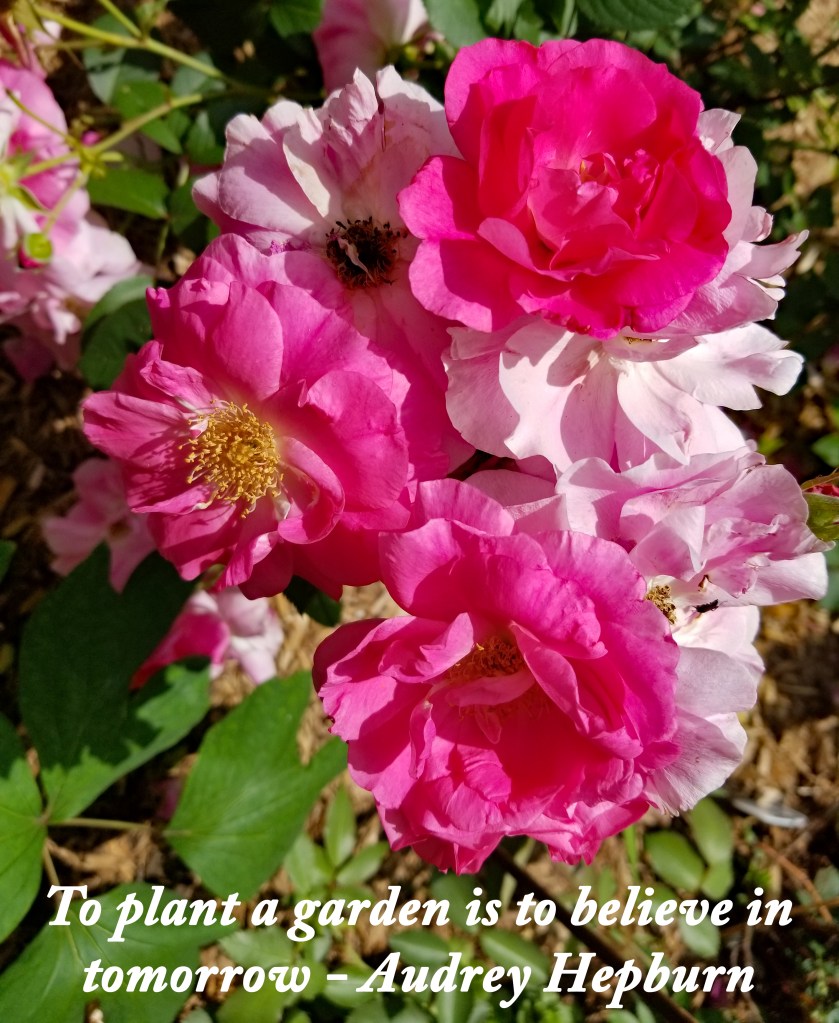
Basically, our gardens are a more intimate form of enjoying and appreciating nature, helping us understand how everything is interrelated in nature, and how we can contribute to the cycle of life by planting a seed and nurturing our flowers, shrubs, and trees. It’s a powerful connection that gives us a sense of optimism and purpose. As Audrey Hepburn said..

My experience with gardeners is that they are lifelong learners, much of that from trial and error. In general we are a patient lot, planning each year and persevering through the seasons. We can also be stubborn and focused, to be found in the garden from early morning through sunset, having totally forgotten about time.

Gardening as Active Meditation

Active meditation or “meditation in motion” is an activity that requires full attention and concentration without needing much deep intellectual thought. Trail running, mountain biking, hiking, and riding a horse are all examples of active meditation, where you must focus on what’s right in front of you.

Trying to figure out the emerging weeds from the young seedlings, setting up your pots and planting your seeds, determining the best tool for an activity – all these things demand your full attention and presence. At the same time, you are allowing your mind to relax and stop worrying about all of life’s daily concerns. Of course, all is this is premised on your attitude. If you look forward to spending time in your garden, viewing it as a pleasure instead of as a “chore” or something that must get done, then you will experience all the positive benefits of gardening.

Certainly no one is saying gardening is not hard work, but on a sunny spring day I can lose hours working in the garden, totally absorbed in the physicality of the activities. Especially after a long winter I appreciate the texture and smell of the soil, the breeze, the birds, the flowers, the trees, and the clouds and sky.

So as the season of outside gardening winds down (yes I actually got all my bulbs in the ground already), my thoughts turn to all that my garden gave me this past year, and I start on my plans for next year. Ever the optimist..

Whether you call it meditation, mindfulness, or ecotherapy, gardeners are blessed to have a steady place of solace in these trying times. Here’s to great memories and planning for next spring.

Some further reading if you are interested

How a Garden Grows You

Why are Gardens so Good for the Soul?

Why COVID gardening is about more than just food

How the Coronavirus Changed Gardening

Gardening is fundamentally an act of enormous hope because everything you do in the garden is for the future.
Barbara Frum, Canadian Broadcast Journalist