
By Marjorie Vendrig, Master Gardener in Training
Springtime gardening comes with a burst of energy, an unavoidable tendency to order too many seeds, buy too many plants and generally underestimate our own energy and garden space. Fall gardening, on the other hand, allows us to work with past season successes and failures fresh in our memories. It’s much more measured — the best season for gardening, in many respects.
Fall is the perfect time to divide perennials. There are several reasons to divide perennials: Mature perennials often begin to die out from the centre, they might be in the wrong spot, or they have gotten too big where they are. For many perennials, division is a straightforward way to create more plants with minimal effort and cost. Many perennials, such as Hostas and Daylilies are good candidates for fall division. Division should take place early enough in the season to allow the roots to establish before it gets too cold. Late-blooming perennials such as Asters and Chrysanthemums are best divided in spring. And some plants, such as Poppies, don’t divide well at all.
Through this year’s growing season, I identified three plants in my garden ready for division: a hosta, a goat’s beard, and a spikenard.
Hosta is a tough plant, it requires some muscle to get out of the ground and split but is also tough enough to withstand the move. Despite the heat and drought this year, my hosta was in fine shape so I decided to dig up the plant without removing the leaves. (If it were later in the season, or if the plant were suffering, I would cut away many of the leaves above the crown and dig up the root without leaves.) The plant was well established, enough that I had to push the spade around the plant a few times, pushing it deeper each time and with some tearing and snapping of roots. In the end, the whole clump came out fairly easily. Sometimes there is an obvious small or ‘baby’ clump that can be broken or cut off easily. In other cases, the roots can be plied apart with a garden fork and, when it’s really tough, a sharp spade or knife cut into the middle of the clump is easiest. Broken or damaged leaves are removed and the new plants are planted at the same level they had been growing. Care should be taken to ensure all roots are under soil and the plant is watered generously for the next weeks.

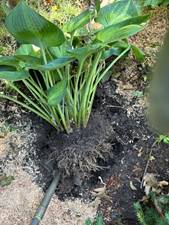
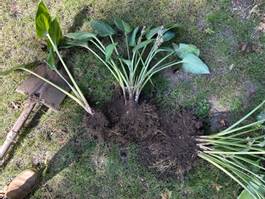
The Goat’s Beard (Aruncus dioicus) is simply too big for its current location, overdue for division. Because of its size – it would be very difficult to dig and divide the plant without breaking the stems – I cut back all the stems to about 6 – 8” above the soil level. With a bit of digging, the clump came out fairly easily. I shook off a lot of the soil making it easier to divide into two substantial clumps, each with good roots. If the centre of an old perennial has died out, the living clumps around the edges can be dug out and replanted, the old clump in the centre discarded. Each clump gets replanted at the same depth and watered well. Smaller perennials, such as perennial Geranium (Geranium), Coral Bells (Heuchera), Lamb’s Ears (Stachys byzantina) can be dug up gently and teased apart to produce new small plants, each to be planted and watered carefully.


Sun King Golden Japanese Spikenard (Aralia cordata) is a real showstopper in my garden. It loves where it’s growing but it is far too big. As with the Goat’s Beard, I cut off all the stems, then tackled the root clump. It is a beast of a plant, requiring lots of digging and hefting to get it out of the ground. Once out, I washed away the soil with high pressure water from the garden hose, then plunged the spade into the almost woody root. It took a lot of force and pushing to split. I only want a small clump so I worked with the spade to pull apart several sections, planting one and giving the rest to friends.


The red circles indicate ‘eyes’, this is where there will be new growth in the spring, each root clump should have several eyes.

References:
Toronto Master Gardeners, Gardening Guide
Fine Gardening, Gardening Basics, 10 Tips on Dividing Perennial Plants
Iowa State University How to Divide and Transplant Perennials
 The Peterborough & Area Master Gardeners