
By Marilyn Homewood, Master Gardener
Sound too good to be true?? Years of trial and error on a property with a (shallow) dug well has taught me the value of adequate bed preparation for long term success of the landscape garden that consists primarily of perennials, shrubs and bulbs (with the odd annual and biennial tossed in). I have large landscape beds and could not keep up without some kind of strategy.
It may seem somewhat discordant to be discussing bed preparation in July but a little planning and preparation can go a long way towards achieving a garden that requires less maintenance, is easier to work in, requires little to no supplemental water or feeding all while looking attractive. The solution lies under our feet.
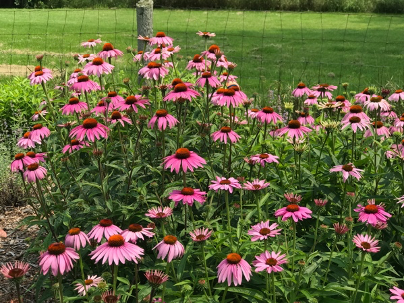
My beds have all been dug to a depth of 18 inches. This one time initial dig allows for loosening of compacted earth, removal of rocks (or boulders) and generous amendment of the soil with organic matter such as rotted manure or leaf or mushroom compost. This preparation will allow plant roots to reach deeper into the earth (especially those with large fibrous roots or tap roots) where residual moisture is still available during drought. Plants will become more resilient and able to survive on the rainfall alone. In my garden, I have not watered the landscape beds since they were begun with the exception for first year plants that are getting established. In dry spells, the blooms may be somewhat smaller but are still found in abundance.
The loosening of the soil also creates a better-draining soil makes it less likely that plants become water-logged or oxygen-deprived in those times when water is abundant. This also minimizes loss of plants/bulbs to rot.
The use of organic matter amendments helps the soil to retain the water that is provided by the rainfall by increasing the porosity of the soil. And finally, an application of a thick layer of mulch (I use shredded bark) on the surface of the soil helps prevent evaporation of moisture from the ground and well as inhibiting the greedy weeds that will compete for moisture.

Organic matter (OM) amendments provide a number of other benefits which ultimately gives healthy plants while saving us labour. It enhances soil structure which increases the porosity of the soil leading to improved water infiltration, better drainage/aeration and help soils to resist compaction. This makes soil more friable and easier for the gardener to work in as well as easing root penetration in the soil profile.
OM helps to store and supply macronutrients (ex. nitrogen) and makes micronutrients (calcium, magnesium and potassium) available to the plant by increasing the soils’ ability to hold onto these elements (prevents leeching). Also binds metal micronutrients (iron, aluminum, zinc, copper, manganese) and increases their availability to the plant. All this means that your need for chemical fertilizers will be reduced or not required.

OM also enhances soil microbial diversity that assists in the suppression of disease so plants are healthier.
Deep beds mean deep roots; improved soil structure means better drainage and water holding capacity; increased biological activity mean more nutrients released for plant use and microbial diversity means less disease. The result is healthy, vigorous plants that need less watering, less additional feeding/supplementation and less treatment for disease.
Resources:
Cornell University Cooperative Extension, Agronomy Factsheet 41, “Soil Organic Matter”, http://franklin.cce.cornell.edu/resources/soil-organic-matter-fact-sheet
Leslie Cooperband (2002), “Building Soil Organic Matter with Organic Amendments” University of Wisconsin-Madison,
Lois Berg Stack (2016), “Soil and Plant Nutrition: A Gardener’s Perspective” University of Maine Cooperative Extension: Garden & Yard, https://extension.umaine.edu/gardening/manual/soils/soil-and-plant-nutrition/
 The Peterborough & Area Master Gardeners