By Mary-Jane Pilgrim, Master Gardener
I was honoured to be part of the Lakefield Horticultural Society’s Garden Tour last summer, along with fellow MG Emma Murphy. It was a glorious day, and I loved the wide range of people who came to tour — each with different backgrounds and gardening styles.
The one question I fielded more than once is “where are the weeds”?
First of all, what’s a weed? To me, a weed is a plant that is growing where it is not wanted. My weeds could be your prized “Lubauchnia” (my hubby’s fabricated word for plants he doesn’t know the name of, which includes most plants).

Disclaimer: I didn’t inherit a bunch of the nasty weeds as there were no gardens at my house when we bought it 32 years ago. I do deal with the nasties at my gardening clients’ homes weekly, though!
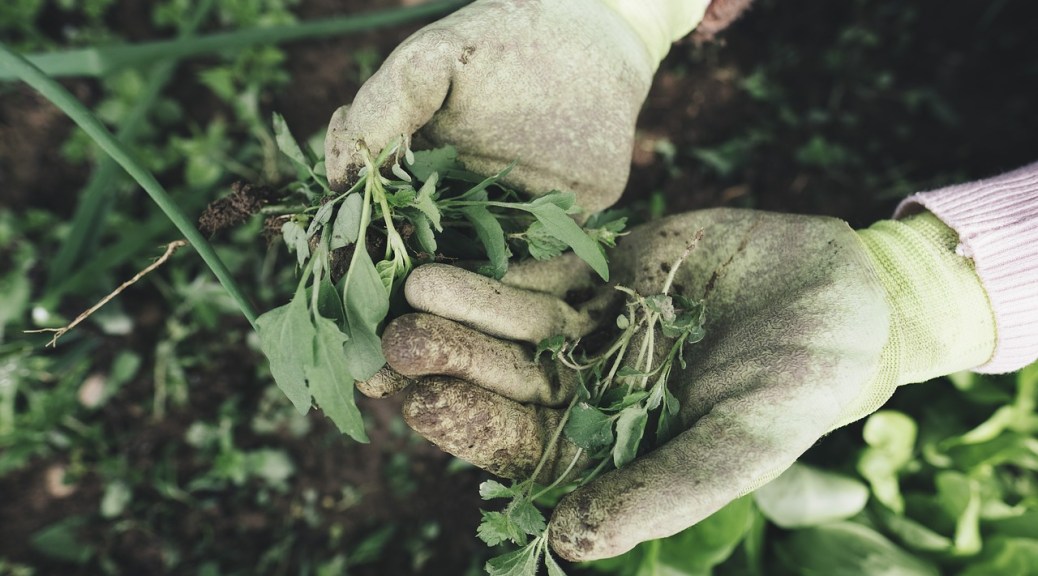
For plants that are growing where they’re not wanted in my gardens, here’s what works for me:
- Don’t wait — smaller weeds are easier to get rid of than larger ones. This applies to spring and fall when we’re often not as diligent in getting outside. Sometimes it seems like a full grown weed can appear overnight during those seasons!
- Use mulch — I love my leaf mulch, and it seems to be very effective in suppressing weeds. A chipper makes short work of a pile of leaves. Mulch also conditions your soil and encourages earthworms and microorganisms, a win-win situation.
- It’s especially important to weed BEFORE the seed heads develop — you’ll save yourself a LOT of trouble getting them early in their life cycle.
- Cut back perennials after they’ve finished blooming, and check for the inevitable “weeds” underneath.
- Weed when the soil is moist, so that the maximum amount of root comes with the weed. Weeding in dry/hard soil results in small pieces of the root being left behind, which can usually regrow. I rarely weed without my trusty Lee Valley Root Knife — loosening the soil around the root before pulling.
- Watch newly planted perennials closely, especially natives. If they send out runners or if they are very proficient at casting seedlings, they get “shovel pruned” at my place. You can do you at your place.
- Lastly, “know your garden“. The more time you spend out there, the fewer undesirable plants there will be.

Simple knife-in then pulling works well for most regular weeds. However, some types such as japanese knotweed, lily of the valley, bindweed, cow vetch, DSV or creeping bellflower will require more diligence as their mother-roots are buried deep underground. Eradicating those weeds involves a lot of deep digging, soil sifting, and extreme diligence. There are actually support groups on Facebook for those truly invasive plants. May actually be easier to move!
Weeds that contain viable seeds should be “solarized” — left in a black plastic bag on the driveway for a couple weeks. The heat will fry the seeds. Dispose of the bag in the garbage. Don’t put seed heads attached into your composter.
There’s a new thought process that suggests that repetitively cutting difficult weeds at soil level is more effective than pulling them. It’s true that if it’s done often enough, those roots will eventually die for lack of nutrient supply from any top growth — however the weeds are usually much more persistent than the weeders! I read that cutting bindweed every 2 weeks will still take multiple years to make an impact. Sigh.
What are your tricks?
 The Peterborough & Area Master Gardeners
I agree with you on what classifies as ‘weed’. some tree species are ‘weed’ trees in my opinion – like the suckering, unwanted poplars which are constantly trying to encircle our property and creep into the garden. Also, a common invasive in Finland is Aegopodium podagraria or goutweed. It’s everywhere. Our entire 3000 sq m property had it. Constant grass cutting took care of most of the portions in the ‘lawn’. So it was confined to popping up everywhere else the mower wasn’t going. Along fencelines, in garden beds, etc. it’s still a constant battle – as it continues to pop up 7 years later. Unfortunately, while creating a new garden bed, my husband removed soil from an area that had, what we now know was bind weed. yep, he cut it and made several hundred more plants. Then they were introduced to an area where they weren’t previously growing. What a disaster! Someday, I hope you we are free of it. But it will probably still be lurking, along with the goutweed, for any chink in our armour, and pop up again. 😦
LikeLike
Goutweed and Field Bindweed are huge problems here in Canada too. Sadly, there is a large patch of Goutweed that has extended outside someone’s property in my neighbourhood and is threatening a beautiful native plant called Virginia Waterleaf (Hydrophyllum virginianum). The variegated Goutweed is not as difficult to eliminate as the regular kind—I was able to pull it out and shade it out over a few years with a big patch of rhubarb. I don’t have Field Bindweed (Convolvulus arvensis) but have Black Bindweed (Fallopia convolvulus). It’s an annual so not that difficult.
LikeLiked by 1 person