
By Marjorie Vendrig, Master Gardener in Training
It’s midsummer in the garden and many plants – annuals, perennials, vegetables – need to be staked and pulled upright or back. They might be flopping over to the point where stems break and buds and blossoms are lost, they might be spilling over onto other plants, blocking light and restricting growth. In the event of high wind or heavy rains, unsupported plants can easily be destroyed or can quickly become an unsightly mess.
Staking is one of those jobs that many gardeners avoid; it never seems to get done at planting time or early in the season when the plants don’t really require mechanical support. Another reason for putting off staking is that many stakes or plant supports are unsightly and look out of place, particularly very early in the season. The result is that staking is often done too late; emergency staking often looks more unsightly than a flopped over plant
Staking of some plants can be avoided: late bloomers such as sedums or asters can be maintained at a shortened height. This is done by developing shorter, bushier plants by pinching the plant by about one third in early summer. It’s a common practice for many annuals: cosmos, zinnias, nicotiana, and many other annuals are pinched back before they arrive at the nursery. (Pinching back of annuals has come to be known as the Chelsea chop, the timing for pinching back or ‘chopping’ coincides with Britain’s famous RHS Chelsea Flower Show at the end of May.)

Knowledge of the mature size of the plant, its light requirements, and any specific soil or nutrient needs could avoid the need for staking some plants. A plant with elongated, weak stems will require staking, whereas a strong-stemmed, sturdy plant that is not reaching for light or that has not been overwhelmed by neighbours is a more likely candidate to stand on its own. An honest evaluation of light levels in the garden and the sun / shade tolerance of plants are prerequisites for finding the optimal location for plants, helping to eliminate some staking.
Best advice for avoidance aside, there are still many plants that need to be staked and it’s best to match the type of support to the vigour and growth of the plant:
- Circular grid supports with epoxy or plastic coated wire squares are best suited to clump forming perennials such as phlox, delphiniums, and some campanulas. These work best when put in place early on in the growing season with care taken to feed growing leaders through the squares. Any escapees can be tied loosely to the outside of the circle. Dahlia, peony and other top-heavy bloomers are also candidates for this approach.
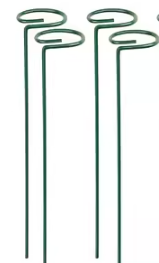
- Once blooms appear on dahlias, or other tall growers, spiral rings or Y-shaped supports are useful to prop up the blossoms. Several supports are often needed for each plant.
- Tall, heavy blossomed dahlias and other tall growers might do better with two or even three or more stakes surrounding the plant, making sure to avoid the tuber or roots when pushing or pounding in the stakes. Bamboo, plastic coated metal, or even rebar are good choices for the supports. They should be pounded as far as possible into the grounds so that they won’t get pulled over with the weight of a wet, heavy plant. Using twine, tie a knot around one of the stakes, then a figure eight to encircle one of the stems, do the same for the other supports and stems. An alternative technique with large multi-staked plants is to tie a knot around one of the stakes, then surround the plant and loop around the next stake. As the plants grow and the blooms get heavier, several levels of twine might be necessary. Stems and plants should not be tied too tightly.
- For shorter plants at the front of a border (penstemon, yarrow, cone flower), pea stakes are a good approach. Pea stakes are multi-stemmed off-cuts from prunings. This is an old method, historically used in vegetable gardens to support pea vines. The twigs, from birch, forsythia, viburnum, etc., are pushed into the ground around the perimeter of the plant. The plant grows up and over the stake, no tying is required, and if done early in the season, the twigs get hidden later in the season. Pea stakes are also a good way to guide climbers over to a trellis. With a bit of practice and creativity, pea stakes can be an eye-catching approach to an otherwise unappealing chore.

References
https://www.rhs.org.uk/plants/types/perennials/staking
https://hort.extension.wisc.edu/articles/pea-staking
https://www.finegardening.com/project-guides/gardening-basics/how-to-avoid-staking-plants
 The Peterborough & Area Master Gardeners
Hello there. I love to garden and have enjoyed and learned so much from the Pbo Master Gardeners I wonder if there are opportunities for novices as myself to work along side someone to Glen valuable info. Please let me know . Thanks so much Beverley
LikeLike
Beverly, please contact the Peterborough Master Gardeners via contact@peterboroughmastergardeners.com and they’ll be happy to answer all of your questions!
LikeLike